




Abstract
The COVID-19 outbreak has seen the largest-scale emergency remote teaching in world history. Drawing on concepts of teacher belief and teacher agency, this study seeks to explore whether teachers’ beliefs about teacher roles may influence their agentive use of online technology amid and after COVID-19. By tracing four English as a Foreign Language teacher participants in both an emergency remote teaching context and a resumed face-to-face classroom setting, our study reveals a complex relationship between teachers’ pedagogical beliefs and their online teaching practices. This study highlights the role of teacher agency and calls for a closer examination of the complexity of teacher roles to better understand teachers’ agentive technology integration in teaching. The study bears significance for educational technology development and teacher education for emergency remote teaching in the post-pandemic era.
Introduction
The COVID-19 outbreak has seen the largest-scale online education, thrusting in-person classrooms into a new teaching reality where technology is no more an option but a necessity (Dhawan, 2020). Teachers’ responses to this abruptly changing and globally challenging educational reality (Sepúlveda-Escobar and Morrison, 2020) thus have drawn immediate scholarly attention (Gudmundsdottir and Hathaway, 2020; MacIntyre et al., 2020; Moorhouse et al., 2021) to emergency remote teaching (ERT) (Hodges et al., 2020). Unlike online teaching, ERT is a crisis response to the sudden disruption of face-to-face teaching, and decisions on digital tools and teaching materials were left to individual teachers who were largely underprepared (Iglesias-Pradas et al., 2021) and self-reliant (Sepúlveda-Escobar and Morrison, 2020).
Teacher beliefs have been identified as one of the key variables to technology presence in classrooms (Farrell and Yang, 2019). For instance, teachers who regard teaching as knowledge co-construction may be more open to technology use (Inan and Lowther, 2010). However, in the abrupt, temporary ERT context, teachers’ adoption of technology may not always agree with their beliefs (Chen, 2008). Therefore, how teachers as individuals with different beliefs about teacher roles vary in their agentic use of technology in ERT and whether ERT could have continuing impact upon teacher beliefs and their practices are questions worthy of exploration. This study, therefore, aims to address these issues by tracing four Chinese English as a Foreign Language (EFL) teachers’ pedagogical beliefs and their teaching behaviors in Spring 2020 when ERT was practiced and Fall 2020 when most EFL teachers in China resumed in-person classroom teaching. Our study may add to the literature on the influence of beliefs upon practices and help us better understand EFL teachers’ online teaching behaviors amid and after COVID-19.
Pedagogical Belief About Teacher Role
Teacher beliefs are ‘psychologically held understandings, premises, or propositions’ (Zheng, 2009: 74) about students, classrooms, teaching materials and teachers themselves. Regarded as ‘the heart of teaching’ (Harendita, 2017: 51), teacher beliefs may govern teachers’ instructional behaviors and classroom practices, and the complex relationship between beliefs and practices (Wang and Du, 2016) has been one major concern in teacher beliefs research.
As one aspect of teacher beliefs, pedagogical beliefs concern ‘what learning is and how teaching is best delivered’ (Berger and Van, 2018: 6). There are two broad types of pedagogical beliefs (Berger and Van, 2018; Kember and Gow, 1994): constructivist (student-centered) and transmissive (teacher-centered) beliefs. Constructivist beliefs treat students as active participants whose development of the thinking process is regarded as more important than the acquisition of specific knowledge, whereas transmissive beliefs regard teachers as knowledge presenters and interpreters, and students as passive recipients. Therefore, constructivist believers conceptualize teaching as knowledge creation between teachers and students, while transmissive believers regard teaching as teachers’ sole decisions on instructional activities.
Studies indicated that constructivist believers tend to integrate technology more frequently in classrooms (Inan and Lowther, 2010) to promote teacher–student interactions (Berger and Van, 2018; Kember and Gow, 1994), whereas teachers with direct transmission views who see themselves as the major knowledge source tend to take less advantage of technology (Ertmer et al., 2012). Nevertheless, other evidence showed that even strong constructivist beliefs may not be sufficient to promote technology use (Nelson and Hawk, 2020), which calls for in-depth investigations into the relationship between pedagogical beliefs and technology practices (Wang and Du, 2016), especially when situated in such specific contexts as the ERT (Chen, 2008) or a particular culture. China, for instance, has a long-standing Confucian tradition which values teachers’ authoritative knowledge transmission. From the 21st century, however, China initiated a nationwide educational reform to promote a paradigm shift from knowledge transmission to knowledge co-construction (Zheng, 2015). This has resulted in a large diversity of Chinese teachers’ pedagogical beliefs (Yang, 2019) given their different educational background, generations, career stages and teaching experiences. Such an evolving social backdrop is further complicated by the ERT reality, making the exploration of how Chinese teachers’ different pedagogical beliefs may influence their technology use during or even after ERT particularly significant.
Pedagogical beliefs have been found to be associated with teacher roles (Phipps and Borg, 2009). Teacher role corresponds with a teacher's professional self and addresses the question of ‘What am I as a teacher?’ (Thomas and Beauchamp, 2011: 763), which encompasses such teacher selves as the actual self that really exists, the ought-to self as expected by others, and the ideal self that the teacher strives for (Lauriala and Kukkonen, 2005). Given its intangibility and implicitness, teacher role has been examined through teachers’ metaphor use because metaphors can serve as a powerful cognitive tool in probing teachers’ hidden perceptions of themselves (Gao and Cui, 2021; Wan et al., 2011) and enable teachers to articulate the otherwise complex, indescribable ideas. For example, teacher role conceptualized as TEACHER IS A COACH may envision a highly controlled learning environment, well-designed learning tasks, an emphasis on learning outcomes and prompt feedback (Ketelaar et al., 2013), projecting the transmissive belief. By comparison, TEACHER IS A FRIEND often reflects the constructivist pedagogical belief (Farrell, 2016). Nevertheless, pedagogical beliefs are multifaceted (Kember and Gow, 1994) and are broadly categorized into core and peripheral beliefs (Pajares, 1992), with the core beliefs exerting stable (Taimalu and Luik, 2019) and more powerful influence on teaching practices than the peripheral ones (Phipps and Borg, 2009). Therefore, teachers with the same pedagogical belief may portray themselves in different ways because of the varied core aspects of their belief system generally represented by their perceived ideal teacher roles (Borg, 2001). However, little attention has been paid to the different aspects of belief system when investigating the relationship between teachers’ beliefs and practices. The sudden shift of teaching mode in ERT that may cause changes in both amid- and after-pandemic teaching can help reveal the role of core pedagogical beliefs in teachers’ classroom practices.
Teacher Agency
Teachers are active ‘agents … playing a pivotal role in promoting quality teaching and learning outcomes’ (Adebayo, 2019: 2) even in a large-scale educational change. That is, teacher agency is the interplay of individual efforts and contextual conditions, negotiated and achieved (Priestley et al., 2012) in response to the constraints of working environment (Erss, 2018) such as the ERT context.
Theorized by Biesta et al. (2015) ‘specifically in respect of the activities of teachers in schools’ (625), teacher agency is the willingness and capacity to ‘intentionally act’ (Moate and Ruohotie-Lyhty, 2020: 94) according to teachers’ personal values, attributes and beliefs (Biesta et al., 2017). As teachers ‘enact agency through making choices’ (Ruan and Zheng, 2019: 349), the underlying teacher beliefs may impact their agentic actions to decide what pedagogical tools to use and what teaching activities to undertake. Studies have revealed that teachers’ beliefs about the pedagogical usefulness of technology in facilitating student learning can positively impact the frequency and variety of technology adoption in classrooms (Anderson et al., 2011; Chen, 2010). In the highly constrained ERT reality, teachers may need to agentively optimize the available teaching resources to maximize the teaching outcomes, making their intentional choices of online activities an indicator of what they perceive as pedagogically important and useful, which is often influenced by their perceived teacher roles.
In addition, Emirbayer and Mische (1998) studied agency through a temporal lens, incorporating the past, present and future dimensions. Teachers who take agentic actions can ‘continually reflect on the past, work to change their present context, and have the capacity to affect the future’ (Balgopal, 2019: 4). Whether teachers’ agentic choices about online activities amid COVID-19 are only temporary behaviors or continuous efforts in the post-pandemic offline classrooms also deserves close examination.
A focus on the complex interactions between belief and agency characterizes one aspect of the current teacher development research. Many researchers have explored how beliefs may interfere with teachers’ agency to act intentionally in specific contexts, such as an educational reform (Donnell and Gettinger, 2015). Specifically, Bonner et al. (2020) claimed that belief and agency are grounded in each other and are ‘integrated to depict the larger process of educational change’ (382). However, the ERT change differs from other well-prepared educational reforms, making the interplay between teacher belief and agency in such context a topic that merits investigation. The present study, therefore, attends to the belief–agency relation by addressing the following research questions:
How do EFL teachers’ pedagogical beliefs influence their online teaching preference? Are their pedagogical beliefs about teacher roles consistent with their agentic choices of online teaching activities? Do they continue using online teaching activities when returning to traditional face-to-face classroom? How do their continued online activities reflect their pedagogical beliefs about teacher roles?
Methodology
Context and Participants
This case study was situated in a university in Beijing, home to nearly 2000 undergraduates and over 50,000 graduate students. Due to the nationwide school lockdown, all the courses were moved to a self-built online teaching platform, iClassroom, for Spring 2020. As the default platform, iClassroom allows teachers to post class materials, document attendance, assess students, and deliver synchronous or recorded lectures. Teachers can also integrate other online tools, such as WeChat, with iClassroom according to their teaching needs and preferences. In Fall 2020, the face-to-face EFL courses resumed.
This inquiry is part of a longitudinal research project from 2017 to explore Chinese EFL teachers’ professional development. A cohort of 13, and later 8, teachers participated in the project. As an exploratory case study, four teachers were chosen as the focal participants in this study because they vary in age, gender, lesson taught, target students, teaching experience, academic title, educational background, engagement with online technology in classroom, and pedagogical beliefs, representing the general EFL teacher population in China's higher education (Table 1). Each of them was responsible for 8–16 hours of weekly teaching in a 16-week semester. They all had no experience of online teaching before the pandemic but received only a two-hour training on iClassroom prior to teaching.
Demographic information on the four participants.
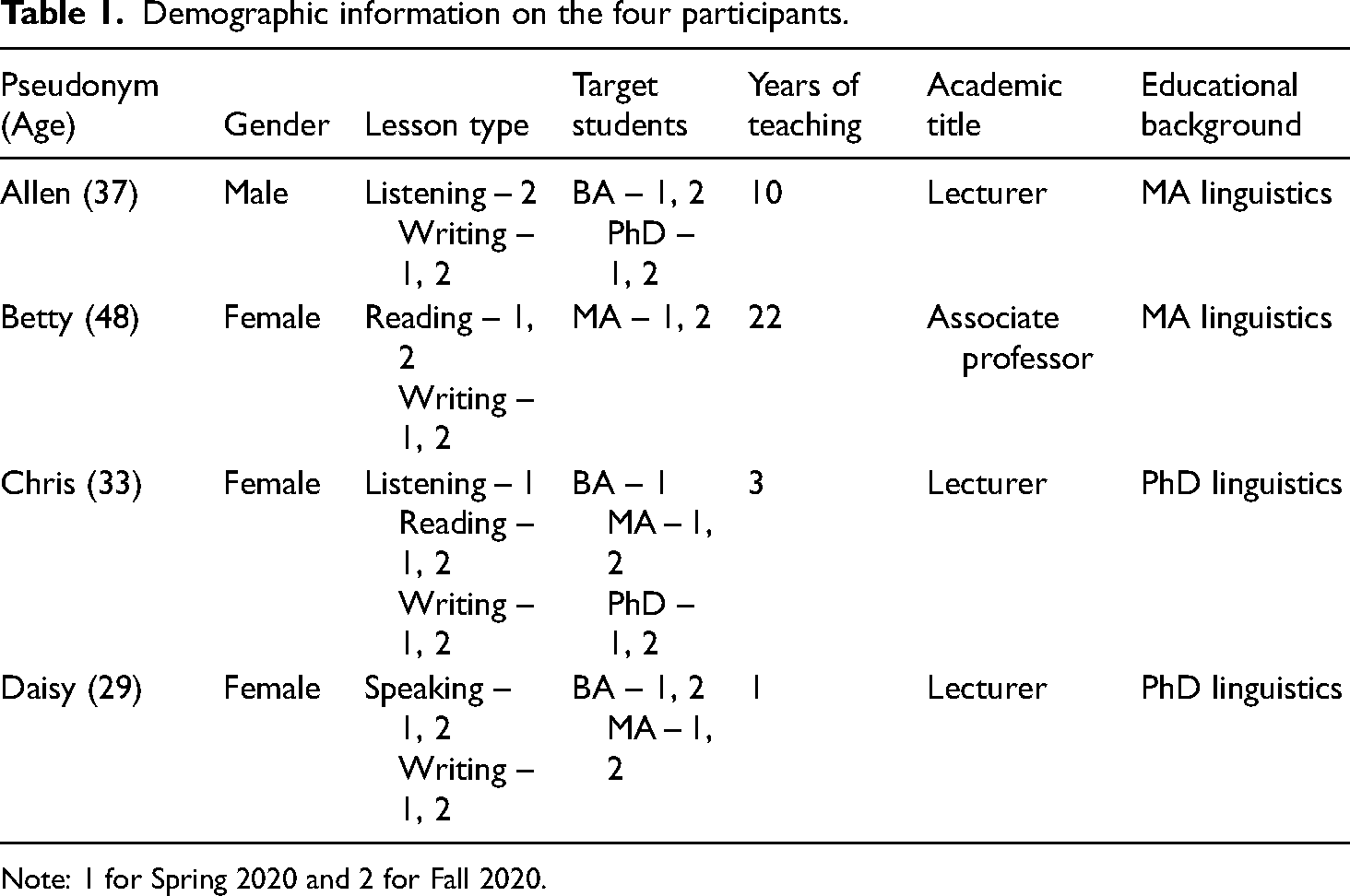
Note: 1 for Spring 2020 and 2 for Fall 2020.
Data Collection and Analysis
We adopted a case study methodology for its advantage in providing a rich, in-depth analysis of a complex phenomenon, particularly over a period of time (Van Lier, 2005), with a focus on ‘the knowledge, performance, or perspectives of a single individual’ (Duff, 2012a: 1) in an ‘accessible, concrete, immediate, and personal manner’ (Duff, 2012b: 96).
Data were collected through two rounds of semi-structured interviews conducted in July 2020 and February 2021, respectively (Figure 1). To avoid guiding the interviewees, the interviewer (Author 1) allowed them to respond completely to each prompt without interruption. Follow-up questions were then asked to build upon each interviewee's responses (see Appendix for interview question protocol). The interviews, conducted in Chinese, were audio-recorded (Allen: 24 and 27 min; Betty: 38 and 35 min; Chris: 43 and 31 min; Daisy: 45 and 53 min), automatically transcribed by iFLYTEK intelligent recording pen, and checked word-for-word before being compiled into 78,814 Chinese characters. The selected interview excerpts were translated into English by Author 1 and doubled-checked by Author 2 until an agreement was reached. Emails and messages were exchanged between participants and Author 1 for clarifications.
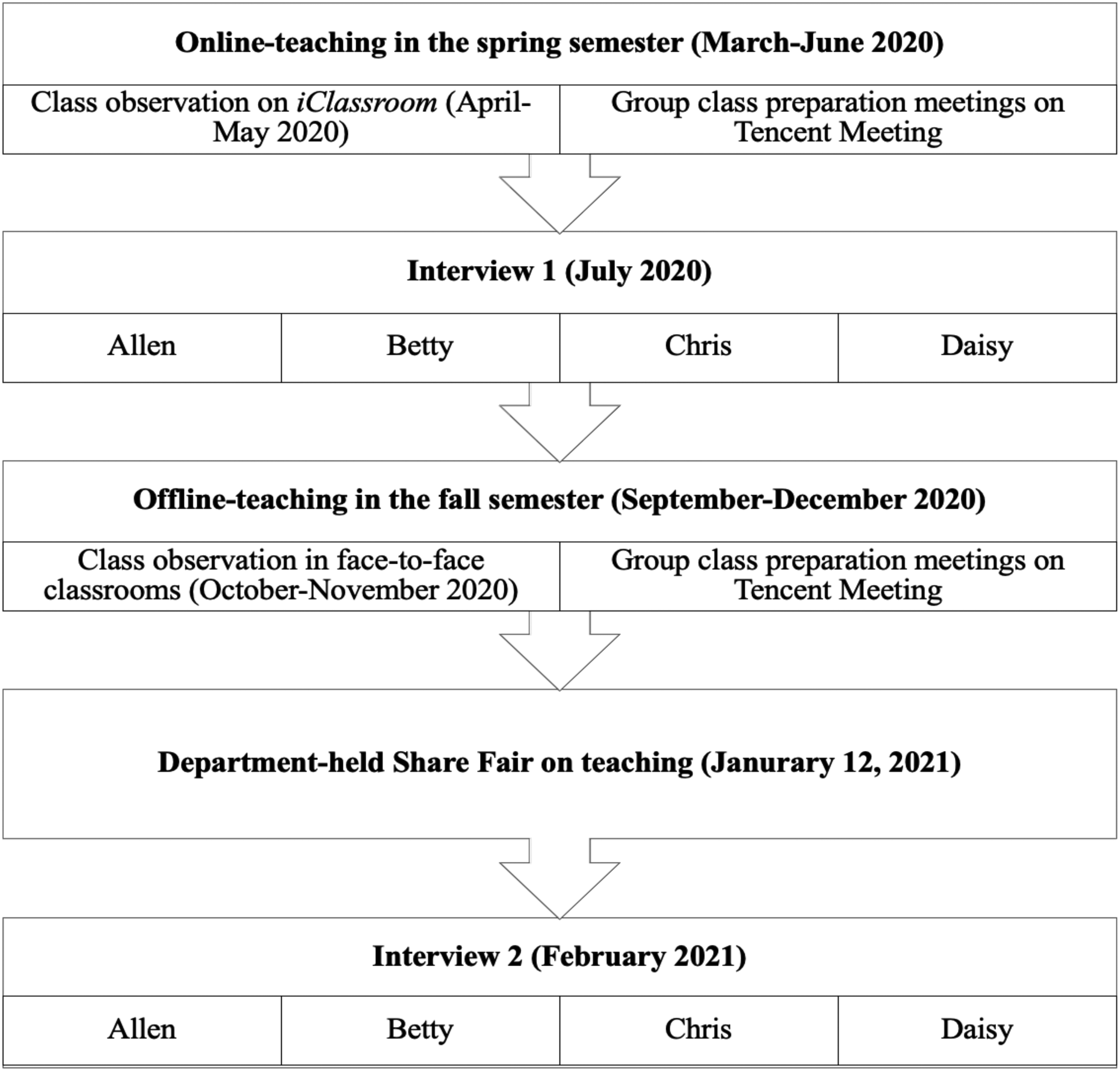
Data collection process.
Data analysis combined inductive and deductive reasoning and was an iterative process (Merriam, 2009). Eight transcriptions were read independently multiple times before they were analyzed separately by the authors. Categories and themes emerged inductively from the data. Data that expressed teachers’ pedagogical beliefs, teacher roles and teaching activities were identified and coded using NVivo software (see Figure 2 for detailed coding procedure). Specifically, significant words, phrases or sentences that indicated pedagogical beliefs were identified, coded, categorized and agreed on between the authors. Data that reported teacher roles were explicitly elicited from the interviewees’ metaphor use which was checked against their other metaphorical expressions to ensure consistency in their stated core beliefs about teacher roles. The interviewees’ descriptions about teaching activities were carefully marked out, with particular importance placed upon the interviewees’ favorite classroom activities amid and after the pandemic. The interviews were also triangulated by observations on their classrooms, lesson preparation meetings on Tencent Meeting (i.e. Chinese version of Zoom) and their presentations in the department-held seminars (Figure 1).
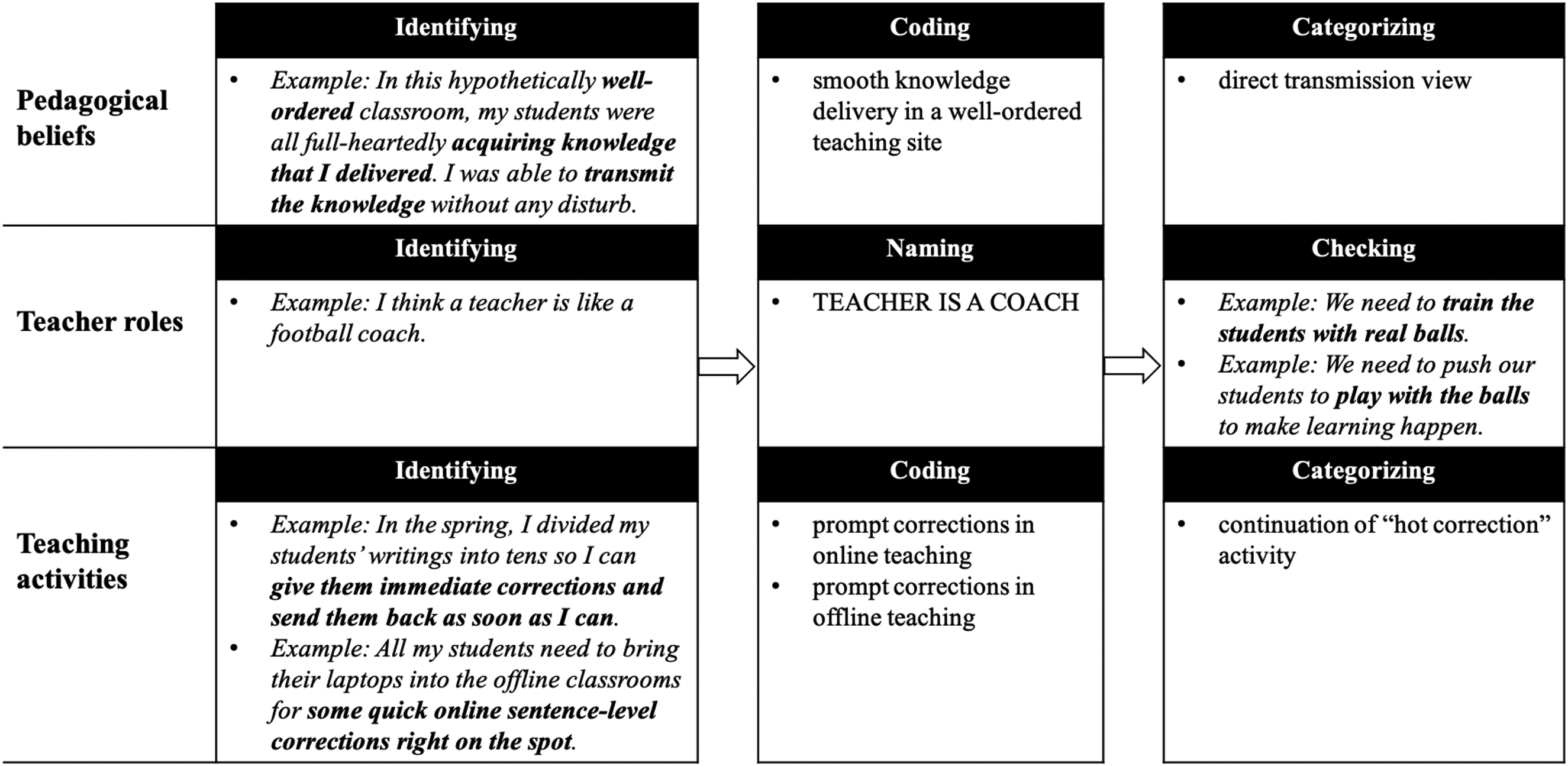
Coding procedure.
Findings
Major findings are summarized in Figure 3. Interview excerpts are presented case by case, connecting participants’ perceived ideal teacher roles and teaching practices in the online and offline classrooms.
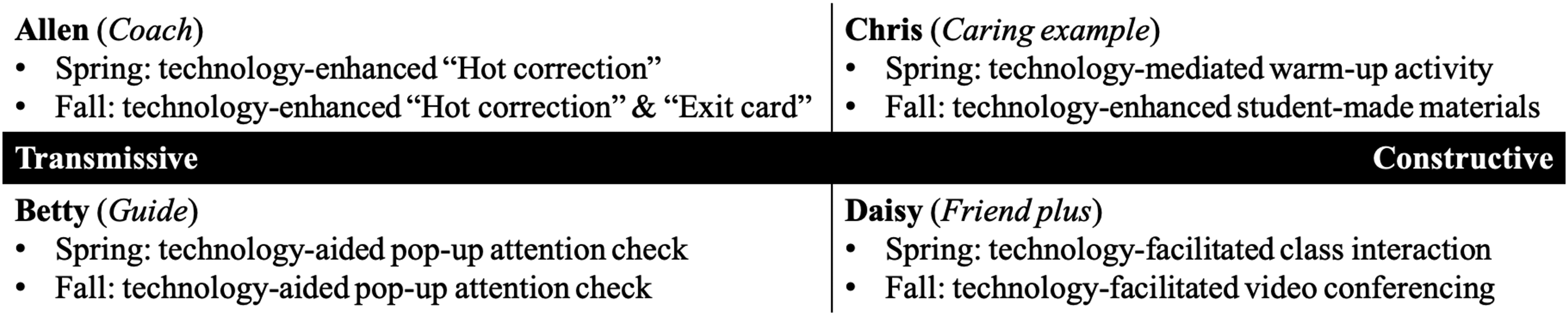
Participants’ pedagogical beliefs about teacher roles and their favorite activities.
Allen: TEACHER IS A COACH
Allen compared an EFL teacher with a coach, knowledge points with football, and practicing skills with playing games. Like a coach who is responsible for demonstrating football skills and pushing his players through repetitive practice, an EFL teacher, according to Allen, should invite students’ ‘explicit noticing’ (Rounds 1 and 2) about the important language points and make every effort to correct their inappropriate language use through immediate feedback: Allen (Round 1): When introducing a sentence pattern, I will ask students to make their own sentence with the pattern and request some to submit their writings in our QQ or WeChat group. I will promptly specify their problems in the online group. I call this ‘hot correction’ or ‘hot feedback’.
Allen took advantage of the instant messaging system to give students immediate feedback in class for better knowledge transmission. His overt emphasis on teaching effectiveness and learning outcome reflects his direct transmissive beliefs. He feels very confident about what to teach or ‘what ball to play with the students’ (Round 1) for he had been conducting needs analysis in each semester. Therefore, Allen gives ‘what the students need’ (Round 2) in one-way knowledge delivery rather than two-way co-constructive communication, which reinforces his coach image as the authority figure on the football field.
Allen showed a positive attitude towards online teaching in both semesters because he found that online teaching could fulfill his knowledge transmission goal, even ‘in a more efficient way’ (Rounds 1 and 2). For example, Allen required his students to bring laptops into his offline writing and listening classes in the Fall. In his writing class, students submitted their answers online for his immediate feedback; in his listening class, he assigned students to post their spoken answers to the WeChat group and compared their pronunciations with others to call students’ explicit notice to their pronunciation problems.
Allen's favorite online activities across two semesters clearly reflect his transmissive pedagogical belief about teacher roles. In Spring 2020, his favorite activity was the ‘hot correction’ or the correction that was as immediate as possible after class to make sure his students indeed acquire the important knowledge. In Fall 2020, Allen continued using the testing function of iClassroom where his favorite ‘exit card’ activity clearly aimed for efficient knowledge transmission: Allen (Round 2): Students had to answer questions in the ‘card’ to be dismissed, like ‘Name one thing you learnt today,’ ‘Name one thing you found interesting today,’ and ‘List any questions about today's lesson.’ It takes them only five minutes, but it's valuable for them to review the instructional focus for learning. I gave my feedback online to secure knowledge transmission.
ERT turned out to be an unexpected opportunity for Allen to realize the potential benefits of online activities because technologies promised him a significant increase in teacher feedback that is ‘useful’ (Round 2) for knowledge transmission.
Betty: TEACHER IS A GUIDE
Betty portrayed herself as a guide who ‘walks with her students through a wonderful garden’ (Round 2). Betty viewed her own knowledge base as a garden full of ‘beautiful things’ (Round 2) that cannot be totally passed on to students owing to the ‘pitifully’ (Round 1) limited class hours. Betty's decision on what to impart within the limited time, therefore, depends on what may draw her students’ attention. As a guide usually shows what might interest the tourists, a teacher should deliver knowledge that students pay attention to: Betty (Round 1): I need to look into my students’ eyes and see their facial expressions, so that I can know about their focus point and make proper adjustments in terms of my teaching content or teaching style.
For Betty, students’ non-verbal expressions serve as an immediate indicator of their interest level from which she could decide whether to continue the same content. Like Allen who conducted needs analysis, Betty relied on her students’ attention for a post-hoc analysis of her teaching content because their attention can directly reflect what they consider as useful.
Allen and Betty share the transmissive pedagogical belief, considering their common concern for the effectiveness of knowledge transmission. However, unlike Allen who most values his own feedback to impart knowledge, Betty attaches great importance to students’ reactions to her teaching. Betty's interactions with students were considerably controlled and mainly confined to students’ non-verbal responses to detect their focus of attention. Betty's emphasis on students’ feedback led to her negative attitude towards online teaching since iClassroom usually foregrounds the human voice while filtering out non-verbal messages. Rather, she proposed ‘a third choice’ (Round 1) of blended teaching which combines digital and face-to-face teaching environments.
Betty's emphasis on students’ responses is clearly reflected in her choice of online activities which can assist knowledge infusion by checking students’ attention: Betty (Round 1): I sent pop-up exercises to the WeChat group and asked students to answer back within three minutes. I did that every now and then to check whether they were with me. Sometimes I surprised them with a secret code on iClassroom and expected them to write the code in the WeChat group right away.
In the Fall offline classroom, Betty continued the pop-up attention-check activities, which were ‘simple but useful’ (Round 2) in catching her students’ attention and adjusting her teaching content to better guide them to the important knowledge. Even though Allen and Betty share the transmissive pedagogical belief, they differed in online teaching preference, showing a discrepancy between pedagogical belief and technology use.
Chris: TEACHER IS A CARING EXAMPLE
Chris regarded Confucius as her ideal teacher image. However, she disapproved of the widely accepted image of Confucius as the absolute knowledge imparting authority; rather, she viewed Confucius as ‘a model in life’ (Round 2) who can influence his students: Chris (Round 2): A teacher is like spring water, inexhaustible and always available for use. Education is like nurturing plants in a silent way, without seeking direct knowledge transmission and students’ instant improvement.
To Chris, there is a human touch in Confucian philosophy which values ‘humanistic care’ (Round 1) in teacher–student intellectual and emotional interactions. A teacher should sincerely care and ‘fully respect’ (Round 2) students and emotionally support them and motivate them to actualize their potentials, which was almost impossible in remote teaching.
Chris bears a strong constructivist pedagogical belief. She pointed out that ERT was ‘not real’ (Round 2) online teaching since teachers merely changed the teaching sites without fully exploiting the advantages of online technology. In particular, the limited opportunities for students’ ‘cooperative learning’ (Round 2) left lecturing as the main teaching activity in ERT. In her eyes, the key knowledge points should be made into mini-lecture videos for students’ autonomous learning ‘anytime and anywhere’ (Round 1). Chris disliked online teaching because of the weak emotional tie with students. Like Betty, she opted for the blended teaching mode or ‘flipped classroom’ (Round 1) in which she could encourage students to gain their first exposure to new knowledge beforehand at their own pace and use class time to assimilate that knowledge through problem-solving, discussions or debates. She would like to foster a dynamic and rich face-to-face environment to make sure that a higher-level learning including applying, analyzing, evaluating and creating will occur.
In both semesters, Chris’ preferred online activities aimed at creating emotional and intellectual bonds with students, reflecting her constructivist pedagogical belief. For instance, Chris played content-related videos before class and talked with students about their opinions. She regards this warm-up activity as ‘useful’ (Round 2) in getting to know her students, which can bring the whole class into an energetic learning group. Chris also encouraged students to share their work creatively in both semesters: Chris (Round 2): I asked students to make videos or visuals to demonstrate their learning, and they really enjoyed it. … Some are quite impressive. … Learning can occur beyond my teaching.
Influenced by the unprecedented development in digital technology due to the pandemic and impressed by students’ digital literacy, Chris strongly believes that the use of online technology in teaching should aim at extending the traditional classroom and empowering individual students, reflecting her constructivist pedagogical belief that highlights the humanistic rather than the authoritative position in Confucius tradition.
Daisy: TEACHER IS A FRIEND PLUS
Daisy treated every English class as an individual community in which teacher and students learn from each other through active interactions. To her, an EFL teacher is a ‘friend plus’ (Round 2) who is neither the knowledge authority dominating the class nor a ‘pure friend’ (Round 2) of students who exerts no control over the class. An EFL teacher is, therefore, ‘between a teacher and a friend’ (Round 2) with multiple identities as ‘knowledge deliverer, engaging participant, and keen observer’ (Round 1) who has ‘chemical reactions with students’ (Round 1): Daisy (Round 2): If we are confined to unidirectional knowledge delivery, we will be easily replaced by technology. … A survey showed that the occupations unlikely [to be] substituted by AI [artificial intelligence] include a creative teacher who is not only a transmitter but a communicator.
Daisy holds a solid constructivist pedagogical belief. She fully recognized her students’ differences and managed to interact with them in individually specific ways. She addressed students of various English proficiencies and personalities with different questions, hoping that they can achieve their own knowledge construction. She would ask her students a series of questions and ‘push them into their own thinking’ (Round 1). She also encouraged students to build their customized corpus to explore specific language use, making students active knowledge explorers instead of passive receivers.
Daisy demonstrated more dislikes than likes for ERT. What she liked about it is the ease in tracking students’ participation, especially those less active students, so as to engage them with more questions in her following lessons. What she disliked is its limitation in classroom interactions. When asked to turn on their camera, for instance, students may have their families or even ‘chickens and ducks around’ (Round 1). Like Betty and Chris, Daisy prefers a blended teaching mode, considering the merits in both.
There was a continuity of activities in Daisy's online and offline teaching, in line with her pedagogical belief about teacher role. She particularly mentioned three such ‘useful’ (Round 2) activities: Daisy (Round 2): I post questions on Kahoot before class to promote interaction and use class time mainly for my explanations or discussions. Besides, it is extremely important to warm up students using course-related video materials before class in online teaching. … Third, in the spring, I adopted video conferencing for group discussions. I visited each group and noticed that the students were quite active in their discussions. I used this in the fall when students were required to videotape their online discussions as a proof of their active participation.
Like Chris, Daisy's agentic choice of these activities in both semesters aimed at the students’ engagement into classroom interactions. For example, the before-class warm-up activities could raise students’ spirits and prepare them with the relevant background for teacher–student and student–student knowledge co-construction.
Discussion
Our findings show that EFL teachers are agentic actors in the time of ERT (Gudmundsdottir and Hathaway, 2020; Moorhouse et al., 2021) and reveal a complex relationship between teachers’ pedagogical beliefs and their selected classroom activities, highlighting the necessity to distinguish teachers’ core beliefs from their peripheral ones and to examine the belief–practice relationship in specific contexts.
Pedagogical Beliefs and Online Teaching Preference
This case study extends the current literature by revealing a complex relationship between teachers’ pedagogical beliefs and their ERT practices. Different from previous findings that constructivist believers are prone to increasing the frequency and variety of technology use in classrooms (Ertmer et al., 2012; Inan and Lowther, 2010; Taimalu and Luik, 2019), we argue that pedagogical beliefs in a broad sense may not be a sound indicator of teachers’ online teaching preference. For instance, in Allen’s and Betty's cases, despite their shared transmission views, their attitudes towards online teaching are different, with Allen showing a strong preference while Betty opted for the traditional classroom. Betty's hope for blended online-offline teaching was shared by Chris and Daisy who, otherwise, hold constructivist pedagogical beliefs. In addition, constructivist believers in our study regarded online technology as an impediment for knowledge co-construction due to the lack of quality interactions in ERT (Lassoued et al., 2020). When technology fails to promote the teacher–student interactive dynamics, constructivist believers may feel themselves reduced to information presentation, dampening their enthusiasm for remote teaching. This discrepancy may be because the ERT context with a total, sudden shut-down of face-to-face classrooms (Hodges et al., 2020) in our study is fundamentally different from the technology-supported online teaching environment reported in previous research (e.g. Inan and Lowther, 2010). Compared with the teachers in previous studies, our EFL teachers lacked digital toolkits usually available in other well-supported online teaching situations; however, they were more likely to make their agentic decisions on the use of online tools and resources (Iglesias-Pradas et al., 2021; Sepúlveda-Escobar and Morrison, 2020) during ERT, which is a direct reflection of their teaching beliefs.
Beliefs About Teacher Roles and Agentic Choices of Online Teaching Activities
Different from previous studies that viewed pedagogical belief as an ensemble when examining the relationship between teachers’ pedagogical beliefs and their in-class technology adoption (Ertmer et al., 2012; Farrell and Yang, 2019; Nelson and Hawk, 2020), our findings reveal that teachers’ pedagogical beliefs do not directly lead to their varying levels of agency in choosing online activities, which may be mediated by the core aspect of their belief systems (Phipps and Borg, 2009). We argue that the core beliefs, represented by teachers’ ideal roles (Borg, 2001), exert a more powerful influence on teaching practices than the peripheral beliefs do. For example, both Allen and Betty hold transmissive beliefs, but the core aspects of their pedagogical belief about teacher roles were clearly distinct from each other. While Allen's role as a coach directed his focus on his immediate feedback (Ketelaar et al., 2013) which can be delivered more efficiently online, Betty's role as a guide profiled her concern about students’ attention in class, and thus her agentic choice of pop-up attention-check activities. To fulfill the knowledge transmission goal, Allen and Betty chose different online activities that reflect their respective pedagogical beliefs about teacher roles. Chris and Daisy, likewise, though both embracing the constructivist belief, adopted different activities that correspond to their respective teacher roles. For Chris, her agentive adoption of technology-facilitated activities is highly associated with her humanistic approach because she believes that online technology is a potential venue for students to stimulate their motivation and for teachers to bond with students. Daisy, on the other hand, proactively used such activities as video conferencing to promote in-class interactions, in line with her teacher role as a friend plus (Farrell, 2016).
In agreement with previous studies on Chinese teachers’ beliefs (e.g. Yang, 2019), we demonstrate a variety of beliefs held by Chinese EFL teachers in this study. Although Confucianism finds its tradition in Chinese teachers’ pedagogical beliefs, the changing reform context also shapes their perceived teacher roles, which diversifies their selected online activities. More importantly, what teachers perceive as pedagogically useful (Anderson et al., 2011; Chen, 2010), which is largely influenced by their core beliefs about teacher role, may determine their selection of online activities to maximize learning outcomes in the restrictive ERT context, confirming that agency is negotiated and achieved (Priestley et al., 2012). Therefore, it may be hasty to form a direct connection between pedagogical beliefs and teacher decisions on technology integration without discriminating the core beliefs from the peripheral ones or without positing teachers’ pedagogical beliefs within specific and dynamic contexts.
Online Teaching Activities Back to In-Person Traditional Classroom
Because of its relative stability (Taimalu and Luik, 2019), the core aspect of pedagogical beliefs can exert lasting influence on teachers’ agentic choices in their online teaching activities. As discussed, the Chinese EFL teachers in this study enacted their agency to optimize the limited pedagogical resources, innovate teaching strategies and make creative use of digital tools to navigate the difficult pandemic time. Notably, our participants demonstrate a continuation in using their preferred online activities when they go back to the face-to-face classroom, highlighting the role of agency in teachers’ longitudinal development (Balgopal, 2019; Emirbayer and Mische, 1998). The ERT context allowed EFL teachers to explore the advantages of online technology and afforded them to agentively build up their own digital toolkit (Kohnke and Moorhouse, 2020) and expand such practice to the post-pandemic reality where teachers’ digital literacy may be important (Moorhouse et al., 2021).
Noteworthily, what teachers continued practicing in their offline classrooms is what they considered as pedagogically useful to facilitate student learning. As an extension of previous studies (Anderson et al., 2011; Chen, 2010), we found that what is ‘useful’ may be treated differently by individual teachers due to their various understandings about ideal teachers. Pedagogical beliefs about teacher roles may, therefore, play an important part in constructing multiple post-pandemic teaching realities.
Continued Online Teaching Activities and Pedagogical Beliefs About Teacher Roles
As discussed, in their exercise of agency, the EFL teachers chose to continue online activities that are in accordance with their core aspects of pedagogical beliefs, which agrees with previous research (Borg, 2001; Phipps and Borg, 2009) in that EFL teachers’ core beliefs, as reflected in their ideal teacher roles, may influence their teaching practices, and thus anticipate their preferred teaching mode in offline classrooms. Despite Betty’s, Chris’s and Daisy's shared preference for blended teaching in the post-pandemic era, their understandings about blended teaching seem to depend on their different core pedagogical beliefs. For example, to Betty, who perceived herself as a tourist guide, massive open online courses (MOOCs) could serve as an efficient addition to her tight offline teaching schedule, whereas to Chris and Daisy, who believed in student-centered knowledge co-construction, the offline classroom in the blended teaching mode should complement the online knowledge input and is supposed to be an actively cooperative process (Berger and Van, 2018; Kember and Gow, 1994) for both teachers and students to analyze, evaluate and utilize the knowledge previewed online. Clearly, the EFL teachers’ perceived teacher roles are manifested in their continued practice of technology-facilitated activities in their offline teaching.
Taken together, teachers’ core pedagogical beliefs and the teaching reality can shape teacher practices, particularly in an ERT context; on the other hand, their agentic selection of teaching activities amid and after the pandemic also reflect and reinforce their pedagogical beliefs. In other words, an educational change can bring changes in teacher practices and grant opportunities for teacher development, in which teacher beliefs play a pivotal role.
Conclusion
This case study traced four EFL teachers’ teaching practices during and after ERT, which was examined with their stated beliefs about the ideal teacher roles, trying to demystify the complex relationship between teacher beliefs and their agentive actions in teaching. Admittedly, due to the limited number of participants in a specific context in this case study, the present findings may not be generalizable to the entire EFL teacher population worldwide. However, through carefully selecting the participants, who vary in different aspects, including their pedagogical beliefs and teaching practices, and tracing teachers both in the ERT (Spring 2020) and traditional classroom teaching (Fall 2020) scenarios, we sketched a fairly representative picture of EFL teachers in China. Nevertheless, future studies may conduct larger-scale quantitative investigations and track EFL teachers in different areas for a longer term to determine whether their intentional choices of online teaching activities will continue into the post-pandemic era. We also call for a temporal lens to study teacher agency to trace its long-term influence on teachers’ professional development.
Despite the limitations, this study bears implications for teaching and teacher education. The global COVID-19 crisis may have a long-lasting influence upon education worldwide, calling for institutional efforts to provide prompt technical support and sufficient learning resources to develop teachers’ technology literacy for their future online and offline teaching. Besides offering regular workshops and training sessions for teachers, institutions are encouraged to make quality MOOCs to: (a) accommodate potential ERT context; and (b) complement traditional classroom teaching with online resources. Pre- and in-service teacher training programs should also address teacher belief as a complex, contextually situated construct that plays a significant role in teachers’ instructional practices. For example, teachers are encouraged to reflect upon their teaching practices against their ideal teacher image; teachers with various pedagogical beliefs can also conduct peer observations to enrich their understanding of the belief–practice relation.
Footnotes
Declaration of Conflicting Interests
The authors declared no potential conflicts of interest with respect to the research, authorship and/or publication of this article.
Funding
This work was supported by Beijing Social Science Foundation (No. 18YYB002), Fundamental Research Funds for the CentralUniversities (No. E1E41701), and Young Scholar Research Fund of the University of Chinese Academy of Sciences (No. Y8540XX242) to the first author.
