




Abstract
This study explores students’ participation in English for Academic Purposes classrooms from both teachers’ and students’ perspectives. Data were collected from videotaping of 11 English for academic purposes classes, semi-structured interviews with 12 teachers and stimulated-recall interviews with 33 students. The results indicate that three types of participation were identified, including willing, silent and forced participation. The results also show that a range of contextual and individual factors affect students’ participation in class activities and discussions. The contextual factors include class atmosphere, teacher support, peer participation, task, topic and interactional pattern. The individual factors include students’ confidence, personality and their perceived and actual communicative competence. Pedagogical implications and directions for future research are also discussed.
Keywords
Introduction
Classroom participation features in many theories about pedagogies of second language learning and teaching (Mackey, 2002; Swain, 1995). Interaction research, for instance, provides abundant evidence for the facilitating role that participation plays in language development. Long's (1996) update of the interaction hypothesis suggests that second language (L2) interaction provides learners with opportunities to receive comprehensible input, to produce and modify their output, to test out hypotheses, and to notice gaps existing in their interlanguage, which in turn, can facilitate language development (Mackey, 2002: 380). Swain’s (1995) output hypothesis suggests that output serves as an oral practise by providing opportunities for learners to test hypotheses about the rules they have constructed for the target language. At the same time, this may lead to greater metalinguistic awareness (Mackey, 2002). In general, research on L2 interaction has provided support for the use of oral output as evidence of L2 learning and classroom participation has been linked to speaking and language practice (Delaney, 2012). This, in turn, has been found to lead to a higher level of communicative competence and language achievement (Shintani et al., 2013).
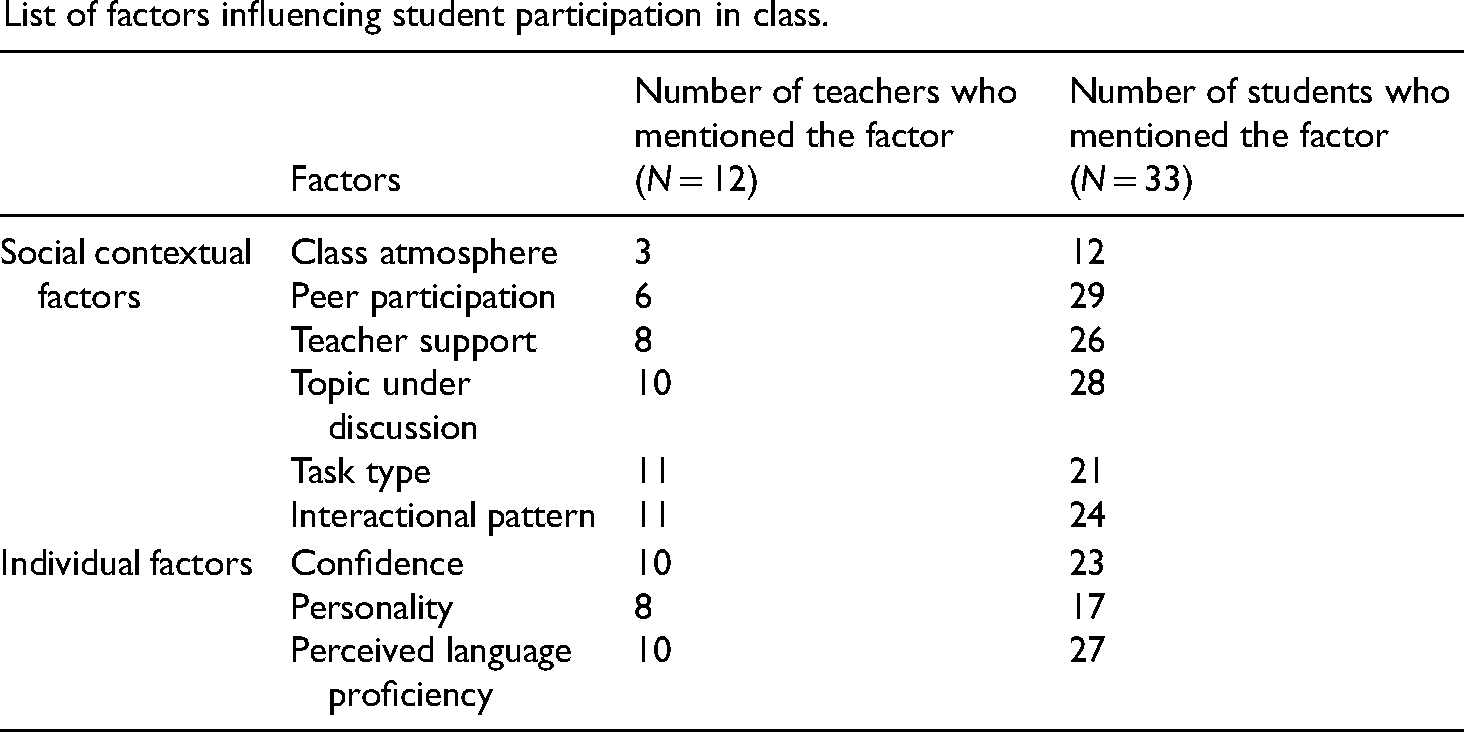
List of factors influencing student participation in class.
Classroom participation as L2 oral output has also been connected to the notion of willingness to communicate (WTC). WTC is defined as ‘a readiness to enter into discourse at a particular time with a specific person or persons, using a L2’ (MacIntyre et al., 1998: 547). Class participation and WTC are closely related in that WTC is the final psychological state before overt communication behaviour whereas participation is a behaviour that can be observed in class (Peng, 2020).
Teachers and students can have very different views and expectations of participation. Teachers usually view participation by students’ oral production as desirable, expected or even required behaviour in language classrooms. However, students may prefer to be quiet and observe others to learn. Bernales (2016) points out that exploring participation as it originates in learners’ minds when they decide whether to speak up or remain silent is scarce. This scarcity is due to methodological and practical complexities. She argues that students in any class can have different levels of speaking skills, language goals and expectations of their participation. To fill this research gap, the present study employed an introspective instrument to tap into students’ perception of participation in class. Video-recorded classroom interactions are used as a stimulus to investigate students’ views of their participation in L2 classrooms in stimulated-recall interviews. To validate students’ perceptions, teachers were also interviewed for their perceptions of students’ participation. By triangulating data and perspectives from video-recorded classroom interactions, teacher interviews and student stimulated-recall interviews, this study extends our understanding of participation practices in an English as the medium of instruction (EMI) multilingual university context.
Literature Review
Willing Participation in L2 Classrooms
Students’ class participation is largely determined by an individual difference variable in second language acquisition known as WTC. The notion of WTC was originally introduced with reference to first language (L1) communication, and it was considered to be a personality-based, trait-like predisposition (McCroskey and Richmond, 1991). WTC entails an intention to initiate communication and is often predictive of actual communicative behaviour. WTC in L2 was schematized in MacIntyre et al.’s (1998) pyramid model and a range of social, contextual and learner variables were conceptualized to converge to predict WTC in L2.
WTC and Learner Variables
MacIntyre et al.’s (1998) pyramid model has been extensively tested in Asian, Canadian and European contexts to explore the underlying factors that influence L2 WTC (Cao and Wei, 2019). Empirical research conducted in the last decade has identified causal relationships between L2 WTC and a number of learner variables, including language anxiety, perceived communicative competence, personality, motivation, attitude, learner belief, emotion, gender and age (Fushino, 2010; Khajavy and Ghonsooly, 2017; Liu, 2018; MacIntyre, 2007; Peng, 2014; Vahedi and Fatemi, 2016).
More recent studies continue to confirm the negative correlation between WTC and L2 anxiety. For example, in Liu’s (2018) survey study, 167 bilingual and multilingual Chinese language learners reported a high level of WTC and a low level of anxiety in communication within classroom settings. Vincze and MacIntyre (2017) found that a non-native accent may cause discrimination and stigmatization, contributing to L2 anxiety. This can indirectly influence students’ WTC in a negative way. However, for low-achieving students, group cohesiveness can help reduce their anxiety levels and motivate them to be more engaged in class tasks (Ben Maad and Saadi, 2020).
Recent studies have also confirmed the impact of perceived opportunity to communicate, perceived communicative competence, L2 fluency and personality on learners’ L2 WTC. The more frequently students are exposed to and speak an L2, the more opportunities students may encounter and therefore be more likely to communicate with each other, build up their self-confidence and satisfy their ideal L2 self, all of which contribute to their WTC (Lee, 2019; Halupka-Resetar et al., 2018). Mixed results have been reported regarding the relationship between learners’ perceived competence and their WTC level. Of the 33 learner-related factors reviewed by Rafiee and Abbasian-Naghneh (2019) that affect L2 WTC, perceived communicative competence, L2 fluency and personality are the most significant factors to influence learners’ WTC. When learners are presented with opportunities to speak an L2, their WTC level could increase. Halupka-Resetar et al.’s (2018) research on 171 university students also revealed that their WTC level was significantly affected by perceived communicative competence.
WTC and Classroom Contextual Variables
Classroom context has been found to exert a direct impact on L2 WTC (Khajavy et al., 2017; Peng and Woodrow, 2010). Research conducted in Asian, Australasian and European classrooms has found that learners’ WTC in class is in a state of flux, being influenced by a host of individual, linguistic and contextual variables. These variables include individual and linguistic factors of personality, self-confidence, emotion, language proficiency and perceived opportunity to communicate, together with contextual factors of the task, interlocutor, teacher and group size (Cao, 2014; Pawlak et al., 2016; Yashima et al., 2016).
As for the task-related factors, variables such as task topic, focus, type and complexity are significant factors contributing to learners’ WTC (Chichon, 2019). Language learners were reported to be more anxious when dealing with unfamiliar and less interesting topics (Cao, 2011, 2014). Moreover, a high level of anxiety was also linked to the perceived difficulty level of the language tasks due to lack of background knowledge and low proficiency level (Cao, 2014; Chichon, 2019). In relation to the interlocutor effect, familiarity with interlocutors plays an important role because students are more willing to communicate with peers with whom they are familiar (Cao, 2014; Chichon, 2019; Lee, 2019). Negative comments from interlocutors and a fear of losing face can impede students’ WTC and class interaction in both online and face-to-face settings (Lee, 2019). Learners could also feel reluctant or shy to speak L2 when they were aware of the differences in identity or cultural background between them and peers (Chichon, 2019; Liu, 2018). As for group size in class, students have been found to be more willing to communicate in small groups or dyads than in teacher-fronted activities (Cao and Philp, 2006; Cao, 2011; Peng, 2014).
In a language classroom, the teacher plays an influential role in affecting students’ WTC. How the teacher conducts the lessons and how they interact with students can influence their communicative behaviour in classrooms (Lee and Ng, 2010). As the enforcer of the classroom regulations, the teacher has the potential to increase or decrease students’ WTC at any moment. Wen and Clément (2003) suggest that the teacher's involvement, attitude, and teaching style can exert a significant and determining sociocultural influence on student engagement and WTC. Cao's (2011, 2014) classroom-based research has found that teaching methods and teacher's interaction strategies can affect students’ WTC in English as second language classrooms. In a culture where teachers are perceived as an authority and knowledge givers and students as passive and receptive learners, students’ WTC with peers can be undermined (Khajavy and Ghonsooly, 2017).
Based on the review of class participation and the notion of WTC, it can be seen that students’ readiness to participate in class can be determined by a range of linguistic, individual, contextual and cultural influences. Further research is warranted to examine students’ intention to participate from both teacher and student perspectives.
Silent Participation
Students’ silence in language classrooms has been mistakenly labelled as non-participation or an obstacle to learning (Bernales, 2016). The premise that L2 learners have to communicate verbally or speak to learn renders silence on the part of students a threat to their language learning process (King, 2013; King et al., 2020). Teachers usually have a limited understanding of students’ silence in class and equate it with shyness. Some might interpret it as a sign of lacking knowledge or engagement on the part of the student or possessing a high level of anxiety or unwillingness to communicate (Tatar, 2005).
Bernales (2016) argues that students possibly consider silence as a valid form of classroom participation though it is not visible to the teacher and other peers. Their thinking-along might constitute a form of silent but valid participation. However, their lack of observable participation in the form of speech may be perceived as not actively thinking or engaging in class. She goes on to argue that silence should not be equated with a lack of proficiency or interest or unwillingness to communicate, instead, it should be seen as potential evidence for alternative forms of participation.
Indeed, some recent research has re-examined silence and considered it a positive contributor to L2 learning as a learning strategy. For example, Bao’s (2014) study found that silence and talk were two domains profoundly related and concluded that verbalization and thinking should be regarded as valid and appropriate forms of participation. Tatar (2005) investigated the reasons behind students’ silence and identified five dimensions of silence, namely, a face-saving strategy, a reaction to others’ contributions, a sign of respect for authority and concern for others, a means of class participation, and the product of a feeling of inarticulacy. In these studies, students perceived silence as a valuable tool for L2 processing and learning. Peng’s (2020) latest study examined Chinese university students’ silence in the English classroom and examined the interaction of silence and L2 WTC. She found that students could be linguistically and cognitively capable but willingly silent, or being desirous but linguistically/cognitively unready and silent, or being silent but ready and yearning for nomination, or willing and breaking the silence.
The two strands of research reviewed above reveal that class participation can take two forms: willing participation in terms of oral production and silent participation. However, research tapping on both strands is still scarce. Previous research has rarely used a triangulation method for a more comprehensive understanding of classroom participation. Therefore, the aim of the current study was to explore students’ participation in L2 classrooms from both teachers’ and students’ perspectives. By drawing on a range of linguistic, individual, contextual and cultural influences, the complexity in students’ participation in class is carefully unpacked and explained. The findings from this study can add to our understanding of classroom participation.
This Study
This study is part of a larger project researching students’ classroom participation and engagement. It aims to address the following research questions:
What are teachers’ views of student participation in the language classrooms? What factors are perceived by teachers and students to affect student participation in class?
Setting and Participants
This study forms part of a larger research project that investigated students’ classroom participation in an EMI context in China. Unlike traditional Chinese universities where the medium of instruction in content programmes is Chinese, this university offers courses accredited by a British university and taught exclusively in English. This study was conducted with 12 English for academic purposes (EAP) teachers and 33 non-English-major freshmen and sophomores from 12 EAP classes at an English-medium university in China. The EAP programme was mandatory and it was intended to prepare the students for academic studies in English and equip them with the necessary skills to succeed in their further academic studies in the UK. Each class met twice weekly, on each occasion for two 50-min sessions separated by a 10-min break.
The EAP programme was streamed according to students’ majors. Of these 12 classes observed, three were year 2 classes covering three majors: electrical and electronics engineering, economics and finance. The rest nine classes were all year 1 with students majoring in science, engineering, business and finance. The materials used in a class all had a focus on major-related content. The lessons were organized to integrate the four macro skills of listening, speaking, reading and writing. In each class observed, there was a time when teachers interacted with the whole class to elicit answers from all students, but there was also time allocated for pair and small group work and discussions.
The teachers had native or near-native English proficiency and they came from a variety of backgrounds. All of them held an MA in TESOL or applied linguistics and two of them held a PhD in applied linguistics. They had a range of teaching experience from five to 40 years. The students were between the ages of 18 and 19 years and their English proficiency level was at an equivalent to IELTS 6.5 to 7.
Procedures and Data Analysis
Data were collected from classroom observations, stimulated-recall interviews with students and semi-structured interviews with teachers. Eleven 50-min lessons, attended by 11 different groups of 20 students, were observed and videotaped. Videotaping was abandoned in one class because a student in that class did not give consent for video recording. The aim of using video recording was to provide stimulus to use for the stimulated-recall interview with students. Field notes were taken by the second author during the observation. After the observation, two to four students in each class (a total of 33) volunteered for a stimulated-recall interview (Appendix 1). The students were played excerpts of video-recorded classroom interaction and made comments on factors affecting their willingness to participate in class. All the teachers were also interviewed after each observed session, for their views of the students’ participation in class (Appendix 2). The questions used for student and teacher interviews were adapted from the instruments used in the second author's previous research studies (Cao, 2011, 2014).
The interviews with the teachers and students and the teacher-fronted activities in the videotaped classes were transcribed verbatim, coded and analysed. The interview data was coded and analysed using thematic analysis (Guba and Lincole, 1994). Thematic analysis is a method for identifying, analysing and reporting patterns (Miles et al., 2014), during which process the researchers scrutinize the data for typical themes and concepts (Rubin and Rubin, 2011). Prior to coding and analysis of the interview data sets, the researchers gained familiarity with the data in the process of transcribing, reading and re-reading the transcripts. Salient and recurring themes, and especially the occasions when the teachers and students commented on class participation were identified. The data collected via teacher interview, student interview and classroom interaction were triangulated and re-examined for the researchers to form tentative explanations and conclusions after the analysis process.
Results and Discussion
Willing, Silent or Forced Participation
This section provides answers to Research Question 1. Three types of participation were mentioned by the teachers in the interviews, including students’ willing, silent and forced participation. They reported that linguistically strong students tend to participate willingly in teacher-fronted activities, while the majority of students appear to be willing to participate in a small group or pair work. It was reported that confident and dominant students would volunteer answers and the others would sit back and remain silent in whole-class activities. However, when the teachers did a comprehension check, the silent students seemed to know what was going on in class. They considered silence as another form of participation and called it silent participation, and they thought that silent participation can still contribute to learning. A number of teachers also identified a third type of participation, forced participation. This means that teachers called upon students to answer questions in teacher-fronted activities. Certainly, when a student was called on by the teacher, they were obliged to respond without having much choice (Cao, 2014). The teachers considered this as an interactional strategy to make sure every student could get an equal chance to participate. The three types of participation identified by the teachers seem to reflect the forms reported by Peng (2020). Students could be willing and break the silence in class when others remain quiet. They could also be linguistically capable but willingly silent due to prohibiting factors. They could be silent but ready to participate and thus they yearn for the teacher's nomination. They could be desirous but have to remain silent because they are linguistically weak.
The teachers commented that students participated to some extent in class activities, but it was usually very hard to tell whether a student's participation was voluntary or forced. Teacher 8 made a conscious effort to ask students questions or encourage their participation in class tasks. This can be seen in his reflection in the interview: I can’t tell whether their participation is voluntary or it's the teacher who dictates the class. When I tell them to do things, they will, but when I throw questions to the floor, they won’t be the first ones to respond…Normally I ensure there is interaction among students through group work and role play in pairs by making them participate in the tasks. It is a conscious effort on my part as the teacher. I personally would like to believe that most of the students I have taught did participate to some extent. It was quite difficult to tell whether they do this willingly or unwillingly. (Teacher 8)
The teachers also acknowledged students’ silent participation in class activities. They found it hard to figure out if the student was shy by temperament or simply unmotivated (Fushino, 2010). But when the teacher deliberately asked the student a question, he would respond which means he understood what was going on. Some teachers attributed students’ silent participation to low language proficiency and prior language learning experience (Halupka-Resetar et al., 2018; Lee, 2019). As shown in the excerpts from a number of teachers: The responses were average there, I find when I’m eliciting from the whole class, I tend to get two or three people, as soon as those people start talking, everybody else sits back and let them do the responding, it's very hard generally to get to rise up with many people, you end up having to ask specific people. (Teacher 6) The majority of the students they have the silent participation…they listen to you because you’re the teacher, they respect you and they’re under your supervision or direction or something like that because they used to do this from elementary school and through to middle school and high school. (Teacher 12)
A number of teachers mentioned that usually, the linguistically strong and extroverted students (MacIntyre, 2007) would volunteer answers to the teacher's questions. Other students would hesitantly volunteer, especially when they were called upon by the teacher, leading to forced participation. Teacher 1 suggested that students were culturally hesitant to volunteer answers (Peng, 2014) and would even find it hard to maintain eye contact. Teacher 2 reported that calling individual students to answer questions in the class had the pedagogical value of taking the pressure off individual students as they knew everyone could be called upon and everyone's ideas were valued. Teacher 7 also used the strategy to call upon quieter students to give answers as they normally performed well and produced quite good work. As can be seen in the following excerpts, One or two students do volunteer, but they’re extraordinarily extrovert students, and others who do volunteer, do it quite hesitatingly, unless they’re called by name. I do call them and I find they do know the answer, but it's not a cultural thing to push yourself forward to give the answer in class…I think it's a cultural influence because even eye contact they find it difficult to learn how to manage eye contact. (Teacher 1) I find if I put an open question out, generally, you’ll be waiting a long time for response, you also face stronger students, because it's them who respond. Sometimes if I’m asking for feedback, like I said, I will elect individuals, but also sometimes give them a chance to think of something and then if I’m eliciting from someone who's clearly got nothing there, I’ll move on to somebody else to kind of take the pressure off, the idea is to let everyone know they could be called upon, everyone's ideas are valued. (Teacher 2) I would nominate quiet students, I will call their names…There are some quiet students who don’t talk much, but they are, it doesn’t mean they’re not performing well, could be the nature of the students, they’re just not outspoken, sometimes they produce quite good writing although they don’t speak well, those active students they don’t always produce good work. (Teacher 7)
It was reported that students seemed to be quite willing to participate in group work but they were quite reluctant to volunteer answers in teacher-fronted activities (Cao and Philp, 2006; Cao, 2011, 2014). They attributed this reluctance or unwillingness to the influence of Chinese culture (Wen and Clement, 2003). This cultural embarrassment of volunteering answers could be due to peer pressure or prior learning experience. As can be seen in Teacher 1's comment, They’re very willing to speak to one another in the discussion groups. But when they’re asked the questions, there's still the cultural embarrassment of volunteering an answer, and I think it's very much of a cultural background thing where they don’t want to be seen to be smart or seen always to give the answer, so I think peer approval may be the reason. (Teacher 1)
The teachers recommended some strategies to identify and engage quieter students in their classes. Teacher 3 reported that quieter students did not want to be the centre of attention but they also wanted their opinions to be heard. Teacher 4 expressed a similar view that quieter students also wanted to be part of a group and sometimes they could come up with impressive answers. Thus, there is some sort of benefit for forced participation, The first challenge for the teacher is finding the quiet student, and noticing the quiet student, and making sure you include them, and maybe they don’t want to be in the centre of attention, so don’t put them in the centre of attention…for a quiet person it might be important to remember the little personal detail of someone, we know you’re there, if you want to say something, we want to listen. (Teacher 3) I tend to keep an eye on the quieter students, sometimes quieter students would surprise you when you prompt them at a specific question, they actually come up with the answer, and that can lead to something else, in the back of my mind I always I try to include everybody even if they’re sitting there you know, that's what we do, isn’t it… you don’t want someone to leave the room and feel they’re not part of it. Sometimes you have to, it's a bit of pushing you know. (Teacher 4)
Factors Affecting Students’ Participation in Class
This section provides answers to Research Question 2. A range of social contextual and individual factors have been reported in teacher and student interviews to affect students’ willingness or a forced participation in class. Of the social contextual factors, interactional patterns (whole-class vs. group/pair work) and task were the most frequently mentioned by the teachers, but peer participation and topic under discussion were the most frequently mentioned by the students. Almost all the teachers commented that the students seemed to be more willing to participate in group or pair work rather than teacher-fronted or whole-class activities. Also, 11 out of 12 teachers reported that task type played a role in exerting influence on class participation. From the students’ perspective, 29 out of 33 students reported that their classmates’ participation in class activities, either in whole-class or group/pair work, had an effect on their participation in class. Twenty-eight out of 33 students commented that whether the topics were interesting or not had an effect on participation.
Among the individual factors, an equal number of teachers, 10 out of 12, acknowledged that students’ participation could be encouraged or hindered by their self-confidence and perceived language proficiency level. Language competence was also reported by 27 students as a factor influencing their class participation. Twenty-three students mentioned that their confidence level could affect their voluntary participation in class.
Class Atmosphere
This factor was reported by students rather than teachers to affect participation. Some students commented that the class atmosphere was one of the determining factors affecting their participation, particularly in teacher-fronted activities (Eddy-U, 2015). When the class stayed quiet and no one took the chance to volunteer the answer, even when someone knew the correct answer, the participants would find it difficult to speak up and would remain silent as well. As can be seen in a few excerpts from student interviews, Class is too quiet and I will speak less than average, sometimes when the teacher ask a question almost everyone stay quiet and say nothing…when everyone stay quiet I had to stay quiet because everyone did that, and the atmosphere was quiet and I was forced to stop. (Student 2) Sometime the class is keeping silent, so all of the people don’t want to answer the question, maybe I’ll feel the pressure, I won’t talk…I think that question is not very difficult, maybe they just wait others to say the answer. (Student 27)
Peer Support
Consistent with findings from previous research, students reported that peer support was quite important for encouraging them to participate in class (Cao, 2011, 2014; Chichon, 2019; Lee, 2019). As Student 5 reported, I think another important factor is our classmate our partners don’t laugh at each other when you make mistakes they won’t laugh at you and they try to help you, that's very important, in our group. (Student 5)
Teacher Support/Participation
Both teachers and students reported that the support from the teacher and even their participation in group work would promote their participation in activities and discussions (Cao, 2011, 2014; Khajavy and Ghonsooly, 2017; Lee and Ng, 2010). The teacher could play an active role by helping them understand topics better and engaging quieter group members, You could either sit down with the group for the whole period or you could move from group to group, or you wander outside to make sure they speak English… the teacher has a chance to pick on a quieter student, and say come on, say something. (Teacher 10) Teacher's encouragement is also very important, like when we meet some words and we don’t know, our tutor will explain to us she will give some examples, that will become easier for us to participate in the discussion and we will familiar with this type of topic (Student 16)
Topic
The majority of the students reported that they would be more willing to participate when they were familiar with the topic, and the topic was interesting or related to their major or of personal relevance (Cao, 2011, 2014; Chichon, 2019; Riasati, 2012). As can be seen in the excerpts, Most important factor is interest, most of the students will join the topic if the topic is interesting…the topic friction is related to our major, also topics related to life, modern things like laptop phones, modern technology, interesting and useful topics, in relation to engineering. (Student 1) When the topic is interesting, I will talk more…interesting topics, topic about how to manage a company, sometimes I would like to talk about environment, or maybe keep fit. (Student 23)
Task
It was also found that students tended to be more willing to participate in focus-on-meaning types of activities, such as role plays, seminars and debates (Cao, 2011, 2014; Pawlak et al., 2016). The teachers commented that when students did debates or role plays, they were right in the process of thinking through the arguments or imagining themselves in the given roles, and they got beyond worrying about the accuracy of the language but focusing on advancing their ideas and opinions and they became more risk-taking in the participation process. It was also mentioned that seminars tended to generate more willing participation from different students, rather than one or two more dominant students. The students appeared to like fun and challenging activities. They will be more willing to speak English if you give them a different role, role play… they find they can distance themselves from who they actually are, they are taking up a different role so they have to behave, make them open up a bit. (Teacher 7) I’m often surprised by doing debates because students they get beyond thinking of whether they’re giving a right or wrong answer, they’re right into the process of thinking through the arguments, trying to do a good job for their side, they get beyond worrying about their language, actually advancing their ideas. (Teacher 9) I think the task should be a little challenging but not very difficult, can you have ability to finish the task, but it's not easy or boring. (Student 12)
Interactional Pattern/Group Size
Both teachers and students reported class interactional patterns can influence participation. As shown in previous research, learners’ preferences for the class interactional contexts are not uniform. Some feel more comfortable talking in small group work or dyads whereas others are more vocal in teacher-fronted activities. However, generally, students prefer small group or pair work to whole-class activity in both ESL and English as foreign language settings. This is similar to findings in other classroom studies (Cao, 2011; Peng, 2014). When they’re answering the teacher and they’re the only one speaking, for that response they feel the most scrutiny, with the most cultural pressure. I think when they’re in the group work talking, they’re much more equal, although people still hold back, maybe the quieter ones still hold back. (Teacher 9) I think I’m more willingness to participate in group work as we’re quite familiar with each other. In the open discussion, we’ll feel shy and be less active. I find it really hard to present in front of the class. (Student 11)
Confidence (Anxiety and Perceived Competence) and Personality
Similar to previous research, confidence and personality were reported by teachers and students that can directly influence students’ willingness to participate in class (Cao, 2011; Riasati, 2012). Students with such personality dispositions as extraversion, impulsiveness, socialization and flexibility tend to be more risk-taking and more prone to communication (Wen and Clément, 2003). Things particular to Chinese students is not to show off, if they answer all the time, classmates might think they just want to show off, but I think it could also be an excuse, they just don’t want to answer in case they get it wrong… Maybe they don’t want to be wrong, so it's their confidence. (Teacher 11) For me it's about personality, sometimes I’m confident enough to stand out and give the answer, you know I’m not very extrovert person. Actually, I’m introvert person, so most of classmates are introvert and they’re not willing to speak out. (Student 13)
Communicative Competence
It has also been shown that both actual and perceived competence of language learners can affect students’ participation (Cao, 2011; Halupka-Resetar et al., 2018; Rafiee and Abbasian-Naghneh, 2019) and low linguistic proficiency can prevent students from risking speaking the L2 in class (Liu and Jackson, 2008). Most students in the classes that I find, their English is actually quite a lot better than they think it is. They’ve been sold the story that their English is poor, but when you actually get them talking, they’re more competent than they believe they are. (Teacher 6) When I focus on our task I think I can do it well, I’m willing to tell the teacher answers, when I’m not sure, I don’t want to make mistake. (Student 2)
Conclusion
Through triangulation of videotaped classroom interaction, semi-structured interviews with teachers and stimulated-recall interviews with students, the present study has revealed three forms of student participation in EAP classes, including willing, silent and forced participation. It seems that the lines between these three types of participation are not so clear. The evidence from this study suggests that silent or forced participation should not be seen as a deficit but should be perceived in a more positive light. The study has also shown that a number of contextual and individual factors can affect students’ classroom participation.
The present findings were based on data collected from a small sample of teachers and students, and may not be generalizable to other contexts. However, this study has ecological validity as it was carried out within actual classrooms. Since this study employed classroom observation and videotaping, an observer's paradox problem might have affected the authenticity of data. Also, a member check should have been performed to test the interpretation of the interview data among the teacher and student participants.
Despite the limitations, this study has a number of pedagogical implications to offer. Firstly, this research highlights that linguistically strong students tend to participate willingly but dominate in teacher-fronted activities. Teachers should give an equal opportunity to students who are desirous and willingly silent to speak up in class. As for students who are linguistically weak and tend to remain silent in teacher-fronted activities, teachers can consider calling on them or forcing them to participate, given that these students might be waiting for the teacher's nomination. Secondly, this study found that students’ willing participation is influenced by a range of individual and contextual factors. As for contextual factors, teachers should design engaging task types, choose topics of interest to students, alleviate peer pressure, and create a class environment that is conducive to willing participation. In terms of promoting positive individual factors, teachers should employ strategies to help students reduce anxiety, promote self-confidence and increase perceived communicative competence. Apart from these, teachers should take into account the diverse and sometimes less salient ways of participation and encourage learner autonomy and self-regulatory behaviour that are conducive to successful language learning (Bernales, 2016).
Footnotes
Declaration of Conflicting Interests
The authors declared no potential conflicts of interest with respect to the research, authorship, and/or publication of this article.
Funding
The authors received no financial support for the research, authorship, and/or publication of this article.

Appendix 1. Stimulated-recall interview questions.
Stimulated-recall questions:
What were you thinking right then/at this point? Can you tell me what you were thinking at that point? I saw you were laughing/looking confused/saying something there, what were you thinking then? Can you remember what you were thinking when she said that/those words? Can you tell me what you thought when she said that?
Probing questions.
I was wondering if I could ask you something. I’m just curious. I noticed when you were talking about the recording you mentioned …quite a lot. Is that what you are most concerned about when you are speaking? Can you say a bit more about this?