




Abstract
This study investigated the efficacy of varying degrees of written corrective feedback (WCF) explicitness on the accuracy of revised drafts and new pieces of writing among learners of different proficiency levels. A total of 130 learners of English were divided into three proficiency groups (basic, independent, and proficient users), with learners at each proficiency level receiving four types of WCF that differed in their degree of explicitness: direct corrective feedback plus metalinguistic explanation (DCF + ME), direct corrective feedback only (DCF), indirect corrective feedback plus metalinguistic explanation (ICF + ME), and indirect corrective feedback only (ICF). Learners completed a text reconstruction task as their first draft, revised their writing according to one of the four types of WCF, and completed another text reconstruction task after 2 weeks. While the accuracy scores differed across different test times for learners at all proficiency levels, split-plot ANOVAs with post hoc comparisons showed that differential effects of varying degrees of WCF explicitness on the accuracy of learners’ revised and/or subsequent writings were found only for the proficient group where the DCF + ME group significantly outperformed the ICF group on revised drafts and both the ICF and ICF + ME groups on new pieces of writing.
Introduction
As a widely used pedagogical tool, the provision of written corrective feedback (WCF) on second language (L2) student writing has been a hotbed of discussion over the past two decades. An increasing amount of literature on WCF has been directed at addressing Truscott’s (1996) controversial claim that there is no theoretical or empirical justification for the use of WCF, and that correcting learners’ written errors is ineffective in improving L2 writing and even harmful to the grammatical accuracy of texts. Truscott's view has since been refuted by a growing body of theoretical (e.g. Bruton, 2010; Ferris, 2004) and empirical evidence (e.g. Bitchener, 2008; Bitchener and Knoch, 2010; Chandler, 2003; Ellis et al., 2008; Sheen, 2007) suggesting that WCF can help learners improve grammatical accuracy in their revised and/or new pieces of writing. While these researchers have demonstrated that WCF is productive for learning in general, others have also shown that its effect can be influenced by some mediating variables such as the type of feedback provided (e.g. Van Beuningen et al., 2008, 2012) and the degree of feedback explicitness (e.g. Karim and Nassaji, 2018; Suzuki et al., 2019).
As one of the factors that can mediate the effectiveness of WCF, feedback explicitness refers to the extent to which the feedback provided involves straightforward information about the nature of the error and how the erroneous structures can be corrected (Nassaji, 2015). However, unlike the conventional binary classification that has tended to describe feedback simply in terms of either explicit or implicit (or direct/indirect) feedback types (e.g. Chandler, 2003; Ferris, 2006), Nassaji (2016) argues that feedback explicitness can vary considerably depending on the amount of explicit information the feedback provides. For instance, although direct WCF (i.e. provision of the correct form) is considered more explicit than indirect WCF (e.g. underlining or simply noting the existence of an error), direct WCF that is accompanied by metalinguistic explanation (ME) (e.g. providing the correct form and at the same time giving learners a written handout explaining the use of the target structure) can be even more explicit than direct WCF. By the same token, indirect WCF accompanied by ME is more explicit than indirect WCF. In this connection, some researchers have adopted different combinations of WCF with varying degrees of explicitness and investigated their impacts on learners’ writings (e.g. Bitchener, 2008; Bitchener and Knoch, 2010; Karim and Nassaji, 2018; Sheen, 2007; Stefanou and Revesz, 2015; Suzuki et al., 2019).
However, these studies have reported divergent findings regarding whether varying degrees of WCF explicitness can have differential effects on the grammatical accuracy of learners’ revisions or new pieces of writing. Apart from its divergent findings, previous research on the degrees of WCF explicitness has some limitations. First, such research has focused on a limited number of WCF combinations, with only one study (Suzuki et al., 2019) comparing the different levels of explicitness for both direct and indirect WCF. Second, the ecological validity of such research might be questioned in that these studies have merely focused on one proficiency level, disregarding the possibility that in mixed-proficiency classrooms, learners with varying L2 abilities might respond differently to different degrees of WCF explicitness. To contribute to the strand of research on the effects of WCF explicitness on learners’ revision accuracy and learning, the present study examines the effects of four different types of WCF which differed in terms of the degree of explicitness on the accuracy of revisions across learners of various proficiency levels.
WCF Explicitness: Beyond a Binary Classification of Feedback
Research on WCF has made great strides toward understanding the extent to which different types of feedback affect learning. Two widely researched types of corrective feedback are direct and indirect feedback. Whereas direct CF refers to the provision of the correct form by crossing out the errors, inserting the correct word, or writing the correct form near the incorrect one, indirect CF simply indicates that the learner has made an error but does not provide the correct form, leaving the learner to find the ill-formed structure and pushing them to correct it (Samiei and Sim, 2016). A number of researchers have empirically compared the effectiveness of direct and indirect CF. Some of them have found direct CF to be more effective than indirect CF as it specifies precisely how one should correct an error (e.g. Chandler, 2003; Van Beuningen et al., 2008), whereas some others have reported an advantage for indirect CF, particularly in the long run, as it assists learners in better engaging in problem-solving learning and becoming autonomous learners (e.g. Ferris, 2006; Sheppard, 1992).
Furthermore, as will be discussed later in this paper, providing learners with some metalinguistic information would raise the level of feedback explicitness and could help learners better comprehend the nature of the error (e.g. Bitchener, 2008; Ellis et al., 2008; Nassaji, 2015; Sheen, 2007). The degree of feedback explicitness is claimed to play a mediating role in the efficacy of WCF (Sheen, 2010; Suzuki et al., 2019). Depending on its degree of explicitness, WCF may influence students’ awareness at the levels of noticing or understanding, which can in turn have an impact on how students process the feedback (Suzuki et al., 2019). According to Schmidt's (1990) noticing hypothesis, noticing brings learners’ attention to their errors which might otherwise go unchecked. Although it generally refers to one's conscious awareness of the target structure, it can also occur somewhat implicitly while one's attention is on meaning (Schmidt, 1995). In this connection, more explicit types of feedback (e.g. direct CF) may reduce the confusion that learners might encounter if they do not comprehend the less explicit types such as ME in the form of a handout (Bitchener and Ferris, 2012). However, understanding requires a higher level of awareness than simple noticing (Schmidt, 1995). Whereas noticing merely involves surface-level awareness of specific forms in the input (e.g. the existence of a and the in English sentences), understanding entails awareness of a general rule or principle (e.g. the use of a before nonspecific nouns and the before specific nouns) (Schmidt, 1995). It would therefore make intuitive sense to argue that although direct CF may be likely to help student writers’ awareness at the level of noticing more than the less explicit indirect CF, more explicit types of feedback such as direct CF accompanied by some metalinguistic cues might even raise students’ awareness to the level of understanding (Shintani et al., 2014; Shintani and Ellis, 2015). Be that as it may, much research is still needed to empirically test this hypothesis.
Studies on the Role of WCF Explicitness
A number of studies have investigated different combinations of WCF with varying degrees of explicitness and empirically tested their effects on the grammatical accuracy of learners’ revisions. Most of the earlier studies have confined themselves to examining different combinations of direct WCF, while ignoring less explicit, indirect types of WCF (e.g. Bitchener, 2008; Bitchener and Knoch, 2010; Sheen, 2007; Stefanou and Revesz, 2015). Their findings have been somewhat mixed. Some of them have shown that different types of feedback can have differential effects on the grammatical accuracy of learners’ revised or new writings (Bitchener, 2008; Sheen, 2007). For example, Sheen (2007) investigated the extent to which two types of direct WCF (direct CF only and direct CF with ME) could promote intermediate-level ESL learners’ acquisition of articles. She found that both experimental groups outperformed the control group on the immediate posttests, and that learners who received direct CF along with metalinguistic comments performed better in the delayed posttest than those who only received direct CF. In addition, Bitchener (2008) studied the efficacy of direct WCF with three levels of explicitness (direct CF with both written and oral ME; direct CF with written ME; direct CF only) on the grammatical accuracy of low-intermediate ESL learners’ writings in terms of using two functions of the English article system, i.e. the referential indefinite article “a” and the referential definite article “the,” while working on three picture-description tasks. He found that those learners in the direct CF with both written and oral ME group and the direct CF only group could perform better on the immediate posttest than those in the control group regarding grammatical accuracy, and that their superior performance was retained after 2 months on a delayed posttest.
However, some other studies (Bitchener and Knoch, 2010; Stefanou and Revesz, 2015) have shown that although WCF is effective for learning, the degree of explicitness of WCF does not play a significant role in L2 writing development. For instance, Bitchener and Knoch (2010) carried out a longitudinal investigation into the effectiveness of direct WCF, adopting the same treatment options used in Bitchener (2008). However, this time the learners produced five pieces of writing during a 10-month period. Bitchener and Knoch found that although learners in all treatment groups performed better than those in the control group on all posttests, no significant difference was found between the three treatment conditions. In a similar study, Stefanou and Revesz (2015) looked into whether any of the two types of direct CF (direct CF with ME; direct CF only) has a greater capacity to promote intermediate-level EFL learners’ use of articles with specific and generic plural referents on two assessment tasks, i.e. a text summary test and a truth value judgment test. Their results showed that while both experimental groups outperformed the control group, neither treatment condition had a particular advantage over the other.
Whereas the above-mentioned studies have merely focused on different combinations of direct WCF, more recent studies (e.g. Karim and Nassaji, 2018; Suzuki et al., 2019) included in their investigations less explicit, indirect feedback types as well. For example, Karim and Nassaji (2018) examined the short-term and delayed effects of three types of feedback with differing degrees of explicitness (direct CF only; underlining plus metalinguistic comments; underlining only) on the accuracy of intermediate-level ESL learners’ revised and new pieces of writing. Although all three feedback types led to higher revision accuracy, some short-term, though statistically non-significant, effects were also found for the more explicit types of WCF (i.e. direct CF only and underlining plus metalinguistic comments) on the accuracy of new pieces of writing. More recently, Suzuki et al. (2019) even added a more explicit type of WCF (direct CF plus ME) to those used in previous studies. They investigated the differential effect of WCF with four different levels of explicitness (direct CF plus ME, direct CF only, indirect WCF plus ME, and indirect WCF only) on the accuracy of using the English indefinite article and the past perfect tense in elementary level ESL learners’ revision and new pieces of writing. The results showed an advantage for the two most explicit WCF (i.e. direct CF plus ME and direct CF) over the less explicit, indirect CF plus ME treatment condition, though only for the past perfect target form.
Context and Purpose of the Present Study
Relatively few studies to date have attempted to assess the effectiveness of different levels of WCF explicitness, with only one study (Suzuki et al., 2019) comparing different levels of explicitness for both direct and indirect WCF. Besides, no study to date has investigated the effect of WCF explicitness for different proficiency levels, which tends to limit the ecological validity of such research, because the provision of WCF in some classroom contexts where the English proficiency of the learners is mixed raises the question of whether or not learners at various proficiency levels would benefit equally from WCF with varying degrees of explicitness. For instance, in order to gain admission to higher education in Iran, students have to attend the national university entrance exam (also known as Konkur). Given that admission to an English major in Iranian universities is not determined solely based on a candidate's proficiency in English, and other subjects such as Persian Literature, Religious Studies, and Arabic Language equally influence candidates’ chances of acceptance, the populations of English-major students in Iranian university classrooms are often quite heterogeneous. However, to the best of our knowledge, no study has yet investigated how learners in mixed-proficiency classes might respond to different degrees of WCF explicitness. In this connection, it would make intuitive sense to hypothesize that more explicit types of WCF may help lower proficiency learners better comprehend the feedback, whereas higher proficiency learners may benefit more from less explicit feedback types because their proficiency level allows them to have more retrieval experience, helping them to consolidate their previously acquired knowledge and assisting them with making room for new pieces of knowledge to be internalized. Be that as it may, the jury is still out on whether direct or indirect feedback, and at which level of explicitness, should be given to learners at different proficiency levels. In this study, we employed different types of WCF (direct CF, indirect CF, direct CF plus ME, and indirect CF plus ME) across learners of various proficiency levels to examine the effects of WCF explicitness on their revision accuracy and learning. The following two research questions were addressed:
Does WCF have an impact on the accuracy of basic-, independent-, and proficient-level L2 users’ revised drafts and new pieces of writing? Do different types of WCF with varying degrees of explicitness have differential effects on the accuracy of revised drafts and new pieces of writing?
Participants
A total of 138 undergraduate students at two universities located in the northeast of Iran voluntarily agreed to take part in this study by signing informed consent forms, and were given extra course credit for their participation. They were all native speakers of Persian, majoring either in English Literature or Teaching English as a Foreign Language, and represented a wide range of English proficiency levels from A1 (Breakthrough) to C2 (Mastery) based on the levels defined by the Common European Framework of Reference for Languages (CEFR). After excluding learners who were absent from any phase of the study, the number of participants reached 130 (female, n = 78; male, n = 52; Mage = 19.39, range = 18–21). The Oxford Placement Test (OPT; Allen, 2004) was used for placing learners at different levels of L2 proficiency. The OPT consists of listening (10 min) and grammar (50 min) sections which are also integrated with reading skills and contextualized vocabulary. The test has been calibrated against the language proficiency levels based on CEFR and Cambridge ESOL Examinations (Allen, 2004) and there is a high correlation between the OPT and TOEFL scores (Birjandi and Siyyari, 2010). Based on the levels defined by CEFR, learners were divided into three proficiency groups: Basic Users (A1 and A2, n = 44), Independent Users (B1 and B2, n = 40), and Proficient Users (C1 and C2, n = 46). The participants from each proficiency group were then randomly assigned to four groups receiving feedback with varying degrees of explicitness.
Tasks and Target Structures
The participants were given two similar text reconstruction tasks to complete, one as their first draft (which was then revised) and the other as a new piece of writing. The reason for the use of text reconstruction was that such a controlled, guided writing task could encourage learners to use the target structures rather than avoiding them, whereas in uncontrolled tasks such as picture description learners might avoid using the target structures (Suzuki et al., 2019). The narratives used for the three proficiency groups were written by a native speaker of English and manipulated by the researchers to contain the target structures. Target structures for the three proficiency levels were selected based on the level descriptions of the CEFR. We used WCF in a focused manner by choosing a limited number of target structures. For the basic level, adverbs of frequency were chosen in which learners’ understanding of the occurrence level of an action was tested. Students in the independent group were tested on the use of comparative and superlative forms. Proficient-level students were tested on structures using inversion to make a sentence more emphatic and formal.
Design and Procedure
A between-subjects pretest, treatment, posttest, and delayed posttest design was adopted in the current study to examine the effects of varying degrees of WCF explicitness on learners’ accuracy of revision and new pieces of writing. There were two independent variables: feedback explicitness as our between-subjects variable (four levels of explicitness: direct CF, indirect CF, direct CF + ME, and indirect CF + ME) and testing time as our within-subjects variable (three levels: first draft, revision, and new writing). The dependent variable was accuracy scores regarding the correct use of the target structures.
Data collection took place over a 4-week period. During the first week, participants were given a text reconstruction task and were asked to read and write any information they found necessary in 15 min. The texts were then collected. Afterwards, all participants received a blank piece of paper and were asked to reconstruct the original text as precisely as they could in 20 min. In the second week, participants received their writings along with corrective feedbacks according to the treatment conditions (see the Appendix for an example of each type of feedback). They were allowed to look over their errors and the corrections for 5 min. In the direct CF treatment condition, the errors were corrected by underlining or crossing out the ill-formed structures and providing the correct forms by removing redundant elements, replacing the error or adding a missing element. In the indirect CF treatment condition, the erroneous form was underlined or, if any item was missing, its position in the sentence was marked with an insert symbol (^). Those groups having metalinguistic feedback in their treatments (direct CF + ME, indirect CF + ME) were also provided with a handout which included an explanation of each target structure along with two example sentences. After looking at their CFs, all participants were asked to revise their first drafts in 20 min. In the end, the writing sheets, together with revisions and handouts, were collected. In the fourth week, in order to see whether and to what extent learners can transfer their accuracy gains from WCF on their first drafts to new pieces of writing, they were asked to complete another text reconstruction task.
Results
Table 1 shows the descriptive statistics and Figure 1 provides a visual representation of the grammatical accuracy scores of adverbs of frequency across three test times. First, a one-way analysis of variance (ANOVA) was conducted on the accuracy scores for the first draft to find out if the learners in the four WCF groups began the study with similar writing proficiency. The results revealed that there was no statistically significant differences among the four treatment conditions in the first draft (F (3, 40) = .79, p = .51). To find out whether different degrees of WCF explicitness significantly affected accuracy in terms of using adverbs of frequency, the mean accuracy scores were submitted to a split-plot design ANOVA with the type of WCF (four degrees of explicitness) as a between-subjects variable and testing time (three levels) as a within-subjects variable. The ANOVA showed a significant main effect for Time (F (1, 40) = 10.21, p = .003), suggesting that learners’ accuracy differed across different test times. The effect size for Time using partial eta squared (ηp2) was 0.20, representing a large effect (based on Cohen, 1988: small = .0099; medium = .0588; large = .1379). However, there were no significant effects for Group (F (3, 40) = 1.17, p = .33, ηp2 = 0.08) and Group × Time interaction (F (3, 40) = .13, p = .94, ηp2 = 0.01), suggesting that varying degrees of WCF explicitness did not have differential effects on accuracy and that the effectiveness of different types of WCF did not vary across different test times. With regard to test timing, Bonferroni's post hoc pair-wise comparison revealed significant differences between the accuracy of (a) the first draft and the revision (p = .000), (b) the first draft and new writing (p = .008), and (b) the revision and new writing (p = .003).
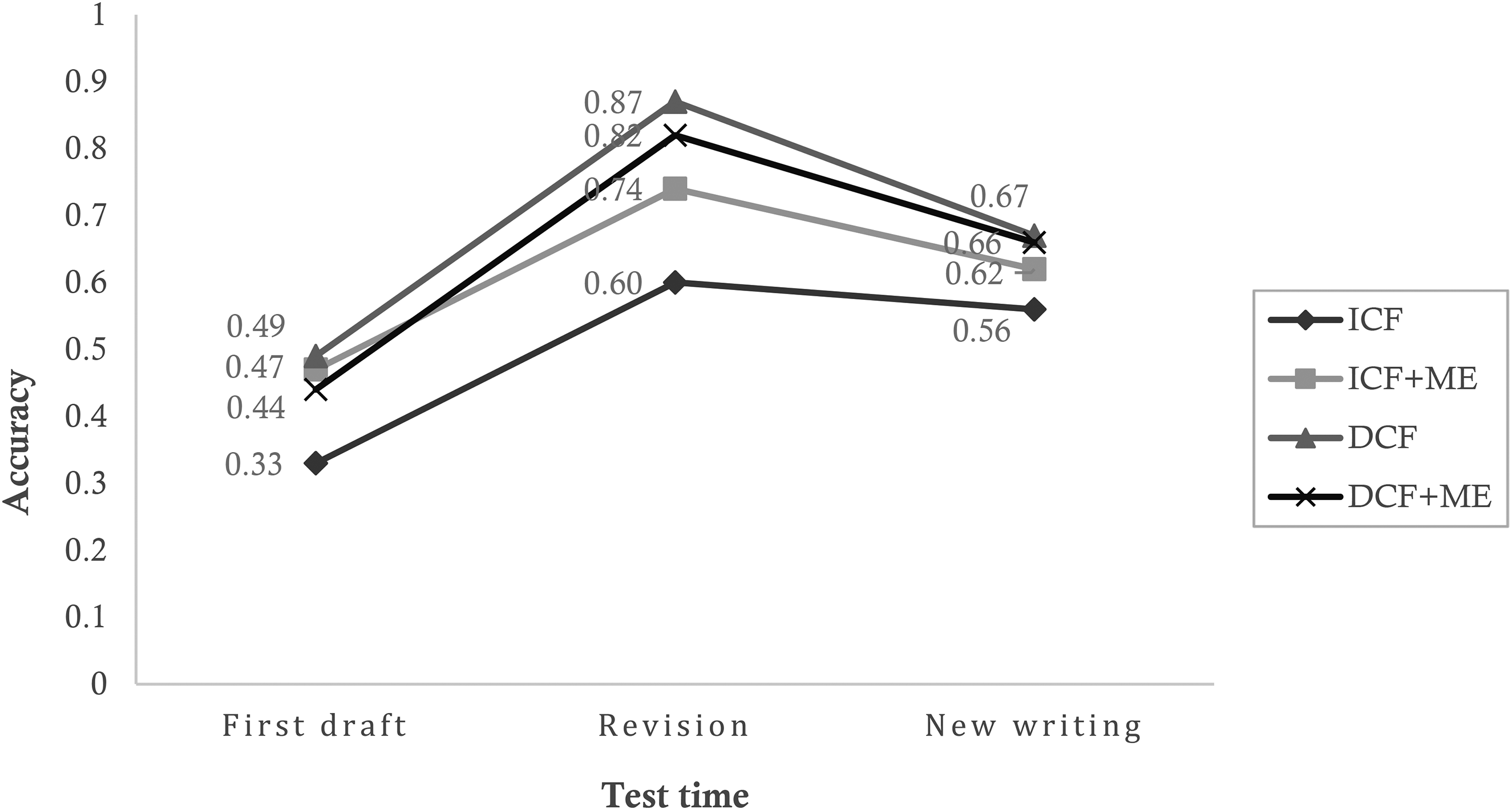
Mean percentage scores of the adverbs of frequency across test times.
Descriptive statistics: accuracy of adverbs of frequency across three test times.
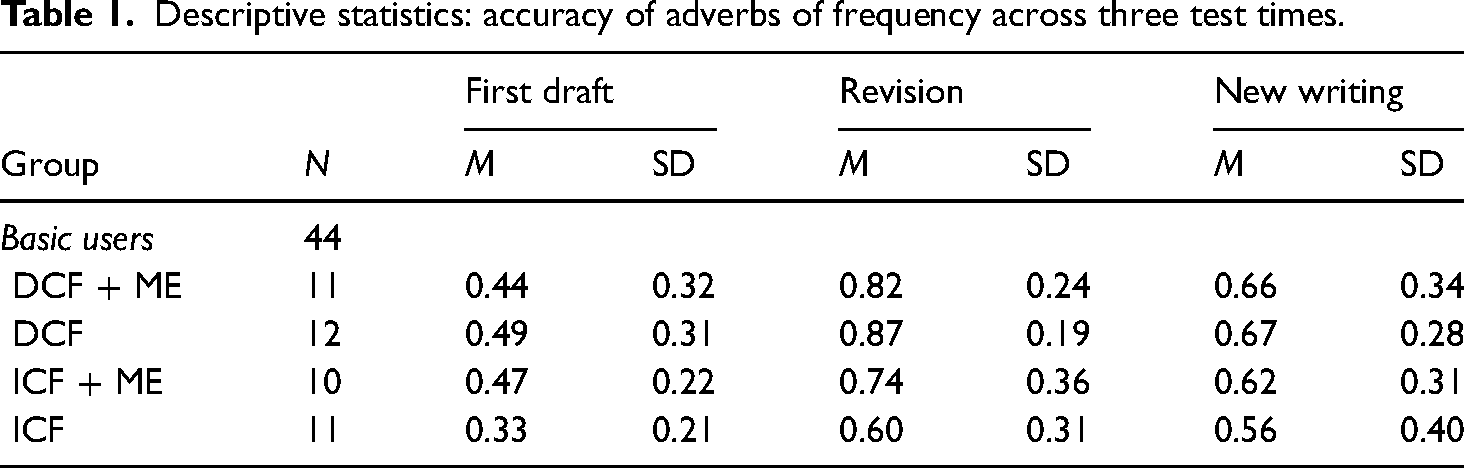
Table 2 shows the descriptive statistics for the accuracy scores of comparative and superlative forms across three test times (also see Figure 2 for a visual representation). First, a one-way ANOVA was performed to compare the WCF group differences on the grammatical accuracy of the first draft in terms of using comparative and superlative forms. Because no statistically significant difference was found among the four WCF groups (F (3, 36) = .27, p = .84), the proficiency of all the groups was considered to be similar at the time of pretest. Also, the outcome means were submitted to a split-plot design ANOVA to examine the effects of the degree of WCF explicitness on accuracy scores. The results showed a significant main effect for Time (F (1, 36) = 6.35, p = .016, ηp2 = 0.15), indicating that learners’ accuracy varied across different test times. However, there were no significant effects for Group (F (3, 36) = .04, p = .98, ηp2 = 0.003) and Group × Time interaction (F (3, 36) = .23, p = .87, ηp2 = 0.02), suggesting that the degree of WCF explicitness did not significantly affect accuracy and that such an effect did not vary across different writing sessions. With regard to test timing, Bonferroni's post hoc pair-wise comparison showed significant differences between the accuracy of (a) the first draft and the revision (p = .000) and (b) the first draft and new writing (p = .049). No significant difference was found between the accuracy scores of the revision and new writing (p = .984).
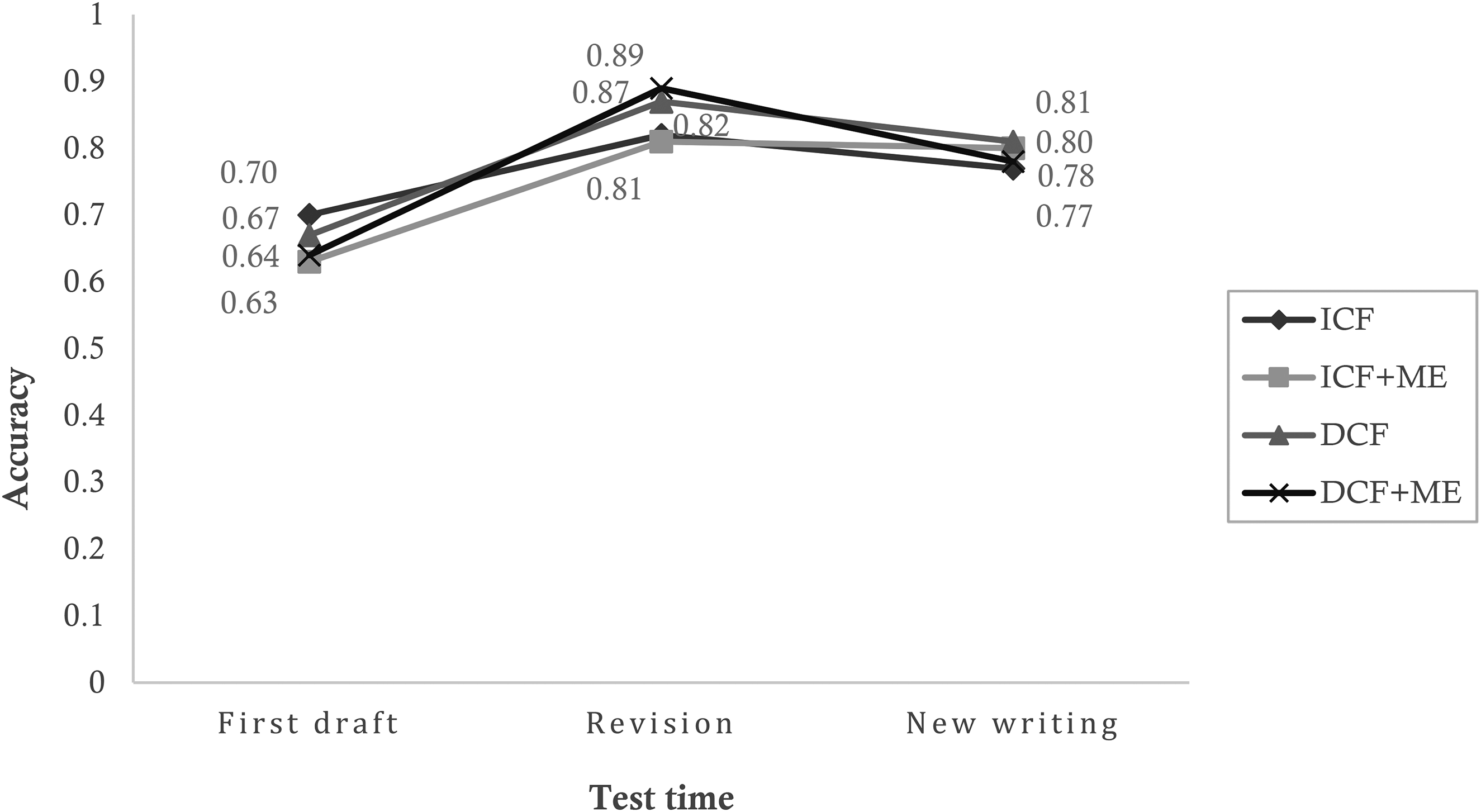
Mean percentage scores of comparative/superlative forms across test times.
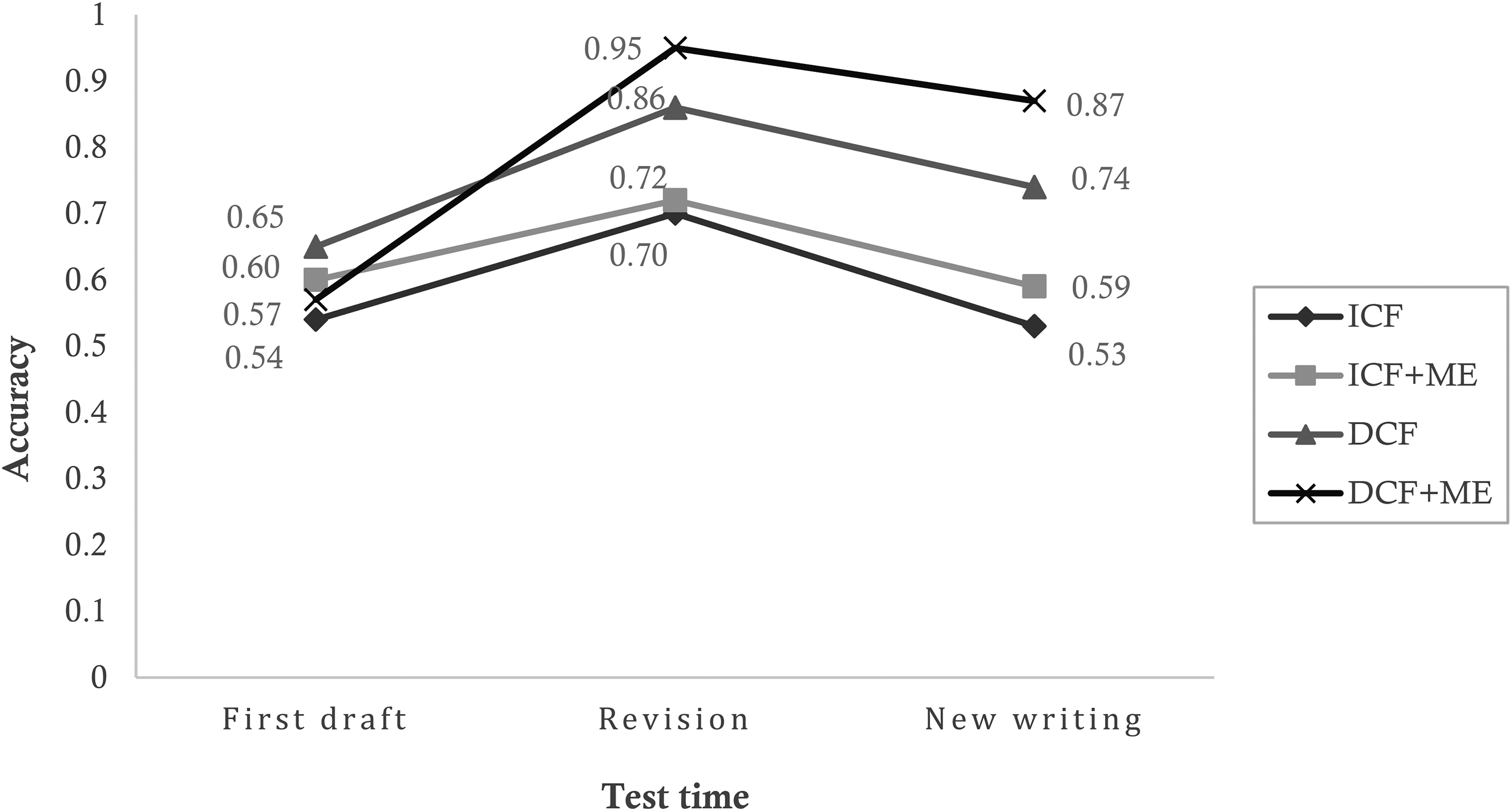
Mean percentage scores of inversion across test times.
Descriptive statistics: accuracy of comparative/superlative forms across three test times.
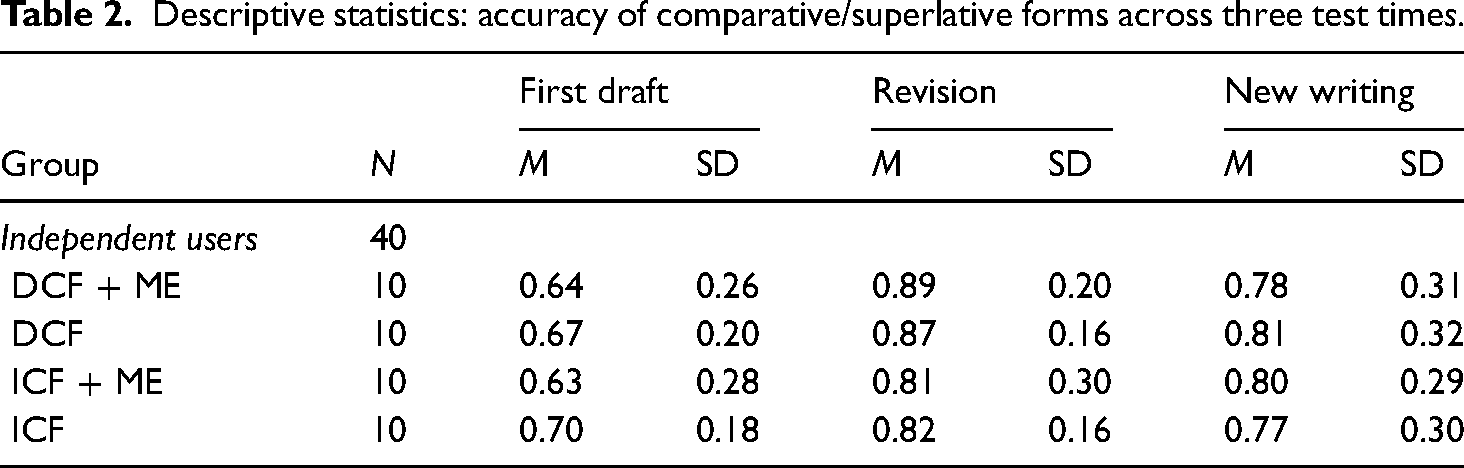
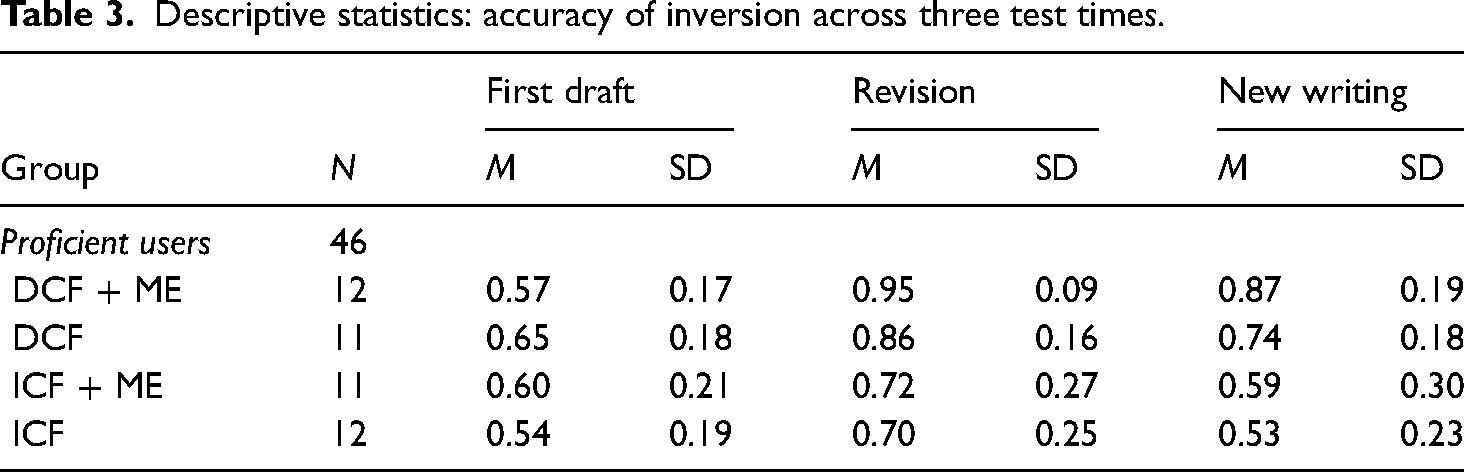
Table 3 shows the descriptive statistics and Figure 3 presents a visual representation of the grammatical accuracy scores of adverbs of frequency across three test times. Results from a one-way ANOVA revealed that there was no statistically significant differences among the four treatment conditions regarding the use of inversion in the first draft, F (3, 42) = .59, p = .62, indicating that all WCF groups were similar regarding their L2 proficiency at the time of writing their first draft. Also, results from a split-plot design ANOVA revealed significant main effects for Time, F (1, 42) = 6.89, p = .012, ηp2 = 0.14, and Group, F (3, 42) = 3.57, p = .022, ηp2 = 0.20. There was also an interaction of time and group (WCF condition), F (3, 42) = 4.57, p = .007, ηp2 = 0.24, suggesting that the effects of different feedback types varied over time. One-way ANOVAs were then conducted to find out which type of WCF was more effective at each test time. The ANOVA revealed that accuracy differences were significant in both revised and new pieces of writing with large effect sizes (in revised drafts: F (3, 42) = 3.77, p = .017, ηp2 = .21; in new pieces of writing: F (3, 42) = 5.00, p = .005, ηp2 = .26). For revised drafts, post hoc pair-wise comparisons with Bonferroni correction showed that the direct CF + ME group significantly outperformed the indirect CF only group (p = .032). The mean values also indicated that learners in the direct CF + ME group performed better than those in the indirect CF + ME group. However, the difference was not significant (p = .081). As for new pieces of writing, there was a significant difference between the direct CF + ME group and the indirect CF only group (p = .007), and also between the direct CF + ME group and indirect CF + ME group (p = .035), suggesting that learners who received a combination of direct WCF and metalinguistic information performed better in new pieces of writing than those who received either indirect WCF or indirect WCF along with metalinguistic cues.
Descriptive statistics: accuracy of inversion across three test times.
Discussion and Conclusions
The first research question asked whether focused WCF would enhance L2 learners’ accuracy of using the target structures in their revised writing and subsequent performance. Our statistical analyses revealed that, overall, the provision of WCF led to significant improvements in the accuracy scores of learners at all proficiency levels in both their revised drafts and new pieces of writing. Therefore, in contrast to Truscott’s (1996) claims of WCF ineffectiveness, our study corroborates the findings of previous research indicating that WCF can assist L2 learners in enhancing the grammatical accuracy of their subsequent performances in terms of both short-term effects (e.g. Bitchener, 2008; Bitchener and Knoch, 2008; Ferris and Roberts, 2001; Karim and Nassaji, 2018; Sheen, 2007; Suzuki et al., 2019; Van Beuningen et al., 2008) and longer-lasting effects (e.g. Bitchener and Knoch, 2010; Ellis et al., 2008; Ferris, 2006; Shintani et al., 2014; Van Beuningen et al., 2012).
The second research question asked whether the improvement of learners’ writing accuracy from the first drafts (pretest) to the revised drafts (posttest) as well as retaining their accuracy gains in new pieces of writing (delayed posttest) would vary depending on the degree of explicitness of WCF they received (i.e. direct or indirect ± metalinguistic information). As for the proficient L2 users, our statistical analyses revealed that the direct CF + ME group could significantly outperform the indirect CF group on revised drafts, which suggests that the most explicit type of CF was more effective than the least explicit CF in reducing the grammatical errors made by proficient users in the short term, i.e. when revising their original draft. This finding largely reflects those documented by previous researchers (e.g. Bitchener, 2008; Ellis et al., 2008; Nassaji, 2015; Sheen, 2007), and thus corroborates the view that providing learners with some metalinguistic information would raise the level of feedback explicitness and would help learners understand more deeply the nature of the error (see Bitchener and Ferris, 2012). That said, further analyses showed no significant superior performance on the posttest for the direct CF + ME group over the direct CF group or the indirect CF + ME group. This finding might suggest that supplementing indirect CF with metalinguistic information could somehow compensate for the lack of explicitness in the indirect CF, and could help learners notice the target structure and better understand the grammatical rule that lies behind it.
However, when examined in terms of delayed effects, the comparison of accuracy scores among the four treatment conditions revealed that the direct CF + ME group significantly outperformed both the indirect CF and the indirect CF + ME groups on new pieces of writing, which means that the learners whose explicit, direct CF was supplemented with metalinguistic information showed a greater reduction in error rates than those who did not receive any direct CF as well as those who received ME along with the less explicit, indirect CF. Comparing this finding with that of the posttest, it may well be the case that the effectiveness of metalinguistic information could have persisted in the highly explicit, direct CF + ME group in the long run, but it has faded away in the less explicit, indirect CF + ME group. However, whereas learners in the direct CF + ME group significantly outperformed those in the two indirect CF groups (i.e. indirect CF and indirect CF + ME), the direct CF group showed no significant superior performance on the posttest or delayed posttest over any of the indirect CF groups. This means that the direct CF that is accompanied by some grammatical information could prove more effective than direct CF alone. This finding lends credence to the argument that, although direct CF might be more successful than indirect CF in raising learners’ awareness at the level of noticing, supplementing direct CF by some metalinguistic cues may increase the degree of CF explicitness, which might in turn raise the learners’ awareness to the level of understanding (see Shintani et al., 2014; Shintani and Ellis, 2015).
Despite the effectiveness of degrees of WCF explicitness on the proficient L2 users’ revision accuracy, a comparison of the accuracy scores of the four treatment groups on the assessment tasks for basic or independent L2 users yielded no significant difference among the treatment conditions. Put another way, different degrees of WCF explicitness did not have differential effects on the accuracy of using the target structures selected for learners at these two proficiency levels, i.e. adverbs of frequency and comparative/superlative forms. A plausible explanation for such variations in the efficacy of degrees of feedback explicitness on the accuracy of revision and new pieces of writing for learners at different proficiency levels might lie in the nature of the target structures. There is evidence indicating that the type of target structure can mediate the effectiveness of WCF (e.g. Ferris and Roberts, 2001; Suzuki et al., 2019; Van Beuningen et al., 2012). For example, research has shown that learners may notice the corrective force of the CF differently depending on the salience of the target structure (e.g. Mackey et al., 2000; Nassaji, 2016). Salient items are noticed and perceived more easily, and are more likely than non-salient items to be cognitively processed and subsequently learned (Ellis, 2017). Given that such salience is to a great extent “experience-dependent” (Cintrón-Valentín and Ellis, 2016, 2), it may be easier for L2 users to notice the target structures that are more salient in the input (Mackey et al., 2000) or the forms that are “more frequent or physically more noticeable due to other formal or positional properties” (Nassaji, 2016, 19). Both structures used in the current study for basic and independent proficiency levels have equivalents in learners’ L1 (Persian) and their relative positions in the sentence are often similar to those used in Persian (e.g. the adverb “always” [hamishe in Persian] or the comparative form “more expensive than” [geran tar az in Persian]). It is therefore reasonable to argue that less explicit types of WCF such as indirect CF or indirect CF + ME might have been useful in such cases. However, if the target structure is of low salience, like inversion in English, especially when the feedback is less explicit, it is quite possible that the CF may not be noticed. Although the exact measurement of the salience of linguistic items is difficult and, more often than not, it tends to be a subjective matter (Ellis, 2017), it might make intuitive sense to argue that this structure lacked salience in the input because there is no equivalent form for it in learners’ L1, and thus it is particularly difficult for Iranian learners to learn it. In view of this, teachers are advised to consider the effectiveness of CF within a specific context (i.e. with a specific group of learners whose L1 might be similar to or different from the L2) and in relation to a specific target structure, because a type of CF that appears to be effective in one context or for a particular structure might not be as beneficial in another context or for another structure. In the case of a complex structure like inversion, common sense suggests that, without disregarding the importance of indirect CF, L2 writing teachers provide feedback in a way that is explicit enough for the learners to be noticed as CF. This reinforces Shintani et al.'s (2014) view that directly correcting learners’ errors regarding a complex grammatical structure is more beneficial than giving them indirect CF.
Finally, it is important to bear in mind that the empirical results reported herein should be considered in light of some limitations that could be addressed in future research. In this study, WCF was given to learners on a single occasion and was directed at only one target structure for each proficiency level, hence affecting the generalizability of the findings. Given the complexities involved with WCF and a large number of variables that might potentially mediate its effectiveness (e.g. the salience and complexity of the target structure as well as a multitude of other affective and contextual factors), it appears quite possible that providing WCF on several written performances and attending to several target structures for learners of each proficiency level might have yielded somewhat different results.
Footnotes
Ethics Approval Statement
All procedures performed in studies involving human participants were in accordance with the ethical standards of the institutional and/or national research committee and with the 1964 Helsinki declaration and its later amendments or comparable ethical standards.
Consent Statement
Informed consent was obtained from all individual participants included in the study.
Permission to Reproduce Material From Other Sources
Not applicable
Declaration of Conflicting Interests
The author(s) declared no potential conflicts of interest with respect to the research, authorship, and/or publication of this article.
Funding
The author(s) received no financial support for the research, authorship and/or publication of this article.

Appendix
Examples of different types of WCF with varying degrees of explicitness