




Abstract
As English as a lingua franca (ELF) continues its global expansion, the need to deal with related pedagogical questions becomes more urgent. Although there have been some studies on ELF-aware students, there is also a need for inspiring ELF-aware teachers, especially at the pre-service stage so that they begin their professional lives with an ELF-aware mindset. The study reported here aimed to explore the views of a group of pre-service teachers (N = 24) after exposure to a variety of awareness-raising tasks. Data gathered by interviews and a questionnaire suggested that good ELF-aware teachers have seven main characteristics: they give less value to error correction and more to intelligibility, they respect linguistic and cultural identity, and they are open-minded, tolerant, willing to allow choice, and realistic about language use in the real world. These characteristics are exemplified and discussed, and recommendations are made for on-going development of the ELF-aware teacher.
Introduction
Although in reality English has been used as a lingua franca for centuries (especially as a means of conducting business among interlocutors around the world who do not share a common native language) the concern with how to deal with it in an educational context is relatively recent. Early definitions of English as a lingua franca (commonly known as ELF) generally excluded native speakers of English as interactions were restricted to being ‘between members of two or more different lingua cultures in English, for none of whom English is the mother tongue’ (House, 1999, p. 74). Today, however, ELF is commonly viewed as including interlocutors from around the globe, even native speakers of English (e.g. Mauranen, 2018). Although this medium of communication has sometimes gone by different names, such as English as an International Language (e.g. Jenkins, 1998, 2000; Marlina, 2018; Matsuda, 2017; McKay, 2018; Pennycook, 2013; Sifakis and Sougari, 2005) or Global Englishes (e.g. Fang and Ren, 2018; Mahboob, 2018; Rose and Galloway, 2017), the current article will use the well-established term English as a lingua franca (ELF), broadly defined as ‘a multifaceted phenomenon involving a large number of speakers of English (non-native or native) coming from many diverse linguacultural backgrounds’ (Bayyurt and Dewey, 2020, p. 2).
In addition to sometimes heated ontological, epistemological and ideological debates (e.g. Baker, Jenkins and Baird, 2015; Sewell, 2013), the pedagogical implications of ELF have also been considered (e.g. Bowles and Cogo, 2015; Cogo, 2012; Jenkins, 2012; Kuo, 2006; Seidlhofer, 2004; Wen, 2012). The Routledge Handbook of English as a Lingua Franca includes a section specifically devoted to policy and pedagogy (e.g. Dewey and Patsko, 2018). Nevertheless, teachers are often left uncertain about the route they should pursue concerning the use of ELF in their classrooms, amid often conflicting demands, such as between a desire to allow freedom of choice versus the need to get students through exams, or the desire to foster communicative ability versus the need to conform to institutional requirements. To address this uncertainty, increasingly, there are calls for inspiring ELF-aware teachers, which, according to Sifakis and Bayyurt (2018) involve a process of engaging with ELF research and developing one’s own understanding of the ways in which it can be integrated into one’s classroom context, through a continuous process of critical reflection, design, implementation and evaluation of instructional activities that reflect and localise one’s interpretation of the ELF construct (p. 459).
There are several ELF-oriented research studies recently published in the literature which investigate language teachers’ perceptions and their awareness of ELF pedagogy. Of these studies, one of the first was carried out by Sifakis and Bayyurt (2015). They initiated an online in-service teacher-training programme in which the participants read articles related to ELF, discussed in online group meetings, and responded to questions. In the second phase, they conducted ELF-aware lessons themselves, either with their classes or with their peers, and in the final phase, they evaluated their own and/or their colleagues’ lessons. According to a focus-group interview with 11 participants, the programme succeeded in raising teachers’ awareness of ELF as they were encouraged to challenge their established ways of thinking regarding learning and teaching English. For this reason, the programme was judged to be ‘beneficial’ (p. 483).
In a study in South Korea, Choi and Liu (2020) reported the experiences of seven primary English teachers who were enrolled in a series of teacher development workshops over four days which were designed to support their attempts to teach from an ELF perspective. According to the data collected through semi-structured interviews, the teachers faced some challenges, such as having poor pedagogical skills to implement the expected ELF-aware lessons, as well as having a lack of relevant instructional materials. They also encountered parents’ strong preference for standard English.
Sifakis, Tsantila, Masina and Vourdanou (2020) researched the implementation of ELF-aware instructional interventions in ten teaching sessions carried out by two practitioners in Greece. They found during interviews that the teachers could address the principles of ELF-aware pedagogy successfully, namely awareness of language and language use, awareness of the instructional practice, and awareness of learning.
Yet another research study with in-service English language teachers was conducted in Turkey by Yalçın, Bayyurt, and Alahdab (2020), who aimed to explore whether the teachers’ practices (N = 30) in a CLIL context triggered the participant teachers’ awareness of English as a lingua franca. After collecting the data via five open-ended questions, Yalçın et al. (2020) found that teachers’ experience of CLIL made them aware of the three major components of ELF-awareness that Sifakis (2019) proposed as a theoretical framework of ELF (noted above).
Nevertheless, by the time teachers are actually in the classroom, they may be fully occupied dealing with the day-to-day demands of their profession. Increasingly, therefore, the answer would seem to be to promote ELF-awareness at the pre-service teacher-education level to establish an ELF-aware mindset from this early stage. Investigations of pre-service teachers, however, are comparatively rare. In one of the few such studies, Dewey and Pineda (2020) explored perceptions of both pre-service and in-service language teachers towards language and ELF in the UK and Spain. When the participants took an online survey after the two training sessions, it was found that teachers showed an ELF orientation, opting for successful communication rather than accuracy as well as supporting students’ L1 sociocultural identity. Another study of pre-service teachers was conducted by Biricik Deniz, Kemaloglu-Er and Ozkan (2020) who employed 20 pre-service teachers in two state universities in Turkey in order to explore how prospective teachers exposed to intense ELF-related theory and practice during two academic terms (a total of 28 weeks) could integrate ELF into their classrooms. The data gathered by classroom observations, practicum journals, and in-depth interviews showed that the teachers favoured the ELF perspective, reflecting on its many advantages such as overcoming affective and psychological factors and gaining novel insights into language teaching pedagogy. However, they also found that the teachers were aware of the challenges that may emerge due to stakeholder preferences, institutional practices, and language teaching materials.
Theoretical Framework for ELF-aware Pedagogy
Siqueira (2020) suggests that EFL (English as a foreign language) learners become ELF users inevitably once they step out of the classroom and therefore ELF practice and EFL pedagogy must orchestrate with each other in order to respond to this reality. In his framework, ELF and EFL practices should be integrated, thus suggesting that ELF-aware teachers should start questioning and disputing their traditional EFL practices in such a way as to harmonise with an ELF perspective.
According to Sifakis (2019, p. 291–292), ELF-awareness has the following three major components.
Awareness of language and language use: being aware of ELF discourse, including communications between people from diverse linguistic backgrounds, and developing communication strategies using various linguistic and non-linguistic resources.
Awareness of instructional practice: being aware of teacher-related classroom practice, including teachers’ own personal theories about instruction, their perceptions and attitudes to the use of language, and textbook- and policy-related practice, including awareness of different goals set in the teaching context based on students’ needs.
Awareness of learning: as English increasingly becomes an integral part of day-to-day interactions, it is appropriated by students so that they become users of ELF and it ceases to be a foreign language in the same way that other languages are foreign.
In order to help inspire ELF-aware teachers in line with the components Sifakis (2019) suggests, the study reported in this article aimed to expose a group of pre-service teachers to a variety of awareness-raising tasks and to investigate their views of the ELF-aware teacher following participation in these activities. By this means, it was hoped to expand the awareness of the pre-service teachers towards the growing ELF phenomenon, to encourage them to consider the pedagogical implications, to increase their awareness of the learning process, and to increase the likelihood that they would take this awareness with them into their new classes. For all these reasons, the study reported below makes an original contribution to the field of ELF-aware pedagogy.
The Study
This study adopted a qualitative methodology aimed at understanding changes in the perceptions of pre-service teachers regarding the characteristics of ELF-aware teachers after exposure to a series of activities for 15 weeks. Following procedures outlined by Dörnyei (2007), the data were collected during focus-group interviews conducted by the researcher (the first author of this article), who taught the unit (see below for more details about this procedure). In order to add triangulation, which ‘reduces observer or interviewer bias and enhances the validity and reliability (accuracy) of the information’ (Johnson, 1992, p. 146), an open-ended questionnaire (see below for the actual questions) was also administered at the end of the course. In order to reduce response bias, neither of the data collection procedures was included in the students’ assessment, and students were assured that their participation was voluntary and would in no way affect their grades. All of the participating students appeared to be happy and interested in contributing to the study on this basis.
Setting and Participants
The study was conducted at a state university in Turkey. The participants were Turkish fourth-grade student English language teachers receiving different pedagogical and methodology courses in the teacher-training programme, which was the last semester before they were due to start teaching English professionally. The course reported in this article was an elective course called ‘Varieties of English’ which lasted for 15 weeks and which was planned to raise awareness of the ELF issue. Although there were 42 students on the course, six failed to participate in all sessions regularly, and another 12 did not complete all tasks as required; thus, their responses were not included in the data pool, leaving 24 participants in the final analysis. Nine of the participants were male, while the remainder (N = 15) were female, with an average age of 21.
ELF-awareness-raising Programme: Materials and Procedure
To help promote ELF-awareness, a course pack and syllabus were prepared before the semester started. The pack included 14 ELF-related articles to provide at least one every week during four regular classroom hours per week in the 15-week long semester. The articles were chosen and put into the pack by two academicians who know and write about the ELF phenomenon. The course was based on three different activities.
The structure of the course is represented diagrammatically in Figure 1:
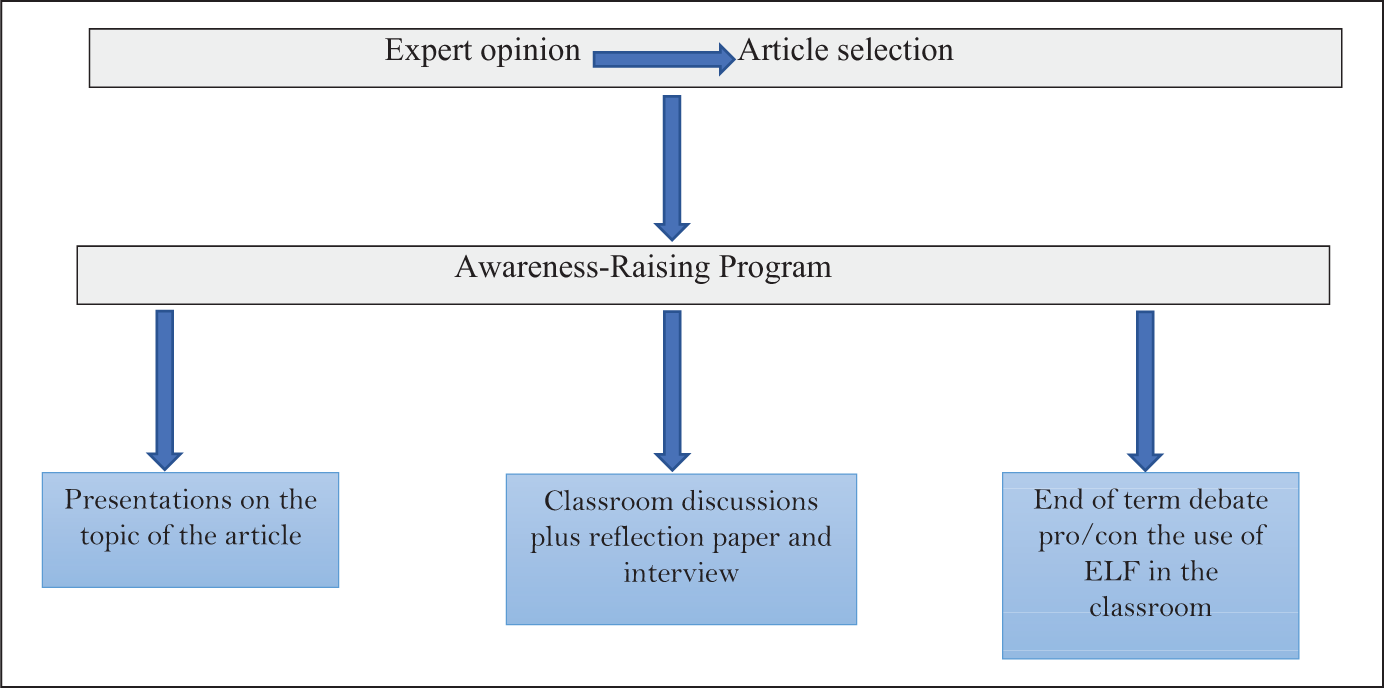
The ELF-awareness-raising program with its components.
Data Collection and Analysis
Focus-group Interviews
In order to stimulate discussion aimed at collecting data, as well as raising awareness of the ELF phenomenon, of instructional practice in connection to ELF, and the process of learning in general, following the presentation of the article the two presenters were invited every week into the researcher’s office to carry out focus-group interviews. This method was chosen so that the two presenters, who had studied together for the presentation and then presented and adopted expert-panellist roles in the Q&A session after the presentation, could stimulate each another’s opinions.
The interviews were carried out in English, because the participants themselves preferred this, as English is the global lingua franca, and they would soon be required to teach it. The interviews lasted between 30 to 45 minutes each. The interviews were semi-structured and revolved mainly around the issues raised in the chosen article or in the subsequent discussion. All the responses were audio-recorded and transcribed.
Open-ended Questionnaire
At the end of the semester, after the procedures described above, the participants were given an open-ended questionnaire with three questions to reflect on and reply to. This instrument was given after the whole awareness procedure was completed because it was assumed that ELF-awareness would have developed by the end of the program and that the student teachers could give informed responses. The questions were:
How would you describe a good ELF-aware teacher?
What could be his/her main characteristics?
Do you have any other opinions regarding the ELF issue?
Although the participants were Turkish and since they are training to be English teachers, they said that they would like to express their opinions in English, not in their mother tongue (Turkish), so translation of the data was not required. Although the classroom activities such as the presentations and discussions were the assignments and therefore marked, the students were informed that the interview and the anonymous questionnaire data would not influence their grades and therefore they were able to express themselves freely. All the data were kept confidential and anonymous during analysis and subsequently destroyed.
Data Analysis
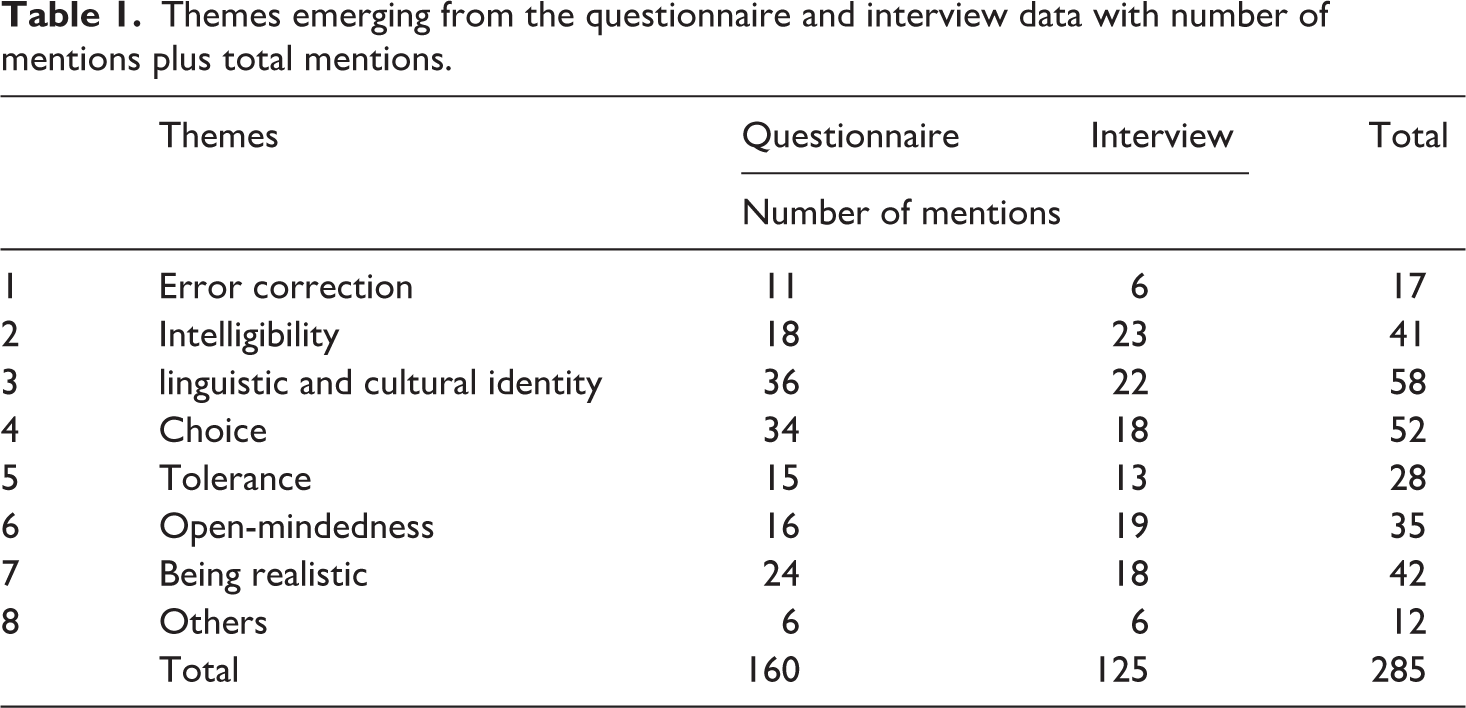
The analysis was carried out by performing a content analysis of the interview and questionnaire data. In the first stage, 160 statements were extracted from the questionnaires, while 125 statements emerged from the interviews, making a total of 285 statements. All the statements (n = 285) were then recursively examined for salient themes. The initial grouping, labelling and counting were done by Author 1, who identified seven themes. Author 2 added an extra theme (number 3, the idea of linguistic identity), making an inter-rater agreement rate of 87.5% for category specification. Author 2 also moved ten items relating to the students’ L1 from category 8 to category 3, making an inter-rater agreement of 96.5% for assignment of statements to categories. A frequency count was conducted for the number of times each theme was mentioned, both in the questionnaire and in the interviews and also in total.
Results
The theme with the most mentions relates to linguistic and cultural identity, which was followed by the need for choice (both with 50+ total mentions). Next most frequently mentioned are the ideas that ELF-aware teachers are realistic and value intelligibility (both with 40+ total mentions each). According to these student teachers, ELF-aware teachers are also open-minded, tolerant, show awareness of the learning process, and do not over-emphasise error correction. The open-ended questionnaire plus interview results along with the total mentions are set out in Table 1.
Themes emerging from the questionnaire and interview data with number of mentions plus total mentions.
Since space does not allow all 285 comments to be reproduced here, a sample will be selected to exemplify the kinds of statements that were made by the participants in relation to each of the themes noted above. It should be remembered that the student teachers in this study were themselves non-native users of English, and, for the sake of authenticity, their statements have been reproduced as they were written (in the case of the questionnaires) or spoken (in the case of the interviews), including any ‘infelicities’.
The theme of error correction was infrequently mentioned (only 17 mentions). The comments were uniformly negative in terms of the importance of such correction, for instance: ‘the ELF-aware teacher does not focus on correction of their Ss’ errors or wrong usages of English but focuses on encouraging them to produce in English’. According to another participant: ‘As an ELF-aware teacher we don’t have to correct students’ all mistakes. We can give them opportunity to speak English in a freer environment. It will be both positive classroom environment for teachers and students too’.
Participants recognised the importance of intelligibility (41 mentions), for instance: ‘An ELF- aware teacher knows how the native language and culture of the student may affect the learners’ L2, what kinds of errors/mistakes may occur. These kinds of teachers mostly focus on one aim: teaching the language for its main purpose, communication. They are not that obsessed with the standard ‘perfect’ language’. Another participant noted: ‘ELF-aware teachers are more understanding towards students because they know that English is used for communication and as long as their English is intelligible, little grammatical mistakes are not very important’.
It is interesting to note that the most frequently mentioned theme (58 mentions) was the need to recognise linguistic and cultural identity. According to one participant: ‘an ELF-aware teacher uses the belief that language and culture cannot be separated from each other. Therefore our own identity and features of our own culture can be adopted, can remain and can be lived within a new language’. Another participant suggested that ELF-aware teachers ‘allow students to use their L1/mother tongue linguistically and culturally. Therefore, students can express themselves in difficult situations in their L1’.
The second most commonly mentioned theme (n = 52) was the need for ELF-aware teachers to provide choice. Comments made by the student teachers in this study included: ‘ELF-aware teachers do not force learners to learn English as native-like by taking into consideration that English is not the property of natives. ELF-aware teachers let learners choose what variety they want’. Another participant commented: ‘By being ELF-aware, we profoundly take into account students’ choice. That is to say, they will decide on their pronunciation and their word use. By means of this attempt, they will not be underestimated and unmotivated by the teacher’.
The idea of tolerance received 28 mentions. Comments included: ‘an ELF-aware teacher is a person who provides an environment that every individual, including teacher, tolerates everyone’s mistakes. As well as, ELF-aware teacher does not let students feel humiliated’. According to another: ‘ELF-aware teacher can be more empathetic towards the language learners throughout the process of learning a new language. S/he can be much more tolerant when s/he encounters language errors/mistakes’.
According to this group of student teachers, ELF-aware teachers are also open-minded (35 mentions), since ‘ELF-aware teachers know that English is spoken by many people around the world all those speakers are from different countries. Therefore ELF-aware teachers are open-minded and they are attentive about people, cultures and traditions’. Furthermore ‘An English teacher who is aware of English as a lingua franca is open-minded towards development and changes in English and the world. They offer intercultural items as they do not focus on inner circle countries’ cultures’.
Third, in terms of frequency of mention (n = 42) was the need to be ‘realistic’, interpreted as meaning that the ELF-aware teacher recognises the way language is used in the real world, and also has realistic expectations of students in terms of achieving ‘native-speaker’ competence. Comments to this effect included: ‘They are the teachers who know the mismatch between the languages as taught in the class and the language as used in “real-life”. So they try to be authentic and they don’t try to manage something utopian and unrealistic’. Another participant adds: ‘Since I am an ELF-aware teacher, my expectations from my students will be more realistic. . .I believe that archiving native-speaker communicative competence sounds unrealistic’.
A number of other comments (n = 12) seemed to relate more generally to the process of learning. These included the use of strategies, for instance: ‘an ELF-aware teacher is aware of the difficulties a foreign language student may come across. The teachers may show many strategies and techniques to learn the target language’. The importance of motivation was also mentioned: ‘an ELF-aware teacher will be good at motivating these kinds of students towards the lesson since these teachers are aware of the characteristic of these kind of students’.
Discussion
The results of the study reported here seems to suggest that it is possible to raise awareness of ELF at the pre-service teacher-education stage by the end of a 15-week course. After the awareness-raising programme, because they were very aware of the need for linguistic and cultural identity, including support for the use of the students’ L1, the student teachers surveyed here strongly supported the idea that respect for students’ cultural and linguistic identity is essential, as argued by Jenkins (2007), Rajagopalan (2008), Dewey and Pineda (2020), and Soruç and Griffiths (2015) among others. In accordance with scholars such as Cogo (e.g. 2012) and Jenkins (e.g. 2012), participants also gave strong support to the need for students to be given freedom of choice (e.g. regarding the extent to which they want to sound like a native speaker or to adopt other varieties of English) in order to maintain motivation.
The need to be realistic, including about the desire to attain native-speaker competence is also noted by Alptekin (2007). ELF-aware teachers also have characteristics such as tolerance and open-mindedness (e.g. Sifakis and Bayyurt, 2015), which can be considered important for an ELF-aware teacher to establish empathy, as well as to avoid ‘humiliation’ and anxiety by too much error correction. Although a number of these features (such as tolerance, open-mindedness) can hardly be claimed to be exclusive to ELF-aware teachers, it is certainly true that ELF-aware teachers must display these characteristics to at least the same degree as other teachers, if not more so.
Intelligibility to establish and maintain communication was generally considered more important than ‘little grammatical mistakes’ as also argued by Jenkins (e.g. 2012). And although there was also recognition that being ELF-aware may be only one of the many sometimes conflicting demands on a real teacher in a real world classroom, overall, the pre-service teachers in this study were very positive about ELF by the end of their course, and very aware of the characteristics that might be expected of an ELF-aware teacher.
In terms of the theoretical framework, this study also contributes to the three major components of ELF-awareness pedagogy suggested by Sifakis (2019). The findings also align well with the suggestion of Siqueira (2020), who proposed that ELF practices should orchestrate with EFL pedagogy. The students in this study displayed an awareness of language and language use (for instance with regard to the native/non-native issue); of instructional practices (both in terms of their own planned behaviour and what they believed/had observed others to be doing); and of the process of learning (for instance relating to the role of strategies and motivation). Therefore, as argued by Sifakis et al. (2020), if learners can communicate freely without constant error correction in authentic ELF interactions and when they are given freedom of choice, they are likely to adopt a more positive approach towards ELF. According to Choi and Liu (2020), guided reflection, peer collaboration, and effective communication should be some of the strategies to deal with the challenges faced in the ELF environment.
Nevertheless, although by far the majority of the comments made were along the ELF-positive lines of those quoted above, there were a few cautious voices. One of the students, for instance, stated that there should be a standard English to facilitate communication or comprehension in or outside the classroom, while another suggested the standard rules of English should also be the aim for the sake of academic goals and because of the inevitable existence of international exams. In fact, although many students may have communicative ability as their main objective, many also want to develop accuracy and to pass their exams, and they may well have extrinsic pressure (e.g. from parents, school authorities) to achieve according to traditional academic standards (e.g., Griffiths and Soruç, 2019; Soruç, 2015; Soruç, 2020). At the current point in time, although there are some debates related to the replacement of standardised English language tests with university entry and internal assessment made by university departments (e.g. Jenkins, 2020), the question of which of these objectives should be prioritised remains an on-going dilemma for the classroom teacher, and we have to assume that even the most idealistic and ELF-aware new teachers in the current study will not be immune from these pressures when they are in their own classrooms in the not-too-distant future.
Recommendations
Since the programme reported here seems to have had such largely positive results in terms of promoting ELF-awareness, we would like to recommend that similar courses be developed in other locations, ideally delivered to all pre-service teachers rather than to just those who choose it as an elective as was the case here. We would also like to recommend that, if it is to be truly useful, ELF-awareness needs to go beyond just the individual teacher and be developed in parents, administrators and those who formulate educational policies. In reality, teachers are not free to consider only their own classes and inclinations: they are accountable to the school administration, which, in turn, has to conform to educational policies, usually directed from government or some other higher authority somewhat distant from the day-to-day running of the institution. They have to satisfy parents, who may well have ambitions for their children’s further education, and which often depend on passing key exams. They have to satisfy their students, sometimes large numbers of them, depending on the location, and keep them motivated. In the face of such pressures, it may be very difficult for teachers to maintain an ELF-aware mindset, and to put such values into practice, in spite of what they may think about the issues involved themselves. Ultimately, therefore, awareness is required on a scale broader than just the individual classroom teacher. Nevertheless, promoting ELF-awareness at the pre-service teacher level is a start, like a raindrop in a pool, and the ripples may well expand to exert influence on a wider scale. Also important, however, is continuing in-service teacher education, such as that by Sifakis and Bayyurt (2015) or Sifakis et al. (2020), as, without it, the positivity generated at the pre-service level may well wither under the pressures of the real classroom experience and pedagogical demands.
Directions for Further Research
This study has a number of limitations which suggest three main directions for future research.
(a) The study used three different procedures for developing ELF-awareness: presenting ideas from the literature, discussion of these ideas, and debating. However, there are other possible procedures which might also be included, such as activities, assignments, research projects, conference attendance/participation, materials development, and so on. It would be interesting to include some of these other approaches and compare their effectiveness, and to consider whether their effectiveness varies according to the context or other factors.
(b) Sorely needed are longitudinal studies to follow a group of pre-service teachers such as those in this study into their classrooms in order to observe how much of the ELF-awareness encouraged at the pre-service stage remains once they have to cope with the realities of their classrooms.
(c) A currently under-developed area which could greatly benefit from more research and capital is that of materials. Some more materials such as Teaching English as a Lingua Franca (Kiczkowiak and Lowe, 2018) would be a great help to teachers struggling to know how to put their ELF-awareness into practice.
Conclusion
As we can see from the extracts from the questionnaires and interviews quoted above, these pre-service teachers expressed considerable ELF-awareness. However, the findings of this study should be considered with its limitations because it was conducted with only one group of pre-service English teachers adopting a qualitative research strategy. Considering the characteristics of the ELF-aware teacher elicited from the participants in this study, hopefully future studies with more participants might be conducted elsewhere in order to promote an ELF-aware mindset that novice teachers can take with them into their new classrooms. If this were done, we might expect to find teachers becoming more open-minded, tolerant and realistic about the way English is used, more aware of students’ linguistic and cultural identities and the value of intelligibility, and more willing to allow students’ choice regarding the kind of English they want and need. Hopefully, over time, such awareness displayed by teachers might influence others (such as parents and administrators) beyond the immediate classroom.
