



Abstract
Veterans experiencing homelessness (hereinafter, homeless veterans), an important group in society, often have limited access to digital technologies, which may affect their ability to achieve social integration. Using data from annual national surveys of homeless-experienced veterans (HEV) from 2022 through 2024 (1992 in 2022, 2596 in 2023, and 2860 in 2024), this study compared their ownership of cell phone devices and computers or laptops and their use of the internet during a 3-year period. While we found no significant change in ownership of cell phones, we found significant increases from 2022 through 2024 in ownership of smartphones (from 69.1% to 72.3%) and computers or laptops (from 36.7% to 38.5%), as well as use of the internet at least occasionally (from 75.8% to 79.0%) and often (from 71.9% to 77.3%). We observed increased internet use among currently and formerly homeless veterans when we analyzed the samples separately. Together, these findings provide updated prevalence rates of digital technology use among HEV and highlight opportunities for technology-based interventions. More HEV are using digital technologies, but we estimate that more than one-fifth of HEV still do not have a cell phone or smartphone or use the internet at all. Although access to digital technologies has increased in this population, some gaps remain, and further research is needed on how to increase the uptake of new technologies.
In the United States and globally, concerns have been raised about a digital divide between those who have access to digital technologies and those who do not. 1 Some groups, such as people experiencing homelessness and people living in rural areas, often experience socioeconomic and geographic barriers to accessing and using digital technologies.2-4 Populations experiencing homelessness (hereinafter, homeless populations) in the United States are an important group because homelessness is a major public health problem and one that has many opportunities for technology-based solutions, such as data tracking and telehealth. Groups who do not have access to new technologies or do not learn to use them may fall behind in society. Past studies of homeless US populations reported on the prevalence of their use of various technologies, such as smartphones and computers.5-7 However, these studies are at least 5 to 10 years old and became outdated as new infrastructure for technology (eg, expanded cell towers, broadband carriers) and new technologies (eg, low-cost smartphones) rapidly developed during this time. Participation in the use of these technologies can intersect with housing instability, poverty, and other psychosocial problems.8,9 Younger populations may also be more engaged with these technologies than older generations. 10 Thus, a contemporary examination of digital technology use among veterans experiencing homelessness (hereinafter, homeless veterans) across time is needed to understand how well prepared this population is for the opportunities and advantages of the increasingly digital world.
We used data from annual national surveys of homeless-experienced veterans (HEV) to examine changes in the use of digital technologies during a 3-year period (2022-2024). These surveys were conducted each year and did not necessarily follow the same individuals over time but were widely distributed and represent broad samples of the population that allow for the analysis of patterns and trends in the use of digital technologies.
Methods
The Community Homelessness Assessment, Local Education and Networking Groups (CHALENG) was launched by the US Department of Veterans Affairs (VA) in 1994 in response to public law 102-405 to enhance the continuum of services for homeless veterans provided by VA health care facilities and community service agencies.11,12 One major task of CHALENG is to conduct an annual national survey of homeless veterans and veterans at risk of homelessness to assess their needs. Across the country, the survey is distributed by VA clinicians and partnering community providers continuously throughout the year. The survey sample can be considered a convenience sample; to avoid sampling or response bias and elicit broad participation from veterans of various demographic characteristics, VA and non-VA partnering providers are encouraged to distribute the survey widely. 13 The CHALENG survey has been conducted annually for >2 decades 14 and has evolved to include various items. Beginning in 2022, the VA Homeless Programs Office included new questions that asked about access to digital technologies. 15 These questions are the focus of the current study.
Questions Related to Digital Technologies
Five digital access–type questions were asked in the CHALENG survey from 2022 through 2024. Four questions were as follows: “Do you have a cell phone?” “Do you have a smartphone?” “Do you own a computer or laptop?” and “Do you use the internet at least occasionally?” The response options to each question were yes, no, or don’t know. We intended to mean that a smartphone has a full operating system and internet capabilities, whereas a cell phone does not. A fifth question assessed the frequency of internet use: “How often do you access the internet?” Response choices were never, less than once a year, at least once a month but less than once a year, at least once a week but not every day, and at least once a day. For frequency of internet use, we categorized responses of at least once a week or more as often.
Other Variables
Background characteristics of HEV were based on self-report and included age, gender, race and ethnicity, geographic region, number of minor dependents, military service branch, enrollment in VA health care, any chronic homelessness, and current living situation. We assessed current living situation with the question “Where are you living now?” We categorized responses of emergency housing, literally homeless, or transitional housing as currently homeless and responses of permanent subsidized housing or unsubsidized housing as formerly homeless. For the purposes of this study, we refer to HEV broadly to include currently and formerly homeless veterans, but we also conducted analyses on both groups separately.
Data Analysis
We used descriptive statistics to characterize the background characteristics of HEV who participated in the CHALENG survey from 2022 through 2024. Because various samples were recruited annually, we examined differences in their background characteristics by using Pearson χ2 tests. We then examined the answers to questions on the use of digital technology across samples and compared them by using bivariate logistic regressions to determine differences among years, treating year as a continuous variable. Finally, we conducted multivariable logistic regressions on the digital technology use questions, including background characteristics as covariates in the analysis. We determined P < .05 to be statistically significant.
Ethical Considerations
Collection and use of data from the CHALENG surveys were approved by the VA and the US Office of Management and Budget in accordance with the Paperwork Reduction Act. This work was conducted for quality improvement purposes and was exempt from the institutional review board per regulations 45 CFR 46 104 (d). All participants provided verbal consent and were told that their participation was voluntary and would not affect their benefits or services.
Results
From 2022 through 2024, most HEV were male, aged 55 to 74 years, White or Black, and non-Hispanic. Most served in the army, were enrolled in VA health care, and were not chronically homeless. Most were also living in an urban area and did not have dependent children with them (eTable 1 in the Supplement). We found good geographic representation in the sample from the 4 regions of the country. Fewer than half of HEV were currently homeless, and the remaining HEV were formerly homeless.
In the total samples, bivariate logistic regressions found no significant change in ownership of cell phones from 2022 through 2024 but did find significant increases in ownership of smartphones and computers or laptops, as well as use of the internet at least occasionally and often (ie, once a week or more) (Table). These results remained the same when we conducted multivariable tests, adjusting for differences in background characteristics of samples from 2022 through 2024. Exploratory correlational analyses indicated small to moderate intercorrelations between the items on digital technology use, with Pearson correlation coefficients ranging from 0.16 to 0.53 (eFigure 1 in the Supplement).
Changes in digital technology use among a sample of homeless-experienced veterans who participated in the CHALENG Survey, United States, 2022-2024 a
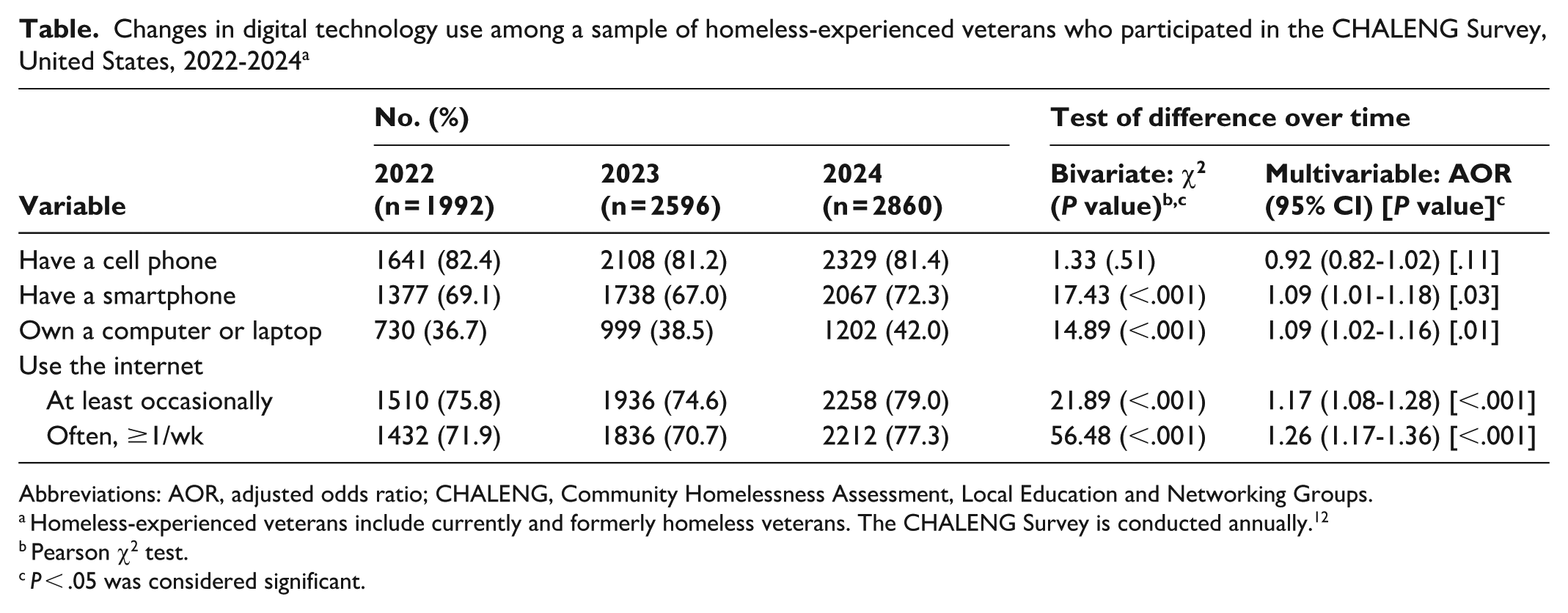
Abbreviations: AOR, adjusted odds ratio; CHALENG, Community Homelessness Assessment, Local Education and Networking Groups.
Homeless-experienced veterans include currently and formerly homeless veterans. The CHALENG Survey is conducted annually. 12
Pearson χ2 test.
P < .05 was considered significant.
Moreover, we observed an increased use of digital technologies when the total samples were divided into currently and formerly homeless veterans (Figure). For currently and formerly homeless veterans, bivariate tests found no significant increase in cell phone ownership but significant increases in the following from 2022 through 2024: smartphone ownership among formerly homeless veterans (from 72.3% to 75.1%; P < .001), ownership of computers or laptops among currently homeless veterans (from 26.9% to 32.1%; P < .001), and use of the internet at least occasionally and often among currently and formerly homeless veterans (using the internet often increased among currently and formerly homeless veterans from 70.6% to 77.3% [P < .001] and from 73.1% to 77.4% [P < .001], respectively). Among currently and formerly homeless veterans, these findings remained the same in multivariable analyses adjusting for background differences, except that formerly homeless veterans showed a small significant decrease in cellphone ownership. Across time, when compared with formerly homeless veterans, currently homeless veterans were significantly less likely to own a cellphone, smartphone, or computer or laptop and to use the internet (eTable 2 in the Supplement).
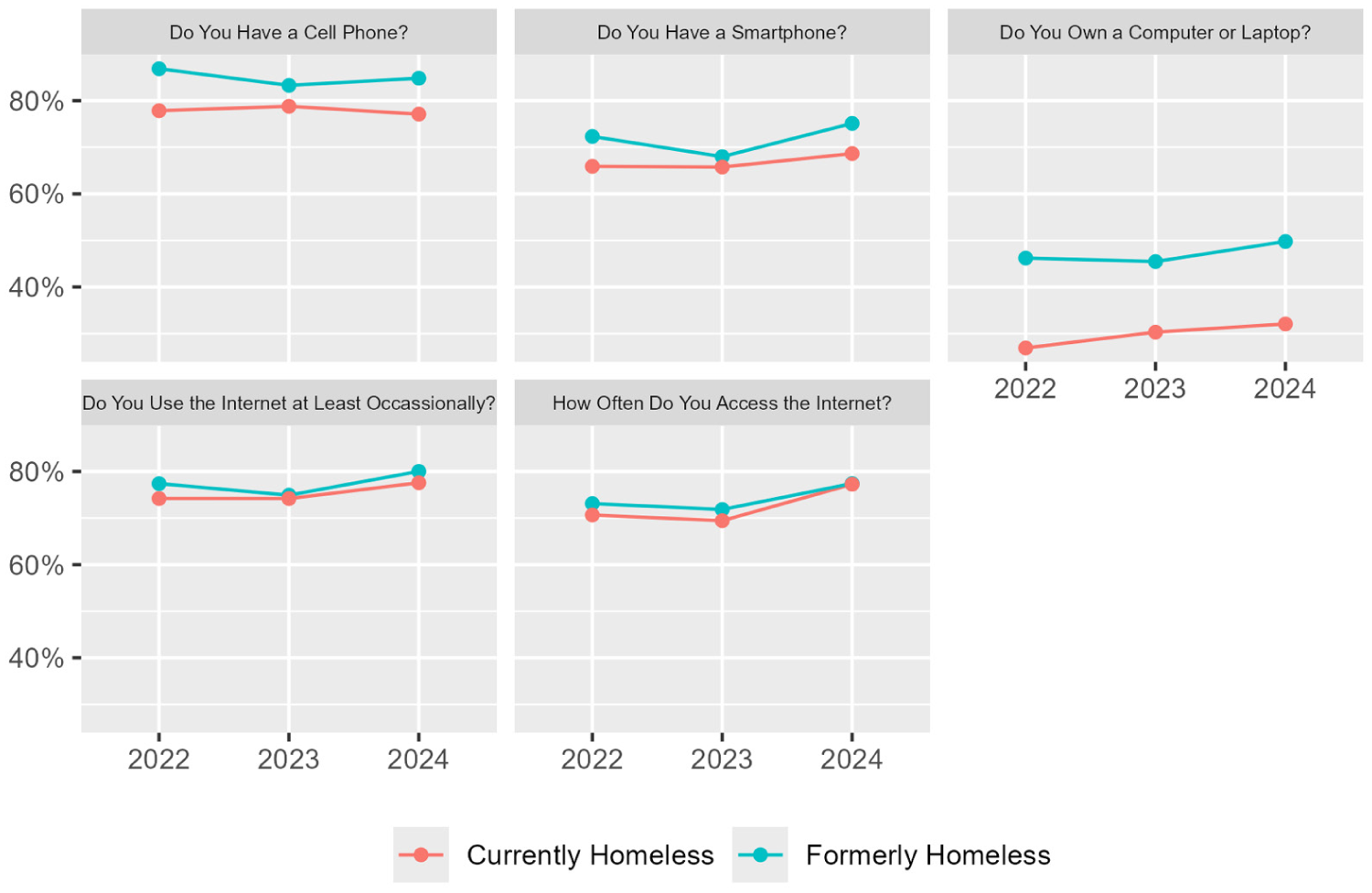
Changes in digital technology use among homeless-experienced veterans who participated in the CHALENG survey, United States, 2022-2024. Homeless-experienced veterans include currently and formerly homeless veterans. Graphs indicate the proportion who indicated yes to owning a cell phone, smartphone, or computer or laptop and using the internet at least occasionally and often (once a week or more). Abbreviation: CHALENG, Community Homelessness Assessment, Local Education and Networking Groups. Data source: US Department of Veterans Affairs. 12
Discussion
With the proliferation of new technologies, expanded access to technologies, and concern about a digital divide between population groups in the United States, this study used recent national data collected from HEV to understand their use of digital technologies. Our findings show that the difference in ownership of cell phones was not significant from 2022 through 2024 but ownership of smartphones and computers or laptops increased, along with greater overall use of the internet. These findings were generally found in the total HEV sample and among the groups of currently and formerly homeless veterans, with a few differences (eg, increase in smartphone ownership only among formerly homeless veterans, ownership of computers or laptops only among currently homeless veterans). These findings provide important updates from older literature5,15 on rates of the use of these important technologies and supplement findings from general homeless samples that include nonveterans. 2
Our findings are encouraging in that there appear to be small increases in the use of digital technologies among HEV in recent years. However, we also found that substantial proportions of HEV do not have smartphones (>25%), do not own computers or laptops (>60%), or do not use the internet at all (>20%). Among those who use these technologies, we do not know whether HEV are fully using them to benefit themselves, which may depend on digital literacy, any physical or cognitive limitations, and/or resources (eg, smartphone data plans). Notably, most of our sample of HEVs were aged ≥55 years, and sizable proportions were living in rural communities. Previous studies have reported that older age and rurality are associated with lower access to and use of digital technologies.15,16 If these patterns continue, continued and possibly even greater gaps may occur in digital access and use among HEV.
As the VA, community social service providers, and the rest of society move toward a digital age of information, communication, and resources, some subgroups that may lag in access to and adoption of technologies need to be assessed and provided with interventions when necessary. For example, VA resources such as MyHealtheVet allow veterans immediate access to their VA medical records and secure messaging options to their VA providers 17 that may be helpful to HEV when they need to coordinate care or share their information with other community providers or social service agencies. Various initiatives, such as text reminders for medical appointments or scheduled medication alerts, could also greatly benefit homeless veterans.18,19 Research is needed on how best to not only increase the use of digital technologies among HEV and other homeless adults but also identify how these technologies can be used to improve their care.
Supplemental Material
sj-docx-1-phr-10.1177_00333549261442135 – Supplemental material for Increasing Use of Digital Technologies Among Homeless-Experienced Veterans, 2022-2024
Supplemental material, sj-docx-1-phr-10.1177_00333549261442135 for Increasing Use of Digital Technologies Among Homeless-Experienced Veterans, 2022-2024 by Jack Tsai and Austin Lampros in Public Health Reports®
Footnotes

Funding
The authors disclosed receipt of the following financial support for the research, authorship, and/or publication of this article: This work was funded by in-kind support from the National Center on Homelessness Among Veterans.
Declaration of Conflicting Interests
The authors declared no potential conflicts of interest with respect to the research, authorship, and/or publication of this article.
Data Availability Statement
Data are available upon reasonable request to the corresponding author with proper institutional approvals.
Supplemental Material
Supplemental material for this article is available online. The authors have provided these supplemental materials to give readers additional information about their work. These materials have not been edited or formatted by Public Health Reports’s scientific editors and, thus, may not conform to the guidelines of the AMA Manual of Style, 11th Edition.
References
Supplementary Material
Please find the following supplemental material available below.
For Open Access articles published under a Creative Commons License, all supplemental material carries the same license as the article it is associated with.
For non-Open Access articles published, all supplemental material carries a non-exclusive license, and permission requests for re-use of supplemental material or any part of supplemental material shall be sent directly to the copyright owner as specified in the copyright notice associated with the article.
