




Abstract
Objectives:
Menthol flavoring is a critical public health issue, but prior research has largely represented the voices of White adults who smoke menthol cigarettes, who represent a small subset of adults who smoke menthol cigarettes in the United States. This study compared perceptions of a hypothetical menthol cigarette or flavored cigar (MC/FC) ban among Black and White adults who smoke menthol cigarettes.
Methods:
Participants were a convenience sample of 2113 Black and 1087 White adults who smoke menthol cigarettes, collected through Amazon Mechanical Turk from July 2023 through January 2024. Participants reported opinions about an MC/FC ban, the likely public health outcomes, and a hypothetical impact of the ban on their smoking behavior. We used stepwise logistic regression to model factors associated with ban opposition or ambivalence.
Results:
More than one-third of adults who smoke menthol cigarettes supported an MC/FC ban (37.2% Black vs 34.5% White; P = .13), but Black (vs White) adults who smoke menthol cigarettes were more likely to endorse the public health benefits of a ban, as assessed via agreement with 5 statements of US Food and Drug Administration rationale (mean [SD] number of statements endorsed, 3.0 [1.7] vs 2.4 [1.8]; P < .001). Smoking more cigarettes per day, believing that menthol cigarettes are more addictive or harder to quit than nonmenthol cigarettes, and intending to continue using nicotine under a ban increased the odds of opposition or ambivalence to the ban.
Conclusions:
Targeted outreach to those who consume predominantly menthol products and those who do not intend to quit nicotine could increase support of an MC/FC ban among adults who smoke menthol cigarettes.
Keywords
Menthol as a characterizing flavor in cigarettes is a critical public health issue due, in large part, to targeted tobacco industry marketing that has led to a high number of Black adults using menthol cigarettes, which are more addictive and harder to quit than nonmenthol cigarettes.1-4 As of 2020 in the United States, 81% of Black adults who smoke and 34% to 51% of adults in other racial and ethnic minority groups who smoke used menthol cigarettes. 5 Furthermore, among US adults who smoke cigarettes, the overall number who smoke menthol cigarettes has been increasing since 2008, reaching 43% in 2020.5,6
The US Food and Drug Administration (FDA) gained authority to regulate tobacco products in 2009 under the Family Smoking Prevention and Tobacco Control Act. 7 This law eliminated all flavored cigarettes, except menthol, and formed the Tobacco Products Scientific Advisory Committee, which was charged with investigating the threat of menthol cigarettes to public health. Following extensive review of the public health impact of menthol cigarettes, the committee concluded that “removal of menthol cigarettes from the marketplace would benefit public health in the United States.” 8 Simulation modeling estimated that a menthol cigarette ban implemented in 2021 would save more than one-quarter million Black lives by 2060. 9 To date, no federal menthol cigarette or flavored cigar (MC/FC) bans have been enacted, despite continued evidence that these actions have the potential to improve public health by reducing cigarettes per day and promoting smoking cessation among adults who smoke menthol cigarettes.10-12
Recent prominent news stories cite fear of backlash from the Black community as a reason for failure to enact an MC/FC ban, 13 despite overwhelming public support for an MC/FC ban among Black leaders and other health care groups.12,14-16 However, the opinions of Black adults who smoke menthol cigarettes are substantially underrepresented in current research. While existing studies provide valuable information about perceptions of an MC/FC ban among adults who smoke menthol cigarettes17-25 and its impact on their tobacco use behaviors,11,18,19,24,25 findings overwhelmingly represent those of White adults who smoke menthol cigarettes. Some insights derived from these studies include that adults who smoke menthol cigarettes in racial and ethnic minority populations support the institution of an MC/FC ban more than non-Hispanic White adults who smoke menthol cigarettes 16 and that increased culturally tailored communication is needed to correct disinformation about MC/FC tobacco companies’ engagement and activities in Black communities. 17 Given that Black adults represent the majority of adults who smoke menthol cigarettes in the United States, the paucity of data from Black voices engenders a critical gap in research used to inform health policy. 5
To address this gap, the objectives of the current study were to (1) compare perceptions of an MC/FC ban among Black and White adults who smoke menthol cigarettes and (2) examine demographic characteristics, tobacco use, and other factors associated with opposition or ambivalence to a ban. We assessed an MC/FC ban together because they disproportionately affect Black adults, who are more likely than their White counterparts to consume these products. Given the exploratory nature of this study, we made no a priori hypotheses about racial differences in perceptions or factors associated with ban opposition or ambivalence.
While an MC/FC ban was withdrawn from the Office of Management and Budget register in January 2025, it was active during the time that the study was conducted and remains highly relevant as momentum for implementing MC/FC bans at the state and local levels continues to increase. 26
Methods
Participants were registered workers on Amazon’s Mechanical Turk (MTurk), an online crowdsourcing platform that has been used widely in tobacco control research, who self-opted into the Smoking & Health Behaviors Survey from July 2023 through January 2024. Interested respondents completed informed consent and a screening questionnaire. Eligible participants were African American/Black or White adults aged ≥21 years who had used menthol cigarettes for ≥1 year, indicated a preferred menthol brand, and were using a computer with a US internet protocol address. Participants were excluded if they primarily used noncigarette tobacco products or lived in a place where the sale of menthol cigarettes was prohibited (eg, California, Massachusetts). Using standard methods, we excluded those who incorrectly answered ≥2 of 3 validity questions placed throughout the survey or indicated “do not use my data.” 27 Validity questions asked participants to select a response from a list of options on a Likert-type scale (eg, very likely, somewhat likely, somewhat unlikely) and endorse their attention to the inquiries to avoid fraudulent survey completion. In addition to 159 exclusions because of incomplete surveys, 99 participants were excluded for incorrect responses to validity questions.
The study was administered anonymously through REDCap and approved by the University of Kansas Medical Center Institutional Review Board (STUDY00160222), and its conduct was consistent with applicable federal law and Centers for Disease Control and Prevention policy. Participants were compensated $5 for completing the survey. Surveys took about 10 minutes to complete. Respondents gave written consent for review and signatures before starting interviews.
A total of 6924 potential participants were screened to enroll the targeted sample size of 3200 (n = 2133, Black; n = 1087, White; Figure 1 in Supplemental Material).
Measures
We adapted survey questions and response options from the European Union’s 2020-2021 International Tobacco Control Survey. 28
Demographic and tobacco use characteristics
Participants reported the following: their age, gender identity, race, sexual orientation, marital status, employment status, education level, annual household income, home ownership, length of time as a smoker overall and as a menthol smoker, age that they started smoking regularly, number of cigarettes per day, nicotine dependence, and use of other tobacco products and marijuana.
Beliefs about menthol cigarettes vs nonmenthol cigarettes
Participants were asked to express their beliefs about menthol cigarettes as compared with nonmenthol cigarettes by indicating whether they were less or equally as addictive, harmful, and difficult to quit versus more so. We subsequently calculated a score to average the number of responses among 3 that indicated a belief that menthol cigarettes are more (vs less) addictive, harmful, and difficult to quit. We gauged opinions of a potential MC/FC ban by having participants indicate opposition, ambivalence, or favor toward the ban, both individually and as what they believed others in their community would feel. Participants then indicated whether multiple outcomes following an MC/FC ban would be likely or unlikely, including encouraging adults who smoke MC/FC to smoke less, quit, or something else. We then assessed overall support for FDA rationale of an MC/FC ban by scoring the number of statements among 5 that were endorsed as very or somewhat likely regarding potential outcomes of a ban on MC/FC.
Opinions and perceived public health outcomes
A brief statement outlined the FDA’s proposed ban and explained that MC/FC would not be available for purchase if the bans were enacted. 29 A single item assessed participants’ knowledge of the MC/FC ban before completing the survey. Follow-up items gauged participants’ personal feelings about a federal ban and their beliefs about their community’s feelings about a ban. Those in favor and opposed indicated the primary reason for their support or opposition (Table 1 in Supplemental Material). Five statements outlined the FDA’s suggested public health benefits of an MC/FC ban (eg, a ban “would prevent youth from ever starting smoking,” “would encourage menthol smokers to smoke less”). Participants indicated their belief about the likelihood of each outcome as a result of a ban. 29
Concerns about victimization
Participants rated their concern that an MC/FC ban would lead to increased policing and victimization in their community and in communities at elevated risk of poor health outcomes and disparities, including Black people, LGBTQ+ people (lesbian, gay, bisexual, transgender, and queer plus), people with mental health conditions, and those with low income or education levels.
Impact on smoking behavior
Participants were asked what single action they would take if menthol cigarettes and flavored cigars were no longer available. Options included “continue using menthol cigarettes obtained from other sources or by adding menthol flavoring to nonmenthol cigarettes,” “look for nonmenthol synthetic cooling agent products,” “switch to nonmenthol cigarettes,” “quit smoking cigarettes and switch to noncombustible products (eg, electronic cigarettes),” “quit smoking cigarettes and switch to other combustible tobacco products,” and “quit using all tobacco and nicotine products.” 27
Statistical Analysis
We summarized continuous variables with means and SDs and categorical variables with frequencies and percentages. We used independent samples t tests with Bonferroni correction for continuous variables and the Pearson χ2 test for categorical variables to compare differences by race and ban favor versus opposition or ambivalence. Only the contrasts that remained significant at P < .05 after the Bonferroni correction were considered significant. To identify factors associated with ban opposition or ambivalence, variables that were significant between individuals who favored the ban and those who opposed or were ambivalent to the ban at P < .10 were entered into a stepwise logistic regression model. Only the variables significant at P < .05 were retained in the final model predicting ban opposition or ambivalence. We used a data-driven approach to ensure the best fit of models to the data. We used sensitivity analyses with backward elimination logistic regression modeling to confirm the final model. Stepwise and backward elimination procedures led to a final model composed of the same 8 factors. We summarized results from the stepwise logistic regression model. Modeling opposition or ambivalence to an MC/FC ban allowed us to identify all participants not “in favor,” who are an important target for public health messaging to increase public support of a federal ban. We completed all analyses using SAS version 9.4 (SAS Institute Inc).
Results
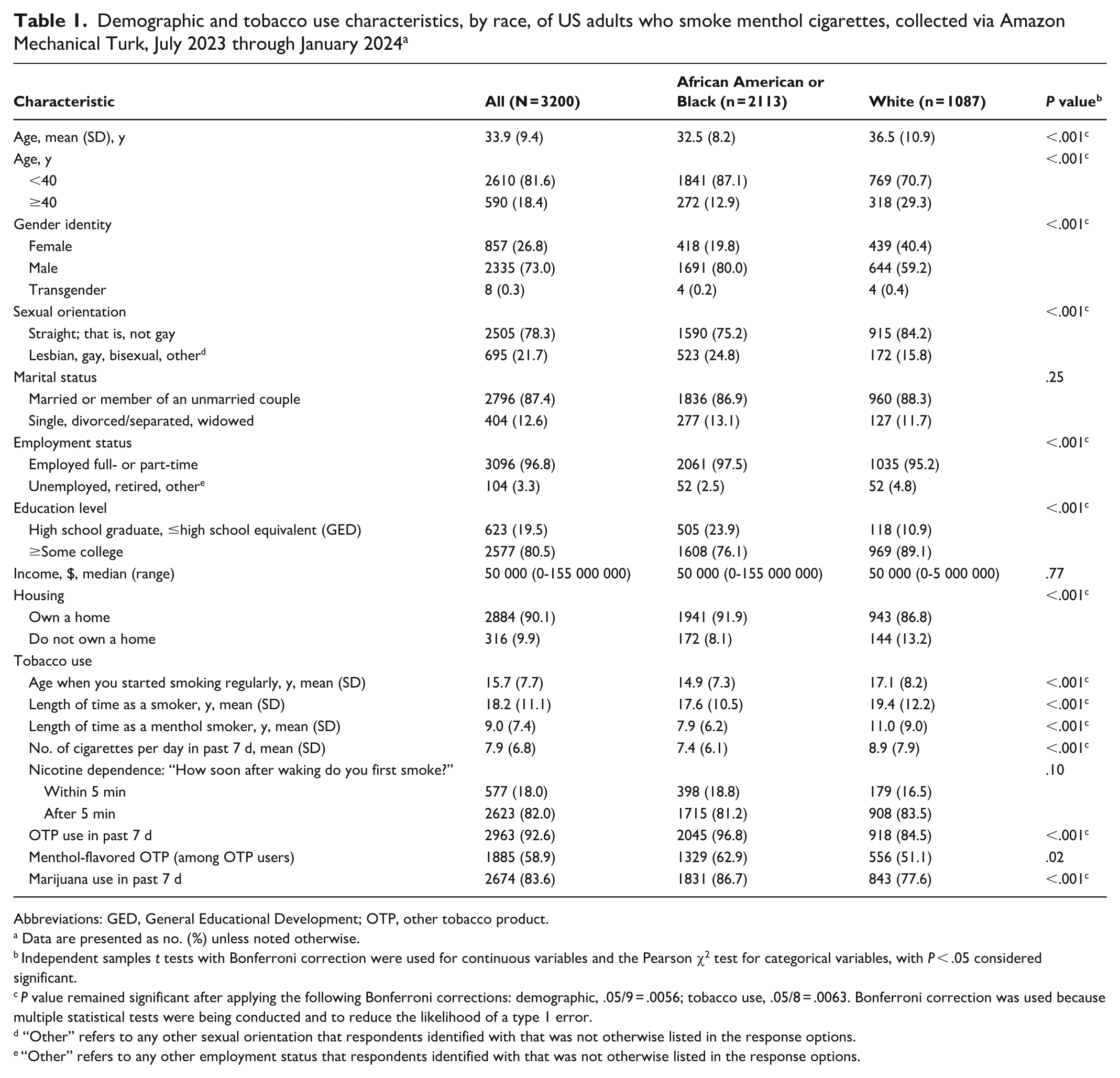
Participants were predominantly young adults (aged <40 y), male, married, and employed full- or part-time and reported some college education or higher (Table 1). They indicated an average age of 15.7 years when they started smoking regularly and an average time of 9 years as a menthol smoker, with most reporting menthol-flavored other tobacco product use and marijuana use in the past 7 days.
Demographic and tobacco use characteristics, by race, of US adults who smoke menthol cigarettes, collected via Amazon Mechanical Turk, July 2023 through January 2024 a
Abbreviations: GED, General Educational Development; OTP, other tobacco product.
Data are presented as no. (%) unless noted otherwise.
Independent samples t tests with Bonferroni correction were used for continuous variables and the Pearson χ2 test for categorical variables, with P < .05 considered significant.
P value remained significant after applying the following Bonferroni corrections: demographic, .05/9 = .0056; tobacco use, .05/8 = .0063. Bonferroni correction was used because multiple statistical tests were being conducted and to reduce the likelihood of a type 1 error.
“Other” refers to any other sexual orientation that respondents identified with that was not otherwise listed in the response options.
“Other” refers to any other employment status that respondents identified with that was not otherwise listed in the response options.
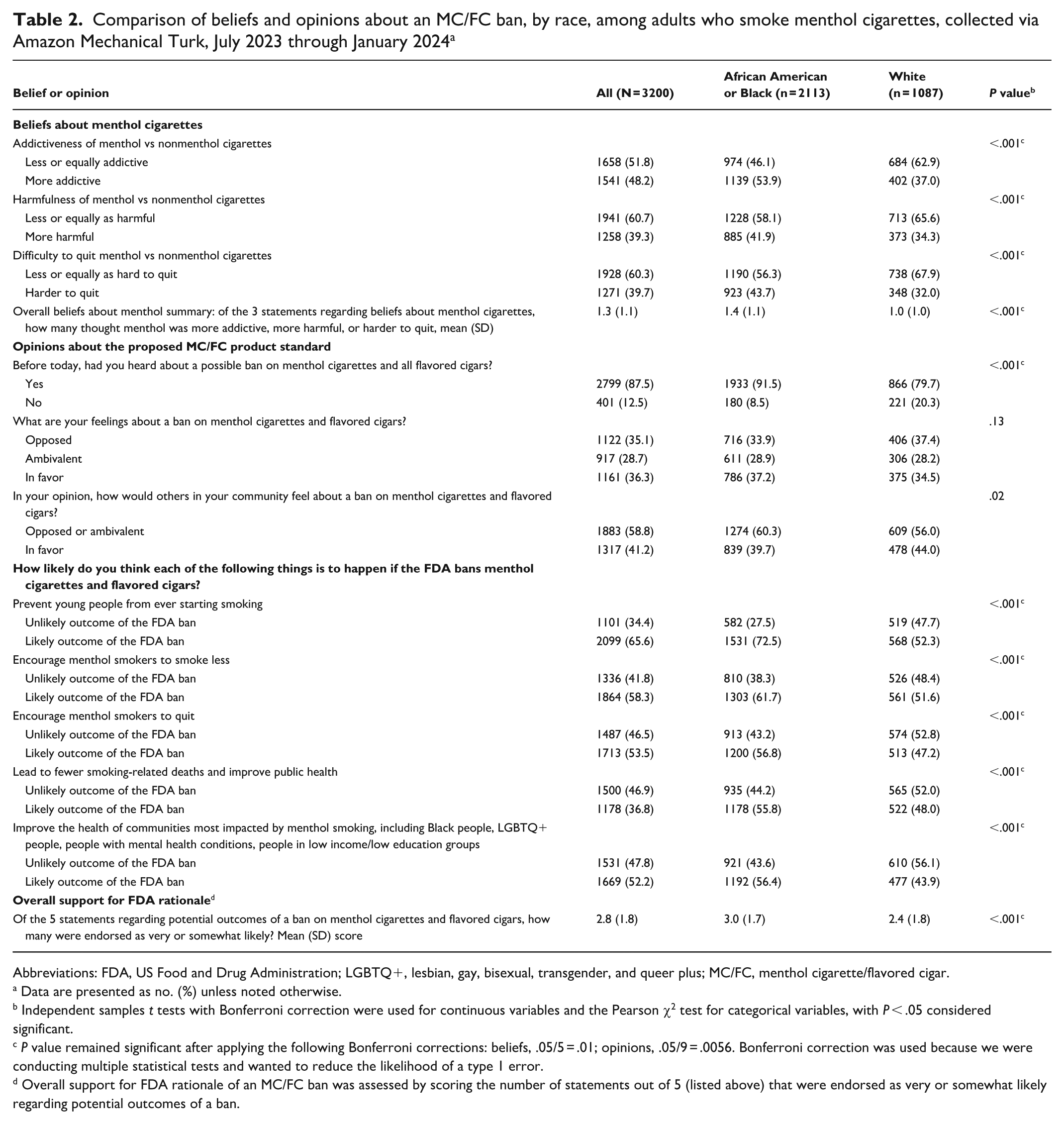
Black participants were significantly more likely than White participants to have heard about a federal MC/FC ban (91.5% vs 79.7%; P < .001); however, we found no significant difference in favor versus opposition or ambivalence to an MC/FC ban (37.2% of Black and 34.5% of White adults who smoke menthol cigarettes indicated favor for a ban; P = .13) (Table 2). Beliefs that menthol cigarettes are more addictive, harmful, and harder to quit than nonmenthol cigarettes were low overall (mean [SD] = 1.3 [1.1] of 3.0 statements endorsed), but Black participants were significantly more likely than White participants to endorse these beliefs (1.4 [1.1] vs 1.0 [1.0] statements; P < .001). A significantly higher proportion of Black (vs White) adults also supported FDA’s rationale of the public health benefits of an MC/FC ban (3.0 [1.7] vs 2.4 [1.8] of 5 statements endorsed; P < .001). Both groups were concerned that an MC/FC ban would lead to increased policing and victimization in their community (95.3% overall) and other communities (90.9% overall), although Black participants were significantly more likely than White participants to endorse these statements as concerns in their community (96.4% vs 93.1%; P < .001).
Comparison of beliefs and opinions about an MC/FC ban, by race, among adults who smoke menthol cigarettes, collected via Amazon Mechanical Turk, July 2023 through January 2024 a
Abbreviations: FDA, US Food and Drug Administration; LGBTQ+, lesbian, gay, bisexual, transgender, and queer plus; MC/FC, menthol cigarette/flavored cigar.
Data are presented as no. (%) unless noted otherwise.
Independent samples t tests with Bonferroni correction were used for continuous variables and the Pearson χ2 test for categorical variables, with P < .05 considered significant.
P value remained significant after applying the following Bonferroni corrections: beliefs, .05/5 = .01; opinions, .05/9 = .0056. Bonferroni correction was used because we were conducting multiple statistical tests and wanted to reduce the likelihood of a type 1 error.
Overall support for FDA rationale of an MC/FC ban was assessed by scoring the number of statements out of 5 (listed above) that were endorsed as very or somewhat likely regarding potential outcomes of a ban.
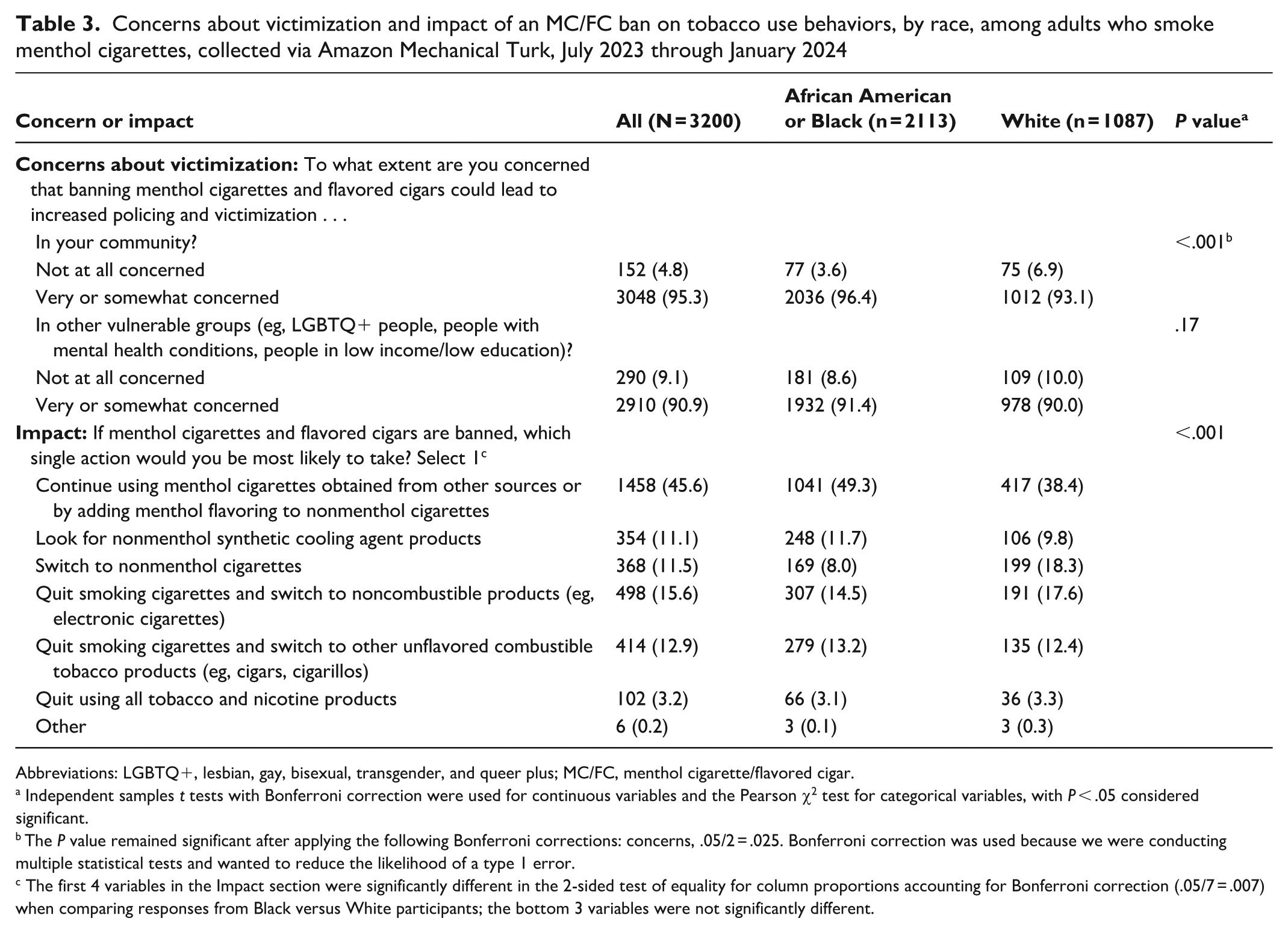
Both groups selected “continue using menthol cigarettes” as the most likely single action they would take if MC/FC were banned (45.7% overall); however, post hoc analyses identified significant differences by race. Black adults who smoke were more likely than White adults to look for ways to continue purchasing menthol cigarettes or add menthol flavoring to nonmenthol cigarettes (49.3% vs 38.5%) and to look for nonmenthol synthetic cooling agent products (11.8% vs 9.8%), while White adults were more likely than Black adults to switch to nonmenthol cigarettes (18.4% vs 8.0%) or noncombustible products (17.6% vs 14.6%; P < .01 for all). Few participants in either group endorsed quitting all tobacco and nicotine products as their most likely single action (3.2% overall).
Ban Opposition or Ambivalence
Ban opposition or ambivalence did not differ significantly by race (Table 2). The primary reasons for being in favor of (n = 1161) or opposed to (n = 1122) a ban included “a ban will encourage me to quit smoking completely,” “a ban will reduce the number of smoking-related deaths and improve public health,” “it is not the government’s place to tell me what I can and cannot consume,” and “a ban would leave me no or few options for what to smoke” (Table 1 in Supplementary Material). Those indicating ambivalence to a ban (n = 917) were not queried about why they were ambivalent. Black and White adults who smoke expressed concern that banning MC/FC could lead to increased policing and victimization in their community, but they also indicated that if an MC/FC ban were enacted, the single action that they would most likely take was to “continue using menthol cigarettes obtained from other sources or by adding menthol flavoring to nonmenthol cigarettes” (Table 3).
Concerns about victimization and impact of an MC/FC ban on tobacco use behaviors, by race, among adults who smoke menthol cigarettes, collected via Amazon Mechanical Turk, July 2023 through January 2024
Abbreviations: LGBTQ+, lesbian, gay, bisexual, transgender, and queer plus; MC/FC, menthol cigarette/flavored cigar.
Independent samples t tests with Bonferroni correction were used for continuous variables and the Pearson χ2 test for categorical variables, with P < .05 considered significant.
The P value remained significant after applying the following Bonferroni corrections: concerns, .05/2 = .025. Bonferroni correction was used because we were conducting multiple statistical tests and wanted to reduce the likelihood of a type 1 error.
The first 4 variables in the Impact section were significantly different in the 2-sided test of equality for column proportions accounting for Bonferroni correction (.05/7 = .007) when comparing responses from Black versus White participants; the bottom 3 variables were not significantly different.
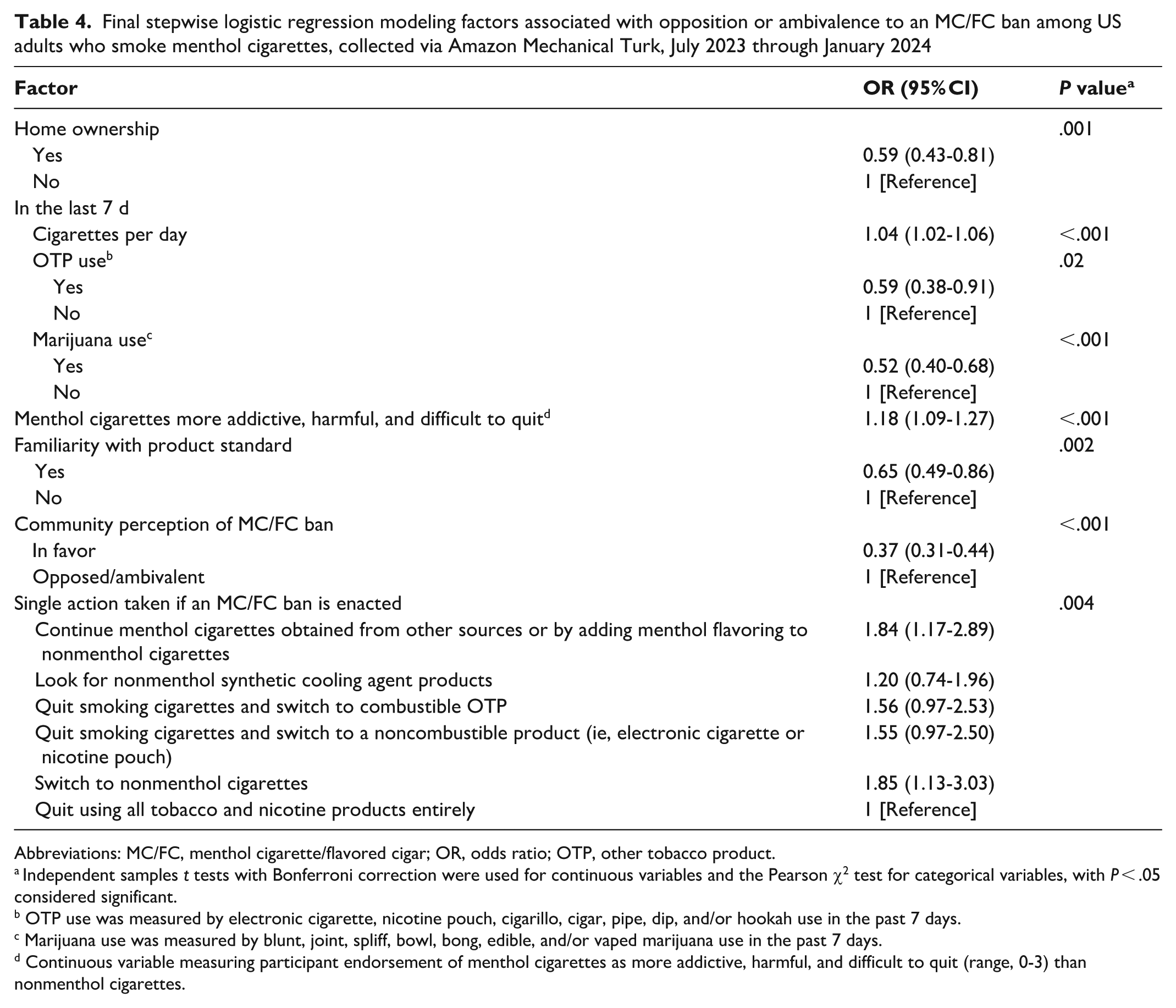
We found univariate differences among those who were in favor of versus opposed to or ambivalent about an MC/FC ban across all variables (Table 2 in Supplementary Material). Twenty-three variables were significant at P < .10, and 8 factors remained in the final regression modeling opposition or ambivalence to a ban (Table 4). Owning a home (odds ratio [OR] = 0.59; 95% CI, 0.43-0.82), using other tobacco products (OR = 0.59; 95% CI, 0.38-0.91), using marijuana (OR = 0.52; 95% CI, 0.40-0.68), being familiar with a ban (OR = 0.65; 95% CI, 0.49-0.86), and believing that their community would favor a ban (OR = 0.37; 95% CI, 0.34-0.44) decreased the odds of opposition or ambivalence to a ban. In contrast, smoking more cigarettes per day (OR = 1.04; 95% CI, 1.02-1.06) and believing that menthol cigarettes were more addictive, harmful, and harder to quit than nonmenthol cigarettes (OR = 1.20; 95% CI, 1.01-1.30) increased the odds of ban opposition or ambivalence and intent to continue using menthol cigarettes. Specifically, for each additional cigarette smoked per day, individuals had 4% higher odds of indicating opposition or ambivalence to the menthol ban. Furthermore, those who selected a single action other than quitting all nicotine and tobacco products (ie, selected “continue smoking menthol cigarettes obtained from other sources”) had increased odds of being opposed to a ban.
Final stepwise logistic regression modeling factors associated with opposition or ambivalence to an MC/FC ban among US adults who smoke menthol cigarettes, collected via Amazon Mechanical Turk, July 2023 through January 2024
Abbreviations: MC/FC, menthol cigarette/flavored cigar; OR, odds ratio; OTP, other tobacco product.
Independent samples t tests with Bonferroni correction were used for continuous variables and the Pearson χ2 test for categorical variables, with P < .05 considered significant.
OTP use was measured by electronic cigarette, nicotine pouch, cigarillo, cigar, pipe, dip, and/or hookah use in the past 7 days.
Marijuana use was measured by blunt, joint, spliff, bowl, bong, edible, and/or vaped marijuana use in the past 7 days.
Continuous variable measuring participant endorsement of menthol cigarettes as more addictive, harmful, and difficult to quit (range, 0-3) than nonmenthol cigarettes.
Discussion
We compared perceptions of an MC/FC ban among Black and White adults who smoke menthol cigarettes and examined factors associated with opposition or ambivalence to a ban. One primary finding was that support for an MC/FC ban did not differ significantly by race, with the proportion in favor of a ban close to 40%. This proportion is higher than the 28.5% support found among adults who smoke menthol cigarettes (race and ethnicity not specified) in a national survey 16 conducted in 2021 and indicates that public support for government action on this issue has grown in recent years. Support among Black participants in this study contradicts recent headlines that cite fear of backlash from the Black community as a reason for failure to enact an MC/FC ban 13 and supports actions by leaders of the Black community, the National Association for the Advancement of Colored People, and health organizations to promote the advancement of an MC/FC ban.10,14,15
Notably, Black participants demonstrated significantly greater support for the public health benefits of a ban than White participants. Specifically, Black participants were more likely to cite the following public health benefits as likely outcomes of an MC/FC ban: preventing young people from ever starting smoking, encouraging adults who smoke menthol cigarettes to smoke less, encouraging adults who smoke menthol cigarettes to quit, fewer smoking-related deaths, and improving the health of communities most affected by menthol smoking. Our findings differ from a previous study that found that misperceptions about the health harms of menthol cigarettes were disproportionately held by Black adults. 30 Findings from the current study indicate that Black (vs White) participants were more likely to endorse menthol cigarettes as addictive, harmful, and difficult to quit, suggesting that public health messaging targeting communities where menthol cigarette use is most widespread is being heard.2,3,9,17
Findings indicate several important areas for future action. Specifically, most participants (63.7% total) remained opposed or ambivalent to an MC/FC ban, indicating an opportunity to increase support for a ban among adults who smoke menthol cigarettes. In this study, adults who smoke menthol cigarettes had increased odds of opposition/ambivalence to an MC/FC ban if they (1) smoked more cigarettes per day; (2) believed that menthol cigarettes were more addictive, harmful, and difficult to quit than nonmenthol cigarettes; and (3) did not intend to quit all nicotine and tobacco products. We speculate that if these participants were highly addicted to MC/FC and did not perceive having other suitable options to switch, they would find MC/FC more difficult to quit and would struggle to find an alternative under an MC/FC ban scenario. These findings suggest that messages targeting more addicted or dependent adults who smoke menthol cigarettes could increase overall support for an MC/FC ban. Furthermore, support for a menthol ban is likely to increase when respondents have accurate perceptions of the health consequences and addictive properties of MC/FC. 23 Conversely, participants who believed that their community would be in favor of an MC/FC ban and who were familiar with the ban reported less opposition. Black participants (91.5%) were more likely than White participants (79.7%) to have heard about the ban, indicating that ongoing messaging to populations disproportionately affected by menthol has the potential to decrease overall opposition. Findings from Sterling et al and White et al indicate widespread misperceptions about tobacco industry engagement in downplaying the harms of MC/FC, thereby supporting communication policies that aim to correct this disinformation and, thus, decrease opposition to an MC/FC ban.17,31 Overwhelming concern in our study about the increased policing and victimization (95.3% overall) of adults who smoke MC/FC presents an opportunity to better clarify the intended outcomes from implementation of these policies. 32
One of the intended outcomes of an MC/FC ban is to encourage adults who smoke menthol cigarettes to quit,8,10,11,21,32,33 yet only 3.2% of participants in our sample selected “quit using all tobacco and nicotine products” as their likely course of action. This 3.2% is much lower than the 25% to 64% of US adults who indicated in previous studies9,33 that they would attempt to quit smoking under a proposed ban, but the percentage is consistent with actual rates of 3.6% in a 2024 study among US adults aged 18 to 34 years who smoked menthol cigarettes under a real-world ban. 19 The low proportion of participants indicating intent to quit in the face of an MC/FC ban is concerning, although the actual response to an implemented ban could be higher. 34 White respondents in the current study had an increased likelihood of indicating an intention to switch to noncombustible tobacco products, consistent with literature that consumers of electronic nicotine delivery system products are predominantly White. 35 Interest in nonmenthol synthetic cooling agent products (ie, WS-3, WS-23) as a substitute for menthol cigarettes was low (11.1%), but interest was higher among Black adults (11.8%) than among White adults (9.8%). This trend is worth monitoring as the tobacco industry seeks regulatory loopholes to an MC/FC ban.36,37
Limitations
This study had several limitations. First, the use of MTurk as a crowdsourcing tool for participant recruitment was a limitation. By virtue of using internet-based recruitment, older adults who use menthol cigarettes were underrepresented in the study population because of the skewed demographic of MTurk participants toward younger ages. 38 Second, while the use of convenience sampling does not reflect the demographic characteristics of the US population, it is consistent with other studies in this area.17-19,21,31,36 Third, reliance on self-report was subject to reporting bias. Concerns about data quality control were mitigated by using validity questions interspersed throughout the survey. Our findings cannot be generalized to individuals from other racial and ethnic groups. Finally, participants were asked their opinions about the MC/FC bans together rather than as separate policies, which may have limited the potential that participants would have responded differently if questions were asked about menthol cigarettes versus flavored cigars.
Conclusions
To our knowledge, this study comprises the largest convenience sample of perceptions and perceived effect of an MC/FC ban among Black adults who smoke menthol cigarettes in the United States and provides valuable evidence to inform policy action in these areas. Targeted messaging may increase support for an MC/FC ban when directed to adults who smoke menthol cigarettes who (1) smoke more cigarettes per day; (2) believe that menthol cigarettes are more addictive, harmful, and harder to quit than nonmenthol cigarettes; and/or (3) do not intend to quit all nicotine and tobacco products in response to an MC/FC ban. Overwhelming concern about increased policing and victimization of adults who smoke MC/FC represents a clear opportunity to correct misperceptions about ban implementation and garner support. While an MC/FC ban was withdrawn from the Office of Management and Budget register on January 21, 2025, momentum for implementing MC/FC bans continues to increase at the state and local levels. 26 In 2023 and 2024, 10 US states and >400 municipalities introduced bills to ban the sale of menthol cigarettes. This is in addition to the 2 states and >170 US cities with bans in place, suggesting relevance of the study findings irrespective of a federal ban on menthol cigarettes. 26
Supplemental Material
sj-docx-1-phr-10.1177_00333549251385947 – Supplemental material for Perceptions of a Menthol Cigarette and Flavored Cigar Ban Among Black and White Adults Who Smoke Menthol Cigarettes, United States, 2024
Supplemental material, sj-docx-1-phr-10.1177_00333549251385947 for Perceptions of a Menthol Cigarette and Flavored Cigar Ban Among Black and White Adults Who Smoke Menthol Cigarettes, United States, 2024 by Michael J. Arnold, Eleanor L.S. Leavens, Lisa Sanderson Cox, Alexandra Brown, Matthew S. Mayo, Nathaniel L. Baldwin, Thu A. Nguyen and Nicole L. Nollen in Public Health Reports®
Footnotes
Acknowledgements
The authors are grateful for the time and effort of Tricia Snow, MPH, University of Kansas School of Medicine, Department of Population Health, and her assistance with data collection and MTurk navigation.
Declaration of Conflicting Interests
The authors declared the following potential conflicts of interest with respect to the research, authorship, and/or publication of this article: N.L.N. is a member of the scientific advisory board for Qnovia, a startup company that is developing a smoking cessation medication for FDA approval. The authors reported no support from or affiliation with the tobacco industry. No study sponsor had any role in the study design; collection, analysis, and interpretation of data; writing the article; or the decision to submit the article for publication.
Funding
The authors disclosed receipt of the following financial support for the research, authorship, and/or publication of this article: E.L.S.L. received support from the National Institute on Drug Abuse/FDA under award K01DA054995, and M.J.A. received support from the Jewell Summer Research Training Program at the University of Kansas Cancer Center.

Data Availability
The authors will make the data and associated documentation available to users only under a data-sharing agreement that provides for (1) a commitment to using the data only for research purposes and not to identify any individual participant; (2) a commitment to securing the data using appropriate computer technology; and (3) a commitment to destroying or returning the data after analyses are completed. All requests for data will go through a data request committee, which will include Drs Nollen and Mayo, who will review any requests and will oversee data-sharing procedures. If the request is deemed reasonable by the committee, we will proceed with a data-sharing agreement and secure data-sharing plan, using a secure file transfer system that meets industry and government regulations (eg, Health Insurance Portability and Accountability Act, Gramm-Leach-Billey Act, Sarbanes-Oxley Act) to ensure data security and compliance.
Supplemental Material
Supplemental material for this article is available online. The authors have provided these supplemental materials to give readers additional information about their work. These materials have not been edited or formatted by Public Health Reports’s scientific editors and, thus, may not conform to the guidelines of the AMA Manual of Style, 11th Edition.
References
Supplementary Material
Please find the following supplemental material available below.
For Open Access articles published under a Creative Commons License, all supplemental material carries the same license as the article it is associated with.
For non-Open Access articles published, all supplemental material carries a non-exclusive license, and permission requests for re-use of supplemental material or any part of supplemental material shall be sent directly to the copyright owner as specified in the copyright notice associated with the article.
