




Abstract

All communities are worthy of safety and security, but many are affected by violence, which can have harmful effects on neighborhoods, families, and individuals. 1 Community violence occurs in public places such as streets or parks; it involves individuals who may or may not know each other; and it includes assaults, fights, and shootings.1,2 Community violence can affect anyone, but research indicates that people aged 10 to 34 years, particularly people from Black, Hispanic/Latino, or American Indian or Alaska Native communities, are disproportionately affected. 3 In 2022, more than 700 000 emergency department visits were among young people aged 10 to 34 years (hereinafter, young people) in the United States for physical assault–related injuries and more than 13 000 young people were victims of homicide. 4 Annually, physical violence–related injury and death among people aged 10 to 34 years results in an estimated financial burden of nearly $250 billion, encompassing medical care, lost productivity, reduced quality of life from injury-related illness, and avoidable mortality. 4 However, community violence can be prevented. The purpose of this commentary is to outline how the public health approach can be used to inform the primary prevention of community violence and address differences in risk of community violence. To prevent community violence, communities can integrate science and data to inform public health action, actively engage community members in prevention efforts, and address differences that increase the risk of community violence for some groups. The application of the public health approach can inform future research, develop cross-sector partnerships for implementation of effective prevention strategies, and create healthy, safe, stable, and thriving communities so that everyone can live to their fullest potential. The examples highlighted in this article are ongoing studies; thus, no outcomes are presented.
Differences in the Risk of Community Violence
Community violence causes substantial harm in communities and disproportionately affects neighborhoods that experience economic disinvestment and young people from racial and ethnic minority groups. For example, in 2022, the homicide rate of non-Hispanic Black males aged 10 to 34 years was nearly 20 times higher than that of their White counterparts (92.3 vs 4.7 homicides per 100 000 population). 4 Inequities in health and well-being are affected by societal-level systems that can increase harmful community conditions, thereby creating barriers to healthy living such as poverty, income inequality, lack of education, and unequal access to health care and social services. 5 Existing systems may create an advantage for some groups and a disadvantage for others, contributing to differences in health outcomes.6-8 The effects of these inequities are evident across multiple domains, including housing, banking, public education, health care, political participation, and criminal justice.7,8 Thus, evidence-based approaches are needed to focus on addressing root causes of community violence at the community or societal level to prevent, reduce, and mitigate harm in affected communities.
The Public Health Approach
Public health uses a systematic, scientific approach to understand and prevent violence by proactively addressing risk and protective factors across all levels of the social ecology (ie, individual, family/relationship, community, and society). 9 The public health approach provides a roadmap on how to use science and data to inform public health action and includes 4 interconnected steps: (1) define and monitor the problem, (2) identify risk and protective factors, (3) develop and test prevention strategies, and (4) assure widespread adoption to inform implementation in the most affected communities. 9 A critical step in preventing community violence involves collecting accurate data to define and monitor the magnitude of the problem. Next, research on risk and protective factors informs the development and tailoring of prevention strategies for community violence. Prevention strategies are then rigorously evaluated for effectiveness in scientific studies for effect on community violence outcomes (eg, homicides). Finally, effective strategies are disseminated and widely adopted at scale to produce population-level impact.
The public health approach to violence prevention is multifaceted, interdisciplinary, collaborative, iterative, and community-based, and it offers an approach to help keep communities safe and healthy. 10 Tailored to fit the changing needs of affected communities, the public health approach considers the broader context of an individual’s environment and can help address the root causes that drive inequities in the risk for violence. 9 Several variations of the public health approach have been applied to prevent community violence in a complementary fashion, blending concepts from public health with the medical community 11 and school-based restorative justice programs. 12 For example, hospital-based violence intervention programs are multidisciplinary programs that work with violently injured patients to address psychosocial needs to reduce the risk of re-injury, prevent future violence, and improve recovery and life after injury.11,13,14 School-based restorative justice programs and practices offer alternatives to more punitive practices; they build relationships, foster positive school climates, and promote nonviolent communication and respect via circles, conferences, mediation, and restorative conversations. 12 The principles of repairing and avoiding harm, reducing risk, and resolving conflict peacefully and proactively in schools are examples of effective integration of restorative justice concepts in public health to prevent and respond to community violence. 12 By focusing on prevention, public health may relieve the burden on other systems (eg, the criminal justice system, health care systems) by reducing the amount of community violence that occurs in the first place; thus, the combination of approaches can achieve more together than in isolation. 15
Integrating Science and Data to Inform Public Health Action
An important aspect of community violence prevention is building the evidence base of effective strategies through research and promoting the use of actionable data to improve program planning and implementation. Science and data to action is a process in which evidence is generated through research and data, which are continually and systematically collected, analyzed, and communicated to inform programmatic decisions and public health action. 16 A feedback loop creates a multidirectional flow of relevant, actionable information between researchers and programs that includes ongoing systematic data collection, research-based outcomes, and monitoring and evaluation of prevention practice programs. When science and data are used to inform action, community leaders and public health providers have access to patterns and trends of community violence to inform timely, effective decision-making.
A way to generate knowledge from data is through the ongoing, systematic collection of health-related information. These ongoing data collection systems, known as surveillance systems, are central to understanding and monitoring the effect of violence; the circumstances of nonfatal assaults, injuries, and fatalities; and differences in the risk for violence. Data collected by communities, health departments, and local organizations can serve as actionable data to inform decision-making and help monitor implementation quality and progress. 17 Additionally, other publicly available data sources, such as those offered by the Centers for Disease Control and Prevention (CDC) and the US Census Bureau, can be used to assess community- and societal-level indicators to examine the effectiveness of prevention programs. 18
To help communities make decisions about community violence prevention activities, CDC released a resource that describes the best available evidence to prevent violence and promote safety among young people. The Community Violence Prevention Resource for Action: A Compilation of the Best Available Evidence for Youth and Young Adults highlights such programs, policies, and practices reported in the peer-reviewed literature. 2 Strategies and approaches in this resource include strengthening economic security through tax credits and income support policies, providing quality education through preschool enrichment with family engagement, creating protective environments by modifying the physical environment and reducing exposure to harmful conditions, promoting healthy family relationships through home and family programs, connecting young people to caring adults and activities through mentoring and after-school programs, strengthening skills via job training and employment programs, and intervening to lessen harms and prevent future risk. 2 Other growing areas of attention include addressing conditions that contribute to violence and place some groups at greater risk of violence exposure, revitalizing and enriching neighborhoods, and enhancing civic engagement. 2 As research outcomes demonstrate whether these areas are effective at preventing and reducing community violence, public health action may be updated appropriately.
Engaging and Partnering With Communities to Address Violence
Meaningful engagement and partnership with communities are critical to their ability to make their own choices and decisions. Engaging communities also helps to inform scientific plans and data strategies. Miao et al 19 identified 5 essential elements for community engagement in evidence-based community violence prevention programs: common vision, inclusivity, collaboration, leadership and capacity building, and evaluation and self-reflection. These elements collectively foster a flow of information about community needs and violence that can be used to inform prevention and intervention efforts. 20 Through the creation of community boards or participation councils, a shared vision and values are authentically established, and community voices ensure the selection of sustainable, culturally appropriate programs. Additionally, outreach workers and credible messengers can offer lived experiences to enhance the effectiveness and credibility of community violence prevention programs and shift norms around violence.19-21 Credible messengers, typically recruited from the communities burdened by violence, are critical to the successful implementation of community violence interventions (eg, environmental approaches, hospital-based interventions, trauma-informed care models, outreach programs). 21 One well-known example of community engagement is the evidence-based Cure Violence model, which uses community-based violence interrupters and outreach workers to stop the spread of firearm-related violence (https://cvg.org). Community engagement strategies—including formalized processes such as community-based participatory research and those that consider the voices of individuals with lived experience, including young people—foster more equal collaboration in communities and address differences in risk for community violence. 22
It is important for community members, practitioners, and decision makers to recognize and confront the profound effect of factors that contribute to increased risk of community violence. As such, community engagement is crucial at every stage of the public health approach. Community members possess knowledge of the underlying causes of violence and provide a deep understanding of culturally relevant and appropriate policies, programs, and practices.19,20 Community involvement may also foster trust and credibility and enhance relationships among engaged residents, partners, and organizations. Importantly, community involvement in community violence prevention efforts cultivates leadership of community safety and well-being. 20 A community-involved, multifaceted approach that focuses on both immediate factors contributing to violence and underlying conditions is needed to address inequities in the risk for community violence. By addressing these differences in community violence through a collaborative approach informed by the best available evidence (ie, the public health approach), safer and more resilient communities can be created for all residents.
Communities Implementing the Public Health Approach to Prevent Community Violence
Since 2021, CDC has awarded more than $44 million to state and local health departments and academic researchers to implement and evaluate the public health approach to community violence prevention in young people (Table). Funded recipients include the Youth Violence Prevention Centers and Community Violence Prevention Interventions. Recipients meaningfully involve affected young people, young adults, and community members through advisory or participation councils. These councils provide input on the selection, implementation, and evaluation of violence prevention strategies and approaches. Prior funding cycles demonstrated how successful collaborative approaches, community engagement, and participation led to advances in the science of preventing violence among young people.30-35 In addition, during fiscal years 2022-2023, the US Department of Justice awarded nearly $200 million through the Community-Based Violence Intervention and Prevention Initiative to community-based organizations, local and state governments, and academic institutions to implement evidence-based community violence prevention programs using many of the same principles as the public health approach. 36
CDC’s Division of Violence Prevention recipients who used the public health approach to prevent community violence, 2021-2026
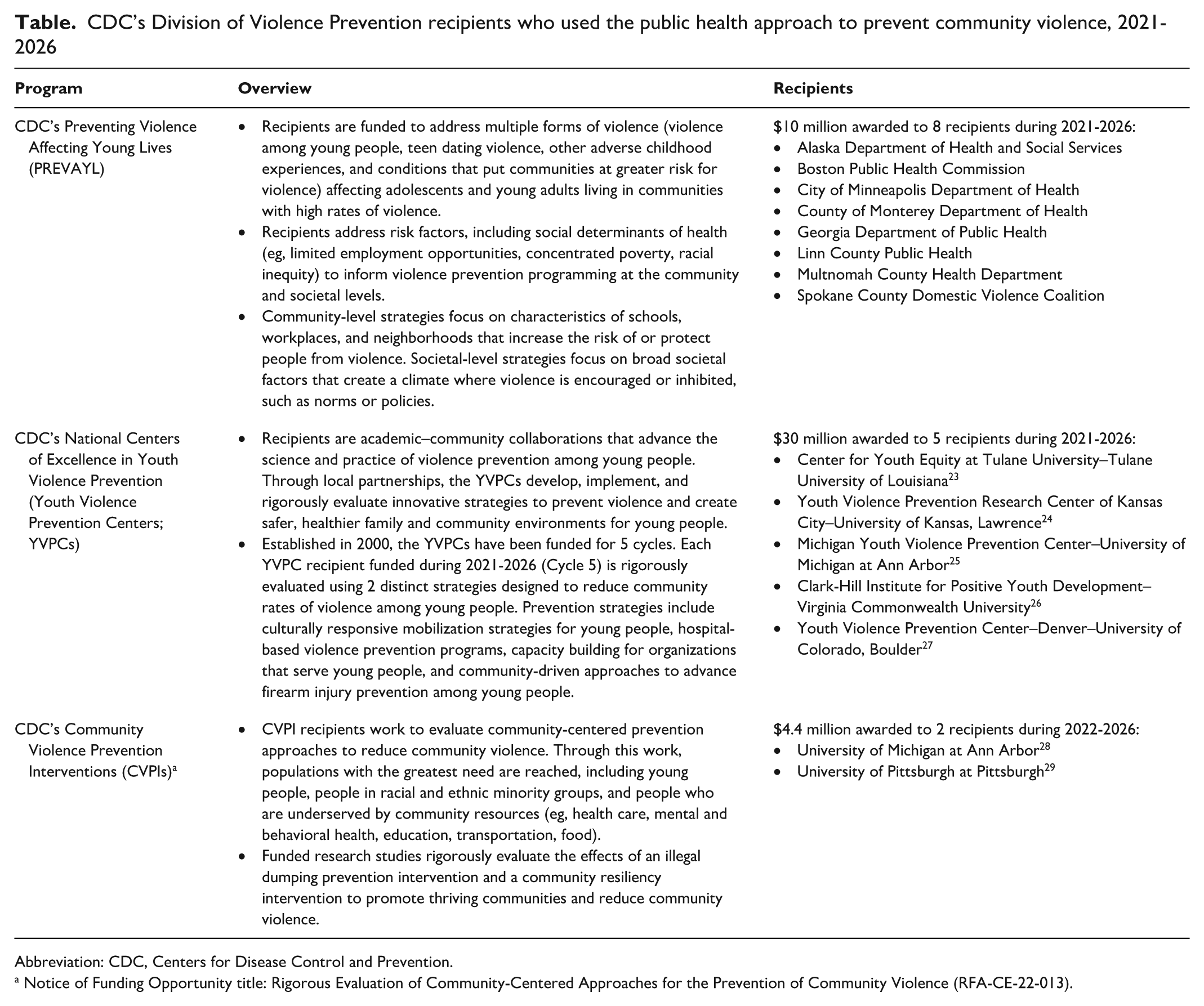
Abbreviation: CDC, Centers for Disease Control and Prevention.
Notice of Funding Opportunity title: Rigorous Evaluation of Community-Centered Approaches for the Prevention of Community Violence (RFA-CE-22-013).
Challenges and Future Directions in Community Violence Prevention Research and Practice
Future research can address challenges in applying the public health approach to community violence prevention. Improved data (eg, cost data, more timely data, data disaggregated by demographic characteristics) are needed to help researchers, health care and prevention providers, and communities prevent community violence and monitor the effects of their efforts. Research and measurement of conditions that increase or decrease the risk for violence can inform the development of novel prevention approaches and methodologies, which can then be rigorously tested for effectiveness in communities. Implementation research of promising practice-based community violence prevention strategies can identify existing strategies (eg, economic policies, hospital-based violence intervention programs) with the greatest potential for adaptability, replicability, scalability, and sustainability in affected communities. Prevention efforts that address underlying drivers of violence are important for eliminating the disproportionate experience of violence in some communities. As more communities use science and data to inform action, evaluations are needed to monitor and refine prevention efforts. Finally, collaborative cross-sector partnerships are needed to address the unique needs of communities and provide a comprehensive approach to preventing community violence. 37
Conclusion
Decades of research, data collection and monitoring, and programmatic evaluations indicate that violence is preventable. Everyone deserves to live in a community free of violence. By using a comprehensive public health approach, engaging with communities, and applying science and data to action, communities can address and reduce disparities in the risk for community violence and create an environment in which all individuals are healthy, safe, and thriving.
Footnotes
Declaration of Conflicting Interests
The authors declared no potential conflicts of interest with respect to the research, authorship, and/or publication of this article.
Funding
The authors received no financial support for the research, authorship, and/or publication of this article.
Disclaimer
The findings and conclusions in this article are those of the authors and do not necessarily represent the official position of the Centers for Disease Control and Prevention.
