




Abstract
Objectives:
Suicides among Black adults in the United States increased nationally during the COVID-19 pandemic, although limited empirical evidence documents the pathways that explain how suicide risk may develop in this population. We examined experiences of non-organizational religious involvement, gratitude, and loneliness and their relation to suicidal ideation among Black adults in the United States.
Methods:
We analyzed data from a probability-based sample of 995 Black adults in the United States who completed online surveys from April through June 2022. We recruited participants from the AmeriSpeak panel at the National Opinion Research Center. We applied structural equation modeling techniques to measure direct and indirect associations among religiosity, positive psychology, and mental health variables. We tested whether non-organizational religiosity was indirectly associated with suicidal ideation via feelings of gratitude and COVID-19–specific forms of loneliness during the pandemic.
Results:
The measurement model demonstrated a good fit to the data. Structural model results indicated that non-organizational religious involvement was positively related to gratitude (β = 0.51; P < .001); in turn, feelings of gratitude were associated with reduced suicidal ideation (β = −0.12; P = .02). Moreover, COVID-19–specific forms of loneliness were positively associated with past-year suicidal ideation (β = 0.11; P = .01). Non-organizational religious involvement, however, was not directly associated with feelings of COVID-19–related loneliness or suicidal ideation.
Conclusions:
Public health officials should account for feelings of gratitude and loneliness as mechanisms that can be leveraged to inform the development of evidence-based suicide prevention interventions for Black adults during public health emergencies such as the COVID-19 pandemic and beyond.
Data from the Centers for Disease Control and Prevention confirm that suicides among Black adults in the United States increased nationally during the COVID-19 pandemic. 1 Similar trends have also been detected among Black adults in the United States residing in major urban cities 2 and in states across the country. 3 While epidemiological data can help identify changing suicide rates both within and across racial groups, what is unclear are the pathways or mechanisms that either contribute to or mitigate suicide risk for Black adults, specifically in the context of COVID-19. For example, several studies clearly explained what is happening as it relates to the increase in suicide trends among Black early adolescents, teens, and young adults in recent years,1,4,5 but few studies have applied measures of indirect associations to ascertain why Black adults in the United States may be ending their lives at higher rates than ever before. Learning which pathways either reduce or exacerbate suicide risk can help determine points of intervention.
The current study addresses these methodological limitations by examining whether COVID-19–specific forms of loneliness and feelings of gratitude mediate the relationship between non-organizational religious involvement and suicidal ideation among Black adults in the United States during the global pandemic. We prioritize the study of these associations as a way to consider the holistic experiences of Black Americans’ psychological well-being and to intentionally integrate questions of positive psychology into the suicide prevention and public health literature.
Previous research has found that loneliness, gratitude, and religion influence mental health outcomes among Black adults in the United States. Loneliness is a distressing feeling in which one perceives that one’s relationships are inadequate or not meaningful.6-8 Limited research has addressed loneliness and mental health among Black people; however, a recent study found that loneliness among older Black adults was associated with greater depressive symptoms and increased odds of experiencing a lifetime psychiatric disorder. 9 To our knowledge, few studies have examined loneliness and suicidality among Black adults in the United States; however, a study by Hirsch et al 10 found that greater perceived loneliness moderated the association between social problem-solving and suicidal behavior among members of this group. Additionally, loneliness is an established risk factor for suicidality in the general population. 11
Relatedly, a small but growing body of research has measured the relationship between gratitude and a host of mental health outcomes, including anxiety, depressive symptoms, and suicide. Scholars name gratitude as one of the most understudied psychological emotions that is centrally focused on the role of “undeserved merit” and thankfulness that is felt and experienced in response to others instead of turning inward and focusing on oneself.12-15 Researchers point to the physical and mental health benefits of practicing thankfulness and appreciation for both major events or milestones and practical pleasures that occur in daily life. 16 Prior studies examined the gratitude–suicide link among US college students,17-19 military veterans,20-22 and adults admitted to receive inpatient psychiatric treatment. 23 Associations between gratitude and suicide risk have also been evaluated across international samples of young people and adults.24-27 Overall, the results are consistent in demonstrating that gratitude is associated with a decreased risk of suicidality in both cross-sectional and longitudinal evaluations.21,28
In contrast, more studies have examined religion in the lives of Black adults in the United States, who on average participate in religious or faith-based activities more than adults from other racial groups in the United States. 29 Furthermore, previous studies found that religious participation, religious service attendance, and religious social support are all associated with better mental health outcomes for this group. 30 Studies also indicate that greater religious involvement among Black adults in the United States is associated with reduced suicidality. Chatters et al 31 found that greater contact with and greater emotional closeness to church members are associated with reduced suicidality. Additionally, Taylor et al 32 showed that service attendance and religious coping (looking to God for strength) were associated with reduced suicide attempts and reduced suicidal ideation.
Current Study
Still, a gap exists in researchers’ empirical evaluations of non-organizational religious involvement, loneliness, and gratitude and their combined potential to influence mental health and suicidal ideation for Black adults in the United States. Moreover, questions remain when examining the factors that contribute to or inform Black adults’ experiences of loneliness and gratitude. We assessed whether loneliness and gratitude mediate the relationship between non-organizational religious involvement and suicidal ideation among Black adults during the COVID-19 pandemic. We hypothesized that (1) non-organizational religious involvement and gratitude would be negatively associated with suicidal ideation, while loneliness would be positively related to suicidal ideation, and (2) non-organizational religious involvement would be indirectly associated with decreased suicidal ideation via increased gratitude and decreased feelings of loneliness. We viewed this study as an opportunity to redress a dearth in the literature by intentionally integrating elements of positive psychology with public health and suicidology research. This intersection across interdisciplinary fields could yield promising pathways to health promotion that are largely missing from national discourse on the mental health and well-being of Black adults in the United States during the COVID-19 pandemic.
Methods
Sample and Procedure
We analyzed responses from 995 Black adults who participated in a national survey that examined Black adults’ mental health experiences during the pandemic. We recruited a probability-based sample of Black adults in the AmeriSpeak panel. The AmeriSpeak panel is a data source for social scientists with a sampling frame that covers 97% of US households. 33 Eligibility criteria required participants to identify as Black or African American, be aged ≥18 years, and live in the United States. Eligible participants completed cross-sectional online surveys from April through June 2022. All participants provided informed consent prior to enrollment and received a list of both general and specific mental health resources designed to support the mental health needs of Black adults in the United States. The University of Chicago Crown Family School of Social Work, Policy, and Practice and Chapin Hall Institutional Review Board approved this study (IRB#22-0016).
Measures
Demographic characteristics
We analyzed data on participants’ age, sex (male, female), annual family household income (<$30 000, $30 000-$59 999, $60 000-$99 999, ≥$100 000), education level (<high school diploma, General Educational Development [GED]/high school diploma, vocational/some college/bachelor’s degree), residential region (Northeast, Midwest, South, West), and experiences of losing a friend or family member to COVID-19.
Non-organizational religious involvement
We used 6 items to measure Black adults’ experiences of non-organizational religious involvement. We adapted 4 items from the National Survey of American Life (NSAL 34 ) and developed 2 items for this project. We assessed experiences of non-organizational religious involvement by using items that measure frequency of reading religious materials, listening to religious music, watching religious programs, and participating in communal and individual prayer. Responses were on a 6-point Likert scale, where 1 = never and 6 = nearly every day. Higher scores represented greater frequency of participation in non-organizational religious practices. The Cronbach ⍺ was 0.89.
Organizational religious involvement
A single item captured Black adults’ frequency of attending religious services before the COVID-19 pandemic (aside from weddings and funerals). Response options were 0 = I never attended a religious service in my life, 1 = less than once a year, 2 = a few times a year, 3 = at least once a month, 4 = at least once a week, and 5 = nearly every day or ≥4 times a week.
Loneliness
We used 3 items from the UCLA Loneliness Scale for this study. 35 We adapted the items to focus on experiences of loneliness during the COVID-19 pandemic. We asked participants to report how often they lacked companionship, felt left out, or felt lonely during the pandemic. Response options were measured using a 4-point Likert scale, from 1 = never to 4 = often. Higher scores indicated greater frequency of loneliness. The Cronbach ⍺ for COVID-19–related loneliness was 0.89.
Gratitude
We measured feelings of gratitude by using The Gratitude Questionnaire—Six Item Form. 13 We used an adapted set of response options to gauge how often respondents reported feeling grateful in their everyday lives. Responses were captured using a 6-point Likert scale, where 1 = never and 6 = nearly every day. Higher total scores represented more gratitude. The Cronbach ⍺ for gratitude among this sample of Black adults was 0.76.
Suicidal ideation
We measured suicidal ideation with a single item that asked participants to report whether they had seriously considered ending their lives in the past year, with responses coded as 1 = yes and 0 = no.
Data Analysis
We applied structural equation modeling techniques to measure direct and indirect associations among measures of religiosity, loneliness, gratitude, and suicidal ideation. We began this process by first evaluating the psychometric properties of each latent factor to determine whether the model was a good fit to the data. We needed to measure the factor structure for each latent variable, as many popular psychology scales have not yet been applied to samples comprised entirely of Black adults in the United States. Thus, before examining relationships among study variables, we first used confirmatory factor analysis techniques to identify any sources of potential measurement error. When examining the factor structure, items were freely loaded and factor variances were fixed to 1.
We then implemented the structural model to determine whether non-organizational religiosity was directly and indirectly related to suicidal ideation via loneliness and gratitude. We adjusted the model for age, income, and whether participants had lost a loved one to COVID-19–related complications. We assessed model fit by reviewing indices proposed by Hu and Bentler, 36 who suggest that Comparative Fit Index (CFI) and Tucker-Lewis Index (TLI) values ≥ .95, root mean square error of approximation (RMSEA) values <.06, standardized root mean squared residual (SRMR) values <.08, and Pearson χ2 values >.05 indicate good model fit. We followed guidelines proposed by Worthington and Whittaker 37 that suggest factor loadings for the measurement model should all be >.40. Mplus applies the weighted least-square mean and variance-adjusted estimator (WLSMV) for categorical outcomes (in this case, suicidal ideation); as a result, missing data were handled using listwise deletion. 38
Results
Descriptive Statistics
Participants were on average aged 46.5 years (Table 1). Most respondents lived in the South (54.4%), 25.1% lived in the Midwest, 10.8% lived in the Northeast, and 9.7% lived in the West. Forty-four percent completed vocational/some college, 18.6% received a GED/high school diploma, 16.4% earned a bachelor’s degree, and 14.1% completed a graduate/professional school degree. Forty-two percent lived in a large city or metropolitan area, 30.6% in a small city/town, 18.9% in a suburban community, and 7.7% in a rural area. Approximately 6.5% of the sample reported considering suicide in the past 12 months.
Characteristics of participants in a survey assessing associations between suicidal ideation and non-organizational religiosity, gratitude, and loneliness among Black adults (N = 995), United States, 2022 a
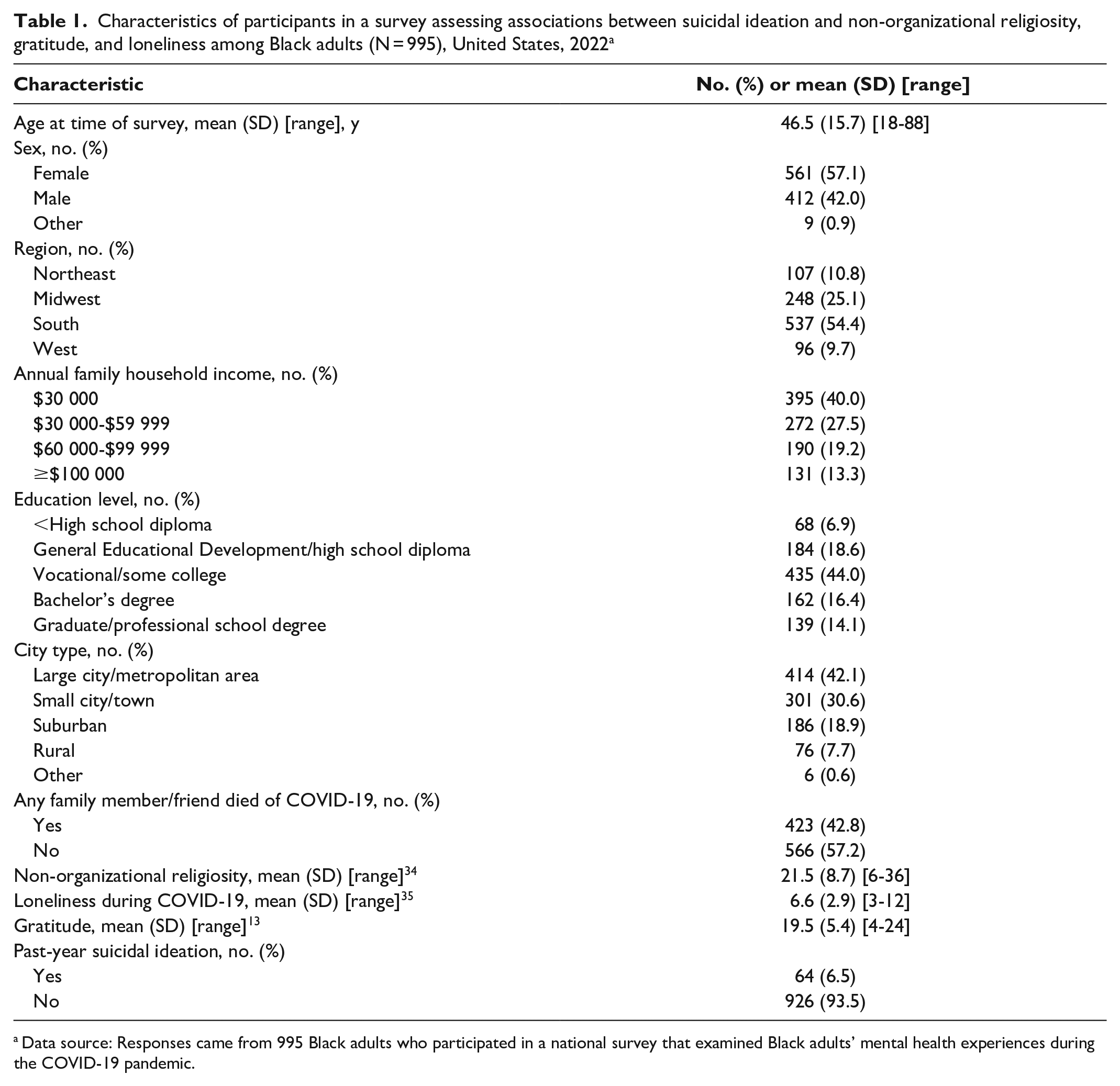
Data source: Responses came from 995 Black adults who participated in a national survey that examined Black adults’ mental health experiences during the COVID-19 pandemic.
Measurement Model Results
The 2 reverse scored items #3 and #6 on the gratitude scale had poor loadings below 0.40 and were removed from the analyses. Final measurement model results indicated that the model was a good fit to the data (CFI = 0.99, TLI = 0.98, RMSEA = 0.06, SRMR = 0.05, χ2 = 302.97; P < .001). Item loadings for each of the 3 latent factors were higher than the suggested cut-off criteria (Table 2). Shared error was found between 2 of the non-organizational religiosity items focusing on prayer.
Measurement model results of a survey assessing associations between suicidal ideation and non-organizational religiosity, gratitude, and loneliness among Black adults (N = 995), United States, 2022 a
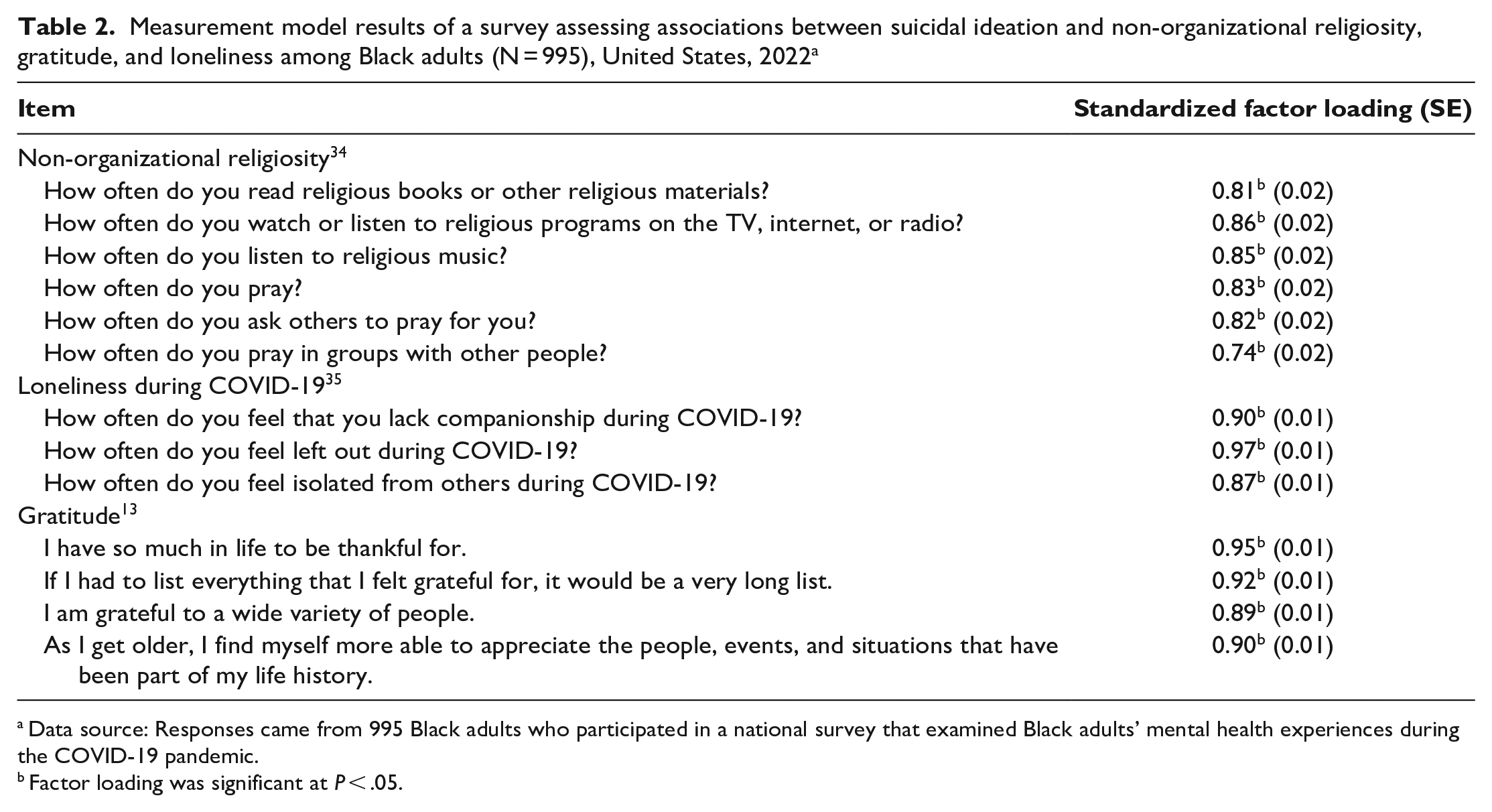
Data source: Responses came from 995 Black adults who participated in a national survey that examined Black adults’ mental health experiences during the COVID-19 pandemic.
Factor loading was significant at P < .05.
Structural Model Results
Direct and indirect associations
Results from the structural model yielded good model fit (CFI = 0.96, TLI = 0.95, RMSEA = 0.03, SRMR = 0.06, χ2 = 234.51; P < .001). Organizational religious involvement (eg, religious service attendance) was positively associated with non-organizational religious involvement (β = 0.54; P < .001) (Figure). Moreover, organizational religiosity was not directly related to the proposed mediating or outcome variables.
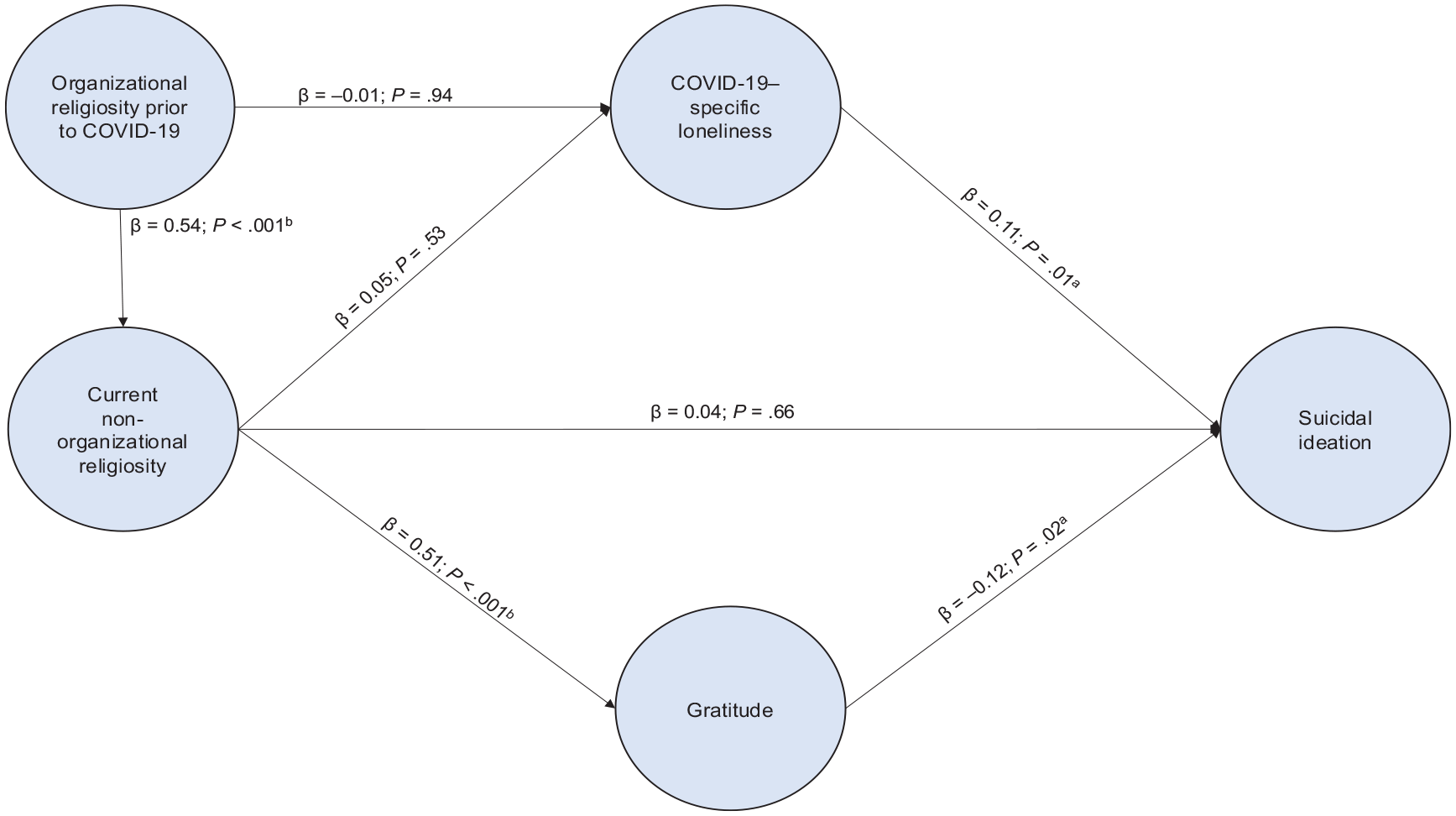
Structural model results measuring direct and indirect associations from religious involvement to suicidal ideation through loneliness and gratitude among a probability sample of Black adults in the United States (N = 995), April–June 2022. The figure measures indirect associations in modeling the pathways from organizational and non-organizational religious involvement to suicidal ideation through proposed mediators of loneliness and gratitude. Structural equation modeling techniques were used to probe for potential sources of measurement error while also measuring direct and indirect relations between the variables. Standardized beta coefficients and corresponding P values are presented.
Non-organizational religiosity was significantly associated with gratitude (β = 0.51; P < .001), although the association between non-organizational religiosity and loneliness was not significant (β = 0.05; P = .53) (Figure). Gratitude was negatively related to suicidal ideation (β = −0.12; P = .02), and loneliness was positively related to suicidal ideation (β = 0.11; P = .01). The direct association between non-organizational religiosity and suicidal ideation was not significant.
Results measuring indirect associations show that non-organizational religious involvement was indirectly associated with decreased suicidal ideation through increased feelings of gratitude (β = −0.06; P = .03). The pathway from non-organizational religious involvement to suicidal ideation through loneliness, however, was not significant (β = 0.01; P = .55). A similar pattern emerged when accounting for the role of religious service attendance, as indirect pathways from organizational religious involvement to loneliness to suicidal ideation via loneliness (β = 0; P = .94) and organizational religious involvement to suicidal ideation via gratitude (β = 0.06; P = .48) were not significant.
Discussion
Our study sought to identify potential mechanisms that influence suicidal ideation among Black adults in the United States during the COVID-19 pandemic. Study hypotheses were partially supported in that a 1-unit increase in COVID-19–specific experiences of loneliness was directly associated with an 11% increase in the likelihood of experiencing suicidal thoughts in the past year. Moreover, a 1-unit increase in feelings of gratitude was directly associated with a 12% decrease in the likelihood of seriously considering suicide during this same time frame. Furthermore, we found that gratitude, not loneliness, mediated the relationship between religious participation and suicidal ideation among Black adults. Our results both align with and diverge from existing research while pointing to promising pathways for future work. We consider implications for research and intervention with Black adults related to matters of loneliness, gratitude, and suicidality hereinafter.
It was surprising to see that non-organizational religious involvement was not directly associated with suicidal ideation and that loneliness did not mediate the relationship between non-organizational religiosity and suicidal thoughts. We anticipated that the frequency of engaging in regular spiritual practices of reading religious texts, listening to religious music, and praying would be directly linked to less loneliness and fewer suicidal thoughts; however, this was not the case. Similarly, organizational forms of religious involvement were not directly related to experiences of loneliness, gratitude, or suicidal ideation, with no significant indirect associations emerging among these factors.
As a result, our findings run counter to existing scholarship in this area where greater religiosity protects against suicidal ideation among Black adults.31,32 Similarly, one established pathway in which religious engagement influences loneliness is through increased social participation and social support 39 ; yet our findings do not align with results generated in existing reports. When working to understand this conundrum, it is important to note that these earlier studies accounted for different forms of religiosity, whereas we measured service attendance and more personal forms of devotion alone. Moreover, null findings may have emerged because large gatherings of people were prohibited early in the pandemic to reduce the spread of COVID-19. Once in-person bans were lifted, many people may have still felt uneasy or uncomfortable returning to weekly events held at their regular houses of worship. This disruption in formal religious participation and attendance also may have inadvertently affected Black adults’ personal or private form of religious involvement and devotion.
Direct pathways to addressing suicidal ideation among Black adults may come from mitigating feelings of loneliness and enhancing gratitude. Previous studies have found multiple methods of reducing loneliness, including addressing maladaptive social cognitions, increasing opportunities for socialization, building better social skills through psychosocial education, and having community groups.40,41 Within the context of COVID-19, gratitude improved well-being scores among college students who participated in a 10-week gratitude journaling intervention, 42 protected against loneliness and depressive symptoms in a sample of first-year college students, 43 and was indirectly related to posttraumatic stress disorder symptoms among first responders. 44 Our study, therefore, offers a new contribution to this nascent area of literature by both using a COVID-19–specific measure of loneliness and centering a strengths-based, positive psychology perspective in the study of Black adults during the pandemic. Interventions that are empirically tested and validated for treatment efficacy among Black adults in the United States are still warranted.
Limitations
There are important limitations to consider. First, we analyzed data collected at a single time point and cannot confirm the direction of association among key study variables. Future studies should implement prospective designs to evaluate relationships among non-organizational religiosity, loneliness, gratitude, and suicidal ideation over time. Second, we focused our study on the mental health experiences of Black adults in the United States in the social context of COVID-19. Federal lockdowns were initiated across the country that restricted large in-person gatherings in summer 2020. Some restrictions remained in place in 2021. Although our data were collected in 2022, some people did not immediately return to attending in-person religious services once lockdowns were lifted. For these reasons, we prioritized measuring non-organizational forms of religiosity in this study. Researchers should continue to account for the roles of both organizational and non-organizational religious involvement in future work.
Next Steps and Future Research
Next steps in this line of research include measuring differences in loneliness across age groups and developmental stage, as young Black adults likely have different social needs than older Black adults who may be facing serious challenges related to their physical health, shifts in professional or work experiences, and the development of chronic morbidities and health conditions. In short, the types of support young versus older Black adults seek, prefer, and offer to others likely vary across the life course and should be accounted for in future research. Lastly, specific efforts are needed to support the mental health needs of those who lost a loved one to COVID-19, as their experiences of loneliness and grief may be complex due to preventive hospital policies that prevented family members from saying goodbye to their loved ones in-person early in the pandemic.
Conclusion
Suicide and suicidal ideation are steadily increasing among Black adults in the United States; therefore, it is critical that we understand the mechanisms driving this phenomenon. Our study identified pathways to suicide risk for Black adults in the context of COVID-19 and aligns with priorities for tackling the epidemic of loneliness and social isolation set forth by former US Surgeon General Vivek Murthy in 2023. 45 Interventions prioritizing ameliorating loneliness and promoting gratitude may directly reduce suicidal ideation. It is our hope that this study will inform future research and interventions designed to better support the mental health needs of Black adults in the United States, especially during times of international pandemics, collective pain, and widespread distress.
Footnotes
Declaration of Conflicting Interests
The authors declared no potential conflicts of interest with respect to the research, authorship, and/or publication of this article.
Funding
The authors received no financial support for the research, authorship, and/or publication of this article.
