




Abstract
A lack of infection prevention and control protections for essential industries in the United States led to increased risk and incidence of COVID-19 among essential workers during the COVID-19 pandemic. When the nation deems an industry essential during a disease outbreak, an ethical obligation exists to safeguard the health of workers who are at increased risk of being exposed to disease. The Global Center for Health Security at the University of Nebraska Medical Center began work to rapidly develop and disseminate infection prevention and control guidance for essential industries, such as meat processing. The Global Center for Health Security established an ethics advisory committee to support COVID-19 response efforts. The ethics advisory committee supported the development of guidance on infection prevention and control to promote justice, reciprocity, health, safety, and equity for workers in the meat processing industry. Our experience highlighted the fundamental role of ethical analysis in public health response efforts, but ethical analysis in this case required an interdisciplinary approach, including the need for effective community-relevant solutions. The integration of an ethics committee into public health emergency response efforts can address ethical concerns for workers in industries that must remain operational during public health emergencies.
In March 2020, as the COVID-19 pandemic was emerging, the US Department of Homeland Security-Cybersecurity and Infrastructure Security Agency developed lists of essential, critical infrastructure workers who “conduct a range of operations and services that are typically essential to continued critical infrastructure viability.” Lists of essential workers extended outside of health care, to industries such as food and agriculture. 1 Most states used guidelines from the US Department of Homeland Security-Cybersecurity and Infrastructure Security Agency as a starting point to add and subtract essential worker categories based on what was considered essential for the state. 2 The lists, along with an April 2020 presidential executive order declaring the meat processing industry essential, enabled meat processing facilities to remain operational during heightened pandemic conditions, 3 but neither the lists nor the executive order came with enforceable infection prevention and control (IPC) standards for workers. 4 Workers in meat processing facilities encountered a constellation of problematic conditions that elevated their risk of contracting COVID-19, leading to outbreaks in processing facilities across the country.5,6
Industries considered essential to the US infrastructure, such as the meat processing industry, were some of the early hotspots for COVID-19 outbreaks, 7 and essential work became a way of looking at increased COVID-19 disparities.8,9 For example, many essential workers are part of historically marginalized groups, whose increased risk of exposure to SARS-CoV-2 through employment was compounded by a lack of or inadequate health insurance, limited paid time off, food insecurity, and housing instability. 10 The 2020-2021 Coronavirus Preparedness and Response Supplemental Appropriations (CARES) Act sought to support individuals affected by COVID-19 through ensuring employment benefits, paid sick leave, and expanded health care access, 11 but the CARES Act did not cover unauthorized meat and poultry workers—one estimate suggested that one-quarter of workers are unauthorized immigrants. 12 Furthermore, meat processing workers face occupational health and safety risks and are susceptible to both acute and repetitive injuries (eg, amputations, carpal tunnel syndrome), consequences from dangerous long-term exposures (eg, noise-induced hearing loss), and morbidity from chronic diseases (eg, diabetes) with limited resources to manage health. 13 Although occupational health and safety risks have been well documented, the meat processing industry has a history of focusing on profit at the expense of workers’ well-being. 13
The Global Center for Health Security (GCHS) at the University of Nebraska Medical Center (UNMC), which leads activities that range from laboratory research to boots-on-the-ground, hands-on training, works to provide innovative and advanced preparedness in response to emerging infectious diseases and catastrophic public health emergencies. The GCHS began to develop and disseminate “IPC playbooks” for essential industries, such as meat processing, at a time when industry-specific IPC guidance was not available. 14 The GCHS modeled the meat processing playbook on the National Institute for Occupational Safety and Health’s hierarchy of controls, which is a method of identifying and prioritizing protections to mitigate hazards for workers. 15 An interdisciplinary team with expertise in infectious diseases, health disparities, industrial hygiene, public health, and ethics drafted the playbook, and the team released a draft before industry-specific guidance became available from the US Occupational Safety and Health Administration and Centers for Disease Control and Prevention at the end of April 2020. 16
As the GCHS team developed the Meat Processing Facility COVID-19 Playbook (hereinafter, Meat Processing Playbook), 14 the team identified issues of injustice for worker populations. However, ethical guidance for the protection of frontline workers outside of health care did not exist in early 2020. Despite being essential workers, workers in the meat processing industries did not have equitable frameworks for allocation of resources, such as respirators and surgical masks, to protect against COVID-19 infection or have ethical considerations for access to testing, health care, and sick leave. The GCHS integrated an ethics committee into public health emergency response efforts to address emerging ethical concerns for essential meat processing workers during the COVID-19 pandemic.
Purpose
The purpose of this case study was to (1) detail the process of establishing and integrating an ethics advisory committee (EAC) to promote equity, reciprocity, justice, health and safety, trust, and transparency into IPC guidance for meat processing workers at the onset of the COVID-19 pandemic; (2) describe the outcomes of the EAC’s work as it related to essential meat processing workers; and (3) document key lessons learned.
Methods
We start with an overview of the development of an EAC to support response efforts. The second section details the ethics request process and the integration of the EAC into the technical assistance team and is followed by an overview of the extensive community engagement effort to account for the lived experience of workers and their communities. The final section provides a brief overview of the approach to analyzing key considerations for the protection of meat processing workers during the pandemic. This project did not involve human data or participants; therefore, institutional review board assessment was not necessary per the policy of the Office of Science and Medicine at the US Department of Health and Human Services, Office of the Assistant Secretary for Health.
An Ethics Advisory Committee to Support COVID-19 Response
In February 2020, the GCHS recognized a need for an EAC to support the navigation of complex, emerging issues that were arising in the COVID-19 response. GCHS’ national capabilities (eg, the National Quarantine Unit and Biocontainment Unit) led to involvement in some of the earliest COVID-19 response efforts, from developing the first functional laboratory-developed diagnostic test in the United States to repatriating US citizens from Wuhan, China. 17
In March 2020, the GCHS convened an EAC of 12 members with extensive expertise in ethics. The GCHS appointed a chair external to UNMC and an associate chair who was the lead ethicist for the GCHS. The associate chair selected other EAC members based on their expertise to support areas of public health emergency response related to COVID-19, with 9 of 12 EAC members selected from academic medical centers external to UNMC. The EAC members had expertise in the following areas: public health, health law, preparedness and response, clinical, infectious diseases, epidemiology, health disparities, rural health, and pediatrics. The EAC, which was advisory in nature, provided on-demand ethics consultations to the GCHS response teams, federal and state public health teams, and external academic partners; these groups contacted the associate chair to request ethics consultations. 18
The Ethics Consultation Process: An Interdisciplinary Approach
In March 2020, infection control experts at the GCHS began providing technical assistance to multiple industries outside of health care, including meat processing facilities in Nebraska, where they evaluated facility-specific safety considerations, identified gaps, and provided facility-specific recommendations to reduce potential COVID-19 transmission. 19 While conducting visits in coordination with local public health departments, the technical assistance team recognized a power differential between workers and plant leadership. The technical assistance team asked the associate chair of the EAC to participate in the site visits to observe education provided to workers, review sick leave policies, and assess access to testing and health care for workers. Providing applicable ethical analysis and specific guidance was contingent on the level of integration with the technical assistance team, and the ethics consultation was conducted alongside the development of the GCHS’ Meat Processing Playbook.
As an initial goal, the EAC performed an analysis to identify the range of groups affected by the health of the meat processing workforce, such as ranchers and growers, feeding operations, veterinarians, meat processing workers, meat processing facility leadership, local public health departments from affected regions, hospitals, and the Nebraska Department of Health and Human Services. The associate chair of the EAC led the analysis through a combination of informal conversations that occurred during the site visits or during the weekly state coordination calls. Each week, the GCHS hosted a COVID-19 coordination call with leaders from the Nebraska Department of Health and Human Services, public health departments across Nebraska, health care coalition coordinators from across Nebraska, and hospital leaders to support situational awareness and response activities. 16 By performing an analysis of key groups, the EAC could understand the complexity of the problem and track some of the far-reaching consequences of the outbreaks at meat processing facilities. For example, the EAC gained an understanding that not only were ranchers, growers, and feeding operations sustaining financial losses, but some were forced to euthanize their animals because they lacked processing capacity and had facility design limitations.
From February 2020 through February 2022, the EAC met weekly to address incoming ethics requests. Some requests, such as the meat processing request, required the EAC to integrate with technical assistance teams, conduct community engagement, and consult with GCHS leadership to develop an appropriate ethics question and to ensure that the deliverables of the ethics request aligned with response efforts of the GCHS. The EAC adapted to meet the needs of the requestor, and the EAC benefited from having access to first-hand accounts of the challenges to protecting workers given that the associate chair was part of the technical assistance team.
Ethical Obligation to Account for the Lived Experience of Workers
The emergence of the COVID-19 pandemic substantially affected an already dangerous environment for meat processing workers. 20 During site visits, the associate chair met with plant leadership but did not have opportunities to interact with workers. The site visits also revealed that IPC recommendations could address only some of the factors affecting COVID-19 transmission at meat processing facilities; the EAC realized that it needed a better understanding of other factors, such as incentives to work while symptomatic, access to IPC training, and disincentives to access testing, to inform recommendations. The technical assistance team and the EAC began collaborating with an academic partner from the Center for Reducing Health Disparities at UNMC who had long-standing ties to communities of meat processing workers (Figure 1).
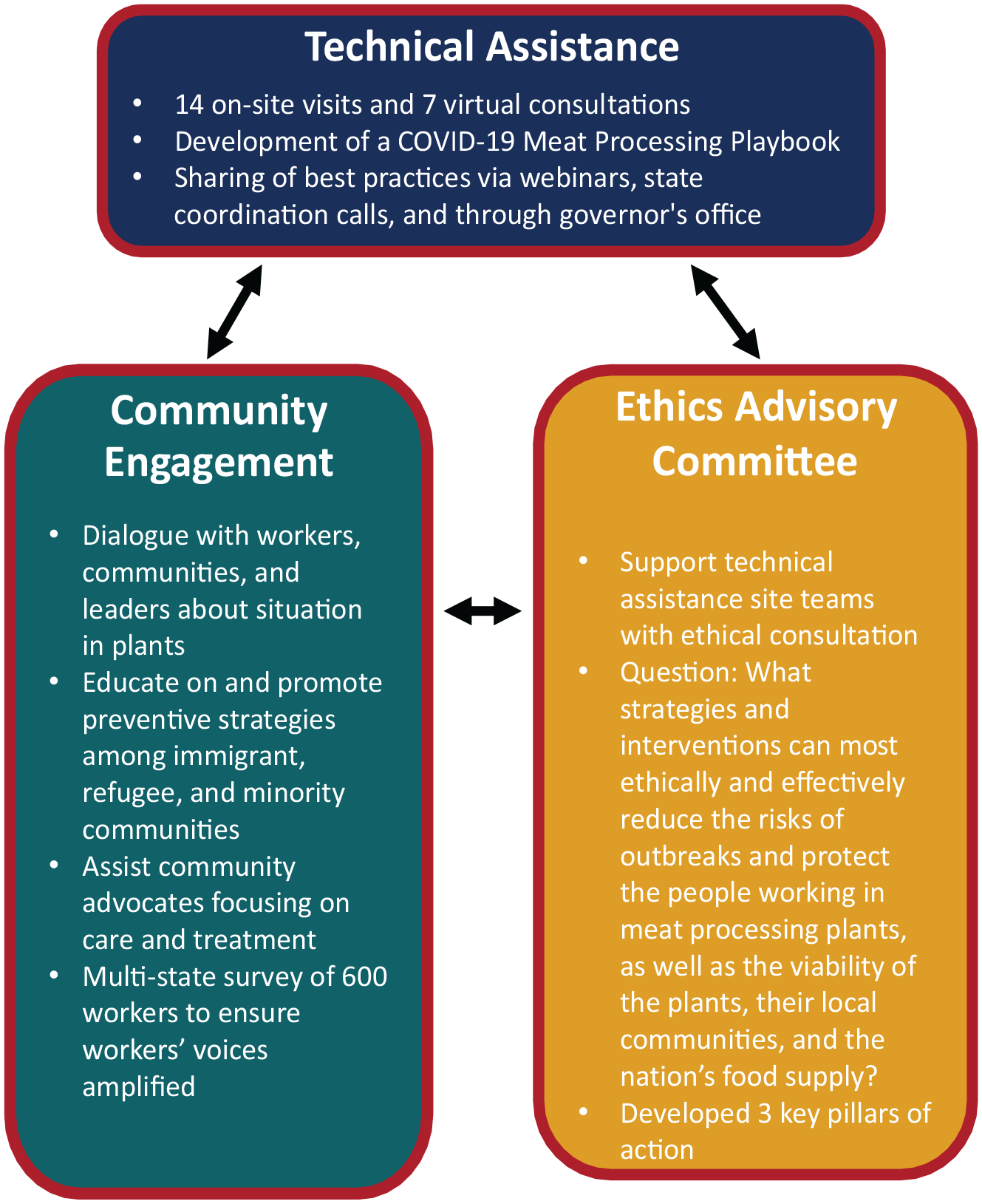
Interdisciplinary approach established by the Global Center for Health Security at the University of Nebraska Medical Center, integrating an ethics advisory committee, to support meat processing workers during the response to the COVID-19 pandemic, March 2020.
In early April 2020, the UNMC hosted 4 virtual meetings with community members and community organization partners across Nebraska to discuss COVID-19 outbreaks in meat processing facilities. The UNMC invited partners based on their engagement with communities of meat processing workers. Each meeting attracted 10 to 55 attendees from throughout the state, including Omaha, Grand Island, Norfolk, Lexington, Crete, Columbus, and Hastings, with representation from local public health departments, community organizers and worker advocates, university public health practitioners, and community members. During the meetings, the GCHS technical assistance team updated attendees on current efforts and then opened the forum to attendees to voice concerns about the risks of COVID-19 transmission in meat processing facilities and to share experiences and fears among meat processing workers and their families. The meetings unveiled a common theme: the need for a mechanism by which the workers could directly share their experiences without fear of retribution from their employer.
In response, members of the interdisciplinary team developed and conducted a 40-question, cross-sectional survey to help understand the concerns of workers on safety and well-being related to COVID-19 exposure. 21 In the survey, workers reported concerns about types of protective strategies implemented in plants and the information on COVID-19 provided to them. Workers also reported what they wanted their employers to do to prevent the spread of COVID-19. 5 The EAC found these community engagement efforts to be crucial, allowing for the lived experiences of workers to be included in the key group analysis.
Ethical Analysis to Support Response Efforts
As the technical assistance team developed recommendations, the EAC realized a core concern was how to prioritize public health recommendations that attended to the needs of meat processing workers. The EAC recognized that the ethical analysis needed to account for an expansive landscape of considerations among key groups in the context of persistent worker safety issues and social determinants of health that predated the pandemic. 22 The EAC, through interdisciplinary collaboration, put forth the following ethics question: “What strategies and interventions can most ethically and effectively reduce the risks of outbreaks and protect the people working in meat processing plants, as well as the viability of the plants, their local communities, and the nation’s food supply?” The EAC attended to this question through (1) considering relevant key groups, interests, and values; (2) highlighting the ethical considerations involved in the question posed; and (3) recommending pillars of intervention to prevent COVID-19 outbreaks in meat processing facilities. The EAC grounded the analysis in the core public health ethical values of equity, reciprocity, justice, health and safety, trust, and transparency that underlie public health policy and practice and support the substance of recommendations. 23
Outcomes
An ethical framework for the protection of workers in meat processing facilities during public health emergencies emerged as a key outcome of the ethics request (Figure 2). Dissemination of the framework and ethics considerations to advocates of meat processing workers became a crucial next step, and the EAC engaged with the National Institute of Environmental Health Sciences (NIEHS) worker training program to co-lead a webinar series on COVID-19, ethics, and the workplace. Finally, the ethical framework influenced state policy and national vaccine allocation for meat processing workers.
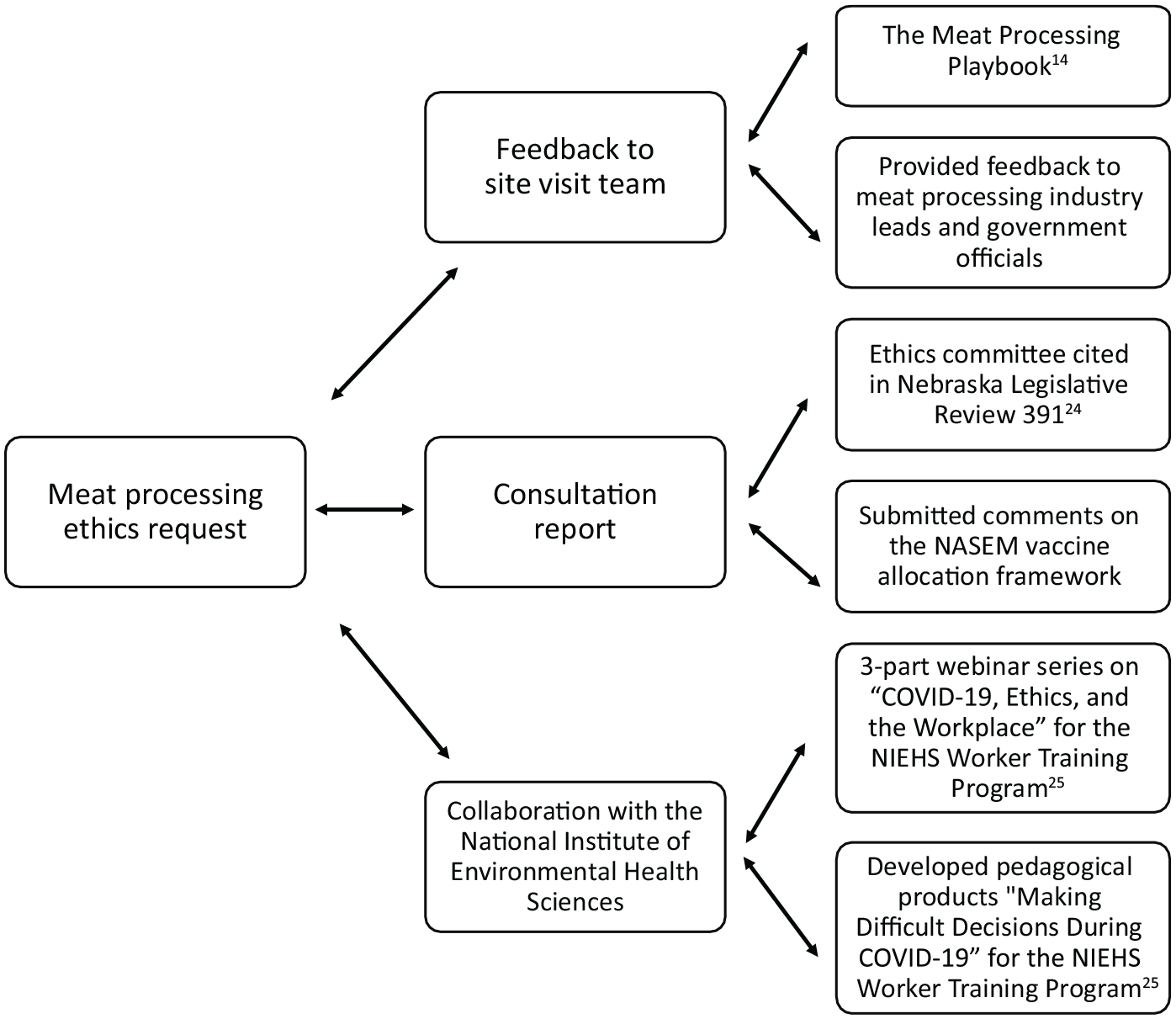
Process and outcomes of the ethics request on meat processing developed by the ethics advisory committee established by the Global Center for Health Security at the University of Nebraska Medical Center during the COVID-19 pandemic, April 2020. Abbreviations: NASEM, National Academies of Sciences, Engineering, and Medicine; NIEHS, National Institute of Environmental Health Sciences.
Ethical Analysis to Support Complex Public Health Decision-Making
Perhaps the most important outcome from the EAC was the development of an ethical framework to support the technical assistance teams as they developed The Meat Processing Playbook and prioritized IPC guidance to some facilities during the early months of the pandemic. Integration of the EAC into the operational aspects of pandemic response (eg, site visits, weekly COVID-19 coordination calls, community engagement efforts) ensured that the ethical framework was rooted in the real-time challenges faced by public health responders. One of the barriers encountered was the urgency that the public health emergency demanded against the time required for thorough analytical work. Members of the EAC needed to prioritize ethics requests, and the GCHS team needed to ensure that the EAC had access to information and experts to develop the framework. Even though the ethics framework was finalized rapidly in June 2020, ethical guidance was needed in April 2020. 26 Resource needs and structural barriers highlighted in the EAC framework included the importance of access to paid sick leave for workers, provision of space for exposed or ill workers to safely quarantine or isolate, training on the basics of IPC for workers, and reducing barriers to accessing resources provided by the CARES Act for workers without legal documentation. 26
Education and Dissemination of Findings to a Broader Audience
Educational efforts were targeted toward 2 domains: education to local decision makers and national education to worker advocates. The ethical framework was presented to industry leaders and Nebraska’s governor. Although neither the meat processing industry nor the governor had requested the ethics consultation, the GCHS leadership asked that the EAC provide an overview of the framework and highlight the resource needs and structural barriers for workers to the meat processing industry and Nebraska’s governor.
The NIEHS worker training program funds a network of nonprofit organizations, labor-based health and safety organizations, and academic institutions that deliver high-quality, evidence-based safety and health training across the United States and surrounding territories (eg, for emergency medical services, transportation, food and commercial industries). 27 The aims of the NIEHS webinar series on COVID-19, ethics, and the workplace were to provide overviews on public health ethics, COVID-19, and work; describe ethical considerations for meat processing plant operations, worker safety, and community welfare; and identify ethical issues related to contact tracing and testing in the workplace.25,27 The webinar series educated worker advocates in key industries across the country. In 2020, the NIEHS worker training program trained 113 898 workers. 25
Finally, although not part of the original education goals, the EAC provided education to the ethics community and disseminated the framework to the Association of Bioethics Program Directors to support ethicists who were responding to similar ethical concerns. The EAC also presented the framework and the ethics consultation process to the Harvard Medical School Center for Bioethics Organizational Ethics Consortia. 28
Effect on Guidance and Policy
State Legislative Resolution 391 was introduced by Nebraska Senator Sue Crawford to conduct a review of current academic literature on the effects of paid sick leave policies on COVID-19 pandemic spread in various states and industries and to identify best practices for paid sick leave policy. 29 The review of research cited the work of the EAC, the GCHS’ Meat Processing Playbook, and the survey of workers in meat processing facilities, noting the importance of paid sick leave as a critical strategy to control COVID-19 spread in meat processing plants and surrounding communities. 29 State Legislative Resolution 391 was delivered to the Business and Labor Committee of the Nebraska State Legislature, 24 and Senator Tony Vargas introduced Legislative Bill 241, the Meatpacking Employees COVID-19 Protection Act, which included paid sick leave, to the Business and Labor Committee. Although Legislative Bill 241 stalled in the legislature, Vargas continued to pursue legislation for sick leave for workers in essential industries and, in 2023, introduced a ballot initiative aimed at setting minimum standards for paid sick leave in Nebraska. 30
Nationally, the EAC submitted comments with considerations tailored to meat processing workers to the National Academies of Sciences, Engineering, and Medicine’s (NASEM’s) Vaccine Allocation Framework. 31 The EAC convened a group of worker advocacy organizations, representatives from the United Food and Commercial Workers (the union representing meat processing workers), and the NIEHS worker training program to ensure that the submission reflected concerns of those closest to the issue. 32 The United Food and Commercial Workers requested that the EAC also review its submitted comments to NASEM. The EAC continued to recommend equitable allocation of vaccines even under political pressure, in Nebraska and across the country, at the time. 33
Lessons Learned
This case study of COVID-19 pandemic protections for meat processing workers illuminated gaps in public health response to safeguard the health of workers from an emerging virus and a failure in public governance to protect essential worker populations outside of health care. 4 Several lessons were gleaned from our experience. First, public health response benefits from ethical analysis. However, an ethical analysis requires a process that creates an opportunity for response teams to analyze the complexity of the ecosystem among key groups, identify ethical concerns present for decision makers, and engage effectively to assess the needs and priorities of communities. Including an ethicist on a public health response team can be a first step toward creating such an opportunity. Because ethics was embedded in the GCHS response, the EAC could support a multifaceted request for ethics guidance. The EAC represented a range of ethics and legal expertise from across the country; for the GCHS response, this range of expertise was crucial to providing guidance, but convening such a panel may not always be feasible. Through the same process, the EAC has supported ethics consultations on other issues, including COVID-19 surveillance in schools, COVID-19 vaccine relevance to crisis standards of care triage plans, and monoclonal antibody allocation.
Our experience highlighted the importance of a process that integrated various skill sets in service of real-time ethical decision-making during a public health emergency, underscoring the fundamental role of ethical analysis in public health response efforts, particularly given the interdisciplinary nature of preparedness and response and responsibility for effective community-relevant solutions. Finally, public health response efforts should not shy away from difficult questions but must attend to these questions through analysis grounded in core ethical values of public health.
Footnotes
Acknowledgements
The authors acknowledge the valuable contributions from members of the Global Center for Health Security and the Global Center for Health Security’s Ethics Advisory Committee.
Correction (December 2024):
Article updated to correct the headings “Lessons Learned” and “Effect on Guidance and Policy.”
Declaration of Conflicting Interests
The authors declared no potential conflicts of interest with respect to the research, authorship, and/or publication of this article.
Funding
The authors received no financial support for the research, authorship, and/or publication of this article.
