




Abstract
Across the United States, the rate of firearm deaths and domestic violence increased during 2019-2022, particularly in racial and ethnic minority populations.1,2 The rate of firearm deaths per 100 000 people increased from 11.9 to 14.2 during this period.1,2 This spike in violence has been widely attributed to economic insecurity, shelter-in-place policies, and mental health exacerbations brought on by the COVID-19 pandemic.2,3 While much of the literature on gender-based violence has focused on rates of intimate partner violence among cisgender women during this period, less is known about rates and modalities of violence in transgender and nonbinary populations.3,4 This lack of knowledge is not specific to the COVID-19 pandemic but instead highlights a historical lack of comprehensive reporting on deaths among transgender and nonbinary people.
Researchers have identified common barriers to reporting firearm injury rates in this population: (1) inaccurate estimates of the size of the US transgender population, (2) nonuniformity in the definition and terms used to describe transgender individuals, and (3) injury reporting databases that report primarily gender or sex binaries. 5
Researchers sought to address the first barrier by including gender-inclusive metrics in the Centers for Disease Control and Prevention’s Behavioral Risk Factor Surveillance System survey and Youth Risk Behavior Survey, which have provided updated prevalence estimates on the population sizes of transgender adults and young people. 6 Overall, however, heterogeneity still exists in the language used to describe transgender populations. As transgender research evolved during the past several decades, various recommendations emerged to identify and capture data on transgender and nonbinary populations, helping to address the second barrier. Specifically, organizations such as the National Academies of Sciences, Engineering, and Medicine, the National Institutes of Health, and the National LGBTQIA+ Health Education Center have designed evidence-based protocols to aid in identifying transgender populations through surveys.7,8 Furthermore, several institutions have worked with community members to create glossaries of gender-diverse terminology to inform research and/or clinical practice.9,10
Despite these advances in transgender health and advocacy, national databases for injury reporting primarily use gender or sex binaries (ie, man/woman or male/female) to capture data on gender identity. This commentary details the data limitations to assessing violent injury in transgender and nonbinary populations and provides suggestions for increasing gender inclusiveness in injury reporting.
Data Deficits
Most federal data on violent injuries are collected and reported by the Federal Bureau of Investigation (FBI) via the Uniform Crime Reporting (UCR) program. This program enlists law enforcement agencies across the United States to voluntarily submit crime data to the UCR program, which is managed directly by the FBI. 11 In jurisdictions without a UCR program, local and regional agencies submit crime data statistics directly to the FBI. Nationally, the Centers for Disease Control and Prevention uses the National Violent Death Reporting System (NVDRS) to compile information about violent injuries collected from death certificates, coroner/medical examiner reports, law enforcement reports, and toxicology reports into one anonymous database. Both systems report hundreds of unique data elements to contextualize the multifactorial causes of violent injury, although they lack the gender-inclusive metrics necessary to assess violent injury in transgender and nonbinary populations.
The FBI Homicide Statistics Data Collection (HDC), which is part of the FBI Crime Data Explorer database, has a demographic category that includes “sex,” listed as male, female, or unknown. 11 The HDC includes no other demographic characteristics to categorize gender identity. Similarly, the NVDRS limits its demographic sex category to male/female.
Violent injury among transgender and nonbinary populations can be gathered only from the FBI Hate Crime Statistics Data Collection (HCDC), which is also part of the FBI Crime Data Explorer database. 12 The HCDC contains reports on hate crimes based on “gender identity,” defined as “anti-transgender” or “anti-gender non-conforming” offenses (Table). 12 The HCDC includes data on numerous crimes, such as “murder and non-negligent manslaughter,” “simple assault,” and “aggravated assault.” While the type of hate crime is broadly reported on, no information is available on the victims’ gender identity. The HCDC also does not report on victims’ race or ethnicity by type of hate crime, although this information is available for offenders of each bias category. This lack of information on racial identity hinders an intersectional understanding of how hate crimes against transgender and nonbinary populations vary. This lack of information on racial identity is concerning given the body of literature that suggests that while transgender people overall may not be at a higher rate of being murdered than cisgender people, young Black transfeminine populations have a significantly higher rate of murder. 13
Language on sex and gender identity used in national violent injury reporting databases in the United States
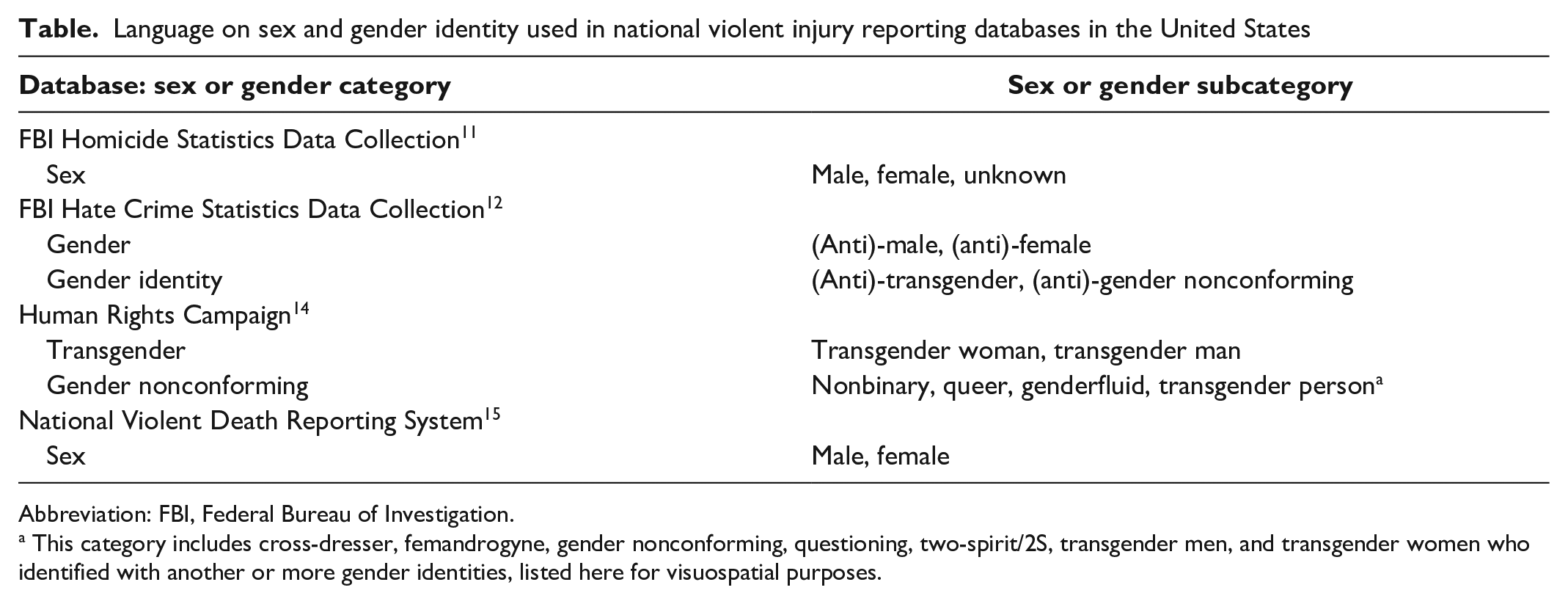
Abbreviation: FBI, Federal Bureau of Investigation.
This category includes cross-dresser, femandrogyne, gender nonconforming, questioning, two-spirit/2S, transgender men, and transgender women who identified with another or more gender identities, listed here for visuospatial purposes.
Beyond deficits in demographic identification in transgender communities, the HCDC does not include the kinds of contextual details about violent injuries that the HDC includes. The type of weapon used to conduct the homicide (eg, firearm, knife/cutting instrument, personal weapons), the victim’s relationship to the offender, and the victim’s circumstances (ie, context at time of homicide) are all categories of the HDC that are not available in the FBI data on hate crime. These categories give valuable insight into the mechanism and circumstances of injury, which are essential to developing community-based preventive interventions.
Many advocates for transgender rights have also noted concern with the underreporting of transgender homicides and violent injuries by local and federal law enforcement agencies. The FBI UCR program and NVDRS receive information from law enforcement agencies that have disparate practices in reporting and identifying transgender and nonbinary victims. These disparate practices are evidenced in the differences between the Human Rights Campaign (HRC) reporting of fatal violence against the transgender and nonbinary communities as compared with the HCDC reporting of this violence (Figure). In 2021, for example, the HRC estimated that at least 59 transgender and nonbinary people were murdered, while the HCDC indicated that 2 transgender people were murdered in that year. 14 These kinds of differences may be attributable to the HRC’s approach to collecting data on homicide victims. The HRC gathers information through daily monitoring of reports by community advocates, media outlets, direct contacts, and law enforcement agencies. Furthermore, the organization reports only on murders of transgender and nonbinary people that occur in the United States and US territories and have been confirmed by law authorities or news media reports.
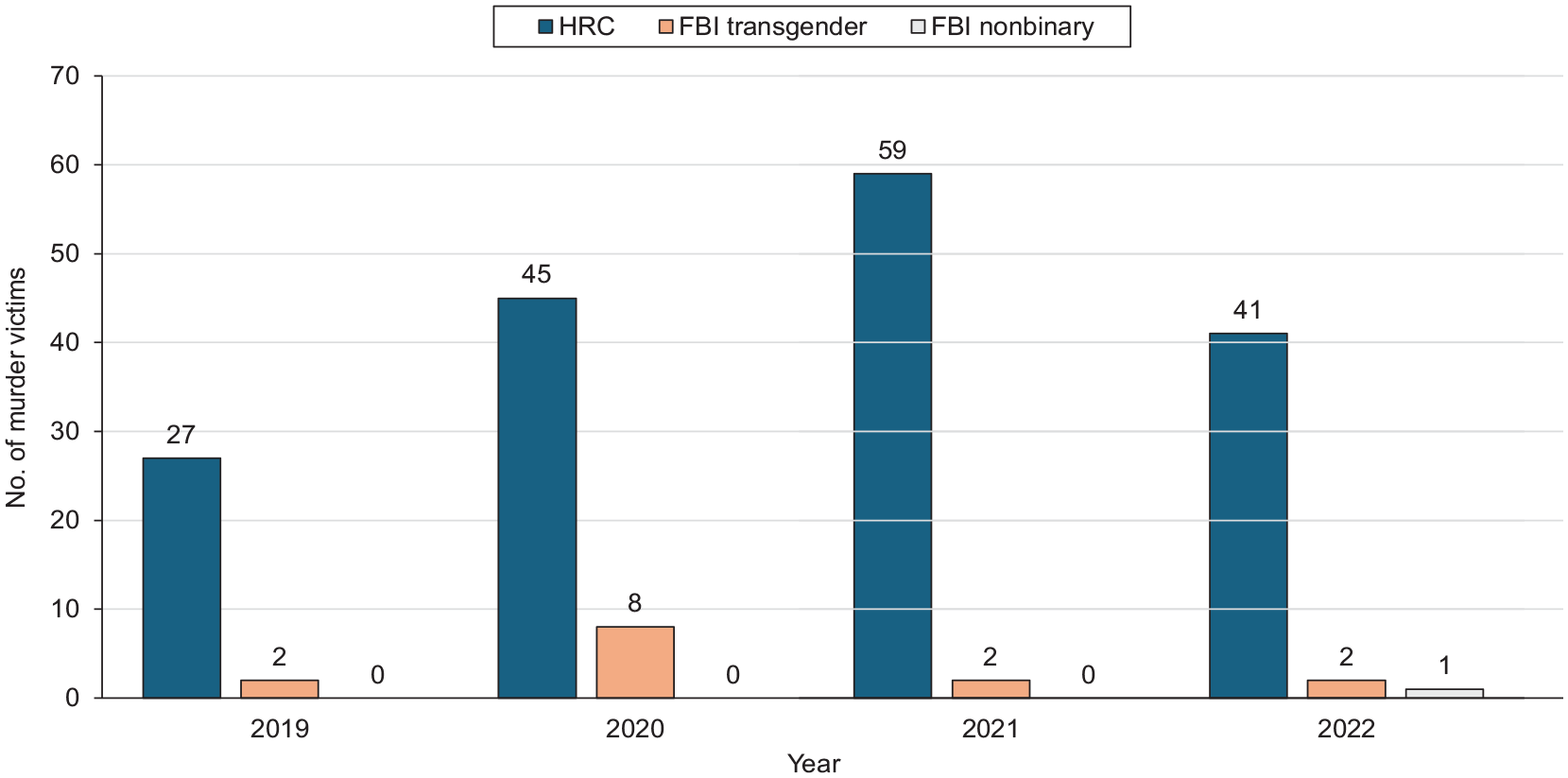
Number of murders of transgender and nonbinary people, United States, 2019-2022. The Human Rights Campaign (HRC) includes transgender and nonbinary murders 14 ; the Federal Bureau of Investigation (FBI) Hate Crime Statistics Data Collection includes transgender murder and nonnegligent manslaughter of transgender victims; and FBI nonbinary includes murder and nonnegligent manslaughter of gender-nonconforming victims. Although the figure indicates “nonbinary,” the FBI Hate Crime Statistics Data Collection uses “gender nonconforming.” 12
Room for Improvement
The FBI’s underreporting of violence against transgender people is explained in part by local law enforcement agencies having limited structures for reporting on crimes against transgender people beyond reporting on gender identity–motivated crimes. 5 The lack of reporting by the NVDRS on gender identity is also linked to its information sources. The NVDRS compiles information submitted by law enforcement agencies, coroner/medical examiner reports, and toxicology reports, and the system’s data on gender identity are based on what these various reports indicate. Therefore, the lack of gender-inclusive national databases is more understandable given the constraints in receiving gender-inclusive data from primary reporting agencies, such as hospitals. Even with required sexual orientation and gender identity reporting in hospitals, information on gender identity was missing for >60% of patients in one study. 16 Across law enforcement agencies, medical examiners/coroners, and health care providers, it is necessary to include gender-inclusive language that goes beyond collecting information on sex or gender binaries. Inclusion of this language can be achieved through requiring these agencies to have mandatory reporting of gender identity, providing guidelines on how to collect information on gender identity that is specific to each agency, and including transgender and nonbinary individuals in the creation and implementation of these interventions.
The goal of the NVDRS is “to help find ways to prevent violent death” through “information about the ‘who, when, where, and how’ from data on violent deaths and provide insights about ‘why’ the deaths occurred.” 15 In alignment with its mission, these databases must also be able to identify the “who, when, where, how, and why” for transgender populations so that effective violence prevention measures can be developed for those most affected by violence in this population.
Footnotes
Declaration of Conflicting Interests
The authors declared no potential conflicts of interest with respect to the research, authorship, and/or publication of this article.
Funding
The authors received no financial support for the research, authorship, and/or publication of this article.
