




Abstract
Objectives:
The relationship between the onset of the COVID-19 pandemic and interest in master of public health (MPH) programs is unknown. We examined trends in MPH application rates for 31 MPH concentrations and specifically for the MPH concentration in epidemiology and differences by race and ethnicity before and after the onset of the COVID-19 pandemic.
Methods:
We constructed a quasi-experimental design to examine trends in MPH application rates from academic years 2015-2016 through 2022-2023 by using Centralized Application Service for Schools and Programs of Public Health data. We used an interrupted time-series analysis to test whether application rates surged after the pandemic’s onset (academic years 2019-2020 through 2020-2021) and whether this increase persisted during the pandemic (academic years 2020-2021 through 2022-2023). We fit models for the overall sample, a combined racially and ethnically minoritized sample, each racial and ethnic group separately, and a non–US citizen sample.
Results:
The pandemic’s onset correlated with an immediate increase in application rates across most samples: overall (38%) and among American Indian/Alaska Native/Native Hawaiian/Pacific Islander (91%), Asian (35%), Black (42%), Hispanic (60%), multiracial (30%), racially and ethnically minoritized (44%), and White (53%) samples. However, this trend was not sustained; application rate trends during the pandemic were significantly lower than prepandemic trends. Application rate trends for all MPH concentrations and the MPH in epidemiology concentration among non–US citizens were significantly higher during the pandemic than prepandemic.
Conclusions:
Our results highlight the need for innovative strategies to sustain MPH degree interest and a diverse applicant pool.
Keywords
During the COVID-19 pandemic, public health students had real-world examples of disease transmission concepts that they learned. 1 Consequently, students helped with conducting COVID-19 testing, performing contact tracing, and developing data visualizations for case statistics.1,2 This enthusiasm aligned with an application surge for graduate public health degree programs3,4—what many call the “Fauci effect,” 5 for Dr Anthony Fauci, a lead member of the White House Coronavirus Task Force. Despite an increase in graduate applications, 3 no empirical evidence exists on whether this trend persisted over time and among all racial and ethnic groups.
Examining this topic is crucial, because ethnically and racially minoritized individuals are underrepresented in graduate degree programs, tenured faculty positions, and leadership roles in core public health disciplines.6-14 Moreover, the pandemic worsened health inequities; socially marginalized groups had reduced access to care and high rates of hospitalization and death.15-19 For example, Black patients had 2.7 times higher odds of being hospitalized for COVID-19 than White patients. 15 Addressing this persistent issue in public health and improving population health requires recruiting, training, retaining, and promoting more people from socially marginalized communities. 20 Potential solutions include eliminating barriers for socially minoritized individuals and creating additional pathways to enter graduate public health degree programs.21-23 However, more empirical evidence is needed to substantiate these efforts.
The onset of the COVID-19 pandemic provided a unique analytic opportunity to evaluate the association between the pandemic’s onset and interest in master of public health (MPH) programs. We conducted a quasi-experimental study by using data from academic years 2015-2016 through 2022-2023 from the Centralized Application Service for Schools and Programs of Public Health (SOPHAS). Our primary objective was to compare trends in MPH application rates before and after the pandemic’s onset. We developed the following research questions to guide our data analysis: (1) Did the rate of MPH applications rapidly increase following the pandemic’s onset? (2) Did the trends in MPH application rates remain consistent between the prepandemic years and the pandemic years? and (3) Was there racial and ethnic variation in trends in MPH application rates before and after the pandemic?
We explored these research questions for all MPH concentrations and specifically for the MPH in epidemiology concentration. With application count characterized as the total number of applications submitted from any individual and application rates defined as the number of applications per Association of Schools and Programs of Public Health (ASPPH) member institution, we hypothesized that the pandemic’s onset was associated with a rapid increase in the rate of applications. However, using historical ASPPH trends, we hypothesized that this increase was not sustained, particularly among racially and ethnically minoritized groups. Insights could guide future decisions in public health admissions, including the elimination of the Graduate Record Examination requirement.24,25 Ultimately, this research will contribute to cultivating a racially and ethnically diverse public health workforce and to improving global public health outcomes.
Methods
Study Design and Setting
We used SOPHAS data to conduct a retrospective study of MPH applications from academic years 2015-2016 through 2022-2023. We noted that SOPHAS data include approximately 80% of applications submitted to ASPPH member institutions and that not all member institutions use SOPHAS for admissions (Table 1). We considered the single-group quasi-experimental design that we constructed with the data suitable for several reasons.26,27 First, a real-world event (COVID-19) occurred at a clearly defined time point, allowing for a pre–post-event setup.26,28-31 Second, we evaluated the relationship between the pandemic’s onset and a population-level outcome.26,28-31 Third, we had measures of MPH application counts at evenly spaced intervals (per academic year) before and after onset of the COVID-19 pandemic.26,28-31 We analyzed aggregate data but not person-level data. We followed the Strengthening the Reporting of Observational Studies in Epidemiology guidelines. 32 This project did not involve human data or participants; therefore, the New York University Institutional Review Board determined that assessment by the institutional review board was not necessary.
Number of master of public health applications to schools and programs of public health, academic years 2015-2016 through 2022-2023, United States a

Abbreviations: ASPPH, Association of Schools and Programs of Public Health; MPH, master of public health; SOPHAS, Centralized Application Service for Schools and Programs of Public Health.
Data were collected from SOPHAS.
Measures
In the analytic dataset, we included the MPH submission cycle, MPH concentration, race and ethnicity, count of ASPPH member institutions using SOPHAS for MPH admissions, and number of MPH applications. For the primary analysis, we focused on the overall MPH concentration sample, aggregating 31 MPH concentrations, which included the MPH in epidemiology concentration. For the secondary analysis, we focused on the MPH in epidemiology concentration, as we hypothesized that the pandemic stimulated interest in learning about and implementing epidemiological concepts. For categorical measures of race and ethnicity, we examined applications from those who identified as American Indian/Alaska Native, Asian, Hispanic/Latinx (Hispanic), Native Hawaiian/Pacific Islander, non-Hispanic Black/African American (Black), non-Hispanic White (White), or multiracial (applications from those who identified as ≥2 races). We combined American Indian/Alaska Native and Native Hawaiian/Pacific Islander because of small values. We also examined data on non–US citizens, who were not included in the aforementioned racial and ethnic groups.
Analytic Strategy
We used an interrupted time-series analysis with segmented regression to formally test whether annual application rates surged shortly after the onset of COVID-19 (academic years 2019-2020 to 2020-2021) and whether this increase persisted during the pandemic period (academic years 2020-2021 through 2022-2023). This approach has been applied to assess the effects of public health interventions, labor strikes, financial crises, and vaccine mandates.33-37 We fit quasi-Poisson regression models to allow for overdispersion and computed robust SEs. 28 We inspected residual plots and used the partial autocorrelation function in R (R Foundation for Statistical Computing) to assess autocorrelation. 28 We fit segmented regression models for the overall sample, a combined racially and ethnically minoritized sample, each racial and ethnic group separately, and a non–US citizen sample. We analyzed the racially and ethnically minoritized sample to examine the trend of a combined group (American Indian/Alaska Native/Native Hawaiian/Pacific Islander, Asian, Black, Hispanic). We used R version 4.3.0 for statistical analyses. We determined significance at P < .05 by using 2-sided tests.
Results
Trends During the Prepandemic Period, 2015-2016 Through 2019-2020
Notable are the significant average annual decreases in MPH application rates (all MPH concentrations) among the overall (−5%), American Indian/Alaska Native/Native Hawaiian/Pacific Islander (−12%), Asian (−3%), White (−5%), and non–US citizen (−6%) samples during the prepandemic period (Table 2). The average annual rate of non–US citizen applications for the MPH in epidemiology concentration also significantly decreased (−2%). However, average annual application rates for the MPH in epidemiology concentration among Black (8%), Hispanic (7%), and multiracial (8%) samples significantly increased. Average annual MPH application rates during the prepandemic period did not change significantly for the remaining samples.
Changes in rate of MPH applications to ASPPH member schools and programs of public health by race and ethnicity before and after the onset of the COVID-19 pandemic, academic years 2015-2016 through 2022-2023, United States a

Abbreviations: AI/AN/NH/PI, American Indian/Alaska Native/Native Hawaiian/Pacific Islander; ASPPH, Association of Schools and Programs of Public Health; MPH, master of public health.
Data were collected from the Centralized Application Service for Schools and Programs of Public Health.
Estimated from the segmented regression model.
All MPH concentrations include the MPH in epidemiology concentration.
Indicates significance at P < .05 (2-sided test).
Racially and ethnically minoritized sample included applicants who identified as Black, Hispanic/Latinx, Asian, American Indian/Alaska Native, and Native Hawaiian/Pacific Islander. Multiracial sample included applicants who identified as ≥2 races.
Trends Immediately After the Onset of COVID-19, 2019-2020 to 2020-2021
The pandemic’s onset was associated with significant increases in MPH application rates (for all MPH concentrations and for the MPH in epidemiology concentration) across many samples (Table 2). Annual application rates increased among the overall (38% increase; Figure), American Indian/Alaska Native/Native Hawaiian/Pacific Islander (91% increase), Asian (35% increase), Black (42% increase), Hispanic (60% increase), multiracial (30% increase), racially and ethnically minoritized (44% increase), and White (53% increase) samples. With the exception of the multiracial sample, annual application rates for the MPH in epidemiology concentration increased significantly among all other samples: 33% for overall, 111% for American Indian/Alaska Native/Native Hawaiian/Pacific Islander, 46% for Asian, 43% for Black, 43% for Hispanic, 44% for racially and ethnically minoritized, and 47% for White. Annual application rates did not change significantly among the non–US citizen sample (all concentrations: 10% increase; epidemiology concentration: 15% increase) or among the multiracial sample for the MPH in epidemiology concentration (4% increase).
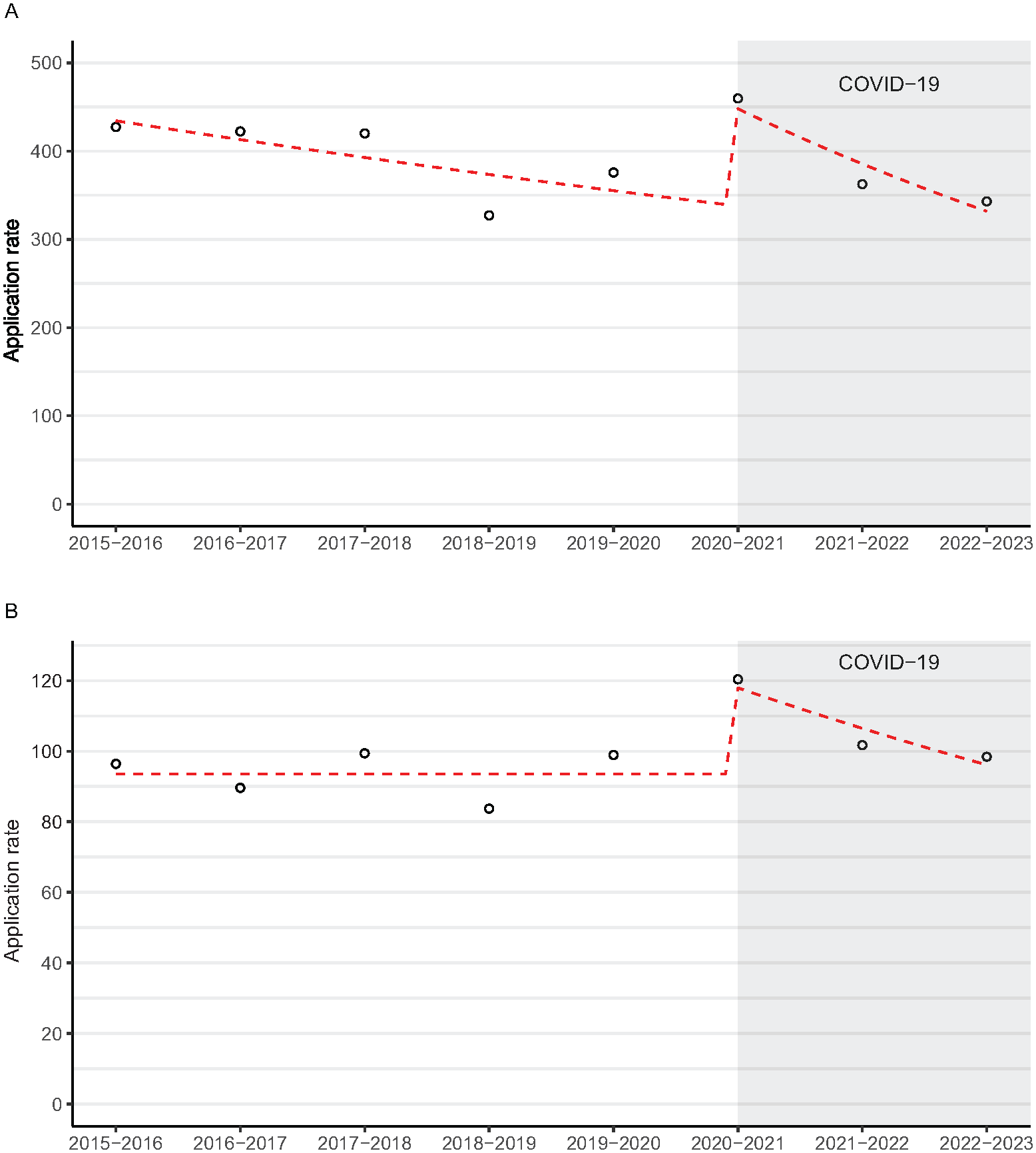
Observed points (circles) and predicted trends (dashed lines) in (A) overall MPH applications and (B) MPH applications for the epidemiology concentration at ASPPH member schools and programs of public health, academic years 2015-2016 through 2022-2023, United States. Data were collected from the Centralized Application Service for Schools and Programs of Public Health. Application rate was defined as the number of applications per ASPPH member institution. Abbreviations: ASPPH, Association of Schools and Programs of Public Health; MPH, master of public health.
Trends During the Pandemic Period, 2020-2021 Through 2022-2023
The increasing trend in MPH application rates after the pandemic’s onset was not sustained across many samples (Table 2). For all MPH concentrations, average annual application rates decreased significantly from the prepandemic period to the pandemic period among all samples, with percentage-point differences of −10 for overall, −25 for American Indian/Alaska Native/Native Hawaiian/Pacific Islander, −11 for Asian, −23 for Black, −27 for Hispanic, −14 for multiracial, −19 for racially and ethnically minoritized, and −25 for White samples. Similar patterns of significantly lower annual application rates for the MPH in epidemiology concentration were shown among all samples except among American Indian/Alaska Native/Native Hawaiian/Pacific Islander, with percentage-point differences of −10 for overall, −15 for Asian, −40 for Black, −30 for Hispanic, −19 for multiracial, −26 for racially and ethnically minoritized, and −30 for White samples. In contrast, in the non–US citizen sample, the application trend was significantly greater during the pandemic period than during the prepandemic period (percentage-point difference of 16 for all MPH concentrations and 18 for the epidemiology concentration).
Discussion
We evaluated the relationship between the onset of the COVID-19 pandemic and interest in the MPH degree by using retrospective data. Specifically, we constructed a quasi-experimental design of SOPHAS applications (for all MPH concentrations and specifically for the MPH in epidemiology concentration) received from academic years 2015-2016 through 2022-2023. We confirmed our hypothesis that the pandemic’s onset was associated with an immediate increase in the rate of applications across most samples (overall, American Indian/Alaska Native/Native Hawaiian/Pacific Islander, Asian, Black, Hispanic, racially and ethnically minoritized, and White) for all MPH concentrations and for the MPH in epidemiology concentration. However, the positive association of the pandemic’s onset was not sustained; rates decreased significantly for many samples during the middle and later years of the pandemic versus the prepandemic period. However, application rates for all MPH concentrations and for the MPH in epidemiology concentration among non–US citizens were significantly higher during the pandemic period than prepandemic.
Our findings are consistent with recent results.38,39 Rahbar et al 38 found that the proportion of underrepresented minority applicants to biomedical engineering graduate programs increased by 5 percentage points (from 17% to 22%) from 2019 through 2021 and the proportion of international applicants increased by 8 percentage points (from 30% to 38%) during the same period. Pharmacy graduate programs at the University of North Carolina Eshelman School of Pharmacy had a 59.1% year-over-year increase in applications and a 9.8% year-over-year increase in underrepresented applicants during the 2020-2021 admission cycle. 39 Small percentage increases followed in the 2021-2022 admission cycle (applications and underrepresented applicants, with 1.6% year-over-year growth). 39 As more admissions data become available, more studies are needed to determine how COVID-19 affected interest in public health education. Furthermore, datasets that allow analysis of applications from students from underrepresented, socially marginalized, and low socioeconomic status backgrounds are needed to study the effects of public health emergencies, such as COVID-19, on enhancing the public health workforce capacity.40-42
The increase in applications to MPH programs among non–US citizens must be acknowledged for several reasons. First, the increase in non–US citizen applications may affect access to higher public health education in the United States for lower-income and racially and ethnically minoritized US populations. 43 Second, the recent change to science, technology, engineering, and mathematics designations in many MPH programs may have led to increases in non–US citizen applications and changes in MPH curriculum and program emphasis. 44 Another factor that may have affected our findings is the changes to US policies for non–US citizen graduate school enrollments and visa requirements enacted by the 2020 US administration. 43
In a recent commentary that discussed the public health implications of the 2023 Supreme Court ruling on race-conscious admissions, 23 Bather et al suggested strategies to boost and sustain interest in MPH programs. These strategies include creating educational partnerships between highly and less selective institutions and establishing more pipeline programs. 23 Furthermore, Bather et al recommended crafting pedagogical philosophies and practices based on principles of universal design 23 —an inclusive design framework that addresses needs regardless of socioeconomic background, disability status, or learning ability. 45 Additional mechanisms to increase interest in MPH programs include creating and expanding dual-degree partnerships with schools of medicine, dentistry, social work, education, public policy, design, business, divinity, engineering, and law.46,47 For example, alumni of a dual pediatric dentistry/MPH program overwhelmingly reported that the program was worthwhile, and they could readily apply the public health content to their dental practice. 48 In this example, the MPH program was fully funded and followed an executive MPH format of 1 weekend per month for 2 years, allowing students to complete the dual degree without increasing their time in the program or incurring additional costs. 48 These considerations will be important to ensure that racially and ethnically minoritized and economically disadvantaged students can access and benefit from these programs. Combining the expertise of these professions with an MPH can spur innovative solutions to tackle local, regional, and national public health issues.
Undergraduate institutions and community-based organizations are underused resources with much to contribute to public health.49-52 Collaborations between universities and community-based organizations can help undergraduate students and community members conceive research ideas, conduct statistical analyses, and develop manuscripts. In addition, leveraging the social media skills of undergraduates and community members can help create public health content (eg, data visualizations, infographics) for individuals in their social network.53,54 These service-learning models for public health undergraduates are growing in popularity and have been deemed a high-impact educational practice by the American Association of Colleges and Universities. 55 At least 1 study provided empirical support for the effectiveness of this pedagogy for promoting student learning and fulfilling the foundational accreditation domains of the Council on Education for Public Health. 55 Such strategic initiatives hold promise to foster an early interest in MPH programs through nontraditional channels. Engaging students early in the academic pipeline can foster novel idea generation that will advance public health science and improve global health outcomes.
Funding sources are necessary to achieve the desired effects of these collaborations.1,56 Sponsors are needed to fully fund MPH scholarships, pilot research grants for student-led projects, and conference travel awards for students from all backgrounds. Historically, increased funding has proven effective.1,46,57-59 Private foundations (eg, The Rockefeller Foundation) in the 1900s funded schools of public health, contributing to the exponential growth of the field.1,46,57,58,60 Government financial support, such as that provided by the Hill-Rhodes Act in 1960, 61 resulted in an application surge to schools of public health.46,62 Other stimulants of increased federal support included the AIDS epidemic (1980s and 1990s), Harold Varmus’ public health lobbying (1990s), and bioterrorism (2000s).59,61 Adequate public health funding should not have to rely on sudden global health threats or public health leaders authoring commentaries in peer-reviewed journals. 59 Funders such as the US Public Health Service, Robert Wood Johnson Foundation, Bloomberg Foundation, and Bill & Melinda Gates Foundation have led the charge in providing financial support for a wide range of public health issues. 61 Additional philanthropic and governmental funders are needed to support research related to persistent health threats (eg, the opioid crisis, legal intervention deaths) affecting racially and ethnically minoritized communities.63-68 As a result, graduate students from socially marginalized backgrounds may pursue these research areas and encourage others from their communities to pursue public health careers.69,70
Limitations and Strengths
Our study had several limitations. First, enrollments were not addressed, warranting future investigations on the relationship between the onset of COVID-19 and enrollments in public health graduate programs. Second, many programs accredited by the Council on Education for Public Health are not ASPPH members, warranting replicate analyses among these programs. Third, future studies should evaluate whether our findings hold by incorporating more time periods after the pandemic’s onset and by accounting for fixed effects at the state and national levels. Fourth, we could not account for the few individuals who submitted multiple applications across different cycles. Fifth, we did not analyze other epidemiology degrees (eg, master of science), which is an avenue for future research. Sixth, we did not consider other events in 2020 that may have affected application rates, such as the change in the US administration and the murders of Breonna Taylor, Ahmaud Arbery, and George Floyd.71,72 Seventh, we did not examine other minoritized populations, including sexual and gender minorities, applicants with low socioeconomic status, first-generation applicants, and individuals with disabilities. Eighth, our analysis was based on data from ASPPH member institutions that used SOPHAS, representing about 80% of annual application counts. Potential biases may have arisen because schools and programs of public health that use SOPHAS may differ from institutions that do not. Because of unavailable data, we also could not account for nonaccredited and non–ASPPH member institutions. Ninth, we did not explore the other 30 disaggregated MPH concentrations, which were outside the scope of this analysis. We recommend this investigation as an avenue for future research because racial and ethnic composition may differ significantly by MPH concentration. Finally, we did not analyze heterogeneity within racial and ethnic groups (eg, Cuban, Dominican).
Our study also demonstrated several strengths. First, we used an interrupted time-series design, a robust quasi-experimental research approach for assessing the longitudinal trend of a real-world event in a nonrandomized setting.26,28-31 This design minimizes internal validity threats (eg, history, maturation), accounts for temporal trends, and reduces confounding bias.26,28-31 In addition, this design allowed us to investigate heterogeneity in MPH application rates across racial and ethnic groups through stratified analyses. Other notable strengths included using all available data from application cycles spanning from 2015-2016 through 2022-2023 and adjusting for changes in the number of ASPPH member institutions that used SOPHAS over time. We also conducted a sensitivity analysis of the racially and ethnically minoritized sample (excluding the Asian sample); estimates were relatively similar. We performed a secondary sensitivity analysis for applicant rates (eSupplement). We defined applicants as unique individuals and measured applicant rates based on the number of applicants per ASPPH member institution. This secondary sensitivity analysis yielded no meaningful differences relative to the primary aggregate analysis of application rates.
Conclusions
With the use of routinely collected SOPHAS data, we estimated the association between the onset of the COVID-19 pandemic and application rates for all MPH concentrations and specifically for the MPH in epidemiology concentration. We observed a rise in MPH application rates, which may suggest an increased awareness of public health’s role during health crises. However, it is important to note that other fields, such as pharmacy, also experienced significant application increases.38,39 Our study, limited to application data, cannot definitively make conclusions about the MPH degree’s perceived value or long-term implications for the public health workforce. Further research incorporating acceptance rates, enrollment figures, and graduate outcomes would be necessary to fully understand these trends and their potential effect on the field.
Supplemental Material
sj-docx-1-phr-10.1177_00333549241288140 – Supplemental material for An Immediate but Fleeting Interest in MPH Programs After the Onset of COVID-19: An Interrupted Time-Series Analysis
Supplemental material, sj-docx-1-phr-10.1177_00333549241288140 for An Immediate but Fleeting Interest in MPH Programs After the Onset of COVID-19: An Interrupted Time-Series Analysis by Jemar R. Bather, Emily M. Burke, Christine M. Plepys, Janani Rajbhandari-Thapa, Debra Furr-Holden and Melody S. Goodman in Public Health Reports
Footnotes
Acknowledgements
The authors acknowledge the Association of Schools and Programs of Public Health (ASPPH) Data Advisory Committee for critical review and helpful comments on the concept paper for this article. We thank ASPPH for providing the data used in this study. We also thank ASPPH member schools and programs of public health that contributed data to this study. We thank Sharese Terrell Willis, PhD, ELS, of Doc’s Editing Shop, LLC, for providing editing assistance on an early draft.
Declaration of Conflicting Interests
The authors declared no potential conflicts of interest with respect to the research, authorship, and/or publication of this article.
Funding
The authors received no financial support for the research, authorship, and/or publication of this article.

Supplemental Material
Supplemental material for this article is available online. The authors have provided these supplemental materials to give readers additional information about their work. These materials have not been edited or formatted by Public Health Reports’s scientific editors and, thus, may not conform to the guidelines of the AMA Manual of Style, 11th Edition.
References
Supplementary Material
Please find the following supplemental material available below.
For Open Access articles published under a Creative Commons License, all supplemental material carries the same license as the article it is associated with.
For non-Open Access articles published, all supplemental material carries a non-exclusive license, and permission requests for re-use of supplemental material or any part of supplemental material shall be sent directly to the copyright owner as specified in the copyright notice associated with the article.
