




Abstract
In 2020, the Houston Health Department (HHD) in Texas launched a citywide wastewater surveillance program, including a pilot program that monitored manholes at schools in Houston’s largest school district (prekindergarten–12th grade). By 2022, the pilot program monitored wastewater for SARS-CoV-2, influenza A and B, and respiratory syncytial virus. To ensure effective communication of wastewater surveillance results to school communities, HHD designed and implemented a text- and email-based alert system using existing City of Houston resources. This alert program informs recipients about the presence of a virus at their schools and actions to protect themselves and others against that virus. To promote alert program sign-ups, a dedicated bilingual community involvement coordinator conducted in-person outreach geared toward school nurses and student caregivers. From September 2023 through February 2024, a combined 5178 alerts for 43 schools were sent following virus detections. As a supplemental initiative, HHD offered vaccination events to pilot program schools with consistent virus detection. As wastewater surveillance becomes more common across the United States, this alert program presents a framework for other public health agencies to scale and adapt according to their resources.
The Houston Health Department (HHD), partnering with Houston Public Works and Rice University, launched a wastewater surveillance program to monitor the spread and incidence of SARS-CoV-2 in Houston, Texas, in May 2020. Data from the wastewater surveillance program are used to inform various public health interventions and initiatives. The program was subsequently designated a National Wastewater Surveillance System Center of Excellence by the Centers for Disease Control and Prevention. 1
As part of its surveillance, HHD launched a pilot program in December 2020 to monitor wastewater from dedicated manholes associated with 51 schools in Houston’s largest public school district (prekindergarten–12th grade; hereinafter, the School District), which is also the largest school district in Texas.2,3 HHD selected schools for the pilot program from zip codes with the highest COVID-19 incidence from March through November 2020. The purpose of the pilot program was to provide information to school nurses and community members about the presence of SARS-CoV-2 in their schools based on wastewater detections. HHD staff emailed pilot program data to the School District’s nurse manager and made them available on a public dashboard. School nurses could use the data to inform decision-making about preventing the spread of the virus in their schools, and members of the school community could use the data to inform personal choices to protect their health. Influenza A and B (flu) and respiratory syncytial virus (RSV) were added to the pilot program in November 2021 and September 2022, respectively.
In October 2021, HHD, in partnership with Rice University, solicited feedback from School District administrators, teachers, staff, and student caregivers, as well as a school health expert advisory board, on how best to communicate pilot program data to the schools’ communities. Results indicated that additional methods were needed to disseminate the data more widely. 4 Inspired by HHD’s previous creation of an opt-in air pollution alert system for those at risk of asthma attacks, 5 HHD launched the School Virus Alert Program: a short message service (SMS) text- and email-based alert system that sends public health information derived from school wastewater data directly to individuals who enroll in the program. Alerts are coupled with free vaccine events at schools with positive virus detections in their wastewater, mitigating barriers to vaccine accessibility and creating opportunities to provide public health education in school communities.
Using existing City of Houston communication tools, the School Virus Alert Program delivers timely, concise, and actionable wastewater virus detection information and related vaccine event information, empowering recipients to protect themselves and others without having to seek out the information proactively. This system can be easily adapted for use by other jurisdictions (Figure).
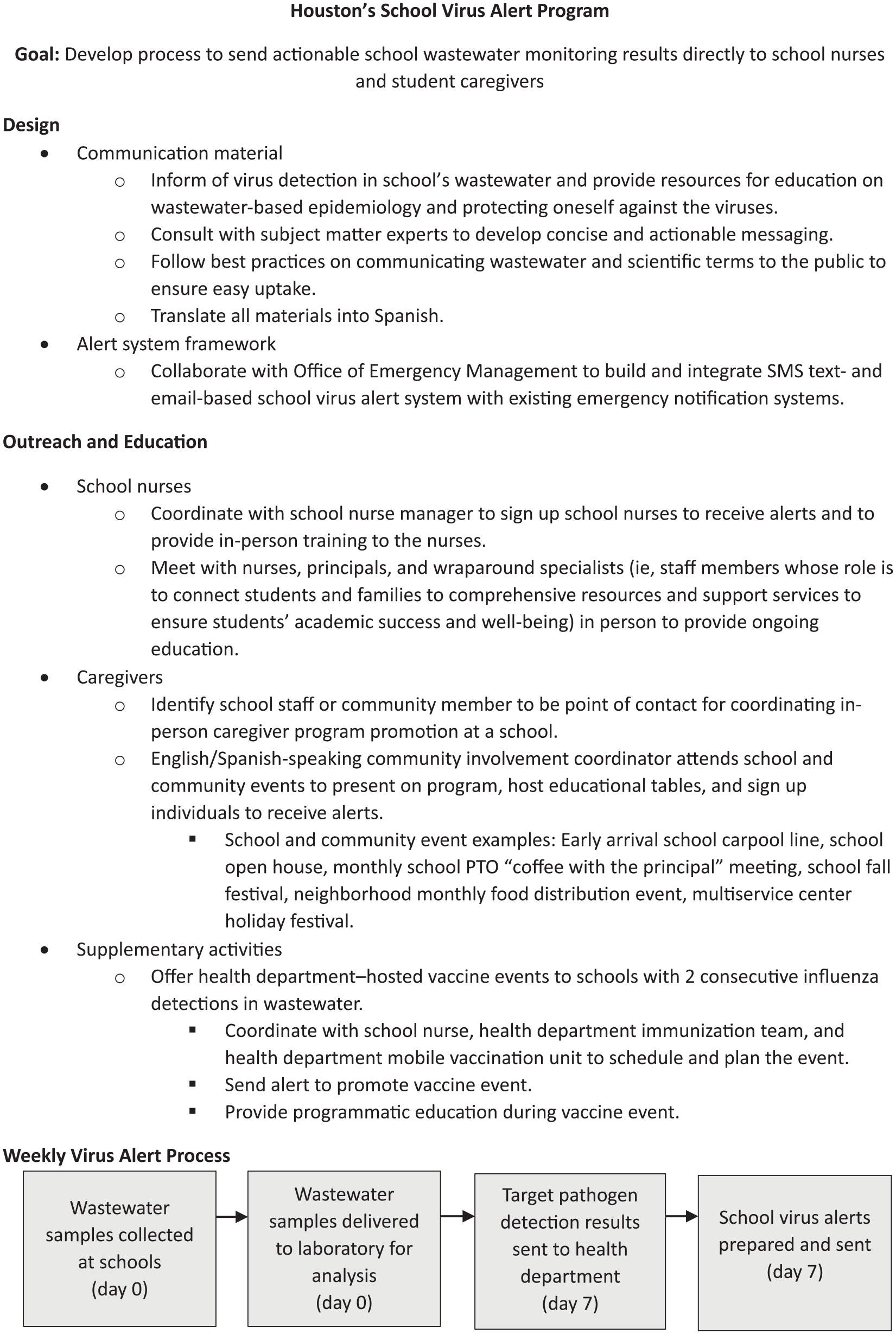
Design, outreach, and implementation of the School Virus Alert Programa during the 2023-2024 school year for COVID-19, influenza, and RSV monitoring, Houston Health Department, Houston, Texas. Abbreviations: PTO, parent-teacher organization; RSV, respiratory syncytial virus; SMS, short message service.
Methods
Development of Alert Program Framework
Each week, a composite wastewater sample is collected from a school’s dedicated manhole; analyzed in a laboratory to detect the presence of SARS-CoV-2, flu, or RSV; and reported as a positive, negative, or inconclusive test result. 2 HHD prepares a report of test results from all the schools in the pilot program, including a heat map showing results from each school over time so that nurses can observe trends across the group of schools. This report is distributed to the School District’s nurse manager, who shares it with participating school nurses. The school wastewater data are also displayed on HHD’s dashboard 6 and the School District’s COVID-19 dashboard. 7 This project did not involve individual human data or participants; therefore, per the guidelines of the Rice University Institutional Review Board, board assessment was not necessary.
Dashboards are a useful tool for distributing public health data, but they rely on users to seek out the data. Although the school wastewater data were displayed on 2 dashboards, student caregivers still needed to actively access these dashboards to retrieve their schools’ wastewater results. To improve the distribution and actionability of school wastewater data, HHD tailored the School Virus Alert Program toward school nurses and student caregivers—2 groups with the most direct influence on student public health behavior who had previously expressed interest in receiving additional information on school wastewater data. 4 HHD worked with Houston’s Office of Emergency Management, which sends official city emergency alerts, to identify the best platform for sending messages via SMS and/or email directly to school community members who wanted to receive alerts for a specified school or schools. The team selected the same critical event management platform (hereinafter, the vendor) that sends official emergency notifications for the City of Houston, as well as the aforementioned asthma-related air pollution alerts.
Next, HHD determined that alerts were triggered only by a positive test result from the wastewater of a school manhole. Negative or inconclusive results were still available in the weekly report sent to the School District’s nurse manager and posted to the dashboards. HHD consulted with Houston’s Public Health Authority and an infectious disease physician to develop language for the alerts and related program materials, ensuring that it was concise, actionable, and tailored to each pathogen.
Alert messages communicate a positive detection of a pathogen in a school’s wastewater, the most important actions to take in response to that detection (in order of priority), and a link to a dedicated HHD website with more detailed information. 8 The website includes educational material about the target viruses, wastewater monitoring, and links to related public health resources, such as where HHD offers COVID-19, flu, and RSV vaccinations. HHD crafted all program-related materials for easy understanding and uptake. For example, HHD swapped out scientific terms for more conversational words where appropriate (eg, “germ” and “virus” replaced “pathogen,” “target,” or “disease”; “poop” replaced “fecal matter”). 9 In addition, HHD used “wastewater monitoring” instead of “wastewater surveillance” to avoid “negative associations with invasion of privacy and spying.” 10
HHD translated all materials into Spanish, the second most-spoken language in Houston. 11 HHD’s communication team reviewed and approved the final wording for all materials (Table 1).
SMS text and email virus alert templates in English and Spanish from the School Virus Alert Program, a Houston Health Department, Houston, Texas, September 2023 through February 2024
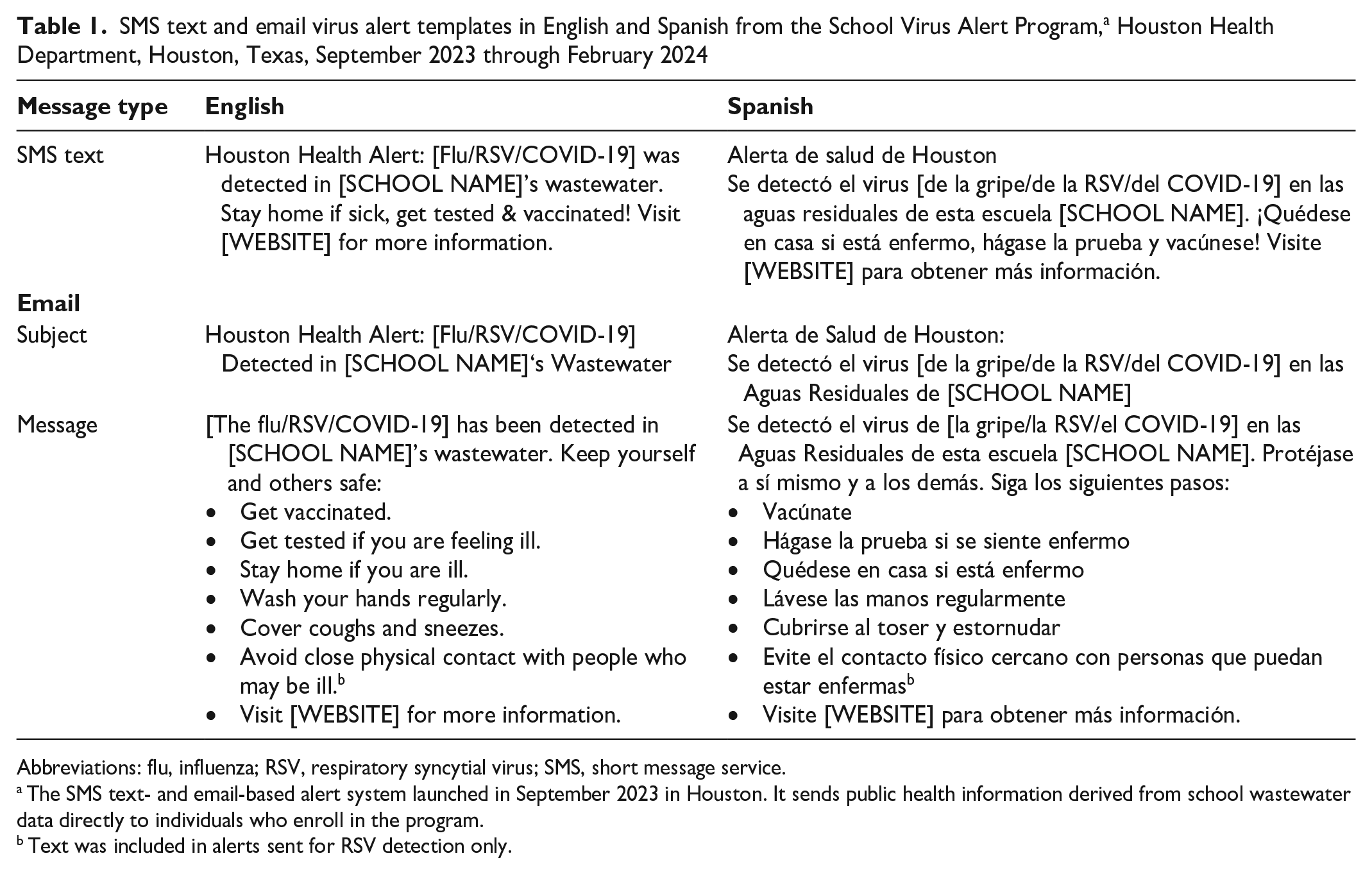
Abbreviations: flu, influenza; RSV, respiratory syncytial virus; SMS, short message service.
The SMS text- and email-based alert system launched in September 2023 in Houston. It sends public health information derived from school wastewater data directly to individuals who enroll in the program.
Text was included in alerts sent for RSV detection only.
Upon notification from the laboratory of a positive detection in a school’s manhole, HHD prepares an alert using the approved template for the detected pathogen and submits the alert on the vendor’s website. The vendor then delivers an SMS message and/or email to individuals who signed up to receive alerts for that school. HHD reports results for school manhole samples on Monday mornings, and alerts are sent within 3 hours of the report’s distribution.
School Outreach
HHD presented the School Virus Alert Program, as well as background information on wastewater-based epidemiology, to School District nurses at a staff in-service day before the 2023-2024 school year. HHD automatically enrolled nurses at all schools participating in the pilot program in the School Virus Alert Program via their School District email addresses.
To inform student caregivers about the program and encourage their participation, HHD worked with the School District’s communications team to post promotional flyers in participating schools and infographics on the School District’s social media platforms. To handle caregiver sign-ups, HHD also used a dedicated English/Spanish-speaking HHD community involvement coordinator with prior experience working directly with School District nurses.
To promote sign-ups for the School Virus Alert Program, the community involvement coordinator visited participating schools in person, attended one-on-one meetings with school principals, presented information at scheduled parent-teacher organization events, and managed tables at school festivals or neighborhood events.
Vaccine Events and Vaccine Event Alerts
When a school has 2 consecutive positive detections for the flu, the community involvement coordinator offers the school the opportunity to host a vaccine clinic in partnership with HHD. If the school accepts, the community involvement coordinator then works with the school’s nurse, HHD’s immunization team, and HHD’s mobile vaccination unit (MVU) to select a time and date at least 4 days out for hosting a vaccine event. The 4-day time frame allows adequate time for the immunization team to secure the necessary vaccines, for the MVU to assign staff to the event, and for the community involvement coordinator and school nurse to promote the event to the school community. HHD sends a vaccine event alert using the School Virus Alert Program to advertise the time and location of the vaccine event in English and Spanish.
At vaccine events, the MVU team offers attendees not just flu and COVID-19 vaccines but also vaccines for hepatitis A, hepatitis B, human papillomavirus, meningococcal, measles-mumps-rubella, polio, tetanus-diphtheria, tetanus-diphtheria-pertussis, and varicella.
Outcomes
From September 2023 through February 2024, target pathogens were detected in 254 wastewater samples, spanning 43 schools and resulting in 5178 alerts sent by the School Virus Alert Program (Table 2). From September 2023 through February 2024, the website was visited 2204 times. A total of 719 people signed up to receive alerts—43 school nurses, 219 school staff, and 467 members of the public. HHD staff manually entered 689 of 719 people (95.8%) who signed up to receive alerts; the remaining participants signed up individually online. Twelve participants unregistered by the end of the 2023-2024 school year, resulting in a 98% retention rate.
Number of schools (prekindergarten–12th grade) with positive pathogen detection in wastewater samples and corresponding alerts sent by the School Virus Alert Program, a Houston Health Department, Houston, Texas, September 18, 2023–February 12, 2024
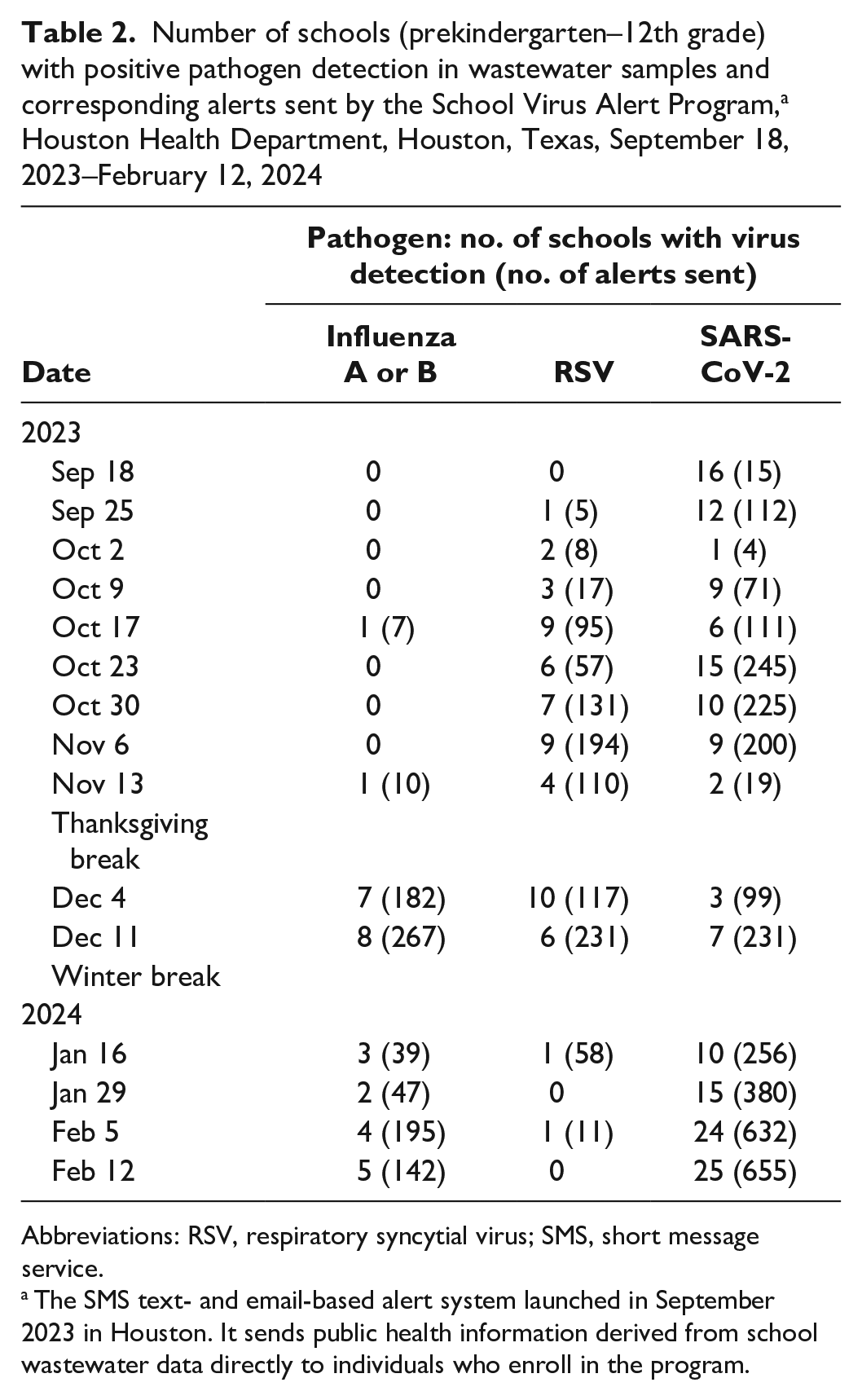
Abbreviations: RSV, respiratory syncytial virus; SMS, short message service.
The SMS text- and email-based alert system launched in September 2023 in Houston. It sends public health information derived from school wastewater data directly to individuals who enroll in the program.
The highest sign-up rates occurred at community-wide events that served multiple schools; the highest single-school sign-up rate occurred during an early arrival carpool line.
From September 2023 through February 2024, 7 schools had consecutive flu detections in their manhole wastewater samples. HHD hosted vaccine events in response to the consecutive flu detections at 4 of the 7 schools. While not the primary focus of the School Virus Alert Program, these events were a natural extension of the program’s public health objectives. At the events, the MVU team administered a total of 29 flu vaccines, 8 COVID-19 vaccines, and 98 routine vaccinations (24 meningococcal, 13 human papillomavirus, 12 tetanus-diphtheria-pertussis, 12 hepatitis A, 9 hepatitis B, 8 measles-mumps-rubella, 8 polio, 8 varicella, and 4 tetanus-diphtheria).
Lessons Learned
The primary challenges that HHD faced were associated with enrolling caregivers in the School Virus Alert Program. Based on knowledge gained from previous experience working with the caregivers of the pilot program schools, 4 HHD understood that this population preferred to receive public health information through in-person interactions, making it difficult to engage its interest in signing up for virus alerts through passive means such as posting printed materials on school notice boards or encouraging visits to the informational website. Accordingly, the most effective recruiting efforts involved face-to-face communication with HHD’s Spanish-speaking community involvement coordinator. Most sign-ups occurred when people wrote their contact information on the community involvement coordinator’s paper sign-up sheet rather than enrolling online via the program’s sign-up QR code. This type of grassroots outreach work necessitated physical access to school campuses and events where caregivers were present.
Explaining the School Virus Alert Program to caregivers presented another set of challenges. Through trial and error, the community involvement coordinator learned that references to wastewater in her sales pitch about the program were confusing. Potential participants were more interested in obtaining information about viruses circulating in their school communities—not the process used to detect those viruses. As a result, the School Virus Alert Program eliminated the term “wastewater alerts” from its materials and interactions with school staff and student caregivers and replaced it with “virus alerts.”
These in-person interactions provided opportunities for the community involvement coordinator to educate caregivers about the viruses being monitored, particularly RSV and the new RSV vaccines, which were unfamiliar to many program participants. HHD hoped to amplify this messaging at vaccine events, but a lack of vaccine availability made it impossible to offer the RSV vaccines at such events.
The community involvement coordinator offered vaccine events to every school with consecutive flu detections in the manhole wastewater samples, but some schools opted not to host on-site events because school staff resources were limited.
As wastewater surveillance becomes more common in municipalities throughout the United States and around the world, developing systems to translate the data into meaningful public health actions will be important. HHD’s School Virus Alert Program succeeds in translating data into action by informing people about viruses circulating in their communities, empowering them to protect themselves and their children from illness, encouraging greater engagement with schools, triggering vaccination events, and educating people about infectious diseases and how to reduce their spread. The program outlined in this case study provides a framework for pairing existing municipal resources—in this case, the Houston Office of Emergency Management’s alert system with HHD’s wastewater surveillance program, immunization team, and MVU—to maximize the public health utility of wastewater data. HHD’s virus alert system is adaptable and scalable, making it a useful model for public health agencies of any size or resource level. Other organizations are invited to use these written materials or processes to develop their own wastewater-based virus alert programs.
Footnotes
Acknowledgements
The authors thank the following people for their support with the development and implementation of the School Virus Alert Program: Maria Murillo, BA, and Francesca Gastaldo, BA, Houston Health Department (HHD); Brent Taylor, BA, and Kenneth Cochran, BS, City of Houston Office of Emergency Management; the HHD immunization team; and the HHD Mobile Vaccination Unit.
Declaration of Conflicting Interests
The authors declared no potential conflicts of interest with respect to the research, authorship, and/or publication of this article.
Funding
The authors disclosed receipt of the following financial support for the research, authorship, and/or publication of this article: This article was funded in part by the City of Houston General Funds and the Epidemiology and Laboratory Capacity for Infectious Disease Cooperative Agreement through the Centers for Disease Control and Prevention (grant NU50CK000557-01-05).
