




Abstract
Objectives:
The Centers for Disease Control and Prevention (CDC) needs leaders at all levels who can address technical and adaptive challenges in a changing public health landscape. We assessed the feasibility of implementing an enterprise-wide leadership development model.
Methods:
In June 2023, we launched a pilot program, Learn and Lead, for nonsupervisory staff in early and mid-career levels. One hundred sixty-nine participants registered, and 149 completed at least 6 weeks of the 8-week program. We gathered quantitative and qualitative data through weekly electronic surveys and in-depth interviews. We calculated frequencies for closed-ended Likert-scale items and performed content analysis of open-ended items to assess most frequently mentioned themes. We based the pilot’s design on CDC’s leadership development framework to assess application of the framework and alignment of curriculum to the framework.
Results:
Three themes emerged: logistics and facilitation, leadership development curriculum, and making connections with self and others. Findings for logistics and facilitation highlighted preferences for course length, small breakout groups, mixed weeks, and value of staff support. Findings for the leadership development curriculum underscored the relevance of the US Office of Personnel Management’s fundamental competencies to leadership development. Findings for making connections with self and others supported the cohort model and the importance of networking.
Conclusions:
The pilot curriculum aligned well with the CDC leadership development framework. Feedback provided by pilot participants is being used to help shape CDC’s ongoing leadership development efforts.
To be effective in a constantly evolving landscape such as public health, leaders must be able to co-create, empower others, adapt to changing priorities, and hold themselves and others accountable for outcomes. 1 As noted in the Deloitte 2023 Global Human Capital Trends report, “Leadership is no longer contingent on position, hierarchy, or number of direct reports.” 1 In what the report calls a “boundaryless world,” where change is constant, “Leadership is less about formal authority and hierarchy and more about insight, personal accountability, connection to values, and action.” 1 For public health leaders, Glynn et al 2 noted, “Skills and aptitudes now extend beyond the traditional competencies to focus on strategic and systems thinking, communication, and translating science to policy.”
Globally, public health faced a major crisis of leadership during the COVID-19 pandemic.3-5 Health care systems and many leaders were unprepared to address a global emergency. 4 Nationally, leadership turnover during the pandemic exacerbated this crisis. 5 Effective leadership is needed at all levels of an organization to address such complex multifaceted challenges. 6 An additional concern faced by science-based public health organizations is the need to train scientific professionals for leadership roles for which they often have not been adequately developed. 7
Developing effective leaders is a top concern for organizations across sectors. 8 The federal system is no exception. The first priority of the Biden–Harris Administration’s President’s Management Agenda was “strengthening and empowering the federal workforce.” 9 In large public health organizations, or those with a large entry-level staff base, eligibility for a formal leadership role or leadership trainings can take years. For these organizations, beginning leadership development early in an employee’s career can help solidify skill acquisition and proficiency, ensure staff are prepared to lead from their current roles, and assess their aptitude and interest in future leadership roles. 10
In support of the President’s Management Agenda and in response to Employee Viewpoint Survey scores indicating a need for more training and leadership opportunities (Centers for Disease Control and Prevention [CDC], unpublished data), CDC began focusing on an enterprise leadership development initiative. This initiative is intended to ensure that all CDC employees can achieve the leadership competencies needed to address technical and adaptive challenges early in and throughout their careers. These adaptive, also termed wicked, challenges often have multiple ways they can be perceived or addressed. 11 Addressing these challenges requires not only subject matter and technical expertise but also broad-based leadership skills. 12 As noted by a leadership consultant and coach, “The skills of an effective leader radiate in all directions, and the sooner such leaders are developed, the more the organization benefits from all that they can contribute.” 13 As employees advance in an organization, skill sets must be enhanced and expanded to ensure effective leadership. Development of competent future leaders, therefore, must include a thoughtful, goal-oriented, competency-based program.
Methods
To assess the feasibility of identifying logistical and support needs to establish an enterprise-wide leadership development model, CDC launched a pilot program termed Learn and Lead: Developing Transformational Leaders (hereinafter, Learn and Lead). The pilot was virtual, cohort-based, held during 8 consecutive weeks (June 13–August 3, 2023), and open to nonsupervisory employees in General Schedule (GS) 5-11 position levels. This activity was reviewed by CDC, deemed not research, and conducted consistent with applicable federal law and CDC policy (#0900f3eb8223b7a3).
The first objective of Learn and Lead was to assess the relevance of fundamental leadership competencies for participants. Because GS 5-11 employees have not historically had access to CDC’s leadership development opportunities, the second objective was to build and enhance CDC’s leadership development curriculum aimed at this group.
We designed the pilot based on CDC’s leadership development framework (Figure), which guides leadership development at all staff levels. The pilot’s tiered framework delineates focus areas where competency-based leadership curriculum and skill-based opportunities can be centered (eg, focus area of core leadership in the Professional as Leader tier). We based the Learn and Lead curriculum on the first tier of the framework (core leadership) and on the US Office of Personnel Management Fundamental Competencies. 14 Notably, the framework includes exposure to supervision, management, and executive leadership. Management and leadership are conflated in many organizations; however, both require distinct and unique skills. 15 Providing CDC employees with the opportunity to understand both management and leadership roles at CDC early in their careers allows them to make informed decisions about their career paths.
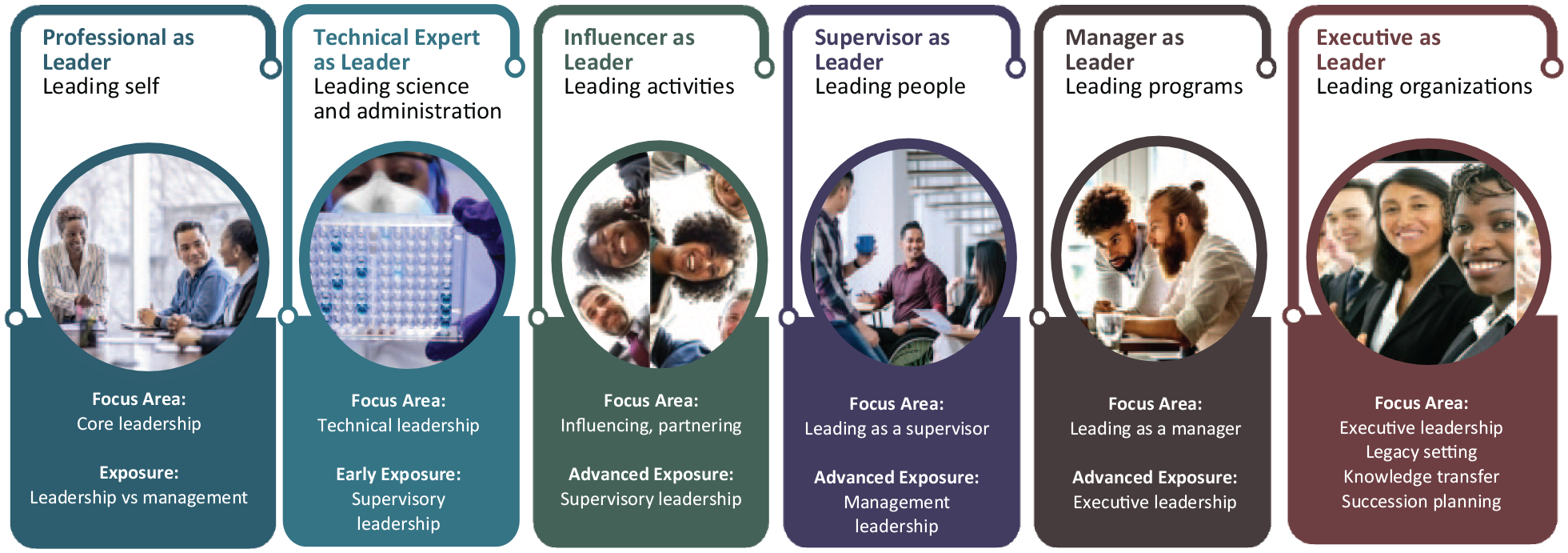
Centers for Disease Control and Prevention’s Leadership Development Framework.
We designed the Learn and Lead training plan (Table 1) to provide pilot participants with both knowledge and skill acquisition through reading, dialogue, role-playing, and small group and homework assignments. Odd-numbered weeks (ie, weeks 1, 3, 5, and 7) were led by an external training vendor, and participants attended sessions in their cohort by GS level (ie, 1 cohort of GS 5-8; 3 cohorts of GS 9-11). Even-numbered weeks were led by internal CDC training staff, and participants attended in mixed cohorts. Participation by cohort level on odd weeks allowed for discussion to be geared toward participants’ GS levels and shared experiences; mixed cohorts on even weeks facilitated cross–GS level learning and networking. We structured the final week of Learn and Lead to provide early exposure to what it means to supervise and manage at CDC and implemented it as a panel discussion with current CDC supervisors/managers who use leadership skills in their current roles.
Training plan for Learn and Lead: Developing Transformational Leaders, CDC, 2023 a
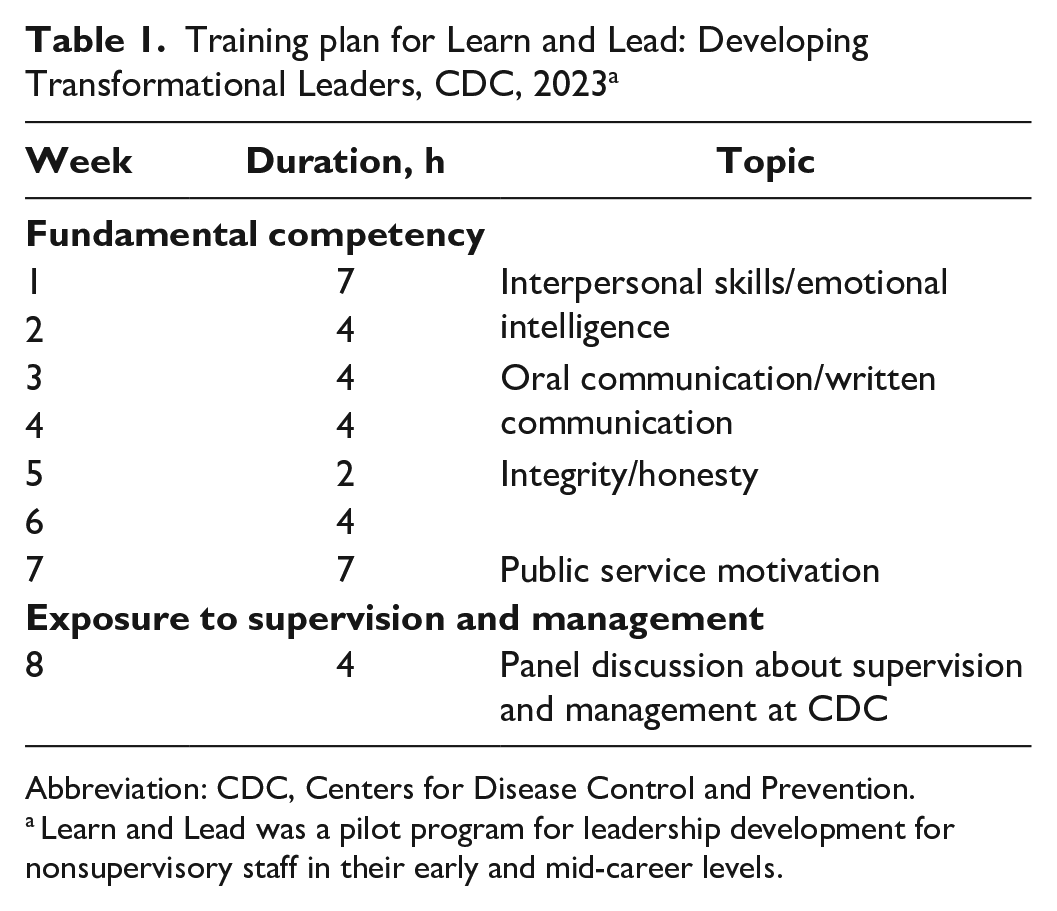
Abbreviation: CDC, Centers for Disease Control and Prevention.
Learn and Lead was a pilot program for leadership development for nonsupervisory staff in their early and mid-career levels.
Because of the large number of participants and the need for both large and small group discussions, we asked for volunteer co-facilitators via email to CDC employee working groups and workforce and career development specialists. Eighteen CDC senior leaders volunteered to help facilitate the small breakout discussion groups during the even weeks of Learn and Lead. For the small group sessions, we randomly assigned each co-facilitator to a virtual breakout room along with a small group (eg, 3-7) of pilot participants. Numbers in each room varied by how many co-facilitators were available for the session. Co-facilitators led discussions on program content and how it related to CDC. Many co-facilitators were professional coaches, and their expertise helped enhance small group discussions.
Before the pilot launch, all registered participants completed a baseline survey, which asked about the knowledge, skills, behaviors, and overall goals they wanted to achieve from participating in Learn and Lead. Responses included (1) leadership skills, (2) communication skills, (3) management/supervision skills and how to manage others, (4) interpersonal and emotional intelligence skills, (5) skills to help them be promoted to a higher position, and (6) increased confidence in one’s skills and abilities.
We used mixed methods to collect data throughout the pilot. Weekly, after each session, we sent that day’s participants an electronic survey to evaluate content delivery, relevance, and usability. In addition, during even weeks, we sent an email request to all participants to engage in a virtual interview to provide more in-depth feedback. Interviewers scheduled each interview with the individual participant. Participation in the evaluations was voluntary; therefore, findings were based on feedback from participants who responded to surveys or interviews.
Results
A total of 169 employees registered for Learn and Lead (Table 2). Most (82.8%; n = 140) participants identified as female, 49.1% (n = 83) as Black or African American, and 10.1% (n = 17) as Hispanic or Latino. Most participants (85.2%; n = 144) were in the GS 9-11 or US Public Health Service Commissioned Corps equivalent cohort, and more than half (51%; n = 86) represented 1 of 3 CDC centers, institute, and offices (National Center for Emerging and Zoonotic Infectious Diseases, Office of the Chief Operating Officer, and National Center for HIV, Viral Hepatitis, STD, and TB Prevention). Almost three-quarters of participants (n = 125) identified in 1 of 2 occupational series categories; 36.7% of participants (n = 62) reported their occupational series as general administrative, clerical, and office services, and an additional 37.3% (n = 63) as the medical, hospital, dental, and public health occupational series. Of the 169 participants who registered for Learn and Lead, 149 (88.2%) completed at least 6 weeks of the 8-week program.
Characteristics of participants registered for the Learn and Lead: Developing Transformational Leaders program pilot, CDC, 2023 a
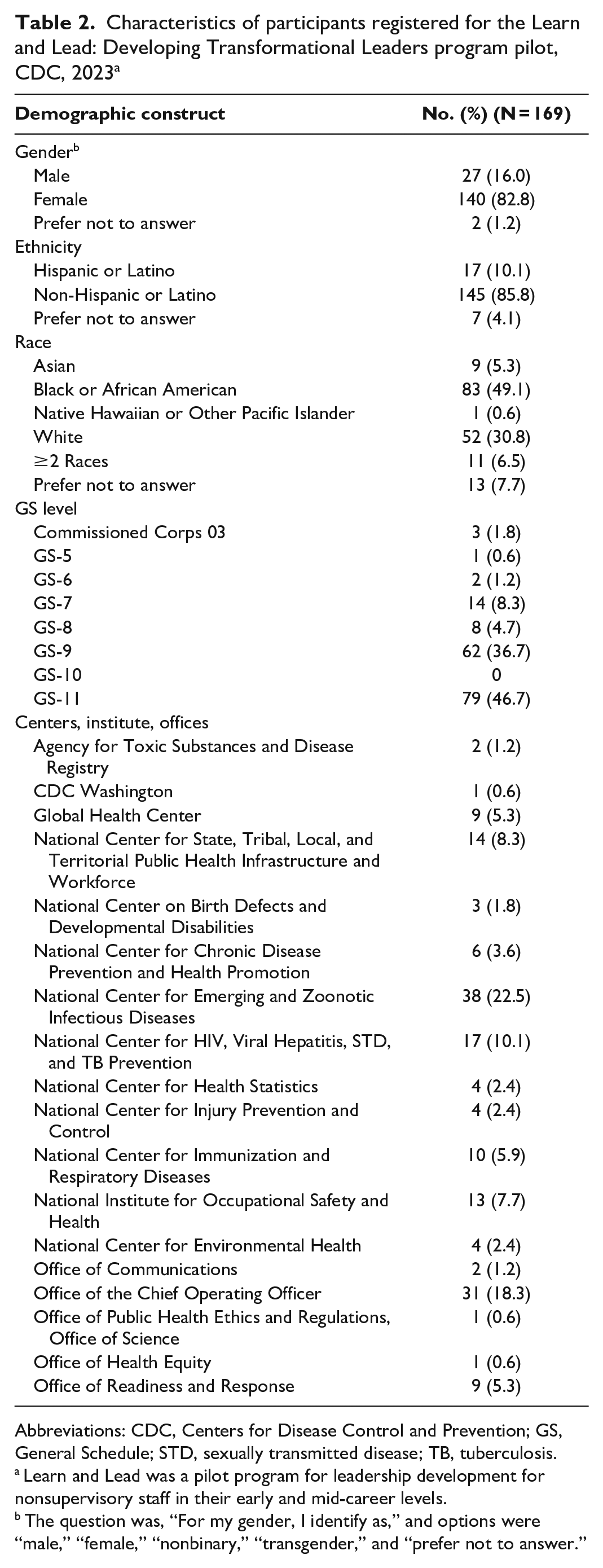
Abbreviations: CDC, Centers for Disease Control and Prevention; GS, General Schedule; STD, sexually transmitted disease; TB, tuberculosis.
Learn and Lead was a pilot program for leadership development for nonsupervisory staff in their early and mid-career levels.
The question was, “For my gender, I identify as,” and options were “male,” “female,” “nonbinary,” “transgender,” and “prefer not to answer.”
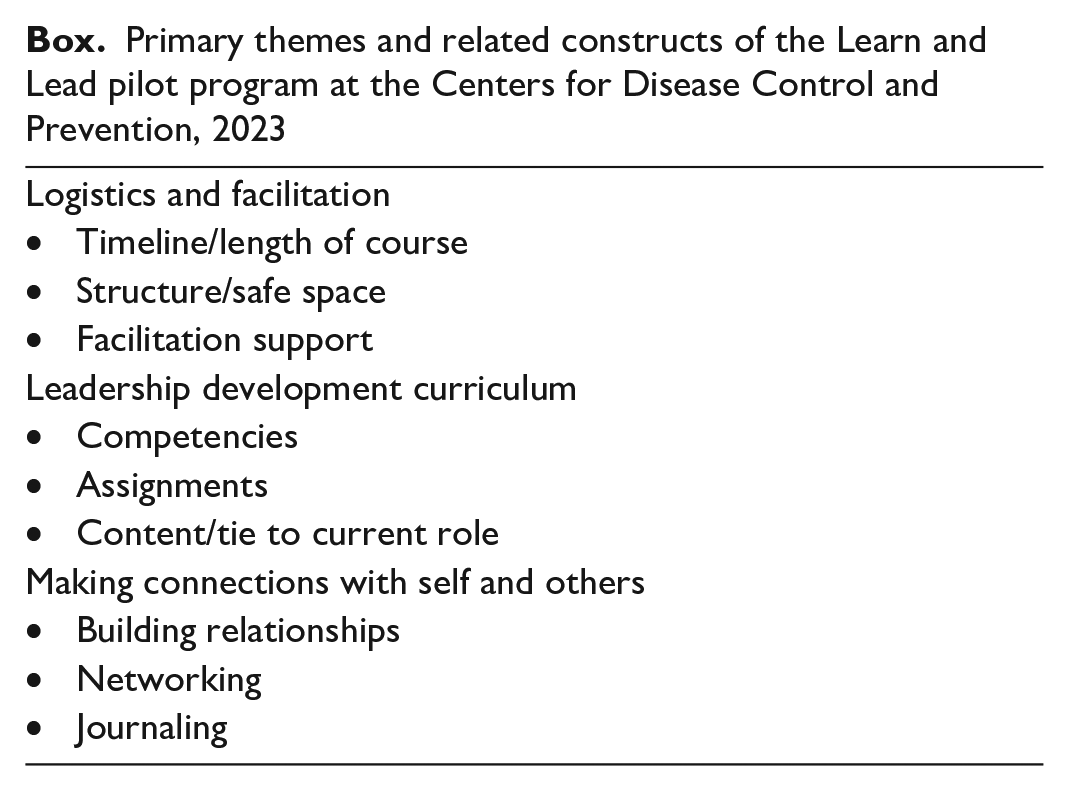
Pilot findings were categorized into 3 themes: logistics and facilitation, leadership development curriculum, and making connections with self and others. Related constructs are noted within each theme (Box).
Primary themes and related constructs of the Learn and Lead pilot program at the Centers for Disease Control and Prevention, 2023
Theme: Logistics and Facilitation
Findings for logistics and facilitation highlighted participants’ preferences for course length, time in small breakout groups, mix of vendor-led and internal-led weeks, and the value that facilitation by vendors, internal staff, and co-facilitators brought to the pilot.
Feedback was mixed on pilot length; some participants wanted 1 session per week or sessions every other week for a longer number of weeks, whereas others wanted more sessions per week for fewer weeks. Summer months were mentioned as challenging because children are home and travel is planned. In addition, some participants mentioned that this timing was difficult because it is near the end of the CDC fiscal year, so schedules are already full.
Participants wanted more time in small breakout groups and more breaks during longer sessions. For several participants, having breakout groups where facilitated conversations could occur and smaller numbers of participants could share was critically important. Small breakout groups also allowed quieter participants the chance to speak and share.
Allowing a little more time in the breakrooms. Also, there should be a minimum of 10-minute breaks to go to the restroom and/or check work emails. (Survey response) Love the mixture of large-group presentations and small-group discussions. We gained so many resources and so many perspectives from the large group settings, and then we were able to provide our perspectives in the small group discussions. (Interview response)
Participants enjoyed the mix of vendor-led weeks and internal staff–led weeks and indicated that the latter created a safe space where challenging leadership topics could be shared openly. Discussions often touched on personal experiences of participants who were members of a racial or ethnic minority group. While these conversations were difficult and emotionally charged, participants appreciated the discussions.
My favorite part of Learn and Lead was when the entire group got into deep discussions on topics that are rarely discussed in the workplace. I thought it was very important that we got to hear the obstacles of BIPOC [Black, indigenous, and other people of color] employees in the workplace when trying to advance their careers, and that they were given a safe space to speak about them. (Survey response) Having a safe space to discuss these experiences helped me realize that so many others have the same challenges, but I feel like it also gave me the opportunity to hear new perspectives and have other ways to think about the scenarios. (Survey response) The aspect I enjoyed the most about participating in Learn and Lead was the open dialogue and deep conversations we had. It was refreshing to address uncomfortable topics and challenge the existing narratives. Discussing real issues, such as stereotypes, and exploring perspectives was valuable. (Interview response)
Finally, participants’ feedback on vendors who presented information during the odd-week sessions was positive overall. At times, it can be challenging for external vendors to provide training that resonates with the CDC employee experience; however, participants noted enjoying the Learn and Lead vendors’ training style and examples provided. On even weeks, 3 internal CDC training staff co-led the sessions. These internal staff were familiar with the CDC context, provided relevant examples, and tied training content back to the CDC experience.
I appreciate [internal training instructors] being there to help connect all sessions in a meaningful way. (Interview response) [The internal training instructors] made me feel safe to share my feelings and opinions. (Interview response)
Feedback on volunteer coaches was extremely positive, noting that these co-facilitators helped ensure small group discussions were fruitful and engaging, and their willingness to engage as leaders at CDC with Learn and Lead participants was inspiring and meaningful.
Having current CDC leaders in our sessions as facilitators and speakers was powerful. It was awesome to hear their feedback and experience. It was also amazing to have them tie what we were learning into examples at CDC. It made the information more relatable and connected the dots between what we were learning and how we can apply it. (Survey response) Interacting with facilitators, receiving feedback and advice from them as a group and individually. I think they added a lot to small group breakouts that wasn’t there in week 1 breakouts where we were by ourselves. (Survey response)
Theme: Leadership Development Curriculum
Findings for the leadership development curriculum underscored the relevance of OPM’s Fundamental Competencies to leadership development at all levels, especially interpersonal skills, emotional intelligence, and communication competencies.
Participants were asked to develop a PowerPoint slide that described their role at CDC. Participants’ responses to this activity were positive. For many, this was the first time they had made a slide or presented information; participants learned how to present information concisely, develop an informative and visually appealing slide, and receive feedback from colleagues. One participant noted, “The impromptu slide presentation was extremely helpful to practice presenting quickly putting together information and to receive constructive feedback from my peers and facilitator” (survey response).
Participants watched a TED Talk (https://youtu.be/D9Ihs241zeg) about how stereotypes can lead to preconceived misperceptions and a breakdown in communication. This viewing was followed by a discussion in small breakout groups. For all cohorts, this discussion was difficult and emotional, but findings showed that participants appreciated having the opportunity to engage with one another on this topic. One participant said, “I really enjoyed the discussion after watching the TED Talk. I feel like having the deep conversations really helps us grow as individuals and as leaders” (survey response).
Participants completed assignments to (1) interview a leader of their choice about their leadership style, journey, and philosophy and (2) choose a quote that reflects their view of integrity and honesty in leadership. They shared completed assignments in small groups.
[I most enjoyed] the discussions in the breakout rooms about the interviews with leaders. Listening to the things people have learned and understanding what kind of leader I would like to be and why. (Survey response). Hearing the quotes different people selected and hearing them express what that quote means to them and how and why they selected that quote. (Survey response)
It was of critical importance to pilot organizers that the training content was relevant and applicable to the participants’ current roles and future aspirations. Several participants shared how they were applying what they learned. One participant noted, “By demonstrating honesty and integrity, I will prove myself to be trustworthy and then using the tools that I’ve learned in this training will help me reach my goals” (interview response).
Theme: Making Connections With Self and Others
Findings for making connections with self and others supported the cohort model. Participants indicated that one of the most positive experiences of the pilot was networking with other CDC employees they might never have otherwise met. Given the number of employees who can access future leadership development efforts, a cohort model would engage more employees while providing networking and shared learning opportunities.
[I have most enjoyed] networking! I really enjoyed colleagues being so open and vulnerable about their internal struggles because it creates a comfortable space for everyone. I know for me it allowed me to open up. (Interview response) I like the opportunity to meet a lot of people from the agency and understand that others may have the same thoughts or issues that I have. (Interview response)
During week 1, each pilot participant was provided an accountability partner. They set up meetings throughout the 8 weeks to discuss leadership and work-related issues. The accountability partner model was viewed very favorably overall. One participant said, “[The accountability partner] really helped me to move forward in my leadership journey and take the lessons learned outside of the sessions” (survey response).
Finally, each even week ended with time devoted to journaling. Guiding questions were provided (eg, What are specific ways in which I can apply what I am learning?), and participants were encouraged to journal freely. Most participants reported that journaling as a practice was not new to them, but journaling as part of leadership development was. Overall, participants enjoyed the opportunity to reflect on what they were learning and how they could apply it to their current role and their development as leaders. One participant said, “[My favorite was] the journaling part. I was able to take a moment to reflect on myself. This is something I’m starting to do more of” (survey response).
Discussion
A well-trained public health workforce is the first line of defense to prevent disease, protect health, and keep people safe. 16 CDC needs leaders at all levels who can operationalize evidence-based approaches that affect population health. Learn and Lead created an opportunity for participating CDC employees to enhance their leadership skills and provided timely data to inform CDC’s ongoing leadership development efforts. These efforts can help ensure that CDC’s workforce continues functioning at high performance levels through a development approach that supports leadership skills for all staff.
Findings from Learn and Lead underscored the relevance and applicability of leadership competencies to CDC staff, public health overall, and others interested in leadership development in the federal sector. An opportunity exists for CDC to model the implementation of leadership development in a federal agency, guided by the CDC leadership development framework. Findings from Learn and Lead can be applicable to other public health organizations as they explore internal leadership development.
Limitations
The study results had several limitations. First, because evaluations were voluntary, feedback was limited to those participants who responded and, therefore, subject to response bias. Second, although surveys were anonymous, because pilot leaders were encouraging participation in evaluations, respondents might have felt pressured to provide positive feedback (ie, social desirability bias). Third, because the pilot was implemented at CDC, findings may not be generalizable to other public health or federal agencies. Finally, this pilot was short in length and limited in number of participants. Monitoring as additional efforts are implemented can ensure offerings continue to meet the needs of the CDC workforce.
Conclusion
Data provided by Learn and Lead participants are critical to ensure that future leadership development initiatives for CDC employees are relevant, meet their skills needs for both their current roles and future professional aspirations, and are delivered in a way that is engaging and accessible. A strategic leadership development model can enable CDC to build both technical and adaptive leaders at all levels, ready to address current and future complex public health challenges.
Footnotes
Acknowledgements
The authors thank all the Learn and Lead pilot program participants for engaging in thoughtful dialogue, for sharing their experiences, and for their openness to learning and thinking about leadership issues in new ways. The authors also thank the following CDC colleagues for their many contributions to the conceptualization, planning, and implementation of Learn and Lead: Onika Blaize, BS; Leslie Dauphin, PhD; Dawn Lynch, MAA; Daniel McDonald, PhD; Kenneth Quintana, MBA; Patricia Simone, MD; Crystal Spears-Jones, MPA, CHES; and Li-lien Yang, MS. Finally, the authors thank their CDC colleagues who volunteered their time to assist with co-facilitating small group Learn and Lead sessions, collecting and evaluating data, and sharing their time and expertise on panel discussions.
Declaration of Conflicting Interests
The authors declared no potential conflicts of interest with respect to the research, authorship, and/or publication of this article.
Funding
The authors received no financial support for the research, authorship, and/or publication of this article.
Disclaimer
The findings and conclusions in this article are those of the authors and do not necessarily represent the official position of the Centers for Disease Control and Prevention.
