




Abstract
Objectives:
Youth suicide is an urgent public health problem. Gatekeeper training aims to prevent suicide by training people to identify warning signs and make referrals to appropriate services. Many states in the United States have enacted gatekeeper training laws (GTLs) to train school staff in suicide prevention. The objectives of this study were to describe the development of a dataset on GTLs and use the dataset to summarize trends in uptake of GTLs from 2002 through 2022 as well as differences in characteristics (eg, frequency and duration of training) of GTLs.
Methods:
We used publicly available legal databases from all 50 states and the District of Columbia to conduct a policy surveillance assessment of GTLs. We cross-checked data with the American Foundation for Suicide Prevention’s 2022 Suicide Prevention in Schools (K-12) issue brief and used Westlaw Edge to conduct a sensitivity analysis. We included the following data in the full dataset: type of laws (encouraged, mandatory, or conditional mandatory), date passed, effective date, frequency of training, and length of training.
Results:
In 2022, 49 states and the District of Columbia had GTLs, 31 of which were mandatory laws. In 2002, only 6 states had such laws, and none were mandatory.
Conclusion:
The growing proliferation of laws on suicide prevention training for school staff warrants evaluation of the laws’ effectiveness. Our policy surveillance data may be used to better understand the role of these laws in a school-based approach to youth suicide prevention.
Suicide and suicidal behaviors among young people are an urgent public health problem. In 2021, suicide was among the top 3 leading causes of death among children, adolescents, and young adults aged 10 to 19 years in the United States. 1 The percentage of high school students who attempted suicide increased from 2011 to 2021 among female students and among non-Hispanic Black and non-Hispanic White students. 2 Nationally, an estimated 3.3 million (12.7%) adolescents aged 12 to 17 years had serious thoughts of suicide, and 892 000 (3.4%) attempted suicide in 2021. 3 Preventing suicide requires a comprehensive public health approach that addresses individual, relationship, community, and societal risk and protective factors. 4
Schools offer an important setting through which to identify young people at risk of suicide and refer them to appropriate services. In 1 study, 39% of surveyed school personnel reported having contact with at least 1 suicidal student in the past year. 5 Gatekeeper training for school staff is 1 school-based intervention recommended to help prevent suicide among young people.4,6 -8 Gatekeeper training is designed to train individuals to identify people at risk of suicide and to respond by referring them to appropriate support services. 4 Evidence suggests gatekeeper training improves trainee knowledge,9 -12 self-efficacy,9,12 attitudes,10,11 and skills 10 in suicide prevention. These programs have been found to increase the percentage of students receiving services after being referred 13 and may reduce suicidal behaviors.14 -16 Compared with staff who interact with children and adolescents in child welfare, juvenile justice, or health settings, school staff reported lower pretest knowledge and self-efficacy in suicide prevention, suggesting a greater need for school-based gatekeeper training. 12
US jurisdictions have enacted laws designed to increase school staff training in suicide prevention, including through certification requirements, education standards, and professional development. The American Foundation for Suicide Prevention publishes briefs that provide overviews of state laws that mandate or encourage suicide prevention training for school staff. 17 These briefs primarily focus on descriptions of current mandatory laws.
The potential effect of gatekeeper training laws (GTLs) on reducing suicidal behaviors among young people has not been rigorously evaluated, and no comprehensive legal dataset exists to facilitate such an evaluation. The objective of this study was to provide a longitudinal view of GTLs in all 50 states and the District of Columbia and uniformly specify the legal components, including frequency and length of training, of GTLs in each jurisdiction.
Methods
We developed a dataset on GTLs that were effective as of January 1, 2000, or enacted through December 31, 2022, in all 50 states and the District of Columbia. Because training programs and parameters of GTLs differ in frequency and duration of training,18,19 we documented these components. We then used the dataset to summarize trends in uptake of GTLs from 2002 through 2022 and differences in components of GTLs.
We used a legal epidemiology approach 20 to conduct a review of relevant statutes and regulations enacted in all 50 states and the District of Columbia through 2022. We collected legal data from the legislative websites of each jurisdiction. We implemented standard search procedures to the extent possible given the different functionalities of each jurisdiction’s databases.
Data collection for legislative history consisted of 2 phases. The primary search for legislative history involved keyword searches of text for all bills passed by a legislature from 2000 through 2022. Because this search does not account for laws passed before 2000 and may fail to capture enacted bills that repeal sections of laws, we implemented a secondary search. The secondary search involved keyword searches of statute text for a jurisdiction’s current and historical statutes. Although enacted bills and statutes are both law, for the purposes of this data collection, we distinguish between the two. An enacted bill may amend numerous statutes or may be passed as a resolution not codified in statute. A statute is a specific section of a jurisdiction’s code of laws that may be amended by numerous enacted bills. Public databases for bills are often located on a legislature’s website, whereas databases for statutes are more often located on a secretary of state’s website.
In addition to searching legislative history, we also conducted a search for administrative regulations that may be involved in the implementation of laws.
Primary Search for Legislative History
For each legislative database, we used the term “suicid*” to search the text of bills enacted in each jurisdiction. When available, this search also included resolutions adopted by the legislatures. We reviewed each bill for relevance to suicide prevention training for school staff. Functions for text searching bills across the full time frame were available for 44 of 51 jurisdictions (86%). For the 7 jurisdictions where this process was not fully successful, the barriers included missing legislative data for some years (n = 2), in which case we used the information for all other available years, or lack of functionality to text search bills for some years (n = 5), in which case we used other search methods as available, such as keyword searches of bill descriptions.
Secondary Search for Legislative History
For each statute database, we used the search phrase “suicid* AND (school OR train*)” or variations of the word “suicide” (eg, suicide, suicidal) when the database had no search string functions. We cross-checked data collected from searching statutes with data collected from searching enacted bills to ensure historical accuracy and capture any additional laws. Searching statutes was successful in 48 of 51 jurisdictions (94%). For the remaining 3 jurisdictions, barriers included lack of text-search functions (n = 2) and an unreliable platform or search engine (n = 1). To account for potential laws that were in effect before 2000 that may have been repealed later in the study period, we searched statutes from 2000 where possible. Historical searches were possible for 8 of 51 jurisdictions (16%). We identified additional laws through the secondary search for legislative history for 11 of 51 jurisdictions (22%).
Search for Administrative Regulations
Finally, we searched publicly available administrative regulations databases to capture regulations that address suicide prevention training for school staff. The search string used to search regulations was “suicid* AND (school* OR train*)” or variations of the word “suicide” when the database had no search string functions. Searching regulations was successful for 38 of 51 jurisdictions (75%). An additional 10 jurisdictions (20%) provided alternative, although less comprehensive, routes to collect regulatory data, such as searching individual sections of the jurisdiction’s administrative code by keyword. We captured any relevant regulations and reviewed them for historical changes, if available. Where possible, we searched the jurisdiction’s historical administrative regulations for relevant, previously enacted regulations. This historical search feature was successful in 13 of 51 jurisdictions (25%).
Case Definitions
We classified state laws into the following categories: “encouraged,” “mandatory,” or “conditional mandatory.” To meet the minimum definition to be coded as encouraged, a law had to expressly encourage training (eg, “teachers should be trained”) or have a mechanism through which training is reasonably expected to be encouraged (eg, funding for training, dissemination of training models to schools, allowing training to count toward professional development requirements). Laws that merely enabled teachers to be trained (eg, “teachers may be trained”) were not sufficient to be coded as encouraged and, thus, were excluded from analysis. Laws that required some or all school staff to be trained (eg, “teachers must be trained”) or included mechanisms to require training (eg, requiring training as part of licensure renewal) were coded as mandatory.
For some laws, we found no clear distinction between whether the law encouraged or mandated training, most frequently due to a lack of information on implementation of and compliance with those laws. We grouped these laws into a third category, conditional mandatory. Generally, laws in this category appeared to mandate training but had conditions such that real-world implementation may not mandate training. For example, Alabama’s law mandates training subject to the appropriation of funds. Because the mandate is conditional on the appropriation of funds, real-world implementation may be closer to “encouraged.” 21 For frequency and length of training, some state laws had different requirements for different classifications of school staff (eg, teachers vs principals). We classified such laws as having “tiered requirements.”
Inclusion Criteria and Quality Control in Coding
This methodology captured a total of 4041 legal documents (including public acts, statutes, and administrative regulations, hereinafter “laws”), each of which we reviewed for relevance to suicide prevention training for school staff. Suicide prevention training included any training in which information on suicide was a required component. Mental health awareness training, for example, would be included if training had to include information on suicide risk and protective factors but would be excluded if suicide was not mentioned or was mentioned as an optional component. School staff could include teachers, nurses, school counselors, or any other school employee. School staff was limited to staff at public schools in any grade level from kindergarten through grade 12.
We excluded laws with no express relevance to training for school staff (3642 of 4041; 90%). We reviewed the remaining 399 laws in order of their date of enactment. We removed laws that updated previous laws with negligible effect on suicide prevention training for school staff (210 of 399; 53%). Two researchers (K.R. and K.F.) reviewed the remaining 189 laws and used a consensus approach to determine whether the law met scoping criteria to be included for further analysis (eReport 1 in the Supplement). They identified a total of 94 laws across 50 jurisdictions for inclusion. Two researchers (K.R. and K.F.) then independently coded each law identified for inclusion and assessed interrater reliability (81.2%). Divergences in coding were resolved between the 2 coders (K.R. and K.F.); sustained disagreements were resolved by a third reviewer (C.D., J.W., R.H., or S.W., based on the subject matter of the disagreement). A flow chart summarizes the inclusion and exclusion process (eFigure 1 in the Supplement).
Sensitivity Analysis
Given the variation in accessibility of comprehensive legal data across the public databases for each jurisdiction, we conducted a sensitivity analysis by using information from 5 randomly selected jurisdictions and temporary access to Westlaw Edge, a robust, online legal research service. 22 For each of the 5 states, we used a refined search string (eReport 1 in the Supplement) to search statutes and regulations over time. All states included data starting at least from the year 2000; some states included data from before 2000. We examined only regulations from a state’s department of education or an equivalent agency.
We identified 47 statutes across the 5 states. All coded statutes were accurately identified through the Westlaw Edge sensitivity test. Forty statutes (85%) identified by the Westlaw Edge search string were captured through the original methodology used in our study. Of the 7 remaining statutes not originally captured, only 1 (2% of 47) would have met the scoping criteria for inclusion. In addition, the sensitivity analysis identified 5 administrative regulations across the sample of 5 states. Four of these regulations were captured through the original methodology. The regulation not originally identified would not have met the scoping criteria to be included.
This research did not involve human data or participants; therefore, the Centers for Disease Control and Prevention did not require institutional review board assessment.
Results
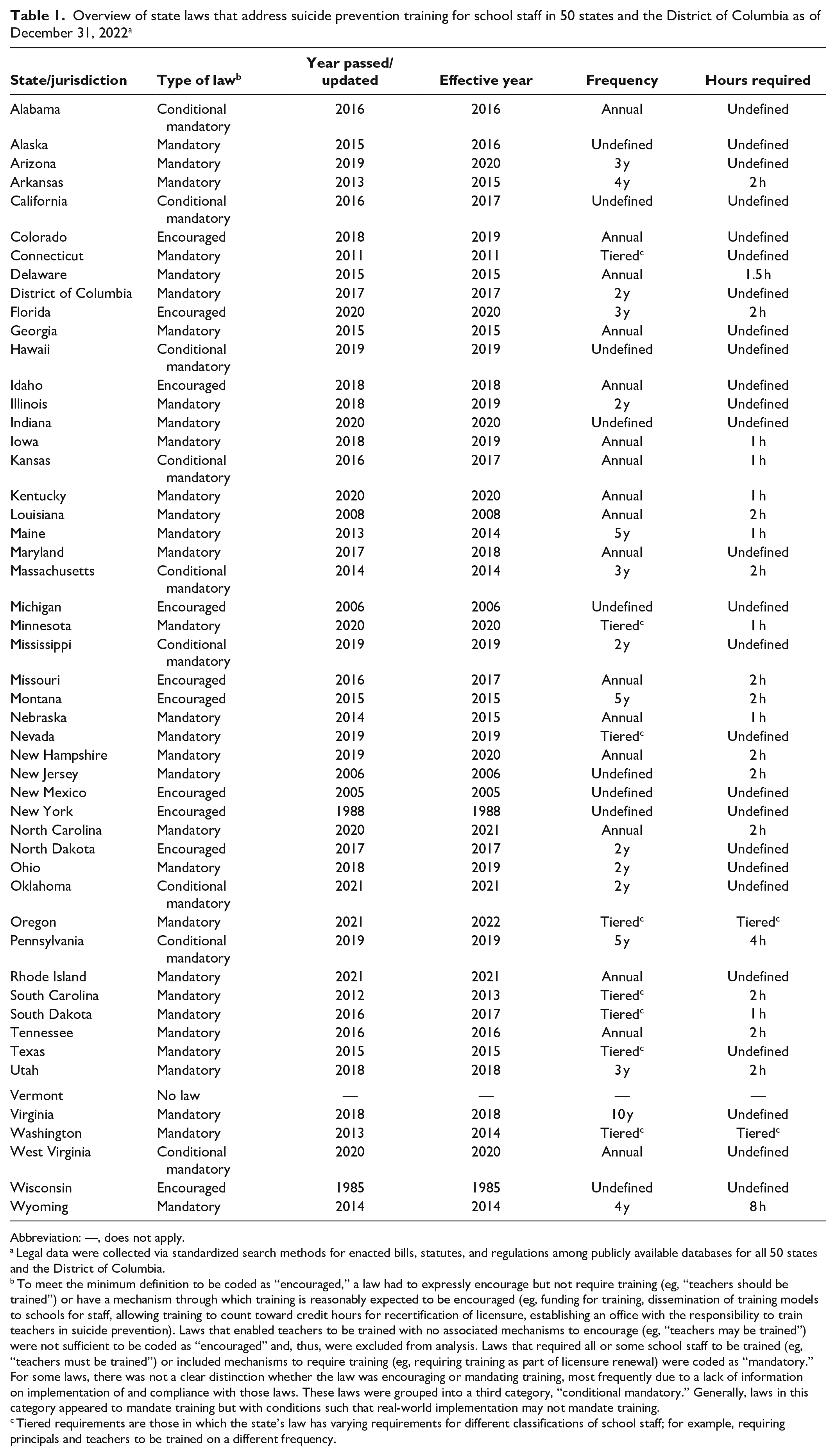
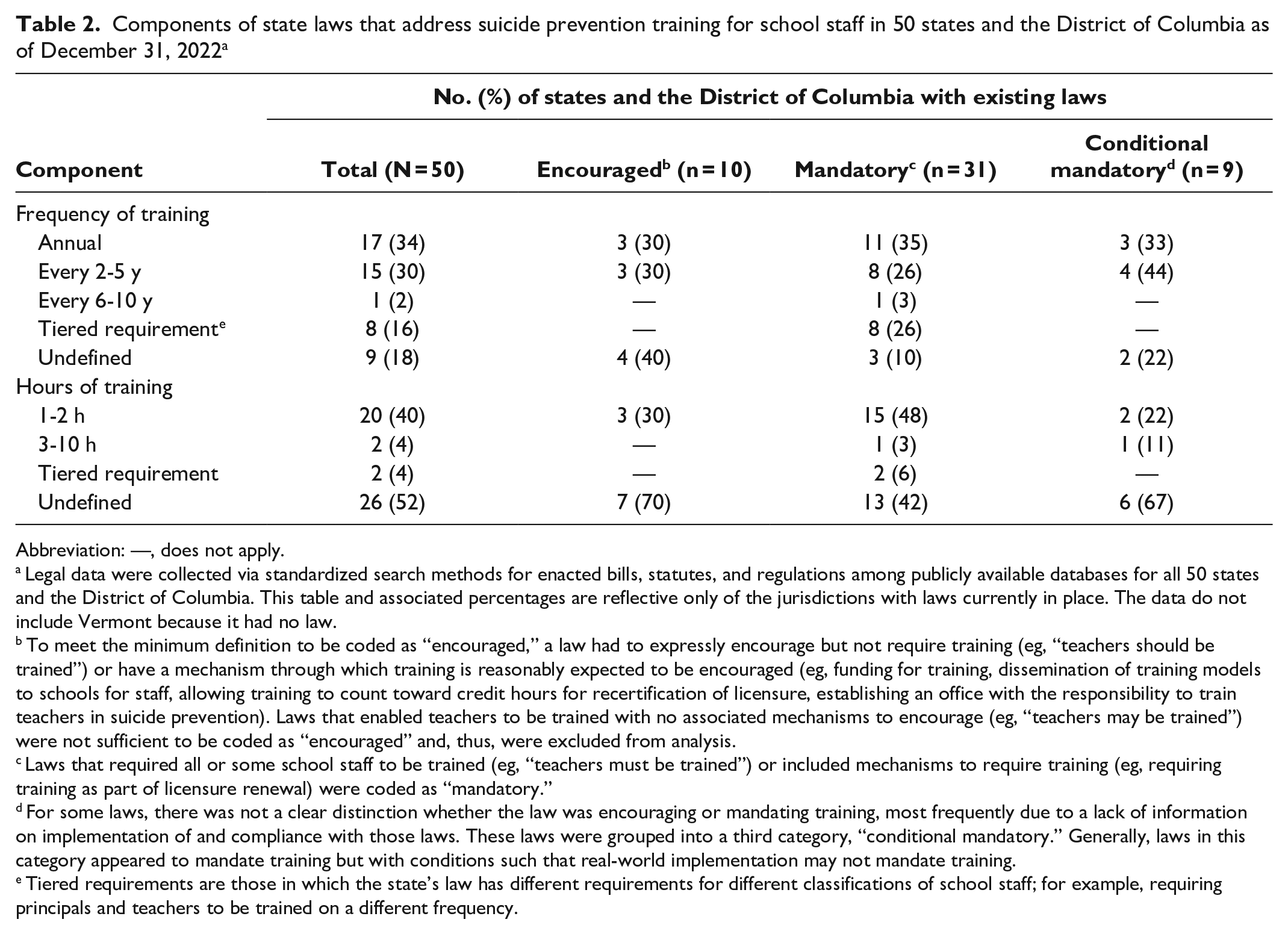
As of December 31, 2022, 49 states and the District of Columbia had GTLs; Vermont was the sole exception (Table 1). Of jurisdictions with GTLs, most (62%; n = 31) mandated training, 18% (n = 9) had conditional mandates, and 20% (n = 10) encouraged training. About one-third (34%; n = 17) of jurisdictions with GTLs specified annual training and 30% (n = 15) specified training every 2 to 5 years. In addition, 40% (n = 20) of jurisdictions with GTLs specified a training length of 1 to 2 hours. Among jurisdictions with mandatory laws, 35% (11 of 31) required annual training and nearly half (15 of 31) required training to be 1 to 2 hours in length (Table 2).
Overview of state laws that address suicide prevention training for school staff in 50 states and the District of Columbia as of December 31, 2022 a
Abbreviation: —, does not apply.
Legal data were collected via standardized search methods for enacted bills, statutes, and regulations among publicly available databases for all 50 states and the District of Columbia.
To meet the minimum definition to be coded as “encouraged,” a law had to expressly encourage but not require training (eg, “teachers should be trained”) or have a mechanism through which training is reasonably expected to be encouraged (eg, funding for training, dissemination of training models to schools for staff, allowing training to count toward credit hours for recertification of licensure, establishing an office with the responsibility to train teachers in suicide prevention). Laws that enabled teachers to be trained with no associated mechanisms to encourage (eg, “teachers may be trained”) were not sufficient to be coded as “encouraged” and, thus, were excluded from analysis. Laws that required all or some school staff to be trained (eg, “teachers must be trained”) or included mechanisms to require training (eg, requiring training as part of licensure renewal) were coded as “mandatory.” For some laws, there was not a clear distinction whether the law was encouraging or mandating training, most frequently due to a lack of information on implementation of and compliance with those laws. These laws were grouped into a third category, “conditional mandatory.” Generally, laws in this category appeared to mandate training but with conditions such that real-world implementation may not mandate training.
Tiered requirements are those in which the state’s law has varying requirements for different classifications of school staff; for example, requiring principals and teachers to be trained on a different frequency.
Components of state laws that address suicide prevention training for school staff in 50 states and the District of Columbia as of December 31, 2022 a
Abbreviation: —, does not apply.
Legal data were collected via standardized search methods for enacted bills, statutes, and regulations among publicly available databases for all 50 states and the District of Columbia. This table and associated percentages are reflective only of the jurisdictions with laws currently in place. The data do not include Vermont because it had no law.
To meet the minimum definition to be coded as “encouraged,” a law had to expressly encourage but not require training (eg, “teachers should be trained”) or have a mechanism through which training is reasonably expected to be encouraged (eg, funding for training, dissemination of training models to schools for staff, allowing training to count toward credit hours for recertification of licensure, establishing an office with the responsibility to train teachers in suicide prevention). Laws that enabled teachers to be trained with no associated mechanisms to encourage (eg, “teachers may be trained”) were not sufficient to be coded as “encouraged” and, thus, were excluded from analysis.
Laws that required all or some school staff to be trained (eg, “teachers must be trained”) or included mechanisms to require training (eg, requiring training as part of licensure renewal) were coded as “mandatory.”
For some laws, there was not a clear distinction whether the law was encouraging or mandating training, most frequently due to a lack of information on implementation of and compliance with those laws. These laws were grouped into a third category, “conditional mandatory.” Generally, laws in this category appeared to mandate training but with conditions such that real-world implementation may not mandate training.
Tiered requirements are those in which the state’s law has different requirements for different classifications of school staff; for example, requiring principals and teachers to be trained on a different frequency.
The prevalence of GTLs across the United States increased over time, from 6 states in 2002 to 26 states in 2012, and finally to 49 states and the District of Columbia in 2022. Whereas no jurisdiction in 2002 mandated training, 8 jurisdictions mandated training in 2012 and 31 (more than half) mandated training in 2022. By geographic region, the Southeast had an earlier initial uptake of GTLs and had the highest concentration of jurisdictions mandating training as of 2022 (Figure 1).
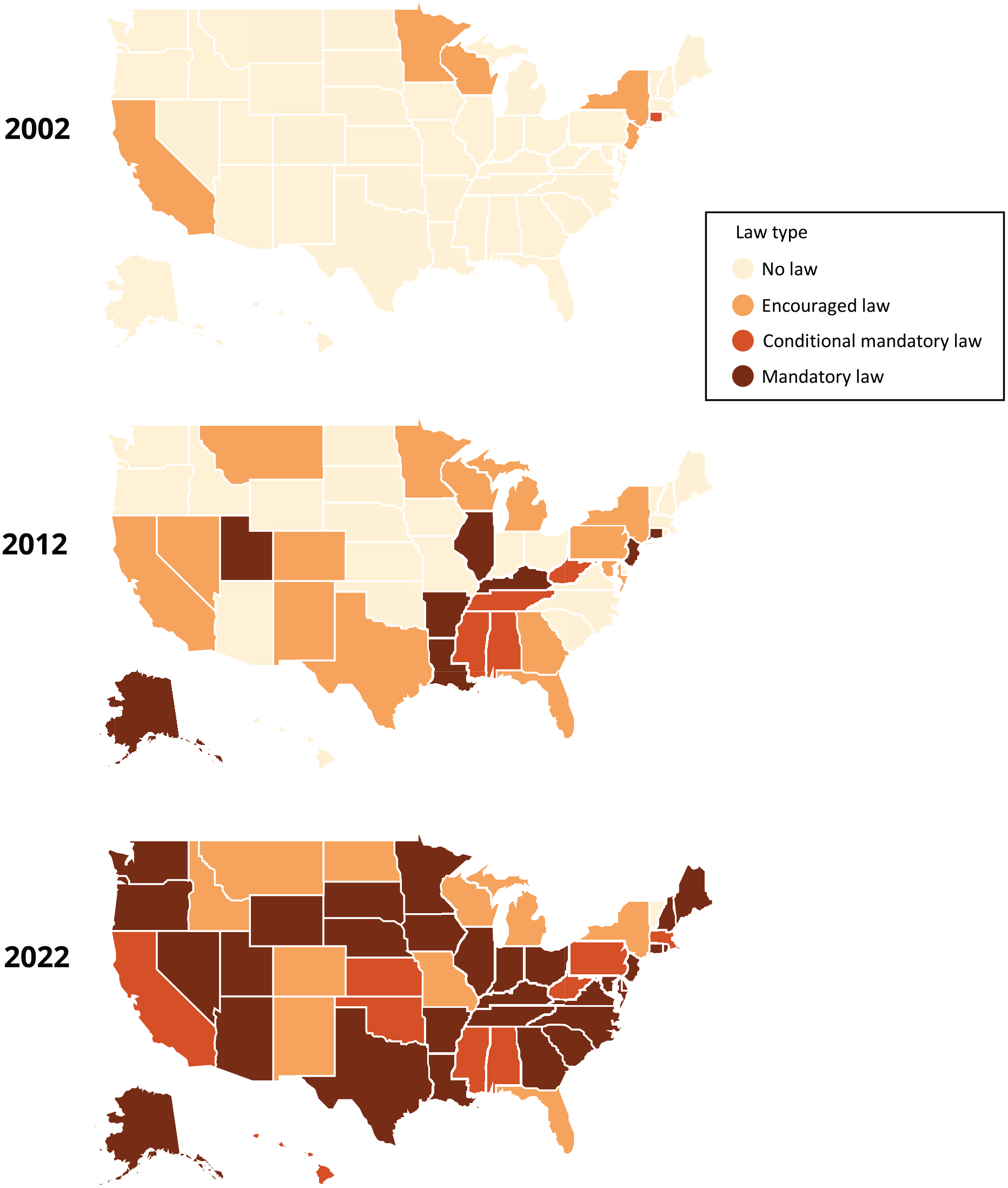
Types of suicide prevention gatekeeper training laws in 50 states, 2002-2022. Legal data were collected via standardized search methods for enacted bills, statutes, and regulations among publicly available databases for each jurisdiction.
Nearly one-third (16 of 51) of all jurisdictions enacted their first GTL during 2012 through 2017. The greatest increase in the number of jurisdictions with a mandatory GTL also took place during this period, with 8 jurisdictions having mandatory laws in 2012 and 25 jurisdictions having mandatory laws in 2017, an increase of more than 200% (Figure 2).
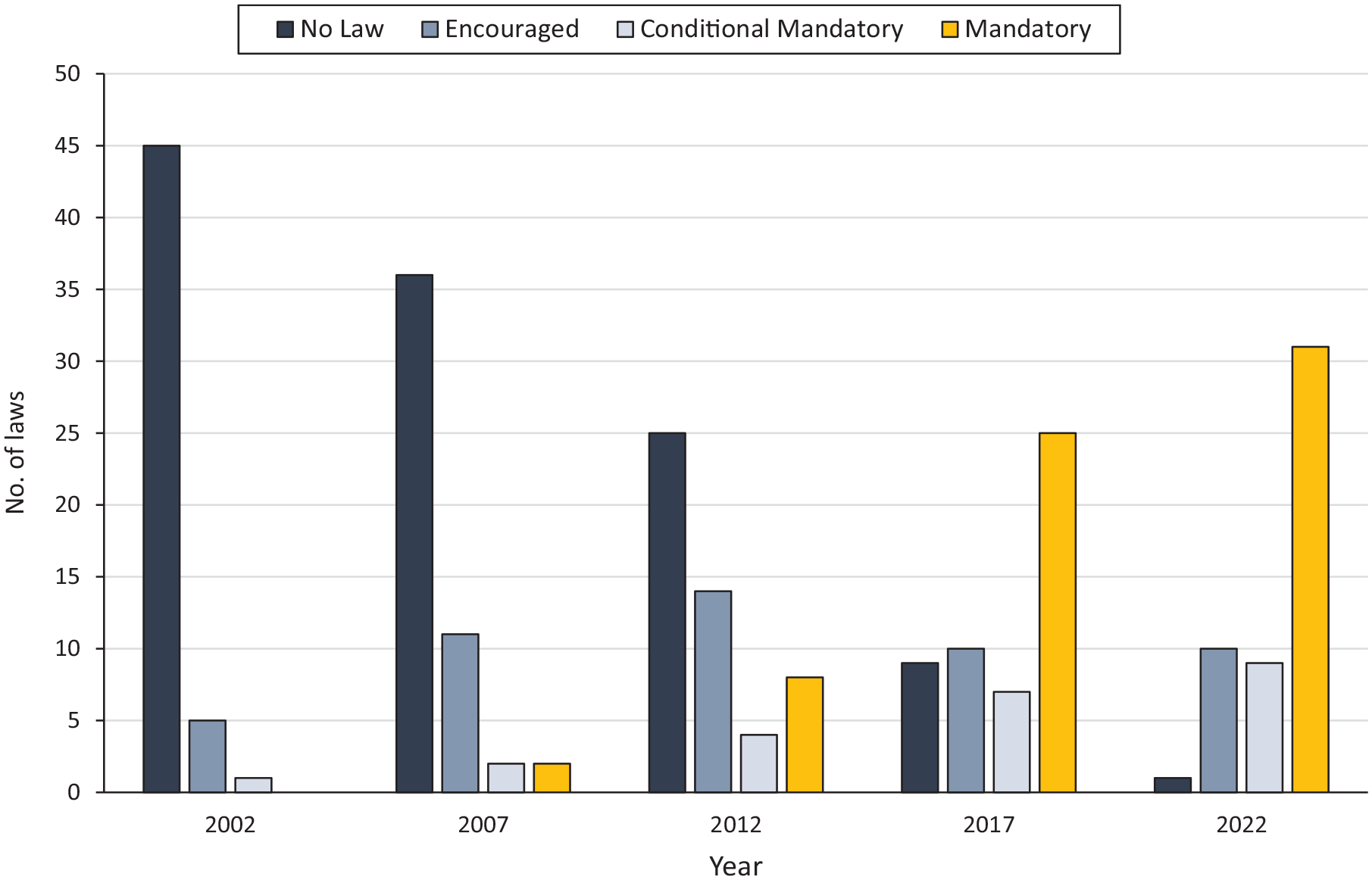
Type of suicide prevention gatekeeper training law in 50 states and the District of Columbia, by year, 2002-2022. Legal data were collected via standardized search methods for enacted bills, statutes, and regulations among publicly available databases for each jurisdiction.
From 2002 through 2018, the number of laws affecting suicide prevention training for school staff (ie, changes in type of law, frequency of training, or length of training) passed or amended each year increased steadily before declining through 2022 (Figure 3).
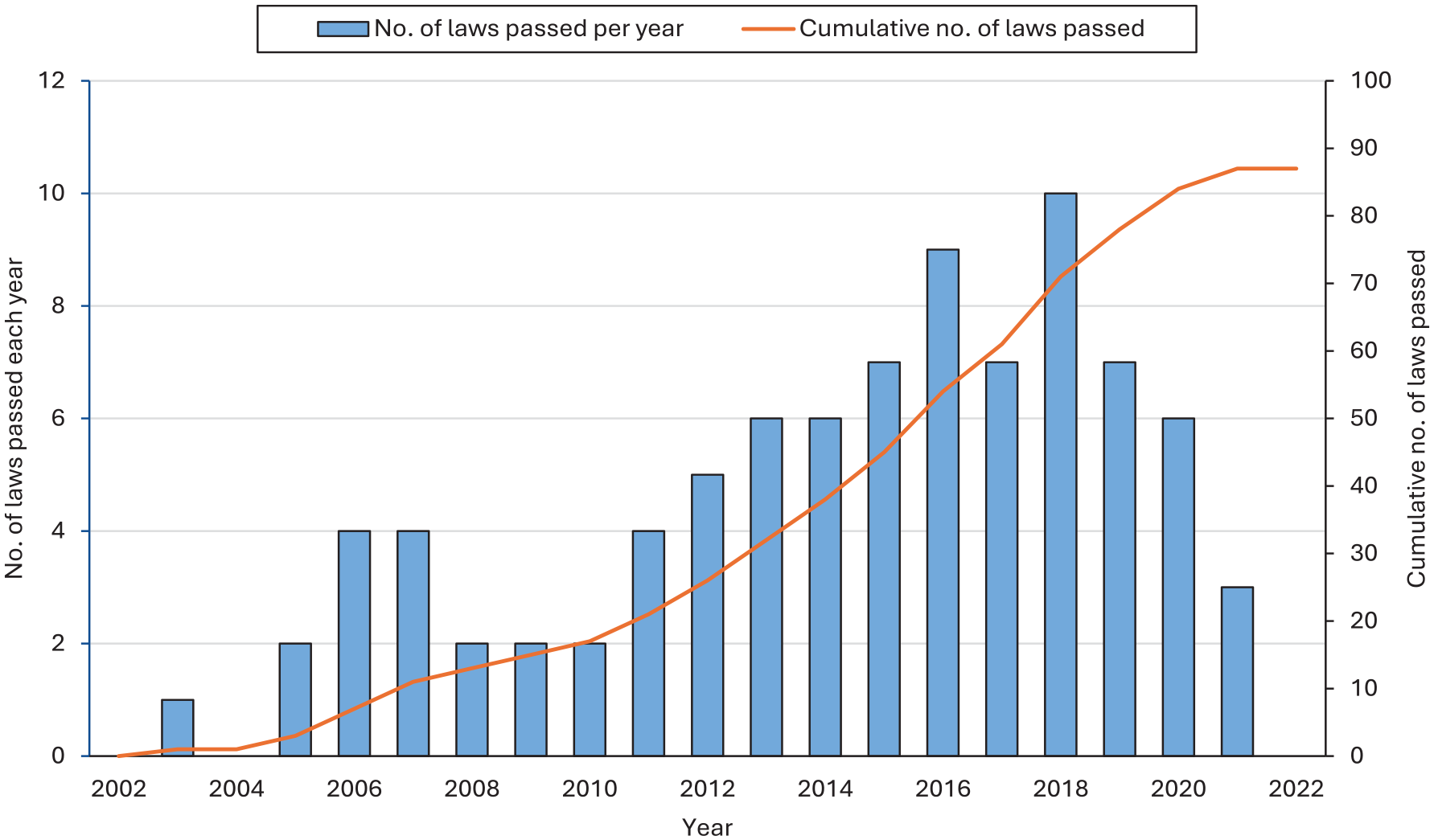
Number of suicide prevention gatekeeper training laws passed, by year, in 50 states and the District of Columbia, 2002-2022.Yearly data could include multiple laws from a single jurisdiction. Only laws with substantive changes to legal requirements for trainings are captured.
Discussion
While other studies have described GTLs at a specific point in time,19,23 our study is the first to use a legal epidemiology approach to measure and categorize GTLs over time. We found notable growth in GTLs across the United States from 2002 through 2022, such that the number of jurisdictions with a GTL increased from 6 to 50. In addition, we found that although no jurisdiction mandated training for school staff in 2002, more than half (62%; 31 of 50) of jurisdictions with GTLs mandated training in 2022. GTLs were heterogeneous in training requirements, including type of law, duration, and frequency. Our detailed documentation of the national landscape of and heterogeneity in GTLs lays a critical foundation for future policy evaluation of the various components of GTLs and how they affect suicide-related outcomes among young people.
Suicide rates among adolescents declined in the 1990s until 2007, when trends then started to rise. 24 In 2012, a new US National Strategy for Suicide Prevention was released, and by 2017, more suicide prevention activity was taking place across the nation than ever before.25,26 The confluence of increasing youth suicide rates and increasing national investment and activity in suicide prevention may help explain the substantial increase in first-time GTLs and mandatory GTLs during 2012 through 2017.
Many jurisdictions enacted substantial changes in these laws over time, such as changing whether the law was encouraged or mandatory or changing the frequency of training. In most cases, jurisdictions enacted laws that became more explicit (eg, from a law with an undefined frequency of training to a law with an explicitly defined frequency) and that included greater requirements (eg, from an encouraged law to a conditional mandatory law, increasing the hours of training required). We found 14 instances in which jurisdictions strengthened the type of GTL (eg, from conditional mandatory to mandatory) and 6 instances in which jurisdictions increased training frequency (eg, from every 2 years to annually). These findings suggest a growing trend of jurisdictions using legal mechanisms to increase training for school staff in preventing youth suicide. We also found 7 instances in which laws became less explicit or reduced requirements. One potential explanation for this finding is a desire to reduce the administrative burden required of schools and to provide more flexibility in how schools implement training. North Dakota, for example, amended its law in 2017 to include suicide prevention as one option among a range of behavioral health training topics from which school districts could choose to fulfill a broader professional development requirement, rather than requiring suicide prevention training in particular.
The near-universal uptake of GTLs by 2022 reflects nationwide progress toward youth suicide prevention. However, it is unclear how differences in the components of these laws may differentially affect youth suicide outcomes and the retention of learned skills, knowledge, and practices among school staff. These laws should be evaluated to better understand their effectiveness. The variability in quality of and access to publicly available legal databases as identified through our methodology may indicate a barrier to more widespread evaluation of law and policy. Our dataset (eTable 1 in the Supplement) can help facilitate further evaluation of GTLs to inform policy makers and school administrators aiming to reduce suicide and suicidal behaviors among young people through school-based gatekeeper programs.
Limitations
This research had several limitations. First, we did not have access to a comprehensive legal database, such as Westlaw Edge, throughout the full data collection period. Instead, we used publicly available databases from each of the 51 jurisdictions. The availability, complexity, and accuracy of these databases varied among jurisdictions, suggesting that we did not capture data on some changes in law. To reduce this likelihood, we collected data on statutes by using a broad search term for enacted bills in a jurisdiction’s legislature each year and then cross-checked this information by using a redundant search of a jurisdiction’s statute database, when available. We also cross-checked the categorization of types of GTLs by using the American Foundation for Suicide Prevention’s 2022 Suicide Prevention in Schools (K-12) issue brief, 19 which overviews the current laws in each state and notes the adoption or amendment dates for mandatory laws. Second, regulations proved more difficult to assess than statutes. Although 94% of jurisdictions provided some level of public access to search current regulations, only 25% of jurisdictions provided public access to search historical regulations. Third, we did not assess implementation of or compliance with GTLs. Fourth, we did not delineate whether laws applied to private schools as well as public schools; as such, our findings may not be generalizable to private schools.
Future Research
Our dataset is available to facilitate further research into the association between GTLs and suicide-related outcomes among young people (eTable 1 in the Supplement). Future research may consider examining associations between GTLs and measures of suicide risk, differences in associations by school or student demographic characteristics, and associations that include other school-based suicide prevention strategies. Future research on other components of GTLs not assessed in this study, such as type of school staff trained or mechanism for enforcement, may help further inform policy makers considering the implementation or alteration of these laws. Future legal epidemiology research may help expand public access to legal datasets to facilitate further policy evaluation.
Conclusion
The growing proliferation of GTLs as a strategy to prevent suicide and suicidal behaviors among young people warrants evaluation of the laws’ effectiveness. To our knowledge, our study is the first to construct and disseminate a legal dataset on GTLs in all 50 states and the District of Columbia over time. These data may be used by policy makers, researchers, and the public to better understand the role of GTLs in a school-based approach to youth suicide prevention.
Supplemental Material
sj-pdf-1-phr-10.1177_00333549241249922 – Supplemental material for Changes in State Laws on Suicide Prevention Training for School Staff, 2002-2022
Supplemental material, sj-pdf-1-phr-10.1177_00333549241249922 for Changes in State Laws on Suicide Prevention Training for School Staff, 2002-2022 by Kyle Rosenblum, Christopher Dunphy, Jing Wang, Kessa Frantz, Rachel Hulkower and Sharon Wong in Public Health Reports®
Footnotes
Disclaimer
The findings and conclusions in this article are those of the authors and do not necessarily reflect the official position of the Centers for Disease Control and Prevention. The mention of any nonfederal entity or its products is for informational purposes only and is not to be construed, implied, or interpreted, in any manner, as federal endorsement of that nonfederal entity or its products.
Declaration of Conflicting Interests
The authors declared no potential conflicts of interest with respect to the research, authorship, and/or publication of this article.
Funding
The authors received no financial support for the research, authorship, and/or publication of this article.

Supplemental Material
A longitudinal dataset developed to describe changes in GTLs, including frequency and length of training, from 2000 through 2022 in all 50 states and the District of Columbia is available in a Supplement (eTable 1). In addition, a protocol report and codebook are provided in a Supplement to interpret and use the dataset (eReport 1 and eTable 2). The authors have provided these supplemental materials to give readers additional information about their work. These materials have not been edited or formatted by Public Health Reports’s scientific editors and, thus, may not conform to the guidelines of the AMA Manual of Style, 11th Edition.
References
Supplementary Material
Please find the following supplemental material available below.
For Open Access articles published under a Creative Commons License, all supplemental material carries the same license as the article it is associated with.
For non-Open Access articles published, all supplemental material carries a non-exclusive license, and permission requests for re-use of supplemental material or any part of supplemental material shall be sent directly to the copyright owner as specified in the copyright notice associated with the article.
