




Abstract

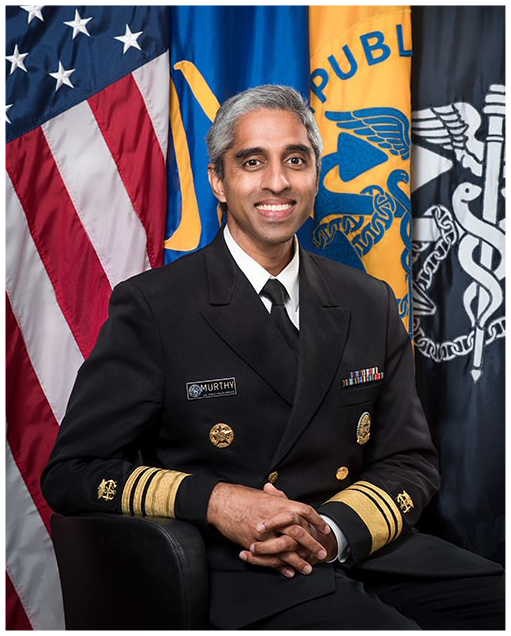
Vivek H. Murthy, MD, MBA VADM, US Public Health Service US Surgeon General
Three years into the COVID-19 pandemic, we honor and recognize the valiant and enduring service and sacrifice of the US Public Health Service (USPHS) Commissioned Corps and their families to our nation. As America’s health responders, Public Health Service officers defend our nation’s public health against threats large and small. 1 Today, approximately 6000 Public Health Service officers support our nation around the clock. 2 Through natural disasters, disease outbreaks, global public health emergencies, and humanitarian missions, they have stood by us and served in the midst of great suffering and loss.
I was blessed to have the opportunity to join the USPHS Commissioned Corps in 2014, when I was sworn in as US Surgeon General, and again for a second term in 2021. It has been a great privilege and honor to serve alongside our officers and to immerse myself in the rich history of our service. My hope today and well beyond is that we celebrate their achievements while reaffirming our organizational and societal commitment to caring for them, as they continue to care for us all.
More Than 200 Years of Public Health Service
The USPHS Commissioned Corps has served on the frontlines for more than 200 years. January 4, 2023, marked 134 years since Congress passed a bill to create the USPHS Commissioned Corps. 1 The origin and history of the USPHS Commissioned Corps trace back to 1798, when Congress created the US Marine Hospital Service to protect against the spread of disease from sailors returning from overseas ports. In 1905, President Grover Cleveland signed the Act to Regular Appointments in the Marine Hospital Service of the United States, establishing the Commissioned Corps as the distinct uniformed component of the USPHS. 3 The USPHS Commissioned Corps is 1 of 8 uniformed services, with the US Army, US Air Force, US Marine Corps, US Navy, US Space Force, US Coast Guard, and the National Oceanic and Atmospheric Administration Commissioned Corps. It is the only uniformed service dedicated to protecting the nation’s public health. Authorized by Congress and commissioned by the president, the USPHS Commissioned Corps is led by the US Department of Health and Human Services (HHS) Assistant Secretary for Health and the US Surgeon General.
Public Health Service officers dedicate their lives to serving our nation’s most vulnerable and medically underserved populations. Guided by the USPHS values of leadership, service, integrity, and excellence, Public Health Service officers represent various professional specialties, including nurses, dentists, physicians, pharmacists, dietitians, clinical and rehabilitation therapists, scientists, epidemiologists, engineers, environmental health and health service officers, and veterinarians.
When not deployed, Public Health Service officers are assigned throughout the federal government at various agencies at HHS, including the Centers for Disease Control and Prevention, the US Food and Drug Administration, the Indian Health Service, the National Institutes of Health, the Centers for Medicare & Medicaid Services, and the Office of Global Affairs. Officers are also detailed to non-HHS agencies, such as the US Department of Defense, the Bureau of Prisons, and the National Park Service, where their clinical and public health expertise is needed. Some are also assigned with state, local, territorial, and tribal public health entities, where they provide essential health care services, lead public health programs, develop policy, and advance science and innovation. Other officers may work with the US Department of State or partner with international organizations, such as the United Nations, the World Health Organization, and the World Bank.
As more officers are needed to meet increasing deployments to protect the nation’s health, the USPHS Commissioned Corps now has Public Health Emergency Response Strike Teams, which comprise dedicated full-time active-duty officers who can deploy rapidly in times of urgent public health emergency response needs. 4 In 2020, the USPHS Commissioned Corps also reestablished the Ready Reserve Corps to offer a surge capacity and additional deployable services for public health emergencies and national health security challenges that may arise. 5 The Ready Reserve Corps helps maintain service continuity at agencies that rely heavily on Public Health Service officers for critical health care and public health services.
Public Health Contributions Since 2020
Since the start of the COVID-19 pandemic, a historic number of Public Health Service officers have deployed in support of COVID-19 response-and-recovery efforts. Deployments have included responding to an outbreak onboard the Diamond Princess cruise ship in Japan, repatriating Americans to US military bases, caring for some of the first patients with COVID-19 at Kirkland Nursing Home in Washington State, assisting community-based sites with testing and infection control, providing clinical care to long-term care facilities and hospitals, and setting up field hospitals in hard-hit communities.
In addition to supporting the COVID-19 response, Public Health Service officers have provided care, preventive measures, and surveillance for numerous public health responses across the country. In 2021, officers supported Operation Allies Welcome, which sought to help resettle more than 80 000 Afghans across the country. Public Health Service officers were the first health care providers to meet refugees, delivering medical and behavioral care while connecting Afghans and their families to housing, education, and employment assistance as they integrated into communities across the country. Additionally, about 700 Public Health Service officers provided care and protection for unaccompanied children through the Unaccompanied Children Program.
Throughout 2022, Public Health Service officers also provided monkeypox vaccine procurement support; responded to tuberculosis, influenza, and respiratory syncytial virus outbreaks; and supported Indian Health Service hospitals in need with high-quality health care. In October 2022, Public Health Service officers conducted Ebola entry screening at five US airports for all passengers traveling from Uganda. Their efforts protected people in the United States by reducing the chance for spread of this highly contagious infectious disease. Finally, officers have served as behavioral health practitioners, strengthening access to mental health services, crisis intervention, substance use support, and case management.
Protecting Officer Mental Health and Well-being
Notably, Public Health Service officers often respond and adapt to long working hours during times of public health uncertainty and intense crisis situations. Some officers witness profound suffering and death and support communities through trauma and recovery.
USPHS leadership remains committed and responsive to protecting the safety, health, and well-being of its workforce. Building on lessons learned from the Ebola response in 2014, hurricanes in 2017, and the incredible demands on health workers during the COVID-19 pandemic, USPHS Commissioned Corps leadership has bolstered policies and programs to ensure vital Force Health Protection: “the protection of disease and injury in order to protect the strength and capabilities” of its service population. 6 In 2017, the Commissioned Corps established its Corps Care program, 6 a comprehensive model to address the well-being and resiliency of its workforce. It includes a standardized and evolving strategy for proactively identifying and responding to the behavioral, medical, and spiritual needs of all officers.
Recognizing that resilience is a dynamic skill, all officers are supported throughout their entire career, as newly commissioned officers, through predeployment planning, during deployment missions, and during reintegration after deployment. This support can include crisis intervention, resiliency training, peer support, and confidential safety and wellness checks following natural or manmade disasters. Additionally, officers can access a safe harbor program for substance use and recovery support, including case management. 7 These efforts align with the Surgeon General’s Advisory on Addressing Health Worker Burnout and Surgeon General’s Framework for Workplace Mental Health and Well-being. 8 , 9 This will ensure that USPHS continues to build resiliency, prioritizing safety and cultivating healthier lives to protect, promote, and advance the health and safety of the nation.
Gratitude for Officers and Their Families
Public Health Service officers are the resilient and enduring core of our nation’s public health response. They use diverse experiences and expertise to deliver high-quality health care, lead public health programs, develop policy, and advance science and innovation. They care for us all in the face of unprecedented challenges. Their health, safety, and well-being are as important as the patients and communities they serve. We each have a powerful role in helping build a culture of gratitude for all health workers and public health professionals, including our Public Health Service officers. A strong culture of gratitude and well-being—one where health workers feel seen, heard, supported, and valued—makes for a stronger health workforce and nation. Today, and for generations to come, let us recognize and appreciate each US Public Health Service Commissioned Corps officer and their families for their sacrifices and continued service.
Footnotes
Acknowledgements
The author acknowledges the following people for their contributions to the development and review of this article: Jeane Garcia Davis, MSN/MPH, RN; Atul Nakhasi, MPP, MD; Thomas Quijano, MPH; and Jamie Babin, MS (Office of the Surgeon General, US Department of Health and Human Services); Carolyn Greene, MD (Centers for Disease Control and Prevention); RADM Denise Hinton, MS, RN, FAAN, and RADM Susan M. Orsega, MSN, RN, FNP-BC, FAANP, FAAN (Office of the Assistant Secretary for Health and Office of the Surgeon General, US Department of Health and Human Services); and CAPT Wanza Bacon, DrPH, MBA, BSN, RN; CDR Tina Bryant, LCSW; CDR Kami Cooper, DNP, RN; CDR Kate Migliaccio-Grabill, MPH; CDR Yvon Yeo, PharmD, MPH; LCDR Jerome Anderson, DSW, LCSW, BCD; LCDR Shamika Brooks, PharmD, MHA, BCPS; LCDR Eric Butcher, PharmD, BCPS; LCDR Heather Light, LCSW-C; LCDR Renee Nwankwo, MPH, BSN, RN; Larry Fletcher; and Henry Johnson (US Public Health Service).
Declaration of Conflicting Interests
The author declared no potential conflicts of interest with respect to the research, authorship, and/or publication of this article.
Funding
The author received no financial support for the research, authorship, and/or publication of this article.