




Abstract
Objectives:
The Inter Tribal Council of Arizona, Inc (ITCA) Special Supplemental Nutrition Program for Women, Infants, and Children (WIC) provides nutrition services for families by partnering with local vendors. In 2009, the US Department of Agriculture (USDA) instituted the WIC Vendor Cost Containment Final Rule, which required WIC programs to group vendors with similar characteristics. USDA issued guidance for evaluating and constructing vendor peer grouping systems in 2017. We constructed vendor peer groups using USDA recommended methods.
Methods:
We used ITCA WIC vendor and redemption data to construct composite variables for mean food basket cost as the outcome in linear models using the following predictors: business model, Supplemental Nutrition Assistance Program (SNAP) store type, WIC total sales, number of Universal Product Codes (UPCs) redeemed, number of cash registers, store square footage, rural–urban commuting area codes, 2010 Frontier and Remote (FAR) area codes, distance to the closest interstate in miles, and urban or nonurban location. We developed an ITCA WIC vendor peer group system.
Results:
We examined 146 ITCA WIC vendors. Final complete vendor peer groups for ITCA WIC in linear regression models included SNAP store type (P < .001), number of cash registers (P < .017), and FAR codes (P < .001). FAR codes were important, while other geography measures were not.
Conclusions:
Using vendor peer groups can improve cost containment measures and the integrity of WIC services. Other WIC programs can use FAR codes as a USDA-required geography measure for local vendor peer group evaluations.
Keywords
Gaps in access to healthy foods across the United States, American Indian Tribes, and US territories are well documented in the literature.1-3 Lower-income communities and communities of color have been largely affected by a lack of grocery stores with fresh food or by high costs of healthy foods that render these items unattainable.1,4-6 Unequal access, largely driven by poverty (urban or rural), can contribute to increased obesity prevalence and risk of chronic disease development later in life.4,7-10
Program Description
The Special Supplemental Nutrition Program for Women, Infants, and Children (WIC) is a federal program that provides funding to states, Tribes, and other entities to ensure access to nutrient-dense foods during critical growth periods, nutrition and breastfeeding education, and referrals for community resources.4,11 In 1985, the Inter Tribal Council of Arizona, Inc (ITCA) implemented 1 of 3 WIC programs in Arizona.4,11 ITCA WIC serves 11 Tribal WIC programs and 1 urban Tribal health center, and services are open to clients regardless of race or ethnicity. The focus of this analysis was ITCA WIC vendors, which are grocery stores serving ITCA WIC clients. ITCA WIC authorizes vendors to serve WIC clients in urban, suburban, rural, and remote areas in Arizona. Vendors must include a minimum combination of competitively priced healthy foods for clients (ie, cereal and whole grains, fresh dairy products, legumes, fresh fruit and vegetables, and baby foods) to ensure access to WIC food benefits.
Purpose and Criteria
To keep food costs competitive, the US Department of Agriculture (USDA) issued the WIC Vendor Cost Containment Final Rule in 2009. 11 WIC is required by federal regulations to create a maximum price allowance among stores in the same peer group. Constructing vendor peer group systems specific to each WIC program allows for standardized reimbursement of food items per vendor peer group. Vendor peer group systems are one strategy used to ensure competitive pricing by reimbursing vendors for food items up to a maximum value based on their respective vendor peer group and reducing pricing fraud. The USDA rule states that the WIC vendor peer group system must group vendors with similar characteristics. One of these characteristics must be geography, while the other characteristic should be a business feature (or features) that may predict the vendor’s pricing. 12 Therefore, vendor peer groups are actually the underpinning of cost containment for WIC programs.
In 2017, USDA issued guidance for evaluating WIC vendor peer group systems. The USDA guidance was developed using an analysis of only 4 WIC state agencies, indicating that a “one size fits all” statistical approach would not work. 12 The USDA guidance requires that 2 conditions be met: (1) vendors need to be grouped on factors that are related to food costs (eg, one must be geography and others can be business features that may predict the vendor’s pricing) and (2) a minimum overlap of mean food prices should occur between vendor peer groups. 12 Using these criteria, the ITCA Tribal Epidemiology Center supported the ITCA WIC vendor peer group evaluation to determine if using the proposed USDA guidance 12 would improve the ITCA WIC vendor peer group system.
Methods
Based on USDA guidance, our analysis included (1) developing composite variables for food basket costs, (2) examining characteristics for vendor peer groups, and (3) designing vendor peer groups based on ITCA WIC knowledge of the vendor population and linear modeling. 12 The Indian Health Services, Phoenix Area, Institutional Review Board determined this public health evaluation was exempt because it used grocery store data and does not include individual human subjects or contain any data about individuals. We used characteristics of ITCA WIC vendors and redemption data from May 1 through July 31, 2019. The ITCA WIC vendors are located on and off Tribal lands in Arizona, and 1 store is in Blythe, California. We examined store characteristics and redemption data from all ITCA WIC vendors (N = 146). Unlike USDA guidance, no vendors were removed from this analysis if they were missing redemptions, because we wanted to group all of the ITCA WIC stores. Data on geography came from several sources. We examined the 2010 rural–urban commuting area (RUCA) codes and Frontier and Remote (FAR) area codes by zip code from the USDA.13,14 The network analyst determined the closest interstate in miles by creating a road network using the Arizona Department of Transportation roads network shape file and StreetMaps.15,16
WIC Dependent Variables
The dependent variables tested were the cost of a complete food basket and the cost of a child food basket, which are composite variables constructed by using the mean per-unit price for each food category. Complete and child food baskets are defined by the food items contained in the baskets, not by the WIC client characteristics. 12 We chose WIC food categories based on the USDA guidance and ITCA WIC vendor redemption data. 12 We used the ITCA WIC vendor redemption data to examine the most common food categories purchased to develop the complete and child food baskets. The food categories that are most commonly purchased influence food prices. The composite variables for complete and child food baskets are unweighted sums of the mean cost of each food category. These food categories included the following: 16 oz cheese, 1 dozen eggs, 36 oz cereal, legumes (16 oz dry beans, peas, or lentils; 15.5 oz canned beans; 16-18 oz peanut butter), 4 oz jarred infant fruit and vegetables, 16 oz whole grains, gallons of low-fat and skim milk, and bottled juice (Table 1). To be consistent with USDA guidance, we removed the following food items from the WIC total sales: tofu, goat’s milk, soy milk, evaporated milk, lactose-free milk, Boost, Ensure, Pediasure, frozen juice, canned fish, infant cereal, infant formula, and all fruit and vegetables. These items are rarely purchased or they already have some form of cost containment applied to purchase prices. 12 Forty-four (30%) vendors did not have redemptions for food items in the complete food basket cost, and 7 (5%) vendors did not have redemptions for food items in the child food basket during the ITCA WIC vendor peer group study period and 1 year later. For these vendors, we imputed the value of the missing food items by using the pricing of a comparative store.
Food quantities and mean price (in dollars) for complete and child food basket items used to construct composite outcome variables, United States, 2019 a
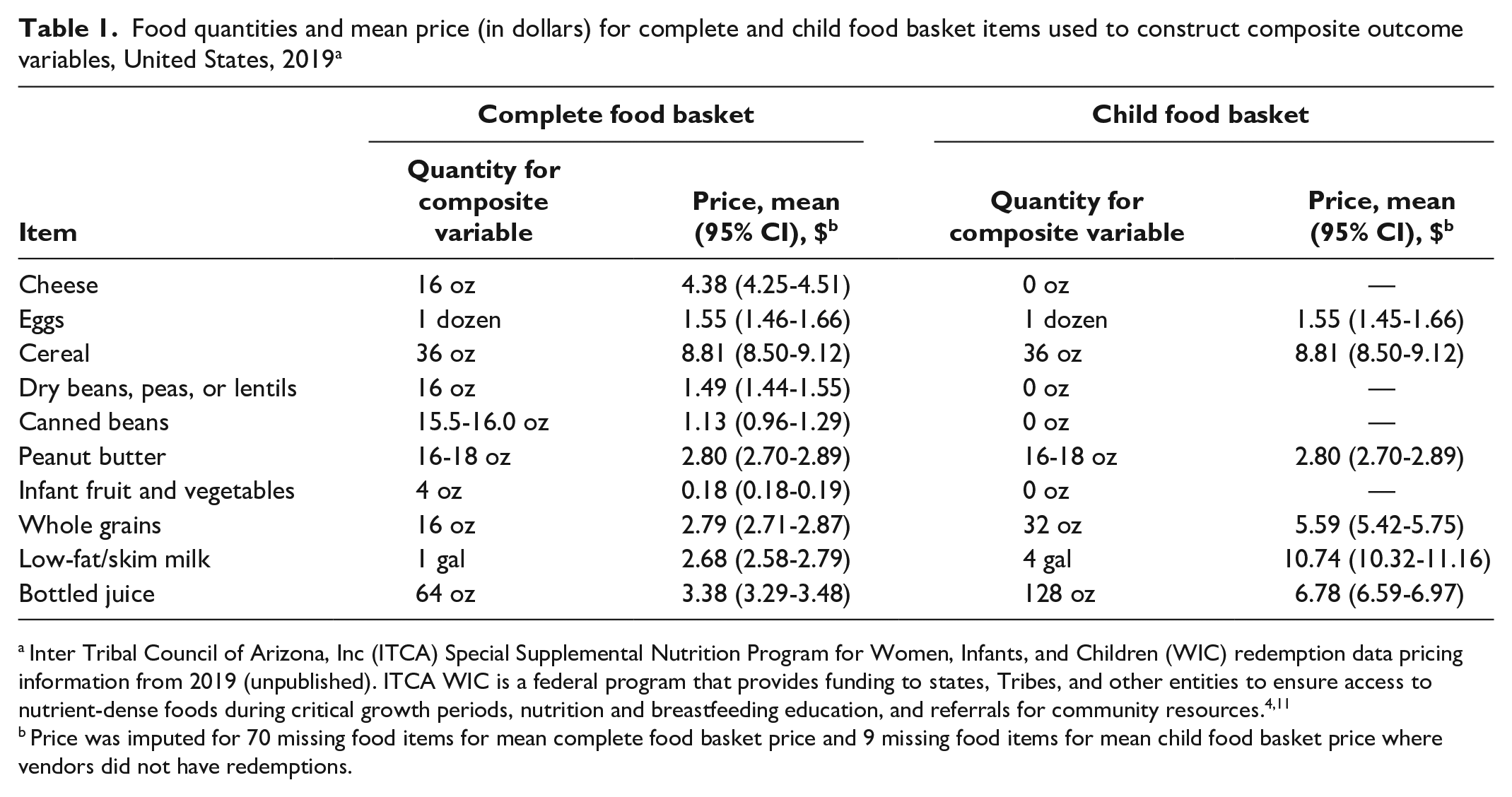
Inter Tribal Council of Arizona, Inc (ITCA) Special Supplemental Nutrition Program for Women, Infants, and Children (WIC) redemption data pricing information from 2019 (unpublished). ITCA WIC is a federal program that provides funding to states, Tribes, and other entities to ensure access to nutrient-dense foods during critical growth periods, nutrition and breastfeeding education, and referrals for community resources.4,11
Price was imputed for 70 missing food items for mean complete food basket price and 9 missing food items for mean child food basket price where vendors did not have redemptions.
WIC Independent Variables
We examined 9 variables as potential independent characteristics that determined complete and child food basket costs. The 6 WIC variables were business model, Supplemental Nutrition Assistance Program (SNAP) store type, WIC total sales, number of Universal Product Codes (UPCs) redeemed (by food basket), number of cash registers, and store square footage. We considered 4 geography variables in the models: USDA RUCA codes, USDA FAR codes, urban and nonurban designation, and distance to an interstate. The USDA guidance did not contain the use of FAR codes or urban and nonurban binary variables in its analysis 12 ; FAR codes identify sparsely populated areas. We examined these additional geographic variables because our WIC service area included remote places and this code was simpler than the RUCA codes.
We examined 3 store type variables: business model, secondary business model, and SNAP store type. The USDA guidance used and defined a business model as having the following 12 levels: (1) mass merchandiser, (2) discount and limited assortment chains, (3) national grocery chain, (4) national drug chain, (5) regional grocery chain, (6) local grocery chain, (7) independent grocery store, (8) regional or local drug store, (9) other, (10) vendors that received more than 50% of total sales from WIC purchases (ie, A50) or WIC purchases only, (11) commissary, and (12) convenience store, liquor store, or gas station. 12 We constructed a secondary business model variable with the same 12 levels and added a category by removing Tribally owned stores from the “other” variable. Tribally owned stores may differ in important ways when considering ITCA WIC pricing. Tribally owned stores tend to be easiest to access for rural Tribes but smaller than typical vendors. SNAP store type used in the USDA guidance (referred to as “store tracking and redemption system” store type) consisted of self-reported store size and a variety of foods available in the store. We collapsed the 7 SNAP store type categories into 4 groups: (1) super stores, (2) supermarkets and large grocery stores, (3) medium grocery stores, and (4) small grocery stores, convenience stores, a combination of grocery stores, and other.
We considered 4 continuous WIC variables in the models: number of UPCs redeemed, number of cash registers, store square footage, and distance to an interstate. We separated the number of cash registers into 2 categories similar to the USDA guidance (≤10 and >10). We defined the number of cash registers as the number of cash registers that can process WIC payments, not the total number of cash registers in the store, which is a gauge of the store’s capacity to process WIC payments. We separated the number of UPCs redeemed into 2 groups to designate the vendor peer groups (<135 and ≥135).
Geography Independent Variables
We explored 4 geography variables for the analysis. The distance to the nearest interstate was included as a continuous variable (miles).15,16 The 2010 RUCA codes have 10 levels: (1) metropolitan area core (urbanized area), (2) metropolitan area high commuting, (3) metropolitan area low commuting, (4) micropolitan area core (urban cluster, 10 000-49 999), (5) micropolitan high commuting, (6) micropolitan low commuting, (7) small town core (urban cluster, 2500-9999), (8) small town high commuting, (9) small town low commuting, and (10) rural. 13 We included the FAR codes for Arizona as a binary variable (remote/rural or not remote/rural), 14 and the remote/rural vendors were largely included in level 10 of the RUCA codes. Finally, we included urban and nonurban vendors, with urban vendors largely in RUCA codes 1-5 and nonurban vendors largely in RUCA codes 6-10. 17 These variables were not multicollinear in full models.
Data Analysis
Box plots
Using R version 3.4.2 (R Foundation for Statistical Computing), we constructed box plots using the mean values and IQR for mean costs of complete and child food baskets for all 146 vendors from May 1 through July 31, 2019. We examined outlier prices for the mean costs of complete and child food baskets but did not remove any vendors, because all needed to be classified. We examined the original and imputed values for the food basket costs; we found more outliers for the original values than for the imputed values.
Modeling
Using SAS version 9.4 (SAS Institute, Inc), we used full linear regression models. We examined the cost variables for the complete and child food baskets as the outcome in the models, and vendor characteristics were used as independent variables. We did not examine interactions between independent variables because we were exploring the importance of each variable related to vendor pricing, and grouping vendors on interactions in practice may not be practical for 146 ITCA WIC vendors. Using partial t tests, we excluded variables as independent predictors based on significance (P < .05). Once we determined the variables for the reduced models, we examined possible outlying stores by using regression diagnostics and residual plots. We examined Cook’s distance, R studentized residuals (jackknife residuals), and high leverage points for influential stores on food basket cost. We found several influential vendors, but we did not remove them from the analysis because the information in the dataset for the vendors was correct, and we wanted to ensure that all ITCA WIC vendors were grouped.
Vendor peer group system
The USDA guidance has 6 vendor peer group systems: 3 met the current cost containment rules and 3 did not. The USDA guidance recommends each vendor peer group to consist of a minimum of 30 vendors and to group vendors by their business model, number of cash registers, and a geography variable. We started with 146 vendors, so the maximum number of vendor peer groups we could possibly have would be 4 or 5 groups.
The ITCA Tribal Epidemiology Center and ITCA WIC collapsed groups for SNAP store type as appropriate based on statistics and ITCA WIC knowledge of the vendor population. Our goal was to use the most parsimonious model that explained food basket costs and to minimize overlap in mean food basket costs between the ITCA WIC vendor peer groups. We combined vendor SNAP store types with <30 vendors where possible based on what ITCA WIC staff determined was acceptable.
Results
We included all 146 ITCA WIC vendors in the analysis. The mean complete food basket cost was $29.23 (95% CI, $28.35-$30.10), and the mean child food basket cost was $36.28 (95% CI, $35.23-$37.33) (Figure).
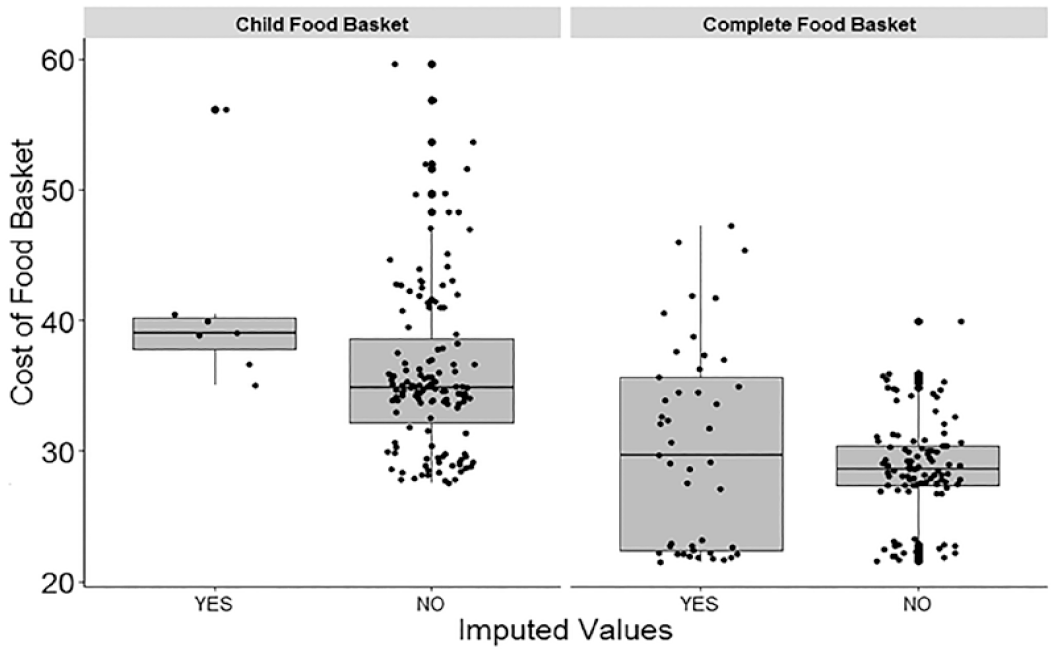
Inter Tribal Council of Arizona, Inc (ITCA) Special Supplemental Nutrition Program for Women, Infants, and Children (WIC) median complete and child food basket costs (in dollars) using reported and imputed values, Arizona, 2019. WIC is a federal program that provides funding to states, Tribes, and other entities to ensure access to nutrient-dense foods during critical growth periods, nutrition and breastfeeding education, and referrals for community resources.4,11 The horizontal bar inside the boxes indicates the 50th percentile using the first and third quartiles. The lower and upper ends of the boxes are the first and third quartiles of the vendor food basket cost data. The whiskers indicate the range of values, and the plotted dots indicate the median value of each food basket for each vendor in the dataset, including the outliers.
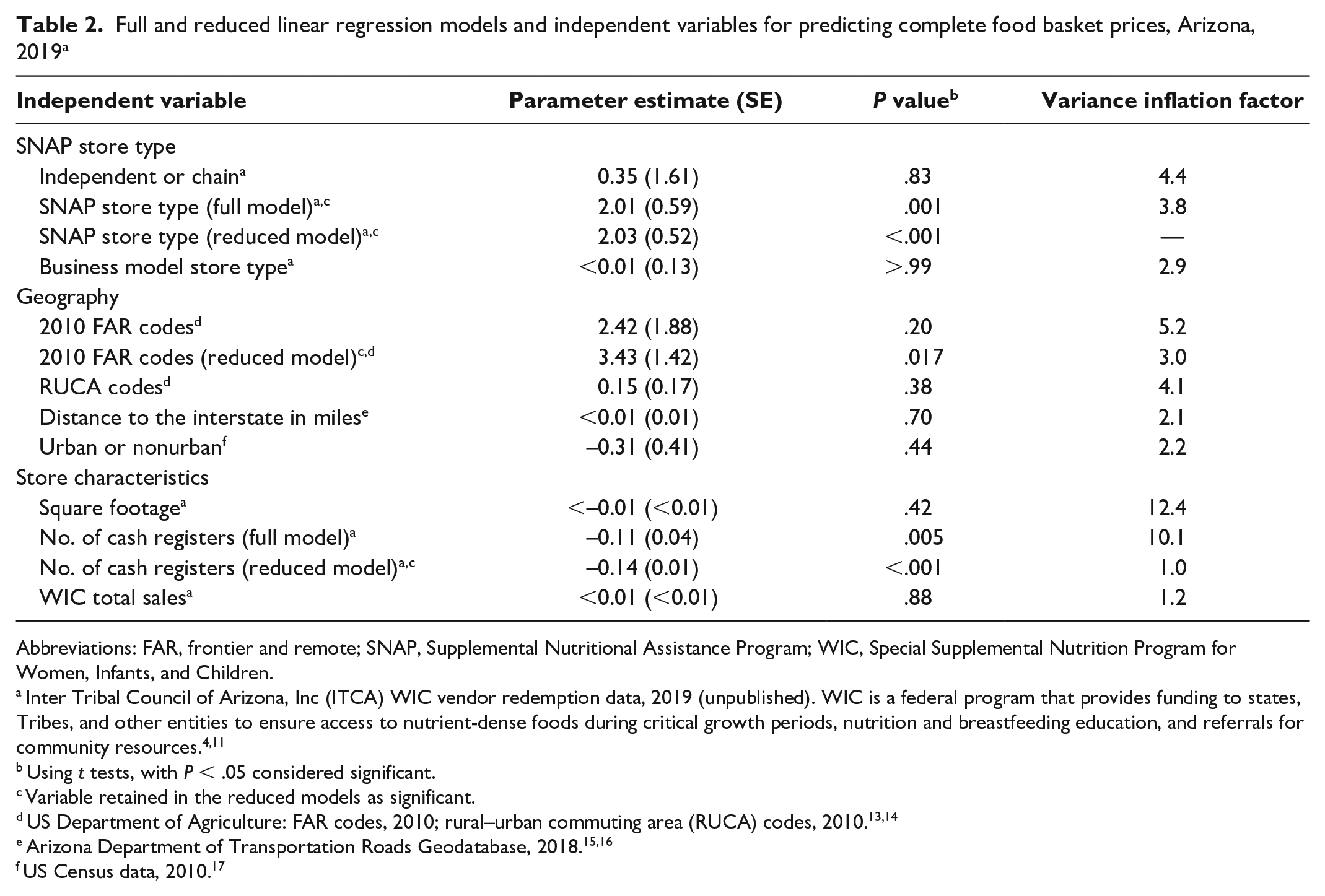
In full linear regression models for complete food basket cost, number of cash registers and store square footage were highly correlated (Table 2). The number of cash registers was significant (P = .005) but store square footage was not (P = .42). SNAP store type (P < .001) performed better than business model (P > .99). SNAP store type, number of cash registers, and FAR codes were significant predictors of complete food basket cost in reduced models (adjusted R2 = 68%).
Full and reduced linear regression models and independent variables for predicting complete food basket prices, Arizona, 2019 a
Abbreviations: FAR, frontier and remote; SNAP, Supplemental Nutritional Assistance Program; WIC, Special Supplemental Nutrition Program for Women, Infants, and Children.
Inter Tribal Council of Arizona, Inc (ITCA) WIC vendor redemption data, 2019 (unpublished). WIC is a federal program that provides funding to states, Tribes, and other entities to ensure access to nutrient-dense foods during critical growth periods, nutrition and breastfeeding education, and referrals for community resources.4,11
Using t tests, with P < .05 considered significant.
Variable retained in the reduced models as significant.
US Census data, 2010. 17
The full model adjusted R2 value was low (19%), and a reduced model with FAR code and square footage was minimally improved (adjusted R2 = 21%). The reduced model did not agree with the USDA guidance or ITCA WIC knowledge, so we decided to use complete food basket cost to determine ITCA WIC vendor peer groups.
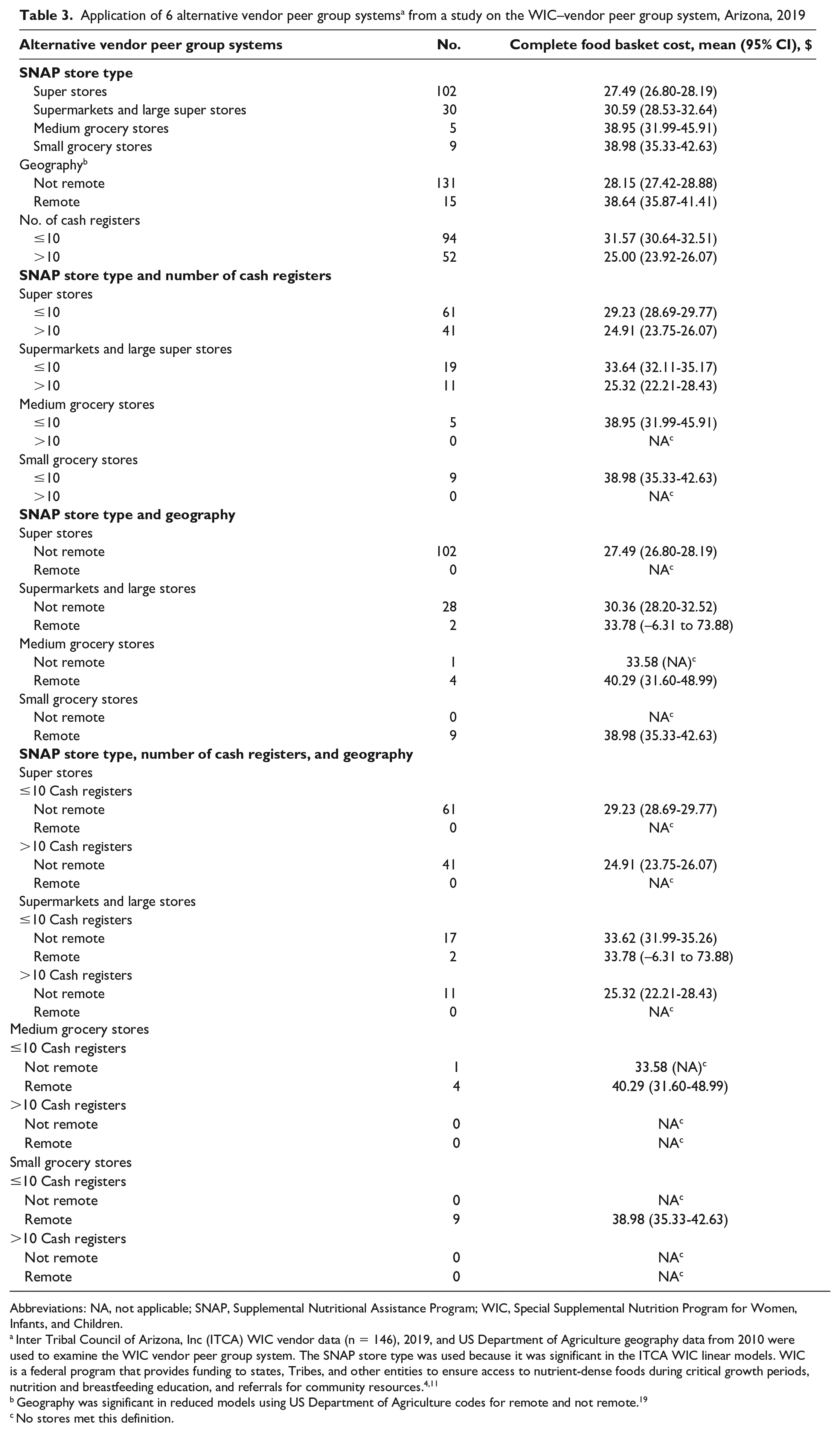
We applied the 6 vendor peer group systems found in the USDA guidance and made 3 changes to construct the ITCA WIC vendor peer group system comparatively: (1) we used SNAP store type rather than business model, (2) we used FAR codes rather than RUCA codes for geography, and (3) we collapsed number of cash registers into 2 groups (Table 3). Small grocery stores had a significantly higher mean food basket cost ($38.98; 95% CI, $35.33-$42.63) than larger vendors did. When we stratified on more than 1 variable, some groups had no vendors. The most practical grouping that agreed with USDA guidance and ITCA WIC analysis was the SNAP store type, number of cash registers, and FAR codes.
Application of 6 alternative vendor peer group systems a from a study on the WIC–vendor peer group system, Arizona, 2019
Abbreviations: NA, not applicable; SNAP, Supplemental Nutritional Assistance Program; WIC, Special Supplemental Nutrition Program for Women, Infants, and Children.
Inter Tribal Council of Arizona, Inc (ITCA) WIC vendor data (n = 146), 2019, and US Department of Agriculture geography data from 2010 were used to examine the WIC vendor peer group system. The SNAP store type was used because it was significant in the ITCA WIC linear models. WIC is a federal program that provides funding to states, Tribes, and other entities to ensure access to nutrient-dense foods during critical growth periods, nutrition and breastfeeding education, and referrals for community resources.4,11
Geography was significant in reduced models using US Department of Agriculture codes for remote and not remote.19
No stores met this definition.
Lessons Learned
The models in the USDA guidance varied by region. 12 In ITCA linear regression models, we found that the SNAP store type, number of cash registers, and FAR codes were independent predictors of complete food basket costs (adjusted R2 = 68%). We used 2010 FAR codes (the USDA guidance did not), and this variable was more important than other geography variables proposed in the USDA guidance. 12 The ITCA WIC vendor peer group system is a starting point for any WIC program in the United States, territories, or Tribes that include rural and remote populations. In some instances, the WIC-approved stores are the only stores in the area. Using vendor peer groups for WIC cost containment improves pricing and ensures availability of nutritionally balanced food, not only for ITCA WIC clients but for everyone living nearby.
In contrast, none of the independent variables were necessarily highly important for predicting child food basket costs (adjusted R2 = 21%). We found that remote or not remote geography was important to explain mean differences in food basket cost among ITCA WIC vendors. Using ITCA knowledge of the vendor population and significant variables from linear modeling, we found a workable vendor peer group system that largely explained differences in mean complete food basket cost that will function as a cost containment method for ITCA WIC vendors.
The USDA guidance provided a set of variables to form vendor peer group systems using vendor characteristics, geography variables, and expert program knowledge for 4 state agency WIC programs. 12 An advisory panel of WIC experts across the country reviewed the simulations in 2015 and found that the only consistent significant characteristics related to food basket costs were the number of cash registers and business model. 12 The USDA guidance tested 3 vendor peer group systems that met the cost containment rules: (1) business model and geography (urban vs nonurban), (2) number of cash registers and geography (urban vs nonurban), and (3) business model, number of cash registers, and geography (urban vs nonurban). USDA guidance tested 3 vendor peer group systems that did not meet the cost containment rules: (1) business model only, (2) number of cash registers only, and (3) business model and number of cash registers. 12 Our results were fairly consistent with the USDA guidance, but there were some differences in our models using the ITCA WIC vendor data.
The business model was not significant in ITCA WIC models, but the SNAP store type was significant. We suspect that the difference between our findings and the findings of the USDA guidance is that we had a smaller sample size. The 4 categories of SNAP store type were a better fit than the 12 levels of the business model variable to explain ITCA WIC vendor costs. In simple linear models, SNAP store type explained 38% of the variation in mean food basket costs in ITCA WIC models. Interestingly, the SNAP store type variable groups vendors inherently on specific items, such as UPC counts and store size, which may explain why store square footage was not significant. We kept SNAP store type in the final ITCA WIC vendor peer group based on ITCA WIC knowledge.
USDA guidance requires that geography be included in vendor peer group systems, although a waiver can be requested. The USDA guidance recommended determining if geography is an important variable for each WIC state agency. 12 We examined 4 geography variables and found that only FAR codes were significant predictors of complete food basket cost. In a state with many rural and remote communities, the finding that this geography variable persisted and influenced food costs was not surprising. New Mexico WIC analysis considered USDA food deserts, which was different from the USDA guidance and beyond the scope of our analysis. 18 Given these findings, ITCA WIC is moving forward to keep geography in the ITCA WIC vendor peer group system and may examine USDA food deserts as a variable in the future. 18 Other WIC programs may evaluate their vendor peer group system using FAR codes to capture remote communities.
This analysis of the ITCA WIC vendor peer groups had several strengths. First, we used a tested and recommended methodology for selecting vendor peer groups and found similar results. 12 Second, although our sample size was small (n = 146), 2 of the state agency WIC programs in the USDA guidance also had a small number of vendors (221 and 78). 12 Third, the ITCA WIC staff has been with ITCA WIC for many years and understands the vendor population well.
This application also had several limitations. First, the data used in the USDA guidance were from 2014, and we used the most recent ITCA WIC data from 2019. 12 Using a different redemption period may have affected food pricing, RUCA codes, and WIC annual sales. Second, we did not remove vendors who had missing values for food basket items. We imputed missing costs from competitive stores nearby, which may not be accurate. However, our box plots indicated that the imputed values were not largely different from nonimputed values. Third, the USDA guidance recommends that each vendor peer group have at least 30 stores. 12 We did not reach 30 stores in each of our peer groups because of our sample size. However, USDA guidance often did not achieve 30 stores per group either. 12 Fourth, we do not know how the COVID-19 pandemic will influence food basket costs and change vendor peer group systems in the future. During the ongoing pandemic, WIC programs allowed the purchase of different foods, which could influence the average food basket cost. Fifth, vendors such as Amazon Prime Whole Foods and Fresh Market may change WIC product availability, thereby changing the dynamic of geography for non–brick-and-mortar stores in the vendor peer group systems.
The USDA guidance was helpful for developing the new ITCA WIC vendor peer group system. We plan to use SNAP store type, number of cash registers, and FAR codes to group vendors into vendor peer groups. Despite changes resulting from the COVID-19 pandemic, we believe this vendor grouping is still optimal. Other WIC programs may want to consider FAR codes rather than RUCA codes for the geography component, particularly if their programs have stores in remote areas. This evaluation can assist other WIC programs by providing an example of applying the USDA guidance along with using WIC knowledge and other variables to predict food costs.
Footnotes
Acknowledgements
The authors thank the member Tribes of the Inter Tribal Council of Arizona, Inc, and WIC vendors, clients, and staff.
Declaration of Conflicting Interests
The authors declared no potential conflicts of interest with respect to the research, authorship, and/or publication of this article.
Funding
The authors disclosed receipt of the following financial support for the research, authorship, and/or publication of this article: This work was supported in part by the Indian Health Service, Epidemiology Program for American Indian/Alaska Native Tribes and Urban Indian Communities, grant no. U1B1IHS0003-21-01.
