




Abstract
Objective:
Tulane University School of Public Health and Tropical Medicine created a program planning course required for all master of public health (MPH) students to address the revised 2016 Council on Education for Public Health (CEPH) foundational competencies. The objective of this study was to examine students’ feedback on this new class based on their reflective writing.
Methods:
Students across 3 class sections during 3 semesters (fall 2018, spring 2019, and fall 2019) wrote a reflection paper as a final assignment about their course experience (N = 102). We conducted a conventional qualitative content analysis of deidentified student responses to systematically examine themes in the overarching areas of what students found valuable about the course and what they would want to be improved. We calculated frequency counts of themes to further contextualize the findings.
Results:
Students found the following aspects of the course valuable: a positive perception shift toward program planning (93.1%), new transferable career skills (87.3%), the course format (77.5%), course content (69.6%), working in teams (52.0%), course assignments (47.1%), and the instructional team (31.4%). Critiques included the following: more support for course assignments (39.2%), challenges of working in teams (27.5%), aspects of the course format (25.5%), gaps in course content (19.6%), and wanting more consultations with the instructional team (5.9%). About 14% of students stated there was nothing or little they would change about the course.
Conclusion:
Overall, the course received positive feedback from students. They identified several valuable course components and areas that could be enhanced, which we have worked to improve. We offer the course as a potential model for how schools and programs of public health can meet the 2016 CEPH competencies.
Program planning skills are used in an array of public health positions and are essential for preparing a competent public health workforce.1-3 Gaining program planning expertise is central to the revised 2016 Council on Education for Public Health (CEPH) master of public health (MPH) competencies, 4 reflecting the importance of emerging public health professionals becoming proficient in designing public health programs.
Undergraduate and graduate program planning courses have used diverse teaching and learning approaches, including service learning, problem-based learning, practice-based learning, and traditional classroom health education formats.5-10 The few published evaluations of program planning courses have found that they have effectively prepared students for public health careers. For example, 1 study contacted health education program alumni to inquire if, and how, program planning and evaluation courses prepared them to work in various health settings. Participants reported that the program planning course provided essential training crucial to their current job. 10 Additional studies have noted that service learning–based program planning courses can enhance students’ comprehension of course concepts, increase their self-efficacy, and make students feel more career-ready.3,5
Although these studies present promising findings on the role of program planning courses in students’ professional development, the literature is limited regarding best practices for the design and implementation of these courses and students’ attitudes about them. Furthermore, of the studies that have been conducted, all have focused on students attaining degrees in health education/health promotion. To our knowledge, no studies have examined graduate program planning courses intended for students across public health disciplines. Given the revised 2016 CEPH competencies, training all public health students in program planning is now critical. We therefore examined student perceptions regarding the value and areas of improvement for a new graduate-level program planning course required for all MPH students at Tulane University School of Public Health and Tropical Medicine designed to meet the revised 2016 CEPH competencies. This article contributes to the literature by providing evidence-based information about best practices for program planning courses, particularly for students across public health disciplines. It also serves as a curricular model for how schools and programs of public health can address the CEPH competencies.
Course Description
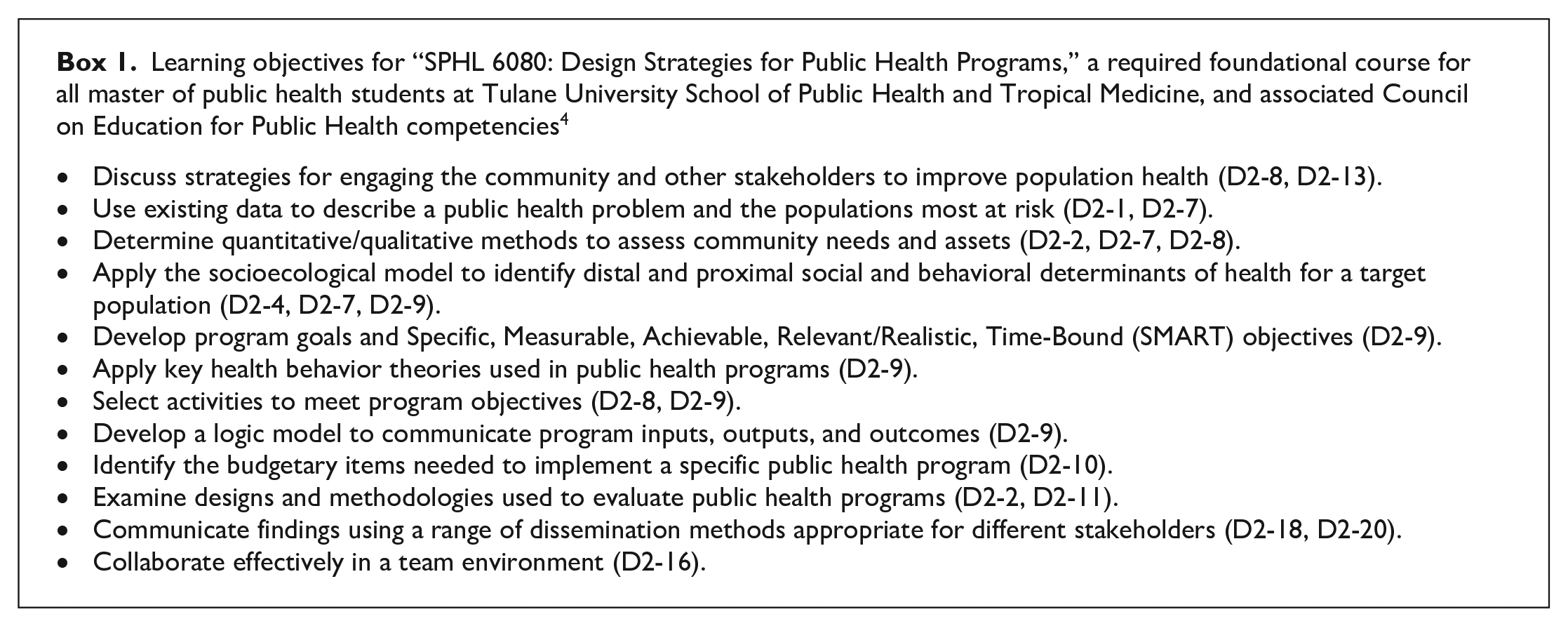
The course “SPHL 6080: Design Strategies for Public Health Programs” was created as a requirement for all MPH students at Tulane University School of Public Health and Tropical Medicine to meet specified 2016 CEPH-D2 foundational competencies (Box 1). 4
Learning objectives for “SPHL 6080: Design Strategies for Public Health Programs,” a required foundational course for all master of public health students at Tulane University School of Public Health and Tropical Medicine, and associated Council on Education for Public Health competencies 4
A multidisciplinary team of faculty and staff with varying areas of expertise collaborated during several months to create the course using a backward design course development process. 11 First, a course framework was developed with the core knowledge and skills students should gain from the course, followed by associated assessment methods. Then, individual class sessions were shaped through the development of specific learning objectives and activities.
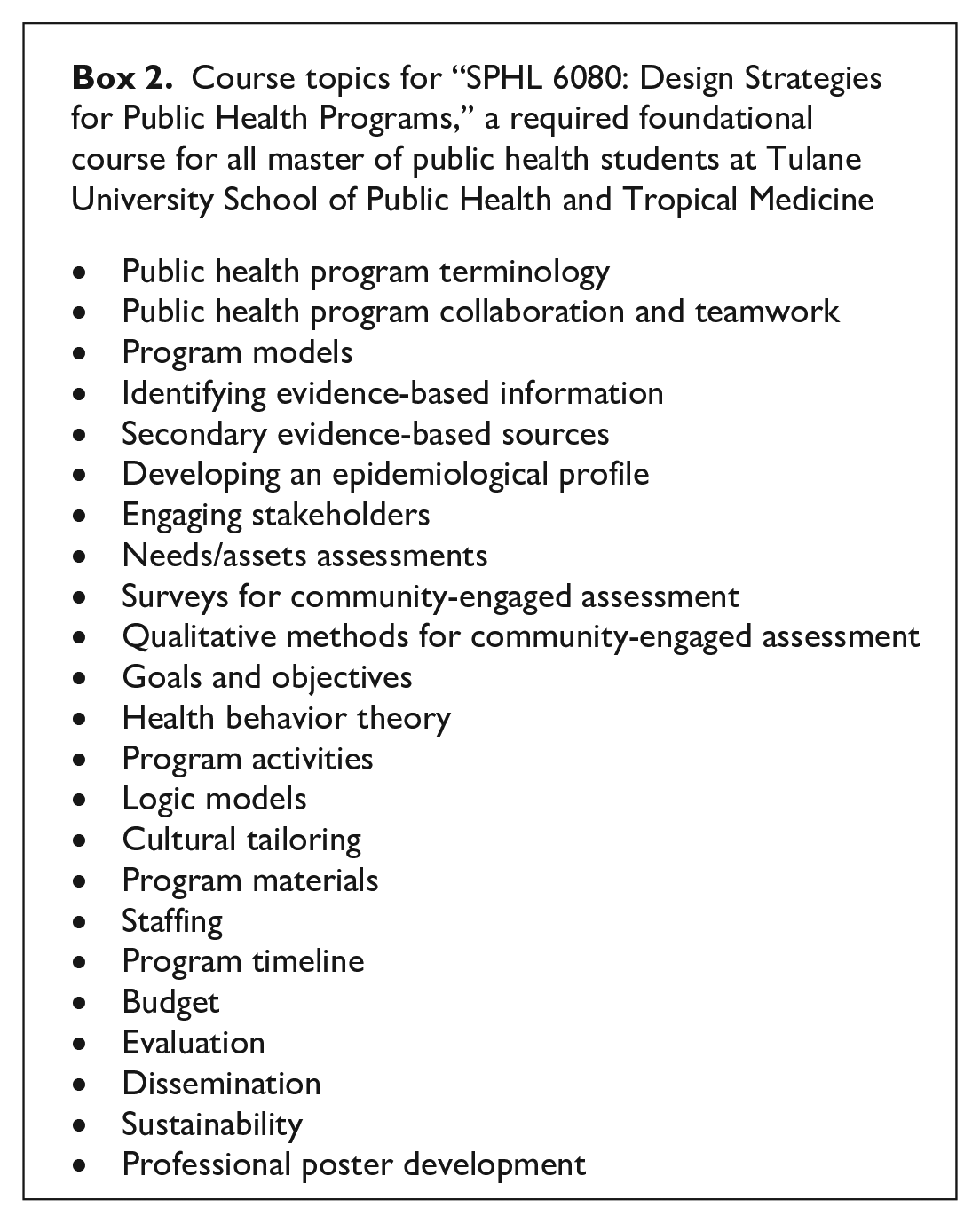
The course took students through the 5 phases of the Generalized Program Model: conducting a needs assessment, creating goals and objectives, designing the program, implementing the program, and evaluating the program. 12 Students worked in small teams to design a public health program based on their area of interest. The course was purposefully designed to give students professional development experience with team-based and applied public health projects, recognizing the benefits of collaborative learning 13 and that collaboration is a developable skill. The instructional team devised and followed the motto “learn it, try it, refine it” in the course approach to in-class content and assignments. For example, students created a public health program step-by-step throughout the course through a series of scaffolded “mini-step” assignments. They received extensive feedback from the instructional team, revised the assignments, and then consolidated them into a culminative written program proposal and professional poster presentation due at the end of the course. The course instructor was a tenure-track student-centered faculty member with professional program planning experience, who was supported by 2 advanced doctoral teaching assistants. Course content areas included conducting a community needs/assets assessment, developing program goals and objectives, using health behavior theory to inform program design, and developing a program budget, among many others (Box 2). The course design framework and an abridged course syllabus are available in supplementary material (supplemental Figures 1 and 2).
Course topics for “SPHL 6080: Design Strategies for Public Health Programs,” a required foundational course for all master of public health students at Tulane University School of Public Health and Tropical Medicine
Students completed a course reflection paper assignment in which they were asked to process their course experience while providing formative feedback about the class. The instructions provided the following prompts for students to answer in 1-2 pages: what, if anything, they found valuable about the course; in what ways, if any, the course prepared them for a public health career; if their perception of program planning changed as a result of the course; and if they were to take the course again, what, if anything, they would want to be different. Students uploaded their reflection papers into the online course management system on the last day of class. The directions encouraged students’ honesty and explicated that grading was based solely on thoughtfulness and following formatting instructions. This study is a critical analysis of students’ reflection papers intended to draw conclusions about students’ perceived value of the course and what modifications may be needed for course improvement.
Methods
Students were enrolled in the course sections taught by the authors in fall 2018, spring 2019, and fall 2019. A total of 103 students were enrolled in the sections, and 102 reflection papers were submitted. After receiving approval from the Tulane University Institutional Review Board, all reflection papers were downloaded from the institution’s learning management system, deidentified, and given a participant number, ensuring anonymity. Documents were uploaded into a qualitative software program, MAXQDA Analytic Pro 2020 (VERBI GmbH), for storage and analysis.
Conventional qualitative content analysis was used to inductively analyze the reflection papers. 14 This analytical approach involved systematically coding text data, without having preconceived categories in mind, to identify emergent themes. 14 The qualitative content analysis included the quantification of themes to summarize thematic findings and to represent their magnitude.15,16 Reflection papers have been used as an analytical approach in prior research, as they allow students to critically contemplate their learning experience, course content, and perceptions of personal or professional growth.17-20
Coding was collaborative and iterative21,22 and included several rounds of coding, discussion, and adjustment before final coding. The authors read all deidentified reflection papers to cooperatively create a preliminary codebook. They then independently coded 3 randomly selected papers to assess general coding alignment using interrater agreement in MAXQDA as a guide. They discussed any discrepancies and modified the codebook as needed. 23 A total of 12 reflection papers were jointly reviewed in 4 rounds of coding and comparison, after which both authors’ coding completely paralleled, and a finalized codebook was established. The first author independently coded the remaining reflection papers based on the finalized codebook. The second author randomly coded 3 additional reflection papers for a final coding alignment check. In total, 14.6% (15 of 102) of the papers were dual coded, consistent with recommendations to dual code approximately 10% of a sample.23,24
Because the study’s sample size was large (N = 102), a frequency count of each theme was calculated to show the extent that each theme was present across students’ writing.15,16 Codes that appeared in 5% or more of the papers were included. Exemplar quotes were selected to illuminate the thematic findings in the verbatim words of the students. To address the research aims, themes were grouped into 2 predetermined categories: what students found valuable about the course and recommended course changes.
Results
Student Demographic Characteristics
Demographic information was taken directly from course rosters and information provided by students. Most students were in their first year (75.5%), enrolled in either the MPH or combined degree (bachelor of science in public health [BSPH]–MPH) program (99.0%), in the Department of Global Community Health and Behavioral Sciences (60.8%), and identified with she/her pronouns (77.5%) (Table 1).
Characteristics for students enrolled in the sections studied of “SPHL 6080: Design Strategies for Public Health Programs,” a required foundational course for all MPH students at Tulane University School of Public Health and Tropical Medicine, in fall 2018, spring 2019, and fall 2019 (N = 102)
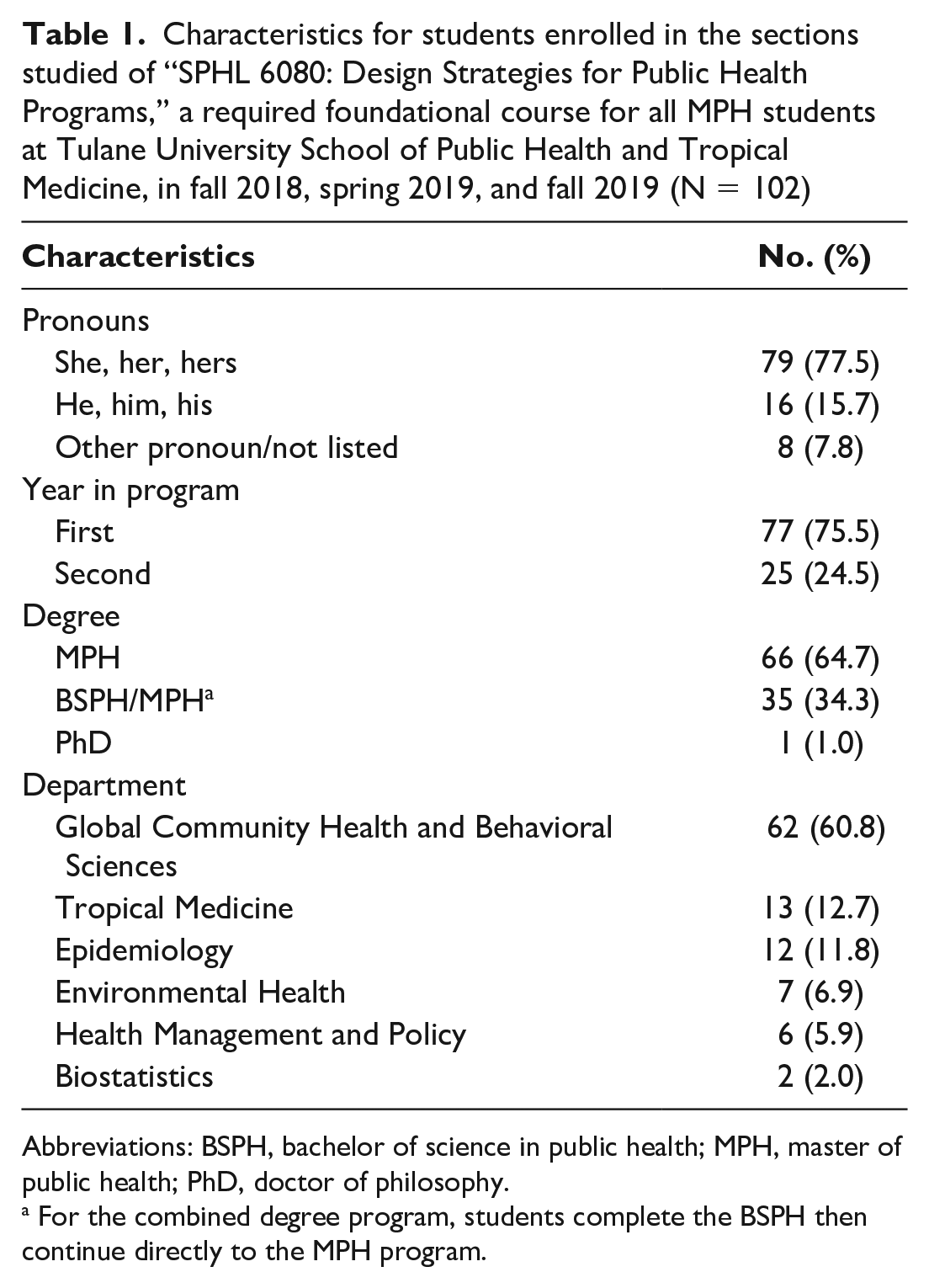
Abbreviations: BSPH, bachelor of science in public health; MPH, master of public health; PhD, doctor of philosophy.
For the combined degree program, students complete the BSPH then continue directly to the MPH program.
What Students Found Valuable About the Course
Students identified several themes regarding what they found valuable about the course, as detailed hereinafter (Table 2).
Analysis of what students found valuable about “SPHL 6080: Design Strategies for Public Health Programs,” a required foundational course for all master of public health students at Tulane University School of Public Health and Tropical Medicine, in fall 2018, spring 2019, and fall 2019 (N = 102)
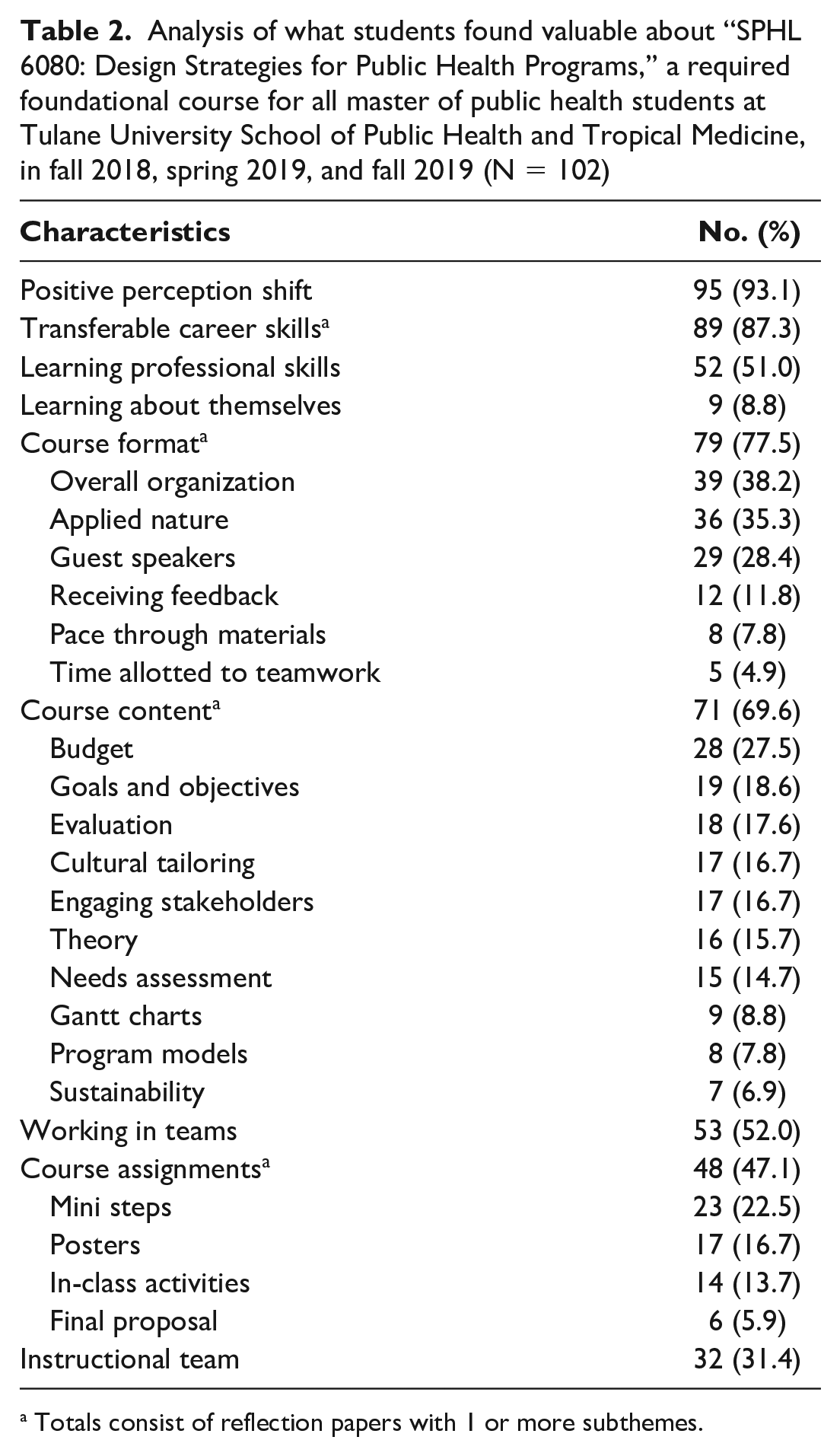
Totals consist of reflection papers with 1 or more subthemes.
Positive perception shift about program planning
Almost all students (93.1%) discussed how their perceptions of program planning positively changed due to the course. Papers revealed that most students originally had little knowledge about what program planning entailed or its utility as a multidisciplinary sector of public health. Students’ perceptions evolved as they learned the various steps involved in the program planning process and the skillset involved in program design. One student stated, “I have gained an increased appreciation for public health professionals and the program design process. It is a complex process that takes a lot of planning, time, motivation, and dedication in order to be successful. Overall, my perception has been positively improved and shaped.”
Transferrable career skills
Most students (87.3%) believed that the knowledge and skills gained from the course prepared them for their future public health career, even if they did not envision doing program planning themselves. Students felt that the course provided opportunities to learn and hone professional skills prior to entering the workforce. The following skills were commonly mentioned: teamwork, organization, time management, attention to detail, systematic thinking, public speaking, presentation skills, networking, and leadership. One student stated: “In my future career as a public health professional, [the course] helped me to assess and organize every step of a program [so that] I can plan a real program . . . it helped me rehearse my networking and presentation skills that I think are vital for any public health professional.”
Approximately 20.6% of students, without prompting, discussed the importance of the course being required for all MPH students because they believed the content was relevant to all public health professionals regardless of discipline.
Working in teams
More than half of the students (52.0%) expressed that working in a team enhanced their learning experience and understanding of course material. Students felt that working in teams enabled professional growth, because collaborating with people of different backgrounds and disciplines gave them exposure to new ways of thinking and learning. One student stated: “The most essential takeaway I learned from [the course] was how to effectively work in a team. Public health is often times teamwork based and the course gave me the opportunity to experience team building, dividing of tasks, and learning to utilize one’s strengths to truly enhance the program.”
Course format
More than three-quarters of students (77.1%) identified the course format as valuable. Students felt that using the Generalized Program Model and step-by-step scaffolding of content enhanced their learning process. One student noted: “Going through the program planning process step by step and having the mini steps correspond was helpful. I took more from the practical experience and class discussions than I would have a traditional lecture.” Many students (35.3%) reported that the applied nature of the course helped to solidify their knowledge. Students frequently discussed the value of the real-world examples provided and the guest speakers who shared their programmatic experience in local, national, and international settings. Students felt the course went beyond instilling information and increased their self-efficacy by operationalizing this knowledge for their future public health practice.
Course content
Students reported finding value in numerous course content areas (69.6%). Students most frequently discussed budget development (27.5%) and its application across all public health and other career sectors. Additional course content favored by students included goals and objectives (18.6%), evaluation (17.6%), cultural tailoring (16.7%), and engaging stakeholders (16.7%). Importantly, students frequently reported an increased level of self-efficacy to apply course content.
Course assignments
Almost half of students (47.1%) found value in 1 or more course assignments. Students appreciated that the assignments created opportunities to practice, prepare, and receive feedback prior to the cumulative final program proposal. One student stated: “Another thing that I found really valuable was that as we learned new information about program design, we simultaneously were creating one ourselves. This was beneficial for my learning because I could truly understand the content better and I was able to learn from my mistakes along the way to get a better understanding of the ins and outs of programming.”
Instructional team
Approximately one-third of students (31.4%) attributed their positive learning to the instructional team. One student reflected, “I am glad that the instructors were always available for help and were able to answer our questions. . . . It made the planning process easier, doable, and I, personally, was able to gain more out of it.” Students felt that the approachability of the instructional team and positive classroom environment enabled them to feel comfortable, engage openly in discussions, have fun, be creative, and learn via a variety of teaching and learning methods.
Recommended Course Changes
The second research aim addressed what students felt could be changed to enhance their learning experience in the course (Table 3).
Analysis of students’ recommended changes to “SPHL 6080: Design Strategies for Public Health Programs,” a required foundational course for all master of public health students at Tulane University School of Public Health and Tropical Medicine in fall 2018, spring 2019, and fall 2019 (N = 102)
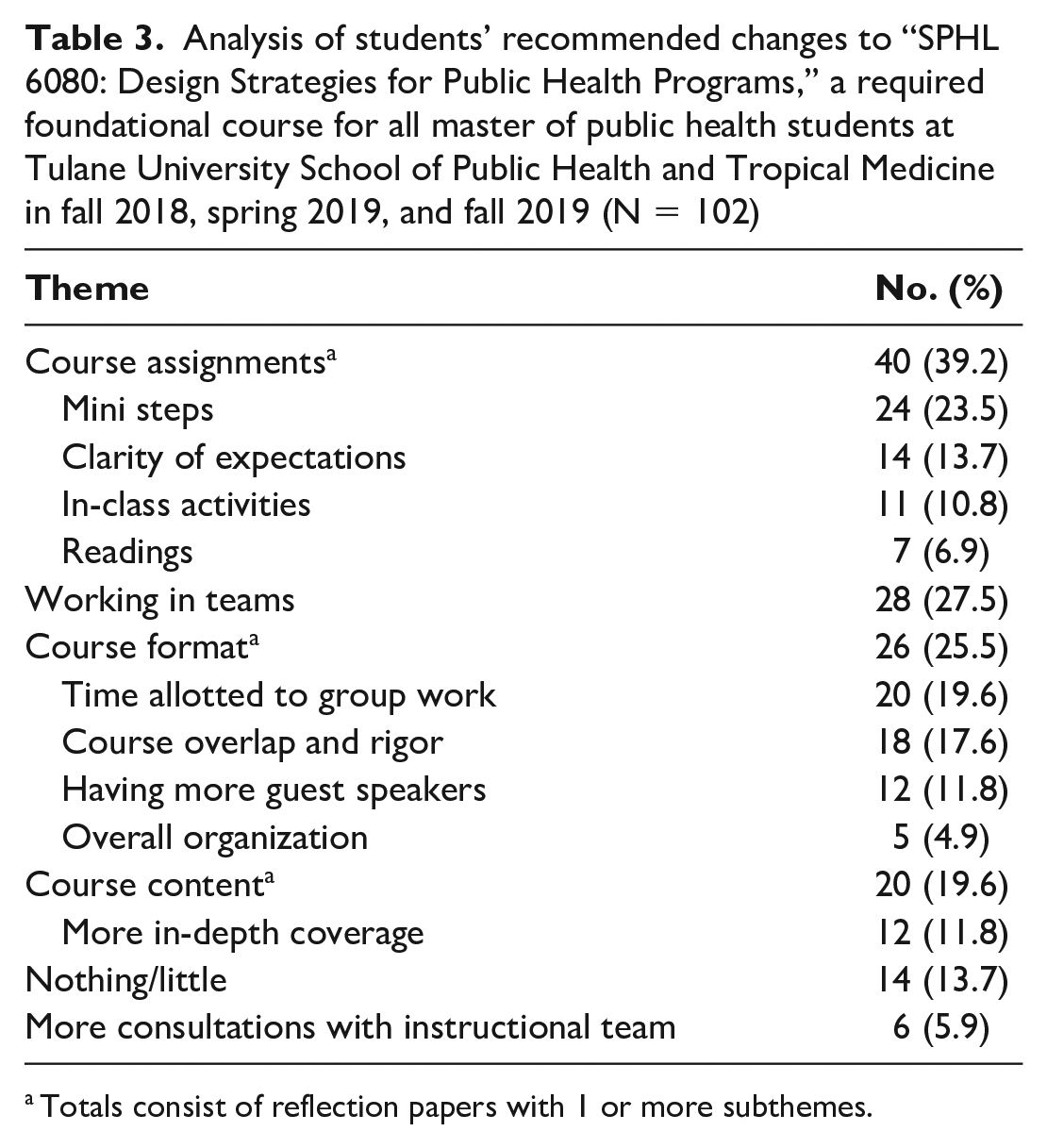
Totals consist of reflection papers with 1 or more subthemes.
Course assignments
Many students found the course assignments valuable; however, some students (39.2%) suggested modifications. Approximately 13.7% of students wanted more clarity in the assignment instructions. Students also recommended that a larger proportion of the course grade be based on independent rather than team-based assignments, as they felt team-based grades were not always reflective of their personal knowledge or academic growth throughout the semester. One student stated: “I would also like there to be more opportunities for individual work because while I did work well with my group, I felt like the majority of the class I was judged based on my group work and not my individual progress.”
Working in teams
Although most students found value in working in teams, some students (27.5%) found elements of teamwork difficult. Students noted that working in a team could be challenging as it involved communication, coordination, patience, and balance of different personalities and skills. Furthermore, students acknowledged that team-based assignments were challenging as the workload was often disproportionate between team members, coordinating schedules could be difficult, and some students were completing multiple semester-long group projects concurrently across several courses. One student stated: “The heavy emphasis on groupwork was a challenge. I had three different group projects to manage at once and barely any time to meet or do work with any of them. As with most group projects, work is never divided equally.”
Course format
One-fifth of students (19.6%) explicitly wrote that additional class time should be allocated toward working on the team-based assignments to help them complete assignments faster, ask the instructional team questions, and receive needed feedback. Some students (17.6%) had concerns about the rigor, both ease and difficulty, of the course. While some students felt the coursework was too simplistic due to redundancy with other courses, others thought the coursework was completely new and, therefore, overly challenging. One student wrote, “This class was not very different from other classes I have taken, especially [course title], which was incredibly similar to the course. Honestly, there were very few topics covered in this class that I hadn’t encountered before in another class.” However, another student wrote, “The course was overwhelming at times because I have not taken a [social/behavioral sciences course] before.”
Course content
Students did not express concern about the existing course content; however, there were some topics that they preferred be added or discussed more in-depth (11.8%). One student wrote: “The one aspect I was hoping to learn more about from the course was grant writing. . . . I assumed that would be included somewhere in the course and was a bit disappointed that it wasn’t anywhere in the curriculum.” Students most frequently requested additional content related to grant writing and program evaluation.
More instructional team consultation time
Some students (5.9%) discussed the importance of support from the instructional team and acknowledged that if they had sought assistance earlier and more frequently, it would have eased completing assignments and learning course content. For example, 1 student said, “I would also want to make standing meetings with the [instructional team] because their guidance is invaluable.”
Nothing/little
About 14% of students explicitly stated there was nothing or very little that they would change about the course. One student wrote: “The course, by the way it is designed, it is meant to be an eye and mind opener for the students. I think the course has pushed me to grow both professionally and personally. So, no, I would not change anything.”
Discussion
This study systematically analyzed students’ reflective writing about their perceived value of taking a graduate program planning course and identified ways to enhance the class. Students found numerous aspects of the course valuable, particularly their newfound understanding of the utility, complexity, and transferability of program planning. The results echo findings from similar studies that found program planning courses are overall enjoyable for students, teach transferable skills, and can hone students’ critical thinking.1-3,5-10 The study findings demonstrate the importance of several evidence-based course practices, such as open-door policies, proactively reaching out to students to provide support, active and applied learning exercises, scaffolding, and maintaining an engaged learning environment in which instructors are invested in student success. 25 These approaches will be crucial to maintain in future courses. Admittedly, these strategies are time-intensive; employing competent teaching assistants can offset some workload if resources allow.
Students’ constructive criticism noted the need for more detailed assignment instructions, more in-class time to work in teams, more workload equity among team members, more individual-based grades, and more instructional support for completing assignments. Given this feedback, we incorporated multiple accountability measures within the team-based assignments and overall class design. We had already instituted a partnership contract that students created and signed at the beginning of the semester. We now ask student teams to revisit the contract regularly. We also require students to list team member contributions on all mini steps, as well as complete a peer- and self-evaluation for the course project. We refined assignment instructions and now review them thoroughly during class. When possible, we allocate time at the end of each class to help with coordinating schedules, task delegation, and troubleshooting with the instructional team, thereby alleviating some communication burdens.
A challenge is striking a balance between the course being introductory enough for students new to program planning yet rigorous enough for students who have more academic background. From our experience, students in the latter group sometimes view content as redundant rather than reinforcing or building upon previously learned material. Curriculum mapping is needed to minimize duplication across classes. However, shared content among classes can be optimal for student learning by strengthening their understanding and exemplifying ways in which public health issues intersect. For example, our course extends core content from a health behavior theory class by focusing on theory application specifically within the context of program planning. In addition, we now proactively address students’ known potential concerns. For example, on the first day of class, we discuss the rationale for the course’s collaborative approach and strategies in place to facilitate workload equity. Research has found that students do not always initially prefer teaching strategies that help them to learn most effectively, but presenting the value of such approaches at course outset can increase student buy-in. 26
Limitations
This study has several limitations. Although honesty was encouraged, the reflection papers were a graded assignment and could therefore be subject to social desirability. In addition, the course was only examined at 1 institution and with 1 instructor; findings may not be generalizable to other institutional contexts. Future research should investigate the impact of other program planning courses, including how different pedagogical approaches may affect student learning outcomes at the undergraduate and graduate levels. Furthermore, with the recent influx of online teaching, future research should explore how to effectively translate course practices to the online environment. Researchers are encouraged to use diverse methodologies, such as the addition of baseline and post-test surveys, in future studies.
Conclusion
This study demonstrated that students across MPH disciplines benefit from taking a program planning course designed to achieve the revised 2016 CEPH competencies. Despite some areas for improvement, the course was discussed favorably by students. The course may serve as a curricular model for other schools and programs of public health seeking to address the revised 2016 CEPH competencies and the 2021 revisions to the accreditation criteria 27 and hone their students’ program planning expertise.
Supplemental Material
sj-jpg-2-phr-10.1177_00333549221074384 – Supplemental material for “I Was Learning Every Step of the Way”: Student Perceptions About a New Required Foundational Master of Public Health Program Planning Course
Supplemental material, sj-jpg-2-phr-10.1177_00333549221074384 for “I Was Learning Every Step of the Way”: Student Perceptions About a New Required Foundational Master of Public Health Program Planning Course by Jeni Stolow and Alyssa Lederer in Public Health Reports
Supplemental Material
sj-pdf-1-phr-10.1177_00333549221074384 – Supplemental material for “I Was Learning Every Step of the Way”: Student Perceptions About a New Required Foundational Master of Public Health Program Planning Course
Supplemental material, sj-pdf-1-phr-10.1177_00333549221074384 for “I Was Learning Every Step of the Way”: Student Perceptions About a New Required Foundational Master of Public Health Program Planning Course by Jeni Stolow and Alyssa Lederer in Public Health Reports
Footnotes
Declaration of Conflicting Interests
The authors declared no potential conflicts of interest with respect to the research, authorship, and/or publication of this article.
Funding
The authors received no financial support for the research, authorship, and/or publication of this article.

Supplemental Material
Supplemental material for this article is available online.
References
Supplementary Material
Please find the following supplemental material available below.
For Open Access articles published under a Creative Commons License, all supplemental material carries the same license as the article it is associated with.
For non-Open Access articles published, all supplemental material carries a non-exclusive license, and permission requests for re-use of supplemental material or any part of supplemental material shall be sent directly to the copyright owner as specified in the copyright notice associated with the article.

