




Abstract
Childhood and adolescence are crucial periods for mental and social development. Currently, mental illness among young people is a global epidemic, and rates of disorders such as depression and anxiety are rising. Urban living, compared with rural living, is linked with a higher risk of serious mental illness, which is important because the world is urbanizing faster than ever before. Urban environments and their landscapes, designs, and features influence mental health and well-being. However, no conceptual frameworks to date have detailed the effect of urban environments on young people’s mental health, and few studies have considered the growing role of digital and social media in this relationship, leading to calls for the development of holistic approaches to describe this relationship. This article synthesizes existing knowledge on urban places (both built and natural environments) and mental health in the public health and urban planning literature and examines the emerging field of neurourbanism (a multidisciplinary study of the effect of urban environments on mental health and brain activity) to enhance current practice and research. We developed 2 novel conceptual frameworks (1 research-oriented, 1 practice-oriented), adapted from Bronfenbrenner’s socioecological model, that focus on the relationship between urban environments and young people’s mental health. We added a digital and social media contextual level to the socioecological model, and we applied a multilayer concept to highlight potential cross-field interactions and collaborations. The proposed frameworks can help to guide future practice and research in this area.
Childhood and adolescence (ie, generally aged <18 years) are critical periods in human growth and development. Mental illness among young people can arise as a consequence of the myriad physical, emotional, and social changes experienced during these years. 1 The prevalence of mental illness among young people is rising,2-5 and the onset of internalizing disorders in early life is among the leading causes of disability. 6
Living in urban areas is linked with an increased risk of serious mental illness. 7 Compared with people who live in rural areas, city dwellers have higher rates of schizophrenia,8-10 distress, posttraumatic stress disorder, and paranoia.11-13 With migration to cities predicted to increase in the coming decades, 14 understanding the influence of urban environments on mental health is important. 15 Urban influences on young people’s mental health are understudied because of a lack of funding16-18 and support19-21 for mental health research on this population. As a result, interdisciplinary research has called for comprehensive frameworks to clarify the relationship between mental health and the environment,4,22 including those that consider how urban environments influence the mental health of young people.22,23
Synthesis Aim, Theoretical Approach
This article synthesizes research on urban influences on young people’s mental health from 3 bodies of literature—public health, planning, and neurourbanism (a multidisciplinary study of the effect of urban environments on mental health and brain activity)—to develop 2 novel, comprehensive, interdisciplinary frameworks for research and action on the relationship between young people’s mental health and the urban environment. Our approach is grounded in Schulz and Northridge’s 24 socioecological conceptual framework of the social determinants of health and environmental health promotion to recognize the dynamic and multilevel relationship between the urban environment and young people’s mental health. Schulz and Northridge’s framework explicitly focuses on social and environmental mechanisms by which urban environments can produce inequities in mental health outcomes, thereby warranting a multifield approach. In our novel conceptual frameworks, therefore, we view the relationship between the urban environment and young people’s mental health as dynamic, socio-relational, and multilevel (individual, interpersonal, environmental, policy). We define and provide a summary of key features, approaches, and ideas associated with each field to provide the material bases for the frameworks (Table).
Overview of fields contributing to urban influences on research on mental health among young people
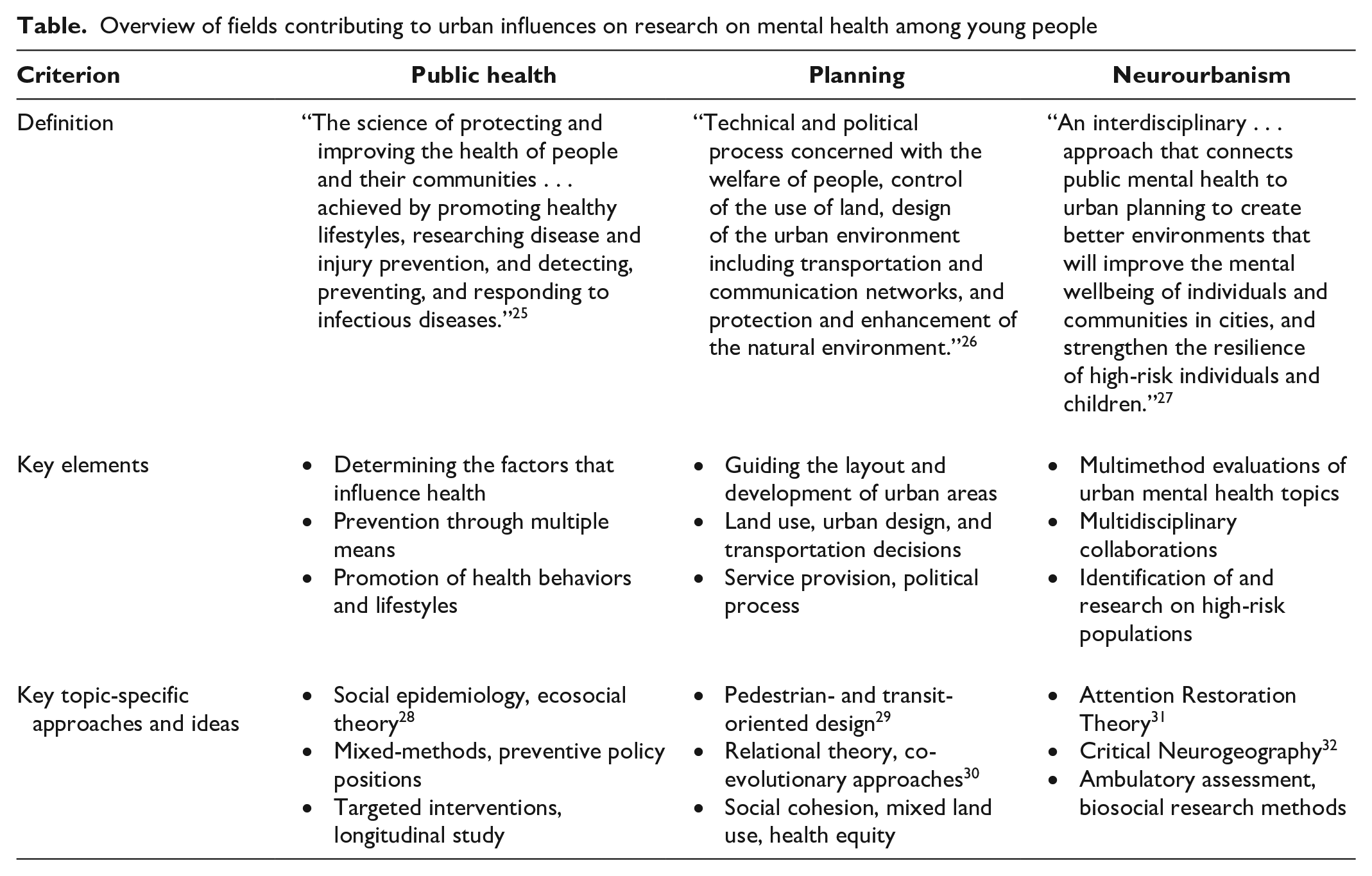
Key public health methods and practices pertaining to this topic include ecosocial theory, the use of mixed methods, and targeted interventions. Importantly, ecosocial theory asserts that a combination of biological, sociological, economic, and psychological phenomena influence health. 28 In urban planning, pedestrian- and transit-oriented design outlines multiple features that may underlie the relationship: imageability (ie, quality of a place that makes it distinct 29 and can contribute to a sense of place), 33 enclosure (ie, the degree to which spaces are visually defined 29 ; the idea of hereness, 33 ie, one’s identity with one’s surroundings), linkage (ie, physical and visual connections that unify disparate elements), 29 and legibility (ie, ease with which the spatial structure of a place can be understood and navigated). 29 Key neurourbanistic features include attention restoration theory, which hypothesizes about the restorative health effects of environments, 31 and critical neurogeography, a biosocial framework that emphasizes a geographic focus during investigations of the brain in social milieus. 32
Public Health
Public health has been at the forefront in considering issues about health and the urban environment since the 19th century, as industrialization and urbanization, the spread of infectious illnesses, and urban health concerns prompted new perspectives on population health. 34 By modern definitions, the urban environment is an important determinant of young people’s mental health35-37; living in urban environments has been identified as an important risk factor in the development and onset of several mental health issues.38-40 Public health is critical to the identification of these health issues, prevention of ill health, and promotion of healthy behaviors through means such as education, research, and policy recommendations. 25 These roles are best understood by breaking down the urban environment into its built and natural features.
Built features of urban environments influence young people’s mental health. 41 For example, the presence of neighborhood facilities (eg, library, recreational center) can improve social competence, 42 whereas the spatial distribution of urban environment characteristics (eg, pedestrian route directness) can increase the risk of depressive symptoms. 43 Urban environments that create a dependency on motor vehicles can lead to negative emotions 44 and produce more worry and stress in child passengers (compared with people who actively travel), 45 while also creating high levels of traffic noise, which is linked to increased annoyance 46 and sleeping problems 47 among young people. In addition, such noisy environments can reduce social cohesion and the restorative quality of neighborhoods, which also increase young people’s mental health issues 48 and are linked to symptoms such as depression, anxiety, 49 and impaired cognitive function. 50 Conversely, urban designs that promote opportunities for active transportation and exercise can support young people’s mental health.51,52 For example, street connectivity, 53 narrow street width, 54 environment aesthetics (eg, street greenery, tree shading), 55 playground features, 56 pedestrian crossovers, traffic lights, intersection densities, 57 and sidewalk presence 58 can all encourage physical activity among young people.
Natural features are also important determinants of young people’s mental health.59,60 Blue spaces (ie, waterscapes) can help adolescents to manage their emotions and distress, 61 provide opportunities for increased social interaction, 62 and improve restoration and relaxation. 63 Likewise, green spaces such as parks can reduce stress, 64 and gardens/gardening can lower levels of depressive symptoms and enhance emotional well-being. 65 Young people’s engagement with natural environments has been positively linked with cognitive development 66 and reductions in symptoms of attention deficit hyperactivity disorder.67,68 In the long term, childhood exposure to nature has been correlated with improved mental health later in life.69,70 Prevention of ill health can also be supported by spaces with dense tree cover, which can lower air pollution and improve mental health 48 and overall quality of life, 71 whereas areas with high levels of greenness are associated with reduced depressive symptoms 72 and internal and external behavioral issues (eg, conduct problems, anxiety). 73
An important and emerging public health research opportunity is to consider the role and influence of technology and social media in offering new ways to capture how physical and natural environment pathways may support (or diminish) young people’s mental health. These ubiquitous media platforms and devices affect adolescents’ health uniquely (given their propensity for use) and can be leveraged to understand social networks, their values, and effects on health with improved temporal precision. 74 To date, social media data have been used to highlight important phenomena such as analyzing park accessibility via visitation trends 75 ; determine which aspects of parks and green spaces improve use 76 ; map the objective characteristics of place with respect to happiness 77 ; and identify which public plazas are most preferred, used, and liveable. 78 Beyond social media and digital media (eg, websites, online surveys), more research is needed on how perceptions of green space quality, usability, and safety affect young people’s mental health. 73 Future public health research should incorporate more longitudinal designs79-81 and reproducible yet theoretically motivated measures rather than self-reports. 82
Planning
Modern city planning emerged in the late 19th century with the aim to address the unsanitary conditions of growing industrial cities. 83 As a field distinct from public health, contemporary planning is primarily concerned with guiding urban development (Table); informing decisions about transportation, urban design, and land use; and providing services. 26 Planning functions (ie, duties, roles) can complement public health goals when they recognize the influence of sociocultural forces, 84 economic development,85,86 and housing 87 in several domains of urban health. Evolving understandings of health in planning have elevated notions of place identity, social constructions of place, 88 the spatial nature of place, and how spatial variations contribute to health inequalities,83,89 with implications for the planning field in addressing young people’s mental health.
Planning processes can affect mental health 90 because several social determinants of health are intertwined with planning governance and its processes. 91 Decisions about land use are particularly important because they affect health via design, density, diversity, and destination accessibility. 92 For example, providing access to green space can facilitate the development of social ties, 93 improved street-network accessibility can lower psychological distress, 94 and high levels of greenery (eg, trees) can mitigate noise annoyance. 52 Mixed land use can enhance ease of access to services and facilities when compared with single land use zoning schemes, 95 as well as encourage exercise. 94 Neighborhood design also affects mental health: areas that include soft edge (eg, front garden) spaces 96 enable both movement and lingering, which promote social interaction, 97 enhance a sense of community, 98 and improve quality of life. 99 Building designs that feature façades with windows and doors facing pathways provide surveillance through “eyes on the street” (ie, continued monitoring) and can contribute to a sense of safety. 100
Importantly, though, the effects of planning processes on young people’s mental health are not equally distributed. For example, green infrastructure can improve mental health by reducing heat stress and air pollution and providing opportunities for exercise101-103; however, young people experience their local infrastructure differently than adults because of limited independent mobility and parental controls.104,105 Planning processes that seek to increase young people’s use of green infrastructure and improve their mental health can address inequities by ensuring that young people have equal opportunities to access these health-promoting resources. 106 Planning for young people’s mental health therefore requires addressing environmental justice and equity (ie, accessibility/usability) in local political processes. 107 Health equity or environmentally just planning processes have the potential to affect young people’s mental health and prevent problems during adulthood 108 by proactively addressing potential etiologies, mitigating identified risks, and enabling behavior changes via policy implementation and resulting opportunity structures.
Better orienting planning to improve young people’s mental health requires an appropriate foundation. Much research promotes physically deterministic approaches that are rooted in the notion that changes to physical landscapes will result in desired social and behavioral changes.109,110 These approaches, however, fail to consider the diverse social and environmental exposures that exist in urban areas and can contribute to (unequal) health effects. 111 Consequently, interdisciplinary and socially conscious viewpoints have been advocated by researchers. 112 Corburn, 113 for example, articulates a relational view of urban places and health equity that suggests places are doubly constructed—physically (ie, urban environment) and socially (ie, assigned meanings and construction of networks, institutions, and processes that shape such meaning)—and composed of complex relations among the physical features, social forces, and processes of meaning-making (ie, how one construes or understands spaces). Thus, no one fixed set of characteristics and meanings define a healthy place or an unhealthy place. 114 Verbeek and Boelens 30 furthered this work by suggesting co-evolving approaches that center on developing solutions to issues via local population participation and expertise. Physically deterministic approaches also fail to recognize the growing influence and roles of social and digital media. In recent years, public sectors have turned to social media and online platforms to expand health information and support, 115 as well as improve participation, coproduction, and evaluations. 116 Adopting these approaches and data sources holds great potential to track the use of urban spaces and mobility flows and reorient city services for local needs. 74
Neurourbanism
The emergence of new fields offers novel methodological approaches for investigation. One relevant approach is neurourbanism,27,117 which is a multidisciplinary field focused on understanding the effects of urban living and environments on neurological processes and enhancing the collaboration among neuroscience, public health, and planning, among other fields, to create healthier environments. 27 Broadly, the field of neurourbanism, which currently exists mostly as a research-oriented endeavor absent an official-affiliated practice component, promotes large-scale collaborations as a means to design more just and humane cities, which improve health outcomes and equity for increasingly diverse populations.117,118 Growing evidence highlights the potential of this field and its strategies and methods for professional practice and health research.119-122 The increasing affordability of wearable sensing technologies that measure physiological parameters such as heart rate, electrodermal activity, and skin temperature has helped to propel the field. 123 These portable technologies have been used to investigate well-being, emotions, and stress levels across places,124-131 whereas laboratory-based technologies such as functional magnetic resonance imaging have been used to assess brain responses to various landscape visuals.132,133
Neurourbanistic approaches have much to offer public health and planning. Compared with traditional methods (eg, surveys), wearable psychophysiological technologies allow for more detailed captures of cognitive and emotional outcomes through measuring physiological parameters 134 such as skin temperature and conductance or heart rate variability. 135 These measures may improve prevention efforts and policy by facilitating more robust investigations into mechanisms by which various characteristics of the urban environment affect frustration 129 and, more precisely, examine the positive psychological effects of natural environment spaces. 136 Methodologically, the incorporation of biosensors can complement qualitative research by transforming qualitative reports of perceptions into quantitative measures of emotions. 137 Neuroscientific study could allow researchers to precisely understand and identify which features of urban environments have the greatest cognitive and emotional effects on young people. 138 Such insights may also help researchers draw closer to revealing the etiology and mechanisms of psychopathology across the lifespan 139 and inform medical and health practitioners on what types of locations might maximize the mental health benefits of exercise. 140 Regarding the study of urban design, these approaches could be used to more precisely and better measure how young people experience urban environments, both positively and negatively. 141
Proposed Frameworks
We synthesized public health and planning literature on the relationship between urban environments and young people’s mental health and highlighted the methodological potential of neurourbanist approaches. Using Schulz and Northridge’s 24 multidisciplinary conceptual framework, we identified central concepts, designs, practices, processes, strategies, tools, and values relevant to this relationship from planning, public health, and neurourbanism. With this background, we designed 2 frameworks that amalgamate the previously discussed fields. We elected to follow this integrative approach to framework development because individual paradigms can be particularly adept at identifying particular concepts but are generally more limited with respect to articulating comprehensive multifactorial phenomena.32,142
Given the desire for holistic and multidisciplinary approaches to urban health issues,143,144 we offer 2 novel frameworks: 1 for practitioners (Figure 1) and 1 for researchers (Figure 2) to guide future practice and study on the relationship between urban environments and young people’s mental health. The frameworks expand on Bronfenbrenner’s 145 socioecological model, which highlights how interactions between various systems (eg, group interaction, institutions) shape and affect health outcomes, from the microsystem of the individual through multiple mesosystems (interpersonal, environments) to the macrosystem of society. 145 In particular, our frameworks add new interactive and collaborative areas of inquiry or importance and adapt the socioecological model to 4 central tenets of our syntheses: (1) a holistic account of individual and interpersonal characteristics to incorporate a wider array of cognitive capacities and social factors; (2) relational 113 and coevolutionary 30 approaches to advise researchers and practitioners to investigate assigned meanings of, and relevant social forces influencing, person–place interactions; (3) the inclusion of participatory methods, as they can lead to more healthy, just, and egalitarian communities 146 ; and (4) the integration of young people’s perspectives because they can make essential contributions to the design and implementation of programs and policies 147 and elucidate missing perspectives in existing models. 148
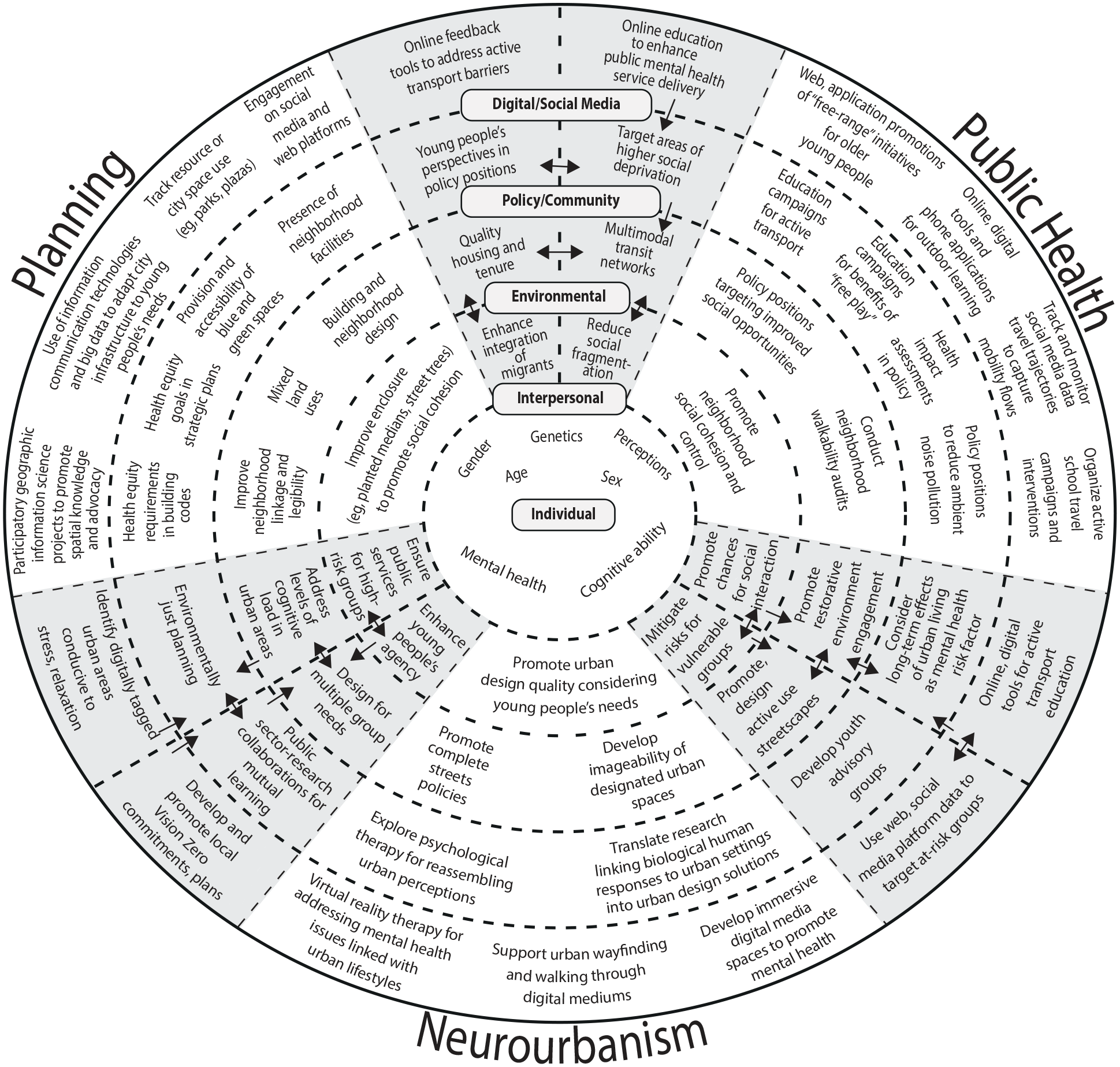
Practitioner framework for young people’s mental health and the urban environment. Shaded sections indicate cross-field collaborative opportunities, and unshaded sections indicate more field-specific opportunities. Arrows between concepts and levels signify potential ideas, issues, and/or topics that collaboratives can jointly address or study. Dashed lines between the levels and sections of the framework denote the fluidity and multilevel nature of concepts, ideas, and points.
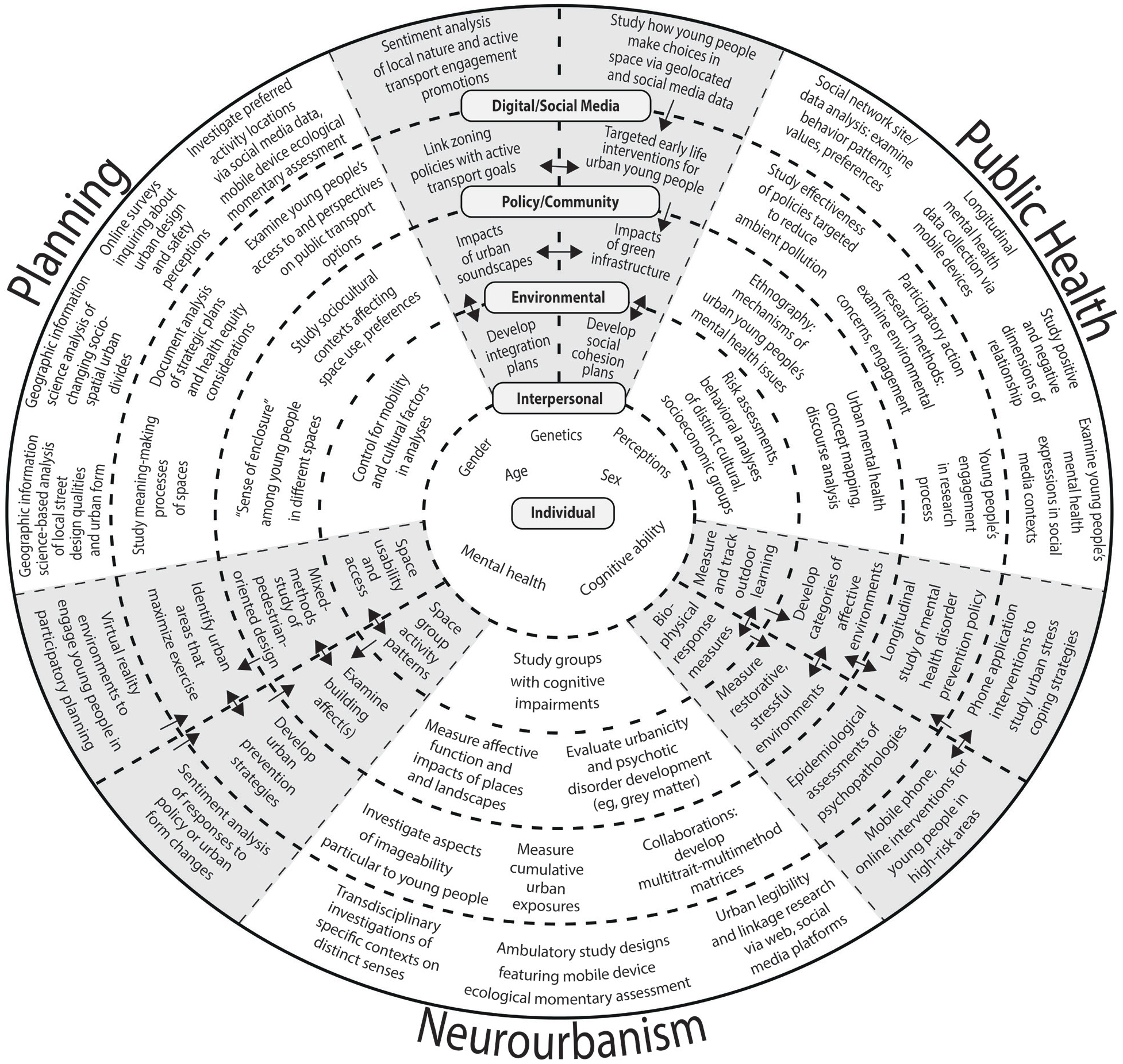
Research framework for young people’s mental health and the urban environment. Shaded sections indicate cross-field collaborative opportunities, and unshaded sections indicate more field-specific opportunities. Arrows between concepts and levels signify potential ideas, issues, and/or topics that collaboratives can jointly address or study. Dashed lines between the levels and sections of the framework denote the fluidity and multilevel nature of concepts, ideas, and points.
We added the new interactive level/zone, digital and social media contexts, to the socioecological model to recognize the pervasiveness of these new settings, namely the influence of related technologies (eg, smartphones, social media) in transforming and facilitating human behavior, communication, and interaction. Mounting evidence suggests that such technologies can both positively and detrimentally affect mental health; extend the capabilities, quality, and reach of health services 149 ; and produce a surfeit of social media, big data, and other digitally derived data that are of interest to human behavior researchers. 74 Recognizing a new distinct digital context can add to the breadth and depth of understanding of this relationship by further illuminating mobility flows and the uses and perceptions of urban spaces, 74 providing revealed rather than stated preference data, 150 and allowing comparisons of emotional and attitudinal responses to social phenomena via sentiment analyses.151,152
Frameworks: Theory to Application
Both frameworks highlight the unique roles and opportunities of each field (unshaded area) and suggest potential collaboration areas with other fields (gray shaded areas) (Figures 1 and 2). Arrows between concepts illustrate potential interactions that the collaborations could explore. The frameworks also illustrate the overlapping roles and opportunities in each field with dashed lines to indicate the fluidity and multilevel nature of concepts, ideas, and points, and that policy positions (practice) and study topics (research) can be complementary endeavors. When interpreting the frameworks, we acknowledge that neurourbanism is not an extant professional practice; rather, it is an emerging interdisciplinary research area. As such, we use this space in the frameworks to suggest ideas and concepts where other relevant fields (eg, neuroscience, psychology) can collaborate and advance knowledge or improve practice. Lastly, although the discussion focuses on collaboration opportunities among the various fields, we note that total neurourbanism–planning–public health collaborations featuring concepts from the 2 frameworks are also encouraged.
Planning practitioners may use this framework to support the mental health of young people in urban areas via strategies such as using digital technologies to track space usage patterns and mobility flows and reorient city services 74 for their needs; addressing housing tenure issues 87 potentially via amendments to municipal codes; and designing areas with greater levels of enclosure to foster social cohesion and/or mitigate social fragmentation. 153 Public health practice may develop and disseminate outdoor learning materials to improve psychological resilience 154 or promote “free-range” initiatives (ie, initiatives that encourage unstructured or child-initiated activity) that support the development of more environmentally conscious adults. 155 Campaigns to educate families about the mental health benefits of free-range play in communal spaces (eg, develop competence, emotion regulation, enhance confidence, promote resiliency) 156 and the promotion of policy positions to reduce noise pollution46,47 would also be advised to ameliorate young people’s mental health. Related fields (as illustrated in the neurourbanism portion) could advocate for complete streets policies, which support designing roadways and transit networks to safely accommodate all users and their needs, 157 or explore the use of virtual reality technologies in practices or therapies to address urban mental health phenomena such as acrophobia. 158
With respect to collaborative practices, planning–public health partnerships may seek to develop and promote policy that addresses neighborhoods with higher levels of social deprivation, 159 aim to improve neighborhood social cohesion, 160 or support multimodal transit networks to increase opportunities for activity. Planning–neurourbanist collaborations could promote environmentally just planning for young people by proposing and developing space-specific legislation to lessen cognitive loads (eg, bio-housing, which uses organic materials 132 ), building partnerships dedicated to mutual learning on planning and neuroscience topics (eg, building and place affects [eg, stress, calm]), or using social media and other geolocated data to localize urban areas that have a higher incidence of depression 161 and provide support via Vision Zero commitments (ie, multidisciplinary campaigns that promote safe transport and physical activity). 157 Public health-neurourbanist collaborations can also engage in a variety promotion-based endeavors including developing youth advisory groups, encouraging regular interaction with restorative environments, and designing active transportation education materials.
In research, planning scholars could explore the perceived exposure effects of routinely traveled routes (eg, trips to and from school) or frequented spaces (eg, parks) via “go-along” interviews (ie, interviews conducted while walking through an environment related to the topic under study), 162 or place accessibility and meanings through PhotoVoice methods. 163 Public health inquiry may pursue future research with the use of detailed ethnographic methods to examine urban-derived mental illness among young people, as a recent study has advocated using such methods to investigate the mechanisms that underlie urban living and mental disorders, and to better understand the lived experiences of affected people and groups. 142 Ambulatory assessments (ie, study of people in their natural environments), which feature ecological momentary assessments that strategically and repeatedly capture people’s emotional, mental, mood, or physiological states on mobile devices, 164 could be used to examine preferred activity locations or engagement patterns. Neurourbanistic study, using neuroscientific methods and physiological sensors that objectively quantify the effects of urban spaces, can expand knowledge on place and building affect 129 and could investigate various relationships: the nature of various exposures across settings (eg, alleys, intersections) or psychotic disorder development. 40
Planning–neurourbanist research collaborations could examine the enhanced cognitive load of urban environments on the brain 165 ; determine if and how distinct urban environments’ designs, such as linkage, legibility, enclosure, and imageability, 166 are perceived by and affect the mental health outcomes of young people; conduct sentiment analyses of younger populations’ responses to changes in urban form; or engage young people in virtual reality environments to gather feedback on different designs. 167 Neurourbanist–public health research collaborations could further investigate strategies to mitigate risks for vulnerable groups by researching biophysical and neurological responses to urban features, including temperature ranges, noise levels, and odors, 168 or to particular settings (eg, transportation corridors, 169 foliage 170 ). Prevention-based research could seek to implement online programs to support mental health 171 or digital health promotion initiatives for young people in areas at high risk for adverse mental health experiences (eg, adolescent girls in urban slums 172 ). Finally, public health–planning collaborations could use geolocated and social media data to study how young people make decisions in space that may affect relevant behavior (eg, physical activity) 74 or to examine the effects of distinct soundscapes (eg, plazas, outdoor malls) and infrastructures (eg, green infrastructure), or conduct qualitative document analyses that link local zoning policies with active transport goals.
Conclusion
Synthesizing literature from public health, planning, and neurourbanism, we proposed 2 novel frameworks to inform practitioners and researchers on the relationship between the urban environment and young people’s mental health. The frameworks may be used to enhance practices at multiple social and ecological levels. Cross-field collaborations are encouraged to improve behavioral change research and interventions and develop nuanced policy recommendations.
Footnotes
Declaration of Conflicting Interests
The authors declared no potential conflicts of interest with respect to the research, authorship, and/or publication of this article.
Funding
The authors received no financial support for the research, authorship, and/or publication of this article.
