




Abstract
Objectives
Although lesbian, gay, bisexual, and transgender (LGBT) people have a higher prevalence of reporting a lifetime suicide attempt than non-LGBT people, suicide prevention research on access to lethal means (eg, firearms) among LGBT people is limited. Our study examined (1) the presence of firearms in the home and (2) among respondents with firearms in the home, the storage of firearms as stored unloaded, stored as loaded and locked, or stored as loaded and unlocked.
Methods
We used data from the 2017 Behavioral Risk Factor Surveillance System surveys from California and Texas (N = 11 694), which were the only states to include items about both sexual orientation and gender identity and the status of firearms in the home. We used logistic regression analysis to assess the association of sexual orientation and gender identity with having firearms in the home while accounting for sociodemographic characteristics and survey state. All analyses were weighted to account for the complex sampling design.
Results
Approximately 4.2% of the sample identified as lesbian, gay, and bisexual (LGB). About 18.2% of LGB people reported firearms in the home compared with 29.9% of their heterosexual peers. After adjusting for sex, age, race/ethnicity, educational attainment, and military veteran status, LGB respondents had significantly lower odds of reporting firearms in the home than their heterosexual peers (adjusted odds ratio = 0.47; 95% CI, 0.27-0.84). Among respondents with firearms in the home, firearm storage did not differ by sexual orientation.
Conclusions
Further research is needed to examine whether lower odds of firearms in the home are protective against suicide deaths among LGB populations.
The United States has the highest rate of firearm-related mortality among high-income countries worldwide (10.6 per 100 000 population) and the second-highest firearm-related suicide death rate (6.4 per 100 000 population). 1 The presence of firearms in the home is independently associated with greater risk of death by suicide in the United States, even after controlling for markers of individual psychopathology and demographic factors. 2 In addition to studies examining means for suicide, other studies show that some of the populations at highest risk for suicide are people who identify as lesbian, gay, bisexual, or transgender (LGBT, or sexual and gender minority). Yet, few studies have examined the prevalence of access to lethal means for suicide, such as the presence and storage of firearms, among LGBT people.
Although the presence of firearms in the home is associated with death by suicide, 3 the presence of unsecured firearms in the home is even more potently linked with suicide. 4,5 In 2017, firearms were used in half (50.6%) of all suicides in the United States, and 3 of every 5 firearm-related deaths were suicides. 6 Firearm suicide is so prevalent in the United States that new theories of suicide have been modified to include a component of lethal means. 7 For example, both Klonsky’s and O’Connor’s ideation-to-action theories of suicide include access to lethal means (eg, firearms) as a key moderator in the hypothesized pathway from suicidal ideation to suicide attempt. 8 -10 Briefly, ideation-to-action theories maintain that constructs commonly cast as risk factors for suicide (eg, hopelessness, thwarted belongingness) are more predictive of suicidal ideation than suicide attempt and that frameworks are needed to identify the subset of people with suicidal ideation who go on to attempt suicide.
LGBT people are a population of concern with regard to suicide risk. 11,12 Hottes et al 13 estimated that lesbian, gay, and bisexual (LGB) populations, on average, have a prevalence of lifetime suicide attempt that is about 3-5 times that of their non-LGB peers. Estimates of the prevalence of lifetime suicide attempts are 10-12 times higher among people who are transgender (ie, people whose sex assigned at birth is different from their gender identity) than among the general US population. 14,15
Despite these robust disparities in suicide attempts, research on exposure to firearms among LGBT people is scarce. Blosnich et al 16 noted that people in same-sex partnerships were less likely than people in opposite-sex partnerships to report having firearms in the household. More recent studies that have used self-reported sexual identity to define LGB status have noted a significantly lower prevalence of firearms among LGB people than among heterosexual people. 17,18 However, none of these studies reported on safe storage practices among LGB and heterosexual people with firearms in the household or examined the presence or storage of firearms in the household among transgender people.
We sought to determine whether the presence of firearms in the home and firearm storage practices differed by sexual orientation and gender identity. These findings can be used to identify needed targeted suicide prevention.
Methods
We used data from the 2017 Behavioral Risk Factor Surveillance System (BRFSS) survey, a probability-based sample of US adults. 19 The BRFSS uses computer-assisted telephone interviews of probability-based samples drawn from noninstitutionalized adults living in US states and territories. A description of the BRFSS methodology is available elsewhere. 19 Briefly, the BRFSS survey contains a mandatory core survey and various optional modules that states and territories can elect to include after the core survey. In 2017, two states (California and Texas) included 2 optional survey modules (Sexual Orientation and Gender Identity; Firearm Safety). Overall response rates in California and Texas were 31.4% and 40.0%, respectively (median 2017 BRFSS response rate was 45.9%). 19 We included in our sample only respondents who met inclusion criteria; completion of the 2 optional modules (overall N = 12 299; California n = 2901, Texas n = 9398) was required for inclusion.
The BRFSS determined sexual orientation by asking the following question: “Do you consider yourself to be: (1) straight, (2) lesbian or gay, or (3) bisexual?” The BRFSS determined gender identity by asking the following 2 questions: (1) “Do you consider yourself to be transgender?” and, for respondents who answered yes, (2) “Do you consider yourself to be (1) male-to-female, (2) female-to-male, or (3) gender nonconforming?” We recoded sexual orientation into 2 categories (heterosexual and LGB), and we recoded gender identity into 2 categories (transgender [ie, male-to-female, female-to-male, or gender nonconforming] and non-transgender [cisgender]). Because this analysis focused on sexual and gender minority status, we excluded from analyses 605 respondents who provided other responses (ie, “other,” “don’t know/unsure,” or “refused”), leaving 11 694 respondents in the sample.
Three items assessed firearm safety. Firearms and their storage were first explicitly defined in the interview: “pistols, revolvers, shotguns, and rifles; but not BB guns or guns that cannot fire. Include those kept in a garage, outdoor storage area, or motor vehicle.” Then respondents were asked, “Are any firearms now kept in or around your home?” The remaining 2 items were skipped by respondents who answered no. Respondents who answered yes were then asked, “Are any of these firearms now loaded?” Respondents who answered yes were asked the third item, “Are any of these loaded firearms also unlocked?” From this information, we logically encoded 2 variables: firearms stored in the home (yes, no) and, for those with firearms stored in the home, firearms stored as unloaded, stored as loaded and locked, or stored as loaded and unlocked. Of 4317 respondents who reported firearms in their homes, 99 (2.3%) were excluded from the firearm storage analysis because they either responded with “don’t know” or refused to answer the firearm storage items.
The BRFSS also assessed demographic characteristics that may confound associations between LGBT status and firearms in the home. Characteristics included sex (male/female), age group (18-29, 30-44, 45-64, ≥65), education (<high school diploma, high school diploma, some college, or ≥college degree), race/ethnicity (non-Hispanic white, non-Hispanic black/African American, non-Hispanic other minority identity, and Hispanic), and history of serving in the US military (yes/no).
We conducted all analyses in Stata/SE version 12.1 (StataCorp LLC), using Taylor-linearized variance estimation, and we weighted data according to survey version to account for the complex sampling design. We first assessed unadjusted differences in sexual orientation among sociodemographic and firearm variables by using the design-corrected Pearson χ2 test, with P < .05 considered significant. We then used logistic regression analysis to assess the association of sexual orientation and gender identity with having firearms in the home while accounting for sociodemographic characteristics and survey state. We used California as the reference group because it has more gun safety laws than Texas. 20 Finally, because of the survey skip pattern ensuring that only respondents who reported firearms in the home were asked about firearm storage, we used a multinomial regression analysis with a subset of the sample who reported firearms in the home to assess the association of sexual orientation with the 3-category variable of firearm storage, again accounting for sociodemographic characteristics and survey state; “firearms stored as unloaded” was set as the reference category. Because of the limited number of transgender respondents in the subsample (n = 8), we did not include gender identity in the multivariable analysis investigating storage of firearms in the home. The VA Pittsburgh Healthcare System Institutional Review Board approved this study.
Results
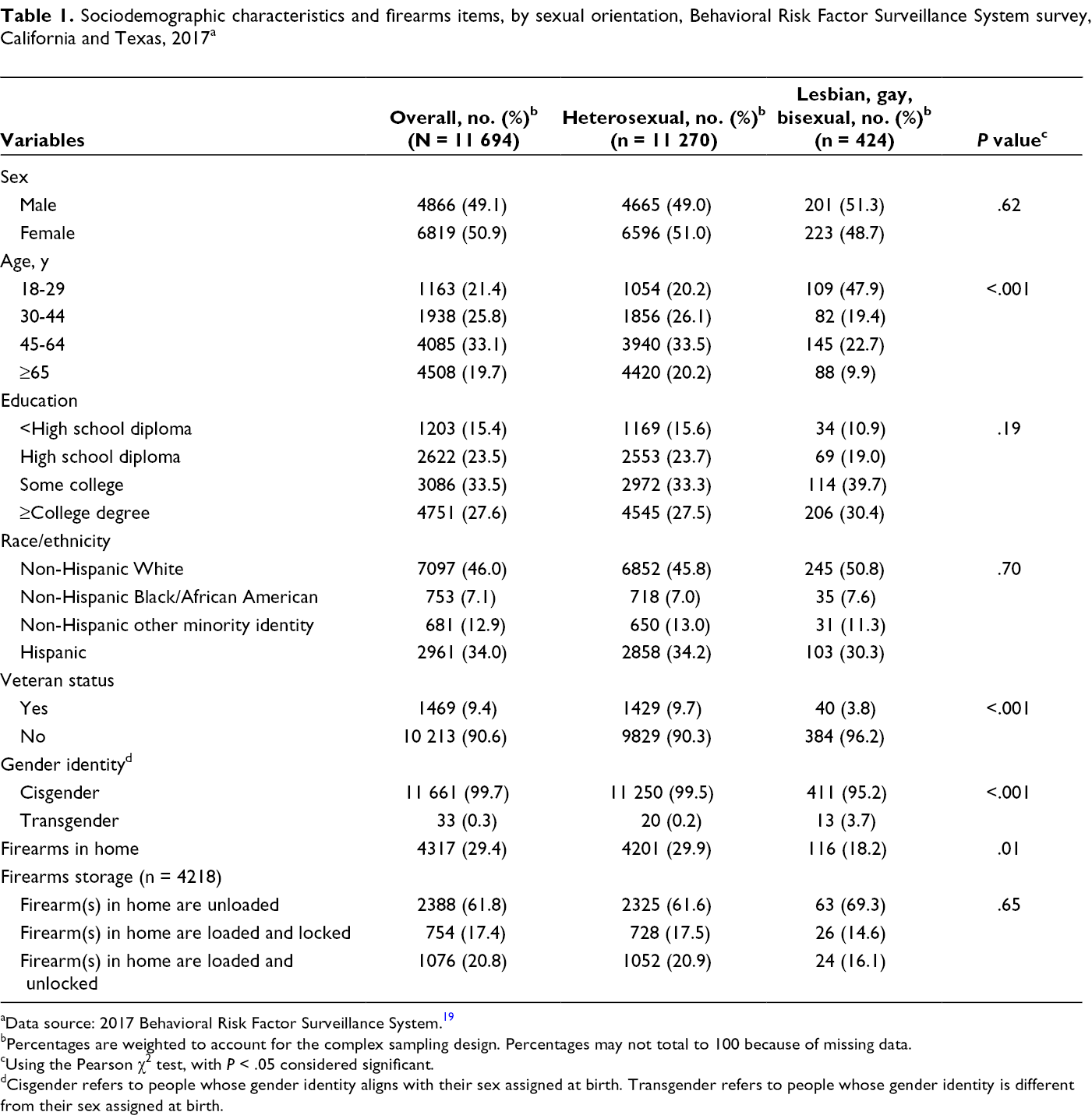
The analytic sample included 11 694 respondents, of whom 424 (weighted percentage, 4.2%) identified as LGB (Table 1). Compared with heterosexual respondents, LGB respondents were significantly younger (aged 18-29: 20.2% vs 47.9%; P < .001), less likely to be military veterans (9.7% vs 3.8%; P < .001), and more likely to self-report a transgender identity (0.2% vs 3.7%; P < .001).
Sociodemographic characteristics and firearms items, by sexual orientation, Behavioral Risk Factor Surveillance System survey, California and Texas, 2017 a
aData source: 2017 Behavioral Risk Factor Surveillance System. 19
bPercentages are weighted to account for the complex sampling design. Percentages may not total to 100 because of missing data.
cUsing the Pearson χ2 test, with P < .05 considered significant.
dCisgender refers to people whose gender identity aligns with their sex assigned at birth. Transgender refers to people whose gender identity is different from their sex assigned at birth.
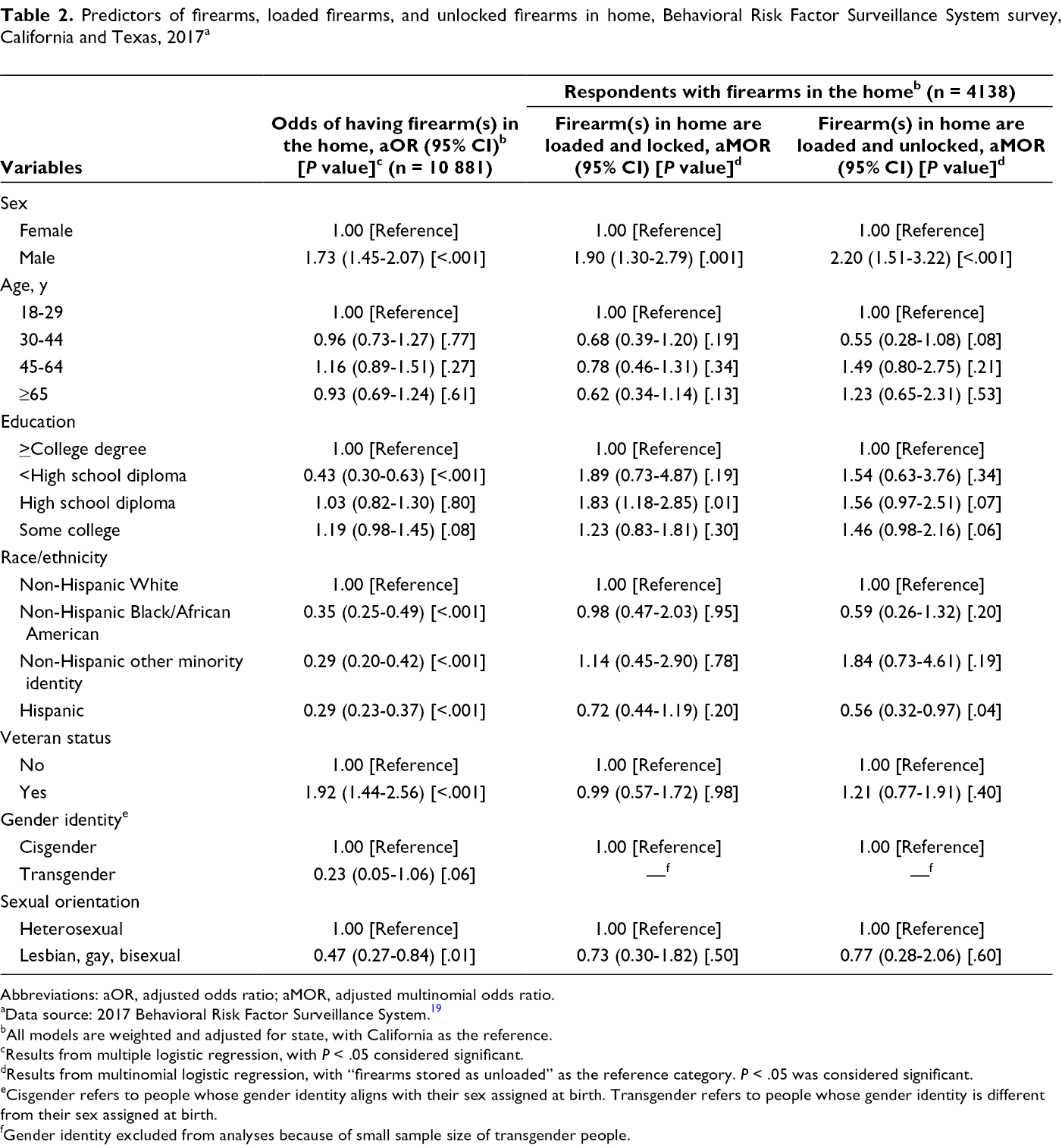
Overall, 29.4% of the sample reported firearms in the home (Table 1). The prevalence of having firearms in the home was 22.0% among California respondents and 36.9% among Texas respondents. Heterosexual respondents were significantly more likely than LGB respondents to report firearms in the home (29.9% vs 18.2%; P = .01). After adjusting for sociodemographic covariates, LGB respondents had nearly half the odds of reporting firearms in their homes than their heterosexual peers (adjusted odds ratio [aOR] = 0.47; 95% CI, 0.27-0.84) (Table 2). Transgender respondents had lower odds of reporting firearms in their homes than did their non-transgender peers, but the finding was not significant (aOR = 0.23; 95% CI, 0.05-1.06; P = .06).
Predictors of firearms, loaded firearms, and unlocked firearms in home, Behavioral Risk Factor Surveillance System survey, California and Texas, 2017 a
Abbreviations: aMOR, adjusted multinomial odds ratio; aOR, adjusted odds ratio.
aData source: 2017 Behavioral Risk Factor Surveillance System. 19
bAll models are weighted and adjusted for state, with California as the reference.
cResults from multiple logistic regression, with P < .05 considered significant.
dResults from multinomial logistic regression, with “firearms stored as unloaded” as the reference category. P < .05 was considered significant.
eCisgender refers to people whose gender identity aligns with their sex assigned at birth. Transgender refers to people whose gender identity is different from their sex assigned at birth.
fGender identity excluded from analyses because of small sample size of transgender people.
Among respondents with firearms in the home, we found no significant differences in sexual orientation in the odds of storing firearms loaded and locked (adjusted multinomial odds ratio [aMOR] = 0.73; 95% CI, 0.30-1.82) or loaded and unlocked (aMOR = 0.77; 95% CI, 0.28-2.06) vs storing firearms unloaded (Table 2).
Discussion
LGBT people comprise a population in need of suicide prevention efforts. 21 -23 Because access to firearms is associated with death by suicide, 3 -5 it is reassuring that in our study LGB respondents were significantly less likely than heterosexual respondents to report firearms in their homes. Transgender people may be even less likely to have firearms in the home than their non-transgender peers. Our findings corroborate the findings of other more limited studies, 2 studies of which examined data on household firearms that included a measure of sexual identity 17,18 and 1 study that examined same-sex partnership status. 16 However, our study extended findings in the field to include storage practices of firearms among sexual minority people and to document the prevalence of firearms in the home among transgender people.
The lower likelihood of firearms in the home among LBG people compared with heterosexual people in our study may indicate that suicide prevention that focuses on firearm safety may not be an effective strategy for reducing suicide among LGBT populations. Recent developments in theories to understand suicide have delved more deeply into the concept of the “acquired capability” of someone to die by suicide, going beyond known individual psychological factors (eg, hopelessness) and into moderating factors of access to lethal means, such as firearms. 9 Suicide deaths may be higher among sexual and gender minority groups than among their heterosexual and cisgender peers, but the means of suicide are most likely to be hanging or ingestion of drugs and poisons, which are difficult to regulate and control. 22 -24 Current research suggests that suicides in which minority sexual orientation issues are relevant at the time of death are less likely to include firearms than suicides without documentation of minority sexual orientation. 25,26 Consequently, prevention and intervention efforts focused on firearm safety to decrease the risk of suicide, 27 although important, may not be as effective public health strategies for LGBT communities as for non-LGBT populations. However, measuring the effectiveness of current efforts to prevent suicide deaths among LGBT communities requires US mortality records to include sexual orientation and gender identity, much the way age and race/ethnicity are typically recorded. 28,29 Current practices include adding comments about sexual orientation and gender identity in law enforcement or medical examiner records if information about sexual orientation and gender identity is viewed as contributing to the suicide. We suggest that these variables be treated as confidential and be included as part of the death record. Documentation of sexual orientation and gender identity would facilitate the ability of states to track and examine the suicides of sexual and gender minority people and address prevention to decrease their rate of completed suicides.
Limitations
Our study had several limitations. First, although the BRFSS is a national survey, only survey data from California and Texas were available, and these data may not be generalizable to other US states. In addition, the survey response rates for California and Texas were below the overall median BRFSS survey response rate, which could further limit generalizability. Second, the wording of the firearm safety item focuses the scope of firearms access to the home. The modules did not ask about personal gun ownership of firearms in the home, a question that injury prevention experts suggest is critical to understanding firearm accessibility and is important in the assessment of risk. 30 Third, the small sample size of LGBT respondents limited our ability to either model household firearms storage among transgender people or investigate the heterogeneity of effect within the LGB population (eg, lesbian/gay vs bisexual). Finally, the estimated association of transgender status with firearms in the home should be interpreted with caution because of the small sample of transgender respondents. Future research might explore sex-specific differences within LGB populations to determine if firearm access is moderated by gender as it is among non-LGB populations, 18 including ownership and storage practices. 31 Increasing the sample size of transgender respondents in surveys would, in the face of suicide risk in this group, facilitate prevention research specific to their particular behaviors.
Conclusions
In this probability-based sample from 2 US states, LGBT people appear less likely than non-LGBT people to report firearms in the home. Because California and Texas differ considerably in policies (eg, carrying concealed firearms, licensing at point of sales of firearms, universal background checks) on firearm ownership and concealment and storage of firearms, 20 examining geographically broader and larger samples of LGBT respondents would help to further identify policies and population-specific prevention needs. In particular, exploring the low level of gun ownership among LGBT people but their potentially high rate of suicide 20,32 is critical to the identification and development of prevention as it relates to suicide means among LGBT populations. Research on firearms is also important to improve science, because access to lethal means is becoming more integrated into theoretical frameworks of understanding suicide risk and how these theories apply to diverse populations, such as sexual and gender minority populations. 7 Development of suicide prevention for LGBT populations should consider additional suicide prevention efforts focused on other widely available means, including hanging and drug or poison ingestion. 33 Finally, measuring the effect of firearms, through either suicide or homicide, on LGBT communities requires standardized collection of data on sexual orientation and gender identity in US mortality and morbidity surveillance. 28,29
Footnotes
Authors’ Note
The opinions expressed in this article are those of the authors and do not necessarily reflect the opinions of the institutions, funders, US Department of Veterans Affairs, National Institutes of Health, or the US government.
Declaration of Conflicting Interests
The authors declared no potential conflicts of interest with respect to the research, authorship, and/or publication of this article.
Funding
K.A.C. was partially supported by the UCLA School of Public Health Gun Violence Prevention Pilot Grant; J.R.B. was partially supported by a US Department of Veterans Affairs Health Services Research and Development Career Development Award (CDA-14-408); V.M.M. was supported by an award from the National Institute on Minority Health and Health Disparities (MD006923) and the National Institute of Mental Health (R21MH115344); S.D.C. was supported by an award from the National Institute of Mental Health (R21MH115344).
