



Abstract
Hepatitis B virus (HBV) infection affects more than 290 million persons globally and up to 2.2 million persons in the United States. 1,2 Similar to HIV and hepatitis C, hepatitis B is transmitted through blood and other infected bodily fluids. The virus can be passed to others through sexual contact; by sharing needles, syringes, or other drug-injection equipment; or from mother to child during pregnancy or childbirth. In the United States, infection with HBV is associated with substantial health disparities, and Asian American, Pacific Islander, and African immigrant communities are disproportionately affected. Although Asian American and Pacific Islander populations account for only 5% of the US population, they compose half of all persons living with hepatitis B in the United States; among African immigrants, the prevalence of HBV infection is about 1 in 10. 3 -5 In addition, in the United States, the opioid epidemic and injection drug use have substantially increased the number of new hepatitis B cases. Spikes in HBV infection rates range from 56% to 457% in states most heavily affected by the opioid epidemic. In Kentucky, Tennessee, and West Virginia, the incidence of acute HBV infection increased from about 2.5 per 100 000 population in 2006 to >5.0 per 100 000 population in 2013; in North Carolina, the incidence of HBV infection increased from 110 cases reported in 2014 to 172 cases reported in 2016; and in Maine, the rate of HBV infection increased from <1.0 per 100 000 population in 2013 to about 4.0 per 100 000 population in 2015. 6 -8
Living with HBV infection can mean living with stigma and facing discrimination. Stigma related to hepatitis B is often caused by low levels of public and health care provider awareness, fear, and misconceptions about the disease. 9 In addition, biases and judgments related to race/ethnicity, sexually transmitted diseases, or substance use compound HBV-related stigma and may lead to discrimination. 10 Discrimination against persons living with HBV infection occurs in their personal and professional environments, 11 -13 including the workplace, academic institutions, and other public settings. 10,12 Discriminatory practices that affect health care students with HBV infection may include unjustified denial of school admission or enrollment, restriction of clinical training, or dismissal from an academic program. 14
In the 1990s, instances of HBV transmission were reported from health care providers who had high levels of HBV DNA in their blood, although only 1 case of a confirmed health care provider transmission has occurred in the United States since 1994. 14 Since 1996, interventions such as Standard Precautions (the minimum infection prevention practices for all patient care in any setting) for all patient care and infection control “have eliminated almost completely the very low risk for transmission of HBV.” 14 In addition, the introduction of highly effective antiviral treatments in 1998 has substantially reduced viral load and further decreased the risk of transmission. 14 Furthermore, no cases of HBV transmission from a health care student have been reported. 14 Given substantial progress in HBV research and treatment in recent decades, it is important to address discriminatory policies that affect health care students.
In this commentary, we discuss hepatitis B–related institutional discrimination against health care students, current protections and recommendations in place to protect health care students from discrimination, and a case study review of admissions and program completion policies at health care professions schools in 1 state. The review reveals a lack of awareness among health care programs of how to design and implement nondiscriminatory policies and the effort needed to ensure that persons living with HBV infection have the opportunity to study and pursue careers in the health professions.
Recent History of Discrimination Against US Health Care Students With HBV Infection
Unlike discrimination against persons living with HIV infection, discrimination against health care students living with HBV infection in the United States has not been well documented or discussed extensively in the literature. Outside the United States, published reviews, primarily of dental school policies in the 1990s, reveal a history of inconsistent or undefined policies resulting in occasional legal action against health care schools. These inconsistent policies highlighted the need for the development of comprehensive, carefully designed policies that prohibit discrimination against students with HBV infection. 15,16 Although we found only 1 published review of hepatitis B–related discrimination in the United States, 15 cases of institutional and informal discrimination affecting HBV-positive health care students have been reported and litigated. 17
In 2011, two students were accepted into health care programs in the same medical school system. On learning of the students’ chronic HBV infection, the schools rescinded the acceptances. The students contacted the Hepatitis B Foundation (HBF), a US-based nonprofit organization, for assistance. HBF, whose mission is to find a cure and improve the quality of life for those affected by hepatitis B worldwide, operates a helpline that persons can call, email, or message via Facebook for assistance, support, or questions related to hepatitis B. Together, the students and HBF worked with the Centers for Disease Control and Prevention (CDC) and the US Department of Justice (DOJ) to address the situation. In 2012, CDC published a report updating its previous recommendations from 1991, 18 reaffirming that a diagnosis of HBV infection should not disqualify any student or worker from a health care career and providing new guidelines for such persons during training and work in a health care setting. 14 These updated recommendations were based on scientific data combined with evidence-based infection control practices, which confirm that “documented cases of confirmed transmission of hepatitis B from health-care providers to patients are rare.” 14
The updated CDC recommendations became the cornerstone of the DOJ investigation on behalf of the students. In 2013, the DOJ reached a landmark settlement agreement that affirmed the medical schools “unlawfully excluded applicants because they have hepatitis B.” 17 As the first successful anti-discrimination case “ever reached by the DOJ on behalf of people with hepatitis B,” the settlement successfully defined hepatitis B as a protected condition under the Americans With Disabilities Act (ADA). 17 Specifically, the DOJ determined that the school discriminated against the complainants by excluding them from participation in the school’s activities on the basis of disability. Although a covered entity may exclude a person with a disability when that person poses a direct threat to the health or safety of others, the DOJ determined that because the complainants would not be required to perform exposure-prone invasive procedures as a condition of graduating, the school could not show that complainants posed a direct threat to the health or safety of others. The DOJ ruling set a historic precedent to combat institutional discrimination of persons living with HBV infection. In compliance with the ADA, whereby covered entities are required to make reasonable modifications to their policies, practices, or procedures when necessary to avoid discrimination on the basis of disability, health care professions schools are advised to review their policies based on the updated CDC guidelines for the management of HBV-infected students. To reinforce this ruling, the DOJ, the US Department of Health and Human Services, and the US Department of Education issued a letter to all medical, dental, nursing, and allied health professions schools notifying them that discrimination against HBV-infected persons was illegal and providing guidance on how to ensure compliance with federal laws. 19
Discrimination Landscape
Current Legal Framework
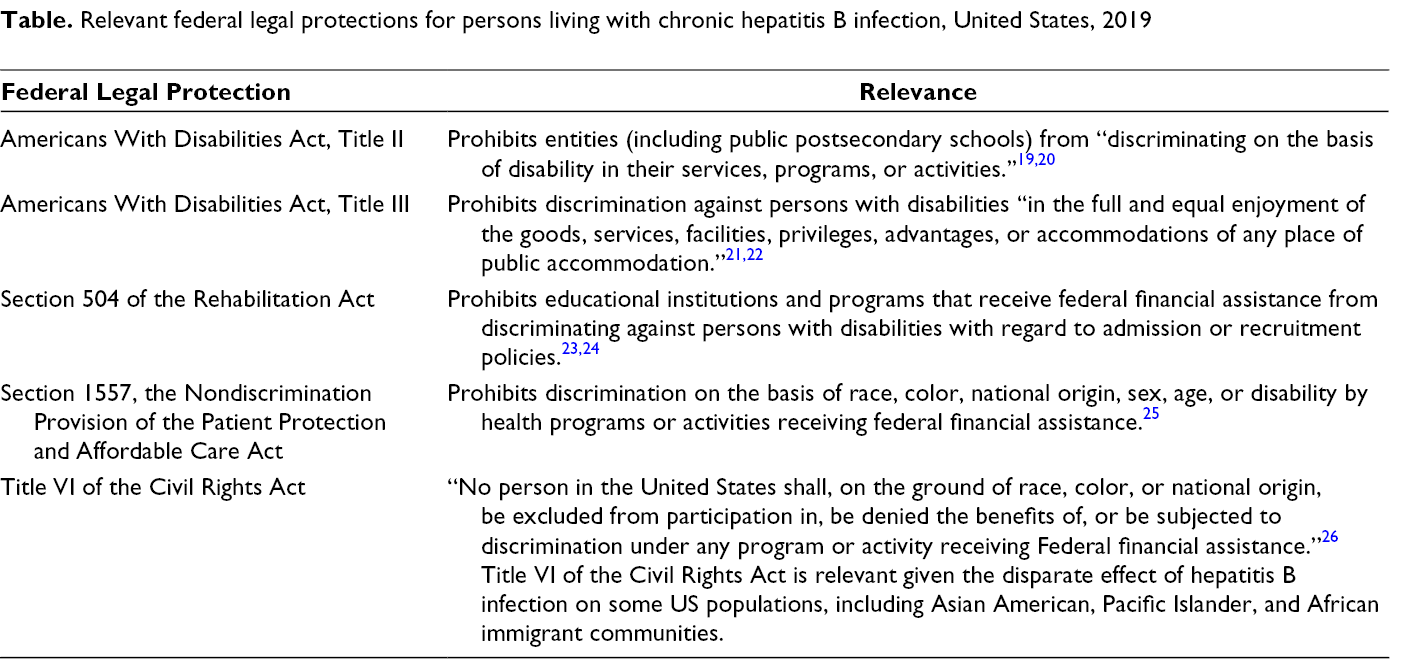
Hepatitis B is a protected condition under the ADA. 20,21 According to the DOJ, no lawful basis for excluding persons with hepatitis B from health professions schools exists, and any such exclusion based on HBV status contradicts CDC recommendations. 14 The DOJ and the Office for Civil Rights in the US Department of Education and the US Department of Health and Human Services oversee enforcement of relevant federal legal protections for persons living with HBV infection (Table).
Relevant federal legal protections for persons living with chronic hepatitis B infection, United States, 2019
Discriminatory Health Professions School Policies
Based on the current legal framework and 2013 DOJ ruling, a health professions school is considered discriminatory to students with HBV infection if the school policy:
Requires proof of immunity to HBV infection and does not permit a student without immunity to enroll or participate in clinical rotations;
Requires proof that a person is not infected with HBV for that student to enroll or commence clinical rotations;
Requires students to disclose their HBV infection to school administrators as a condition of attendance, if the school does not have policies in place to protect and accommodate the students;
Dismisses a student or revokes admission because of an HBV infection;
Alters a student’s educational track or clinical experience because of an HBV infection (or lack of HBV immunity) with or without his or her consent; or
Requires an infected student to maintain an HBV DNA viral load below a specified threshold, even though that student is not expected to perform invasive, exposure-prone procedures as defined by CDC. 14
Health professions schools cannot exclude applicants from admission or enrollment based on an HBV infection. Programs must make “reasonable modifications in policies, practices, and procedures when the modifications are necessary to avoid discrimination on the basis of disability.” 17,21 Thus, any school that requires testing for HBV infection or proof of immunity to HBV infection must have a policy stating that students infected with HBV (as well as vaccine nonresponders who cannot develop immunity to HBV infection) will not have their admission revoked or their clinical rotations altered in a way that would impede completion of the program. In addition, because students infected with HBV are unable to build immunity to the virus, schools asking students to provide proof of immunity must provide accommodation for students who cannot build immunity. Accommodations protect non-immune students from being discriminated against during admissions, enrollment, and completion of the clinical components of their education. Not only does this accommodation protect HBV-infected students, but it also protects nonresponders to the hepatitis B vaccine; this nonresponse to the hepatitis B vaccine affects 5%-16% of health care providers who are unable to develop an immune response to the vaccine. 27
The 2013 DOJ settlement requires schools and health care facilities to adopt a disability rights policy that outlines their nondiscriminatory approach to students with HBV infection, and CDC recommends that these policies include procedures for the “identification and management of hepatitis B–infected health care providers, students, and school applicants.” 14,17 School policies can define HBV vaccination and testing requirements for students and should describe accommodations that will be made for any student whose test results fail to prove HBV immunity or any student who tests positive for HBV infection. For example, one school’s policy states that students who cannot build antibodies to hepatitis B will be “counseled regarding precautions to prevent HBV.” 28 The same policy states that students who test positive for HBV infection and are not expected to conduct invasive, exposure-prone procedures “shall not be subject to clinical restrictions or subsequent testing or ongoing review by the HBV Committee, unless their activities change to include Category I (exposure-prone) procedures.” 28 Ideally, school policies should refer to current CDC recommendations as the basis for their hepatitis B–related procedures.
The DOJ relies on guidance such as the CDC recommendations to determine if policies violate federal legal protections. The CDC recommendations state that health care students should not be arbitrarily excluded or restricted from activities that could impede practice or study. 14 CDC recommends HBV testing only for health care providers at increased risk of infection or conducting invasive, exposure-prone procedures (for which CDC provides definitions that differentiate between invasive and exposure-prone procedures and procedures that are not invasive, as well as examples for each class of procedures), recognizing that students typically do not perform invasive, exposure-prone procedures as part of their professional education and “should not be subject to any restrictions of their activities or studies.” 14
An Assessment of Pennsylvania Health Professions Schools
To assess current health professional school policies toward students living with hepatitis B infection, we analyzed 83 Pennsylvania schools of higher education with accredited health professions programs, focusing on medical (doctor of medicine, doctor of osteopathic medicine), dental (doctor of medicine in dentistry), nursing (registered nursing, licensed practical nursing), and physician assistant degrees. We conducted an online search to find Pennsylvania accredited health professions schools and conducted a review of policies publicly available on school websites, in student handbooks, and on student physical forms. The analysis was limited to information that was publicly available. We categorized school policies based on degree of compliance with federal guidance. We considered policies to be discriminatory if they (1) required proof of HBV immunity for enrollment or program completion, (2) stated that program admission could be revoked if a person tests positive for HBV infection, or (3) required disclosure of HBV infection or communicable disease diagnosis on the health history form without offering information on what would happen to a student who disclosed an infection.
Of 83 programs reviewed, 31 (37%) appeared to align with CDC recommendations, with policies in place for the management of students with chronic HBV infection. Another 36 programs (43%) had policies that appeared to be discriminatory by requiring proof of hepatitis B immunity for enrollment or program completion, stating that clinical rotations could be affected by lack of HBV immunity, stating that program admission could be revoked or clinical rotations could be affected if a person tests positive for hepatitis B infection, or requiring disclosure of hepatitis B diagnosis on the health history form without offering information on what would happen to a student if that student disclosed an infection. In addition, we found that 16 programs (19%) had unclear policies that required follow-up to determine the consequences for a student who tests positive for HBV or negative for immunity.
Paradoxically, 34 of the 36 schools that had discriminatory hepatitis B policies also had in place anti-discrimination policies based on disability, which may indicate a lack of awareness that persons with hepatitis B are protected under the ADA. Fifty-two schools did not appear to have policies in place to accommodate HBV-infected students, although 16 of these 52 schools did not have enough publicly available information to assess compliance. The lack of a policy describing accommodations for students with HBV infection or students unable to build immunity could cause disruptions and delays for a student’s education, graduation, and employment. The lack of clear policies based on current CDC recommendations and ADA protections, the lack of transparency, and the lack of understanding about the effect of immunization requirements without full disclosure of hepatitis B policy can serve as a deterrent for students with hepatitis B to apply for health professions schools or pursue health care careers. Although our results are preliminary, they indicate that, at least in Pennsylvania, some health professions programs still have policies that discriminate against students with HBV infection and demonstrate a lack of awareness of appropriate policies, including federal legal protections. Further research is needed to see if these findings are likely to be reflected in school policies nationwide.
Impact on Students With HBV Infection
Despite CDC guidelines and ADA legal protections now in place, health care students continue to face institutional discrimination because of HBV infection. In 2018, 12 students contacted the HBF helpline because of discriminatory policies. The students sought admission to health care programs, were recently accepted, or were transitioning to clinical practicums after completing didactic coursework. In all cases, the students were informed that being infected with HBV or being unable to show proof of immunity would alter or halt their education and could affect their ability to graduate (unpublished data, HBF internal database documenting interactions with students facing discrimination, 2018).
In some cases, schools learned of students’ HBV infection after the students completed all educational coursework but before they were cleared to begin clinical training. At this point, the students had paid thousands of dollars and invested 6 months to 2 years in their programs. The schools informed the students that they could not move forward with their clinical training or that their clinical rotations would be restricted to certain hospitals and limited procedures. This action provoked panic, stress, and confusion for the students. In some cases, students had to put their education on hold while the schools assessed how to proceed (unpublished data, HBF internal database documenting interactions with students facing discrimination, 2018).
Responding to Discriminatory Policies
When health care students face discrimination, immediate attention and action are required by the students to address the discriminatory policies and avoid delays that could affect the next phase of their training. It is critical that students with HBV infection be apprised of their rights and have information that enables them to communicate with school administrators. Students should also know that they have the right to file an ADA Discrimination Complaint with the DOJ, which can initiate an investigation.
A broader goal, beyond responding to each student, is working with health professions schools to ensure that they have the information and adequate policies in place to assist, protect, and accommodate students infected with HBV. Many schools seem to be unaware that HBV infection is a protected condition and that it cannot be used to discriminate against potential or enrolled students. Schools need to be informed of their legal obligations to protect persons infected with HBV, so that they can implement policies that comply with the ADA and with CDC recommendations.
Recommended Future Action
According to recent experiences reported by health care students (unpublished data, HBF internal database documenting interactions with students facing discrimination, 2018) and the preliminary assessment of HBV-related policies at Pennsylvania health professions schools, students infected with HBV may face discriminatory policies that could derail their professional aspirations. Schools in Pennsylvania appear to be confused or uninformed about disability rights for persons with HBV infection and how to manage applicants and students who are aware of their chronic condition and those who are newly diagnosed. Legal protections are in place along with readily accessible documents to help schools understand their responsibilities and develop appropriate policies. 14,17,18 However, new strategies are required to help schools implement HBV policies consistent with CDC and DOJ guidelines and take steps to communicate these policies to students. Developing good policies and effective communication strategies will help ensure that students living with HBV infection are properly informed and protected.
We recommend engaging federal partners (eg, US Department of Health and Human Services, Department of Education), institutions that oversee accreditation for health professions programs (eg, Association of American Medical Colleges), and organizations that communicate with and set standards for health care school admissions and residency programs to increase awareness among health care professions schools about federal legal protections and potentially discriminatory school policies. Accrediting institutions can communicate directly with health care schools and have the authority to encourage compliance. These institutions are in a position to communicate with health care schools and reach a broad audience of school administrators. The creation of a multisectoral working group is suggested, with these goals:
Improving awareness about the rights and protections in place for persons infected with HBV and of the current CDC recommendations for management of infected health care students and workers;
Educating health professions schools about the CDC recommendations and ADA protections to assist schools in developing appropriate disability policies that include procedures for accommodating HBV-infected students in a nondiscriminatory manner; and
Helping persons infected with HBV to know their rights and assist those who face discriminatory hepatitis B policies.
Discriminatory hepatitis B policies harm persons with hepatitis B who aspire to careers in the health care professions. Such policies reflect a lack of awareness, knowledge, and understanding among school administrators instituting policies that do not align or comply with disability law and are not based on current scientific and medical evidence. Meanwhile, persons living with HBV infection and pursuing health care careers often find themselves alone and without the knowledge and resources to challenge discrimination. Federal agencies, civil rights policy experts, and community stakeholders must collaborate to ensure that students know their legal rights and that all health professions schools are informed of relevant federal legal protections and make efforts to create or change policies and practices to protect the rights of persons with HBV infection. The challenge remains to dismantle institutional hepatitis B discrimination and provide fair and just opportunity for students living with the disease to pursue professional health care careers.
Footnotes
Acknowledgments
The authors thank Susana Lorenzo-Giguere, former attorney with the US Department of Justice Civil Rights Division, for her counsel in pursuing legal action on behalf of health care students infected with hepatitis B virus (HBV) and in supporting the development of this article; and the Centers for Disease Control and Prevention’s Division of Viral Hepatitis for updating recommendations for the treatment of HBV-infected health care workers and students. The authors thank the health care students affected by discriminatory school policies for sharing their experiences.
Declaration of Conflicting Interests
The authors declared no potential conflicts of interest with respect to the research, authorship, and/or publication of this article.
Funding
The authors disclosed receipt of the following financial support for the research, authorship, and/or publication of this article: This project was funded by general operating support from the Hepatitis B Foundation.
