




Abstract
Objective:
The objective of this study was to determine the number, risk factors, and demographic characteristics of potential human trafficking victims from tips reported to a social services agency in a major Midwest metropolitan area from 2008 through 2017.
Methods:
The agency, comprising 90 employees serving more than 10 000 persons annually, received federal funding to raise awareness about trafficking and to identify and support persons who are at risk for trafficking through training, coalition building, direct outreach and service, and case management. We, the authors, counted the numbers of tips and potential victims reported to the agency by year, type of trafficking, economic sector, sex, region of origin, and age and looked for new risk factors for trafficking.
Results:
Data were available for 213 tips received from September 1, 2008, through June 30, 2017, and for 82 potential victims identified from July 1, 2011, through June 30, 2017. Labor trafficking (126 tips, 57 potential victims) was more common than sex trafficking (59 tips, 17 potential victims). The number of tips varied during the study period. Tips and potential victims were diverse and included male and female children and adults. Most victims were from Mexico (n = 68), the United States (n = 47), Asia (n = 31), and Central and South America (n = 23). Potential victims were exploited in several industries including agriculture, construction, commercial sex, and landscaping. New risk factors for trafficking were exploitation within marriage and work in the sales industry.
Conclusions:
Domestic and foreign-born men, women, and children are all at risk for labor and sex trafficking. Direct outreach to foreign-born victims should be a priority. The new risk factors should be explored.
Keywords
In the United States, the Trafficking Victims Protection Act of 2000 defines human trafficking as “the recruitment, transport, provision, or obtaining of a person for labor or services, through the use of force, fraud, or coercion” and a commercial sex act as one “induced by force, fraud, or coercion, or in which the person…has not attained 18 years of age.” 1 Human trafficking is a major public health concern affecting the physical, sexual, and mental health of survivors. 2 -4 Globally, trafficking is estimated to gross approximately $150 billion annually. 5
Although US law addresses all forms of human trafficking across all sex and age groups, in practice, policy makers, law enforcement officers, and researchers tend to focus on women and girls and, in particular, sex trafficking. 6 -8 However, men, boys, and transgender persons are also trafficked, 9 and labor trafficking is pervasive. A 2016 United Nations report found an increasing number of male victims. 10 The International Labor Office reported that about half of the 40 million victims of human trafficking worldwide are exploited through forced labor. 11 In addition to human rights concerns and health risks, 12,13 the high estimated profit from labor trafficking can economically harm legal businesses and the paid labor force and reduce tax revenues. 14
Despite concerted efforts, the scale of human trafficking in the United States has not yet been adequately determined. 6,8 Few data are available on the number of human trafficking tips reported and the number of victims identified, and the available data have important limitations. 6,15 For example, primary data collected with appropriate sampling methods are scant, 8 and some estimates conflate trafficking with forced labor (trafficking is illegal; forced labor is sometimes considered to be legal, for example, forced labor in prison camps). 6 Estimates of the number of victims are believed to be unreliable, and the methods of estimating are often not reported. 8 For example, government and private trafficking estimates have been presented without reporting the process, sources, or evidence from which the estimates were derived. 6,8 (A review of the flawed methods of collecting trafficking prevalence data was conducted by Fedina. 15 ) Thus, data can present a contradictory or inaccurate picture of the proportions of trafficking for commercial sex acts and trafficking for labor or services. 8,16
To protect vulnerable persons, some anti-trafficking programs may be wary of collaborating with researchers to collect or publish relevant data. A 2017 systematic review identified only 3 peer-reviewed articles on interventions for freed survivors of trafficking globally, 17 with only one from the United States. 18 Without partnerships between anti-trafficking programs and researchers, it is difficult to establish evidence-based practices for prevention, identification, intervention, and after-care services. We examined nearly a decade of labor and sex trafficking data collected by one social service agency (hereinafter, Agency A) in a major Midwest metropolitan area. Here, we report the number and demographic composition of the human trafficking tips received and potential victims Agency A identified from September 1, 2008, through June 30, 2017. We also looked for evidence of risk factors for victimization.
Methods
Study Setting and Program Description
Agency A, which primarily serves immigrants and their families, has a service area of about 600 square miles, 10% of which are urban, and annually serves more than 10 000 clients. With 90 employees and hundreds of volunteers, its annual budget is more than $6 million. The region has both rural and urban areas, a median annual household income of $63 000, almost 2 dozen universities, an international airport, interstate highway connections, and large immigrant populations.
Agency A began receiving federal funding to combat human trafficking in 2005 and was funded through 2018. The purpose of each award varied (Table 1), but overall, each award was intended to raise awareness about human trafficking (through training, coalition building, and task-force development) and to identify and support persons at risk for trafficking (through direct outreach, direct services, and case management). Each anti-trafficking award targeted both sex and labor trafficking; however, the funding mechanism determined whether foreign-born or domestic victims were to be served. As part of each award, Agency A worked with external partners and subawardees that received portions of the award funds. The objective of this study was to determine the number and demographic composition of human trafficking tips reported, the number of potential victims identified, and any associated risk factors for trafficking.
Anti–human trafficking programs funded through a social services agency in a major Midwest metropolitan area in the United States, 2005-2018
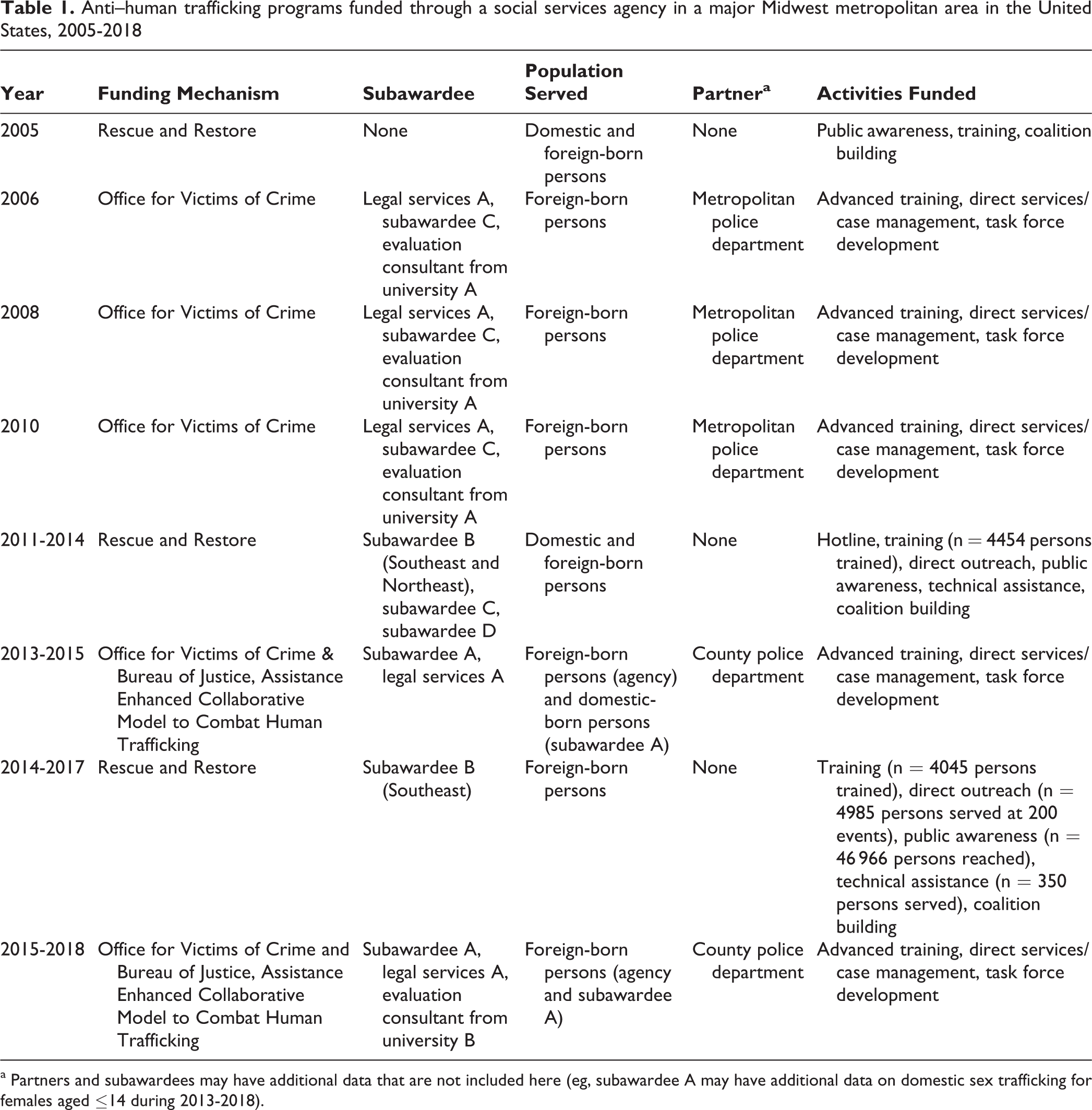
a Partners and subawardees may have additional data that are not included here (eg, subawardee A may have additional data on domestic sex trafficking for females aged ≤14 during 2013-2018).
The purpose of the awards was to increase public awareness of human trafficking, particularly by training professionals who are likely to come into contact with victims of trafficking (eg, law enforcement officers, medical providers, sexual assault counselors). Strategic partners (law enforcement) and subawardees (immigrant legal services, sexual assault counselors) supported the identification and referral of tips. The 2011-2014 award trained 4400 persons, and the 2014-2017 program trained 4000 persons in human trafficking identification and response (Table 1). In addition, during 2014-2017, almost 47 000 persons interacted with the award’s efforts to raise awareness at public events.
Defining “Reported Tips” and “Potential Victims” Identified
In this study, each telephone or in-person human trafficking tip recorded by Agency A’s human trafficking program staff members was counted as one tip. Potential victims were those who met Agency A’s criteria or “red flags” for human trafficking according to the federal definition 1,19 and for whom follow-up verified that they were victims of trafficking. Examples of criteria for red flags included situations in which exploitation and elements of force, fraud, or coercion were present (eg, a person worked a high number of hours but was paid very little or nothing; a person lived with his or her employer and was being driven to work). A tip mentioning multiple potential victims was counted as one reported tip, unless follow-up documented by Agency A identified the number of additional potential victims, in which case each potential victim was then counted as one reported tip. This practice provided a more accurate ratio of reported tips to potential victims identified. Given the limited number of tips and potential victims present at any given time, we anticipated little to no duplication of tips or potential victims. Victims were assessed from personal contact with Agency A. Victims could not be identified if Agency A staff members were unable to make contact with a person reported in a tip.
Data Sources and Analysis
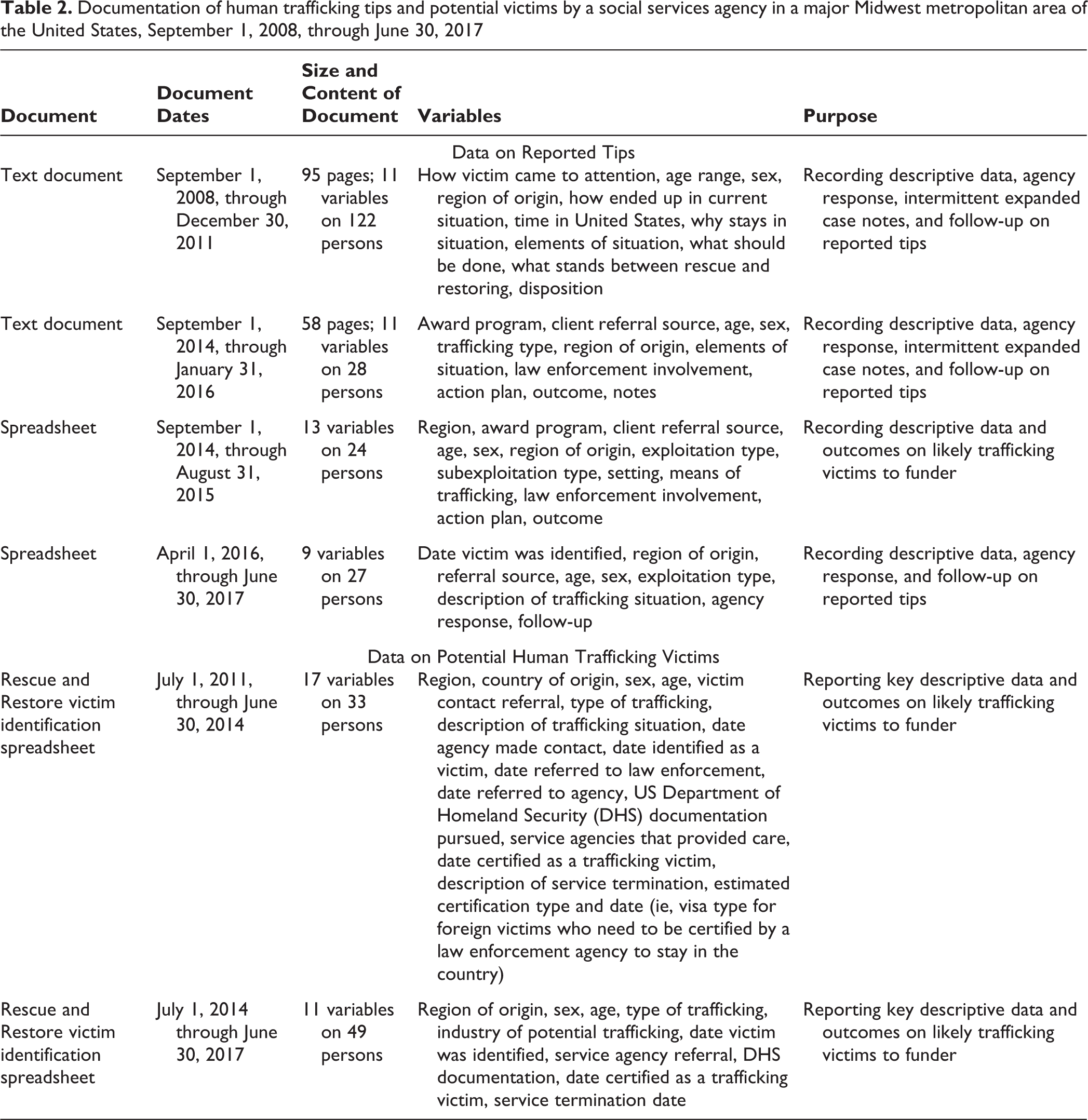
Although Agency A’s anti-trafficking program was funded in 2005 (Table 1), records from before 2008 could not be located. Whether records ever existed or whether they were lost is unknown. Thus, we could not determine the number of tips or potential victims encountered from funds awarded in 2005 and 2006. We received the available records from September 1, 2008, through June 30, 2017, which were deidentified of personal information, in April 2017. Tips were recorded in all documents from 2008-2017; however, potential victims were only reported in the data during 2011-2017.
We collected data on 15 variables: local region within the metropolitan area, country of origin (which we reported as region of origin to protect anonymity of victims when only a few victims from the country were reported), sex, age, source(s) of the tip, type of trafficking (labor, sex, both labor and sex, or unknown), economic sector of trafficking (agriculture, food service, sales, domestic, construction/landscaping, commercial sex, marriage, other/uncertain), length of time in the United States, date of tip or victim identification, anti-trafficking program year, agency(ies) to which the victim was referred, law enforcement involvement, response/action plan, outcome/follow-up, and anecdotal details. Not all of these variables were available for some award years (Table 2). Unclear situations included servile partnerships; that is, victims may have had to provide sex or labor to the partner or to other men while under the control of the partner. Data were compiled using Stata version 13. 20
Documentation of human trafficking tips and potential victims by a social services agency in a major Midwest metropolitan area of the United States, September 1, 2008, through June 30, 2017
Results
Trafficking Tips Received by Agency A
From September 1, 2008, through June 30, 2017, of the 213 tips reported to Agency A, 126 (59%) were for labor trafficking and 59 (28%) were for sex trafficking (Table 3). Almost twice as many tips were made by or on behalf of females (n = 132, 62%) than by or on behalf of males (n = 68, 32%). Reported tips concerned victims primarily from Mexico and the United States, followed by victims from Asia, Africa, and Europe. Most tips concerned adults (n = 185, 86.9%), and 28 (13.1%) reports were for children aged <18.
Characteristics of human trafficking tips reported to a social services agency in a major Midwest metropolitan area of the United States, 2008-2017
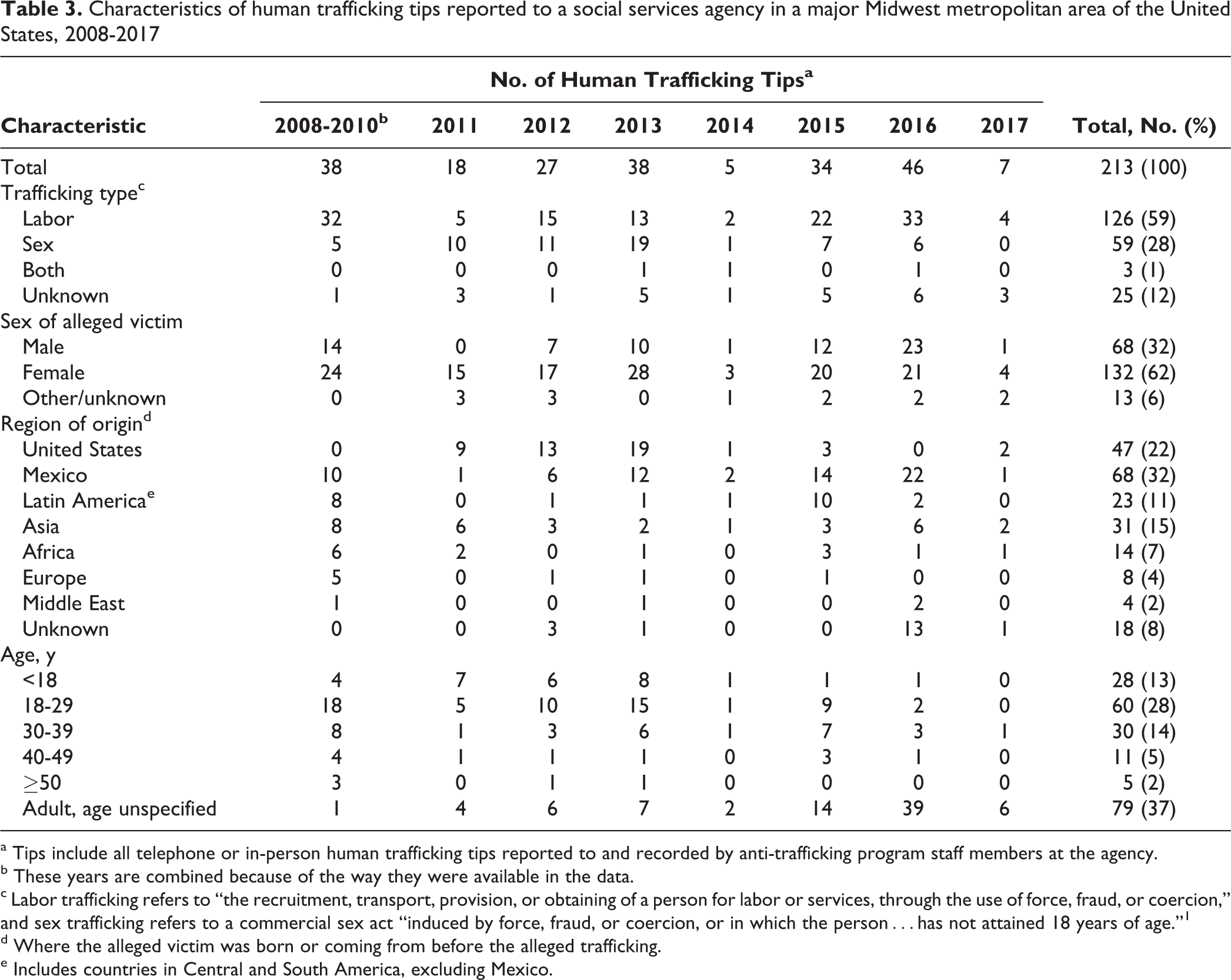
a Tips include all telephone or in-person human trafficking tips reported to and recorded by anti-trafficking program staff members at the agency.
b These years are combined because of the way they were available in the data.
c Labor trafficking refers to “the recruitment, transport, provision, or obtaining of a person for labor or services, through the use of force, fraud, or coercion,” and sex trafficking refers to a commercial sex act “induced by force, fraud, or coercion, or in which the person…has not attained 18 years of age.” 1
d Where the alleged victim was born or coming from before the alleged trafficking.
e Includes countries in Central and South America, excluding Mexico.
Potential Victims of Trafficking
From July 1, 2011, through June 30, 2017, 82 potential victims were identified (Table 4). More potential victims of labor trafficking (n = 57, 70%) than of sex trafficking (n = 17, 21%) were identified, and 2 persons experienced both sex trafficking and labor trafficking. The trafficking experiences of 6 potential victims could not be determined. For example, 3 persons were in servile partnerships in which it was unclear whether they experienced sex trafficking, labor trafficking, or both. Whereas potential female victims were primarily identified in labor trafficking (n = 19) and sex trafficking (n = 16), males were primarily identified in labor trafficking (n = 38). All but 8 victims were adults. Almost all labor trafficking victims were foreign-born (54 of 57); however, most sex trafficking victims (10 of 17) were from the United States. Labor trafficking victims were exploited in the agriculture (n = 16), construction and landscaping (n = 15), food service (n = 8), sales (n = 5), and domestic (n = 5) sectors, as well as in marriage (n = 3). Female sex trafficking victims were exploited through commercial sex (n = 12) and marriage (n = 2).
Characteristics of potential victims of human trafficking identified from tips to a social services agency in a major Midwest metropolitan area in the United States, 2011-2017
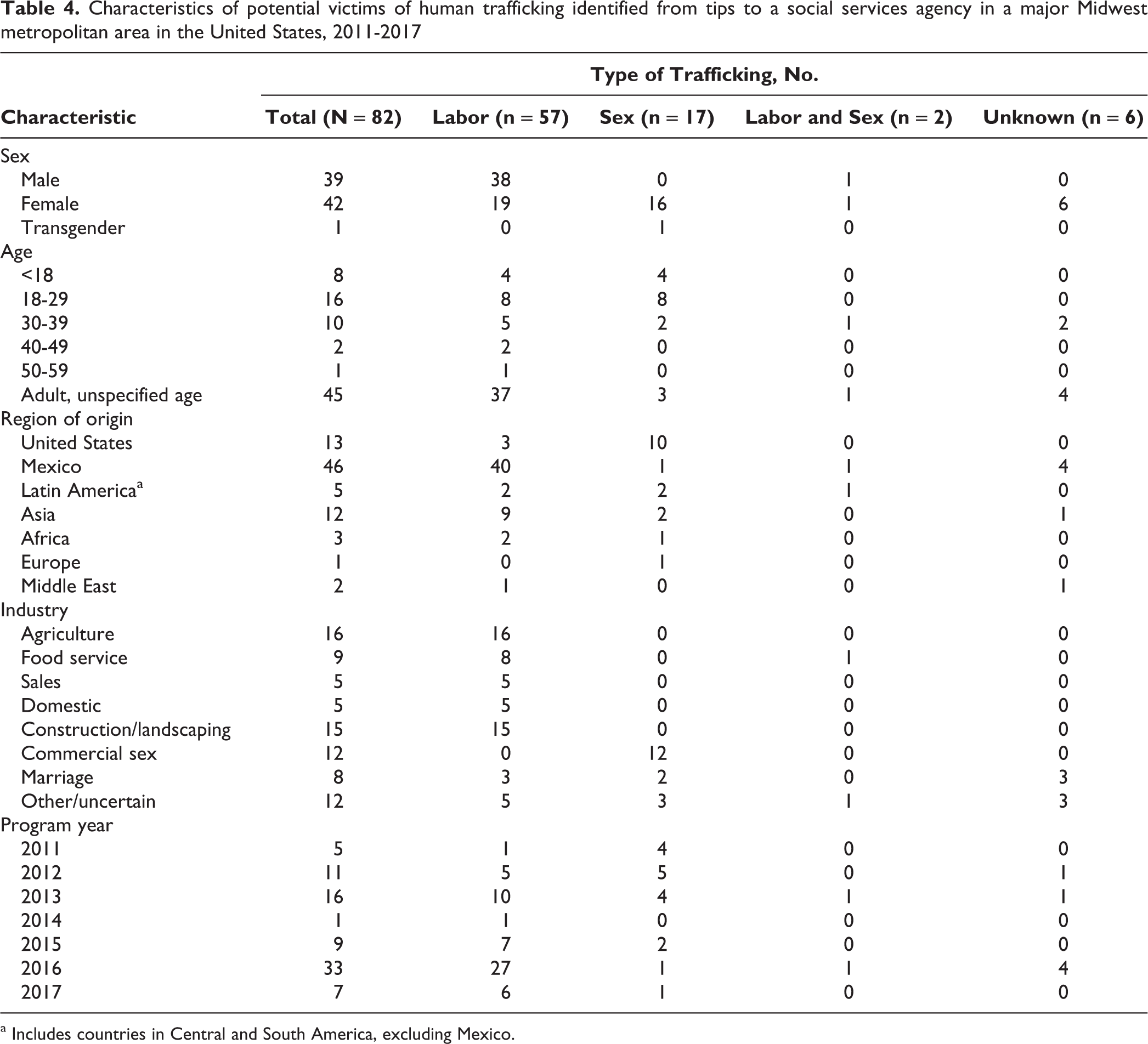
a Includes countries in Central and South America, excluding Mexico.
Changes in the Number of Tips Over Time
An average of 12.6 human trafficking tips per year were recorded in the first 3 years (2008-2010). In each of the following 3 years, the number of tips and subsequent identification of potential victims increased. In 2014, the number of tips (n = 5) and victims identified (n = 1) decreased (Table 1). The number of tips reported and potential victims identified rebounded in 2015 (34 tips, 9 victims) and peaked in 2016 (46 tips, 33 victims). In 2017, the number of tips (n = 7) and the number of potential victims identified (n = 7) decreased, which corresponded to the ending of one source of grant funding in June.
Discussion
During nearly a decade of anti-trafficking programming, one agency in the Midwest received 213 human trafficking tips and identified 82 potential victims. Most tips and potential victims were related to labor trafficking rather than to sex trafficking. The persons mentioned in the tips and potential victims identified were diverse: male and female children and adults were identified from Mexico, the United States, Latin America, Asia, Africa, Europe, and the Middle East. This diversity in victims identified is consistent with a 2017 US Department of State report that discusses how victims identified in the United States included men, women, and transgender persons; adults and children; and US citizens and foreign-born persons, particularly from Mexico and Asia. 21
Our findings confirm the presence of all types of trafficking in this Midwest metropolitan region. Several infrastructure and social factors related to the transaction contribute to the risk for human trafficking in the region—an international airport, interstate highway connections, sporting centers, multiple strip clubs, high poverty, violence, widespread substance use, a weak education system, high numbers of homeless and runaway children, and large immigrant populations. 7,22
Research, services, public officials, and the media tend to emphasize women and sex trafficking, 6 -8,23 but we identified a greater number of tips about potential victims of labor trafficking. This finding is consistent with that of other research, both domestic 24 and international. 11 The human rights advocacy group, Freedom Network, issued a 2016 report noting that 52% of the 2332 persons they served in the United States were labor trafficking survivors, and 6% were survivors of labor and sex trafficking. 24 However, our findings (a sex-to-labor [17:57] trafficking ratio of 0.3) contradict state and national data provided by the National Human Trafficking Hotline, a national anti-trafficking telephone hotline that serves victims and survivors of human trafficking and the anti-trafficking community in the United States and has presented data since 2012. 25 In 2017, the Hotline reported that nationwide, the number of sex trafficking victims (n = 6081) was higher than the number of labor trafficking victims (n = 1249), with a sex-to-labor ratio of trafficking of 4.9, a ratio similar to that reported by the state as a whole. 25 Although identifying and providing services for women and countering sex trafficking is important, Agency A also identified victims of labor trafficking when resources to do so were available.
Although we found twice as many tips for females as for males, similar numbers of potential victims were identified as female and male. All male victims experienced labor trafficking, whereas female victims experienced both labor trafficking and sex trafficking. This finding is consistent with global estimates of identified female and male victims of sex and labor trafficking. 11 Although women might be at increased overall risk, given the potential for both sex trafficking and labor trafficking, whether this risk represents a real difference or whether greater reporting of female victims is related to awareness and available services for female vs male victims is unknown.
We identified more US-born than foreign-born potential sex trafficking victims, a finding with important policy and social implications. Again, whether this difference is real or a result of greater awareness and limited resources is unclear. Data on race/ethnicity were not collected; only data on country of origin were recorded. Data on race/ethnicity should be recorded, particularly on domestic-born populations, so that outreach can be conducted to reflect the needs and gaps identified. Service providers and the legal system need to be mindful that victims of trafficking can be diverse in sex, age, and race/ethnicity and provide resources accordingly. Future efforts should use relevant sampling methods to estimate the size and demographic characteristics of populations who are trafficked. 8 Given the low number of potential victims in some categories, it is not clear whether the victims identified are representative of other victims in the given demographic category.
Although public awareness about human trafficking in Agency A’s early years focused on domestic and foreign-born persons, direct services were offered exclusively to foreign-born persons from 2006 through 2012. It is therefore not surprising that tips about US-born persons were not reported until 2011. Shifts in partner, subawardee, and populations served in the agency’s 2013 grant may have affected the type of tips reported. During 2013-2018, direct services were provided to both foreign-born populations and domestic populations. Agency A primarily provided services to foreign-born victims, whereas subawardee A provided services only to domestic victims. Interestingly, in the first year of providing direct services to US-born victims (2013), 19 of the 38 tips from that year concerned US-born persons. This number dropped to 1 in 2014 and remained low through 2017, even as the number of all tips increased in 2015 and 2016. This increase in tips may be because subawardee A received a portion of the grant’s funding and so received tips about domestic persons instead of Agency A. Decreases in the number of tips reported and potential victims identified in 2014 and 2017 were consistent with the end of Rescue and Restore funding cycles. The overall drop in the number of tips in 2014 (to 5) may have been affected by a shift from years of collaborating with the metropolitan police department to a partnership with the county police department, beginning in 2013. Simultaneously, direct outreach was directed to both domestic persons and foreign-born persons during 2011-2014, but outreach to foreign-born persons occurred only during 2014-2017.
The number of tips and victims peaked in 2016. Several factors may have contributed to this peak. The effect of anti-trafficking programming during several years may have been cumulative, in which a greater awareness of trafficking was raised by Agency A programming and other public and private initiatives. 26 -28 The peak may also be explained by the intentional increase in direct outreach to foreign-born communities by Agency A, as suggested by a brief from the US Department of Health and Human Services. 13
During 2016, not a single tip or victim concerned a US-born person, suggesting that those who experienced or witnessed predominantly foreign-born labor trafficking violations were willing and able to report their information and seek assistance. Conversely, with the sharp decrease in the number of tips and potential victims identified, 2017 was the first year in which every tip resulted in a potential victim identified, suggesting that only those who experienced or witnessed more extreme trafficking situations were reporting the conditions and seeking assistance. The 2017 decline indicates that, in addition to the grant transition, perhaps other factors prevented the public from generating tips. This setback could be the result of a change in political climate in which immigrants were hesitant to report themselves or others as victims of a crime for fear of deportation. 29 Research should examine the effect that immigration policy may have on the health of persons who have survived or are at risk for human trafficking. In addition, the dip in reports around 2014 during changes in funding may make the case for funders to help recipients support continued anti-trafficking efforts even after funding ends.
Strengths and Limitations
This study had several strengths. One strength was that we examined both sex trafficking and labor trafficking. Second, we used data collected directly from persons at a single location (microdata 5 ) in a single region, rather than estimated data collected from aggregated sources (macrodata 5 ), to address questions about the number of victims of human trafficking, as advocated by a seminal study on the topic. 6 This study, by focusing on just 1 agency (Agency A) in 1 metropolitan region, may offer quantitative and qualitative advantages over large-scale studies, particularly in identifying the number of victims. 6
Third, this study provides data on both the number of human trafficking tips reported and the number of potential victims identified from federally funded anti-trafficking programs conducted during an extended period. In addition, this research is a result of collaboration between anti-trafficking program staff members and researchers. To advance our knowledge and to establish evidence-based practices for survivors of human trafficking, such collaborations should be promoted. Finally, this study highlights that labor trafficking victims and male victims, understudied populations in the field of human trafficking, 4,6,8 have been identified when the incentives and resources were available.
This study also had several limitations. First, the data came from several periods, including funding since 2005, reported tips since 2008, and potential victims since 2011. Data were inconsistently recorded over time, likely from changes in grant-mandated documentation and multiple staff member changes with various documentation styles. Establishing earlier partnerships between direct service organizations and researchers could help planning and mitigate inconsistencies in data collection. Second, programmatic focuses differed during the time period. Funding sources dictated the population served (ie, foreign-born, domestic, or both) and the activities that were funded. At most time points, Agency A was able to serve both domestic and foreign-born trafficking victims through at least 1 funding mechanism; however, the focus on foreign-born victims increased across grants over time.
Agency A itself primarily served foreign-born persons. Agency A also collaborated with various local public and private agencies in various years. Each factor likely affected the outreach conducted and, in turn, the type of tips reported and victims identified. In addition, data from partners may not be included in these numbers. Notably, data from subawardee A were not included if potential victims who sought services directly from the subawardee were not referred to or by Agency A. This exception is important because the subawardee primarily served female US-born victims of sex trafficking. In addition, adult victims identified by police partners could opt out of service referrals, whereas children would likely be directly referred to child services. Including these data could affect the ratios of sex-to-labor trafficking, domestic-to-foreign-born, adult-to-child, and female-to-male victims presented in this study, especially given the small number of persons identified at any given time.
We acknowledge that the number of potential victims identified is likely just a small portion of all victims in the region. Identified victims may also not necessarily be “certified as a victim,” a status that can be determined only by the legal system and that is necessary to be eligible for all federal services and programs. Furthermore, the reliance on using “red flags” to classify persons as potential trafficking victims, although standard in monitoring human trafficking, may be problematic because these indicators do not correlate with human trafficking legal case filings and limit the filings of other legal cases. 30 Finally, some tips that would likely have been potential victims could not be classified as such as a result of loss to follow-up (eg, the person moved, was unwilling to work with social services or law enforcement, or lacked transportation or a telephone). Some persons who reported tips expected a guarantee that they would not be deported, which could not be done, and, thus, potential victims declined further assistance. Although services and expertise can be provided, it is ultimately in the hands of law enforcement agencies and the legal system to make decisions about classifying victims as cases.
Conclusions
We believe our results support several conclusions. Both domestic and foreign-born men, women, and children are at risk for labor trafficking and sex trafficking. The results highlight the fact that understudied populations (labor trafficking victims and male victims) were identified when resources were available. Trained and educated groups should continue work on priority issues, including direct outreach to foreign-born populations and difficult-to-reach populations in agriculture, construction, landscaping, sales, and domestic service. Programs should be flexible to address the needs of survivors, regardless of their demographic background and type of trafficking. Changing and interrupted funding can affect regional abilities to respond effectively to human trafficking. Mechanisms to ensure sustainable funding are needed.
Footnotes
Acknowledgments
The authors acknowledge the strength of victims of human trafficking and thank the providers in our region who work tirelessly to support them.
Declaration of Conflicting Interests
The authors declared the following potential conflicts of interest with respect to the research, authorship, and/or publication of this article: Amanda Mohl was previously employed by Agency A and facilitated the partnership between Agency A and Erica Koegler.
Funding
The authors received no financial support for the research, authorship, and/or publication of this article.