




Abstract
International initiatives to strengthen national health laboratory systems in resource-poor countries are often hampered by unfamiliarity with the country’s health laboratory environment and turnover of international partners during the initiative. This study provides an overview of, and lessons learned from, the use of a laboratory long-term partnership approach (ie, “twinning”) to strengthen the national public health laboratory system in an international setting. We focused on the partnering of the Uganda Ministry of Health Central Public Health Laboratory (CPHL) with the New Mexico State Public Health Laboratory to help the CPHL become Uganda’s national public health reference laboratory (Uganda National Health Laboratory Services [UNHLS] Institute) and leader of its nascent Uganda National Health Laboratory Network (UNHLN). Via twinning, CPHL leadership received training on laboratory leadership and management, quality systems, facility management, and the One Health environmental strategy (ie, that the health of persons is connected to the health of animals and the environment), and drafted a National Health Laboratory Policy, UNHLS Institute business plan, and strategic and operating plans for the UNHLS Institute and UNHLN. The CPHL is now responsible for the UNHLS Institute and coordinates the UNHLN. Lessons learned include (1) twinning establishes stable long-term collaborations and (2) success requires commitment to a formal statement of activities and objectives, as well as clear and regular communication among partners.
Keywords
Strengthening national health laboratory systems in resource-poor countries is a strategic undertaking 1 that requires (1) defining a vision and mission for the system, (2) establishing or restructuring the legal and organizational elements that define and regulate laboratory activities in the country, (3) building the physical infrastructure and human capacity in the system to fulfill its mission, and (4) developing a sustainability model. Because achieving sweeping organizational and systemic changes is difficult and expensive, countries often seek assistance from international partners. These partnerships often face steep challenges to achieving their goal of creating a sustainable system capable of performing the core functions of a public health laboratory system: (1) disease prevention, control, and surveillance; (2) integrated data management; (3) reference and specialized testing; (4) environmental health and protection; (5) food safety; (6) laboratory improvement and regulation; (7) policy development; (8) public health preparedness and response; (9) public health–related research; (10) training and education; and (11) partnerships and communication. 2 Although many factors can hamper efforts to achieve such strategic systemic change, 3 common failings are lack of commitment by national leadership and stakeholders, fragmentation of effort by narrow project focus and partner staff turnover, and the international partner’s unfamiliarity with local laboratory, political, business, and cultural environments. 3 -5
One approach to partnering that attempts to avoid these pitfalls is that of laboratory “twinning,” which has been promoted by the World Health Organization, the Centers for Disease Control and Prevention (CDC), and the Association of Public Health Laboratories (APHL). 6,7 Twinning involves developing long-term partnerships between laboratories to build laboratory capacity and quality systems, with the goal of providing effective and accessible laboratory support for universal provision of essential health services in a country. 7 Twinning partnerships pursue this goal by pairing a US public health laboratory with a national laboratory in a resource-poor country to work together in a peer-to-peer relationship. Laboratories enter into a multiyear agreement to conduct activities in pursuit of national priorities defined beforehand by the country’s national laboratory leadership and Ministry of Health. The agreement specifies deliverables (ie, products and outcomes to be achieved) and provides funding for activities to achieve these deliverables during an agreed-upon period. Through this process, twinning partnerships seek to create a stable, knowledgeable working team that comprises the technical, managerial, and leadership personnel essential to achieving the objectives and strengthening the laboratory system. Although the twinning approach has been promoted for more than a decade, to our knowledge, no studies have examined its effectiveness in strengthening national laboratory systems.
The purposes of this case study were to (1) demonstrate the ability of an international public health laboratory twinning approach to strengthen a national laboratory system and (2) provide guidance on how the process may be undertaken. This study focused on the ability of twinning to achieve strategic goals of establishing a national public health laboratory and strengthening the national health laboratory system in Uganda.
Background
The Uganda health laboratory system delivers laboratory services in support of the Ugandan National Minimum Health Care Package, which aims to provide universal access to communicable disease control, noncommunicable disease control, maternal and child health, and health education and promotion services. The Uganda national health laboratory system consists of 1500 clinical and public health laboratories in a 5-tier system, organized into 100 laboratory hubs nationwide for specimen collection and transport. Unlike in the United States, where specialized public health laboratories collect, analyze, and transport specimens, public health laboratory services in Uganda are largely provided by clinical patient care laboratories.
In 2014, the Uganda Ministry of Health entered into a laboratory twinning agreement through APHL, partnering its Central Public Health Laboratory (CPHL) in Kampala with the New Mexico Department of Health Scientific Laboratory Division, which is the state public health laboratory of New Mexico. A 2-year APHL cooperative agreement with CDC funded the initial phase (phase 1) of the partnership with the intent that the partnership would continue beyond that period (phase 2) by accessing additional activity-specific funding from CDC through APHL. APHL managed the budget for the agreement and facilitated purchases, travel, and logistics.
Through twinning, the Ministry of Health sought to achieve 3 strategic objectives that were established in an unpublished strategic priorities roadmap for laboratories that was developed by the Uganda Ministry of Health. The first objective was to transform the CPHL into the Uganda National Health Laboratory Services (UNHLS) Institute, a national public health reference laboratory, ie, a laboratory that can detect and confirm pathogens that local health laboratories do not have the capacity to fully characterize and that can serve as a centralized technical resource for Uganda's national health laboratory system. The second objective was for the UNHLS Institute to become the lead and regulatory authority for a Uganda National Health Laboratory Network (UNHLN), a national network of health testing laboratories. The third objective was to help the CPHL prepare to occupy and operate a new UNHLS Institute laboratory facility, construction of which began concurrently with the start of the twinning project. Achieving these objectives would enable the CPHL to pursue the 5 areas of national responsibility in the UNHLS Institute mandate contained in the strategic priorities roadmap for laboratories: (1) develop health laboratory services policies, guidelines, and standards; (2) provide leadership and governance for Uganda’s health laboratories; (3) build capacity and strengthen laboratory services and structures for laboratory service delivery; (4) provide quality laboratory services for clinical care, public health, and research; and (5) build a national quality management system for health laboratory services in Uganda.
Methods
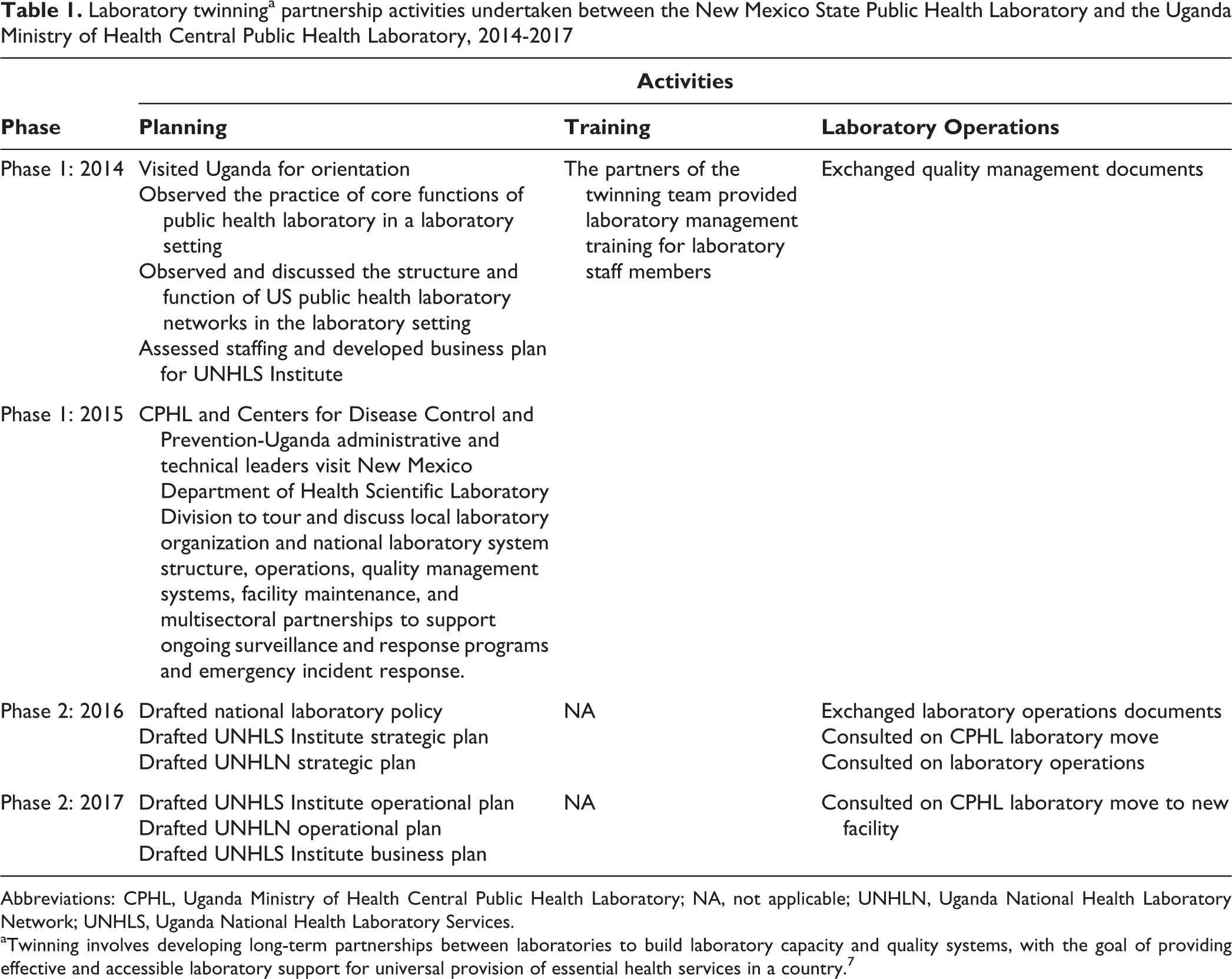
To achieve these strategic objectives, the twinning partners undertook activities in 3 categories: planning, training, and laboratory operations (Table 1).
Laboratory twinninga partnership activities undertaken between the New Mexico State Public Health Laboratory and the Uganda Ministry of Health Central Public Health Laboratory, 2014-2017
Abbreviations: CPHL, Uganda Ministry of Health Central Public Health Laboratory; NA, not applicable; UNHLN, Uganda National Health Laboratory Network; UNHLS, Uganda National Health Laboratory Services.
aTwinning involves developing long-term partnerships between laboratories to build laboratory capacity and quality systems, with the goal of providing effective and accessible laboratory support for universal provision of essential health services in a country. 7
During phase 1 (2014-2015), the twinning partners conducted several planning activities. First, representatives from the Scientific Laboratory Division and APHL conducted an orientation trip to Uganda to meet their CPHL partners and the Ministry of Health leadership, familiarize themselves with Ugandan health care and health laboratory systems, and meet with CPHL staff members to understand CPHL operations. The US partners also led discussions at the CPHL on the core functions of public health laboratory systems, 2 public health laboratory networks in the United States, and concepts of laboratory organizational structures that would facilitate the UNHLS Institute mission. Another activity, led by APHL and a local university partner of the CPHL, assessed staffing models and developed a preliminary business plan for the UNHLS Institute. CPHL senior staff members received management training during a weeklong APHL course, Foundations of Laboratory Leadership and Management, which took place in Uganda. The Scientific Laboratory Division shared its laboratory documents (standard operating procedures, quality assurance plan, emergency preparedness plan, continuity of operations plan) with the CPHL to assist in developing similar plans for the UNHLS Institute.
In 2015, technical and administrative leaders from CPHL and CDC-Uganda (CDC staff members stationed in Uganda) visited the Scientific Laboratory Division in New Mexico. The weeklong visit involved in-depth meetings with the Scientific Laboratory Division’s scientific, business, quality management, information technology, and facility maintenance staffs; its epidemiology and agriculture laboratory partners; and New Mexico Department of Health leadership. The meetings included discussions on laboratory quality management systems and facility management; how to develop multisectoral partnerships for surveillance and outbreak and emergency response; and guidelines for integrating data management and a One Health approach (achieving optimal health outcomes by recognizing the interconnection among humans, animals, plants, and their shared environment).
During phase 2 (2016-2017), planning activities focused on establishing and operating the UNHLS Institute and UNHLN. Partners conducted workshops to draft a National Laboratory Policy to establish the national framework for the organization, management, and regulation of health laboratory services throughout Uganda and to develop for the UNHLS Institute and the UNHLN (1) strategic plans outlining their vision, mission, and 5-year goals and objectives and (2) annual operational plans describing strategies, activities, and targets to enable them to achieve these goals. The Uganda Ministry of Health then met with stakeholders to gather feedback for its plan to establish and implement the UNHLS Institute and UNHLN. Partners conducted a workshop to develop a public health–oriented business plan for the UNHLS Institute, based on an established process that uses key business planning skills and entrepreneurial strategies to achieve social good. 8 For laboratory operations, the Scientific Laboratory Division and CPHL staff members held discussions on how to manage the move of CPHL operations to its new laboratory facility in 2017.
In addition to these activities, partners communicated frequently, by telephone and email, on issues as they arose. These informal communications reflected the positive relationships that developed during the course of the project.
Outcomes
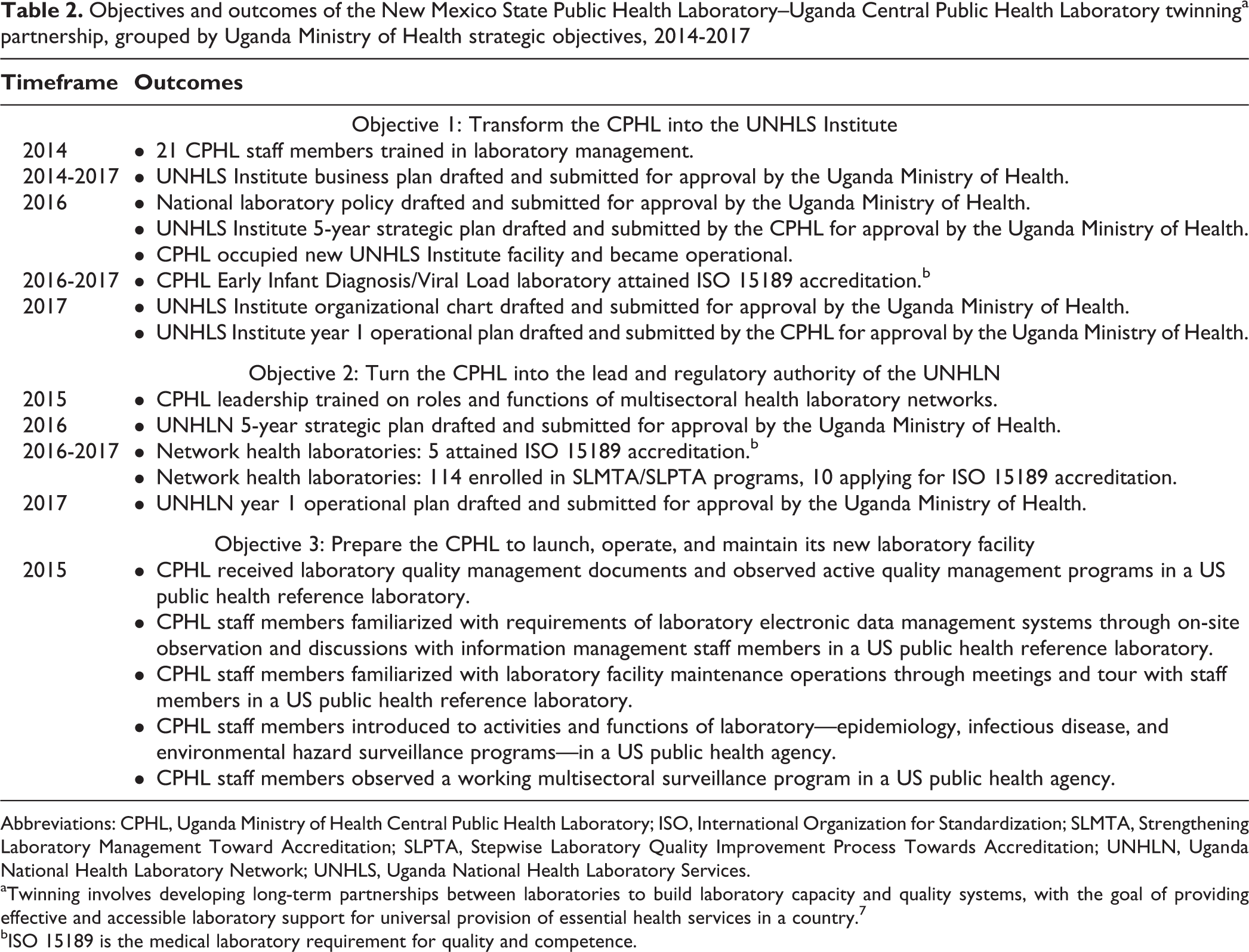
The twinning partnership addressed the 3 strategic objectives (Table 2). In support of objective 1 (transform the CPHL into the UNHLS Institute), the partnership provided the Ministry of Health with 21 CPHL staff members who were trained in laboratory management and leadership and who were familiar with the roles and activities of a national reference laboratory in a multisectoral environment. The Ministry of Health also received a draft National Laboratory Policy, organizational chart, business plan, strategic plan, and year 1 operational plan for the UNHLS Institute. In February 2017, the CPHL’s Early Infant Diagnosis/Viral Load testing laboratory achieved International Organization for Standardization 15189 accreditation (medical laboratory requirements for quality and competence) through the South African National Accreditation System. It now serves as a national and international reference laboratory.
Objectives and outcomes of the New Mexico State Public Health Laboratory–Uganda Central Public Health Laboratory twinninga partnership, grouped by Uganda Ministry of Health strategic objectives, 2014-2017
Abbreviations: CPHL, Uganda Ministry of Health Central Public Health Laboratory; ISO, International Organization for Standardization; SLMTA, Strengthening Laboratory Management Toward Accreditation; SLPTA, Stepwise Laboratory Quality Improvement Process Towards Accreditation; UNHLN, Uganda National Health Laboratory Network; UNHLS, Uganda National Health Laboratory Services.
aTwinning involves developing long-term partnerships between laboratories to build laboratory capacity and quality systems, with the goal of providing effective and accessible laboratory support for universal provision of essential health services in a country. 7
bISO 15189 is the medical laboratory requirement for quality and competence.
In support of objective 2 (CPHL becomes the lead and regulatory authority of the UNHLN), the partnership provided the Ministry of Health with a UNHLN strategic plan and year 1 operational plan for its establishment. It also familiarized UNHLS Institute leaders with the roles and functions of a health laboratory network. The effort to strengthen the quality of health laboratory services resulted in the enrollment of 114 network laboratories in the Strengthening Laboratory Management Toward Accreditation and Stepwise Laboratory Quality Improvement Process Towards Accreditation programs, with 5 network health laboratories having attained South African National Accreditation System International Organization for Standardization 15189 accreditation and 10 more applying for it.
In support of objective 3 (prepare the CPHL to launch, operate, and maintain its new laboratory facility), CPHL received guidance in managing facility relocation, developing a quality management system, and establishing facility oversight and maintenance systems. The CPHL moved into the new UNHLS Institute facility on November 17, 2016, and assumed the responsibilities and activities of the UNHLS Institute at that time. (CPHL has not changed its official name to the UNHLS Institute because its authority to do so is contained in a bill that was before the national Parliament as of January 2019.)
Lessons Learned
International laboratory twinning between a US public health laboratory and an international partner was an effective approach for achieving strategic organizational change in laboratory systems in a resource-poor country. The success of this partnership was evident from its progress on the project’s 3 strategic objectives and from the fact that the partnership has continued beyond the agreed-upon period. The success of this partnership can be attributed to several factors.
First, the project began with clear, realistic objectives that were mutually supported by the Uganda Ministry of Health, the New Mexico Department of Health, APHL, and the partnering laboratories. These objectives came from a strategic priorities roadmap for laboratories, authored by the Uganda Ministry of Health. The partners reached consensus on how to prioritize objectives, set realistic expectations within the project timeframe, define project deliverables, and plan activities to achieve them.
Second, the partnership launched with a visit by key laboratory and APHL personnel to Uganda for an extensive introduction to the Ministry of Health and laboratory leaders, partners, and stakeholders in the initiative. Learning the CPHL operations familiarized the Scientific Laboratory Division and APHL staff members with the Ugandan political, laboratory, and health system environments and helped forge a team identity.
Third, CPHL and CDC-Uganda staff members’ visit to the Scientific Laboratory Division proved invaluable, allowing Ugandan staff members to visit an operating reference public health laboratory, meet with its staff members, and observe laboratory operations. For several visitors, this visit was the first time they had seen what they were striving to create. It also gave CPHL partners the opportunity to meet with their US counterparts and see, firsthand, the value and mechanics of establishing multisectoral partnerships for a One Health approach to surveillance and response.
Fourth, the management of project budget, travel, and logistics by APHL substantially reduced the administrative burden on the laboratory partners. Also, APHL was able to draw on its membership and staff members for assistance when activities required additional personnel (eg, business planning, management training, and strategic and operational planning).
Finally, long-term personnel and funding were essential to sustaining achievements in the national laboratory system beyond the initial partnering period. Because resource-poor countries may not have this funding in their budgets, external funding is important to maintain the gains achieved until they can be internalized by the countries. In the current partnership, additional funds, including funds from PEPFAR (President’s Emergency Program for AIDS Relief), are providing sustainability for the activities of the UNHLS. Although funding will continue to be a challenge, new funding opportunities may arise as Uganda’s national laboratory system increases its competency.
International laboratory twinning is a viable approach to developing partnerships with stability and longevity beyond a formal agreement period. This approach helps to attain project objectives and produces additional benefits from the informal professional interactions that exceed the duration and scope of the initial partnering agreement. As such, twinning is likely to improve the chances that national health laboratory systems in developing countries can achieve complex organizational change to support their national strategic goals.
Footnotes
Declaration of Conflicting Interests
The authors declared no potential conflicts of interest with respect to the research, authorship, and/or publication of this article.
Funding
The authors disclosed receipt of the following financial support for the research, authorship, and/or publication of this article: This project was supported by cooperative agreements #6NU2GGH001097 and #NU60OE000103 funded by the Centers for Disease Control and Prevention (CDC). Its contents are solely the responsibility of the authors and do not necessarily represent the official views of CDC or the US Department of Health and Human Services.