



Abstract
Approximately 1 in 9 teenagers and young adults aged 16-24 in the United States is currently disconnected from school and employment. These disconnected young people (ie, opportunity youth) are not only at high risk for long-term emotional, behavioral, and health problems, but they also represent a loss of human capital, with high social and economic costs. In this article, we offer a public health perspective on opportunity youth by describing their distribution in the population and consequences of their disconnection; proposing a conceptual model of the issue based on epidemiological principles, life course development concepts, and ecological theory; and recommending multisector strategies for preventing disconnection of young people and reengaging opportunity youth. A public health approach to the problem of opportunity youth would involve developing and investing in youth monitoring data systems that can be coordinated across multiple sectors, consolidating both the delivery and funding of services for opportunity youth, developing policies and programs that encourage engagement of young people, and fostering systematic approaches to the testing and scaling up of preventive and reengagement interventions.
Emerging adulthood—the period between the late teens and early 20s—is a profoundly important developmental stage. During this time, most young people obtain the education and training that will provide the foundation for their occupational trajectories during the rest of adulthood. 1 Many young people, however, do not obtain adequate levels of these important experiences to support future financial independence and productive careers. In 2016, nearly 12% of teenagers and young adults aged 16-24 in the United States were both out of school and out of work. 2 These young people are commonly referred to as disconnected youth or opportunity youth. The latter term is preferred by some because it conveys the notion that engaging this group in the educational system and the labor force has potential benefits. Relative to their connected contemporaries, opportunity youth have a disproportionate share of problems as they age, including chronic unemployment, poverty, mental health disorders, criminal behaviors, incarceration, poor health, and early mortality. 3 -5 These alarming disparities between opportunity youth and their more connected peers represent a public health problem with serious social, economic, and health implications.
In this article, we view youth disconnection from a public health perspective, dividing our discussion into 3 sections. First, we describe the distribution and consequences of youth disconnection in the United States. Second, we provide a conceptual model of youth connection and disconnection, which is grounded in ecological theory, life course development concepts, and epidemiological principles. Third, we offer recommendations for multisector strategies aimed at reducing and preventing youth disconnection.
Youth Disconnection: Distribution in the Population and Individual and Social Consequences
Disconnected youth compose a sizable portion of the US population of teenagers and young adults aged 16-24. Measure of America, a project of the Social Science Research Council, uses data from the American Community Survey (ACS) to develop detailed reports on disconnected youth. 2 Measure of America reported that the proportion of US teenagers and young adults aged 16-24 who were neither employed nor in school 3 months before each survey declined from 14.7% in 2010 to 11.7% in 2016. Although this decline represents a 20% decrease in the percentage of disconnected youth from 2010 to 2016, an estimated 4.6 million young people were still disconnected in 2016, the most recent year for which data were available. 2
The 2016 Measure of America data suggested that the probability of disconnection among young people was affected by income, race/ethnicity, and residential environment. Disconnected youth were nearly twice as likely as connected youth to live in poverty and to receive Medicaid. 2 In communities where the poverty rate was below 6%, about 1 in 14 young people were disconnected; however, in communities where the poverty rate was above 21%, 1 in 5 young people were disconnected. Racial/ethnic disparities were striking; youth disconnection occurred in 6.6% of Asian American, 9.7% of white, 13.7% of Latino, 17.2% of black, and 25.8% of American Indian/Alaska Native young people. 2 The fact that these disparities persisted even when controlling for income suggests that structural racism and discrimination may also contribute to youth disconnection. Residential environment disparities were also noted; youth disconnection was found among 11.3% of young people in suburban areas, 12.9% in urban areas, and 19.3% in rural areas. Whereas the national average for youth disconnection was 11.7%, 24% of young people in the rural South were disconnected. Other factors reportedly related to youth disconnection have included poor grades, mental health and substance use disorders, parental unemployment, exposure to trauma, and association with socially deviant peers. 3,6
Youth disconnection has consequences, both for each affected young person and for society. In a longitudinal study published in 2002, young people who were not in school or employed for at least 6 months while aged 16-18 were 3 times more likely than their connected peers to develop depression and other mental health disorders and 5 times more likely to have a criminal record, yet one-sixth as likely to obtain a high school or college degree. 7 In 2012, each disconnected young person was estimated to cost taxpayers $13 890 per year and approximately $250 000 during a lifetime, taking into account criminal justice expenses, welfare and social service payments, taxpayer-funded health care costs, and lost tax revenue. 8
The heterogeneity of this population complicates efforts to understand the unique experiences of or help opportunity youth. The population encompasses a broad range of young people, including those in the juvenile justice and foster care systems, teenage mothers, and homeless young people. 7 Yet these subgroups are often excluded from or underrepresented in population surveys, including the ACS and Current Population Survey. 8 Adding to the challenge, youth disconnection is usually assessed as if it were binary (ie, disconnected or not), when it may actually be better conceptualized and measured along a continuum. Furthermore, although some young people (described as chronically disconnected youth) are consistently out of work and school, others (described as underattached youth) are only intermittently disconnected, having either not progressed satisfactorily through the educational system or not secured consistent, stable employment. Evidence suggests that various subgroups may require different intervention approaches. 8
Another challenge is that the prevailing structural definition of disconnection (ie, out of school and work) may not capture the extent to which many young people lack meaningful connections, including positive relationships with peers, adults, and family. Those enrolled in school (technically connected) may be homeless or abused and may have family disruptions or inadequate peer relationships. Thus, understanding disconnection within not only a structural context but also social and emotional contexts is crucial to providing adequate support to opportunity youth.
Conceptual Model of Youth Connection and Disconnection
To clarify the theoretical underpinnings of youth disconnection, we propose a conceptual model that draws from epidemiological principles, 9,10 life course development concepts, 10,11 and ecological theory (Figure). The model is informed by the Positive Youth Development Framework, which views youth development as embedded within family, school, community, society, culture, and history, and which promotes strategies that provide opportunities that build on young people’s strengths. 14 -18 This framework assumes plasticity (ie, the capacity for adaptive change), which is especially relevant during adolescence, a time of dramatic brain development and emotional growth, both of which provide opportunities for transformation. The framework also emphasizes that positive change can take place within multiple social contexts (ie, family, peer groups, school, community) and can be promoted by various people in those contexts. 14,15,18
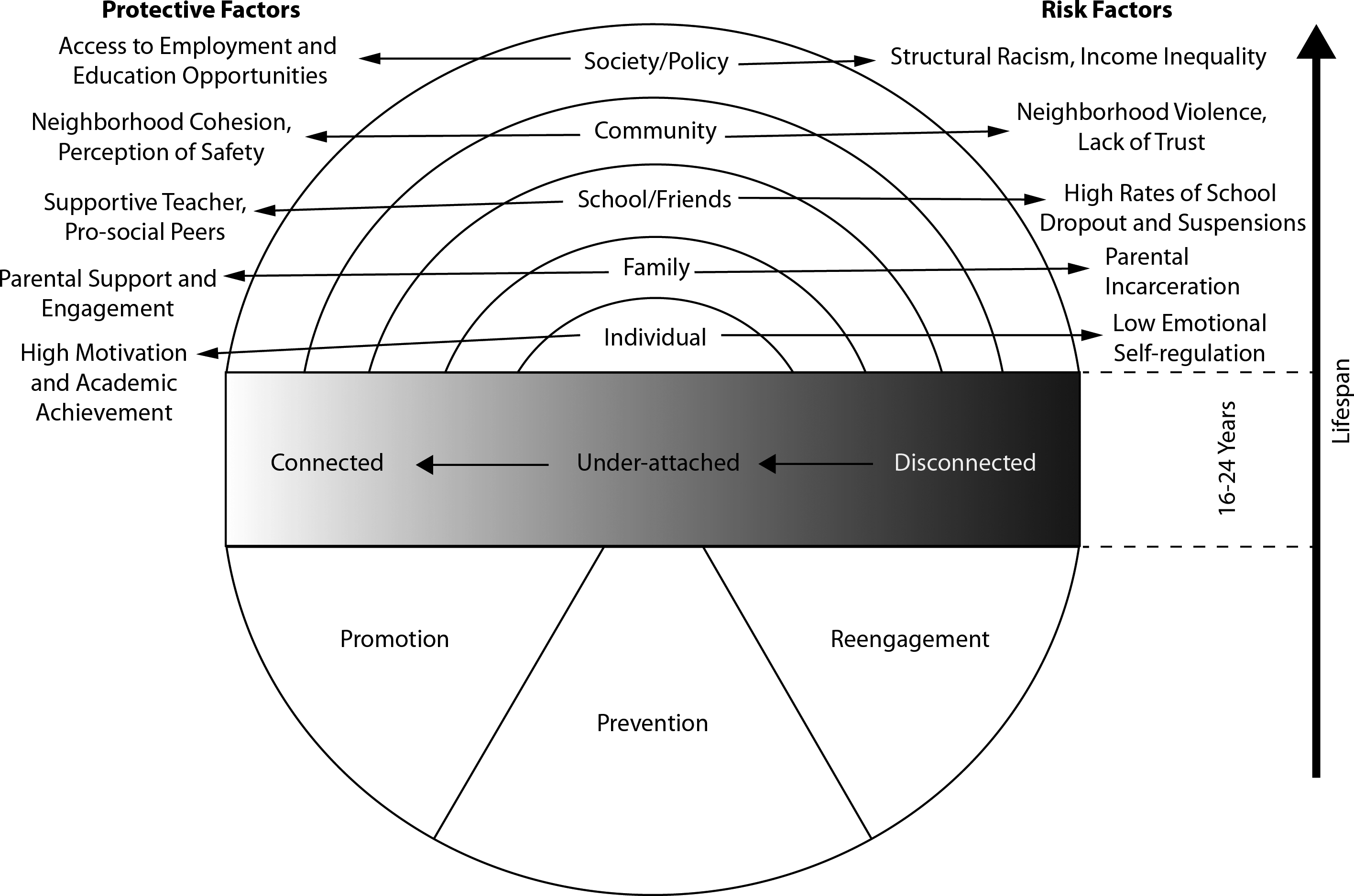
Conceptual model of youth connection and disconnection. Disconnected youth are teenagers and young adults aged 16-24 who are neither in school nor employed. 2 The model is built around developmental stages (continuum: connection to underattachment to disconnection) of young people aged 16-24. Protective factors for connection and risk factors for disconnection may affect development at multiple ecological levels: individual, family, school/friends, community, and society/policy. Promotion of connection, prevention of disconnection, and reengagement of disconnected youth with school, employment, or key social supports can be used to target young people universally (all young people), selectively (young people with risk factors), or as indicated (young people showing early signs of disconnection). 12,13
The conceptual model is built around young people aged 16-24 and their developmental stages. The model depicts a continuum from connection, to underattachment, to disconnection (Figure). The model includes protective factors for connection and risk factors for disconnection, all of which potentially affect youth development at multiple ecological levels, including individual, family, school/friends, community, and society/policy. At each developmental stage and ecological level, risk and protective factors can increase or decrease disconnection. For example, at the societal level, structural racism, sexism, and income inequality may limit options for housing, education, and employment and, thus, increase the likelihood of disconnection. 19 Conversely, access to supportive adults and services can reduce the likelihood of disconnection. 3,20 The model additionally incorporates various interventions, which can also influence youth development. These interventions may range from promotion of connection, to prevention of disconnection, to reengagement of those who are disconnected. 12,13 The model indicates that promotion and prevention strategies—key components of a public health approach that are detailed later—as well as reengagement strategies can be envisioned that target various youth populations, which, depending on the intervention goals, may include all young people regardless of risk (universal interventions); young people with risk factors for disconnection, such as placement in child welfare (selective interventions); and young people exhibiting early signs of disconnection, such as missing numerous school days (indicated interventions). 12,13
Strategies for Preventing or Reducing Youth Disconnection: Applying a Public Health Approach
In this next section, we describe promising prevention and reengagement strategies, and we make recommendations for how these strategies might be improved or expanded by using public health tools. Public health tools—including identifying populations at highest risk for health issues, monitoring protective and risk factors, and implementing population-based prevention and intervention strategies—can be used in an intentional and systematic way to reduce the number of opportunity youth.
So far, the predominant response to youth disconnection has been the use of reengagement strategies. These strategies aim to reconnect young people with education or to provide young people with apprenticeships, other job training, or employment (Table 1). National reengagement programs, such as YouthBuild, Job Corps, and Year Up, have demonstrated measurable (albeit small) benefits for high school graduation rates and wages. 25 Other large-scale initiatives have broadened the scope and impact of this work. One of these initiatives is the Aspen Institute’s Opportunity Youth Incentive Fund, an initiative established in 2012 that provides support to 21 US sites and has 3 goals: (1) reconnecting opportunity youth to education and employment; (2) catalyzing the adoption of approaches in education and career attainment that lead to family-sustaining careers; and (3) promoting local, state, and national policies that increase the replication and scaling up of these approaches. 26 Another reengagement project is the 100 000 Opportunities Initiative, which was launched in 2015 and is the largest employer-led, opportunity youth–focused coalition in the United States. In this initiative, the coalition committed to training and hiring 100 000 opportunity youth by 2018. More recently, after surpassing this original goal 2 years ahead of schedule, it established a new goal to hire 1 million opportunity youth by 2021. 27
Examples of school-, family-, community-, and employer-based programs for the reengagement of disconnected youtha
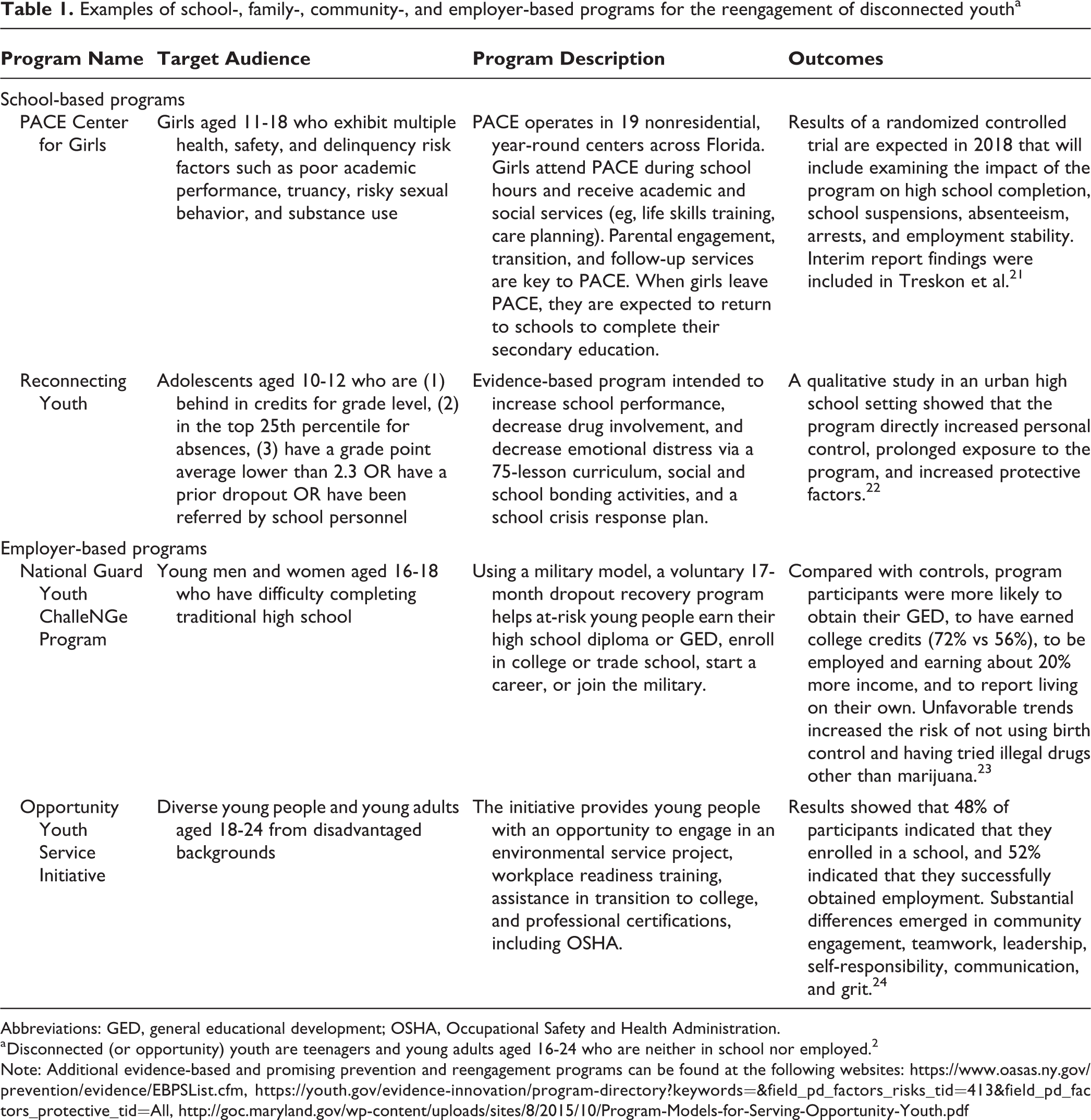
Abbreviations: GED, general educational development; OSHA, Occupational Safety and Health Administration.
a Disconnected (or opportunity) youth are teenagers and young adults aged 16-24 who are neither in school nor employed. 2
Note: Additional evidence-based and promising prevention and reengagement programs can be found at the following websites: https://www.oasas.ny.gov/prevention/evidence/EBPSList.cfm, https://youth.gov/evidence-innovation/program-directory?keywords=&field_pd_factors_risks_tid=413&field_pd_factors_protective_tid=All, http://goc.maryland.gov/wp-content/uploads/sites/8/2015/10/Program-Models-for-Serving-Opportunity-Youth.pdf
Historically, strategies to prevent youth disconnection have not received the same level of priority as reengagement strategies. Yet prevention is at least as important as reengagement; it can reduce the need for costly interventions later in life, and it can reduce suffering and enhance well-being among young people. 28 Preventive approaches for youth disconnection include strengthening connections within the key contexts in young people’s lives (school, family, and community) and promoting academic and career engagement among young people (Table 2). For example, a large body of evidence supports the role that universal preschool education can play in both readiness to learn and good academic performance, demonstrating a positive long-term effect on student engagement in school. 46 -49 The Good Behavior Game, an example of a classroom-centered universal prevention program, was found to reduce conduct problems, emotional disorders, school suspensions, and special education service use, as well as to increase high school standardized test scores and the odds of high school graduation and college attendance; and, during early childhood, to reduce antisocial behaviors, substance use, and violent and criminal behavior. 29 -32 Both Communities That Care and Promoting School-Community-University Partnerships to Enhance Resilience (PROSPER) are examples of community-based strategies to prevent youth disconnection, each of which has demonstrated positive effects that extend into young adulthood. 39 -45 In these approaches, researchers provide structured guidelines and support to communities and help them convene a coalition of agencies, schools, and community leaders to conduct school-based assessments, prioritize protective and risk factors, and implement evidence-based school, family, and community prevention programs matched to their identified priorities.
Examples of school-, family-, community-, and employer-based programs for the prevention of youth disconnectiona
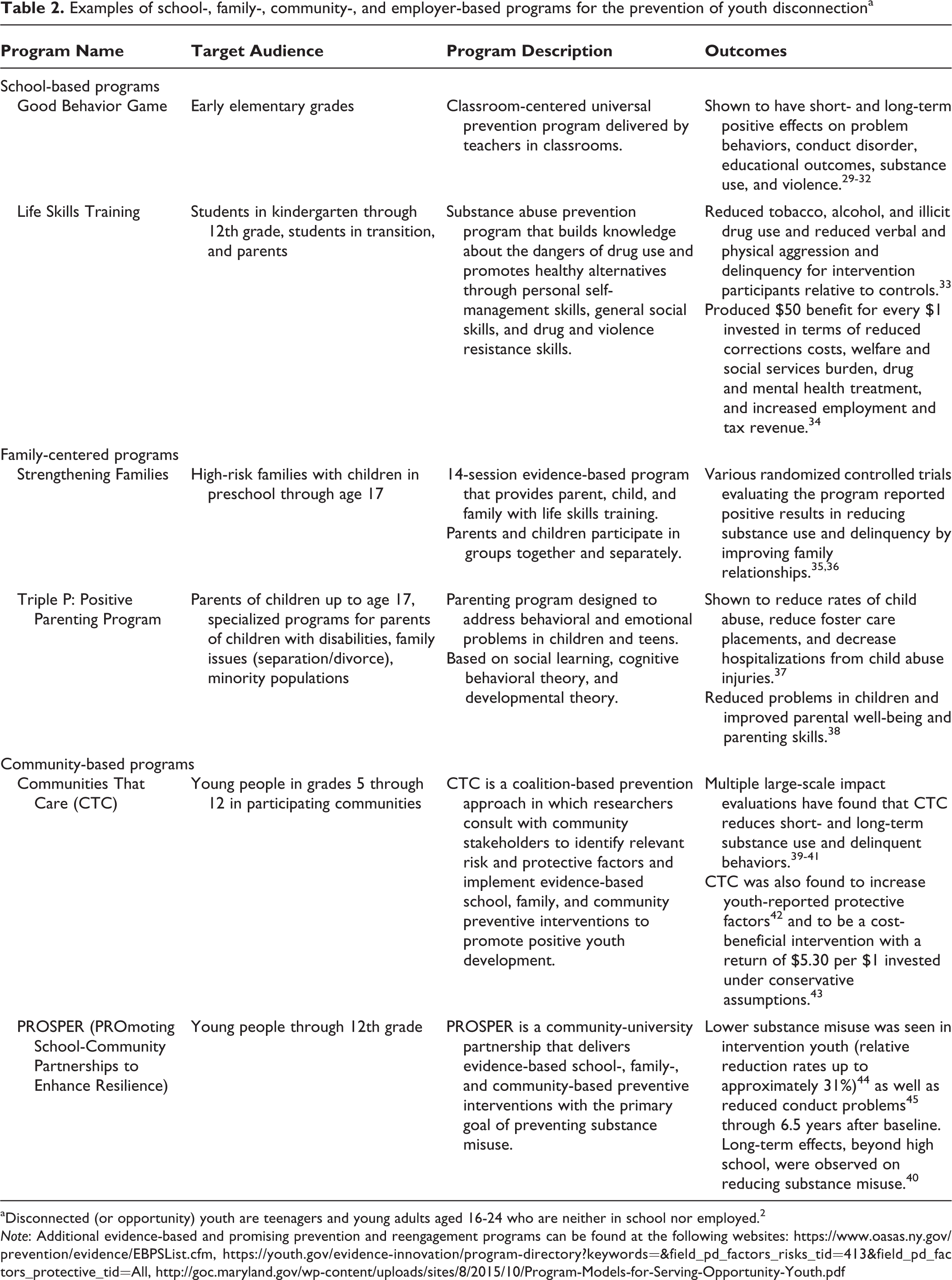
aDisconnected (or opportunity) youth are teenagers and young adults aged 16-24 who are neither in school nor employed. 2
Note: Additional evidence-based and promising prevention and reengagement programs can be found at the following websites: https://www.oasas.ny.gov/prevention/evidence/EBPSList.cfm, https://youth.gov/evidence-innovation/program-directory?keywords=&field_pd_factors_risks_tid=413&field_pd_factors_protective_tid=All, http://goc.maryland.gov/wp-content/uploads/sites/8/2015/10/Program-Models-for-Serving-Opportunity-Youth.pdf
To be maximally effective, however, strategies to prevent disconnection need to be delivered at multiple ecological levels (ie, family, peers, school, community), during various developmental stages (infancy through early adulthood), and across various sectors (eg, education, health). Effective evidence-based prevention strategies certainly exist, 28 but many have not measured their effect on youth disconnection, and most have not been scaled up sufficiently to affect a broad population. In addition, only a few prevention strategies, such as that reported by Stormshak et al, 50 have been integrated with reengagement strategies.
To expand on the work already begun and address a problem as complex as youth disconnection, multisectoral approaches are needed. Public health strategies should be well suited to this effort because they can be formulated to target diverse sectors, to work at multiple ecological levels, and to engage a wide range of stakeholders and disciplines concurrently. 51,52 Strategies most likely to succeed will be those that (1) use coordinated data systems, (2) consolidate service delivery and blend funding, (3) involve young people in the design and implementation of interventions, and (4) undertake systematic approaches to the testing and scaling up of prevention and reengagement interventions.
Coordinated Data Systems
Multiple youth monitoring data systems collect data on education, health care, juvenile justice, child welfare, and foster care. However, because most of these data systems currently lack interoperability, it is nearly impossible to track opportunity youth who move in and out of these sectors. Also, these data systems often fail to gather data elements in consistent ways. The current situation presents an opportunity for creating policies that incentivize standardized data collection and data sharing. Ultimately, coordinated collection and integration of data across multiple systems is crucial for effectively preventing and reducing youth disconnection.
Another challenge is that in many data systems, certain opportunity youth subgroups (eg, homeless and unstably housed young people, lesbian/gay/bisexual/transgender/queer and questioning [LGBTQ] young people) are invisible. LGBTQ young people are known to be disproportionately discriminated against and harassed in schools and the workplace, 53 -55 but they are often concealed within the broader category of opportunity youth because many data systems do not capture data on sexual orientation or gender identity. 2 Data system consistency, consolidation, and sharing across various educational, health, and social services should be a priority. Through new public policies, integrated data systems could be established that would identify disconnected youth communities or subgroups to prioritize for prevention and reengagement efforts.
A related obstacle is the lack of longitudinal data pertaining to opportunity youth. Information about the pathways that young people may follow into and out of disconnection is valuable. For example, longitudinal data have shown that the quality of parental caregiving from age 6 to 42 months is a predictor of high school dropout rates. 56 Evidence also indicates that children exhibiting problem behaviors in first grade or having to repeat first grade had higher high school dropout rates than children without these issues. 56,57 Some longitudinal datasets, such as the National Longitudinal Survey of Youth, the Educational Longitudinal Survey of Youth, and the National Longitudinal Study of Adolescent Health, can be useful in broadening the understanding of differences among chronically disconnected, underattached, and institutionalized young people. 6 Nevertheless, an increase in the collection and monitoring of youth disconnection risk indicators over time could help ensure that at-risk young people are identified early and provided with additional supports to prevent disconnection as they age.
The San Diego Youth Opportunity Pathway Initiative is an example of how detailed and integrated data can be used to prioritize prevention and reengagement programs. 26 Beginning in 2013, this collaborative merged data from the US Census tract with data from the US Department of Health and Human Services and the San Diego Association of Governments to create “heat” maps, which display areas with high concentrations of young people who have various risk factors for disconnection, including unemployment, teen births, probation, foster care, and school dropout. Along with data on levels of existing programming, the maps have been used by collaborative partners to identify priority neighborhoods and potential entry points for prevention and reengagement efforts. Another example is the Opportunity Index, created by Opportunity Nation, a cross-sector national coalition working to expand economic mobility and close the opportunity gap in the United States. This group has integrated information from various data sources to provide an annual opportunity score for states and counties throughout the United States. 58 The opportunity score is based on 20 economic, health, and civic indicators that measure expansion or restriction of access to opportunity for upward mobility, and it can be used to identify the communities that are most in need of prevention and reengagement efforts. We recommend that similar types of monitoring systems, which would collect, merge, and integrate data, preferably across the life course and at a population level, be implemented broadly by the communities.
Most data sets either do not include key risk factors (eg, family trauma) and protective factors (eg, positive relationships with a caring adult) for youth disconnection or do not monitor these risk and protective factors longitudinally. One exception is the Communities That Care Youth Survey, which is administered to young people in grades 6, 8, 10, and 12 on a population-wide basis and provides data on more than 20 risk and protective factors. 59 -61 Another exception is Search Institute’s Developmental Assets Profile, 62 which has been used in schools and communities since 2005. This survey measures young people’s internal strengths, external supports, and growth in these key areas over time. An important step toward preventing youth disconnection would be the development of policies that require schools to perform longitudinal population-level surveys, starting in early elementary school and extending through high school or beyond. These surveys should measure disconnection levels, risk and protective factors, and their consequences. Data captured by such surveys could help inform interventions that are tailored to and responsive to the needs of various subgroups of opportunity youth.
Another strategy that would help deepen our understanding of the experiences and needs of opportunity youth would be to integrate data obtained using qualitative and mixed methods with quantitative data. Interviewing young people who are either at risk for disconnection or are already disconnected would enhance the ability of researchers and policy makers to view issues from the perspective of young people. A more frequent use of qualitative methods would allow comparisons of the experiences of various disconnected youth subgroups, including those in rural areas and urban areas, and those in culturally disadvantaged groups (eg, immigrant youth) and marginalized groups (eg, LGBTQ). Qualitative reviews of school policies would be a way to identify policies that may be contributing to youth disconnection, either inadvertently or by design. One example is the use of “one strike and you’re out” (zero tolerance) school expulsion policies. 63 These and other school policies have been criticized for increasing dropout and incarceration rates, as well as other problems. 63 -67 Information obtained from regular policy analyses would offer the opportunity to modify such policies that may be placing more students at risk for disconnection.
Strategies and policies that promote the capture and use of appropriately detailed, coordinated, and integrated longitudinal data are needed to help various systems and sectors better align with each other to address youth disconnection. However, substantial challenges to implementation of these strategies and policies exist. These challenges include costs, privacy concerns, technological issues, and obtaining stakeholder buy-in. Progress in this area will require collaborative efforts, including making infrastructure- and data-sharing arrangements, to move the field forward.
Service Delivery and Funding
Disconnected youth have historically relied on a handful of public and nonprofit agencies or stand-alone programs in their communities for the prevention and reengagement services they need. These agencies and programs have typically been supported by a fragmented array of funding sources. Because of ineffective interagency coordination, information sharing, and longitudinal follow-up, disconnected youth have received inadequate attention to their needs, and data on both the short- and long-term effects of programmatic efforts have been lacking. Consolidation of prevention and reengagement services to disconnected youth would help address some of these deficiencies, and public policy could be used to help drive and shape this consolidation.
For policies directed at service consolidation to be effective, however, policy makers need to consider the potential costs and benefits of the outcomes they are seeking, applying a return-on-investment approach to any funding commitments that are being considered. 34 For example, funding could be made dependent on programs providing certain returns, such as demonstrations of interagency collaboration, service-system integration, and engagement of young people in service and system development. Policy makers could also consider promoting the blending of funding within jurisdictions. An example of this blending of funding is Performance Partnership Pilots (P3) for Disconnected Youth, 68 which was reauthorized by Congress in 2015. P3 provides jurisdictions with the opportunity to test innovative, cost-effective, and outcome-focused strategies for improving results for disconnected youth. It allows jurisdictions to blend their existing federal discretionary funds across multiple eligible programs, thus removing barriers to disconnected youth service delivery across communities. Another example is a new collective effort by national nonprofit organizations and employers to consolidate $6.5 billion of federal funding, with the goal of reengaging more than 1 million opportunity youth in education and employment annually for the next 5 years. 69 Jurisdictions that use blended funding approaches should be required to provide rigorous impact evaluations of their programs. The results of these evaluations would then shape subsequent policy and programmatic efforts.
Another challenge with current service delivery and programming for young people is that they are often focused only on one developmental period (or age group) without considering the life course implications of disconnection. Although numerous evidence-based programs exist at various grade levels (eg, the Good Behavior Game intervention), rarely are these programs integrated with programming at the next grade level. One exception is the Raising Healthy Children program, which delivers teacher, parent, and child interventions across primary and secondary school. 70 Originally tested in primary schools and found to have broad and lasting effects, 71 -73 the primary school intervention was extended into middle school in a separate trial. 70 Young people in the intervention group demonstrated increased school and family connectedness 74 ; reduced problems with mental health, risky sexual behavior, sexually transmitted infections, and substance use; and other positive outcomes, including increases in high school graduation rates, number of years of college attendance, and measures of socioeconomic status. 70 -72
Disconnected Youth Involvement
Disconnected youth should be asked to provide input on research, strategy development, and intervention delivery efforts. The participation of disconnected youth who are most marginalized (ie, those who are chronically disconnected) should be sought. Young people can provide important perspectives on intervention feasibility and acceptability, which may improve program efficacy. Their involvement also has the potential to provide opportunity youth with leadership and employment opportunities and positive connections with adults. One strategy involves the use of previously disconnected youth as mentors or coaches to young people at risk for leaving school and being disconnected. An example of this strategy is in Baltimore City, Maryland, where the Thread Program (https://www.thread.org) provides a network of supports for high school students at highest risk for leaving school early or for gang engagement. Keys to success in involving disconnected youth include using specific outreach strategies, providing ongoing training with useful real-world applications, engaging in retention efforts, ensuring meaningful representation, and acknowledging input. Trust can be developed by prioritizing the concerns of young people over those of service providers. To date, the most successful efforts to involve disconnected youth have provided young people with human and financial resources and training on how to make meaningful contributions. 75 That said, more research is needed to ascertain the most effective ways to engage disconnected youth in research, strategy, and intervention efforts.
Systematic Intervention Testing and Scaling Up
The United States currently lacks a national public health policy agenda for, or systematic approach to, the development, testing, scaling up, and funding of interventions aimed at disconnected and at-risk youth. Public policy makers could help improve each of these processes by developing policies that provide incentives for programs that use evidence-based practices and for programs that require systematic documentation of implementation and outcomes in a manner that would enable knowledge sharing. Also, researchers and public health practitioners could work together to systematically identify, test, and refine the core components of intervention programs for disconnected youth. 76 The results of this work could then be used to inform future efforts to implement and scale up effective interventions.
As part of this effort, realistic measures of success should be identified. These measures should be developed based on the understanding of pathways into and out of youth disconnection. Development of these outcome indicators would allow for the consistent monitoring of intervention and initiative outcomes and of the progress of target populations. Both intermediate outcome indicators (eg, active engagement with adults, tutors, or other support people) and longer-term outcome indicators (eg, school graduation, post–high school training, education enrollment) need to be specified, refined, and tracked over time.
Public Health Implications
The societal and economic costs of failing to address the needs of disconnected youth in the United States are high, both for this generation of young people and for their children. These costs include the loss of human resources to compete in a global economy, increased demands for public assistance, mass incarceration, drug abuse and opioid epidemics, and massive health service delivery costs. 3,6 The moral case for preventing and reducing youth disconnection is equally compelling. Most disconnected youth grow up in impoverished households and are the victims of failed schools, failed neighborhoods, and failed child welfare systems. Their poor emotional, behavioral, and health outcomes are therefore not surprising. 66 Now, more than ever, we must use the tools of public health—coordinated data systems, consolidated services and funding, population engagement, and systematic evaluation and scaling up—to expand the work already begun for this population.
Footnotes
Authors’ Note
Drs Mendelson and Mmari, listed in alphabetical order, contributed equally to this article.
Declaration of Conflicting Interests
The authors declared no potential conflicts of interest with respect to the research, authorship, and/or publication of this article.
Funding
The authors disclosed receipt of the following financial support for the research, authorship, and/or publication of this article: This article was produced with the support of the Bloomberg American Health Initiative, which is funded by a grant from the Bloomberg Philanthropies.