




Abstract

Trends in the conferral of public health degrees provide a lens into the public health workforce. As the needs of workforce development grow and change, it is imperative to accurately characterize trends in degree conferrals to estimate the future size and composition of the public health workforce. The challenging task of enumerating public health degree conferrals aligns with the equally challenging task of enumerating the public health workforce, for which the “methodology used needs further improvements in standardization, specificity, data storage, and data availability.” 1 Although a 2015 study characterized the growth of the undergraduate public health major in the United States, 2 our study focused on graduate-level public health education trends in the United States.
The impetus for public health education in the United States to have its own identity and academic institutions was established in 1915 with the release of the Welch-Rose Report. 3 The standardization of public health education began in 1919, with a meeting of the Committee of Sixteen. This committee was formed by the American Public Health Association (APHA) to standardize professional public health training. 4 From the beginning, collecting and analyzing institutional data on education in public health presented challenges. A 1950 report by the APHA Committee on Professional Education presented information on the complexities of the definitions used and issues in providing comparable data on public health degree conferrals, showing, for example, that “where both sanitary engineers and public health nurses may receive the degree of MPH [master of public health] through the school of public health, there is sometimes confusion as to the category in which these degrees should be reported.” The report also stated that “this material does not lend itself completely to neat, unequivocal classification.” 5
The Committee of Sixteen first collected information in 1920 from 20 US and Canadian institutions on the education provided to future public health workers. The results showed various degrees, from certificates to doctorates, and differences in requirements for the same degrees. For example, the committee observed that some institutions awarded doctorate degrees in public health for a course of a few weeks’ length, whereas others awarded doctorate degrees after several years of coursework. 4 Informed by this initial effort to catalog public health education, the Committee of Sixteen provided in its final opinions some of the first standardizations of public health education, including that the “first degree in Public Health should be a Certificate in Public Health, a Master of Science in Public Health, or Master of Public Health, to be granted for one or two years postgraduate work” and that “the highest degree in Public Health should be a [Doctor of Public Health], to be granted for not less than two years of work in academic residence.” 4
After the initial work of the Committee of Sixteen, the APHA Governing Council formed a Committee on Public Health Training to make recommendations about public health education. The Committee on Public Health Training released its first report in 1922, which included a list of public health degree offerings, the number of students enrolled, and the number of degrees conferred. The 1922 Committee on Public Health Training report showed more uniformity in the first degrees in public health, as well as doctorate degrees, than the report from the Committee of Sixteen. In 1922, 7 types of public health degrees were granted by 10 US institutions, from certificates to doctoral degrees, that were in either public health or hygiene. 6 After this initial report, various APHA committees conducted similar institutional analyses on public health education that were published in the American Journal of Public Health through early 1970.
In 1974, the Association of Schools of Public Health (now the Association of Schools and Programs of Public Health [ASPPH]) took the helm of public health institutional reporting with the creation of a data collection system. At the time, ASPPH membership was limited to schools of public health accredited by the Council on Education for Public Health (CEPH), and data from 1974-1975 reported 20 schools conferring 2295 graduate degrees. 7 In 2014, ASPPH began collecting data from member programs of public health; in 2016, a total of 91 CEPH-accredited schools and programs of public health, both US and international institutions, conferred 13 629 graduate-level degrees. 8
The enumeration of graduate public health degree conferrals has been conducted by various organizations including ASPPH. One formerly untapped resource is the National Center for Education Statistics (NCES) in the US Department of Education, which provides data on public health degree conferrals regardless of CEPH accreditation or ASPPH-member status. In this study, we created a composite estimate of total graduate public health degree conferrals in the United States by using annual data from (1) ASPPH, which provides data on ASPPH-member CEPH-accredited schools and programs of public health, and (2) NCES, which provides data on ASPPH members and nonmembers (both CEPH-accredited and not).
Methods
Data on Degree Conferrals From NCES
NCES collects, analyzes, and publishes statistics on education in the United States and provides public access to the Integrated Postsecondary Education Data System (IPEDS). IPEDS has collected data on postsecondary education since the 1980s; key areas of data collection include institutional characteristics, costs, enrollment, financial aid, degree conferrals, retention rates, staffing, and institutional financial health. 9 Participation in IPEDS is almost universal in the United States because it is required by all institutions that receive federal student financial aid support, as mandated by Title IV of the Higher Education Act of 1965. 10 These data are self-reported institution-wide, including degree completion by Classification of Instructional Programs (CIP) code, type of degree, gender, and race/ethnicity. CIP codes span all academic fields and disciplines, including public health. The CIP code for public health (51.22) has 11 subcodes and several related codes (eg, biostatistics [26.1102], epidemiology [26.1309], and health policy analysis [44.0503]). 9 The CIP codes reflect domains and subdomains as established by NCES and, as such, may not reflect how institutions organize their departments or programs. For example, epidemiology and biostatistics are traditional public health core knowledge areas, and both are classified outside of the public health CIP category for 2010 standards: epidemiology (26.1309) under “ecology, evolution, systematics, and population biology” (26.13) and biostatistics (26.1102) under “biomathematics, bioinformatics, and computational biology” (26.11). Therefore, many CIP codes must be aggregated to construct reasonable estimates of conferrals for public health degrees.
Data on Public Health Degree Conferrals From ASPPH
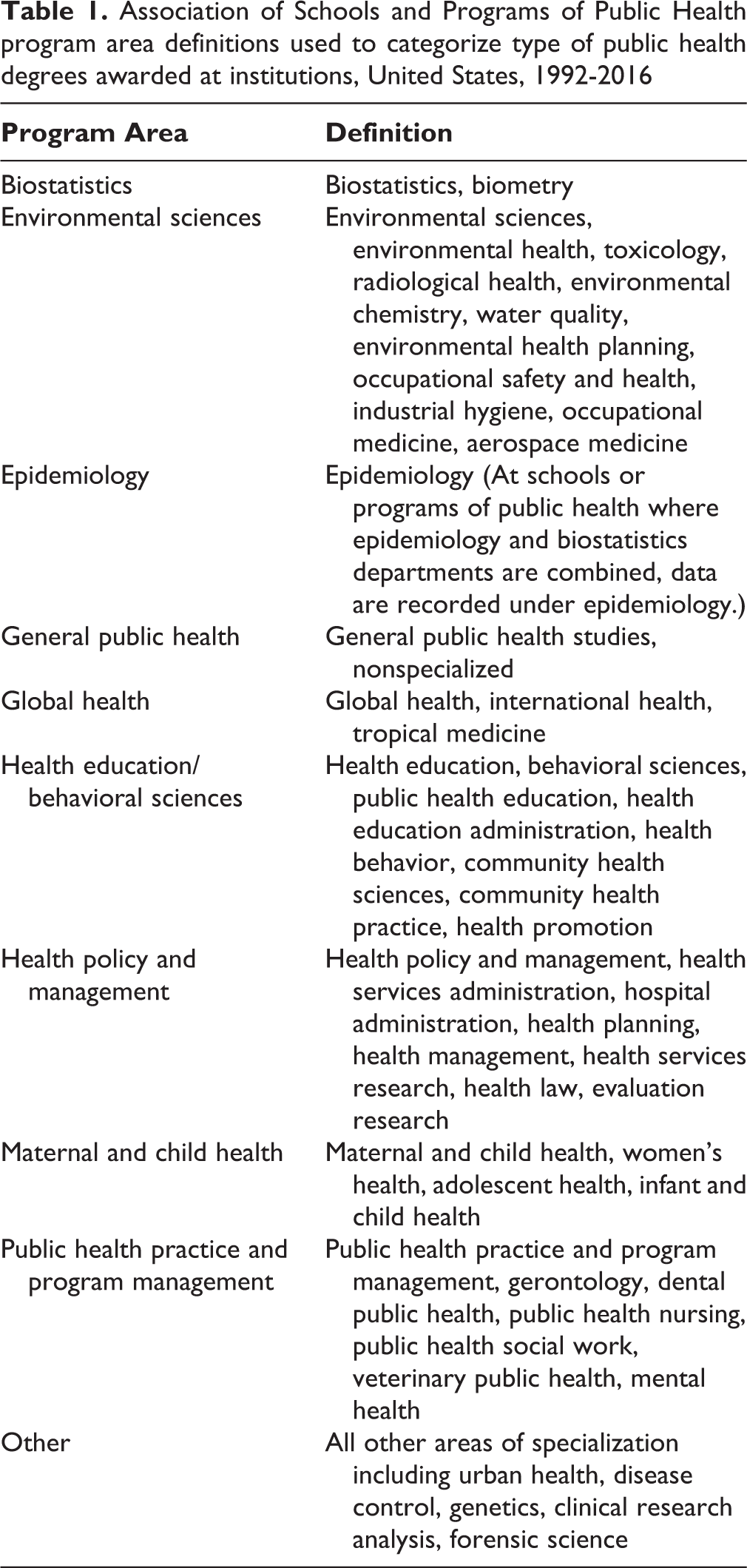
ASPPH represents domestic and international CEPH-accredited schools and programs of public health. 11 Since 1974, ASPPH has collected data annually from member schools and programs of public health on applications, new enrollments, students, graduates, faculty, and expenditures, with the addition of acceptances in 1982, salary in 1997, and graduate outcomes in 2016. 12 Data have been collected from schools of public health since 1974 and from programs of public health since 2014. ASPPH data on graduate degree conferrals provide information on demographic characteristics (gender, race/ethnicity, citizenship), degrees (bachelor’s, master’s, doctoral), and program areas. The program areas are defined under broad categories (eg, health policy and management includes health policy and management, health services administration, hospital administration, health planning, health management, health services research, health law, and evaluation research) (Table 1).
Association of Schools and Programs of Public Health program area definitions used to categorize type of public health degrees awarded at institutions, United States, 1992-2016
Data Management and Analysis
Data from IPEDS are available online for 1980 and 1984 to the present. 9 These data sets are cataloged and available in multiple data formats. Using Stata version 13, researchers integrated data sets, updated CIP codes to the 2010 standard, and cleaned data from 1980 and 1984-2012 (29 data sets). 13 The initial data analysis suggested that data sets from 1980 and 1984-1991 lacked sufficient comparability with data from 1992-2016 because of substantial changes in the 1990s CIP code standards. As such, the final analysis included the 1992-2016 data sets from NCES. For the present analyses, we selected master’s and doctoral degrees. Although bachelor degrees, postgraduate certification, associate degrees, and several other degree types are available in the NCES data, we excluded them from analysis.
Detailed data on degree conferrals from ASPPH-member, US-based schools of public health are available from 1996 onward, by school, gender, race/ethnicity, program area, and degree level. Aggregate estimates by school of public health, gender, degree type, and program area are available from 1992, and historical aggregate estimates are available from 1975 (race/ethnicity) and the 1960s (gender). Detailed conferral records from US-based ASPPH-member programs of public health are available for 2014-2016 in the same categories. We generated descriptive statistics from these data and, where applicable, categorized data based on ease of classification and distribution (eg, categorizing the number of degrees per institution).
We used data from ASPPH and NCES to triangulate a composite estimate of graduate public health degree conferrals. We generated the composite estimate by linking NCES and ASPPH data based on year, NCES school identification, ASPPH program area (using the crosswalk of ASPPH program area and NCES CIP codes [Table 2]), and degree level (ie, master’s and doctoral). We calculated the composite estimate by taking the higher number of ASPPH or NCES degree conferral counts generated in aggregate by institution in 1992 and in detail by institution, program area, and degree from 1996 to 2016 based on available data. We merged additional data on institutional characteristics based on year and institution (eg, institution size, ASPPH membership, and CEPH accreditation). When generating the composite estimates, we excluded counts of nutrition and biomedical degree conferrals from totals to enhance comparability across ASPPH and NCES data sources.
Crosswalk between NCES CIP codes and ASPPH program areas used to enumerate the number of graduate public health degrees conferred in the United States, 1992-2016
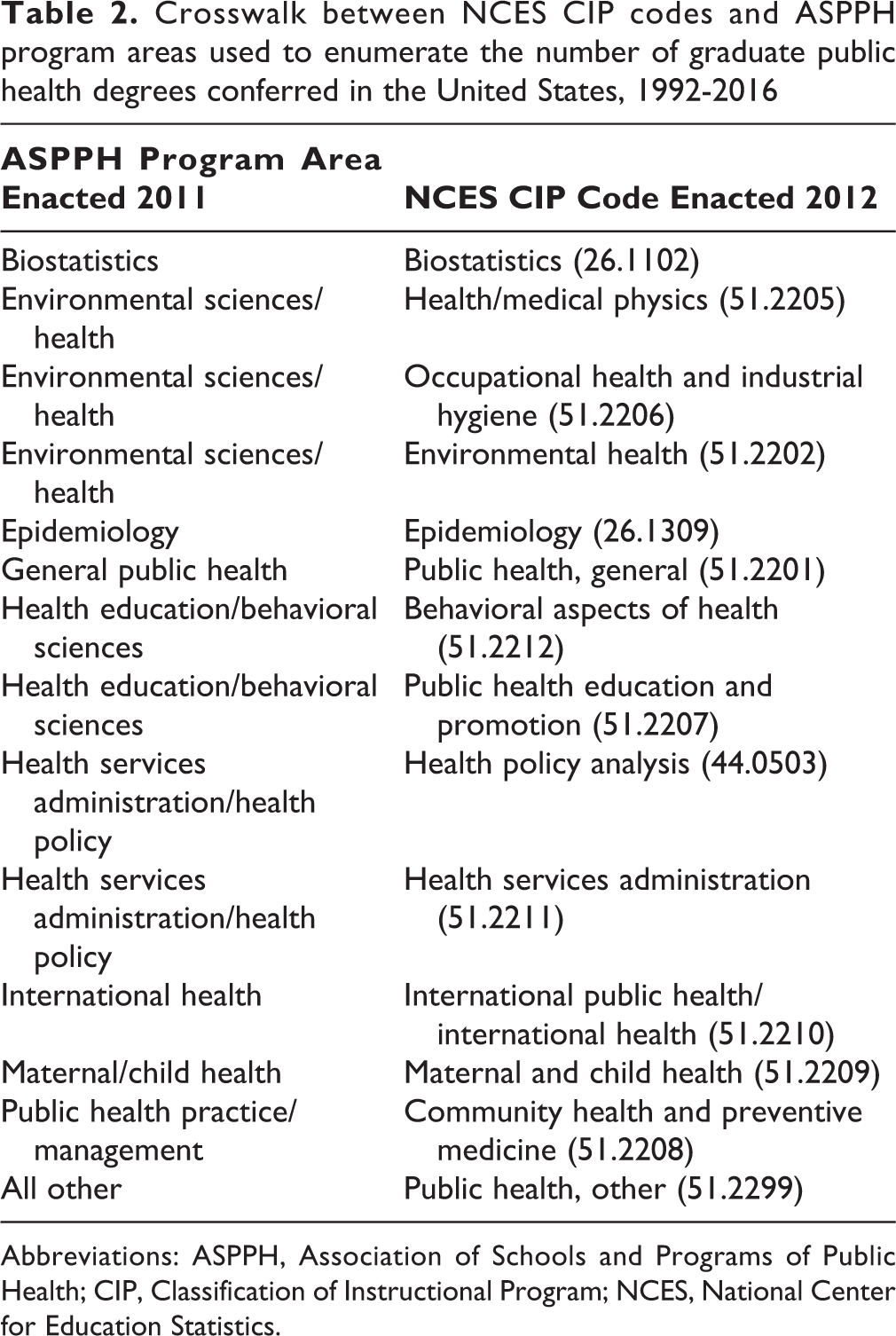
Abbreviations: ASPPH, Association of Schools and Programs of Public Health; CIP, Classification of Instructional Program; NCES, National Center for Education Statistics.
Results
For the 25-year study period (1992-2016), ASPPH data indicated 172 397 public health degree conferrals from ASPPH-member CEPH-accredited schools and programs of public health. NCES data for the same period indicated 209 180 public health degree conferrals from all institutions. The composite estimate, taking the greater of ASPPH-member data or NCES data by institution and year, put the total number of conferrals at 247 909 from 1992 through 2016. Extrapolations from observed differences between ASPPH-member data and NCES data in the 2000s indicate that more than 5000 additional graduate degrees may have been conferred in the early 1990s (based on NCES data) and before many institutions joined ASPPH.
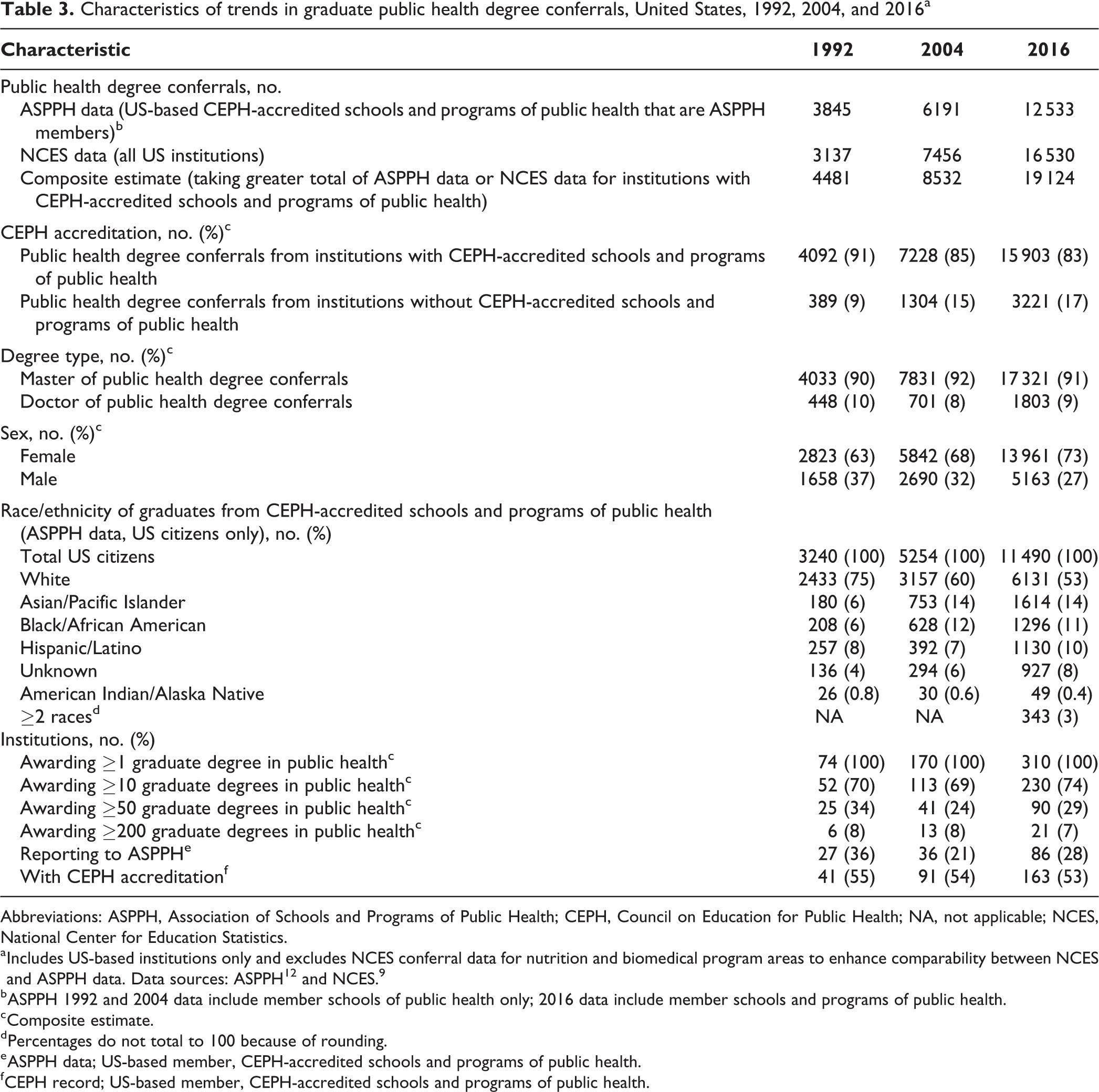
According to ASPPH data, 27 CEPH-accredited schools of public health conferred 3845 graduate degrees in public health in 1992 (Table 3). Using composite data, a total of 4092 degrees were conferred from 41 institutions with CEPH-accredited programs of public health. These conferrals from CEPH-accredited institutions accounted for 91% of the total number of public health degrees conferred in 1992. The proportion decreased to a low of 80% in 2008 and ranged from 82% to 85% through 2016.
Characteristics of trends in graduate public health degree conferrals, United States, 1992, 2004, and 2016a
Abbreviations: ASPPH, Association of Schools and Programs of Public Health; CEPH, Council on Education for Public Health; NA, not applicable; NCES, National Center for Education Statistics.
a Includes US-based institutions only and excludes NCES conferral data for nutrition and biomedical program areas to enhance comparability between NCES and ASPPH data. Data sources: ASPPH 12 and NCES. 9
b ASPPH 1992 and 2004 data include member schools of public health only; 2016 data include member schools and programs of public health.
c Composite estimate.
d Percentages do not total to 100 because of rounding.
e ASPPH data; US-based member, CEPH-accredited schools and programs of public health.
f CEPH record; US-based member, CEPH-accredited schools and programs of public health.
The proportion of master’s degree and doctoral degree conferrals was relatively consistent from 1992 to 2016 (ie, 90%-92% of all conferrals were at the master’s-degree level). From the ASPPH-member data on degrees, MPH degrees constituted approximately 72% of all master’s degrees from 1996 to 2016 (Figure 1). During that same period, doctor of philosophy degrees constituted 62%, doctor of public health degrees nearly 15%, and doctor of science, joint doctoral, and other doctoral degrees 23% of all doctoral degrees.
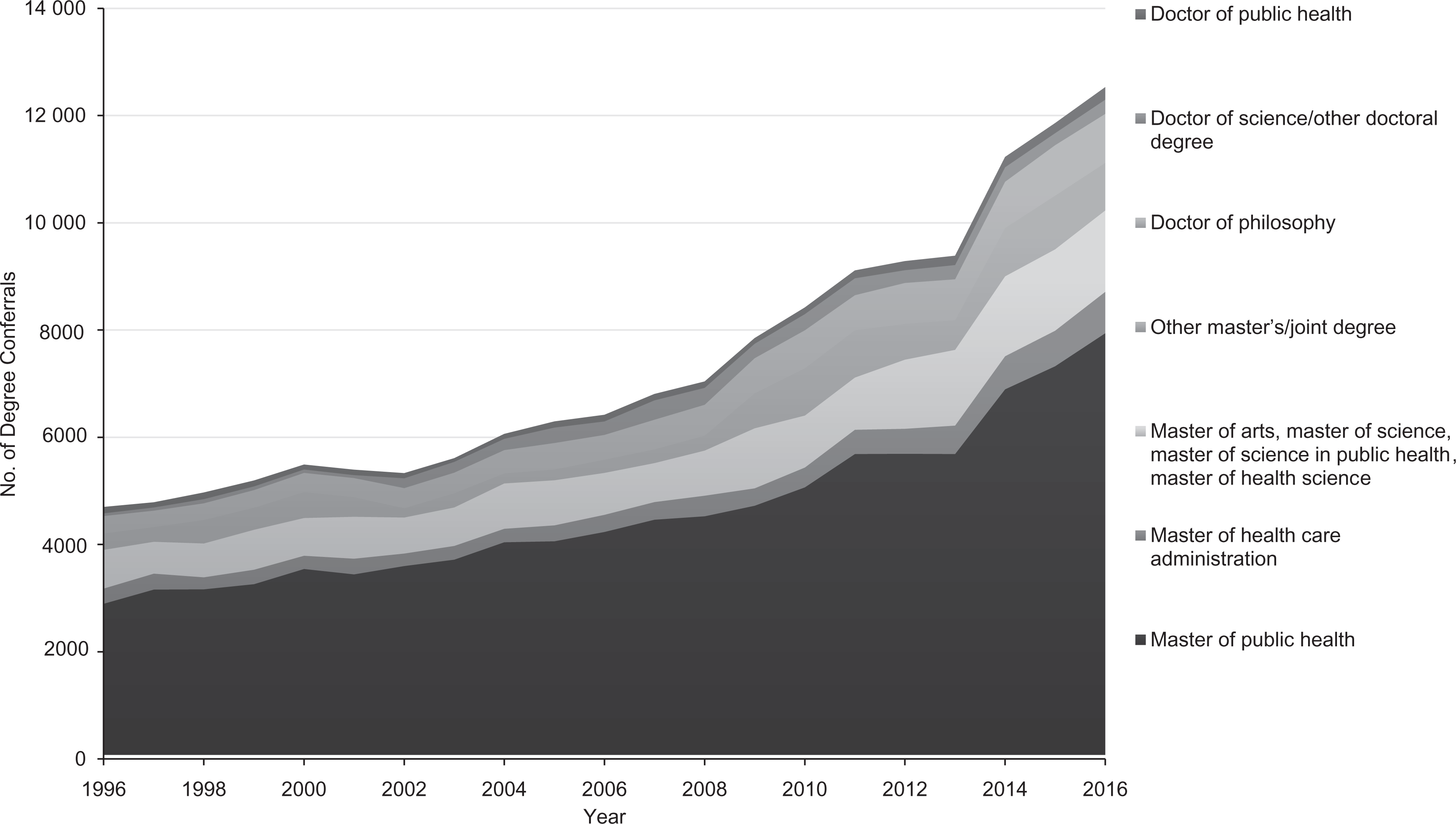
Number of graduate public health degree conferrals awarded at Association of Schools and Programs of Public Health (ASPPH)–member, Council on Education for Public Health–accredited schools and programs of public health, by degree, United States, 1996-2016. Data source: ASPPH. 12
The number of graduate degrees awarded in public health grew markedly from 4481 in 1992 to 19 124 in 2016. Composite estimates suggest that conferrals grew 302% overall for doctoral degrees and 330% for master’s degrees during that period, or 5%-6% average growth annually for all graduate degrees. The additional 14 643 degrees awarded in 2016 compared with 1992 were attributable to an increase from 74 to 310 institutions awarding at least 1 graduate degree in public health. Established schools and programs of public health awarded most degrees in 2016: 57% from institutions that conferred public health degrees before 1995, 12% from institutions that began conferring degrees between 1995 and 2001, 12% from institutions that began conferring degrees between 2001 and 2005, 10% from institutions that began conferring degrees between 2006 and 2010, and 9% from institutions that began conferring degrees between 2011 and 2016.
From 2005 to 2016, the percentage of public health degrees awarded to women ranged from 70% to 73%. The racial/ethnic composition of public health graduates also changed in the last several decades (Table 3). According to ASPPH-member data, nonwhite graduates accounted for 25% of degrees awarded in 1992 and 47% of degrees awarded in 2016. From 1992 to 2016, the percentage of Asian/Pacific Islander students awarded degrees increased from 6% to 14%, black/African American students from 6% to 11%, and Hispanic/Latino students from 8% to 10%.
Trends by Program Area
The proportion of graduate public health conferrals by program area was consistent from 1992 to 2016. Composite estimates show that 40% to 50% of total graduate public health degrees were conferred each year from general public health and health policy and management program areas, with a relatively smaller amount in the core public health sciences of epidemiology (approximately 11% from 1996 to 2016) and environmental health sciences (declining from 11% in 1996 to 6% in 2015), among others (Figure 2).
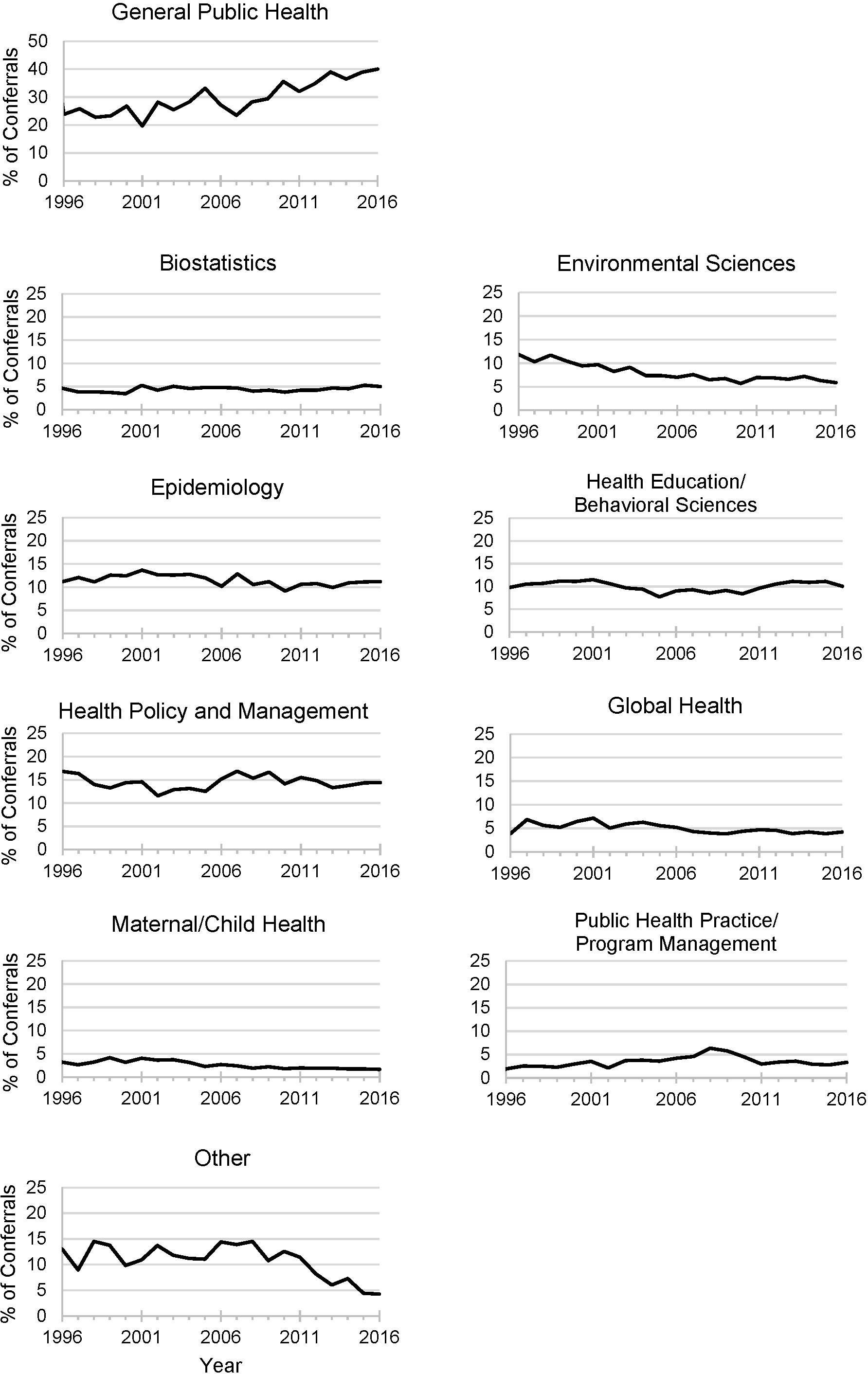
Proportion of graduate public health degree conferrals awarded at US institutions, by program area, 1996-2016. Data source: Composite estimate calculated by taking the higher number of Association of Schools and Programs of Public Health 12 or National Center for Education Statistics 9 graduate public health degree conferrals.
Trends by Institution and Program Size
Most graduate public health degrees were conferred by a small number of institutions (Table 4). In 1992, of 74 institutions awarding graduate public health degrees, 18 (24%) awarded ≥100 graduate public health degrees annually, accounting for 3295 of 4481 (74%) graduate public health degree conferrals. In 2016, of 310 institutions awarding graduate public health degrees, 52 (17%) awarding ≥100 graduate public health degrees annually accounted for 12 542 of 19 124 (66%) graduate public health degree conferrals. The number of institutions conferring 25-99 graduate public health degrees annually increased from 16 (22%) institutions accounting for 827 (18%) graduate public health degree conferrals in 1992 to 97 (31%) institutions accounting for 4893 (26%) graduate public health degree conferrals in 2016. Furthermore, more than half of all institutions conferred <25 graduate public health degrees annually. In 1992, 40 (54%) institutions conferring <25 graduate public health degrees annually awarded 363 (8%) degrees; in 2016, 161 (52%) institutions conferring <25 graduate public health degrees annually awarded 1689 (9%) graduate public health degrees.
Number and percentage of US institutions awarding graduate public health degrees and number and percentage of graduate public health degree conferrals by number of degrees conferred per institution: 1992, 2004, and 2016a
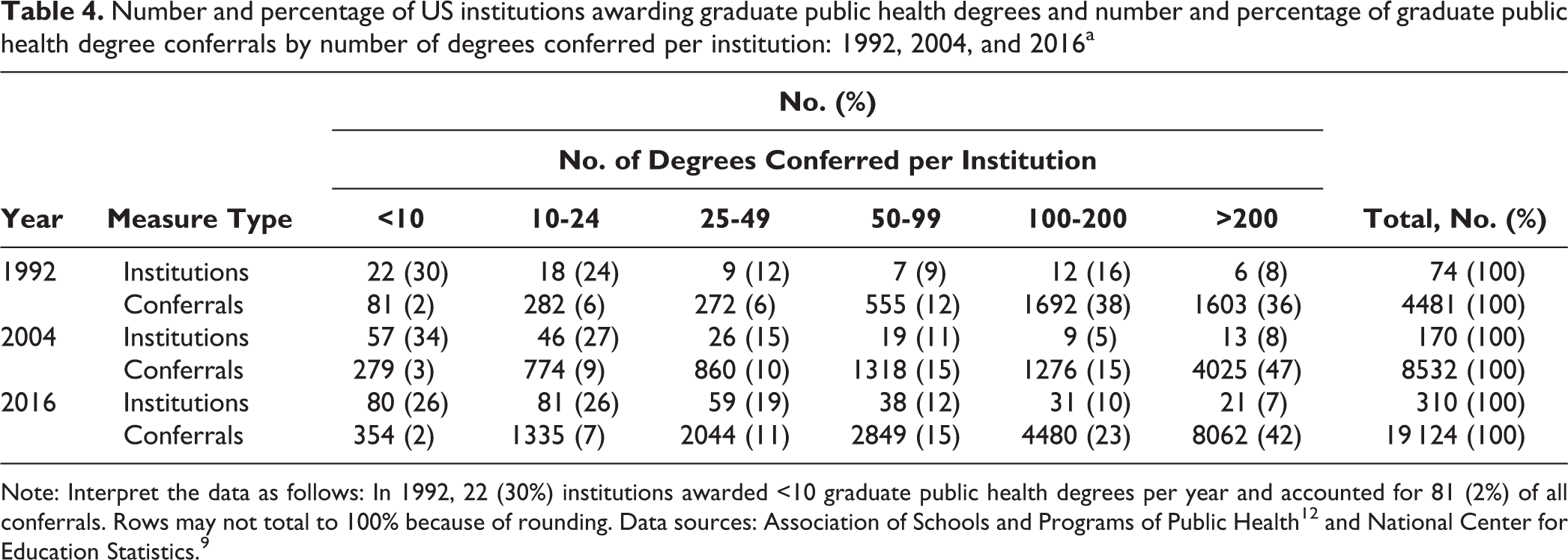
Note: Interpret the data as follows: In 1992, 22 (30%) institutions awarded <10 graduate public health degrees per year and accounted for 81 (2%) of all conferrals. Rows may not total to 100% because of rounding. Data sources: Association of Schools and Programs of Public Health 12 and National Center for Education Statistics. 9
Discussion
To our knowledge, this study presents the first estimates of total US public health degree conferrals at the master’s and doctoral levels for 1992-2016. The composite estimate using ASPPH and NCES data illustrates the breadth and depth of graduate-level public health education. Although either data set might sufficiently indicate growth on its own, a composite estimate gives a rich scope and scale of the trends in public health graduate education nationwide, across ASPPH members and nonmembers, among CEPH-accredited and nonaccredited institutions, and among those that offer other health programs within a public health context. Our characterization of graduate education in public health as a lens into the workforce pipeline will inform strategies to address workforce needs. The timing is critical; a recent report indicated that the US governmental public health workforce is on the verge of a mass retirement, and many public health workers are interested in leaving government for a more competitive salary in the private sector. 14
The number of public health degree conferrals increased more than 300% from 1992 to 2016, ranking public health as having the fifth-highest increase in conferrals among other graduate fields of study that had more than 500 degree conferrals in 1992. 9 The number of institutions offering graduate-level public health degrees also quadrupled during that period. This growth may partially be a response to students’ interest in health and wellness and public health’s “do good” appeal. 15
CEPH-accredited schools and programs of public health conferred most of the public health graduate degrees in the United States during the study period, although the proportion decreased slightly during the past 2 decades. This proportion reflects the influx of new institutions offering public health degrees, some of which may be seeking CEPH accreditation. As of August 2017, 30 institutions were in applicant status with CEPH at the school or program of public health level to accredit new graduate-level degrees. In 2016, these institutions conferred 366 public health degrees (2% of total).
Our data indicate that the proportion of MPH degrees conferred, compared with the proportion of all graduate-level public health degrees conferred, has been consistently high over time, showing that the MPH degree continues to be the predominant degree of interest by public health graduates. These data also show that during the past 2 decades, the number of conferred degrees categorized as general public health rose, the number of conferred degrees concentrated in the public health core sciences (epidemiology, environmental sciences, and biostatistics) was consistent, and the number of conferred degrees in “other” public health areas decreased. One possibility for the increase in general public health degree conferrals is that this degree may be the only public health degree when a graduate public health program is established.
The demographic characteristics of public health are also changing. According to ASPPH-member data, the proportion of women earning public health degrees was approximately 28% in 1961. 16 By 1979, most (51%) public health degrees were conferred to women; by 1992, that proportion increased to 63%. According to ASPPH-member data, the trend toward increased representation from nonwhite graduates as a percentage of total public health degree conferrals began around 1980 (Figure 3).
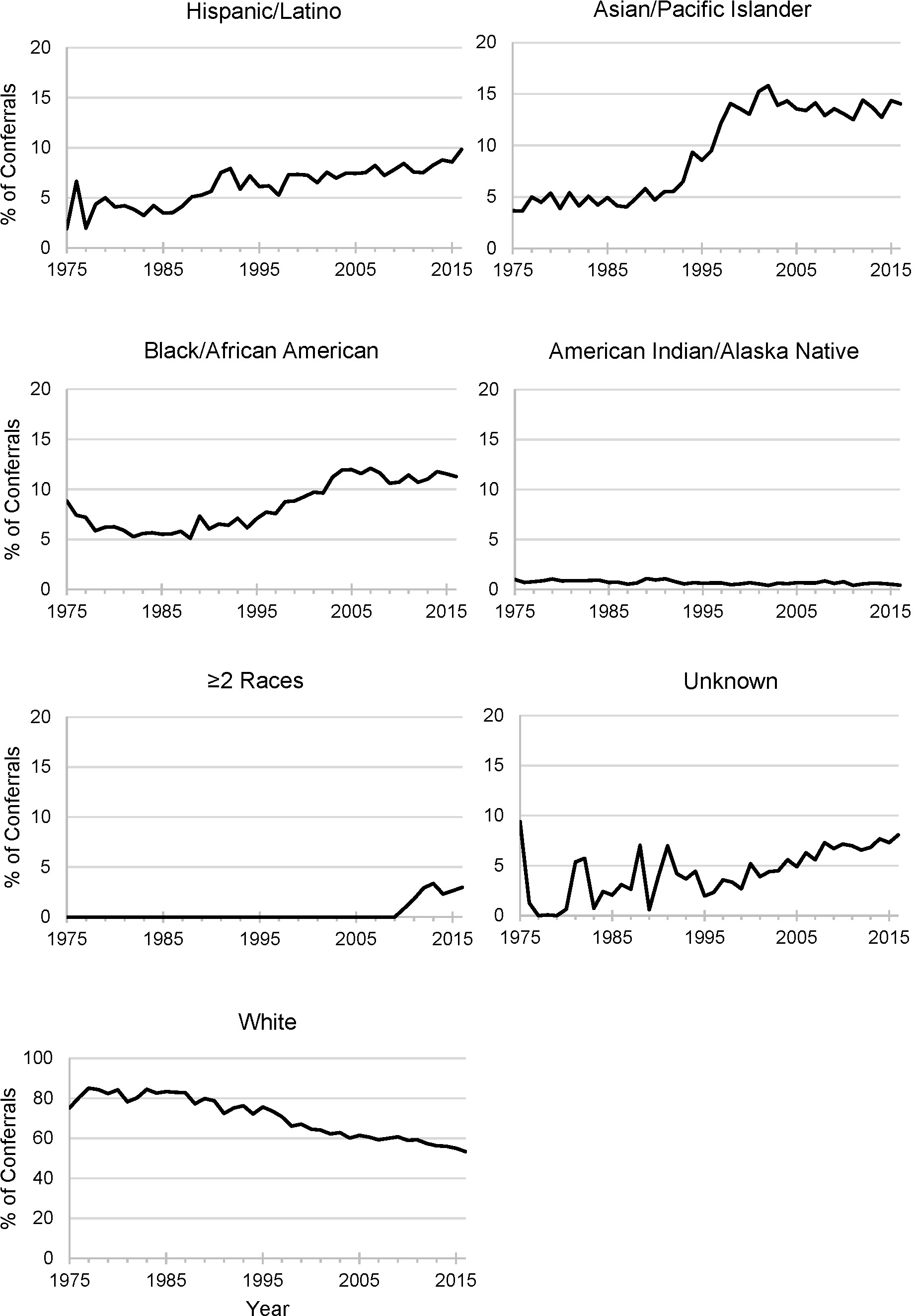
Proportion of graduate public health degree conferrals for US citizens, by recipient’s race/ethnicity, 1975-2016. Data source: Association of Schools and Programs of Public Health. 12
A 2011 article by Rosenstock et al 17 notes that whereas public health students more than 50 years ago were mostly “white physician(s) or nurse(s) who pursued an MPH in order to practice at a health department or other similar setting,” today’s students are “younger, with less work experience, and [are] more varied in the academic disciplines and the perspectives they bring to the profession.” With an increase in the number of underrepresented racial/ethnic minority graduates in public health, it is “hoped that…the number of minority public health practitioners will help the discipline to be better able to respond to the needs of minority populations.” 16 Furthermore, although public health has made strides in racial/ethnic diversity, diversity initiatives must continue.
In addition to increases in graduate public health degree conferrals and institutions offering public health graduate programs, public health education is undergoing substantial changes due to “unprecedented upheavals both in health and in higher education.” 18 In response to these changes, ASPPH released its report, Framing the Future: The Second Hundred Years of Education for Public Health, in 2015. Released 100 years after the Welch-Rose Report, the framework provides “actionable guidelines designed to stimulate positive change for improving education in public health.” CEPH considered these recommendations during its 2016 criteria revisions. 19 The frameworks and criteria revisions were designed to ensure that public health students gain the competencies necessary for the 21st-century workforce, and that as institutions respond to them, future analyses on graduate degree conferrals will identify trends for this continually changing and dynamic field.
Limitations and Interdataset Comparisons
This study had several limitations. The quality of estimates depends on reports from an institution’s registrar, and some degrees may have been misclassified. Inaccuracies may also result if an institution reports data inconsistently or stops reporting for any period of time. These inaccuracies were observed and corrected in at least one large school of public health while data were being prepared for this article, and they provided one of the reasons for using a composite measure of ASPPH and NCES data.
In addition, ASPPH and NCES data sets differed in the number of graduate public health degree conferrals reported to each entity. A sensitivity analysis using 2015 data found that of the 84 ASPPH reporting members, 64 had graduate public health degree conferrals in the NCES data. Of these 64 institutions, 15 reported the number of graduates to ASPPH within 5% of the number of graduates reported to NCES, 4 reported 5.1%-30% more graduates to ASPPH than to NCES, and 10 reported >30% more graduates to ASPPH than to NCES; the remaining 35 institutions reported >5% more graduates to NCES than to ASPPH.
The reason for these differences, especially where ASPPH estimates were larger than NCES estimates, is unclear and warrants further research. One difference may be related to who is reporting the information. For example, the data reported to NCES may have come from an institution’s registrar, whereas the data reported to ASPPH came directly from the school or program of public health. It is also plausible that ASPPH members reported certain degrees to ASPPH under ASPPH-designated codes of “public health other” or “general,” whereas these degrees may fall under various CIP codes in NCES that are not specifically public health.
Conclusion
Estimating and characterizing the pipeline to the public health workforce through graduate public health education are important given changing workforce needs. As evidenced by data from ASPPH and NCES, US institutions have awarded 247 909 master’s and doctoral public health degrees during the past 2 decades, and more than 4 times the number of degrees were awarded in 2016 than in 1992. Given the availability of data on the number of graduate public health degrees conferred, assessing graduates’ career paths would benefit both academic public health and the workforce. This information would further contribute to future workforce estimates and inform the work on a fieldwide public health taxonomy used to guide standardization and specificity of academic and workforce data.
Footnotes
Declaration of Conflicting Interests
The authors declared the following potential conflict of interest with respect to the research, authorship, and or/publication of this article: Dr Leider was a consultant to the de Beaumont Foundation.
Funding
The authors received no financial support for the research, authorship, and/or publication of this article.