




Abstract
The US Food and Drug Administration has announced that it is considering lowering nicotine levels in cigarettes to “minimally addictive or nonaddictive levels.” This could be a transformative public health measure, but the tobacco industry is likely to challenge such an action in court. This article reviews some of the key legal arguments that industry is likely to advance and considers possible responses. As we demonstrate, there are strong arguments that the US Food and Drug Administration has the authority to implement a policy to reduce nicotine in cigarettes to nonaddictive levels.
In July 2017, US Food and Drug Administration (FDA) Commissioner Scott Gottlieb shook the tobacco industry—and surprised the public health world—by announcing that the FDA was considering lowering nicotine levels in cigarettes to “minimally addictive or nonaddictive levels” while also encouraging new product innovation. 1 In the immediate aftermath of this announcement, stock prices of the major US cigarette companies plummeted, losing $60 billion in market capitalization within hours. 2 The reason for Wall Street’s panic is obvious: nicotine is what makes cigarettes powerfully addictive. For decades, cigarette companies have carefully manipulated nicotine levels in cigarettes to maximally “create and sustain addiction.” 3 Reducing nicotine in cigarettes to nonaddictive levels could “help current users of combustible cigarettes to quit and allow most future users to avoid becoming addicted.” 1 This policy change could literally save millions of lives while also threatening the core business of the tobacco industry. 4
Recognizing the threat, tobacco company executives have sought to persuade investors that the FDA lacks the legal authority to follow through on reducing nicotine levels in cigarettes. 5 Indeed, there is little doubt that tobacco companies will challenge any final FDA rule in court, and the industry is likely to advance several legal arguments (Table). However, as we show in this article, strong arguments support the FDA’s authority to implement a policy to reduce nicotine in cigarettes to nonaddictive levels.
Anticipated industry legal arguments against an FDA product standard that mandates a reduction in nicotine to minimally addictive or nonaddictive levels and possible responses
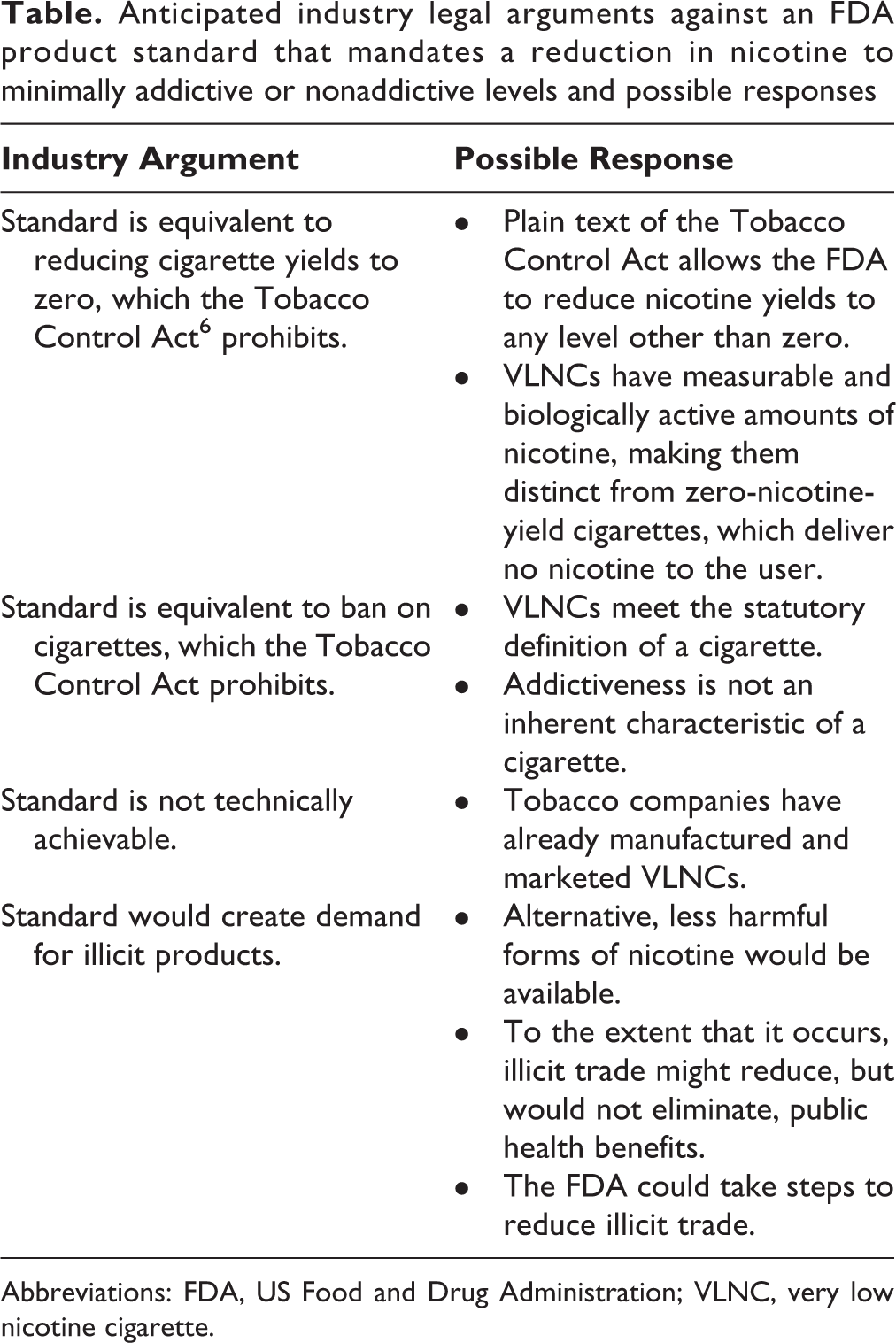
Abbreviations: FDA, US Food and Drug Administration; VLNC, very low nicotine cigarette.
The Tobacco Control Act
The 2009 Family Smoking Prevention and Tobacco Control Act (hereinafter, “Tobacco Control Act” or “Act”) provided the FDA with broad authority to regulate the manufacture, marketing, and distribution of tobacco products. 6 Section 907 of the Tobacco Control Act authorizes the FDA to issue “product standards . . . respecting the construction, components, ingredients, additives, constituents, . . . and properties,” including the “nicotine yields,” of any tobacco product. 6 A product standard for lowering nicotine levels to minimally addictive or nonaddictive levels would likely follow the World Health Organization’s recommendation to allow no more than 0.4 mg/g of nicotine in the tobacco in the cigarette filler—a more than 95% reduction from current levels. 7
To issue such a product standard, the FDA must establish that the standard is “appropriate for the protection of public health.” 6 Importantly, the Tobacco Control Act includes 2 explicit limitations on the FDA’s authority to issue product standards. It states that the FDA cannot issue a rule “requiring the reduction of nicotine yields of a tobacco product to zero” or “banning all cigarettes,” “[b]ecause of the importance” of such policy decisions. 6 The FDA must also consider any information submitted by tobacco companies (or others) relating to the proposed standard’s “technical achievability” and any “countervailing effects of the tobacco product standard . . . such as the creation of a significant demand for contraband.” 6
For the reasons explained later in this article, none of these limits on the FDA’s authority should pose an obstacle to the FDA issuing a product standard that lowers nicotine levels to minimally addictive or nonaddictive levels, such as the level recommended by the World Health Organization. Moreover, it is important to note that courts generally defer to the FDA’s interpretation of governing statutes, as long as the FDA’s position is “reasonable”—which an interpretation permitting a product standard that reduces nicotine to nonaddictive levels almost certainly is. 8,9
A Low-Nicotine Standard Is Not Equivalent to Reducing Yields to Zero
One likely objection to the FDA’s plans to reduce nicotine in cigarettes to nonaddictive levels is that such a policy would be equivalent to reducing nicotine yields to zero. For example, in a recent presentation to investors, Altria’s General Counsel argued that because the Tobacco Control Act prohibits the FDA from reducing nicotine yields to zero, the FDA also cannot reduce nicotine levels “to an amount that is functionally no different from zero, such as when the nicotine is in such small amounts that it has no physiological impact.” 5
This argument is flawed in at least 2 respects. First, and most importantly, the argument is not supported by the plain language of the text. The Tobacco Control Act is clear that with respect to nicotine levels, the only thing the FDA is prohibited from doing is “requiring the reduction of nicotine yields of a tobacco product to zero.” 6 As the Supreme Court has repeatedly said, evaluation of a law’s meaning “begins with the statutory text” and, when the meaning is apparent, it “ends there as well.” 10 Even if one were to examine the legislative history, it is notable that even opponents of the Tobacco Control Act read this restriction literally. In opposing the Act, Representative Michael Burgess (R-TX) stated, “Under the bill language . . . the FDA could take nicotine levels down to 0.00000001—or any number just short of absolutely zero milligrams of nicotine—but the FDA cannot take the level of nicotine all the way to zero.” 11 Although he thought such a regulatory scheme was nonsensical, he acknowledged that this was the rule provided for in the Act.
Second, as a matter of science, arguments that very low nicotine cigarettes (VLNCs) have no physiological impact, or cannot be distinguished from zero-nicotine-yield cigarettes (ie, cigarettes that deliver no nicotine to the user), are incorrect. Although a nicotine product standard would mandate a dramatic reduction in nicotine levels, the remaining nicotine would still have physiological effects, making VLNCs distinct from zero-nicotine-yield cigarettes. For example, a study using cigarettes with the World Health Organization–recommended 0.4 mg/g of nicotine still found that such cigarettes resulted in substantial occupancy of the nicotinic receptors in the brain and reduced cravings, and they produced a small but distinct increase in plasma nicotine level. 12 In other studies, VLNCs showed reliably consistent, measurable levels of nicotine in both the product itself and in its smoke, demonstrating that VLNCs are not equivalent to zero-nicotine-yield cigarettes. 13,14
A Low-Nicotine Standard Is Not Equivalent to a Cigarette Ban
Another likely objection to a nicotine product standard is that, because VLNCs are not a product that consumers would find acceptable, such a product standard would be tantamount to a ban on cigarettes, which is something the FDA cannot do. This argument, of course, depends on how a cigarette is defined and, again, is undercut by the plain language of the Tobacco Control Act. Under the Act, a cigarette is defined (in part) as “any roll of tobacco wrapped in paper or in any substance not containing tobacco.” 6 This definition, which does not depend on nicotine content or consumer acceptability, makes clear that a nicotine product standard would still allow for the sale of “cigarettes.”
Moreover, a voluminous—and perhaps surprising—body of research suggests that VLNCs or fully denicotinized cigarettes (ie, cigarettes that have no nicotine) help to satisfy cigarette cravings and other withdrawal symptoms, “often to a comparable degree as regular cigarettes.” 12,15 –18 Although some participants in studies with VLNCs fail to completely comply with smoking only the study cigarettes, 19 in a study by Donny et al, 17 80% of current cigarette smokers randomly assigned to use VLNCs continued to smoke throughout the study period, though at a generally lower level than those smoking conventional cigarettes. Although this finding is potentially challenging in terms of the likely public health benefits of lowering nicotine levels in cigarettes, it suggests that nicotine consumption is not the only reason people smoke cigarettes and that VLNCs should be viewed as (somewhat less satisfying) cigarettes rather than another product entirely.
Furthermore, even if current smokers did not find VLNCs to be an acceptable alternative to conventional cigarettes, it would not mean that VLNCs are not cigarettes. Although in a different legal context, this point was recently addressed by the Supreme Judicial Court of Massachusetts in Evans v Lorillard Tobacco Co. 20 In Evans, Lorillard argued that cigarettes with nonaddictive levels of nicotine could not be considered a “feasible alternative design” because “addictive levels of nicotine . . . are inherent in all ordinary cigarettes” and VLNCs would not be “an acceptable substitute to ordinary smokers.” 20 That is, nonaddictive cigarettes are not really “cigarettes” because of their lack of consumer appeal. But as the court noted, this logic is fatally flawed. VLNCs may not be an acceptable alternative to current smokers, but that is because current smokers are already addicted to nicotine, not because VLNCs are not cigarettes. As the court wrote, whether or not a VLNC is a reasonable alternative to a conventional cigarette must be determined from the perspective of a consumer “whose freedom of choice is not substantially impaired by addiction.” 20 Otherwise, any manufacturer could make its product addictive and then argue that nonaddictive alternatives were not acceptable to consumers.
That cigarette companies currently sell a highly addictive product does not give them an inalienable right to their current consumer base. If fewer people buy cigarettes with lower nicotine levels, that would prove only that cigarettes are a less attractive product in the absence of addictive levels of nicotine—not that addictiveness is the inherent essence of a cigarette.
A Low-Nicotine Standard Is Technically Achievable and Any Unintended Consequences Can Be Mitigated
The Tobacco Control Act requires that the FDA “consider information submitted in connection with a proposed standard” relating to “technical achievability” and possible “countervailing effects of the tobacco product standard on the health of adolescent tobacco users, adult tobacco users, or nontobacco users, such as the creation of a significant demand for contraband.” This information must be considered by the FDA, but importantly, this requirement does not alter the fundamental legal requirement that its decisions must ultimately be based on what is “appropriate for the protection of the public health.” 6
Although companies might argue that a low-nicotine standard is not “technically achievable,” it is clear that this contention is not true. VLNCs have been marketed intermittently by tobacco companies since the 1980s, starting with Philip Morris’s “Next” brand. 21 All such products have been commercial flops, which is not surprising when cigarettes with much higher nicotine content are available on the market. But the technology to remove nicotine from cigarettes has been known since the 1940s; indeed, such technology has been used for decades to “precisely control nicotine delivery levels and provide doses of nicotine sufficient to create and sustain addiction.” 3
Altria has argued that for a product standard to be “technically achievable,” it must “allow manufacturers to make cigarettes that are sensorially acceptable to adult smokers.” 5 But, like the arguments that VLNCs are not cigarettes, this argument is a transparent attempt to move the goalposts. The Act contains no such requirement; to the contrary, it specifically allows the FDA to reduce nicotine yields, which would invariably make cigarettes less attractive to current smokers. Critically, reducing nicotine levels by a lesser amount would be counterproductive from a public health standpoint, because it would risk prompting compensatory smoking (ie, smoking more to extract similar levels of nicotine from the cigarettes). Compensatory smoking is what happened with so-called “light” cigarettes, which did not in fact reduce nicotine delivery to smokers as purported by their advertising. 22 In contrast, research suggests that VLNCs do not induce compensatory smoking and instead prompt current smokers to reduce their consumption. 7
Reduced acceptability of VLNCs is potentially relevant to the “creation of a significant demand for contraband.” 6 The tobacco industry will undoubtedly suggest that a nicotine product standard will lead to the emergence of a massive black market. The industry regularly uses this standard argument to oppose any aggressive tobacco control measures. 23,24 The FDA is already trying to preempt this argument by noting that it wants to ensure that other, less harmful forms of nicotine delivery are readily available to current smokers before it finalizes a nicotine product standard. 1
To the extent that any black market does develop, it may reduce, but likely would not eliminate, the benefits of a nicotine product standard. 25 And as is true in other contexts, just because the FDA cannot ensure that the law is never violated does not mean that it should not act to protect public health. Charlatans continue to sell fake cures for all sorts of diseases on the internet, but that does not mean that the FDA should stop enforcing its premarket approval requirements for drugs. Additionally, the FDA could take various steps to address illicit cigarette sales, including using its authority under Section 920 of the Act to implement a track-and-trace program that could use a unique identifier or computer chip to track each cigarette pack through the entire distribution process. 26
Conclusion
In March 2018, FDA scientists published the results of a simulation model estimating the potential effects of a product standard that would reduce nicotine in cigarettes (and other combustible tobacco products) to minimally addictive levels. They estimated that such a rule would lead 13 million current smokers to successfully quit within 5 years, prevent millions more from starting to smoke, and lower the US smoking rate to 1.4% by 2060. 4
Such projections make it clear why the tobacco industry can be expected to vigorously oppose any such product standard. But as outlined previously, we believe the FDA stands on solid legal ground. A product standard allowing the sale of only VLNCs would be supported by both the plain text of the Tobacco Control Act and the Act’s public health purpose. Nonetheless, as it prepares to move forward with a rule, the FDA also needs to anticipate the likely legal response and carefully prepare its legal arguments.
Footnotes
Declaration of Conflicting Interests
The authors declared the following potential conflicts of interest with respect to the research, authorship, and/or publication of this article: Micah L. Berman was a senior advisor to the US Food and Drug Administration (FDA) Center for Tobacco Products from 2011 to 2012. Patricia J. Zettler served as an attorney in the FDA’s Office of the Chief Counsel from 2009 to 2013. Before his retirement in June 2017, David L. Ashley was employed as director, Office of Science, FDA Center for Tobacco Products.
Funding
The authors disclosed receipt of the following financial support for the research, authorship, and/or publication of this article: Micah L. Berman’s work on this project was supported by the National Cancer Institute of the National Institutes of Health (NIH) under award number K07CA197221. David L. Ashley’s work on this project was supported by grant number P50DA036128 from the NIH, the National Institute of Drug Abuse, and the FDA Center for Tobacco Products. The content of this article is solely the responsibility of the authors and does not necessarily represent the official views of the NIH or the FDA.