




Abstract
Objectives:
Although a range of factors shapes health and well-being, institutionalized racism (societal allocation of privilege based on race) plays an important role in generating inequities by race. The goal of this analysis was to review the contemporary peer-reviewed public health literature from 2002-2015 to determine whether the concept of institutionalized racism was named (ie, explicitly mentioned) and whether it was a core concept in the article.
Methods:
We used a systematic literature review methodology to find articles from the top 50 highest-impact journals in each of 6 categories (249 journals in total) that most closely represented the public health field, were published during 2002-2015, were US focused, were indexed in PubMed/MEDLINE and/or Ovid/MEDLINE, and mentioned terms relating to institutionalized racism in their titles or abstracts. We analyzed the content of these articles for the use of related terms and concepts.
Results:
We found only 25 articles that named institutionalized racism in the title or abstract among all articles published in the public health literature during 2002-2015 in the 50 highest-impact journals and 6 categories representing the public health field in the United States. Institutionalized racism was a core concept in 16 of the 25 articles.
Conclusions:
Although institutionalized racism is recognized as a fundamental cause of health inequities, it was not often explicitly named in the titles or abstracts of articles published in the public health literature during 2002-2015. Our results highlight the need to explicitly name institutionalized racism in articles in the public health literature and to make it a central concept in inequities research. More public health research on institutionalized racism could help efforts to overcome its substantial, longstanding effects on health and well-being.
Keywords
Although overall health in the United States has improved dramatically during the past century, longstanding racial/ethnic disparities in health (ie, preventable differences in the burden of disease, injury, violence, or opportunities to achieve optimal health) persist. 1 For decades, the public health community has focused attention on eliminating health disparities. 2 However, a recent shift to understand the determinants of health equity has led to a change from the language of health disparities to that of health inequities. Health inequities are systematic, socially produced, and unjust differences in health that could be avoided by reasonable means. 3 Goldberg 4 described an “inescapable ethical valence” in the term health inequities that is absent from the term disparities. This ethical valence is necessary for understanding the role that institutionalized racism (societal allocation of privilege based on race) plays in contributing to unjust health outcomes. Although a range of factors shapes health and well-being, racism plays a crucial role in generating inequities by race. 5 During the past 20 years, research documenting racism and health inequities has grown. 6 Additionally, the call to discuss racism and health—rather than race and health—is becoming more pronounced. 7 –9
Racism occurs at the institutional, interpersonal, and internal levels. 10 Much of the public health literature on racism has focused on understanding the impact of interpersonal racism and documenting individual experiences of perceived discrimination or implicit biases based on race. 11 Although this contribution is important, our understanding of how racism functions at an institutional level—in our structures, institutions, policies, and practices—is nascent as it relates to individual and population health. 9,12
Awareness of the need for the public health field to address institutionalized racism is growing. Institutionalized racism is defined as the macrolevel systems, social forces, institutions, ideologies, and processes that interact with one another to generate and reinforce inequities among racial/ethnic groups. 13 Most notably, the American Public Health Association’s immediate past president, Dr Camara Jones, launched a national campaign against racism in 2015 in which she posited that racism is a “system of structuring opportunities and assigning value based on the social interpretation of how one looks (which is what we call ‘race’).” 7 Her conceptualization acknowledges the institutional manifestations of racism, not just the interpersonal or internal manifestations. Outside of traditional public health discourse, the concept and effects of institutionalized racism have been magnified by multiple police shootings of unarmed black men. The subsequent formation of activist movements such as Black Lives Matter calls attention to the role that institutions (eg, law enforcement) play in underresourced communities of color. 14 These movements amplify the often marginalized voices of those who have experienced the negative health impacts of institutionalized racism. 15 Yet, even as institutionalized racism and its effects are increasingly present in the news, television, and social media, whether the public health research community is explicitly mentioning institutionalized racism in published research is unclear. 14,16
Fifteen years ago, in her article “Confronting Institutionalized Racism,” Jones 17 challenged the public health community to conduct research that confronts racism directly. Although her article was not the first of its kind in public health, or by the author, this work served as a clarion call to public health researchers in the 21st century. She outlined 7 challenges for public health scientists to meaningfully address institutionalized racism—the first being to “name racism.” Naming institutionalized racism refers to explicitly and publicly using language and analysis that describes an issue as a matter of racial justice. For Jones, naming institutionalized racism leads to exploring the question, “How is racism operating here?” and subsequently mobilizing for action. 17 Naming institutionalized racism means not simply using race as a descriptor in analyses and manuscripts, but actually naming the underlying processes (ie, racism) that have created differences by race.
Since Jones’s challenge, little has been done to systematically examine whether and how public health scientists have heeded the call to name institutionalized racism in their peer-reviewed publications on racial inequality and disparities. We conducted a systematic review of the contemporary peer-reviewed public health literature to (1) determine whether public health researchers are naming (ie, explicitly mentioning) institutionalized racism in the titles and abstracts of their peer-reviewed publications and (2) explore the depth of discussion on the concept of institutionalized racism when the term was used.
Methods
We used a systematic method to identify and analyze relevant public health literature, including 6 inclusion criteria and a rationale for each criterion (Table 1): the article had to be indexed in Ovid/MEDLINE and/or PubMed/MEDLINE; contain at least 1 of the primary search terms in the title and/or abstract; be published between 2002 and 2015; address the US context; be published in 1 of the 50 highest-impact journals; and be published in any format (ie, original research, commentary, theoretical article). Understanding that the concept of institutionalized racism might be mentioned in various ways, we used the following search terms: “structural racism,” “systemic racism,” “systematic racism,” “institutional racism,” “institutionalized racism,” and “institutionalised racism.” The term had to appear in the title or abstract of the article. PubMed/MEDLINE did not allow the search to identify only references with adjacent 2-word search terms. Articles that included the words of the search terms but not as adjacent 2-word terms were manually excluded for not having the primary search terms as per the criteria of this search.
Inclusion criteria and rationale for a systematic review of articles on institutionalized racism,a United States, 2002-2015
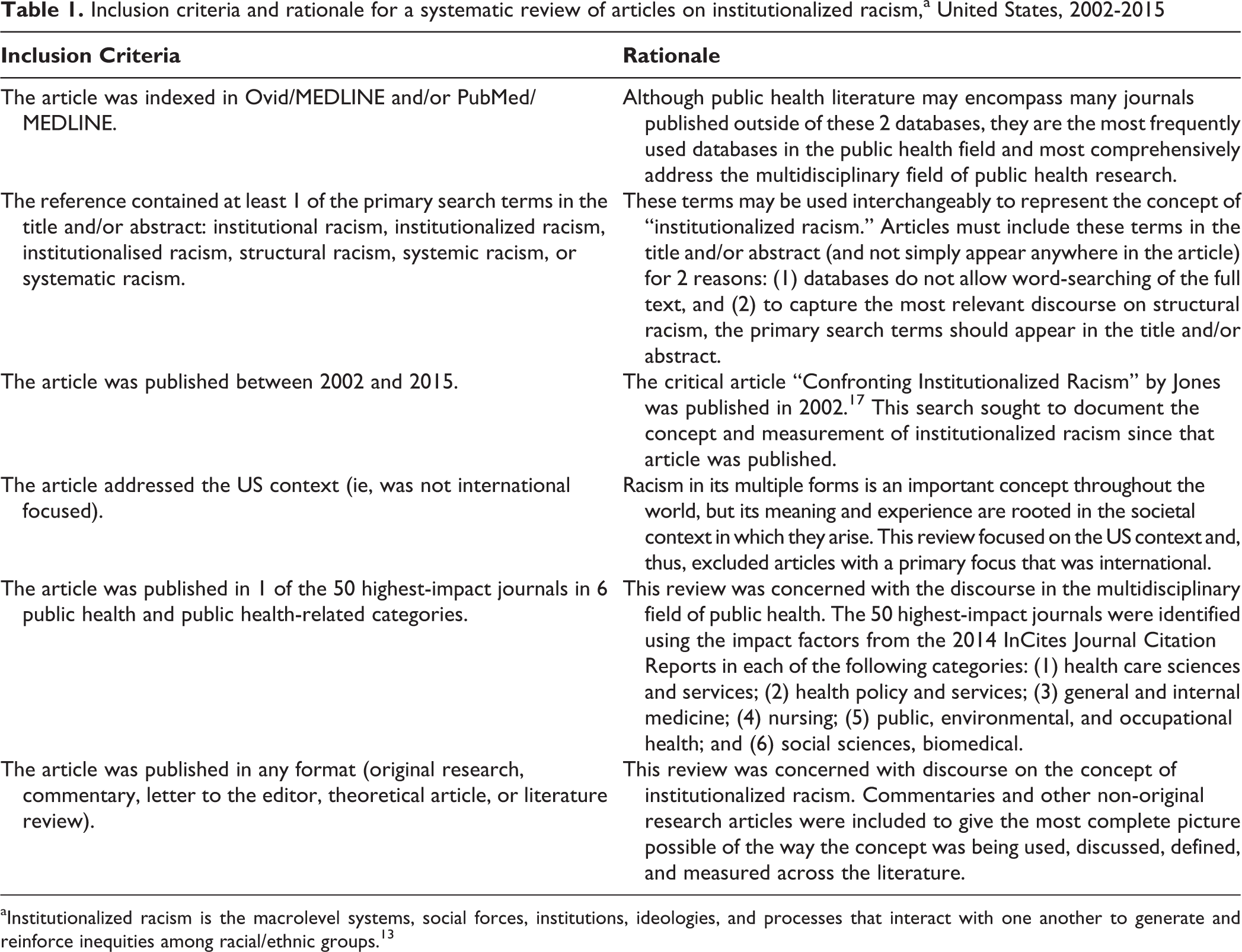
aInstitutionalized racism is the macrolevel systems, social forces, institutions, ideologies, and processes that interact with one another to generate and reinforce inequities among racial/ethnic groups. 13
To most effectively capture the naming of institutionalized racism in the multidisciplinary field of public health, we searched articles from the 50 highest-impact journals in each of 6 categories that most closely represented the public health field and that were indexed in PubMed/MEDLINE and/or Ovid/MEDLINE. We used the most recent (2014) list of categories available from InCites Journal Citation Reports by Thomson Reuters and included the 6 categories that were most representative of the public health literature: (1) health care sciences and services; (2) health policy and services; (3) general and internal medicine ; (4) nursing; (5) public, environmental, and occupational health; and (6) social sciences, biomedical (Table 1). Some journals appeared in more than 1 category, and 1 category had only 38 journals listed. Thus, from the 50 highest-impact journals listed in each of 6 categories, we included articles from a total of 249 journals. (A full list of the 2014 Journal Citation Reports categories and the list of 249 journals included in the 6 categories used for this review are available upon request.)
Abstraction
Once we identified all articles that met all inclusion criteria, we read the full text of each one for use of any of the aforementioned search terms. We recorded which of the 6 search terms were most frequently used in the text of the article. We also recorded the following items for each article: (1) author(s), year of publication, and name of journal; (2) type of article; and (3) use and frequency of the search term used most frequently. We excluded the appearance of search terms in the references section. We used NVivo 10 software for qualitative analysis and coding. 18
Analysis
After coding all articles, we completed a qualitative analysis to determine whether each article explored institutionalized racism as a core concept or secondary concept, which we defined by asking the question, “If all the content on institutionalized racism were removed from the article, would the article still communicate its main message?” If the answer was yes, we coded the article as institutionalized racism as a secondary concept; if the answer was no, we coded the article as institutionalized racism as a core concept. One investigator (K.A.M.) completed this analysis, a second investigator (R.R.H.) reviewed and verified it, and a third investigator (K.B.K.) reconciled conclusions when necessary.
In addition, we tabulated data on the number of articles that met search criteria, journal rank in Journal Citation Reports category, total number of journal citations, and journal impact factor. Because this analysis did not involve human subjects research, institutional review board approval was not required.
Results
We identified 207 articles that met our first 3 inclusion criteria. Of those articles, 97 were indexed in both Ovid/MEDLINE and PubMed/MEDLINE (ie, duplicates). After applying our inclusion criteria, we found that, of the articles published in the 249 highest-impact journals representing the public health field in the United States during the 14-year period, only 25 articles named institutionalized racism explicitly in the title or abstract (Figure 1). Of the 25 articles, 19 were published between 2011 and 2015.
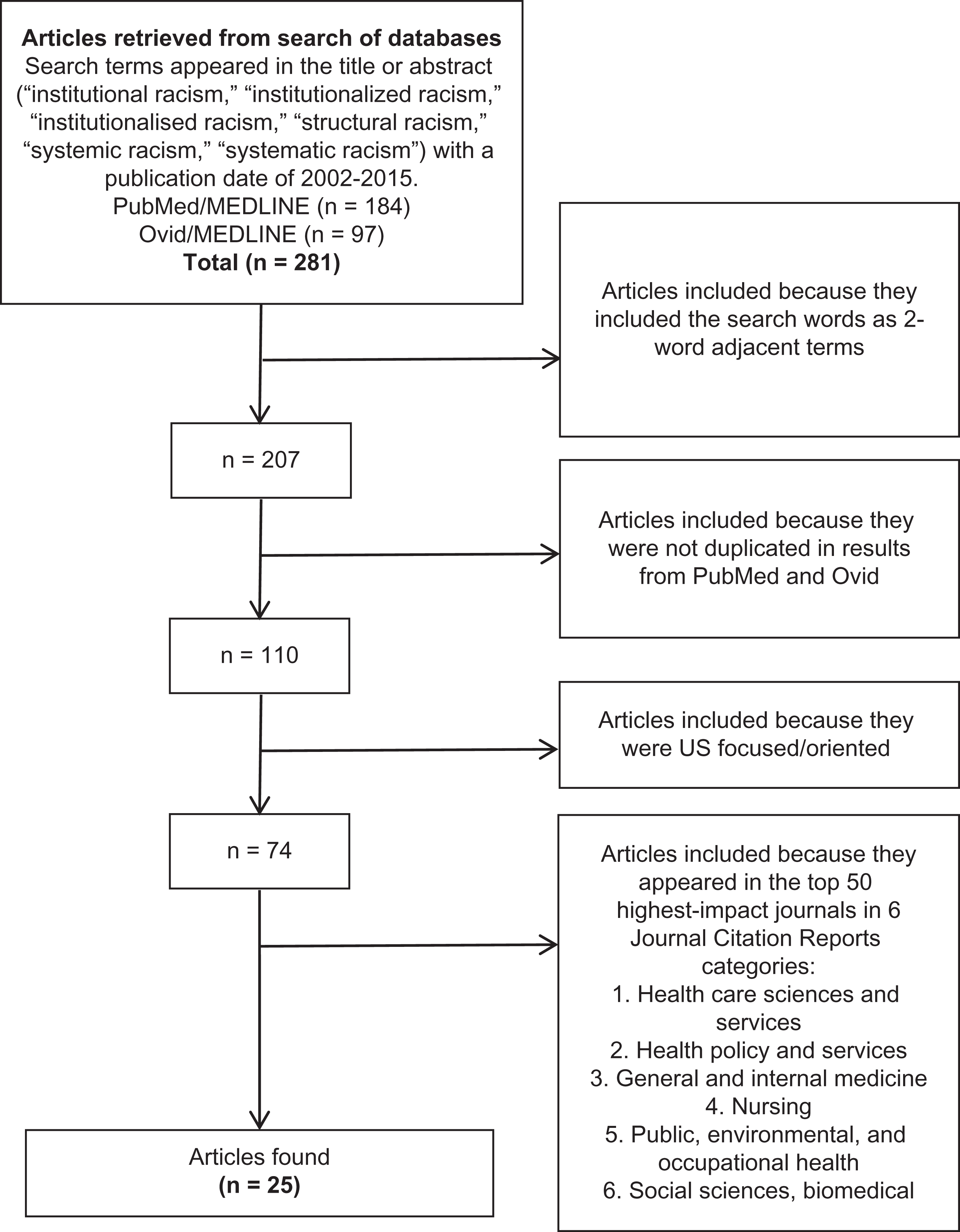
Diagram of methodology and number of articles at each step of the process in a literature review of articles naming (ie, explicitly mentioning) in their title or abstract institutionalized racism, 2002-2015. Institutionalized racism is the macrolevel systems, social forces, institutions, ideologies, and processes that interact with one another to generate and reinforce inequities among racial/ethnic groups. 13 PubMed/MEDLINE did not allow the search to identify only references with adjacent 2-word search terms. Articles that included the words of the search terms but not as adjacent 2-word terms were manually excluded for not having the primary search terms as per the criteria of this search.
Naming Institutionalized Racism
All articles mentioning the term “institutionalised racism” were eventually excluded during application of our fourth inclusion criterion, which required that the study focus on the United States. One article used the terms institutional racism and institutionalized racism twice each, but we coded it as primarily using the term institutionalized racism because that term appeared in the article’s abstract and conclusion. 19 Although the term institutional racism was used in the most articles (n = 15), the term structural racism appeared the most frequently across all articles (n = 181 total occurrences, most of which were in 2 articles 20,21 ) and was the most commonly preferred term (in 12 articles) (Table 2). 15,20,21,25,27,29,30,33,35,39 –41
Type of article, institutionalized racism as a core or secondary topic, and number of search terms in the title or abstract of each included article, United States, 2002-2015
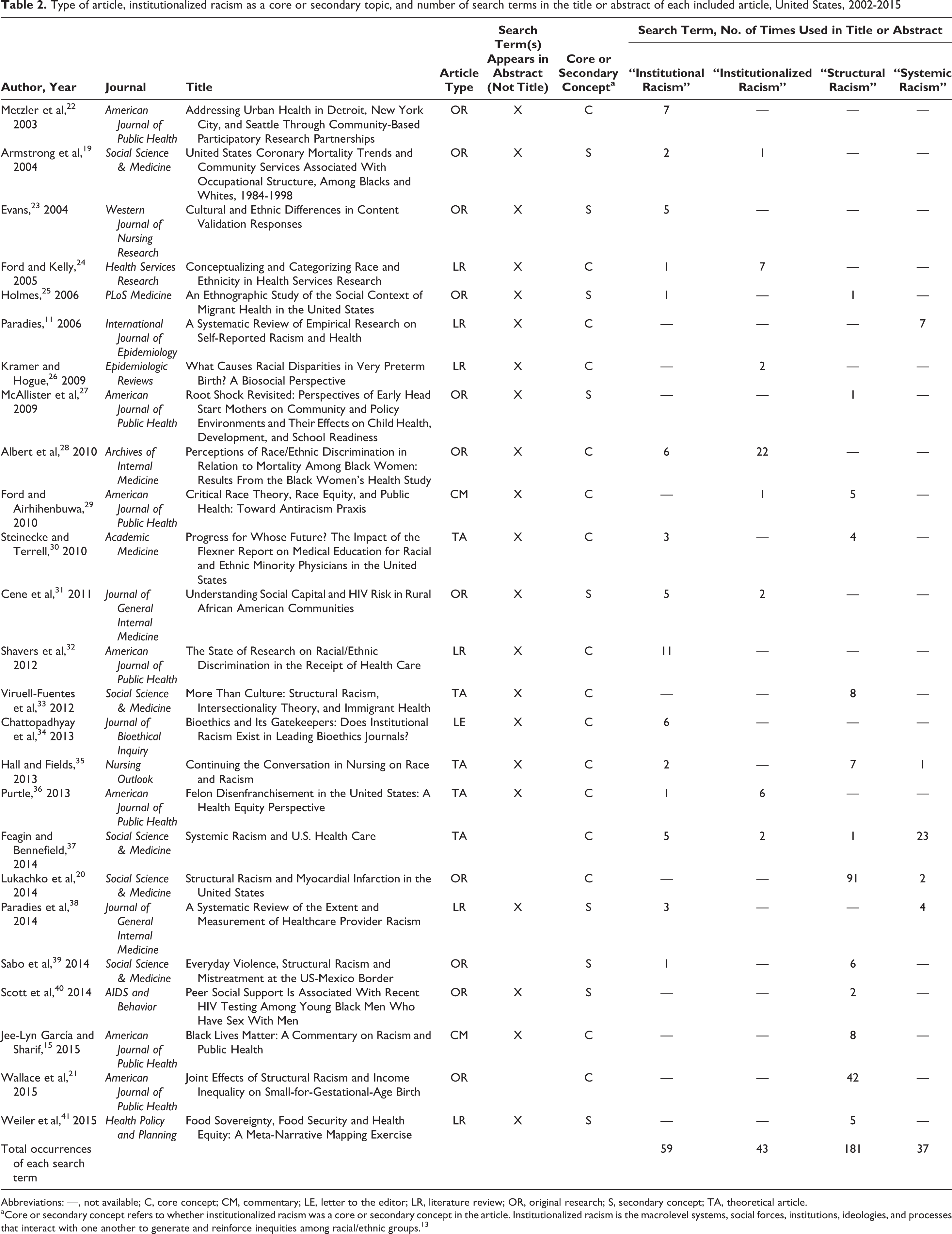
Abbreviations: —, not available; C, core concept; CM, commentary; LE, letter to the editor; LR, literature review; OR, original research; S, secondary concept; TA, theoretical article.
aCore or secondary concept refers to whether institutionalized racism was a core or secondary concept in the article. Institutionalized racism is the macrolevel systems, social forces, institutions, ideologies, and processes that interact with one another to generate and reinforce inequities among racial/ethnic groups. 13
Of the 249 highest-impact journals included in this review, only 14 journals published articles that met our search criteria. Of the 6 Journal Citation Reports categories included in this review, the category with the most included articles was “public, environmental, and occupational health” (n = 15 articles) (Table 3). Twenty-three of the 25 articles were published in journals that were ranked among the top 25 in their respective categories. Two journals that had 1 article each were ranked lower than 25th in their respective categories: Western Journal of Nursing Research (ranked 50th in the nursing category) and Journal of Bioethical Inquiry (ranked 31st in the social sciences, biomedical category).
Rankings of journals in which articles mentioning institutionalized racism in the title or abstract were found, number of articles that met search criteria, number of journal citations, and journal impact factor, by category established by 2014 InCites Journal Citation Reports (JCR), 2002-2015
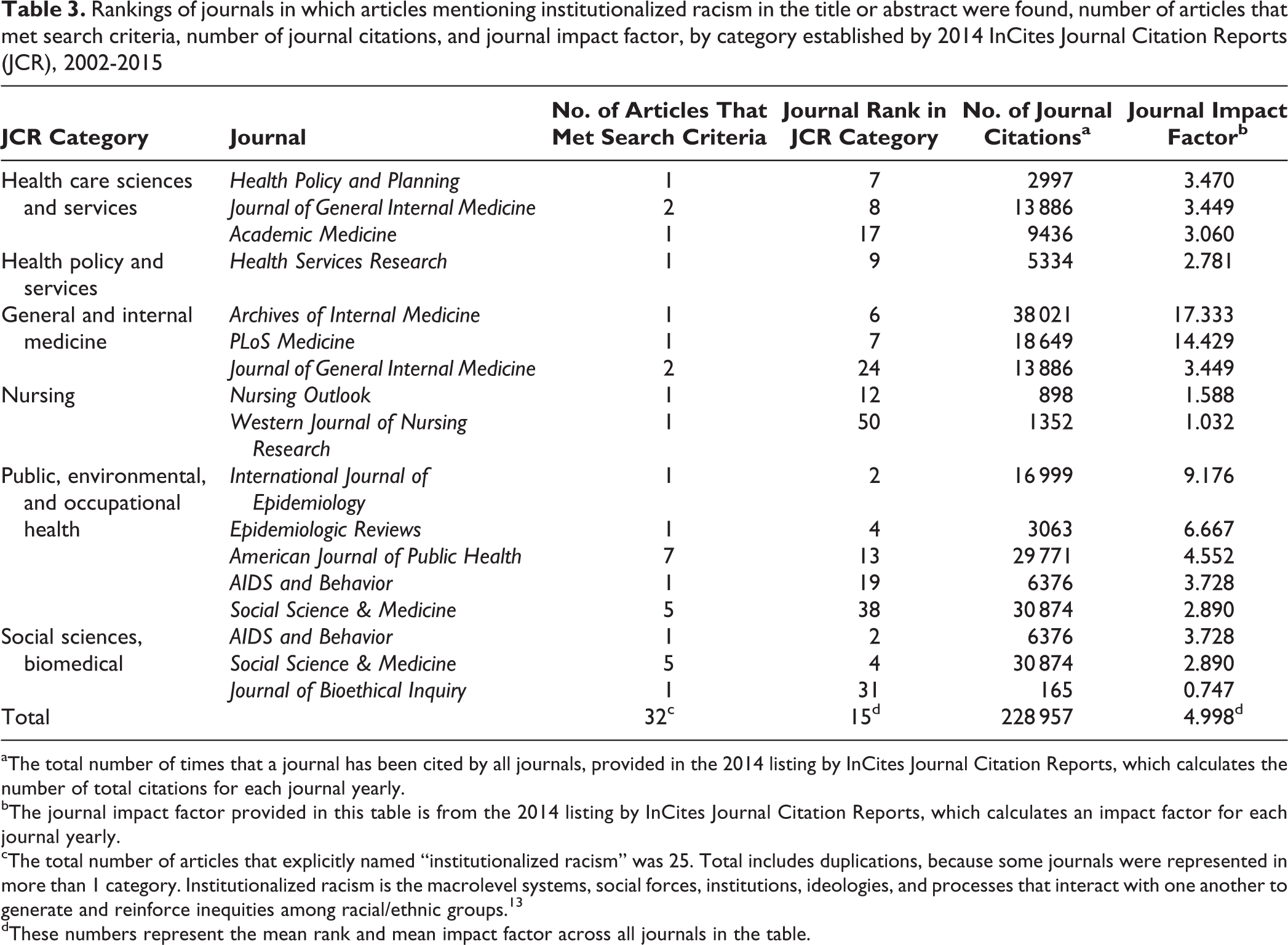
aThe total number of times that a journal has been cited by all journals, provided in the 2014 listing by InCites Journal Citation Reports, which calculates the number of total citations for each journal yearly.
bThe journal impact factor provided in this table is from the 2014 listing by InCites Journal Citation Reports, which calculates an impact factor for each journal yearly.
cThe total number of articles that explicitly named “institutionalized racism” was 25. Total includes duplications, because some journals were represented in more than 1 category. Institutionalized racism is the macrolevel systems, social forces, institutions, ideologies, and processes that interact with one another to generate and reinforce inequities among racial/ethnic groups. 13
dThese numbers represent the mean rank and mean impact factor across all journals in the table.
Included articles comprised 5 types of articles: commentaries (n = 2), original research articles (n = 12), theoretical articles (n = 4), letters to the editor (n = 1), and literature reviews (n = 6) (Table 4). We found that the American Journal of Public Health had both the most articles that named institutionalized racism and the widest range of article types, with 2 commentaries, 3 original research articles, 1 theoretical article, and 1 literature review.
Number of articles mentioning institutionalized racisma in title or abstract in a review of the literature, by type of article, 2002-2015
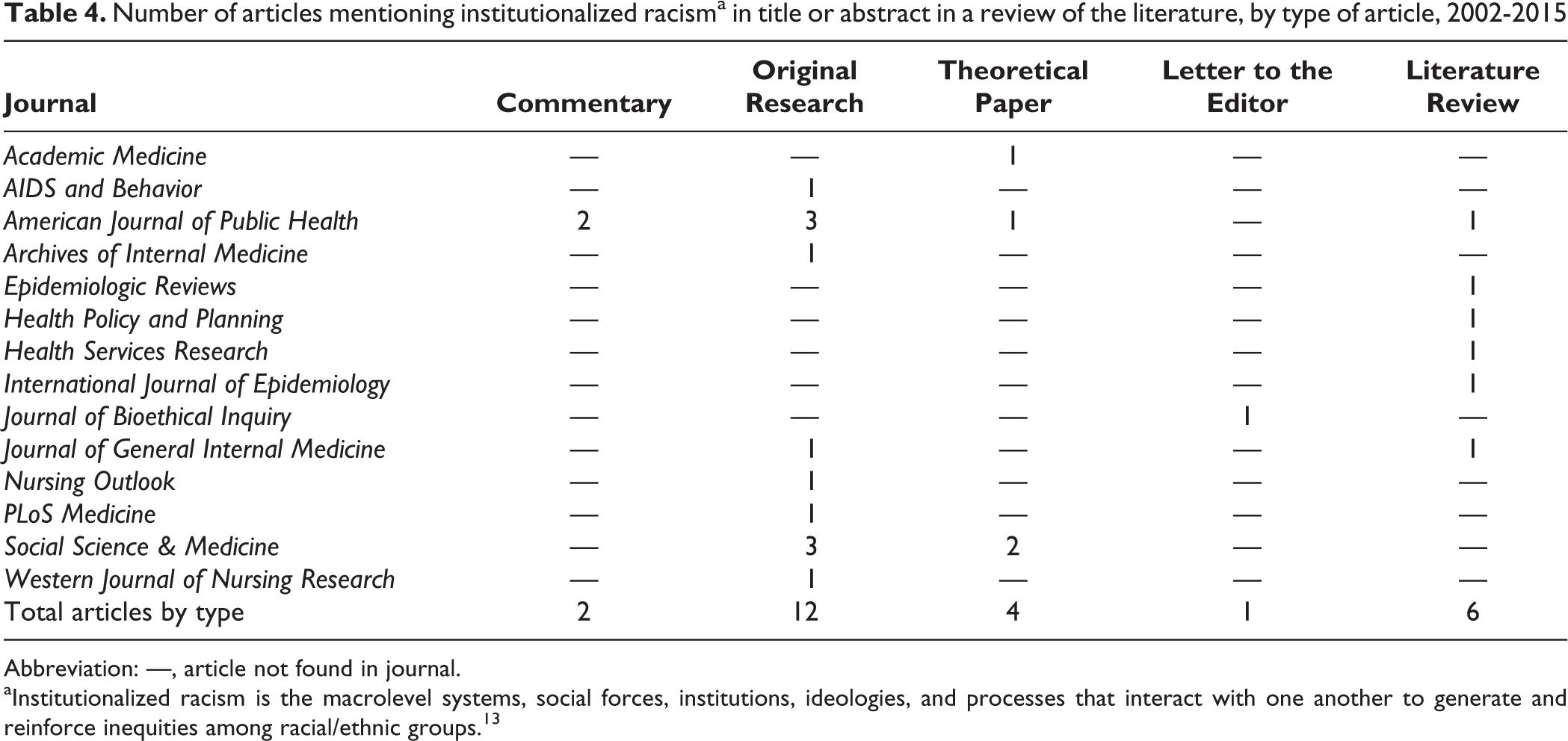
Abbreviation: —, article not found in journal.
aInstitutionalized racism is the macrolevel systems, social forces, institutions, ideologies, and processes that interact with one another to generate and reinforce inequities among racial/ethnic groups. 13
Centrality of Institutionalized Racism
Institutionalized racism was a core concept in 16 of the 25 articles, and these articles included commentaries (n = 2), original research articles (n = 4), theoretical articles (n = 5), letters to the editor (n = 1), and literature reviews (n = 4). 11,15,20 –22,24,26,28 –30,32 –37 The other 9 articles in which institutionalized racism was a secondary concept included 7 original research articles and 2 literature reviews. 19,23,25,27,31,38,39 –41 In general, these articles mentioned the concept in the introduction and/or the discussion section, but the concept was not central to the research question.
Discussion
Despite the 2002 article by Jones, which called for public health researchers to confront institutionalized racism, the number of articles in the contemporary peer-reviewed public health literature that named institutionalized racism in their titles or abstracts from 2002 through 2015 was small. Although researchers may have studied the effects of institutionalized racism by analyzing residential segregation, mass incarceration, housing discrimination, concentrated poverty, and food insecurity, to name a few, during these years, they did not highlight the phrase “institutionalized racism” in the title or abstract of their study.
In the law and justice literature, naming is well understood as vital to the processes of achieving justice. Indeed, naming often results in a critical transformation of the level and type of legal dispute that may occur. Naming is difficult to study empirically, but naming is worthwhile in that it can result in a focus on the level and kind of dispute in a society with an understanding of the initial injury. Felstiner and colleagues 42 used the example of asbestosis, explaining that it became acknowledged as a disease and the basis of a claim for compensation when shipyard workers came to understand and name their condition as a problem. In this vein, if we in the public health field were to name institutionalized racism as a fundamental cause of health inequities, then perhaps we could imagine and work more effectively toward a society in which the initial and ongoing injuries of living by a person of color in America can be better understood.
Dr Jones prioritized naming institutionalized racism because institutional factors perpetuate historical injustices and allow inequities to persist. By naming institutionalized racism explicitly in the peer-reviewed literature, researchers can highlight how injustice and discrimination have been codified, reinforced, and propagated in our health and public health systems. By being explicit about the ways in which some historical and contemporary systems and institutions are designed to alienate or subjugate people of color, 13 we can analyze how these external factors influence both individual behaviors and outcomes as well as population health patterns. Institutionalized racism and its deleterious health consequences have been chronicled and debated in many other disciplines, including but not limited to geography, sociology, African American studies, American Indian studies, and the history of science, which can be of use to public health scholars going forward. 43
To fully understand how institutionalized racism affects health and well-being in the United States, public health scholars must develop and use innovative methods and measures to capture data on the exposure to and health effects of institutionalized racism, think more broadly about disrupting the implicit biases that perpetuate institutionalized racism, and engage with scholarship from other disciplines. Research shows the physiological and public health consequences of interpersonal racism, but little exists in the public health literature about how institutionalized racism influences outcomes. 9
Centering Institutionalized Racism
We found very few explicit uses of the term institutionalized racism, or related terms, in the titles and abstracts of articles in the public health literature. Of the 25 articles we found, only 16 articles included institutionalized racism as a core concept, 4 of which were original research articles. Although our methodology could not measure the full extent of the literature on institutionalized racism as a core concept, this small number of articles suggests a scarcity of original public health research on the topic during 2002-2015.
To heed the call of Dr Jones’s national campaign against racism, public health researchers will need to conduct scholarly work to analyze and evaluate institutionalized racism (as both a primary and a secondary concept) and submit it for publication, and journal editors and peer reviewers should encourage—perhaps even demand—submissions that name institutionalized racism and carefully engage with the concept. If this happens, the number of public health and original research articles that treat institutionalized racism as a determinant of health may grow.
The limited number of original research articles that name institutionalized racism or a similar term in the title or abstract is likely due in part to the complex nature of the concept and a paucity of robust measures of institutionalized racism available in the literature. Because institutionalized racism manifests itself in various structures, policies, and systems, a straightforward way to measure it does not exist. Measuring institutionalized racism in a systematic way is necessary to find solutions to the problem. More public health research on institutionalized racism could help efforts to overcome its substantial, longstanding effects on health and well-being.
Limitations
This review had several limitations. First, we included in our analysis only the highest-impact journals from 6 categories to concentrate on that set of the literature and we excluded international articles and those in lower-impact journals. As a result, relevant articles in lower-impact journals may not have been reviewed for this study. In addition, this review excluded literature that was not published in peer-reviewed journals. As such, we did not include the dialogue on institutionalized racism from community-based, government, nonprofit, or media reports that could inform published public health research. We acknowledge that many scholars have explored how practices and policies, such as redlining and mass incarceration, disproportionately affect populations of color and are influenced by racist ideology, but some of these works might fail to explicitly name institutionalized racism as the overarching mechanism through which these policies are enacted and maintained.
Potentially relevant articles may have been excluded because they did not include search terms in the title or abstract. Also, we may have missed relevant articles that discussed a topic whose underlying cause was related to institutionalized racism (eg, mass incarceration) because the term was not used in the title or abstract. Also, it is possible that other terms were used to represent similar concepts, such as systemic discrimination, structural bias, racism, critical race praxis, and health inequities. These terms might represent the concept of institutionalized racism or closely related concepts but would not have been captured by our study.
Conclusion
This review, although not representative of the entire discourse in public health literature about institutionalized racism, nonetheless highlights how rarely institutionalized racism is named in the titles or abstracts of peer-reviewed, published work. This review adds credence to the call by Dr Jones and others for scholars to identify and name the mechanism through which health injustice is perpetuated and how historical and contemporary policies have negatively targeted and affected underresourced communities of color. 8,9,44
Some public health researchers have mentioned institutionalized racism in their work. 20,28,33,37,41 Others—primarily through commentary and in discussion sections—have begun to identify the mechanisms by which institutionalized racism affects public health. 37 Despite this finding, the literature does not yet adequately engage with this concept, which is central to achieving health equity and improving population health. Much work remains to be done and will require that journals, funders, and peer reviewers support scholarship to explicitly name institutionalized racism. For example, journal editors might sponsor special issues that publish and highlight novel and innovative work that names institutionalized racism. Funders might consider requiring those submitting proposals examining racial disparities to use a public health critical race praxis 29 methodology or include a section that asks the researchers to describe how they will define and measure their race variable(s).
We hope that this initial review will result in future studies that more deeply review the public health literature in response to Jones’s call to action. We also hope that this review will lead to further integration of the law and justice framework for naming to further our understanding of the use of naming institutionalized racism. Finally, future research might include qualitative studies aimed at capturing information on the experience of communities in which institutionalized racism affects their health and well-being. Although institutionalized racism has begun to be named in commentary pieces, empirical work, especially original research, that explicitly names the term in the title or abstract needs to increase. 8,43 Words have power, and being explicit about naming this critical construct may move the field forward in important ways.
Footnotes
Acknowledgment
The authors thank Margaret Hicken, PhD, for her thoughtful feedback on early drafts of this article.
Declaration of Conflicting Interests
The authors declared no potential conflicts of interest with respect to the research, authorship, and/or publication of this article.
Funding
The authors received no financial support for the research, authorship, and/or publication of this article.