




Abstract
Objectives:
Residents of multiunit housing can be exposed to tobacco smoke even if they do not permit smoking in their homes. Although even low levels of tobacco smoke exposure can cause health problems for children and adults, some landlords are reluctant to ban smoking for fear of decreased occupancy rates or tenant satisfaction. The objective of this study was to assess the impact of tobacco smoke-free policies and tobacco-smoke incursions on housing satisfaction in multiunit housing residences with children.
Methods:
In 2013, 3696 randomly sampled US adult multiunit housing dwellers were invited to participate in a survey, and 3253 (88%) participated. Of these, 3128 responded to the question about having a child in the home, and 835 (27%) reported having a child in the home. We collected data on demographic characteristics, tobacco-smoke incursions, knowledge and attitudes about smoking policies, and housing satisfaction for this sample of 835 residents.
Results:
Of the 827 residents who responded to the question, 755 (91.3%) agreed that tenants have a right to live in a tobacco smoke-free building. Although 672 of 835 (80.5%) residents were not cigarette smokers, most lived where smoking was permitted in the units (n = 463, 56.9%) or on the property (n = 571, 70.5%). Of 580 non-cigarette smoking residents who lived where no one had smoked cigarettes in the home for the past 3 months, 144 (25.2%) reported a recent tobacco-smoke incursion. Of these 144 residents, 143 (99%) were bothered. Few (36/143, 25.2%) complained to the landlord. Reasons for not complaining were reluctance to upset neighbors or concern about retaliation. Tobacco-smoke incursions and housing/landlord satisfaction were inversely related (P < .05).
Conclusion:
Multiunit housing residents living with children in the United States strongly support smoke-free multiunit housing.
Tobacco-smoke exposure is known to cause substantial morbidity and mortality. 1 Although the impact of heavy exposure is generally understood, increasing evidence indicates that even low levels of tobacco-smoke exposure can place children at risk for asthma exacerbation and decreased scores on cognitive testing. 2 –4 In a 2006 report, former Acting US Surgeon General Kenneth Moritsugu determined that there is “no risk-free level” of exposure to tobacco smoke. 1 Smoke from combustible tobacco products, including cigarettes, cigars, and hookah, can travel easily through thin walls and floors, along electrical and plumbing routes, and under doorways and can be distributed throughout ventilation systems, 5 placing nonsmoking residents of multiunit housing at high risk for involuntary exposure. Studies of multiunit housing residents confirmed substantial tobacco-smoke exposure among children and adults, even if they live in a unit where smoking is not permitted. 6 –10 Young children may be at particularly high risk of tobacco-smoke exposure because of their increased respiratory rate, potential to spend a lot of time in the home, and likelihood to put objects in their mouths that may be contaminated with nicotine. 11
Most multiunit housing residents support smoke-free policies. 12 Local municipalities and property management companies are increasingly instituting smoke-free policies in response to consumer demand, but most multiunit housing buildings still do not have any restrictions on tobacco smoking. 13 Although recognition of the presence and impact of tobacco-smoke incursions in multiunit housing is rising, many building owners and landlords are resistant to smoke-free policies because of fears that smoke-free buildings may reduce occupancy or decrease resident satisfaction. 14
The objective of our study was to explore opinions about smoking policies, residents’ experience with tobacco-smoke incursions, and knowledge and attitudes about the effects of tobacco-smoke exposure among multiunit housing residents who have children in the home. A secondary objective was to determine how demographic characteristics and smoking behaviors relate to support for smoke-free policies among multiunit housing residents who have children in the home.
Methods
We identified a nationally representative sample of 3696 US adults (aged ≥18) who lived in a building with ≥2 apartments or an attached home; of the 3696 adults, 3253 (88%) agreed to participate in a survey. Of the participants, 3128 responded to the question about having a child in the home, and 835 responded that a child lived in the home (27%). The sample was randomly drawn from a probability-based internet panel; it did not accept self-selected volunteers. 15 To assemble the internet panel, households were recruited from random-digit-dialing and address-based frame samples. The sampling design provided sample coverage for 99% of US households. 16 Respondents from this panel were typically recruited using an equal probability selection method sample from the panel for general population surveys. For this survey, customized stratified random sampling based on profile data from the panel created a sample of adults who lived in multiunit housing. We accounted for this departure from an equal probability selection method design by adjusting the design weights in reference to the latest March supplement of the Current Population Survey benchmarks for this population. We weighted data to adjust for this design effect and survey nonresponse, as well as for noncoverage or under- and oversampling resulting from the study-specific sample design. We collected survey data from September 27 to October 14, 2013, using an internet-based questionnaire. The study was approved by the institutional review board at Mississippi State University.
For this study, we assumed that all references to smoking pertained to cigarette smoke. Residents who reported that they had smoked ≥100 cigarettes and now smoked every day or some days were categorized as current smokers. Residents who indicated that they had ≥1 child aged <18 currently living in the home were categorized as having children in the home. Residents who reported any tobacco smoking in the home in the past 3 months were categorized as having smoking in the home. We categorized a tobacco-smoke incursion as a response of yes to the question, “Do you ever smell smoke in your unit?” Those who responded yes were also asked how often they experienced incursions. All residents were also asked where else in their buildings they had smelled cigarette smoke. Residents were asked, “In your opinion, should smoking be allowed in residents’ apartments/condominiums?” and “How satisfied are you with your apartment/home?” We dichotomized the response into “very satisfied/satisfied” and “very dissatisfied/dissatisfied.”
We estimated P values, odds ratios (ORs), and 95% confidence intervals (CIs) using Rao-Scott χ2 tests and logistic regression; we performed all analyses on weighted data. We considered P < .05 to be significant. We developed logistic regression models based on model building strategies suggested by Hosmer and Lemeshow. 16 We examined collinearity of variables and coefficients at each step. We reported the C statistic, a measure of predictive accuracy for logistic regression models, for each multivariable model. C values vary from 0.5 to 1.0; the higher the value, the better the model discrimination. A C value of 0.7 is considered acceptable. 16 We analyzed the data using survey procedures in SAS version 9.4 to account for the complex survey design. 17 We performed 3 multivariable logistic regression models. All models included variables thought to be relevant based on previous research and that met the statistical criteria for model inclusion. Two multivariable models, “Ever smelled smoke in your multiunit housing unit” and “Does not believe that smoking should be allowed in residents’ apartments/condominiums,” were adjusted for demographic and smoking rule variables. The last multivariable model, “Satisfied with multiunit housing,” was adjusted for demographic, smoking rule, and tobacco-smoke incursion variables.
We limited most analyses to survey respondents who indicated that they had children living in the home (referred to as “parents”), but we also calculated the prevalence of tobacco-smoke incursions in homes without children. Analyses on tobacco-smoke incursions were further limited to those who reported (1) not being current smokers and (2) not having had anyone smoke in their home in the past 3 months, to exclude those who may not have been able to identify tobacco-smoke incursions from other units because of someone smoking in their own unit. We refer to this group hereinafter as nonsmokers without smoking in the home.
Results
Sample Size
Of 3696 eligible panelists contacted, 3253 (88.0%) completed the survey and 3128 (84.6%) answered questions about having a child in the home, home smoking rule, and current smoking status. Of these, 835 (26.7%) reported having a child in the home. Among nonsmokers without smoking in the home, 580 participants had children in the home and 1646 participants did not have children in the home.
Characteristics of Parents
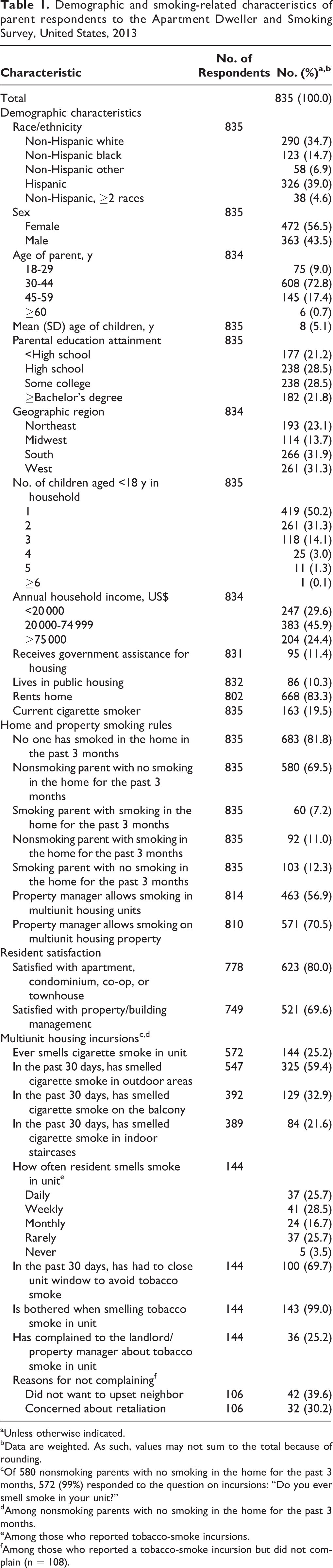
Most respondents reported no one smoking in their home in the past 3 months (Table 1). Most residents reported that smoking was allowed in the units and on the property where they lived. The median number of children in the household was 1 (range, 1-7). The average respondent was aged 36 and the average child age was 8. Three hundred twenty-six (39.0%) residents were Hispanic, 290 (34.7%) were non-Hispanic white, 123 (14.7%) were non-Hispanic black, and 96 (11.5%) were non-Hispanic other/multiple races. Approximately one-third of the sample resided in the southern (266/834, 31.9%) and western (261/834, 31.3%) regions of the United States. Most residents rented their home (668/802, 83.3%) and did not receive government assistance for housing (736/831, 89.0%). Most residents, regardless of smoking status, were satisfied or very satisfied with their apartment (623/778, 80.0%) and their building management (521/749, 69.6%).
Demographic and smoking-related characteristics of parent respondents to the Apartment Dweller and Smoking Survey, United States, 2013
aUnless otherwise indicated.
bData are weighted. As such, values may not sum to the total because of rounding.
cOf 580 nonsmoking parents with no smoking in the home for the past 3 months, 572 (99%) responded to the question on incursions: “Do you ever smell smoke in your unit?”
dAmong nonsmoking parents with no smoking in the home for the past 3 months.
eAmong those who reported tobacco-smoke incursions.
fAmong those who reported a tobacco-smoke incursion but did not complain (n = 108).
Tobacco-Smoke Incursions
Of 572 nonsmokers without smoking in the home who responded to the question about tobacco-smoke incursion, 144 (25.2%) residents reported tobacco-smoke incursions in their unit. Of these 144 residents, 78 (54.2%) reported daily or weekly incursions. In addition to tobacco-smoke incursions in the units, 325 of 547 (59.4%) residents reported smelling smoke in outdoor areas, 129 of 392 (32.9%) reported smelling smoke on their balcony, and 84 of 389 (21.6%) reported smelling it in indoor staircases. Of 144 respondents who reported tobacco-smoke incursions in their unit, 100 (69.7%) reported having to close windows to avoid tobacco smoke in the past 30 days. Almost all (143/144) were bothered by the exposure; of those bothered, 36 (25.1%) reported complaining to their landlord or property manager. Of the 108 residents who did not complain, 42 of 106 (39.6%) cited not wanting to upset their neighbors, and 32 of 106 (30.2%) cited concerns about retaliation (Table 1).
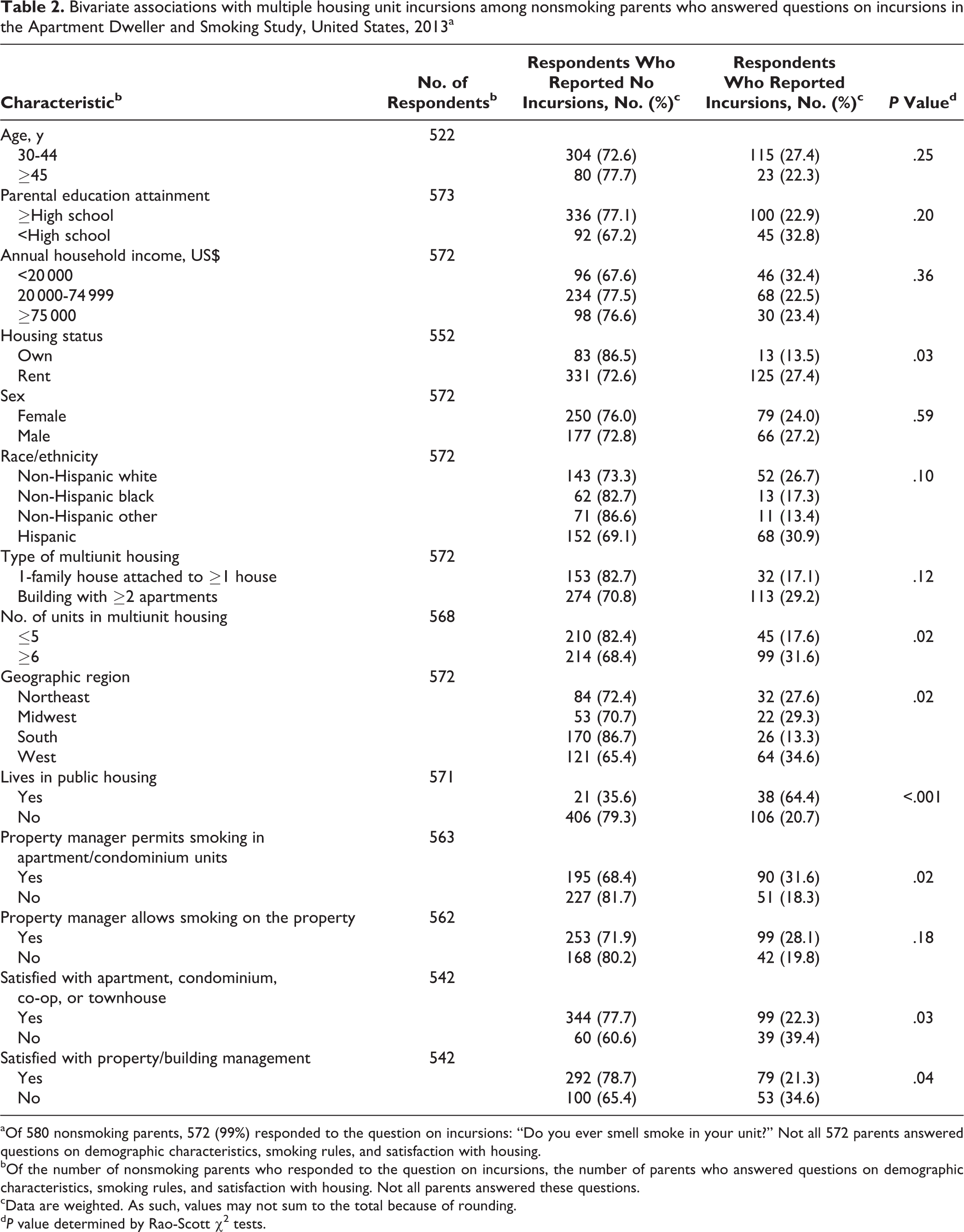
Residents who lived in housing with ≥6 units were more likely than residents in housing with ≤5 units to report tobacco-smoke incursions (31.6% vs 17.6%, P = .02), and residents living in the South were less likely (13.3%) than residents in other regions to report tobacco-smoke incursions (P = .02). Residents in public housing were more likely than residents in private housing to report tobacco-smoke incursions (64.4% vs 20.7%, P < .001), as were people living where smoking was permitted (31.6% vs 18.3%, P = .02) (Table 2). Compared with multiunit housing residents who did not report tobacco-smoke incursions, those who reported incursions were more likely to be dissatisfied with their landlord/management company (P = .04) or housing (P = .03).
Bivariate associations with multiple housing unit incursions among nonsmoking parents who answered questions on incursions in the Apartment Dweller and Smoking Study, United States, 2013a
aOf 580 nonsmoking parents, 572 (99%) responded to the question on incursions: “Do you ever smell smoke in your unit?” Not all 572 parents answered questions on demographic characteristics, smoking rules, and satisfaction with housing.
bOf the number of nonsmoking parents who responded to the question on incursions, the number of parents who answered questions on demographic characteristics, smoking rules, and satisfaction with housing. Not all parents answered these questions.
cData are weighted. As such, values may not sum to the total because of rounding.
d P value determined by Rao-Scott χ2 tests.
Of the 1646 nonsmokers without smoking in the home and without children living in the home, 1642 responded to the question about unit incursions and 357 (21.8%) reported tobacco-smoke incursions in their unit. A total of 356 respondents answered the question about frequency of incursions, and 178 (50.1%) reported daily or weekly incursions. Of all residents responding to these questions, 868 of 1564 (55.4%) reported smelling smoke in outdoor multiunit housing areas in the past 30 days, 288 of 1126 (25.6%) of whom smelled it on their balcony and 210 of 1143 (18.3%) of whom smelled it in an indoor staircase.
Parental Attitudes About Smoking in Multiunit Housing
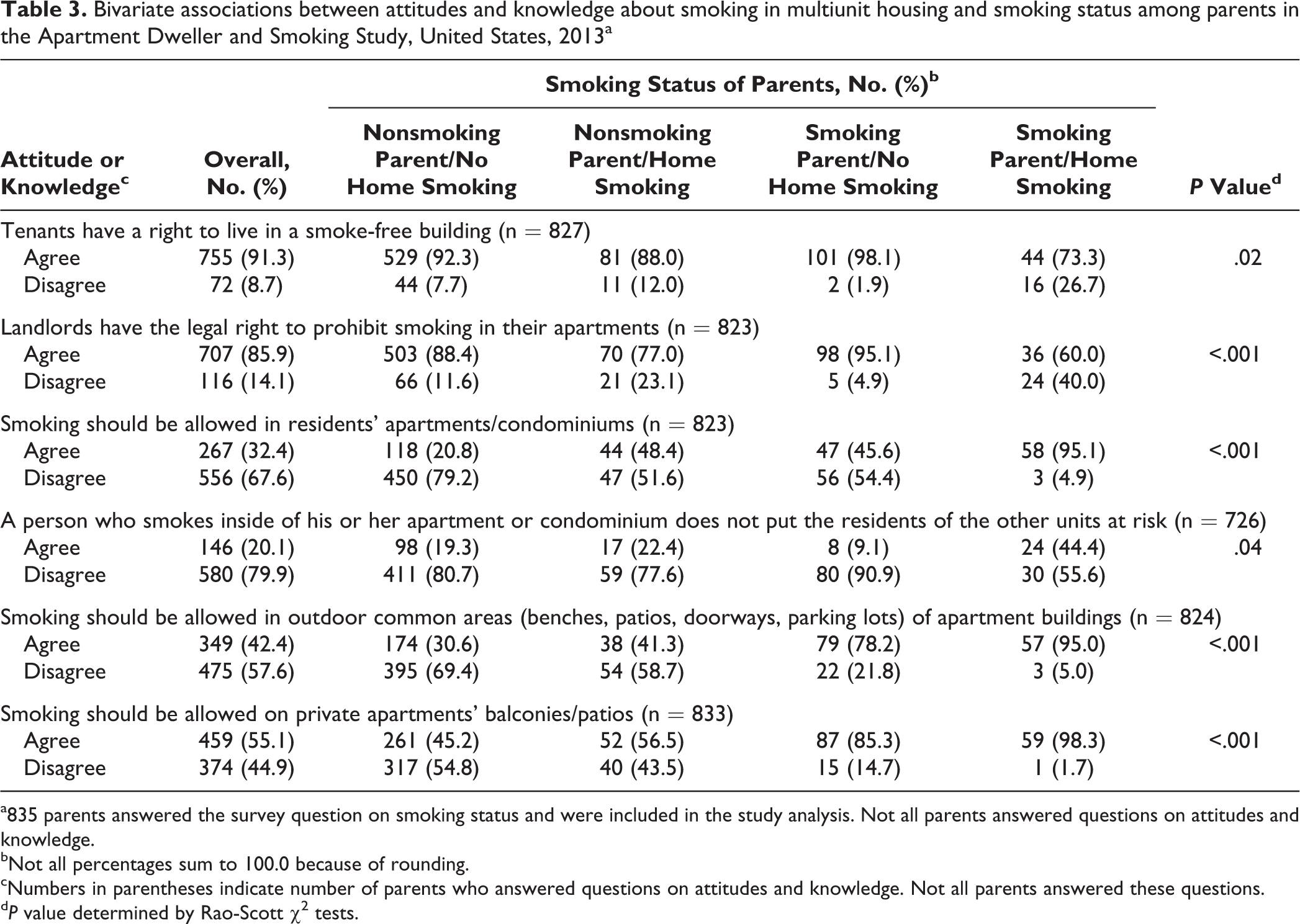
Most multiunit housing residents with children living in the home agreed that tenants had a right to live in a smoke-free building. These proportions differed by smoking status and ranged from 529 of 573 (92.3%) nonsmokers without smoking in the home to 44 of 60 (73.3%) smoking parents who reported smoking in the home during the past 3 months (P = .02) (Table 3). More than three-quarters agreed that landlords have the legal right to prohibit smoking in their tenants’ homes; this proportion varied by smoking status (P < .001).
Bivariate associations between attitudes and knowledge about smoking in multiunit housing and smoking status among parents in the Apartment Dweller and Smoking Study, United States, 2013a
a835 parents answered the survey question on smoking status and were included in the study analysis. Not all parents answered questions on attitudes and knowledge.
bNot all percentages sum to 100.0 because of rounding.
cNumbers in parentheses indicate number of parents who answered questions on attitudes and knowledge. Not all parents answered these questions.
d P value determined by Rao-Scott χ2 tests.
Most residents (n = 556, 67.6%) said that smoking should not be allowed in residents’ apartments or condominiums, and this percentage differed by smoking status: 79.2% (450/568) of nonsmokers with no smoking in the home and 4.9% (3/58) of smokers with smoking in the home (P < .001).
Of 726 residents, 146 (20.1%) agreed with the following statement: “A person who smokes inside their apartment does not put the residents of other units at risk.” Smokers who allowed smoking in the home (n = 24, 44.4%) were the most likely to agree, smokers who reported no home smoking were the least likely to agree (n = 8, 9.1%), and 19.3% (n = 98) of nonsmokers without smoking in the home for the past 3 months agreed with the statement (P = .04). Fewer than half (349/824, 42.4%) thought that smoking should be allowed in outdoor common areas, and 459 of 833 (55.1%) agreed that smoking should be allowed on private balconies and patios. These proportions also differed by smoking status; smokers showed higher support than nonsmokers for both questions (P < .001).
Multivariable Results
Incursions
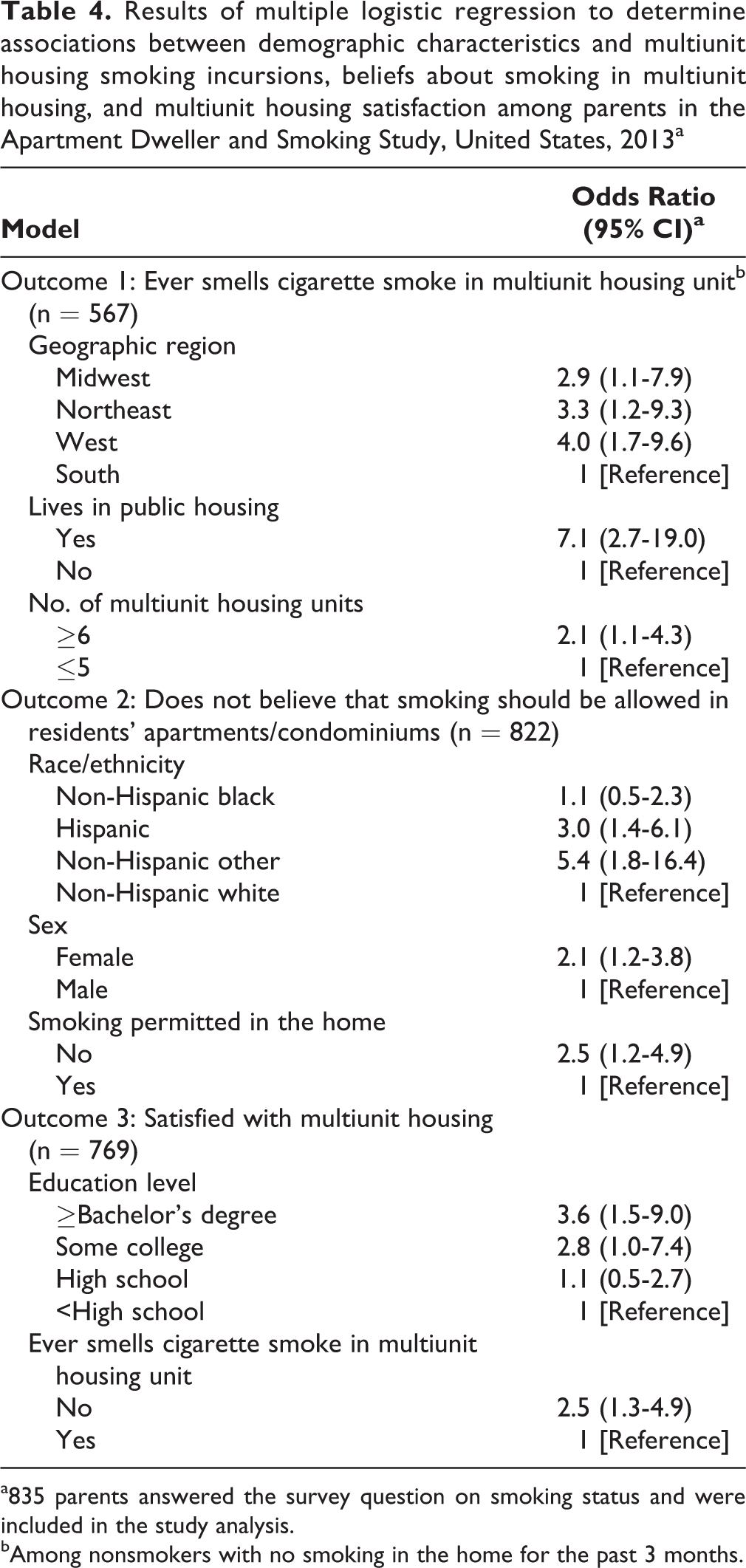
Reporting tobacco-smoke incursions among nonsmoking parents without smoking in their home was associated with living in regions other than the South, living in public housing rather than private housing (OR = 7.1; 95% CI, 2.7-19.0), and living in a building with ≥6 units rather than a building with ≤5 units (OR = 2.1; 95% CI, 1.1-4.3) (Table 4). The C statistic for this model was 0.7.
Results of multiple logistic regression to determine associations between demographic characteristics and multiunit housing smoking incursions, beliefs about smoking in multiunit housing, and multiunit housing satisfaction among parents in the Apartment Dweller and Smoking Study, United States, 2013a
a835 parents answered the survey question on smoking status and were included in the study analysis.
bAmong nonsmokers with no smoking in the home for the past 3 months.
Attitudes
In a multivariable model among all parents, disagreeing with the statement “Smoking should be allowed in residents’ apartments/condominiums” was associated with non-Hispanic other (OR = 5.4; 95% CI, 1.8-16.4) and Hispanic (OR = 3.0; 95% CI, 1.4-6.1) race/ethnicity when compared with non-Hispanic white race/ethnicity, female sex when compared with male sex (OR = 2.1; 95% CI, 1.2-3.8), and having a personal rule of not permitting smoking inside the home when compared with permitting smoking inside the home (OR = 2.5; 95% CI, 1.2-4.9) (Table 4). The C statistic for this model was 0.7.
Satisfaction
In the multivariable model, parental satisfaction with their multiunit housing apartment or home was associated with having obtained at least a bachelor’s degree (OR = 3.6; 95% CI, 1.5-9.0) or some college (OR = 2.8; 95% CI, 1.0-7.4) when compared with having less than a high school education and not ever smelling smoke in the unit (OR = 2.5; 95% CI, 1.3-4.9) compared with smelling smoke in the unit (Table 4). The C statistic for this model was 0.6.
Discussion
Most multiunit housing residents with children in the home did not smoke and did not allow smoking in their units; however, most lived in buildings where smoking was allowed in units and on the building’s property, and many (25%) experienced tobacco-smoke incursions, often regularly. The rate of incursions was similar for residents with no children in the home. Children are particularly vulnerable to tobacco-smoke exposure because they are not able to remove themselves from a situation that makes them uncomfortable or sick. The argument is often made that people bothered by tobacco-smoke exposure in their units can just move; however, families with children, especially those who receive public support for housing, may face discrimination in the housing market and substantial financial and logistical challenges in finding alternatives. 18 Consistent with residents described in previous studies, residents who were involuntarily exposed to tobacco smoke reported being bothered by it, and many reported closing windows to avoid exposure from outdoor smokers. 19,20 Even when bothered by the exposure, few residents reported it to their landlord because of concerns about upsetting neighbors or retaliation. This finding is consistent with other studies that found that tenants can be dissatisfied with the lack of enforcement of smoke-free housing. 21
Residents who did not report tobacco-smoke incursions were more likely to be satisfied with their building than those who did report tobacco-smoke incursions. Building owners and managers may not be aware of the extent to which nonsmokers are affected by their neighbors’ smoking behaviors. Increasing numbers of private multiunit housing buildings are going smoke free, as prospective tenants request smoke-free buildings and generate demand. 22,23 One study found that many tenants would be willing to pay more to live in an apartment building that is smoke free. 19 However, paying more for housing is not an option for most low-income multiunit housing residents or middle-class residents of rent-controlled housing in expensive locations.
As other national studies found, 13,24 we found that incursions were more likely among residents with children in the home who were in public multiunit housing or for those living in the lowest income group compared with those in non-public multiunit housing or those with higher incomes. The elderly, disabled, and children live disproportionately in public multiunit housing and are least able to leave a unit when harmed by tobacco smoke than young, able-bodied adults, leading to legal and ethical considerations favoring implementation of smoke-free status for all public housing. 25 In 2009, the US Department of Housing and Urban Development issued recommendations for all public multiunit housing to be smoke free. 26 In 2016, the US Department of Housing and Urban Development released a final rule to ban smoking in public housing by mid-2018. 27 However, as currently proposed, the rule would not cover residents of multiunit housing funded by Section 8, and it does not include other potentially harmful tobacco products such as electronic cigarettes. The US Department of Housing and Urban Development website has resources for tenants and landlords who are interested in going smoke free. 28
Smokers and nonsmokers strongly supported tenants’ right to live in a smoke-free building and to be protected from smoke exposure, suggesting that housing managers could frame decisions around going smoke free as reflecting strong preferences expressed by most residents. Most residents also agreed that smoking should not be allowed in residents’ apartments or condominiums. Smokers differed from nonsmokers in their opinion; virtually all parents who smoked in the home believed that smoking should be allowed in units. Most smokers and nonsmokers with smoking in the home agreed that smoking should be allowed in common areas and/or outdoor porches. Smoking in common areas and/or outdoor porches is typically not allowed within comprehensive smoke-free rules and can be problematic for nonsmokers, as we documented in the reports of tobacco-smoke incursions through windows. The US Department of Housing and Urban Development rule prohibits smoking within 25 feet of the building but does allow for the creation of smoking areas outside of that distance. 27 Overall, only 20% of residents agreed with the statement, “A person who smokes inside their apartment does not put the residents of other units at risk.” Although the group most likely to agree was smokers who allowed smoking in the home, smokers who reported no smoking in the home were the least likely to agree (9%), followed by nonsmokers without smoking in the home. Most smokers agreed that landlords had the right to prohibit smoking. Any restrictions on smoking should include engagement of smokers to ensure that they have access to cessation services and have a voice in how the rules are implemented, an approach that will facilitate compliance. These findings agree with previous studies that found support for smoke-free policies across sociodemographic groups. 29
Limitations
This study had several limitations. First, we used an online survey panel, and it is possible that the methodology introduced sample ascertainment or noncoverage bias. However, validation studies support the methods used to produce results similar to a random-digit-dial survey. 30,31 Second, we relied on self-report from residents rather than biological samples. Residents who were less satisfied with their homes may have been more likely to report areas of concern than those who were more satisfied with their homes. We also relied on adult report of tobacco-smoke exposure; it was not possible to ascertain what the children in these households were actually experiencing. Odor perception among people exposed to tobacco smoke may be altered, 32 and they may no longer recognize that they are being exposed. However, inability to discern tobacco-smoke incursions biased our study toward the null hypothesis, strengthening our results and conclusions. Finally, small numbers in some analyses may have limited the results for these groups.
Conclusion
Most multiunit housing residents with children in the home across all demographic groups and even smokers themselves supported residents’ rights to live in completely smoke-free buildings. Experiencing tobacco-smoke incursions decreased multiunit housing residents’ satisfaction with their homes; however, most stayed silent and did not report tobacco-smoke exposure to management. Combined with expanding knowledge about the detrimental health effects of exposure to smoke and emissions from all tobacco products, these additional public support data will help foster universal smoke-free multiunit housing in the United States.
Footnotes
Acknowledgments
The article contents were presented at the Pediatric Academic Societies’ annual meeting in May 2015.
Declaration of Conflicting Interests
The authors declared no potential conflicts of interest with respect to the research, authorship, and/or publication of this article.
Funding
The authors disclosed receipt of the following financial support for the research, authorship, and/or publication of this article: This research was funded in part by The Flight Attendant Medical Research Institute and Truth Initiative to the American Academy of Pediatrics Julius B. Richmond Center of Excellence (NIH/NHLBI R01-HL112212, NIH/NCI R01-CA181207) and the Children’s Hospital Colorado Research Institute.