




Abstract
Objective:
Our objective was to provide the first comprehensive picture of alcohol use and binge drinking by US college students with disabilities (SWDs), who represent at least 11% (1.6 million) of the US college student population.
Methods:
In fall 2013, we used a stratified random sampling technique to identify and recruit 2440 SWDs from 122 US colleges and universities. A total of 1285 (53%) SWDs from 61 (50%) colleges and universities completed a survey of alcohol and other drug use and the use of substances by student peers. We conducted 4 multiple logistic regression analyses to compare binge-drinking and non–binge-drinking SWDs by potential correlates of such use and a final model that included only significant variables.
Results:
SWDs aged <21 vs ≥21 (odds ratio [OR] = 0.90; 95% confidence interval [CI], 0.82-0.99) who spent more time vs less time socializing (OR = 1.24; 95% CI, 1.11-1.38), who spent less time vs more time studying (OR = –0.89; 95% CI, –0.80 to –0.99), and who used vs did not use marijuana (OR = 1.44; 95% CI, 1.18-1.75) or amphetamines (OR = 1.82; 95% CI, 1.15-2.89) were significantly more likely to binge drink. SWDs who reported using barbiturates were less likely to binge drink than were those who did not use barbiturates (OR = –0.36; 95% CI, –0.21 to –0.61). In the final model, use of amphetamines (OR = 1.74; 95% CI, 1.15-2.65) or marijuana (OR = 1.60; 95% CI, 1.32-1.94) was the highest predictor of binge drinking.
Conclusion:
SWDs’ reported rates of binge drinking, although high, were not as high as those of nondisabled college students. Nevertheless, prevention efforts should be targeted toward college SWDs.
Substance use by college students is a common event marked by excess. 1 –6 Heavy episodic drinking, or binge drinking (defined as the consumption of ≥5 drinks in 1 sitting by males and ≥4 drinks in 1 sitting by females), by college students has gained attention because of the extremity of such use, in terms of both the number of people who binge drink and the frequency with which they do so. Estimates of binge drinking in national samples of college students range from 42% to 44%. 3 –7 About 85% of students reported drinking alcohol, and more than 26% reported using marijuana at least once in the previous year. 3 –5 Large numbers of college students drink >4 days per week, and many report that drinking to get drunk is the sole purpose for consuming alcohol. 3 –7
Attention to such use is also based on the severity of the negative consequences experienced by students who drink and use other drugs. College student substance users are significantly more likely than are their abstaining counterparts to be engaged in behaviors that lead to unintentional injuries, to be in fights or physical altercations, to be robbed and sexually assaulted, to miss class and fall behind in course assignments, to have unplanned and unprotected sex, to drop out of school, and to have greater difficulty gaining employment after graduation. 3,5,7,8
Few studies have examined substance use by college students with disabilities (SWDs). A 1989 study noted that 19% of college students with an orthopedic disability screened positive for problematic alcohol or other drug use; however, details on such use were not provided. 9 A 1998 study noted that college SWDs who took prescription medications regularly were more likely to screen positive for substance misuse than were SWDs who were not regularly taking prescription medicines. 10 In 2009, a study found that the consequences associated with drinking in a sample of 258 deaf and hard-of-hearing college SWDs were similar to those incurred by nondisabled students. 11 Large-scale studies assessing substance use among college students systematically ignore SWDs. Because SWDs represent about 11% of the total US college population (>1.6 million students), this lack of assessment is a potentially serious oversight. 12
Concern with such an oversight is also highlighted by the nature of substance misuse among general, nonstudent populations of people with disabilities (PWD). Rates of substance misuse range from 14% to 65% among PWD across disability groups. 13 –26 The negative consequences associated with such misuse among PWD are also notable for their frequency, duration, and severity. 13 –26 Many factors are correlated with high rates of misuse, including risk-taking personality, self-medication for symptom and/or pain reduction, and social isolation. 8,20,27,28,29,30 –32 Regardless of cause, rates of substance use among PWD are consistently several times higher than that of the general population. The purpose of this research was to provide the first comprehensive picture of the prevalence and correlates of binge drinking in a national sample of SWDs.
Methods
We conducted a survey of a national sample of SWDs in fall 2013. The sample consisted of SWDs aged ≥18 from a sample of 4-year colleges and universities from across the United States who were registered with the students with disabilities support office (DSO) on their respective campuses. We used a random, stratified, multistage cluster sampling technique to gather the sample for this study. First, we randomly selected 122 colleges and universities nationally, and then we randomly selected SWDs from those registered with the universities’ DSO. We based sampling clusters on the state level so that institutions in the sample reflected colleges and universities nationwide. We stratified the sample based on the size of the institutions (ie, the number of full-time-equivalent students) and institutional affiliation (ie, public or private) so that the sample accurately reflected colleges and universities nationally. We obtained study approval from the Virginia Commonwealth University Institutional Review Board and a National Institutes of Health Certificate of Confidentiality before initiating the study.
We first contacted directors of the DSO at each selected institution by email and telephone during summer 2013 to request their participation in the study. Each director who agreed to participate then randomly selected up to 37 SWDs aged ≥18 from those registered with the DSO. If <37 SWDs were registered, we asked the director to include all students. We identified and recruited 2440 SWDs to participate in the study using this method.
The Survey
The survey consisted of each of the preexisting validated devices (detailed later) and assessed respondents’ use of alcohol and other drugs and the correlates of such use. The survey included numerous existing measures that covered multiple broad domains. This article details only demographic information and data on substance use and the correlates of such use. We used skip-logic, wherein participants answered only questions relevant to their own circumstances, so that the total number of items completed in each survey varied by participant response but generally did not exceed 100 items.
Disability Determination
We asked respondents to self-identify their disability/ies. Then we classified these responses based on modification to the definitions used by the National Center for Education Statistics (NCES) in its surveys of college students, which classify disabilities into distinct categories. The 2012 NCES survey of SWDs in postsecondary settings included 7 disability categories (difficulty hearing, difficulty seeing, difficulty speaking, or language impairment; mobility limitation or orthopedic impairment; traumatic brain injury; specific learning disabilities, attention deficit disorder, or attention deficit hyperactivity disorder [ADD/ADHD]; autism spectrum disorders including Asperger’s, cognitive difficulties, intellectual disability, mental retardation, or health impairment; and psychological impairments), as well as an “other” category for any disability not adequately addressed in the other categories. 33,34
For ease of interpretation and to increase cell size, we reorganized the 7 categories into 5 categories: (1) learning (encompassing the NCES specific learning disabilities group), (2) physical (including the NCES mobility limitation/orthopedic impairment, traumatic brain injury, and health impairment categories), (3) psychiatric (matching the NCES categories of psychological impairments and ADD/ADHD), (4) sensory (including the NCES categories difficulty hearing, difficulty seeing, difficulty speaking, or language impairment), and (5) developmental (including the NCES domains of autism spectrum disorders including Asperger’s as well as cognitive difficulties, intellectual disability, and mental retardation). Because no respondents included a disability that did not correspond to these categories, we did not need the other category.
Alcohol and Other Drug Use Assessment
To provide information on alcohol and other drug use, participants answered questions taken from the National Household Survey of Drug Abuse, a quantity/frequency index of alcohol and other drug use developed by the Substance Abuse and Mental Health Services Administration. 35 We used questions about alcohol to assess alcohol use, number of days of alcohol consumption during the past year and month, number of days of binge or heavy episodic drinking in the previous month, and number of days in the past year the respondent drank to intoxication. We also asked respondents about the frequency and quantity of use of amphetamines, barbiturates, cigarettes, cocaine (not including crack cocaine), crack cocaine, heroin and other opiates, LSD (lysergic acid diethylamide), marijuana, other psychedelics, smokeless tobacco, steroids, and tranquilizers in the same manner.
Assessment of the Correlates of Use
In addition to demographic correlates, the survey included items from 2 screening tools—the College Alcohol Problem Scale (CAPS) and the Alcohol Use Disorder Identification Test (AUDIT)—to assess for potential correlates of alcohol and other drug use. 36 –39 The CAPS is a 10-item device with a 5-point Likert-type scale that is sensitive to the degree of use and consequences associated with college student drinkers. 36 –38 It has good internal consistency ranging from 0.79 to 0.88 and accurately identifies heavy student drinkers and consequences of drinking. The CAPS also has greater cultural sensitivity than do other similar tools used in college settings. 36 –38,40 The CAPS demonstrated strong reliability in this sample (Cronbach α = 0.88). The AUDIT is a 10-item self-report questionnaire designed to identify alcohol misuse in medical settings. 39 Items query the frequency of alcohol consumption, occurrence of dependence, and experience of negative consequences. It effectively identifies alcohol misuse in college student samples. 39,41,42 We obtained Cronbach α = 0.86 for this sample.
Data Analysis
To detail the sample and the overall rates and correlates of alcohol and other drug use, we calculated frequencies, percentages, and central tendencies. We compared demographic information on college SWDs from the NCES with that of our sample to determine overall representativeness by using the Pearson χ2 test on matching data points. 33,34 Next, we conducted 4 multiple logistic regression analyses to compare binge-drinking SWDs with non–binge-drinking SWDs by potential correlates of such use. In these analyses, we calculated odds ratios (ORs) of the association of binge drinking with the following: (1) 6 demographic characteristics (age, marital status, race, Hispanic origin, sex, and disability type), (2) 6 variables for college status (membership in a fraternity or sorority, residence location, number of roommates, number of close friends, major, and year of college [first, second, third, fourth and later]), (3) other drug use, and (4) 6 variables related to students’ engagement in selected activities (exercising, sleeping, socializing with friends, studying, watching television, and working for pay) measured in hours per day. We coded respondents as binge drinkers if they had engaged in heavy episodic drinking (as defined previously) in the past year and as non-binge drinkers if they had consumed alcohol in the past year but did not binge drink. For each logistic regression analysis, we entered variables of interest (eg, college status variables such as membership in a fraternity or sorority, residence location, number of roommates, number of close friends, major, student classification) as potential predictors of the binary binge-drinking variable. Finally, we used a multiple logistic regression model that included predictor variables that were found to be significant (using the Wald χ2 test) in the previous 4 multivariate logistic regression analyses.
Results
Demographic Characteristics
Of the 2440 SWDs from 122 four-year institutions who were invited to participate in the survey, 1285 (53%) SWDs from 61 (50%) 4-year institutions completed the survey. Most SWDs in the sample were female (n = 844, 66%), had an average age of 21.9, were single or never married (n = 1061, 83%), were white (n = 909, 71%), and were non-Hispanic (n = 1096, 85%). Most SWDs attended school full time (n = 1099, 86%), were fourth-year students (n = 520, 40%), had never been on academic probation (n = 923, 72%), and lived off campus (n = 622, 48%). Although student majors varied, the largest group was in the social sciences (n = 274, 21%). Most SWDs were not members of a fraternity or sorority (n = 1057, 82%) (Table 1).
Characteristics of students with disabilities in a study of alcohol use and binge drinking at 61 colleges and universities, United States, fall 2013
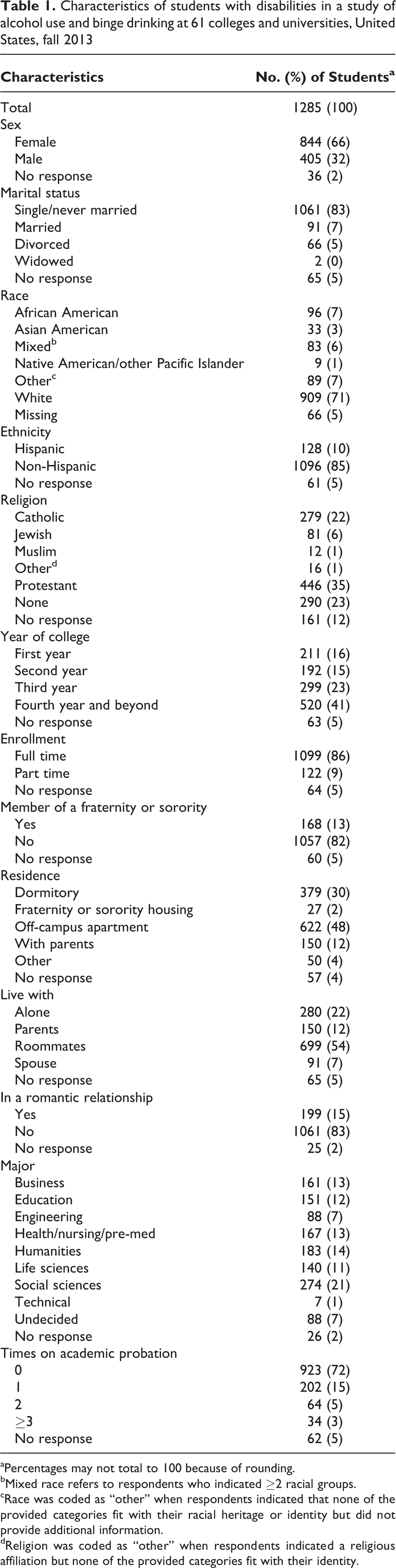
aPercentages may not total to 100 because of rounding.
bMixed race refers to respondents who indicated ≥2 racial groups.
cRace was coded as “other” when respondents indicated that none of the provided categories fit with their racial heritage or identity but did not provide additional information.
dReligion was coded as “other” when respondents indicated a religious affiliation but none of the provided categories fit with their identity.
We found no difference in distributions between demographic characteristics in the NCES and distributions in our sample by sex (χ2 = 2.2, P = .16), but we did find a significant difference in racial/ethnic distribution (χ2 = 12.1, P = .03). Our sample had a greater proportion of white students than the NCES sample did (71% vs 66%). Compared with the NCES sample, our sample also had more SWDs who were Native American/Pacific Islander (7% vs 1%) and multiple races (7% vs 3%) and proportionally fewer who were African American (8% vs 18%) or Asian American (1% vs 4%). The percentage of Hispanic SWDs in our sample did not differ significantly from the NCES sample (10% vs 15%). Finally, our study sample had a significantly larger proportion of college SWDs aged ≤23 compared with the NCES sample (70% vs 45%) (χ2 = 13.8, P = .001).
Most respondents to our survey self-identified their disability as a learning disability (n = 666, 52%), followed by physical (n = 285, 22%), psychiatric (n = 221, 17%), sensory (n = 93, 7%), or developmental (n = 20, 2%) disabilities. Our sample did not differ significantly from the NCES sample by learning (52% vs 58% [χ2 = 0.3, P = .07]), physical (22% vs 18% [χ2 = 0.4, P = .06]), psychiatric (17% vs 14% [χ2 = 0.3, P = .06]), sensory (7% vs 6% [χ2 = 0.8, P = .06]), or developmental (2% vs 2% [χ2 = 0, P = .10]) disability status.
Alcohol Use
Of 1285 SWDs who responded to our survey, 1028 (80%) reported drinking alcohol at least once in their lifetime; of those, the mean age of first drink was 15, and 71 (7%) reported that their first drink was at age ≥21. Of the 1028 SWDs who reported drinking alcohol at least once, 432 (42%) indicated drinking ≤monthly, 144 (14%) drank 2 to 4 times per week, 62 (6%) drank >5 times per week, and 102 (10%) drank daily. A total of 715 (70%) SWDs reported at least 1 binge-drinking episode in the previous year. Of these, 72 (10%) reported binge drinking monthly, 64 (9%) reported binge drinking 2 or 3 times per week, and 7 (1%) reported binge drinking >5 times per week. Only 128 (10%) of all respondents reported binge drinking in the previous 2 weeks.
Of the 6 demographic characteristics (age, marital status, race, Hispanic origin, sex, and disability type) in our logistic regression analysis, only age was a significant predictor of binge drinking. Younger students were more likely than were older students to have engaged in binge drinking (OR = 0.90; 95% confidence interval [CI], 0.82-0.99). None of the other characteristics were associated with binge drinking (Table 2). Of the 6 variables for college status, only student major was correlated with binge drinking; students whose major was nursing/pre-med were less likely (OR = 0.29; 95% CI, 0.10-0.86) to binge drink than were students in all other majors (Table 2). Of the other drugs examined, only marijuana, barbiturates, and amphetamine use was associated with binge drinking. SWDs who used marijuana (OR = 1.44; 95% CI, 1.18-1.75) or amphetamines (OR = 1.82; 95% CI, 1.15-2.89) were significantly more likely than were SWDs who had not used marijuana or amphetamines to binge drink, whereas SWDs who used barbiturates were significantly less likely than were SWDs who did not use barbiturates to binge drink (OR = –0.36; 95% CI, –0.21 to –0.61). Time spent on other activities had no significant association with the likelihood of binge drinking. However, SWDs who spent ≥2 hours per day socializing with friends were more likely to binge drink (OR = 1.24; 95% CI, 1.11-1.38) than were those who spent <2 hours per day socializing with friends. Further, SWDs who studied for ≥4 hours per day were less likely to binge drink (OR = –0.89; 95% CI, –0.80 to –0.99) than were those who studied for <4 hours per day (Table 2).
Correlates of binge drinking by students with disabilities at 61 colleges and universities, by selected characteristics, United States, fall 2013
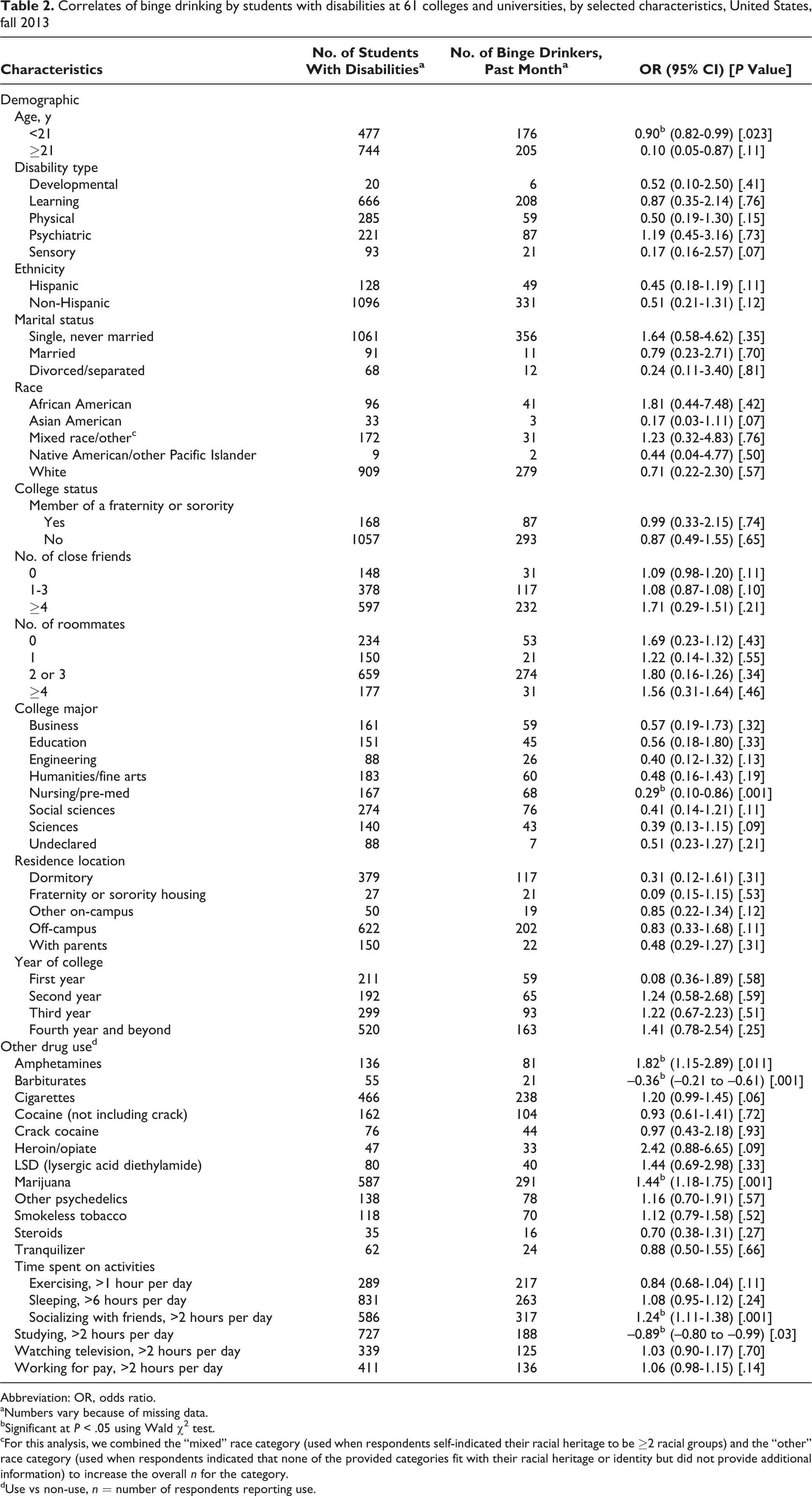
Abbreviation: OR, odds ratio.
aNumbers vary because of missing data.
bSignificant at P < .05 using Wald χ2 test.
cFor this analysis, we combined the “mixed” race category (used when respondents self-indicated their racial heritage to be ≥2 racial groups) and the “other” race category (used when respondents indicated that none of the provided categories fit with their racial heritage or identity but did not provide additional information) to increase the overall n for the category.
dUse vs non-use, n = number of respondents reporting use.
Final Model
In our final multivariate logistic regression model, the most notable predictor of binge drinking was amphetamine use (OR = 1.74; 95% CI, 1.15-2.65). Likewise, SWDs who reported using marijuana (OR = 1.60; 95% CI, 1.32-1.94) were more likely to report binge drinking than were those who reported not using marijuana. Hours spent socializing with friends each day (OR = 1.17; 95% CI, 1.04-1.31) also had a significant positive correlation with binge drinking. Barbiturate use had a modest negative correlation with binge drinking (OR = –0.45; 95% CI, –0.28 to –0.73) (Table 3).
Regression analysis of the odds of binge drinking among students with disabilities at 61 colleges and universities, by various demographic and social characteristics, United States, fall 2013
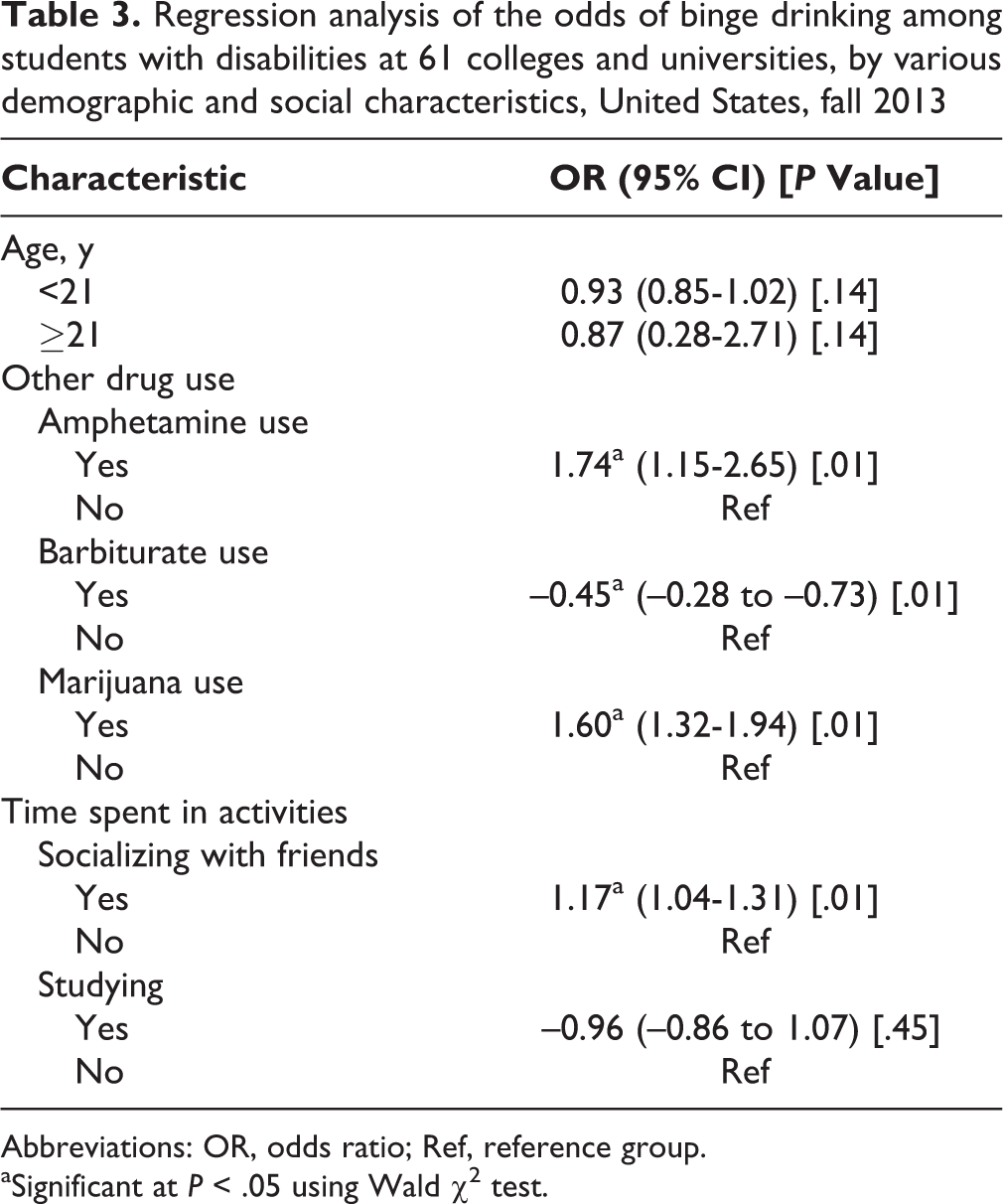
Abbreviations: OR, odds ratio; Ref, reference group.
aSignificant at P < .05 using Wald χ2 test.
Discussion
Our findings indicate that SWDs drink and binge drink at considerable rates. The SWDs in our study were also more likely to binge drink when they were recent users of other drugs compared with SWDs in the sample who did not report using drugs other than alcohol. However, these SWDs as a group did not reflect the same degree of binge drinking commonly reported in samples of nondisabled college students. Whereas multiple reports indicated past 2-week binge-drinking rates >40% in nondisabled college student samples, the SWDs in our study engaged in such drinking at a rate of only about 10%. 3,7 Yet 70% of SWDs in our study reported binge drinking at least once in the previous year, which is much higher than the national average (≤40%) for college students as a whole. 43 Only student major was associated with SWD binge drinking in our analysis. Such findings could suggest differences between SWDs and their nondisabled counterparts. However, because this study is the first to examine these issues in an SWD population, and given the relatively small sample size and that these respondents were acquired via DSOs and not from the wider campus community, these findings are best viewed as tentative and subject to further investigation.
Alcohol and drug prevention efforts are common on college campuses, and many are specific to the populations (eg, members of fraternities or sororities, student athletes) they target. However, SWDs are largely overlooked in such programming. 40 If SWDs are in fact different in their consumption patterns, as these findings suggest, research will be needed to determine if current prevention efforts are effective with this population or if new, population-specific programming is needed.
A large body of work notes that PWD as a whole tend to have limited peer networks and are more likely to be socially isolated. 44 –46 Some researchers conjecture that such social isolation is a factor leading to the large numbers of PWD who use and misuse substances. 27 Our analyses found the opposite to be true: SWDs who spent more time with friends were more likely to binge drink. This finding may be an artifact of the drinking lifestyle that is common on college campuses, wherein SWDs who have more opportunities to socialize also have more opportunities to drink. Research comparing noncollege samples of PWD with college samples is needed to clarify this relationship. It is also important to note that the SWDs in our study did not drink or use other substances to the same degree that PWD in national studies as a whole did. Nationally, PWD have rates of substance use and misuse that are higher than that of the general population. In contrast, the SWDs in our study did not consume alcohol or any of the other drugs assessed at such levels. Additional research is warranted to determine the accuracy of our findings.
Limitations
This study had several limitations. First, to ensure access to a sample of students who were known to have disabilities, we accessed our sample via DSOs. Although this method increased the certainty that these students had a disability, it also may have biased our findings because not all SWDs register with the DSO. For example, an SWD who does not need accommodations in the classroom may not contact an office that exists primarily for that purpose. Notably, the study may not have included students with psychiatric disabilities who likely require little or no classroom accommodations and who, because of the stigma associated with such disabilities, may choose not to disclose their disability status nor register for services with their campus DSO. Because students with psychiatric disabilities are more likely to engage in substance-using and other risk-taking behaviors compared with SWDs with other disabilities, any failure on our part to have them in our sample could be a serious limitation. 5,8,30,31 Such students in our sample may have been underrepresented.
In addition, our reliance on the directors of these offices to conduct our study at each site was potentially problematic, and the self-reported nature of our study may also have introduced error. Although other successful large studies of student populations have successfully relied on local administrative staff members for survey distribution, we cannot say with certainty that all aspects of participant selection and survey distribution were precise. Future work is needed that accesses SWDs via alternate means to corroborate our findings.
Conclusion
Binge drinking by college students is an ongoing concern, and our study highlights yet another vulnerable group. The number of SWDs at colleges and universities, both in shear headcount and in the percentage of all college students, has increased in the last several decades, and this trend is likely to continue. 12 Given that binge drinking is highly correlated with academic failure, drop-out, and an increased risk for various negative health conditions, such use by SWDs may place them at extreme risk for various negative outcomes. Continued research in this area, particularly studies that can inform prevention and intervention efforts, is needed.
Footnotes
Declaration of Conflicting Interests
The authors declared no potential conflicts of interest with respect to the research, authorship, and/or publication of this article.
Funding
The authors disclosed receipt of the following financial support for the research, authorship, and/or publication of this article: This research was supported by grant H133G080123 from the National Institute on Disability, Independent Living and Rehabilitation Research.