



Abstract
This study examined whether the association between impulsivity and compulsivity differs across patterns of engagement in gambling and video gaming. A total of 295 Ecuadorian adults (165 video gamers and 130 gamblers) were assessed with the UPPS-P Impulsive Behaviour Scale and the GRACC-18 Compulsivity Assessment Questionnaire. Regression analyses explored whether five dimensions of impulsivity were differentially associated with compulsivity across groups. The results suggest that executive dysfunction and positive-affect urgency play a larger role in gambling-related compulsivity, whereas negative urgency and maladaptive regulation of distress are more salient in gaming. Such disorder-specific mechanisms call for a re-evaluation of current assumptions about the role of impulsivity in behavioural addictions and support the refinement of diagnostic criteria and interventions tailored to the emotional and cognitive profiles of each group.
Introduction
Historically and culturally, addiction has been almost exclusively associated with drug use, with ancestral records documenting the human consumption of opioids and alcohol, and, in the past two centuries, the emergence of synthetic or laboratory-produced drugs (Le Daré et al., 2022; Wang, 2019). This perspective has influenced the development of new scientific literature and has led to updates in diagnostic taxonomies, which have gradually incorporated behavioural patterns under the category of addictive disorders. One of the first behavioural addictions to be formally recognised by the American Psychiatric Association (APA, 2013) and included in the Diagnostic and Statistical Manual of Mental Disorders (DSM-5) was gambling disorder. The most compelling scientific evidence supporting the classification of gambling disorder as an addictive behaviour was the significant overlap in neurobiological and neuropsychological correlates observed in individuals with substance use disorders and pathological gamblers (Clark & Goudriaan, 2018; Romanczuk-Seiferth et al., 2015). Following its inclusion as a behavioural addiction, various studies have emerged suggesting that other behaviours—such as video gaming, shopping, and internet use—may also be understood within an addiction framework (Carbonell, 2020; Sherer & Levounis, 2022). Although Internet Gaming Disorder was included only in Section III of the DSM-5 as a condition requiring further study, the ICD-11 formally recognises Gaming Disorder as a diagnosable condition, making it the second officially acknowledged behavioural addiction after gambling. Nonetheless, there is still no consensus among researchers regarding whether excessive video game use constitutes an addictive disorder (Griffiths et al., 2016), despite growing evidence that such use can lead to personal problems and diminished quality of life (Fazeli et al., 2020). This has prompted several researchers to reconsider which neuropsychological variables are truly involved in the development and maintenance of behavioural addictions (Clark & Goudriaan, 2018; Etxandi et al., 2023; Weinstein & Lejoyeux, 2020).
Impulsivity is frequently associated with addictive disorders (Grant & Chamberlain, 2014; Hodgins & Holub, 2015; Raybould & Tunney, 2024; Rømer Thomsen et al., 2018; Chamberlain et al., 2018; Jentsch et al., 2014). It is a broad and multidimensional construct that can be understood as the tendency to make decisions or engage in actions that lead to negative consequences due to hasty choices and poor consideration of potential scenarios or alternatives. This process is typically mediated by inhibitory control deficits (Jentsch et al., 2014; Rømer Thomsen et al., 2018). Empirical evidence has shown that impulsivity is related to several neurocognitive components: deficits in both cognitive and motor response inhibition, preference for immediate over delayed rewards (e.g., choosing a quick reward over a more favourable long-term outcome), and impaired decision-making abilities (Lee et al., 2019). It is also important to consider that impulsivity can be a personality trait (Raybould & Tunney, 2024), and as such, individuals with impulsive personality profiles may be more vulnerable to developing addictive behaviours (Antons & Brand, 2018; Chamberlain et al., 2018; Rømer Thomsen et al., 2018).
Compulsivity, on the other hand, is another variable associated with addiction; however, it is also a broad construct that has not yet been clearly defined within the specific context of behavioural addictions (Chamberlain et al., 2018; Muela et al., 2022). This lack of precision has led to its association with other concepts such as “repetitive” or “automatic” behaviours, which are at times used interchangeably. In this context, compulsivity can be defined as a perceived uncontrollable feeling to engage in a specific activity, even when the individual recognises the behaviour as inappropriate and potentially harmful (Lee et al., 2019). Moreover, it has been described as a transdiagnostic trait that reflects a predisposition to perform habitual behaviours in an automatic manner, even in the face of adverse consequences (Muela et al., 2022).
According to the definitions proposed by Chamberlain and colleagues (2018), the key distinction between impulsivity and compulsivity lies in their temporal and functional roles in addiction. Impulsivity refers to the tendency to act without considering the consequences and is often involved in the initiation and early development of addictive disorders (Evenden, 1999). Compulsivity, in contrast, is acquired and characterised by the rigid repetition of behaviours, even when they are no longer pleasurable. It is believed to play a significant role in the maintenance and chronicity of addictive behaviours (Robbins et al., 2012). Empirically, these theoretical distinctions are operationalised through specific behavioural paradigms that complement self-report measures. Impulsivity is typically assessed using tasks measuring motor inhibition, such as the Stop-Signal Task and Go/No-Go paradigms, or choice impulsivity via Delay Discounting tasks. In contrast, compulsivity is measured through paradigms evaluating cognitive flexibility and habit learning, such as the Intra-Extra Dimensional Set Shift or Probabilistic Reversal Learning tasks, which index the persistent inability to adapt behaviour despite diminishing rewards or changing reinforcement contingencies (Chamberlain et al., 2018; Robbins et al., 2012; Voon et al., 2015).
Despite these conceptual and behavioural distinctions, there is ongoing debate about the extent to which impulsivity and compulsivity represent distinct constructs or overlapping dimensions within a broader spectrum of dysregulated behaviour. Both impulsivity and compulsivity have been shown to be relevant in substance addictions as well as in gambling disorder, and they appear to contribute significantly to the persistence of these conditions (Fauth-Bühler et al., 2017). Specifically, in the early stages of substance addiction, use is typically driven by positive reinforcement associated with impulsive behaviour. However, as substance use becomes problematic and leads to negative psychological effects, the behaviour can shift toward compulsivity, functioning as a strategy to avoid unpleasant states such as withdrawal symptoms (Feltenstein et al., 2021).
In the case of gaming disorder, it remains unclear to what extent impulsivity and compulsivity contribute to the potential chronicity of the condition (Müller et al., 2023; Kim et al., 2017). Nonetheless, some studies have shown that video gamers may engage in risk behaviours such as microtransactions, which can negatively impact their daily lives. A specific example of this is the use of “loot boxes”—randomised purchases of virtual game items (such as armour or costumes) acquired through real-world money (González-Cabrera et al., 2022; Raneri et al., 2022). This type of behaviour has been linked to patterns similar to those observed in gambling disorder and has been associated with alterations in functional connectivity among brain regions such as the precuneus, posterior cingulate cortex, prefrontal cortex, and dorsal anterior cingulate cortex—structures that are part of neural networks implicated in addiction (Bae et al., 2017).
Additionally, video gamers have been found to exhibit deficits in inhibitory control, both in the context of gameplay and in the regulation of time and frequency of use (Kim et al., 2017). More broadly, excessive video game use has been associated with consequences that negatively affect individuals’ quality of life (Fazeli et al., 2020), which closely aligns with the symptoms described in the DSM-5 (APA, 2013) for internet gaming disorder.
The Present Study
The present study aimed to assess the extent to which impulsivity is associated with the compulsive features of problematic gambling behaviour and problematic video game use. In this context, impulsivity was conceptualised and measured as a dispositional trait, whereas compulsivity was assessed in terms of specific behavioural expressions within gambling and gaming contexts. Although the cross-sectional design does not allow for causal inferences, it is theoretically consistent to consider traits as antecedents of behaviour, rather than outcomes. Given the established relevance of impulsivity and compulsivity in the development and maintenance of addictive disorders—and considering that these constructs may manifest differently across types of problematic behaviour—it was hypothesised that the strength or direction of the association between impulsivity and compulsive behaviour would differ between the two groups. This comparison seeks to advance understanding of potential differences in the underlying mechanisms of recognised behavioural addictions and those still under evaluation, such as problematic video game use.
Methods
Participants
A total of 295 participants from the two largest cities in Ecuador were assessed, distributed as follows: 165 regular video gamers and 130 regular gamblers.
The inclusion criteria for both groups were: Ecuadorian men or women aged 18 years or older; no diagnosis of neurodevelopmental, neurocognitive, or neurodegenerative disorders; and regular engagement in either video gaming or gambling at least twice per week during the past 12 consecutive months. For this study, only participants who scored 0 on both the IGD and GD questionnaires were excluded. Of the 165 video gamers, 26 participants were considered part of the clinical sample, having obtained a score ≥5 on the IGD questionnaire. Among the 130 gamblers, 69 participants were considered part of the clinical sample for scoring ≥4 on the GD questionnaire.
Instruments
Ad-hoc Initial Questionnaire
This instrument was developed to collect demographic information (age, sex, household net income, and highest level of education completed). It also included screening questions based on the inclusion criteria, such as whether participants played video games or, in the case of the gambling group, whether they engaged in gambling. Individuals who answered negatively were excluded from the analysis. Additionally, participants were asked about the frequency of their gaming or gambling activity, and those reporting less than twice per week were also excluded. Participants who met the inclusion criteria were then asked about their preferred type of video game or gambling activity. Both groups were also asked to report the amount of time and money spent per week on their respective activities.
UPPS-P Impulsive Behaviour Scale
This questionnaire was originally developed by Whiteside and Lynam (2001). However, for the present study, we used a Spanish version that has shown good psychometric properties in previous studies (Cándido et al., 2012; Jara-Rizzo et al., 2019), with Cronbach’s alpha ranging from .61 to .81, indicating acceptable internal consistency. This questionnaire assesses impulsivity through 20 Likert-scale items. According to Whiteside and Lynam’s model, the five dimensions of impulsivity are: negative urgency (acting impulsively under negative emotional states such as sadness or frustration), positive urgency (acting impulsively under positive emotional states such as excitement), sensation seeking (seeking novel and thrilling experiences), lack of premeditation (acting without planning or consideration of consequences), and lack of perseverance (difficulty finishing tasks).
GRACC-18 Compulsivity Assessment Questionnaire
The Granada Assessment for Cross-domain Compulsivity was originally developed as a 90-item and 18-items self-report instrument to assess Compulsivity among gambling and videogaming players. This Likert-scale questionnaire was designed to assess compulsivity, particularly in relation to addictive behaviours (Muela et al., 2023). It has shown excellent internal consistency, with a Cronbach’s alpha of .98. Internal consistency was also analysed in the present study, yielding a McDonald’s ω of 0.94. For the present study, we used the 18-item version of the questionnaire.
Diagnostic Questionnaire for Gambling Disorder (GD9)
This questionnaire was originally developed by Stinchfield (2003) based on the DSM-IV-TR diagnostic criteria for Gambling Disorder (GD). It comprised 19 dichotomous items (yes = 1 point; no = 0 points), with two items assessing each of the ten diagnostic criteria, except for criterion 4, which was assessed by a single item. A total score of 4 or more was used as the diagnostic cut-off for GD. Following the publication of the DSM-5, which eliminated the criterion related to illegal acts committed to finance gambling, the questionnaire was revised to include 17 items, while retaining its binary response format and scoring system (Jiménez-Murcia et al., 2019). The updated version has demonstrated good psychometric properties, with a Cronbach’s alpha of .89 (Muela et al., 2023).
Diagnostic Questionnaire for Internet Gaming Disorder (IGD9)
The Internet Gaming Disorder Scale – Short Form (IGDS9-SF) is a tool adapted from the DSM-5 diagnostic criteria for Internet Gaming Disorder. In this study, each item was answered dichotomously, with participants responding “yes” or “no” to each of the nine items. Responses were scored as 1 for “yes” and 0 for “no”, yielding a total score ranging from 0 to 9. Higher scores reflect greater severity of IGD symptoms. A total score of 5 or more is typically used as a diagnostic cut-off for Gaming Disorder. This scale has demonstrated strong psychometric properties, with a Cronbach’s alpha of .85 (Beranuy et al., 2020; Mallorquí-Bagué et al., 2017).
Procedure
This study received both ethical and scientific approval (see the section on ethical responsibility). All participants were assessed virtually through the PsyToolkit platform (Stoet, 2010, 2017). Initially, the study was promoted at the Faculty of Psychological Sciences at the University of Guayaquil, Universidad Central del Ecuador, Universidad Ecotec and Universidad Iberoamericana del Ecuador to recruit potential participants, who subsequently helped recruit additional respondents using snowball sampling. To ensure the sample reflected active users, recruitment was specifically targeted within established communities of practice. For instance, gamblers were contacted through local betting venues and gambling communities. Before receiving the assessment link, potential participants were asked whether they had played video games or engaged in gambling at least twice per week over the past twelve months. Those who answered affirmatively were sent the evaluation link.
Upon accessing the link, participants were presented with detailed information about the study, including its objectives, estimated duration (approximately 30 minutes), the anonymous and voluntary nature of participation, and their right to withdraw from the study at any time without explanation or consequence. They were also informed that all responses would remain confidential and would not be linked to their names. Each participant was assigned a unique code, which appeared on the screen at the end of the assessment and had to be submitted to the researcher for registration purposes. It was made clear that all data would be used exclusively for scientific purposes and that participation entailed no risk to their physical or mental health.
After receiving this information, participants were asked whether they wished to take part in the study. Those who agreed proceeded to the questionnaires, while those who declined were redirected to the home page and could not continue with the assessment.
Analysis Plan
Descriptive statistics (mean, standard deviation, skewness, and kurtosis) were calculated for all variables of interest, differentiating between the video gamer and gambler groups. In addition, graphical inspections of the distributions were performed using histograms and density plots, and independent samples t tests were used to compare the groups. A correlation matrix was calculated, using Spearman’s rho (ρ), and the assumptions for linear regression were then examined, including the presence of outliers and influential data points (using Cook’s distance and leverage values), homoscedasticity, and normality of residuals. Multicollinearity was assessed using the Variance Inflation Factor (VIF), and all continuous predictor variables were mean-centred to reduce collinearity and facilitate interpretation of main effects in the presence of interactions.
The main analysis consisted of multiple linear regression model was in which the centred impulsivity variables, group (video gamers vs gamblers), and the interaction terms between each impulsivity dimension and group were entered as predictors. The dependent variable was compulsivity. This approach allowed to assess whether the strength or direction of the relationship between each dimension of impulsivity and compulsivity differed between the two groups.
The statistical significance of each interaction term was examined to identify specific group differences. In cases where significant interactions were found, interaction plots were generated to facilitate interpretation. All analyses were conducted using R (version 4.4.3).
A post-hoc power analysis was conducted using Monte Carlo simulations (N = 1,000 replications) to assess the statistical power of the robust regression model. The analysis indicated adequate sensitivity to detect the significant interaction effects observed in the study, yielding power estimates of .92 for the Positive Urgency x Group interaction and .71 for the Negative Urgency x Group interaction at an α level of .05.
Results
Demographic and Consumption Behaviour Data of Gamblers and Video Game Players

Note. MOBA, Shooter, Action, Battle, MMORPG, and Strategy are video game genres. These genres categorise video games based on their type and gameplay objectives.
Descriptive statistics and distribution plots were examined separately for video gamers and gamblers. Figure 1 presents density plots and histograms for all variables. Across both groups, skewness values range from −0.295 to 1.37 and kurtosis values from −0.839 to 1.20 (see Table 2), all of which fall within commonly accepted thresholds for approximate univariate normality (e.g., |skewness| < 1.5, |kurtosis| < 2). These results suggest that the distributions of all measured variables do not markedly deviate from symmetry or exhibit extreme peakedness/flatness. Density plots and histograms by group Descriptive Statistics of Investigated Variables
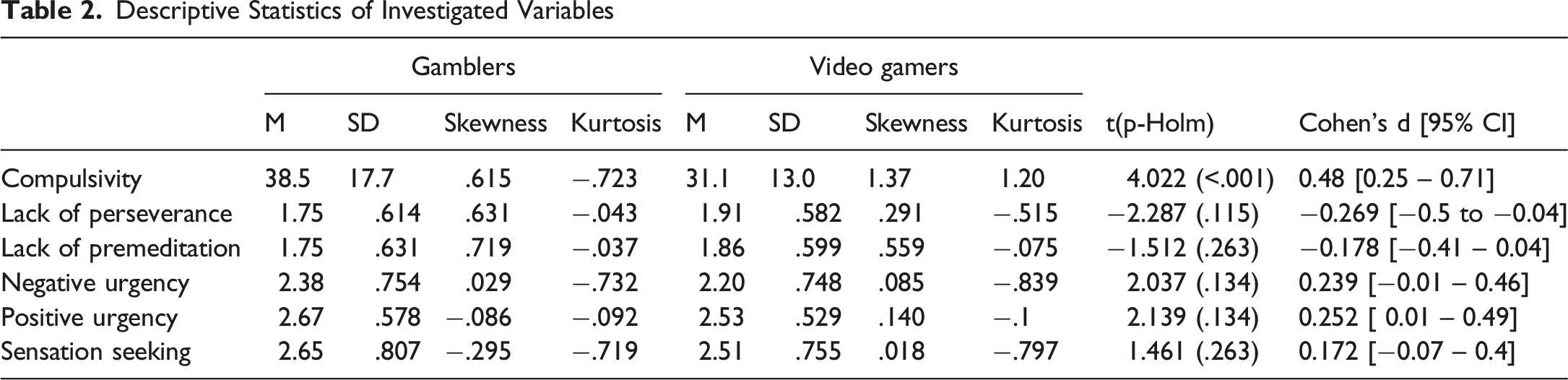
Independent samples t tests were conducted to compare group means, controlling the family-wise error rate for multiple hypothesis tests using the Holm–Bonferroni procedure. As shown in Table 2, a statistically significant difference was found in compulsivity, with gamblers scoring higher than video gamers. No significant differences were observed for any of the impulsivity measures.
Correlation Matrix of Compulsivity and Five Dimensions of Impulsivity

Influential data points were assessed through a scatterplot of leverage versus Cook’s distance (Figure S1 from the Supplementary Materials). Although some cases exceeded the conventional Cook’s distance threshold of 4/n, none approached values typically indicative of problematic influence (i.e., >1), suggesting no substantial distortion of model estimates. Regarding the distribution of residuals, a visual inspection of the histogram indicated approximate symmetry with some irregularities, while the Q–Q plot revealed notable deviations from normality in the tails. In addition, the residuals-versus-fitted plot showed evidence of non-constant variance, with a non-random loess curve and varying residual spread across fitted values. These patterns are indicative of heteroscedasticity.
Robust Linear Regression Predicting Compulsivity From Impulsivity Dimensions, Group, and Their Interactions (HC3 Standard Errors)

Note. Group was effect-coded (0 = gambler, 1 = video gamer).

Interaction plots between impulsivity and group on compulsivity
Each panel depicts the relationship between one impulsivity dimension (centred) and compulsivity, separately by group. Solid lines represent group-specific regression slopes and the shades their corresponding 95% CI.
Discussion
The present study examined how different dimensions of impulsivity relate to compulsivity among individuals engaged in gambling and video gaming. Although no global differences in impulsivity emerged between groups, gamblers displayed higher compulsivity scores, and interaction effects revealed distinct patterns in the way urgency facets predicted compulsivity. Specifically, positive urgency was strongly associated with compulsivity in gamblers, whereas in gamers, compulsivity was more closely tied to negative urgency, with positive urgency showing little influence. These results point to disorder-specific routes by which emotional dysregulation translates into rigid behavioural engagement.
From a clinical perspective, the stronger link between positive urgency and compulsivity in gambling suggests that states of excitement and reward anticipation may drive repetitive behaviour even when outcomes are unfavourable. This pattern is consistent with neurocognitive models of gambling disorder that emphasise reinforcement processes and frontostriatal dysfunction, whereby heightened reactivity to reward cues narrows behavioural repertoires and undermines voluntary control (Robbins et al., 2012; Van Timmeren et al., 2018). In contrast, the compulsive features of gaming appear less dependent on reward-driven urgency. Instead, the association with negative urgency highlights a pathway in which maladaptive attempts to regulate distress or aversive mood sustain rigid play. This finding aligns with prior evidence linking problematic gaming to inhibitory-control deficits and emotion regulation difficulties rather than to reinforcement mechanisms alone (Kim et al., 2017; Lee et al., 2019). Thus, while both behaviours share a compulsive dimension, the underlying emotional drivers differ, offering an explanation for inconsistent reports of a unitary impulsivity–gaming disorder link (Deleuze et al., 2017).
These findings refine the conceptualisation of behavioural addictions by showing that impulsivity is not a uniform vulnerability factor but instead interacts with affective context to shape compulsivity in disorder-specific ways. In gambling, urgency linked to positive affect appears central, whereas in gaming, distress-related impulsivity plays a more prominent role. Such differentiation has important implications for diagnosis. It suggests that compulsivity in gambling and gaming should not be understood as identical phenomena and that diagnostic frameworks should take into account the distinct affective mechanisms underpinning each disorder. Clinically, the results support the need for tailored interventions: gamblers may benefit from approaches that target reward sensitivity and reinforcement contingencies, while interventions for gamers might focus more on emotional awareness, stress regulation, and adaptive coping strategies.
From a neurobiological perspective, these distinct profiles likely reflect different neural substrates. The association between positive urgency and gambling aligns with established models of frontostriatal dysfunction, where hypersensitivity to reward cues weakens voluntary control (Robbins et al., 2012; Van Timmeren et al., 2018). Conversely, the link between negative urgency and gaming points to deficits in prefrontal regions responsible for emotion regulation, suggesting that compulsive gaming functions primarily as a strategy to manage distress rather than to seek reward (Kim et al., 2017; Weinstein & Lejoyeux, 2020).
To date, most studies on video gamers have focused on samples composed of users of one or two specific video game genres, which limits the generalisability of the findings (Şalvarlı & Griffiths, 2019). One of the strengths of the present study lies precisely in the diversity of video game genres reported by the participants, allowing for a more representative approach to the phenomenon of problematic video game use. Additionally, 15% of the video gamers assessed met the diagnostic criteria for IGD, which reinforces the clinical validity of the sample and enhances the relevance of the results obtained. Another noteworthy strength is the population on which the study was conducted: Ecuadorian young adults. Including samples from cultural contexts that differ from those typically explored in the literature helps to expand the global understanding of the effects of excessive video game use and allows researchers to examine whether the neuropsychological implications reported in previous studies replicate beyond Western and Anglophone contexts.
Furthermore, the demographic disparities observed between the groups—specifically the younger average age of video gamers compared to gamblers—likely reflect the intrinsic ecological characteristics of these populations within the Ecuadorian context. Importantly, supplementary analyses including age and gender as covariates confirmed that these variables did not alter the significance of the main findings. This suggests that the disorder-specific pathways between urgency and compulsivity reported here are robust mechanisms, rather than artefacts of the demographic differences between the samples.
Limitations and Future Directions
However, it is important to acknowledge some limitations of the study. First, the online data collection, while efficient, limited control over testing conditions, potentially affecting response validity. Second, the cross-sectional design precludes causal inferences; consequently, the findings must be interpreted strictly as associations, not causal effects. Regarding sampling, two specific issues must be noted: the imbalance in clinical severity between groups (54% of gamblers vs. ∼15% of gamers meeting clinical cut-offs) may have influenced the strength of observed associations; and, although recruitment targeted distinct communities, the study did not explicitly screen for cross-participation, meaning overlapping behaviours cannot be entirely ruled out.
Crucially, as participants were recruited based on regular engagement rather than formal diagnosis, these findings primarily illuminate the interplay between impulsivity and compulsivity across a continuum of use. While identifying potential maintenance factors, replication in strictly clinical populations is necessary to confirm applicability to severe addiction. Additionally, the reliance on retrospective self-reports introduces potential recall bias. Future research should employ Ecological Momentary Assessment (EMA) to capture real-time fluctuations, clarifying whether the disorder-specific pathways identified here—specifically positive urgency in gambling versus negative urgency in gaming—operate as immediate antecedents to behavioural enactment.
Conclusion
In conclusion, the present findings demonstrate that while gamblers and gamers do not differ globally in impulsivity, compulsivity is higher among gamblers and its association with urgency facets differs across groups. These results suggest that executive dysfunction and positive-affect urgency play a larger role in gambling-related compulsivity, whereas negative urgency and maladaptive regulation of distress are more salient in gaming. Such disorder-specific mechanisms call for a re-evaluation of current assumptions about the role of impulsivity in behavioural addictions and support the refinement of diagnostic criteria and interventions tailored to the emotional and cognitive profiles of each group.
Supplemental Material
Supplemental Material - Differences in the Relationship Between Impulsivity and Compulsivity Between Video Gamers and Gamblers
Supplemental Material for Differences in the Relationship Between Impulsivity and Compulsivity Between Video Gamers and Gamblers by María Jara-Rizzo, Diego Erazo-Pérez, José C. Perales, Jose A. Rodas in Psychological Reports
Footnotes

Ethical Considerations
This study is part of the FCI-058-2023 Project (Competitive Research Fund), approved by the University of Guayaquil, Ecuador. University High Council resolution (No. R-CSU-UG-SE34-313-14-09-2023) on Month 09,2023. Additionally, the project has received ethical and scientific approval from the Research Committee of the Psychology Programme at Universidad Ecotec, Ecuador, CERTIFICATE No. 16-08-03-2024. The study complies with ethical standards and research protocols in psychology, ensuring participant protection in accordance with the Declaration of Helsinki of 1964 and its subsequent amendments.
Consent to Participate
Participants were assessed virtually and anonymously using the PsyToolkit platform. After being informed about the assessment process, they gave their consent by clicking the “I agree to participate” button.
Author contributions
MJR: Conceptualization, Methodology, Investigation, Data Curation, Writing – Original Draft, Project Administration, Resources, Supervision, Writing – Review & Editing
DEP: Investigation, Writing – Original Draft
JCP: Conceptualisation, Data Curation, Writing – Review & Editing
JAR: Methodology, Formal Analysis, Funding acquisition, Investigation, Writing – Original Draft
Funding
The authors disclosed receipt of the following financial support for the research, authorship, and/or publication of this article: This work was supported by the University College Dublin.
Declaration of Conflicting Interests
The authors declared no potential conflicts of interest with respect to the research, authorship, and/or publication of this article.
Data Availability Statement
Supplemental Material
Supplemental material for this article is available online.
Author Biographies
References
Supplementary Material
Please find the following supplemental material available below.
For Open Access articles published under a Creative Commons License, all supplemental material carries the same license as the article it is associated with.
For non-Open Access articles published, all supplemental material carries a non-exclusive license, and permission requests for re-use of supplemental material or any part of supplemental material shall be sent directly to the copyright owner as specified in the copyright notice associated with the article.
