




Abstract
This study investigates the effect of self-control on discrimination against groups with perceived controllable and uncontrollable stigmas by experimentally manipulating state self-control. Sixty-nine university students in Canada completed either an ego depletion task intended to temporarily reduce their ability to exert self-control (depletion condition) or a similar task that did not affect self-control (control condition), and then filled out a measure assessing their discrimination against various groups. Results showed that participants in the depletion condition displayed greater discrimination against an uncontrollable stigma group (cutting more funds from the Arabs Association) than did participants in the control condition, but less discrimination against perceived controllable stigma groups (cutting less funds from the Smokers Rights Association and the Fat is Beautiful groups). These findings suggest that ego depletion may exacerbate biases against groups with inherent, unchangeable characteristics, but reduce negative biases towards groups whose stigma may be perceived as controllable.
In everyday life, individuals often engage in social interactions that require the reliance on self-control to regulate their responses. As they navigate their social surrounding, their ability to regulate emotions, attitudes, and behaviours can fluctuate, potentially influencing how they perceive others, including stigmatized individuals. Recent research has emphasized the central role of self-control in shaping social behaviour, demonstrating that its depletion can affect how individuals manage conflict, aggression, and other interpersonal dynamics (Dang et al., 2021; Inzlicht et al., 2021; Ma et al., 2025). Exploring this relationship is crucial, as it can offer insights into how lapses in self-control influence social perceptions and behaviours.
Self-control refers to one’s capacity to regulate one’s thoughts, emotions, and behaviours to achieve desired goals (Inzlicht et al., 2021). It is often conceptualized as an expendable resource, like a muscle, that becomes depleted with repeated use and requires time to recover (Dang et al., 2021). This “strength model” of self-control, proposed by Baumeister et al. (1998), has sparked extensive research on how experimental manipulations of self-control, known as ego-depletion tasks, impact subsequent behaviour and attitudes.
The concept of ego-depletion suggests that exerting self-control in one task reduces performance in subsequent self-control tasks (Baumeister et al., 1998; Dang, 2018; Friese et al., 2019). However, the effect of ego-depletion has also been a subject of debate in recent years, with some work suggesting that ego-depletion primarily impairs goal maintenance (i.e., the ability to uphold task-relevant goals in the face of distractions due to motivational and attentional shifts), rather than uniformly weakening all self-control processes, and other large-scale replication attempts failing to find evidence for ego-depletion (Hagger et al., 2016). With the ongoing argument of the existence of ego-depletion, Friese et al. (2019) conducted a narrative review and analysis on both arguments against ego-depletion (e.g., publication bias, p-hacking, null replications) and those supporting ego-depletion (e.g., limitations of replication attempts, evidence from moderator/mediator studies, absence of “reverse depletion” effects, real-world behavioural evidence). They concluded that both skeptics and proponents lack definitive proof of their arguments and that the evidence of ego-depletion remains inconclusive.
Dang (2018) took a slightly different approach by conducting separate analyses for each ego-depletion task in the literature (e.g., attention essay, emotional video, Stroop, food temptation, thought suppression, working memory). The results of their meta-analysis suggested that ego-depletion is not conclusively disproven, but its existence depends heavily on the specific depletion task used, with emotional video tasks appearing to be the most reliable. More recent multilab research using the Stroop task for ego-depletion has also found support for a small but significant effect (Dang et al., 2021). Additionally, current hypotheses of ego-depletion theory and research strongly support the idea of ego-depletion as a replicable phenomenon that warrants continued investigation (Baumeister et al., 2024; Baumeister & Tice, 2022).
In a recent review, Baumeister et al. (2024) addressed replication concerns by re-evaluating how ego-depletion has been tested and interpreted. They argued that many failed replication studies used weak, brief, or low-demand depletion tasks that were unlikely to meaningfully tax self-control. Whereas recent studies that employ stronger, longer, and more effortful self-control manipulations tend to show more reliable depletion effects (Baumeister et al., 2024). The authors also highlighted that contemporary research has refined the “strength model” to focus more on resource conservation, motivation, and strategic allocation of effort rather than simple exhaustion. Recent studies have also explored the different dimensions of ego-depletion, such as fatigue, emotional regulation disorder, work burnout, low self-efficacy, social withdrawal, somatic distress, low adherence, working memory loss, and low processing fluency (Ying et al., 2023). Instead of treating ego-depletion as a single underlying factor, the researchers modelled it as a system of interacting components and found that all the components were positively interconnected, with fatigue, low self-efficacy, and emotional regulation disorder as the most central and strongly connected nodes in the network (Ying et al., 2023). These findings indicate that ego-depletion may operate as an interlinked web of psychological and physical states.
Indeed, laboratory studies have shown that ego-depletion impairs performance on effortful tasks (Hagger et al., 2010; Schmeichel et al., 2003) and temporarily reduces constructive conflict management while increasing aggression (Cheng et al., 2024; Stucke & Baumeister, 2006). Supporting this perspective, earlier research on cognitive busyness has also shown that when people’s cognitive resources are taxed, they are less able to suppress stereotypical thinking and more likely to rely on automatic biases (Crisp et al., 2004). This conceptual overlap suggests that ego-depletion, which also reduces cognitive capacity, may increase reliance on default or automatic social responses, including prejudice and subtle biases. For instance, Doyle et al. (2024) examined teacher biases on students’ socioeconomic status and ethnicity, where they had participants grade students’ work while performing a simultaneous listening task, which taxed their cognitive resources. Under high cognitive load, participants relied more on stereotypes, favouring affluent White students over lower socioeconomic or minority students. These findings demonstrate that cognitive busyness may impair the ability to suppress biased judgments, consistent with research on ego-depletion and resource-limited self-control in social evaluation.
Given the link between depleted cognitive resources and increased reliance on automatic responses, it is important to understand the implications of ego-depletion on social behaviour, raising questions about its potential impact on other interpersonal processes, including prejudice and discrimination. As a behavioural manifestation of prejudice, discrimination can be influenced by one’s ability to regulate their attitudes and actions (Legault et al., 2007). Since ego-depletion impairs cognitive and emotional regulation (Wagner & Heatherton, 2013), it is important to understand whether and how it might alter discriminatory tendencies. A recent systematic review examining ego-depletion in the context of intergroup relations and social hierarchies found that dominant group members experienced depletion when suppressing biases during interactions with subordinates, which increased their prejudice and stereotyping (Turhan & Kuşdil, 2025). Subordinate group members also experienced depletion when engaging in intergroup interactions or encountering bias and bias-related threats, and under depletion, they were less likely to perceive prejudiced behaviours and more likely to evaluate dominant group members positively (Turhan & Kuşdil, 2025). These findings suggest that ego-depletion may contribute to the maintenance and reinforcement of discrimination and group-based hierarchies.
Although previous research has shown links between ego-depletion and various social behaviours, there is a lack of studies directly examining how reduced self-control affects discriminatory actions towards different stigmatized groups. This study aims to fill this gap by investigating how reduced self-control impacts actions toward groups with different types of stigmas, specifically groups with supposedly controllable stigmas and those with uncontrollable stigmas.
Study Overview
We examine how diminished self-control influences discrimination against groups with controllable stigmas (those perceived to have control over their condition) and uncontrollable stigmas (such as racial minorities). We randomly assigned participants to complete either an ego-depletion task designed to temporarily reduce self-control or a similar task that did not similarly reduce self-control. Following these tasks, participants were led to believe that they were recommending budget cuts to a list of student groups.
Two groups represented perceived controllable stigma groups: the Fat is Beautiful and the Smokers Rights Association. Having a perceived controllable stigma can be particularly difficult as people tend to have much harsher reactions to others whose stigmas can be explained by a lack of self-control (Broomhead, 2019; Dijker & Koomen, 2003; Wirtz et al., 2016). The Fat is Beautiful group represented individuals who are overweight, a condition often perceived by society as within an individual’s control (Campbell, 2022; Crandall, 1994). Research has shown that the general public tends to attribute obesity primarily to personal responsibility rather than genetic or environmental factors (Puhl & Heuer, 2009; Sikorski et al., 2011). Similarly, the Smokers Rights Association represented smokers who choose to continue smoking as an expression of personal freedom and individual choice. Stuber et al. (2008) argue that perceiving smoking as controllable behaviour contributes to its social stigmatization, with smokers seen as not exercising self-control for a harmful impulse. Additionally, Baumeister (2017) noted that while smoking initiation is voluntary, addiction to it involves a gradual erosion of self-control. Because the stigma associated with being overweight and smoking may be construed as controllable (within an individual’s control), the Fat is Beautiful and the Smokers Rights Association were selected to represent groups with a perceived controllable stigma in the study.
In contrast, the Arabs Association was chosen to represent a group with an uncontrollable stigma, as being Arab cannot be conceived as a behavioural choice or within control. In North America, particularly after 9/11, individuals of Arab descent have faced significant increases in negative profiling and discrimination. Widner and Chicoine (2011) demonstrated this bias in employment, finding that resumes with Arab-sounding names were significantly less likely to receive job interview callbacks. More recent research by Awad et al. (2019) further documented the challenges faced by people of Middle Eastern descent, revealing that Arabs experience ethnic discrimination across various settings, including educational institutions, civil organizations, and workplaces. Because the stigma associated with being Arab is rooted in race or ethnicity (factors clearly beyond an individual’s control), this group was selected to represent an uncontrollable stigma in the study. We hypothesized that reduced self-control would increase discrimination against the uncontrollable stigma groups. The depletion of self-control may impair the ability to suppress automatic prejudices, as maintaining non-prejudiced responses typically requires cognitive effort (Devine, 1989). When this effort is compromised, individuals might be more prone to act on ingrained biases, resulting in heightened discriminatory actions.
We also hypothesized that reduced self-control would decrease discrimination against the perceived controllable stigma groups. We reasoned that experiencing a dip in one’s own self-control may increase empathy for others perceived to struggle with it. This reasoning aligns with research suggesting that shared experiences of vulnerability, such as diminished self-regulation, can foster identification and reduce intergroup bias (Behler & Berry, 2022; Zheng et al., 2023). The shared experience of diminished self-regulation may lead to being more forgiving and understanding, thus reducing the tendency to discriminate against those with perceived controllable stigmas. Critically, we propose that this effect may be specific to this perceived controllable stigma type, as the cognitive process of evaluating a “controllable” stigma differs from applying automatic stereotypes. Whereas some biases are implicit and may be unleashed under cognitive load, judgments of responsibility and blame for controllable conditions require more deliberative processing (Crisp et al., 2004; Govorun & Payne, 2006). Therefore, ego-depletion may lead to less discrimination against these groups precisely because the mental work of condemning someone for a “controllable” failing becomes too cognitively costly. We also included a list of neutral groups with no associated stigma and did not hypothesize the depletion to affect behaviour toward these groups.
Method
Participants
Sixty-nine students at a mid-sized Canadian university participated in this study in exchange for a partial course credit. Participant average age was 20 (range of 18 to 42); 54 self-identified as females and 15 as males; and 92.8% reported that they were born in either Canada or the United States. Approval was granted from the University of New Brunswick Research Ethics Board (and is on file as REB 2011-121).
Materials and Procedure
After consent, participants took part in an in-person laboratory session comprising the following tasks and measures.
Demographics
Information about age, sex, and birth region.
Experimental Manipulation
An ego-depletion methodology was adapted from Baumeister et al. (1998) to experimentally manipulate participants’ self-control. Participants in both the control and the experimental (depletion) conditions were given an excerpt from Hauser (1964)’s “Anting by Grey Squirrels” to operate on for the purposes of this task 1 . The excerpt was divided in half, with approximately 693 words for the first half and 643 words for the second half (in accordance with the methodology of Baumeister et al., 1998). All participants were given the first part of the excerpt and instructed to cross out every instance of the letter E/e. Next, Control condition participants were instructed to continue to cross out every instance of the letter E/e, and depletion condition participants were instructed to cross out every instance of the letter E/e except for those which occur immediately before, or two spaces after a vowel (in accordance with Baumeister et al. (1998)’s ego-depletion method). The task in the depletion condition required participants to develop a pattern of behaviour, and then override it, which is taxing on their mental resources and results in exertion and depletion of self-control.
Manipulation Check
The manipulation check was adapted from Finkel and colleagues (2006) to measure the degree to which participants feel mentally taxed after completing the crossing-out-letters task. 2 Participants rated how well each of the two statements reflected their experience with the task they just completed (e.g., “At the end of these tasks, I felt mentally drained,” “At the end of these tasks, I felt tired.”) on a 5-point Likert-type scale from 1 (strongly disagree) to 5 (strongly agree).
Discrimination Measures
Discrimination was measured subtly (See Supplemental Material) with a methodology adapted from Son Hing et al. (2002). Participants were led to believe that they were recommending budget cuts to a list of eleven student groups to the University Student Union. The experimenter distributed a budget-cut form to participants after they had finished the rest of the study as if it were not part of the study but rather a favour to the University Student Union. A fictitious letter was drafted for the purposes of this measure of discrimination, from a fictional member of the Student Union, asking for participants’ input on budget cuts to a list of student groups. The letter asked participants to cut a total of $1000 from 11 different student groups. Two groups represented perceived controllable stigma groups: the Fat is Beautiful and the Smokers Rights Association. One group represented the group with a perceived uncontrollable stigma: the Arab Association. The remaining eight groups were considered neutral, with no associated stigma (e.g., Cooking Club, the Model Train Club).
The amount cut from each group was our measure of discrimination. Participants were then fully debriefed, given a chance to ask questions, and offered the option to exclude their data via a post-debriefing consent form. No participants raised concerns or requested exclusion.
Results
We combined the two manipulation check questions as they correlated highly, r (67) = .77, p < .001, and then conducted an independent samples t-test. Results showed that depletion condition participants (M = 3.41, SD = 1.27) reported feeling more drained and tired to a marginally significant extent than control condition participants (M = 2.91, SD = 1.22), t (67) = −1.66, p = .10, d = .40.
We hypothesized that participants in the depletion condition would show less discrimination against the Fat is Beautiful and Smokers Rights Association groups but more against the Arabs Association compared to the control condition. Since budget cuts for Smokers Rights Association and Fat is Beautiful were highly correlated, r (67) = .75, p < .001, we averaged them and results of independent samples t-tests revealed that, as predicted, cuts were significantly smaller in the depletion (M = 123.84, SD = 67.58) than the control condition (M = 161.17, SD = 69.54), t (67) = 2.26, p < .03, d = .54. In contrast, participants in the depletion condition cut more from the Arabs Association (M = 85.74, SD = 73.39) than those in the control condition (M = 48.31, SD = 41.68), t (67) = −2.61, p = .001, d = .63. As expected, no significant differences emerged for the remaining unstigmatized groups, t (67) = −0.59, p = .56, d = .14, with similar budget cuts in the depletion (M = 83.56, SD = 21.36) and control (M = 80.63, SD = 19.79) conditions
3
. We then analysed each non-stigmatized group separately for differences between conditions. Only the Cooking Club showed a significant effect, with participants in the depletion condition cutting more (M = 86.95, SD = 59.18) than those in the control condition (M = 56.97, SD = 41.82), t (67) = −2.44, p < .02, d = .59). However, given that this was the only significant effect among the eight comparisons for non-stigmatized groups, it is likely a spurious result (Type I error) rather than a theoretically meaningful effect of ego-depletion. (See Figure 1). Mean and standard deviation of cuts to groups.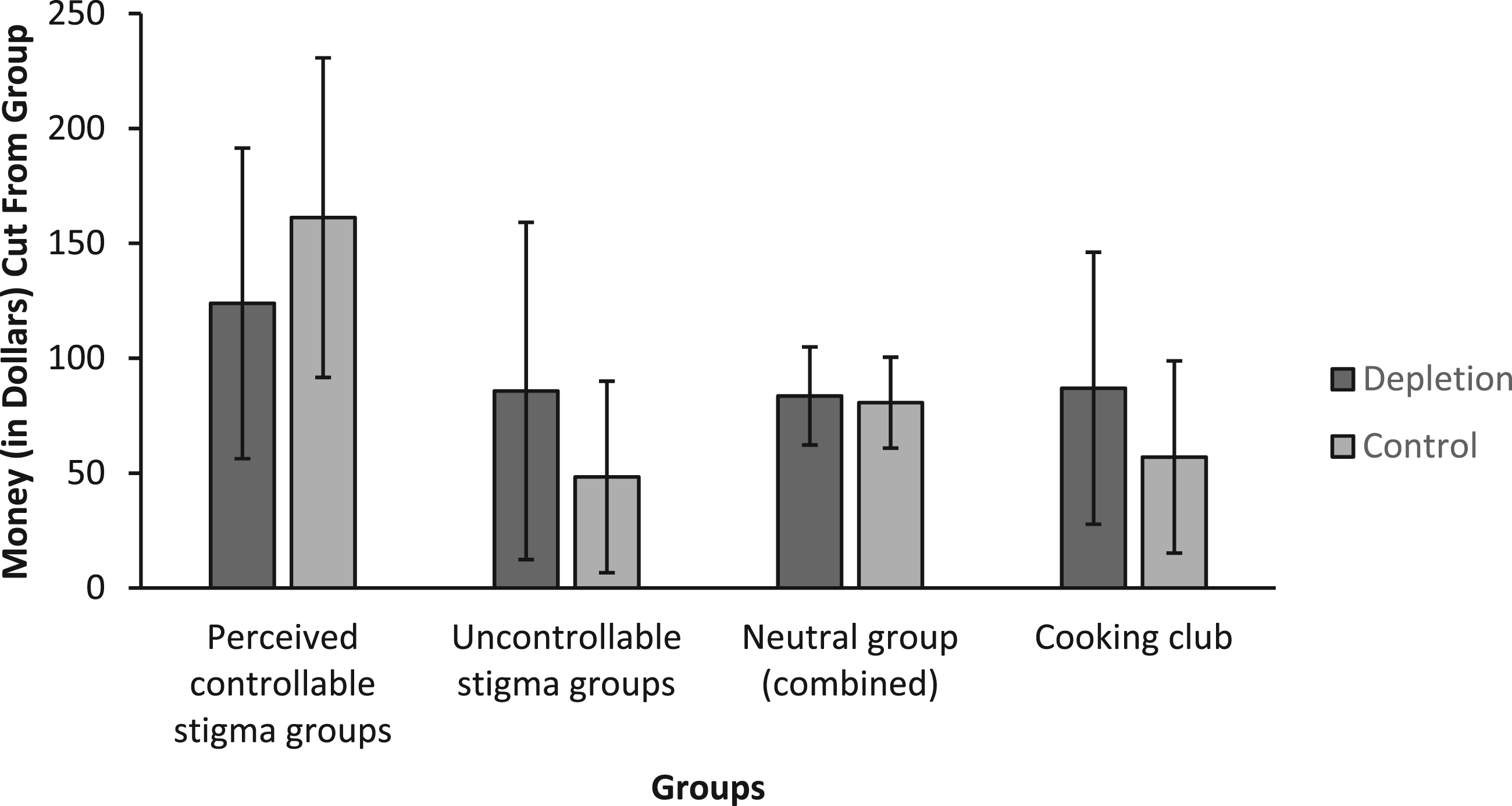
Discussion
This study examined the effect of ego-depletion on discrimination against various groups using an experimental design. The results indicate that depletion in self-control led to greater discrimination against a group with a perceived uncontrollable stigma (the Arabs Association) but reduced discrimination against groups with perceived controllable stigmas (the Fat is Beautiful group and the Smokers Rights Association). These findings contribute to the literature on self-control and bias expression, highlighting the complexity of how depletion of self-control influences discriminatory behaviour.
One possible explanation for these findings comes from prior research on self-control and stereotype application. Previous research suggests that ego-depletion may facilitate the application of stereotypes (Govorun & Payne, 2006; Roth et al., 2019; Zhang & Peng, 2020). Additionally, individuals who seek to avoid acting prejudiced may struggle to do so when depleted, leading to increased bias against out-group members (Baumgartner & Morgan, 2019; Muraven, 2008). Furthermore, reduced self-control has been found to impair the inhibition of aggression (Barlett et al., 2016; Stucke & Baumeister, 2006; Yang & Tang, 2021), which may contribute to acting on existing biases rather than suppressing them. The present findings align with these prior studies, reinforcing the idea that self-control plays a crucial role in regulating biases against racial stigmas.
A key novel finding of this study is that depletion of self-control reduces discrimination against groups with perceived controllable stigmas. To our knowledge, this is the first documented instance of such an effect, highlighting the potential impact of self-control depletion on mitigating biases against stigmatized groups. One interpretation of this effect is that depleted participants may identify more with individuals perceived to have low self-control, fostering empathy and similarity that mitigates discrimination (Behler & Berry, 2022; Richins et al., 2019; Zheng et al., 2023). An alternative, or perhaps complementary, explanation involves depth of processing. Although racial stereotypes may function as implicit attitudes that operate automatically (Anzures & Mildort, 2024; Dovidio et al., 2002; Vitriol & Banaji, 2024) and can be facilitated by ego-depletion (Govorun & Payne, 2006), stereotypes about individuals with perceived controllable stigmas may be more complex. Unlike racial stereotypes, these judgments may require greater cognitive evaluation to determine whether the stereotyped characteristic is harmful, helpful, or neutral. Research on cognitive busyness, suggesting that when cognitive resources are depleted, individuals would be less likely to engage in controlled processing required to suppress stereotypes or override default judgments, supports this distinction (Crisp et al., 2004). Since ego-depletion reduces cognitive resources, it may, in turn, decrease the likelihood of forming discriminatory judgments based on perceived controllable stigmas, as such judgments rely more on deliberative processing. In other words, individuals may lack the cognitive capacity to engage in evaluative scrutiny of these more ambiguous cases during ego-depletion, and hence default to less discriminatory or even empathic responses. Our study provides a foundational step in uncovering these dynamics, offering valuable insights into the differential impact of ego-depletion on biases across different types of stigmas.
Although this study offers valuable insights, it has limitations. First, the moderate sample size limits statistical power, and hence the findings should be interpreted with caution, given the ongoing scholarly debate surrounding the replicability of ego-depletion effects (e.g., Baumeister et al., 2024; Friese et al., 2019; Hagger et al., 2016). Second, the self-report manipulation check effect was marginally significant; however, because the most compelling evidence for a manipulation’s success is the observation of the hypothesized effects on the dependent variables (Hauser et al., 2018), the significant predicted effects observed in our study provide strong evidence that the ego-depletion manipulation was effective despite the limitation in the sensitivity of our measure of manipulation check. Third, the generalizability of our findings may be constrained by the limited set of stigmatized groups included in our dependent measures and the uneven sex distribution of our sample, though supplementary analyses confirmed that the primary results remained robust when controlling for participant sex. Finally, even though our experimental manipulation of self-control depletion was confined to short-term effects, the study’s ecological validity was strengthened by the use of a budget cut allocation task that participants perceived as a real-world decision. Nevertheless, the influence of chronic depletion remains an important direction for future research. Taken Together, the aforementioned considerations provide useful directions for future research, such as using a larger, more diverse sample and multiple robust measures of the depletion state to further refine our understanding of self-control and discrimination.
In addition to examining whether the groups are opinion-based (e.g., groups that people join because of shared beliefs, interests, or values) or social category-based (e.g., groups that people are ascribed to because of social categories like race/ethnicity, sex, age and so on), future studies can also conduct a more in-depth analysis by looking into the differences in group membership (i.e., chosen membership vs. unchosen membership). Individuals may belong to the same group for different reasons, for example, obesity resulting from voluntary overeating versus obesity arising from biological conditions. It would be interesting to examine how perceptions of chosen versus unchosen membership moderate the effect of ego-depletion on discrimination.
This study offers new insights into how temporary reductions in self-control affect discrimination, demonstrating that ego-depletion does not have a uniform effect but rather depends on stigma type. These findings highlight the complexity of self-control in social contexts, lay the groundwork for future investigations into the mechanisms behind these effects, such as depth of processing, empathy, and perceived similarity, and contribute to a deeper understanding of how self-regulation influences social behaviour.
Supplemental Material
Supplemental Material - Discrimination Under Ego Depletion: Differential Effects for Perceived Controllable and Uncontrollable Stigmas
Supplemental Material for Discrimination Under Ego Depletion: Differential Effects for Perceived Controllable and Uncontrollable Stigmas by Jordan Schriver, Mihailo Perunovic, W. Q. Elaine Perunovic, Naomi Levins in Psychological Reports
Footnotes
Acknowledgement
We thank the anonymous reviewers and the editor for their insightful comments on earlier versions, and all the participants for contributing to the research.

Ethical Considerations
This research was conducted in accordance with ethical guidelines. Ethics approval was granted from the University of New Brunswick Research Ethics Board (and is on file as REB 2011-121).
Consent to Participate
Informed consent was given prior completing the online survey.
Funding
The authors disclosed receipt of the following financial support for the research, authorship, and/or publication of this article: This work was supported by University Research Funding from the University of New Brunswick to the third author under Grant RF-EXP-2019-06.
Declaration of Conflicting Interests
The authors declared no potential conflicts of interest with respect to the research, authorship, and/or publication of this article.
Data Availability Statement
Supplemental Material
Supplemental material for this article is available online.
Notes
Author Biographies
References
Supplementary Material
Please find the following supplemental material available below.
For Open Access articles published under a Creative Commons License, all supplemental material carries the same license as the article it is associated with.
For non-Open Access articles published, all supplemental material carries a non-exclusive license, and permission requests for re-use of supplemental material or any part of supplemental material shall be sent directly to the copyright owner as specified in the copyright notice associated with the article.
