




Abstract
The uncertainty that surrounded the COVID-19 pandemic played a key role in the mental health experienced by people during that period. The present study examined the relation between future time perspective and mental health in the context of the COVID-19 pandemic and whether intolerance of uncertainty may play a mediating role in this relation. A sample of 349 university students (Mage = 23.57, 87.4% females) completed scales assessing future time perspective, intolerance of uncertainty, positive mental health and psychological distress. The path analysis indicated that future time perspective was negatively related to both psychological distress and intolerance of uncertainty. The negative implications were significantly linked with both positive mental health and psychological distress. Further, the negative implications mediated the relation between future time perspectives and both indicators of mental health. These results underlined intolerance of uncertainty as a potential mechanism that might explain the impact of future time perspective on mental health in the context of the COVID-19 pandemic. The results are discussed in terms of practical implications regarding future time perspective and intolerance of uncertainty on young people’s mental health.
Keywords
Introduction
Several theoretical models (e.g., the dual framework; Antaramian et al., 2010; Suldo & Shaffer, 2008) conceptualized mental health as a broader concept that consists of both positive mental health (e.g., emotional well-being) and mental health problems (e.g., psychological distress). Previous reviews and meta-analytic works consistently found that positive mental health is related to positive outcomes in various life domains, including higher academic achievement (Bucker et al., 2018) and better physical health (Hernandez et al., 2017), whereas psychological distress is linked with different negative outcomes, such as health-related problems (Barry et al., 2020) and problematic use of social media (Marino et al., 2017). During the COVID-19 pandemic people experienced a decrease in well-being and an increase in mental health problems, due to the large number of stressors to which people were exposed, such as higher risk of contracting the virus and unemployment (see Wang et al., 2020 for a meta-analysis). People also experienced a great amount of uncertainty surrounding the novel coronavirus (e.g., how the infection is spread, how to control it) and various changes in day-to-day life (e.g., disruption of daily routines) (Dodiță et al., 2023; Satici et al., 2022) that led to a “parallel pandemic” of mental health crisis, along with a physical health one (Mucci et al., 2020). Mental health problems were highly prevalent among young adults; given their low life experience they have difficulties in choosing the appropriate psychological resources and coping strategies when faced with COVID-19 pandemic (Fynes-Clinton & Addis, 2023). Further, exploring the factors related to mental health may be particularly relevant for university students due to various changes they experienced in social and educational settings, such as the opportunity to physically attend classes (Wang et al., 2020).
Future time perspective is particularly relevant for both positive mental health and mental health problems (Allemand et al., 2025), although there is limited evidence regarding its impact during the COVID-19 pandemic (see Carstensen et al., 2020; Hytman et al., 2023 for exceptions). The uncertainty and ambiguity that surrounded the COVID-19 pandemic led to less expansive orientation towards the future and to higher levels of fear of the unknown (i.e., intolerance of uncertainty), which might further contribute to people’s mental health problems (Regnoli et al., 2024). Given that university students experienced a multitude of losses, including loss of the opportunity to physically attend classes and of the milestone events, such as graduations (Scheinfeld et al., 2022), it is important to understand how university students’ perception of the future and coping with the uncertainty are related to their mental health. Further, there is limited evidence regarding how future time perspective (Wirth et al., 2024) and intolerance of uncertainty (Yang et al., 2021) are related to positive and negative indicators of mental health, especially on samples of young adults (i.e., university students). To add to the literature, the first goal of the study was to examine the relations between future time perspective and two indicators of mental health - positive mental health and psychological distress within the COVID-19 pandemic context. Further, we explored whether the intolerance of uncertainty might play a mediating role in the relations between future time perspective and mental health.
Future Time Perspective and Mental Health
According to the socio-emotional selectivity theory (Carstensen, 2006; Lang & Carstensen, 2002), the future time perspective refers to a cognitive representation (in the present) of the future, in terms of developing expectations and setting future goals. This theoretical model emphasizes the role of time in motivation (i.e., formulating goals) and well-being (Carstensen, 2021). There are individual differences in people’s perception of future time horizon. When people (typically young adults) perceive time as expansive or open-ended, they tend to set distant (informational) goals (e.g., to acquire new information, skills), and also to plan and act, in the present, in order to optimize their distant future (Carstensen, 2021). A limited perspective toward the future (i.e., limited time horizons) makes people (typically older adults) more prone to focus on short-term (emotional) goals, acting in ways that are meant to reduce negative experiences and to optimize positive ones. People who perceive their future time as extended, meaningful and full of opportunities are more likely to experience higher well-being, whereas those who perceive future time as limited are more likely to experience a decrease in well-being (Carstensen, 2006, 2021). The impact of a limited time horizon on well-being is more harmful in young adults, when it might express the impossibility of attaining future goals, than in middle and older adults, when it could indicate an adjustment to less time left in life (Carstensen, 2021).
Previous studies provided empirical support for the relation of future time perspective with both positive and negative indicators of mental health. Specifically, a limited future time perspective was related to higher levels of mental health problems (e.g., depression, anxiety and stress) on samples of middle-aged adults (e.g., Allemand et al., 2025; Bergman & Segel-Karpas, 2018). A higher focus on future opportunities was linked with fewer depressive symptoms and low levels of negative emotions on samples of adults and older adults (e.g., Kozik et al., 2014; Lalot et al., 2021). Further, middle aged and older adults who reported expansive future time perspectives experienced higher levels of positive affect, satisfaction in life and subjective well-being (e.g., Allemand et al., 2012; Kozik et al., 2014).
According to this model (Carstensen, 2006; Carstensen et al., 2020), disturbing life events (e.g., political events, pandemics) might influence the way people perceive their future horizons by emphasizing the fragility of life and proximity to death. These events might shift people perception of future time toward a limited perspective impacting their mental health (Newton et al., 2022). Inconsistent findings were reported in previous research. Some studies suggested that, after experiencing of a negative event, as terrorist attacks or SARS pandemic, people, regardless their age, who had a limited perspective toward future experienced high levels of well-being (e.g., Fung & Carstensen, 2006), whereas other studies found this relation only on sample of older adults but not on younger adults (e.g., Lin et al., 2002).
Limited studies investigated these relations during the COVID-19 pandemic, which was unique in its length and the extent of protective measure compared to other pandemic crises. Specifically, a limited future time perspective was related to increased levels of depression in samples of middle-aged adults (e.g., Fynes-Clinton & Addis, 2023; Lalot et al., 2021). Further, adults and older participants reporting an expansive future time perspective experienced higher intensity of positive emotions or high levels of psychological well-being (Carstensen et al., 2020; Hytman et al., 2023; Lalot et al., 2021). Fewer studies investigated these relations on samples of young adults (Wirth et al., 2024). The existent findings indicated that college students who reported limited future perspective experienced increased symptoms of depression, anxiety and perceived stress within the COVID-19 pandemic context (e.g., Lind et al., 2022; Smith et al., 2024). Conversely, college students having an expansive future perspective reported higher levels of subjective well-being (Smith et al., 2024). It is possible that when people deal with this global pandemic, an expansive future perspective might be a protective factor for their mental health, given that it helps people to currently focus on activities oriented to attain the desired future goals and, thus to distance themselves from the uncertain and ambiguous present.
To advance the literature, our first goal was to explore how future time perspective was related to mental health indicators on a sample of university students in the context of the COVID-19 pandemic. Based on the socioemotional selectivity theory (Lang & Carstensen, 2002) and the empirical findings presented above, we expected that an expansive future time perspective would be positively related to positive mental health and negatively related to psychological distress.
Intolerance of Uncertainty and Mental Health
According to the Carleton’s model (2012, 2016), intolerance of uncertainty represents a dispositional incapacity to face the negative responses caused by this absence of salient or sufficient information. It can be described as difficulty in handling the response to different aversive situations, especially when individuals do not have sufficient information and perceive it as uncertain. The intolerance of uncertainty may increase the perceived threat related to an event by overestimating the possibility of a negative outcome or amplifying its negative consequences (Buhr & Dugas, 2002; Carleton, 2016). Thus, some theorists distinguish between the two dimensions of intolerance of uncertainty: negative implications (beliefs that uncertainty might impair one’s performance and reflect poorly on an individual’s character) and unfairness (beliefs that the future is unfair and disturbing) (Sexton & Dugas, 2009).
Further, the worry theoretical model (Freeston et al., 1994, 2020) conceptualizes intolerance of uncertainty as a dysfunctional schema that can be activated when people face situations or events about which they do not have sufficient information and perceive it as uncertain and thus might influence the way people cognitively process information about these ambiguous situations. The higher people’s levels of intolerance to uncertainty, the more they will perceive the uncertainty surrounding a certain situation as aversive, which will further lead to uncertainty (anxiety and worry) distress (Freeston et al., 2020). According to this model (Freeston et al., 2020), the activation of a dysfunctional (uncertainty) cognitive schema in an ambiguous situation might have negative consequences, including emotional ones (e.g., worry, anxiety). Thus, when faced with a negative situation surrounded by uncertainty (e.g., COVID-19 pandemic), the difficulty in tolerating the lack of information and ambiguity could be considered a risk factor for people’s mental health (Carleton, 2012, 2016).
Some previous studies conducted before the COVID-19 pandemic indicated that high levels of intolerance of uncertainty (e.g., Lally & Cantillon, 2014), as well as an overestimating the possibility of a negative outcome (i.e., negative implications) or the negative consequences (i.e., unfairness) (e.g., Sexton & Dugas, 2009) were positively related to high levels of mental health problems, including depressive symptoms, psychological distress, generalized anxiety or somatic anxiety in samples of young adults (e.g., university students). Similar findings were reported through different stages of the pandemic on samples of adults of various ages. Specifically, adults who reported high levels of intolerance of uncertainty experienced high levels of anxiety, depression and distress during the lockdown (e.g., Reizer et al., 2021; Rettie & Daniels, 2021) as well as when social restrictions were less severe (e.g., Bavolar et al., 2021). Further, greater intolerance of uncertainty was linked to poorer positive mental health, including mental well-being and happiness (e.g., Bavolar et al., 2021; Morriss et al., 2023; Satici et al., 2022). Overall, these findings indicate that intolerance of uncertainty represents a key factor in adults’ mental health during the COVID-19 pandemic, a period of great uncertainty.
Limited research explored these relations on samples of young adults during this period. The existing studies showed that university students reporting higher levels of (global) intolerance of uncertainty (Altan-Atalay et al., 2024; Marín-Chollom & Panjwani, 2023) or COVID-19 intolerance of uncertainty (Wu et al., 2021) were more likely to experience higher symptoms of depression, anxiety and stress. To our knowledge, the role of intolerance of uncertainty on positive mental health was not previously explored in samples of young adults. Further, there is no evidence regarding the specific role of the negative implication and unfairness dimensions of intolerance of uncertainty on mental health.
To add to the previous research, we investigated how intolerance of uncertainty dimensions would relate to mental health indicators on a sample of university students. Based on the worry theoretical model (Freeston et al., 1994, 2020) and previous studies (e.g., Altan-Atalay et al., 2024), we expected that the greater negative implications and unfairness would be negatively linked with positive mental health and positively related to psychological distress.
Future Time Perspective and Intolerance of Uncertainty
The construal level theory (Trope & Liberman, 2003, 2010) states that the perception of temporal distance (high or low) might influence the way that people emotionally respond to future events. Adopting a more psychologically distant perspective towards future can help individuals to cope with the current negative events and the uncertainty surrounding them (Trope & Liberman, 2010). In other words, a more extended future time perspective can help individuals to have a better tolerance of the present uncertainties by focusing them on current activities and situations in order to attain their distant future goals.
There is limited empirical evidence testing this relation, in general, and especially in the pandemic context. Several empirical studies conducted before the COVID-19 pandemic reveal that both adolescents and college students with greater future time perspective (e.g., focused on distant future outcomes) reported lower levels of global intolerance of uncertainty (Du & Lyu, 2021; Yang et al., 2021). Another study, carried out during the COVID-19 pandemic, showed that the shorter the planning future time perspective, the higher the intolerance of uncertainty was in a sample of adults (Hromova, 2022). No previous study explored how future time perspective was related to the specific dimensions of intolerance of uncertainty.
To advance the literature, our study explored the relation between future time perspective and the negative implication and unfairness dimensions of intolerance of uncertainty during the COVID-19 pandemic. Based on the theoretical models and previous limited empirical studies presented above, we expected that university students who reported an expansive future time perspective would experience lower levels of beliefs regarding the negative consequences of uncertainty on performance and/or character and the beliefs that the future is unfair. Given the lack of previous evidence on these relations, these hypotheses are explanatory of its nature.
Intolerance of Uncertainty as a Mediator
The construal level theory (Trope & Liberman, 2003, 2010) states that temporal distance from future events has an important role in the way individuals respond to present situations by modifying the cognitive representation of those events. Individuals who have a more expansive future time perspective, are more able to psychologically distance themselves from the uncertainty of the present situations and, thus, tolerate them better. In this way, they gain a broader perspective of their actual situation and are less prone to experience the negative impact of uncertainty and thus they experience fewer mental health problems (Trope & Liberman, 2003). According to the worry theoretical model (Freeston et al., 2020), an ambiguous situation might accentuate people’s negative attitude towards the future, which might lead to higher levels of fear of the unknown (i.e., intolerance of uncertainty), which in turn could lead to increased levels of mental health problems and decrease in well-being.
Only one study investigated the potential mediating role of intolerance of uncertainty on the relation between people’s perception of the future time and mental health (Regnoli et al., 2024). The findings indicated that young adults reporting higher levels of future anxiety also reported higher levels of intolerance of uncertainty and worry, which in turn were related to higher levels of psychological distress. Additional research is needed regarding the potential mediating role of intolerance of uncertainty in conditions in which people need to deal with negative, uncertain, ambiguous situations.
To add to the previous literature, our third goal was to explore whether intolerance of uncertainty would play a mediating role on the relationship of future time perspective with positive mental health and psychological distress experienced by university students during the COVID-19 pandemic. Based on previous theoretical models (Freeston et al., 2020; Trope & Liberman, 2003) and limited empirical evidence (Regnoli et al., 2024), we expected that an expansive future time perspective would be negatively related to the intolerance of uncertainty (i.e., lower negative implications and decreased levels of unfairness), which further would be negatively linked with positive mental health and positively with psychological distress. These hypotheses are explanatory in their nature due to the lack of previous evidence on these relations.
Method
Participants and Procedure
After receiving the approval of the Research Ethics Committee, 500 university students from a Romanian university were invited to participate in this study. Of them, 349 university students agreed to participate (87.4% female), aged between 18–40, Mage (SD) = 23.57 (5.61). 62.2% were undergraduate students, and 37.8% were graduate students. Most of the participants were of Romanian ethnicity (98.3%), with the rest of them being of other ethnic groups, such as Hungarian (1.7%). Of them, 61%, lived in the urban area, whereas 39% lived in the rural area. Further, 87.7% of them were single (unmarried), and 12.3% were married. The data was collected through an online survey (December 2021–February 2022). The respondents were informed about the purpose of the study during their online learning activities, and each of them offered their consent to participate. They also were informed that their answers were confidential and their participation was voluntary. The university students were compensated with an extra credit course for their participation.
Measures
The scales assessing future time perspective and intolerance of uncertainty were translated from English to Romanian following the forward-backward translation strategy and adhering to the guidelines found in literature (Sousa & Rojjanasrirat, 2011). Two bilingual researchers were involved into translation process and differences in translations were discussed between the team members. A third researcher, an expert in mental health field, independently compared the translated version with the original version, and minor discrepancies were discussed with the research team members, resulting the final forms of each scale. The scale assessing psychological distress and positive mental health were previously used on Romanian samples.
Future Time Perspective
The Future Time Perspective scale (FTP; Lang & Carstensen, 2002) was used to assess the perception of the future. The scale consists of 10 items; participants rated their level of agreement regarding each affirmation on a 5-point Likert scale from 1 = very true to 5 = very untrue. Samples of items are “I could do anything I want in the future.”, and “I have the sense time is running out.” (reversed). Confirmatory factor analyses (CFA) indicated a good model fit for one-factor solution, χ2 (47) = 283.75, p < .001; comparative fit index (CFI) = .95; root mean square error of approximation (RMSEA) = .05, 90% CI [.049, .067], based the joint fit criteria (Hu & Bentler, 1999). The responses were summed across items, higher scores indicating a more expansive future time perspective (α = 0.86; McDonald’s ω = .90). The FTP has shown good psychometric characteristics (e.g., internal reliability) in previous studies (e.g., Bergman & Segel-Karpas, 2018).
Intolerance of Uncertainty
The Intolerance of Uncertainty scale (IU-27; Freeston et al., 1994) was used to measure the university students’ responses to ambiguous, uncertain situations. The scale consists of 27 items divided into two subscales: negative implications (15 items, e.g., “When I am uncertain, I can’t function very well.”) and unfairness (12 items, e.g., “One should always look ahead as to avoid surprises.”). Each item was evaluated using a 5-point Likert scale ranging from 1 = not at all characteristic of me to 5 = entirely characteristic of me. We tested the factorial structure of the IU-27 scale and the results indicated that the two-factor model fit better, χ2 (67) = 828.11, p < .001, CFI = .91, RMSEA = .06, CI 90% [.063, .075] than one-factor model, χ2 (61) = 1,376.77, p < .001, CFI = .80, RMSEA = .09, CI 90% [.093, .103]. A total sum score was computed for each dimension, higher scores indicating higher levels of negative implications (α = .92; McDonald’s ω = .93) and unfairness (α = .91; McDonald’s ω = .90). The scale has good psychometric properties as demonstrated in previous studies (Buhr & Dugas, 2002).
Psychological Distress
The Depression, Anxiety and Stress Scale (DASS-21; Lovibond & Lovibond, 1995), translated into Romanian by Dodiță et al. (2023), was used to assess psychological distress. The scale consists of three subscales, each subscale consisting of seven items: depression (e.g., “I found it difficult to work up the initiative to do things.”), anxiety (e.g., “I was aware of dryness of my mouth.”) and stress (e.g., “I felt that I was using a lot of nervous energy.”). Each item is rated from 0 = did not apply to me to 3 = applied to me very much or most of the time. The CFA analysis indicated that the one-factor model had a good fit to data, χ2 (179) = 486.30, p < .001; NFI = .90; CFI = .93; RMSEA = .07, 90% CI [.06, .07]. A total score was computed as the sum of all the items composing the three subscales (α = .89; McDonald’s ω = .95). The scale is widely used in psychology research, demonstrating its psychometric properties in various population including Romanian samples (e.g., Dodiță et al., 2023; Măirean et al., 2023).
Positive Mental Health
The Mental Health Continuum Short Form (MHS-SF; Keyes, 2002), translated into Romanian by Măirean et al. (2023), was used to measure the participants’ positive mental health. The scale consists of 14 items measuring three subscales: emotional well-being (3 items; e.g., “During the past month how often did you feel happy?”), social well-being (5 items; e.g., “During the past month how often did you feel that you belonged to a community?”) and psychological well-being (6 items; e.g., “During the past month how often did you feel good at managing the responsibilities of your daily life?”). Participants were required to respond to the items on a 6-point Likert-type scale, ranging from 1 = never to 6 = every day. A total score was computed by summing the scores across all items (α = .92; McDonald’s ω = .93). The scale has shown good psychometric properties (e.g., internal reliability, convergent validity) in previous research (Iasiello et al., 2022) including studies on Romanian adult samples (Măirean et al., 2023).
Socio-Demographic Questionnaire
Participants provided information about their age, gender, education, area of residence, marital status, ethnicity and religion.
Overview of the Analyses
First, we tested the normality distribution of the study variables using the D’Agostino et al.’s (1990; Yap & Sim, 2011) method, and the results showed that the Skewness values ranged between −.38 to .25 and the Kurtosis scores ranged from −.87 to −.32 for the future time perspective, intolerance of uncertainty, mental health variables. Given that the Kurtosis and Skewness scores were lower than |2|, the variables were normally distributed, and the parametric statistical analyses methods were conducted to test the main hypotheses. Then, in preliminary analysis we verified whether the socio-demographic characteristics were related to university students’ mental health (e.g., positive mental health and psychological distress). Thirdly, we computed zero-order correlations among the main study’s variables. Afterwards, we relied on path analyses (AMOS Graphics 29) to simultaneously evaluate how future time perspective and intolerance of uncertainty were associated with positive mental health and psychological distress, and whether intolerance of uncertainty might play a mediating role in these relations. For model fit evaluation, the chi-square χ2 statistic, the normative fit index (NFI), the comparative fit index (CFI) and the root mean square error of approximation (RMSEA) were used. The CFI and NNFI values ≥0.95 (0.90), and RMSEA <0.06 are considered to indicate well-fitting models (Hu & Bentler, 1999). To evaluate the mediation effects, we relied on the confidence interval for the mediated effects method (Tofighi & MacKinnon, 2011). This method determines the confidence intervals for the indirect effects based on the estimated unstandardized path coefficients and their standard errors.
Results
Preliminary Analyses
Descriptive Statistics and Correlations Among the Main Study’s Variables
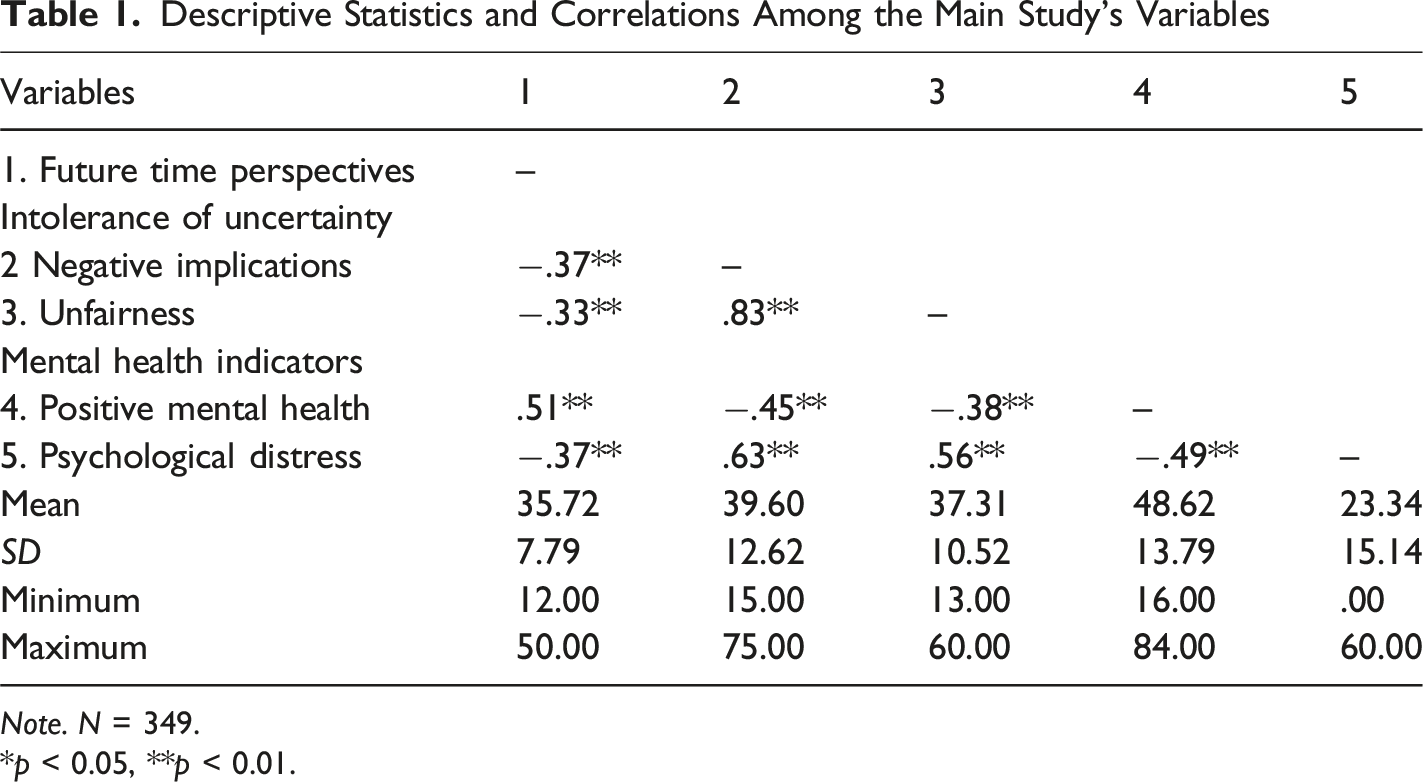
Note. N = 349.
*p < 0.05, **p < 0.01.
Associations Among Main Study’s Variables
Zero-order correlations indicated that future time perspective was significantly positively associated with positive mental health, r = .51, 95% CI [0.43, 0.58], and negatively associated with psychological distress, r = −.37, 95% CI [−0.46, −0.28], all ps < .001 (see Table 1). Future time perspective was significantly negatively related to both dimensions of intolerance of uncertainty – the negative implications, r = −.37, 95% CI [−0.46, −0.28] and unfairness, r = −.33, 95% CI [−0.42, −0.23], all ps < .001. Further, both dimensions of intolerance of uncertainty - negative implication, r = −.45, 95% CI [−0.53, −0.36], and unfairness, r = −.38, 95% CI [−0.47, −0.29], all ps < .001, were significantly negatively related to positive mental health. The negative implication, r = .63, 95% CI [0.56, 0.69], was positively related to psychological distress, and a similar relation was found for unfairness dimension of uncertainty, r = .56, 95% CI [0.48, 0.63], all ps < .001.
Path Analysis Testing the Main Study’s Hypotheses
To test the unique contributions of future time perspective and intolerance of uncertainty dimensions (e.g., negative implications and unfairness) on mental health (e.g., psychological distress and positive mental health) as well as the mediational role of intolerance of uncertainty on these relations, path analysis was conducted. Participants’ gender and marital status were included as control variables because of their significant effect on mental health indicators. Specifically, paths from gender to psychological distress and from marital status to positive mental health were added in the model. The fit indices for the model indicated were good: χ2 (9) = 17.79, p = .039; NNFI = .98; CFI = .99, RMSEA = .05, CI 90% [.012; .089]. Overall, the model explained 34.5% of the variance in positive mental health and 42.4% of the variance in psychological distress. Significant standardized path estimates are shown in Figure 1. Future time perspective was significantly negatively related to both dimensions of intolerance of uncertainty. The negative implications dimension of intolerance of uncertainty was significantly negatively related to positive mental health and positively significantly related to psychological distress. In addition, an expansive future time perspective was significantly positively related to positive mental health and negatively significantly related to psychological distress. Path analysis evaluating the study’s hypotheses (N = 349).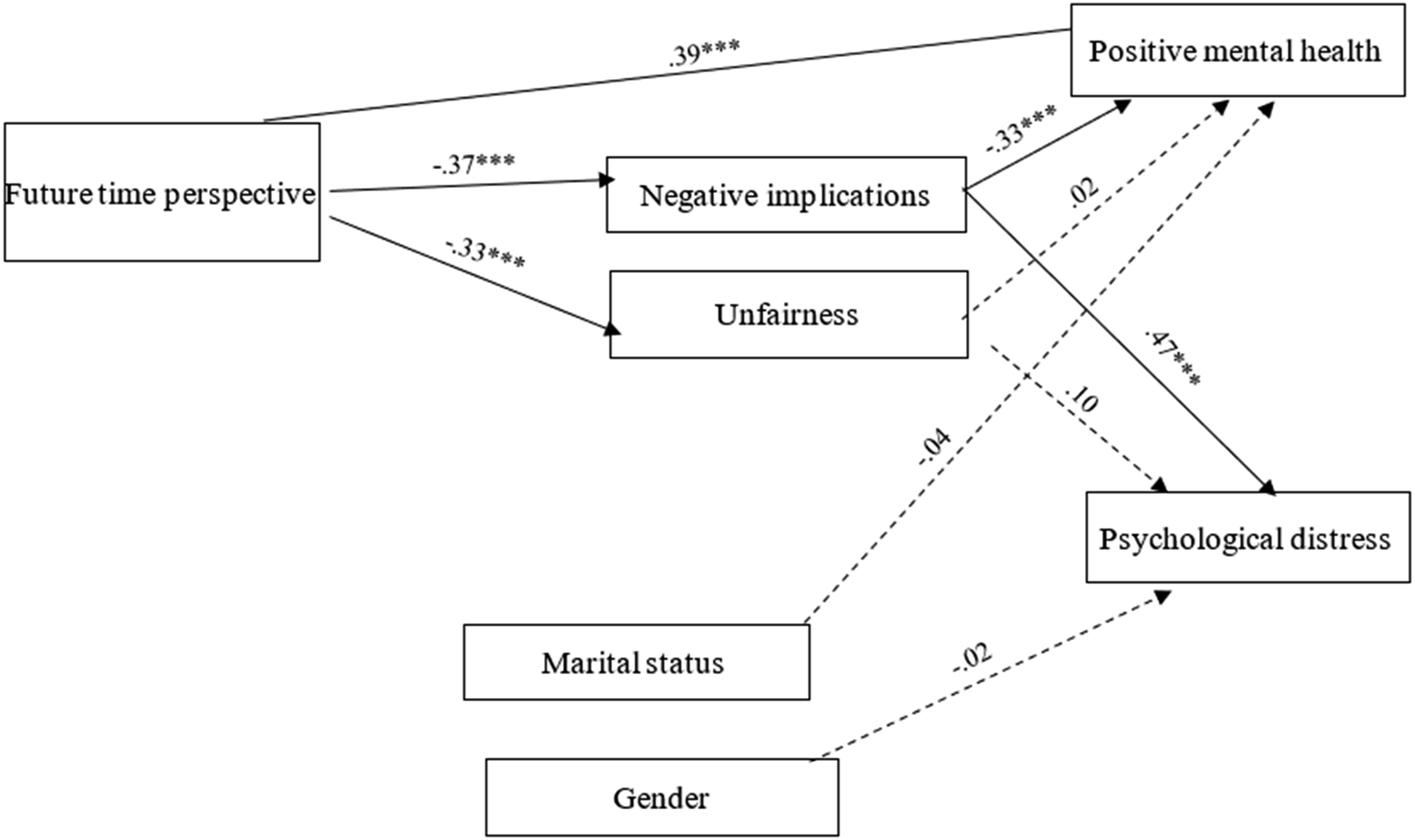
Further, the negative implications dimension of intolerance of uncertainty mediated the relations of future time perspective with positive mental health, Estimate = 0.21 (SE = 0.05), 95% CI [0.114, 0.334] and psychological distress, Estimate = −0.34 (SE = 0.07), 95% CI [−0.491, −0.213]. The unfairness dimension of did not mediate the relation of future time perspective with neither positive mental health, Estimate (SE) = −0.01 (SE = .04), 95% CI [−0.102, 0.074] nor psychological distress, Estimate (SE) = −0.06 (SE = .04), 95% CI [−0.159, 0.02].
Discussion
Our study contributes to a better understanding of the relation between future time perspective and mental health indicators, exploring these relations in the COVID-19 pandemic context, an ambiguous situation. Our study advances the existent literature by investigating the mediating role of intolerance of uncertainty on these relations.
In line with previous studies (e.g., Lind et al., 2022; Smith et al., 2024), both the correlational and path analysis indicated that university students who reported a more expansive future time perspective experienced increased levels of positive mental health and decreased levels of psychological distress. These results are in accordance with the socio-emotional selectivity theory (Carstensen, 2006, 2021; Lang & Carstensen, 2002) which states that people who perceive their time as expansive are more likely to make plans for their future and to pursue them in the present, thus experiencing better mental health. The present study increases the knowledge regarding how the young adults’ future time perspective is linked with their mental health in the context of the COVID-19 pandemic, a physically and emotionally challenging time, especially for university students (Fynes-Clinton & Addis, 2023). Considering that the perception of future time is a key component for mental health, psychological interventions focused on how people perceive their future are necessary. An intervention strategy that could be implemented in university contexts might consist in encouraging students to set a broader future time perspective in term of realistic and attainable distant goals in various life domains, including the educational one, while concurrently identifying concrete ways to make these goals become reality. This goal-directed simulation strategy (Szpunar et al., 2014) involves intention, planning and simulation. When students focus on desired future outcomes, they will engage in activities that will allow them to attain their goals and thus they will better tolerate the adversity and ambiguity of the present time. Further, a detailed and vivid cognitive simulation will decrease university students’ depressive symptoms and enhance their well-being (Gamble et al., 2021). By encouraging university students to perceive the future in a more expansive way, they are more likely to have a larger perspective of the current adverse situation and to be more prone to deal with the uncertainty surrounding it and with the distress caused by it.
Correlational analysis indicated that greater intolerance of uncertainty was associated with poorer well-being and increased symptoms of psychological distress in university students. These results confirm previous studies reporting similar relations (e.g., Freeston et al., 2020; Hytman et al., 2023; Satici et al., 2022). These findings are in line with the idea that intolerance of uncertainty, by accentuating the individuals’ tendency to perceive ambiguous information as threatening, might experience more mental health problems and poorer well-being (Carleton et al., 2007). Path analysis, when accounting for the effects of other variables (e.g., marital status), showed that only the negative implications dimension of intolerance uncertainty was significantly related to mental health indicators. These findings are in line with the idea that an uncertain and ambiguous situation, such as the COVID-19 pandemic, which is perceived as having various negative implications, might lead to an increase in emotional distress and a decrease in well-being (Freeston et al., 2020). As such, university students’ perception of the present as unknown and ambiguous had negative consequences on their mental health during the pandemic. Given that intolerance of uncertainty has an important role in the mental health experienced during the COVID-19 pandemic, future studies could focus on the differential role of the two intolerance of uncertainty dimensions, unfairness and negative implications, in relation with other mental health indicators, such as happiness. Also, intervention strategies could be elaborate in order to help individuals to deal with intolerance uncertainty either by minimizing the objective or perceived threat of the (present) situation or by increasing their capacity to tolerate uncertainty (Carleton, 2012).
Both correlational and path analyses showed that university students reporting an expansive future time perspective experienced decrease levels of uncertainty on both dimensions – negative implications and unfairness. Our findings are in line with the limited studies testing this relation in general (Du & Lyu, 2021; Yang et al., 2021), and during the COVID-19 pandemic (Hromova, 2022), showing that adolescents and adults who reported greater future time perspective experienced lower levels of intolerance of uncertainty. These findings are in line with the idea that an expansive future time perspective might help people deal with the uncertainty of the current situation by reducing the perception of unfairness and negative implications of it, because it helps people focus on the long-term future (Yang et al., 2021). Future studies could explore the relation of future time perspective with intolerance of uncertainty in the context of other ambiguous situations, such as war or political instability.
The present study adds to the literature by examining the mediating role of intolerance of uncertainty in the relation between future time perspective and mental health. Our findings showed that intolerance of uncertainty mediated the relation of future time perspective with both positive mental health and psychological distress. More specifically, a greater future time perspective was associated with lower levels of negative implications of uncertainty in university students, who further experienced poorer mental health and heightened levels of psychological distress. These results confirm Regnoli et al.’s (2024) showing that intolerance to uncertainty mediate the positive relations between perception of the future (anxiety) and psychological distress. In other words, when people have an expanded future time perspective, they are less prone to believe that the present uncertainty they are facing impairs their behavior and reflects in a negative way on their characters, which in turn leads to improved positive mental health and reduced psychological distress. It is possible that individuals who are more psychologically distant towards future are able to anticipate long term future events and outcomes, and to appreciate their present activities given their value for future goal (Carstensen, 2006). Thus, they did report lower negative implications of the present uncertain (i.e., pandemic) situation for their performance and personal characteristics, which further are related to better mental health.
The unfair dimension of uncertainty (the belief that the future is unfair and disturbing) did not mediate the link of future time perspective with both indicators of mental health. These findings are in line with Trope and Liberman’s (2010) construal level theory suggesting that individuals who are more psychologically distant orientate towards future set so distant in time, that the beliefs according to which the present (negative) time is not important enough to negatively influence their positive mental health and cause them psychological distress. It is also possible that individuals with expansive future perspectives, who believe that the future is filled with possibilities (Carstensen, 2006), do not perceive the unfairness of events as relevant enough in order to negatively influence their mental health, especially when they feel that the situation is out of their control, as the pandemic was (Sexton & Dugas, 2009). Future studies could also examine the mediating role of unfairness and negative implications of uncertainty on the relation between time perspective and other indicators of mental health, such as quality of life.
Our results might have implications for psychological counseling services in university contexts. Specifically, when dealing with negative and uncertain life situations, university students could be supported to develop a broader, expansive perspective of their future life. Support could be provided to university students facing situations characterized by uncertainty and ambiguity in order to learn how to cope with the complexity of feelings that might arise or with the possible difficulties in achieving their goals in a short period of time. Thus, by helping university students to extend their future time horizon and to reduce and change their dysfunctional cognitive schema in the present, their mental health could be improved.
Some limitations need to be addressed. First, we used self-report scales which can limit the accuracy of the results due to social desirability bias that might hinder the accuracy of mental health problems (by minimizing the psychological distress symptoms and/or heightening positive mental health). In order to diminish these effects of social desirability, future studies could additionally gather data from people close to the participants (e.g., family members, peers) for the purpose of obtaining a more comprehensive assessment of mental health indicators and its associated factors. Secondly, our results are based on a cross-sectional design and thus we cannot draw conclusions about the direction of the relations among the study’s variables. Future research should use longitudinal designs with multiple measure points to investigate the long-term relations of future time perspective and intolerance of uncertainty with mental health in order to obtain a more complex understanding of these relations. Third, our sample consisted of university students, most of them young (unmarried) female and, thus, the results cannot be generalized to Romanian adult population. Future studies could explore these relations using a more diverse sample of participants in respect of their demographic characteristics, such as age, educational level, marital status, and area of residence.
The current study extends previous literature on the impact of future time perspective on positive mental health and psychological distress experienced during the COVID-19 pandemic, in a sample of Romanian university students. Our results highlight the significant role of future time perspective and intolerance of uncertainty in explaining the mental health outcomes encountered during the pandemic. The negative implications of uncertainty mediated the link between future time perspectives and both positive mental health and psychological distress. Future research could focus on the longitudinal relationships among future time perspectives, intolerance of uncertainty and various mental health indicators (e.g., well-being) on samples of participants with various socio-demographic characteristics. Future studies might also investigate other psychological constructs, such as meaning making, resilience, and hope (Boss, 2016) as potential explanatory mechanisms for the relation between future time perspective and mental health indicators.
Footnotes
Ethical Considerations
All procedures performed in studies involving human participants were in accordance with the ethical standards of the institutional and/or national research committee and with the 1964 Helsinki declaration and its later amendments or comparable ethical standards.
Consent to Participate
Informed consent was obtained from all individual participants included in the study.
Author Contributions
EDD and AM wrote the original draft of the manuscript, LDG conceptualized, ran the statistical analysis and wrote the original draft of the manuscript. All authors reviewed the manuscript.
Funding
The authors received no financial support for the research, authorship, and/or publication of this article.
Declaration of Conflicting Interests
The authors declared no potential conflicts of interest with respect to the research, authorship, and/or publication of this article.
