




Abstract
It is often claimed that romantic relationships with narcissistic partners can lead to adverse outcomes for an individual, including damaged self-esteem and interpersonal trust or elevated cynicism. Romantic ex-partners of narcissistic individuals are also assumed to question their own judgment and partner choice, implying an increased desire for self-insight. An empirical foundation for such assertions is, however, lacking. The present study aims to elucidate aspects of psychological adjustment and personality traits in individuals who report a recent romantic relationship with a narcissistic partner. To this end, we compared self-esteem, interpersonal trust, cynicism, and the self-insight motive of individuals who label their ex-partner as narcissistic (n = 104) with persons who classify their ex-partner as non-narcissistic (n = 193). Furthermore, we asked all study participants (N = 297) to rate their ex-partner’s trait levels of antagonistic narcissism and investigated how these relate to participants’ own self-esteem, interpersonal trust, and cynicism. Moreover, we explored whether relationship length moderates these associations. Independent t-tests revealed that individuals who label their ex-partners as narcissistic reported lower self-esteem, less interpersonal trust, and a stronger desire for self-insight than individuals with presumably non-narcissistic ex-partners. Correlation and multiple regression analyses further indicated significant associations between the ex-partners' level of antagonistic narcissism and participants’ self-reported interpersonal trust and cynicism. Relationship length did not moderate these associations, but had an independent effect on cynicism. Although the present study does not allow to draw causal conclusions, it represents an initial step towards exploring a so far largely neglected research domain. Possible implications and suggestions for future research are discussed.
Introduction
Judging by the large amount of advisory and health care services, including advice literature (e.g., Arabi, 2017), psychotherapeutic counselling (e.g., https://www.paracelsus-recovery.com) or support groups, forums, and platforms (e.g., https://www.wnaad.com), individuals who were in a relationship with a narcissistic person seem to be in particular need of (professional) support. Given the adverse character of many narcissistic personality traits — including manipulation, low empathy, exploitativeness (Miller et al., 2016) — former romantic partners of narcissistic individuals are often addressed as “victims”, “survivors”, or “prey” of narcissists (Arabi, 2017; Lavner et al., 2016).
On closer examination, the vast body of advisory and health care services targeting those “survivors” have two things in common: Firstly, there is a general impression that experiences with presumably narcissistic ex-partners have repercussions on one’s own self-concept, personality, and behavior. An expression used extensively in this context is narcissistic abuse. Roberts (2021) describes narcissistic abuse as “a form of extreme psychological and emotional abuse marked by manipulative communication and intentional deception for the purposes of exploitation by someone who meets the clinical criteria for, or has traits of, pathological narcissism” (p. 8). It comprises behavior such as physical (e.g., intimate partner violence [IPV]), psychological (e.g., manipulation, gaslighting 1 ), sexual (e.g., sexual coercion), and verbal violence (e.g., humiliation; cf., Arabi, 2017; Roberts, 2021; Schneider, 2015). Among other things, low self-esteem, mistrust, cynicism, and severe health problems like somatic illnesses or post-traumatic stress disorder (PTSD) are claimed adverse outcomes for persons who experienced narcissistic abuse (cf., Arabi, 2017; Campbell, 2005; Durvasula, 2024; Knott, 2023; Schneider, 2015). Notably, the term narcissistic abuse is, however, neither officially defined nor publicly recognized in diagnostic manuals (Howard, 2019; Roberts, 2021). This makes it difficult to ascertain if, and under which circumstances, former partners of narcissistic individuals indeed experience mental distress, such as reduced self-esteem or interpersonal trust. The second common feature of advisory and health care services for “victims” of narcissists is their strong reliance on lay theories of narcissism (cf., Koepernik et al., 2022) and a lacking empirical foundation: Even though several studies have investigated the role of narcissism in the context of romantic relationships (e.g., Keller et al., 2014; Rentzsch et al., 2021; Vrabel et al., 2021), they often focus on inter- and intrapersonal characteristics of narcissistic individuals while largely neglecting their partner’s traits and feelings. So far, research concentrating on the psychological adjustment of ex-partners of persons with elevated narcissistic traits is scarce, with only a few qualitative or case studies addressing this subject (e.g., Green & Charles, 2019; Knott, 2023; Roberts, 2021; Zadeh, 2017). More precisely, although some clinicians claim reduced self-esteem and interpersonal trust as potentially maladaptive outcomes of a personal history with a narcissistic ex-partner (e.g., Durvasula, 2024; Schneider, 2015), empirical support of such consequences is largely lacking. Thus, whether individuals who report experiences with narcissistic ex-partners indeed display signs of mental distress remains speculative so far. In the present empirical study, we, therefore, examined psychological adjustment and personality traits of individuals who were in a romantic relationship with a partner described as narcissistic. Hereby, we focused on individuals’ self-esteem, interpersonal distrust, and cynicism (for more details, see below).
Conceptions and Models of Narcissism
Two general conceptions of narcissism can be distinguished: On the one hand, narcissism is used to describe a pathological syndrome (Narcissistic Personality Disorder, NPD) which is, for example, diagnostically defined in the Diagnostic and Statistical Manual of Mental Disorders (5th ed.; DSM-5; American Psychiatric Association, 2013). On the other hand, from a sub-clinical perspective narcissism is regarded as multidimensional personality trait (e.g., Back et al., 2013; Crowe et al., 2019), suggesting that a person can exhibit narcissistic traits without meeting the criteria for NPD. Since it often seems difficult to differentiate between these two conceptualizations, most contemporary accounts postulate a gradual transition from “normal” narcissism to NPD, whereby high-level subclinical narcissism can develop into the pathological personality disorder (e.g., Brummelman et al., 2015).
Although a broad consensus about the dimensionality of narcissism exists, the trait is not uniformly defined (Jordan et al., 2010). According to a wide range of studies, narcissism comprises a grandiose and a vulnerable dimension, which both share antagonistic traits, such as arrogance, manipulativeness, and a lack of empathy (Weiss et al., 2019; Wink, 1991). Therefore, antagonism is often referred to as the “core” of narcissism (Crowe et al., 2019; Jauk & Kaufman, 2018; Szymczak et al., 2022). Previous research linked antagonistic narcissism, among other things, with antisocial behavior, aggression, and mistrust (Schneider et al., 2023; Vize et al., 2019; Weiss et al., 2019), manipulativeness (Sauls et al., 2019; Sleep et al., 2021), dominance (Sleep et al., 2021; Vize et al., 2019), as well as interpersonal dysfunction (Schneider et al., 2023). To capture its complex trait dynamics and structure, researchers provided various theoretical models of narcissism, most of which posit the multidimensionality of narcissism, along with a hierarchical structure of its dimensions and facets (Crowe et al., 2019; Miller et al., 2021; Weiss et al., 2019). One theory that explicitly addresses the dynamics and functions of antagonistic traits in narcissistic behavior is Back et al.’s (2013) Narcissistic Admiration and Rivalry Concept (NARC). This dual process model postulates two narcissistic dimensions – admiration and rivalry – in the sense of social strategies used by narcissistic individuals to maintain a grandiose self: Admiration is considered as assertive self-enhancement by striving for uniqueness, grandiose fantasies, and charm. Rivalry, on the other hand, corresponds to antagonistic self-protection, by strategies like striving for supremacy, devaluation of others, and aggressiveness. From an interpersonal perspective, admiration results in social potency, while rivalry rather prompts social conflict (Back et al., 2013).
Antagonistic Narcissism in Romantic Relationships
As noted above, there is a dearth of research on partners of individuals with elevated narcissistic traits. Few studies, however, implemented a dyadic study design to explore narcissism in the context of romantic relationships: For instance, Keller et al. (2014) found that a person’s narcissism correlates with his or her relationship behavior. In particular, grandiose narcissism was positively related to aggressiveness in relationships (Keller et al., 2014). In other studies, individuals with higher expressions of antagonistic narcissism showed less respect towards their intimate partners (Vrabel et al., 2021), used more influencing strategies like manipulation or detachment (Sauls et al., 2019), and displayed reduced relationship satisfaction (Rentzsch et al., 2021).
Besides this dyadic research, a wide range of studies focused on inter- and intrapersonal correlates of narcissistic traits and behavior which might be relevant in the context of romantic relationships: For example, individuals high in antagonistic narcissism were reported to show less commitment in relationships (Zeigler-Hill et al., 2020), higher exploitativeness and manipulation (Back et al., 2013; Sleep et al., 2021) as well as dominant behavior (Sleep et al., 2021; Vize et al., 2019). In addition, antagonistic narcissism is related to various forms of violence and aggression: Antagonistic narcissistic traits, particularly exploitativeness, are associated with verbal (e.g. insulting; Czarna et al., 2021; Du et al., 2022; Schneider et al., 2023), sexual (e.g., sexual coercion; Barnett & Millward, 2021; Baumeister et al., 2002; Zeigler-Hill et al., 2013), and physical aggression (e.g., Schneider et al., 2023). Further, individuals with antagonistic narcissistic traits used bullying against their romantic partners (Sauls et al., 2019) — a form of abuse that is linked to the dominance facet (Körner et al., 2023) and comprises several types of violence (verbal, psychological, physical; cf., Ren & Voelkel, 2020).
Taken together, recent research shows that antagonistic narcissism predicts socially aversive attitudes and behaviors, some of which are considered as characteristics of narcissistic abuse (e.g., Arabi, 2017; Durvasula, 2024; Roberts, 2021) and which can exert negative impact on the romantic partner.
The Present Study
In addition to the above-mentioned Narcissistic Admiration and Rivalry Concept (Back et al., 2013), which provides the theoretical basis for our assumptions regarding experiences with narcissistic ex-partners, the present study is embedded in Beck’s Cognitive Theory (Beck, 1987; Beck & Haigh, 2014). In light of this framework, dissolution of such a relationship can be considered as a stressful life event (e.g., Michael & Ben-Zur, 2007; Moral et al., 2021) – and, due to the above-mentioned difficulties, this may be particularly the case for separation from partners with high expressions of narcissistic traits. Cognitive Theory suggests that maladaptive cognitive schemas and dysfunctional cognition can emerge as a result of stressful life events and situations (e.g., Beck & Haigh, 2014), and previous empirical research corroborated this general assumption (e.g., for an overview, see Garratt et al., 2007; Scher et al., 2005). Building on this framework, we propose that individuals who recently dissolved a romantic relationship with an individual perceived as narcissistic may be at risk of developing maladaptive/dysfunctional schemas, and thus experience negative consequences of with regard to different aspects of their self (e.g., Durvasula, 2024; Green & Charles, 2019; Knott, 2023; Schneider, 2015). With one exception, existing research on that topic is limited to a few case and small-size qualitative studies (Green & Charles, 2019; Knott, 2023; Zadeh, 2017). To the best of our knowledge, the only quantitative approach so far was presented by Roberts (2021), who conducted a survey among a large sample (N = 1, 995) of women who identified as “survivors” of narcissistic abuse and found high rates of post-traumatic stress symptoms reported in this sample. This recent study, however, has several methodological shortcomings. For example, the study sample showed high rates of self-reported childhood trauma, which explained most of the variance in the outcome variables considered. Second, Roberts (2021) exclusively recruited females who were involved in at least one romantic relationship with a man they believed to have pathological narcissism, which likely lead to considerable selection bias. Furthermore, the author did not collect data from a comparison group of people who report a previous relationship with a non-narcissistic partner.
To directly address these issues, we conducted a quantitative study to examine aspects of psychological adjustment (i.e., self-esteem, adaptive personality traits) of both male and female participants who recently experienced separation from their previous romantic partner. In contrast to Robert’s (2021) study, participants were asked to rate their ex-partner’s narcissistic traits using a standardized inventory and were then grouped into subsamples based on these ratings. Hereby, we investigated the following preregistered 2 research questions: Which characteristics of the self discriminate individuals who recently experienced separation from a putatively narcissistic ex-partner, from individuals who separated from a partner not labeled as narcissistic? How are indicators of psychological (mal)adjustment, measured shortly after a break-up, associated with narcissistic traits of the person’s ex-partner? In our study, we focused on low self-esteem, interpersonal distrust and cynicism as core dependent variables. These constructs are associated with negative outcomes, including mental health problems like depression (Orth et al., 2014; Schneider et al., 2011; Sowislo & Orth, 2013), anxiety disorders (Fernandes et al., 2022; Schneider et al., 2011), or eating disorders (Colmsee et al., 2021; Noordenbos et al., 2014). Therefore, they can be described in terms of maladaptive personality traits and signs of reduced psychological adjustment. Since individuals who experienced intimate relationships with narcissists are thought to question their own life decisions (cf., Knott, 2023) and seem to show particular interest in (psychological) support (Howard, 2019; Knott, 2023), we, furthermore, explored the self-insight motive, which represents the tendency to gain accurate and diagnostic information about oneself, for instance, by seeking improvement-oriented feedback (Heine et al., 2024; Sedikides & Hepper, 2009). All in all, the core aims of the present study were (1) to examine potential differences in aspects of the psychological adjustment (self-esteem, interpersonal distrust, cynicism, self-insight motive) between individuals who do vs. do not describe their recent ex-partner as narcissistic and (2) to relate these aspects of the self with expressions of antagonistic narcissism traits reported for the participants’ ex-partners.
Self-Esteem
Rosenberg (1965) defined self-esteem as the attitude that people have towards their own self. Previous studies showed that individuals’ low self-esteem is positively related to experiences of verbal abuse (Cañete-Lairla & Gil-Lacruz, 2018), sexual aggression or violence (Jordan et al., 2010), psychological, emotional, physical, and sexual abuse (Campbell, 2005; Cascardi & O’Leary, 1992; Leedom et al., 2019) as well as IPV (Holt & Gillespie, 2008).
Only little research focused on self-esteem in the context of narcissistic abuse in intimate relationships: In a qualitative study published by Knott (2023), most partners of individuals with elevated narcissistic traits reported long-lasting reductions in self-esteem. Based on three case studies of women (two of whom reported having a narcissistic ex-partner) and a context-specific literature review, Zadeh (2017) investigated trauma and the self-esteem loss of women with narcissistic ex-partners. Grounded on her analyses, she postulated a mild form of PTSD as outcome of narcissistic abuse in romantic relationships, namely Post-Traumatic Self-Esteem Damage (PTSED). Based on the preliminary findings reported by Knott (2023) and Zadeh (2017), we predicted lower levels of self-esteem in individuals who label their ex-partner as narcissistic as compared to individuals with ex-partners that are labeled as non-narcissistic (H1a). Moreover, we assumed to find a negative correlation between participants’ self-esteem and participant-reported antagonistic narcissistic traits of their ex-partner (H1b). We further expected this association to depend on relationship length (H1c), suggesting that the probability of narcissism-related relationship problems increases with the frequency of within-relationship interactions and, therefore, the length of the relationship (cf., Marsh, 2020).
Interpersonal Distrust and Cynicism
Interpersonal trust “refers to the extent to which a person ascribes credibility to other people and expects positive outcomes in the context of social interactions” (Nießen et al., 2020, p. 2). In the context of romantic relationships, a person’s degree of interpersonal trust is based on experiences of the partner’s dependability and predictability in the past (Rempel et al., 1985). Simpson (2007) noted that a person’s interpersonal trust is higher when they have confidence that their partner’s commitment to the relationship is high. Commitment to an ongoing relationship, in turn, was found to be negatively related to narcissism (Campbell & Foster, 2002). Moreover, recent research revealed that people in unequal-power relationships (i.e. one partner is more dominant than the other) display less interpersonal trust compared to individuals in equal-power relationships (Du Plessis et al., 2023). Based on these findings, we examined interpersonal trust as the second major outcome variable in our study 3 and expected lower levels of interpersonal trust in individuals who label their ex-partner as narcissistic as compared to individuals with ex-partners that are labeled as non-narcissistic (H2a). Moreover, we postulated a negative correlation between interpersonal trust and the partner’s expressions of antagonistic narcissism (H2b). Again, this relationship was thought to be moderated by relationship length (H2c).
Although closely related (e.g., Joshanloo et al., 2010; Leung et al., 2002; Singelis et al., 2003; Stavrova & Ehlebracht, 2016), interpersonal distrust and cynicism must not be considered as identical. Cynicism comprises “a negative view of human nature, a biased view against some groups of people, [and] a mistrust of social institutions” (Leung et al., 2002, p. 292). Furthermore, cynic individuals tend to have a hostile view of relationships and hold the expectation to be exploited by others (Simons & Burt, 2011). To this end, as compared to interpersonal distrust cynicism appears to involve a more general, particularly hostile view of the world through a negative lens. Simons and Burt (2011) implied that cynic, hostile views are results of past situational or interpersonal experiences where individuals were confronted with exploitative or disrespectful behavior. On the one hand, cynicism has been related to deficient interpersonal functioning (Joshanloo et al., 2010). On the other hand, Li et al. (2011) proposed a potentially protective function of cynicism in romantic relationships: Cynicism seemed to buffer individuals against negative effects of relationship conflicts and prepared them mentally for interpersonal difficulties. Furthermore, it reduced persons’ negative reactions toward these difficulties (Li et al., 2011). Against this background, cynic attitudes could evolve during the relationship with a highly narcissistic person in order to protect the individual from conflict-breeding narcissistic behaviors of their partner. To this end, we expected to find higher levels of cynicism in individuals who label their ex-partner as narcissistic as compared to individuals with ex-partners that are labeled as non-narcissistic (H3a). Moreover, we postulated a positive correlation between cynicism and the partner’s expressions of antagonistic narcissism (H3b). Again, this relationship was thought to be moderated by relationship length (H3c).
Self-Insight Motive
In light of the recent rise of self-optimization as a socio-cultural trend in contemporary Western societies (Nehring & Röcke, 2023), the so-called self-insight motive has received increasing attention in the field of psychological science (Heine et al., 2024). The self-insight or self-assessment motive refers to the dispositional tendency to gain accurate self-knowledge 4 and, therefore, to seek highly diagnostic information or feedback (American Psychological Association, 2023; Heine et al., 2024; Sedikides & Strube, 1997). This feedback informs individuals about the correctness or the social and emotional impact of their behavior and thinking, and is provided, for instance, in interpersonal relationships or psychotherapy (American Psychological Association, 2023) and might be particularly pertinent for individuals who aim at self-improvement (Heine et al., 2024). Interestingly, a change in life circumstances can increase the self-insight motive (Heine et al., 2024). Against this background, one can assume that individuals who experience a break-up from a narcissistic ex-partner might report an elevated self-insight motive. This presumption is supported by the few studies which focused on partners of narcissistic individuals, who tended to seek information and validation by turning to the internet (e.g. online support forums or groups, social media groups, etc.) or therapeutic interventions (e.g. counselling, psychotherapy, etc.; Howard, 2019; Knott, 2023; Roberts, 2021; Zadeh, 2017).
Consequently, we expected to observe a stronger self-insight motive reported by individuals who label their ex-partner as narcissistic as compared to individuals with ex-partners that are labeled as non-narcissistic (H4a). We further explored if the strength of the participants’ self-insight motive is correlated with their partner’s expressions of antagonistic narcissism (H4b) and if this relationship depends on relationship length (H4c) 5 .
Method
Power Considerations and Sample Size Calculations
To estimate the necessary sample sizes, we conducted a priori power analyses for each statistical method using G*Power version 3.1 (Faul et al., 2009). The expected assumed small to medium effect sizes were based on our own estimations and considerations of practical relevance of the proposed effects, due to a lack of quantitative studies examining similar research questions. For the t-tests with independent groups (cf. H1/2/3/4-a), a total sample size of N = 204 (i.e., n = 102 per group) was required to detect an effect of at least d = .35 (α = .05, power = .80). A minimum sample size of N = 153 was required to detect bivariate correlation effects (cf. H1/2/3/4-b) of at least r = .20 (α = .05, power = .80). To detect multiple regression effects (cf. H1/2/3/4-c) of f 2 = .085 (α = .05, power = .80), power analysis indicated a minimum sample size of N = 95.
Sample
Parts of the data (N = 63; recruited from April to May 2023) were collected in the course of a Bachelor’s thesis. To achieve sufficient statistical power for our intended hypothesis tests, we recruited further 373 participants from online platforms in universities and social media (e.g., Instagram; recruited from December 2023 to April 2024) in Germany. Individuals were invited to participate in the study if they had recently gone through a break-up (no longer than six months ago). The merged raw data set consisted of N = 436 cases. In line with our preregistration, we excluded participants if they did not provide data use permission (n = 11), were underage (<18 years; n = 3) or reported that they had been separated from their ex-partners for more than six months (n = 75). Moreover, data of individuals were excluded if they admitted dishonest or inattentive participation (n = 20) or did not pass the attention check item, which was presented among the items assessing self-esteem (n = 14). In addition, three cases displayed invariant responding (SD = 0) in two of the inventories (Narcissistic Admiration and Rivalry Questionnaire [NARQ; Back et al. (2013)] and Rosenberg Self-Esteen Scale [RSES; Ferring and Filipp (1996)]) and were, therefore, removed. Finally, we excluded 13 individuals who did not complete the questionnaire. The final sample consisted of n = 297 participants (79% females), ranging from 18 to 63 years (M = 28.11, SD = 8.69). The majority defined their relationship with their ex-partner as serious/steady (91%), three percent were engaged, five percent were married and two participants were divorced (<1%). Mean relationship length was 3.11 years (SD = 3.45). One-hundred sixteen individuals reported that they had initiated the separation, 67 participants stated that their ex-partners initiated the break-up and 51 persons reported a consensual separation. To investigate the hypotheses 1-4a, the sample was divided into two independent groups. To do so, participants’ responses to the Single Item Narcissism Scale (SINS; Konrath et al., 2014) were used to distinguish the groups (for a detailed description, see Measures). The first group consisted of persons who classified their ex-partner as narcissistic (n = 104) with a mean age of 29.15 years (SD = 9.29). Concerning their biological sex, the majority of this group was female (91%; n = 95), whereas only nine individuals were male (9%). Persons who labeled their ex-partners as non-narcissistic were assigned to the second group (n = 193; Mage = 27.54, SDage = 8.31) consisting of 141 biologically females (73%), 51 males (26%), and one diverse person (<1%). 6
Measures
Demographics and Relationship-Related Information
We asked a number of demographic questions to determine, amongst other things, participants’ age, biological sex, gender identity, and educational level. In addition, we assessed relevant features of their previous romantic relationship, such as relationship status, living arrangement and time (in months) since separation. The variable relationship length as possible moderator (Hypotheses 1-4c) was assessed with one open-ended question (“How long were you in a relationship with your ex-partner? Please indicate the length of your former relationship in years.”).
Narcissism
Ex-Partners’ Antagonistic Narcissism
To measure the narcissistic traits of our participants’ former partners, we used an informant version of the German version of the Narcissistic Admiration and Rivalry Questionnaire (NARQ; Back et al., 2013). The NARQ assesses grandiose narcissism with 18 items and comprises two subscales, admiration (9 items) and rivalry (9 items). We used the rivalry subscale to capture antagonistic narcissism. We modified the items to create an informant-report form without changing item content (For example, the NARQ item “I want my rivals to fail” was changed to “My ex-partner wants his/her rivals to fail.”). Participants indicated their assessment of their ex-partner’s narcissistic traits on a 6-point Likert scale ranging from 1 (does not apply at all) to 6 (applies completely). Back et al. (2013) reported good internal consistencies for the total scale (α = .88), admiration scale (α = .87), and rivalry scale (α = .83).
The Single Item Narcissism Scale (SINS)
In addition to the dimensional assessment of antagonistic narcissism, we asked participants to indicate whether they would (or would not) describe their ex-partner as narcissistic in general. To this end, we used an adaptation of the Single Item Narcissism Scale (SINS; Konrath et al., 2014), in which respondents are asked to indicate to what extent they agree with the statement “I am a narcissist.” Hereby, we created a bipolar, informant-version of the SINS: “Which statement matches your ex-partner best? (Note: The term “narcissist” means egoistic, self-centered and conceited, among others.)”. Participants were asked to chose one of two possible answers (1 = He/She is a narcissist., 2 = He/She is not a narcissist.). We used this item to compare participants who labeled their previous partner as narcissistic and participants who indicated that their previous partner was not narcissistic with respect to our relevant outcome measures (i.e., self-esteem [H1a], interpersonal trust [H2a], cynicism [H3a], and the self-insight motive [H4a]).
Self-Esteem
We used the German version of the Rosenberg Self-Esteem Scale (RSES; Ferring & Filipp, 1996) to assess participants’ self-esteem. The RSES contains ten items of which five are inverted. Participants rated statements about themselves on a 4-point Likert scale that ranged from 1 (does not apply at all) to 4 (applies completely). According to Roth et al. (2008), the internal consistencies of the German RSES are good, both for the five positively (α = .81) and the five negatively worded items (α = .86), as well as for the total scale (α = .88).
Interpersonal Trust
We measured self-reported interpersonal trust with the 3-item Kurzskala Interpersonales Vertrauen (English: Short Scale of Interpersonal Trust; KUSIV3; Beierlein et al., 2014). One item was presented inversely („You can’t rely on anyone these days.“). Participants indicated the extent to which they agree with each statement on a 5-point Likert scale, ranging from 1 (do not agree at all) to 5 (agree completely). Beierlein et al. (2014) used McDonalds’s omega to estimate the total scale’s reliability, which was reported to be good (ω = .85).
Cynicism
To assess self-reported cynicism, we used the Social Cynicism dimension of the Social Axioms Survey (Leung & Bond, 2004), in the translated German version by Blötner and Bergold (2022). The 18 items are phrased in a positive manner (e.g.: “Young people are impulsive and unreliable.”), but the 5-point Likert response scale was reversely coded (1 = strongly believe to 5 = strongly disbelieve). The internal consistency of the scale was reported to be good with α = .82 (Blötner & Bergold, 2022).
Self-Insight Motive
We used the recently developed Self-Insight Motive Scale (SIM; Heine et al., 2024) to measure the participants’ self-reported desire for self-know. It contains five items (e.g., “I want to know exactly what my strengths and weaknesses are.”), which were rated on a 6-point Likert scale ranging from 1 (do not agree at all) to 6 (agree completely). Heine et al. (2024) reported good internal consistency of the SIM (α = .88).
Design and Procedure
For our cross-sectional study, we collected data online: Participants were provided with a QR-Code or URL to access the platform Unipark (Tivian XI GmbH, 2023), where the online survey was hosted. All subjects were informed that participation was anonymous and voluntary and they were further informed about length of the study, conditions of participation, data protection policy, and inclusion criteria. The latter included a minimum age of 18 years, a good command of German, and, further, that the time span since they separated from their ex-partner should not exceed six months. Participants were offered feedback on personality measures (i.e., narcissistic traits reported for their ex-partner, their own self-esteem, and their own interpersonal trust) based on participants’ scores obtained with the NARQ, RSES, and KUSIV3. Furthermore, they had the option to win one of two 25 EUR shopping vouchers. In addition, students were offered course credit for their participation. It took approximately 25 to 30 minutes to complete the survey.
Data Processing and Statistical Analyses
We first filtered the data based on the inclusion and exclusion criteria (see “Sample”). The resulting pre-processed dataset did not include any missing values.
In accordance with our pre-registration, we performed t-tests to compare the means of independent groups (participants who labeled their ex-partner as narcissistic vs. participants who labeled their ex-partners as non-narcissistic) with regard to their self-esteem (H1a), interpersonal trust (H2a), cynicism (H3a), and self-insight motive (H4a). The assumptions for these analyses were tested, using the R packages car (Fox & Weisberg, 2019) and pastecs (Grosjean et al., 2021). Levene tests indicated approximately equal variances in both groups (p > .05) to test hypotheses 1a, 3a, and 4a. With respect to interpersonal trust (H2a), however, the Levene test indicated heteroscedacity (F(1, 295) = 5.50, p = .020). Hence, we performed a one-sided Welch t-test to compare mean interpersonal trust between groups. Except for cynicism (H3a), Shapiro-Wilk tests indicated a non-normal distribution of the respective dependent variable in either one or both groups (p < .05). Therefore, we used percentile bootstrapping with 5,000 iterations, to test the hypotheses 1-4a. The R packages used in order to execute these analyses were MKinfer (Kohl, 2024) and lsr (Navarro, 2015). We performed correlation analyses to examine the associations between the partner’s antagonistic narcissism and participants’ self-esteem (H1b), interpersonal trust (H2b), cynicism (H3b), and self-insight motive (H4b), using the R package stats (R Core Team, 2024). According to Bishara and Hittner (2015), bias in point estimates of the Pearson correlation coefficient due to nonnormal data is negligible when the sample size is large (N >160). In light of the size of our full sample (N = 297), we, therefore, conducted one-sided Pearson correlation analyses (α = .05) to test the hypotheses 1b, 2b, and 3b, and a two-sided Pearson correlation analysis for the exploratory test of H4b.
To examine relationship length as possible moderator of the aforementioned associations, we conducted multiple regression analyses. Regression models comprised the partner’s antagonistic narcissism, relationship length, and their interaction (narcissism × length) as predictors and participants’ self-esteem (H1c), interpersonal trust (H2c), cynicism (H3c), and self-insight motive (H4c) as criterion variables. The assumptions were tested using the R packages car (Fox & Weisberg, 2019) and pastecs (Grosjean et al., 2021). Three influential cases per regression model were detected by computing Cook’s distances. Upon closer inspection, these outliers reflected plausible response patterns of participants, so we did not exclude them. McClelland et al. (2017) stated that, for moderation analyses, the assumption of multicollinearity is irrelevant. Therefore, we, in our study, considered multicollinearity negligible, even though that assumption was violated (VIF >10, for all regression models). Shapiro-Wilk tests indicated non-normal distributions of residuals (p < .05) for H1-4c. In addition, residual scatterplots suggested heteroscedastic residuals across regression models. To remedy the violations of normality and homoscedasticity, we used heteroscedasticity-robust standard errors (HC4; Hayes & Cai, 2007) and applied bootstrapping to determine 95% confidence intervals (based on 5,000 iterations) of regression coefficients. We used the R packages car (Fox & Weisberg, 2019), stats (R Core Team, 2024), and lmtest (Zeigler-Hill et al., 2020) to conduct these analyses 7 .
Results
Descriptive Statistics and Manipulation Check
Descriptive Statistics, Intercorrelations, and Internal Consistencies
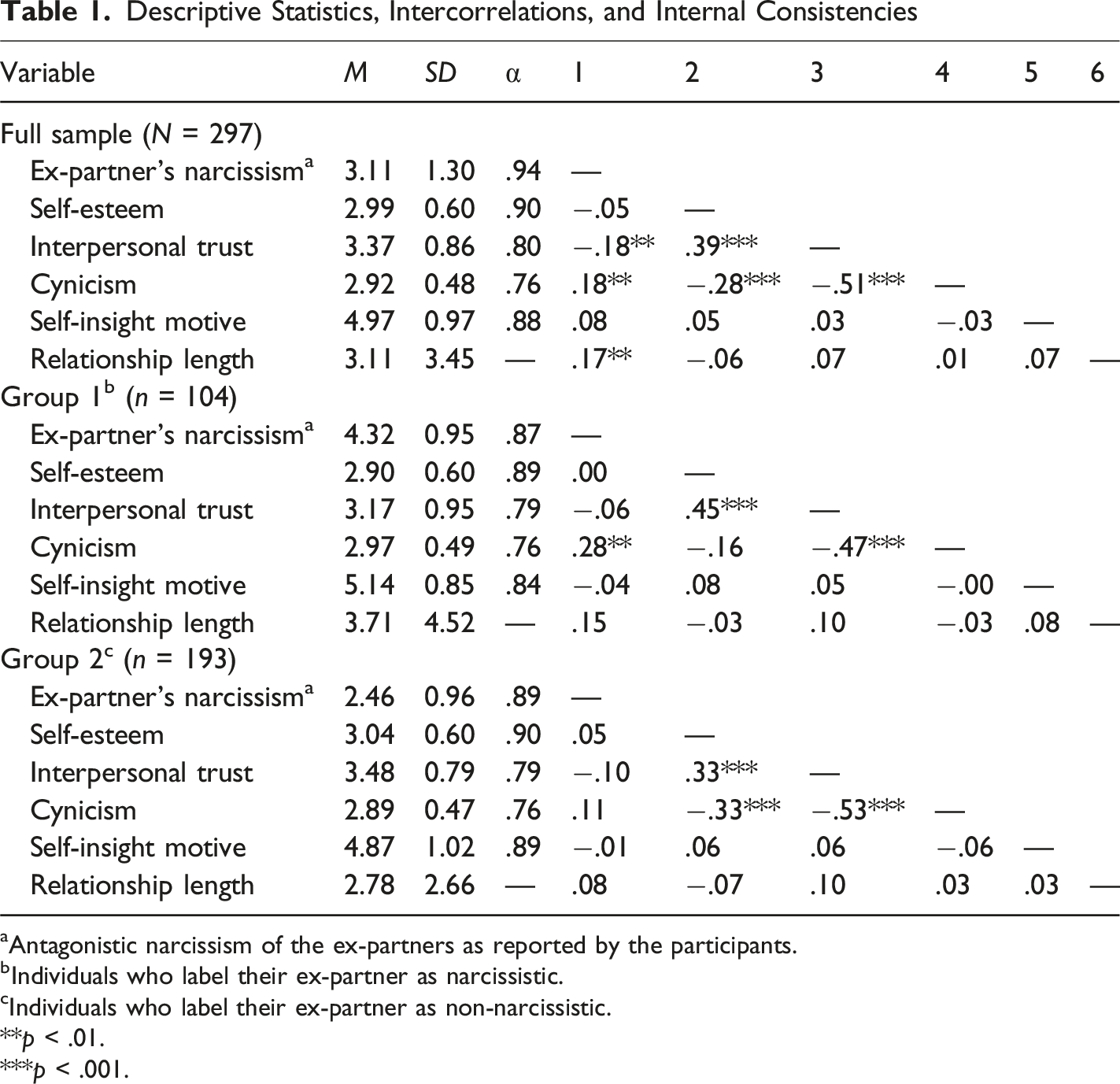
aAntagonistic narcissism of the ex-partners as reported by the participants.
bIndividuals who label their ex-partner as narcissistic.
cIndividuals who label their ex-partner as non-narcissistic.
**p < .01.
***p < .001.
To determine if the independent groups differed from each other in respect to the participants’ estimation of their ex-partners’ narcissism, we performed a bootstrapped t-test as manipulation check. On average, individuals who labeled their ex-partners as narcissistic (M = 4.32, SD = 0.95) reported significantly more antagonistic narcissism (NARQ Rivalry) in their ex-partners than individuals who classified their ex-partners as non-narcissistic (M = 2.46, SD = 0.96), t(295) = 15.90, p < .001, d = 1.93).
T-Tests for Independent Groups (H1a, H2a, H3a, and H4a)
Figure 1 presents mean values, standard deviations and Cohen’s d for the two compared independent groups
8
. In line with H1a, the bootstrapped t-test revealed that, on average, persons who label their ex-partners as narcissistic reported less self-esteem than individuals who classify their ex-partners as non-narcissistic (t(295) = −1.97, p = .026, d = 0.24) and indicated a small to medium effect size (cf., Cohen, 1992). Means, Standard Deviations and T-tests (Cohen’s d) of Self-Esteem, Interpersonal Trust, Cynicism and Self-Insight-Motive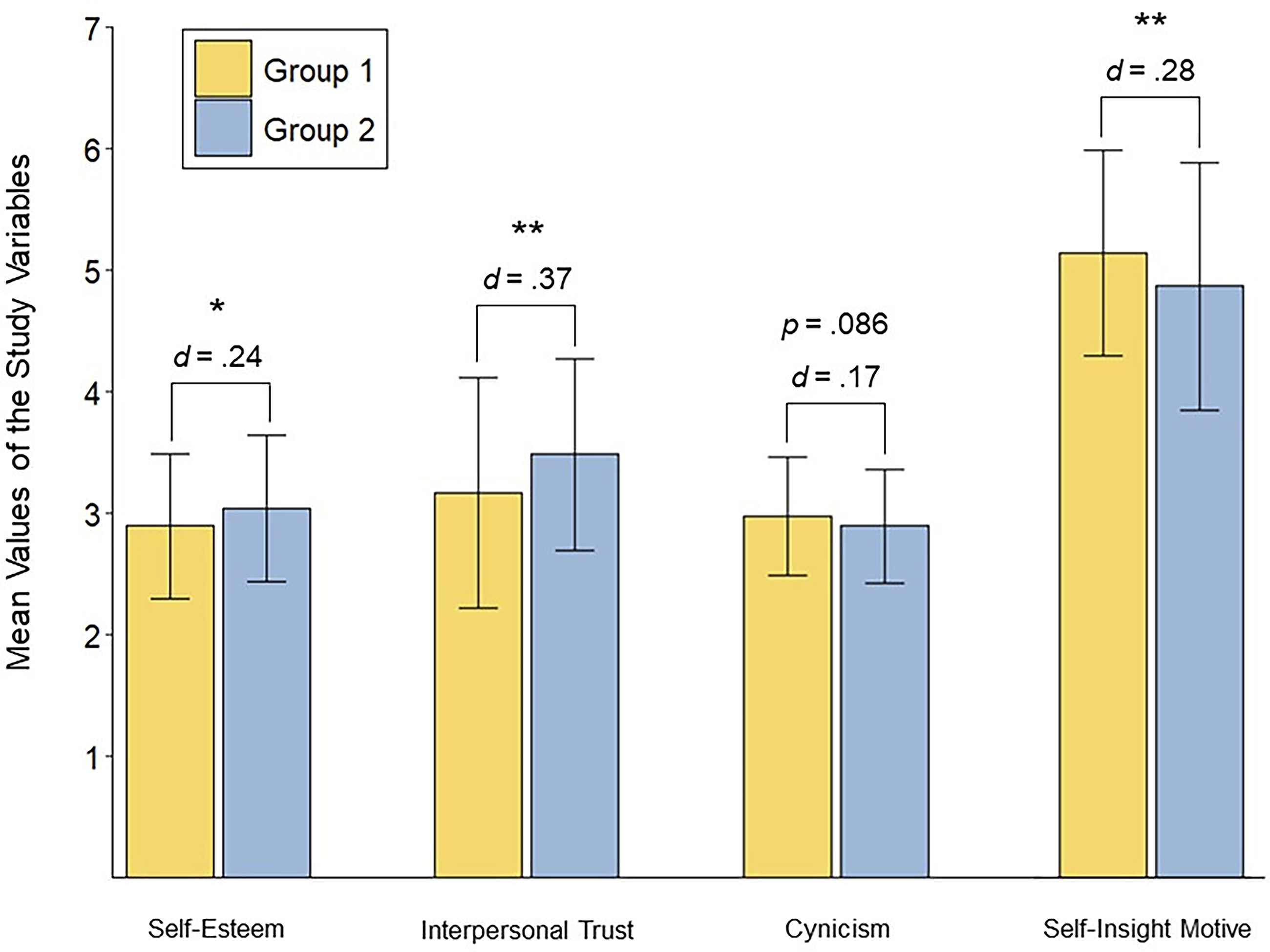
Consistent with H2a, the bootstrapped Welch-t-test indicated a significant small to medium effect for trust: Individuals who label their ex-partners as narcissistic reported less average interpersonal trust than persons with non-narcissistic ex-partners (t(181.6) = −2.91, p = .002, d = 0.37).
Contrary to our assumption (H3a), the mean cynicism scores did not differ significantly between individuals with presumably narcissistic vs. non-narcissistic ex-partners (t(295) = 1.37, p = .086, d = 0.17).
In support of hypothesis H4a, on average, individuals who label their ex-partners as narcissistic reported a higher self-insight motive than persons with ex-partners labeled as non-narcissistic (t(295) = 2.31, p = .008, d = 0.28). These results indicated a small to medium significant effect.
Correlation Analyses (H1b, H2b, H3b and H4b)
Contrary to our hypothesis, Pearson correlation analysis revealed that the relationship between informant-reported antagonistic narcissism and self-reported self-esteem (H1b) did not differ significantly from zero (r = −.05, p = .188, 95% CI [−1.00, 0.04]). As assumed, informant-reported antagonistic narcissism and self-reported interpersonal trust (H2b) were negatively correlated (r = −.18, p < .001, 95% CI [−1.00, −0.09]). In line with H3b, informant-reported antagonistic narcissism was significantly positively related to self-reported cynicism (r = .18, p < .001, 95% CI [0.09, 1.00]) and this relationship was most prominent in the subsample that defined their ex-partners as narcissistic (see Table 1). The exploratory analysis of H4b revealed no significant correlation between self-reported self-insight motive and informant-reported antagonistic narcissism (r = .08, p = .192, 95% CI [−0.04, 0.19]).
Moderation Analyses (H1c, H2c, H3c, and H4c)
Multiple Regression Analyses for the Testing of Hypotheses H1c, H2c, H3c, and H4c
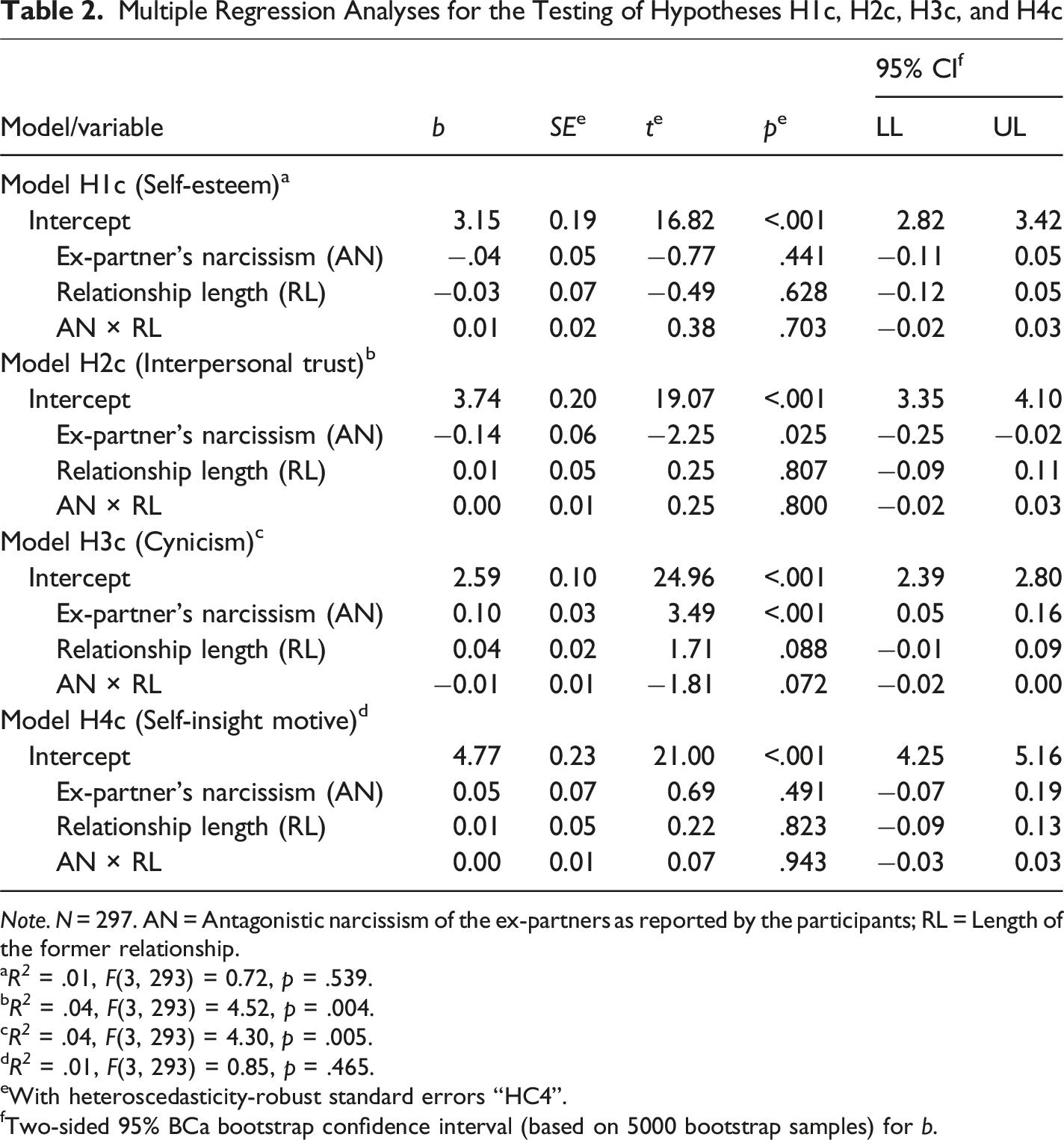
Note. N = 297. AN = Antagonistic narcissism of the ex-partners as reported by the participants; RL = Length of the former relationship.
aR 2 = .01, F(3, 293) = 0.72, p = .539.
bR 2 = .04, F(3, 293) = 4.52, p = .004.
cR 2 = .04, F(3, 293) = 4.30, p = .005.
dR 2 = .01, F(3, 293) = 0.85, p = .465.
eWith heteroscedasticity-robust standard errors “HC4”.
fTwo-sided 95% BCa bootstrap confidence interval (based on 5000 bootstrap samples) for b.
Discussion
We investigated associations between an individual’s psychological adjustment and antagonistic narcissistic traits of that person’s recent romantic partner shortly after separation. We expected differences in self-esteem (H1a), interpersonal trust (H2a), cynicism (H3a), and the need for self-insight (H4a) between individuals who label their former partners as narcissistic and persons who classify their ex-partners as non-narcissistic. Furthermore, we examined whether individuals’ self-esteem (H1b), interpersonal trust (H2b), cynicism (H3b), and self-insight motive (H4b) were related to their ex-partners’ expressions of antagonistic narcissism and explored if these potential associations were moderated by relationship length (H1c, H2c, H3c, H4c).
T-tests for independent samples revealed expected group differences in self-esteem, interpersonal trust, and the need for self-insight, with lower self-esteem and trust and a stronger self-insight motive in individuals who reported having a narcissistic ex-partner as compared to the study group with non-narcissistic ex-partners. While participants who reported narcissistic ex-partners were not significantly more cynical than the comparison group, the small group difference (d = 0.17) was in the expected direction. In addition to the group effects, bivariate correlation analyses indicated that higher expressions of narcissistic traits reported for ex-partners were related to less interpersonal trust and more social cynicism.
Broadly speaking, these results can be interpreted from two different perspectives which imply distinct causal directions of effects:
Firstly, there is good reason to believe that being confronted with antagonistic narcissism in an intimate relationship leads to adverse outcomes and, therefore, impaired psychological adjustment. In Knott’s (2023) narrative study as well as in Zadeh’s (2017) case studies, persons who suspected their ex-partners to be narcissistic reported the loss of self-esteem or long-lasting low self-esteem, respectively. In addition, the experience of behaviors which are prevalent in the context of antagonistic narcissism (e.g., forms of verbal, sexual, and psychological abuse (e.g., Barnett & Millward, 2021; Czarna et al., 2021; Du et al., 2022; Zeigler-Hill et al., 2013) seem related to low self-esteem (e.g., Campbell, 2005; Cañete-Lairla & Gil-Lacruz, 2018; Jordan et al., 2010; Leedom et al., 2019). Similarly, negative experiences or specific life events can affect interpersonal trust (Lewicki et al., 2006; Simons & Barr, 2014; Stavrova & Ehlebracht, 2016). As mentioned above, individuals who report a recent relationship with a narcissistic partner might have experienced a low-quality relationship (e.g., a less respectful and less committed partner; e.g., Vrabel et al., 2021; Zeigler-Hill et al., 2020) and/or might have been confronted with narcissistic behavior, for instance various forms of abuse (e.g., Körner et al., 2023; Zeigler-Hill et al., 2020). Encountering these aspects could not only affect self-esteem, but can also damage interpersonal trust in individuals with narcissistic ex-partners. On another note, previous findings showed that persons incorporate their partners’ worldviews as well as personality traits into their own self-concept and that these integrated attributes of the partner might be retained even after a break up (Slotter et al., 2014). Since a number of studies indicated that narcissism is strongly correlated with low interpersonal trust and cynicism (e.g., Back et al., 2013; Schneider et al., 2023; Szymczak et al., 2022), individuals who have been in a relationship with a narcissistic person might also have adopted these traits from their ex-partner. In addition to lower self-esteem and trust, we found that individuals who reported a narcissistic ex-partner showed an increased interest in self-insight. According to Heine et al. (2024), an instability in life circumstances (e.g., a change caused by a break up) increases the self-insight motive. Since individuals in both study groups recently experienced a relationship dissolution, our results were congruent with Heine et al. (2024) as average expressions of the self-insight motive were quite high in both groups (MGroup1 = 5.14; MGroup2 = 4.87 with a response scale maximum score of 6). Still, the group with persons who label their ex-partner as narcissistic indicated an even higher desire for self-insight. Hence, ending a relationship which was characterized by the former partner’s narcissism-related behaviors (e.g., manipulation or various forms of abuse; cf., Körner et al., 2023; Schneider et al., 2023; Sleep et al., 2021; Zeigler-Hill et al., 2013) might have a greater impact on persons – so-called “survivors” or “victims” (cf., Arabi, 2017; Lavner et al., 2016; Roberts, 2021) – than a dissolution of a non-narcissistic relationship. As a consequence, these persons might have a higher need for self-concept clarity (cf., Howard, 2019; Roberts, 2021) or self-improvement (e.g., regarding their own personality traits; cf., Knott, 2023; Zadeh, 2017) that might also foster treatment-seeking behaviors (cf., Howard, 2019; Knott, 2023; Roberts, 2021; Zadeh, 2017). This seems to be particularly relevant, judging by the countless advisory literature, (online) support and self-aid groups, social media forums, and therapeutic offers or programs (e.g., Arabi, 2017; Durvasula, 2024; Schneider, 2015), which particularly address individuals with narcissistic ex-partners and claim to offer salvation and, notably, insight. So far, however, to a large extent these resources lack empirical foundation or are often developed by other so-called victims having little or no intervention-related professional training (Roberts, 2021).
The interpretations offered above presume that the disturbances in psychological adjustment, which we observed in individuals who label their former partner as narcissistic, reflect a consequence of the ex-partner’s narcissism. Given the cross-sectional design of our study and the fact that the partner’s narcissistic traits were rated retrospectively by the participants – not by the ex-partners themselves – the present findings could also be interpreted in another way: Individuals with lower self-esteem and people who find it more difficult to trust others might also tend to label their recent romantic partner as narcissistic. This could reflect a compensational attribution bias towards victimization (“poor me”) to help individuals justify own self-esteem and trust issues by blaming the ex-partner in general, or their alleged narcissistic personality traits and behaviors in particular. Most research investigating the relationship of self-esteem and blame, however, indicates that lower self-worth is rather associated to self-blame than to blaming others (e.g., Fornells-Ambrojo & Garety, 2009; Reich et al., 2015; Udachina et al., 2012). Moreover, if people retrospectively label their previous partners as narcissistic due to their own negative self- and/or world views, one would expect these individuals to be more cynical than individuals who do not label their ex-partners as narcissistic. In the present study, however, we did not observe significant differences in cynicism between those two groups of individuals. Taken together, while the direction of effects found in our study can generally be interpreted in both ways, we argue that previous research provides less support for the latter explanation (i.e., that poorly adjusted individuals are more prone to label their ex-partners as narcissistic).
Notably, not all of our a priori established hypotheses could be upheld. For example, contradictory to our expectation, we did not find a linear association between self-esteem and the ex-partner’s antagonistic narcissism. Likewise, participants’ need for self-insight was not correlated with expressions of their ex-partner’s narcissistic traits. At the mean level, however, both traits distinguished participants who labeled their former partner as narcissistic from those who reported a non-narcissistic ex-partner. A possible reason for these discrepant results could be rooted in the multi-dimensional structure of narcissism: While, in the present study, we focused on correlations with antagonistic narcissism, a person’s post-separation self-esteem and self-insight motive could also be related to other narcissistic traits of the ex-partner, such as authoritativeness, acclaim seeking, or vulnerable narcissistic traits, which are not captured appropriately by the rivalry subscale of the NARQ (see Miller et al., 2021). Future research should include additional narcissism dimensions for a more holistic approach.
Based on the premise that the confrontation with narcissistic behaviors of one’s ex-partner might foster adverse outcomes for the self, like a person’s level of psychological adjustment, we considered that the duration of being exposed to these behaviors might influence this effect. In contrast to our assumptions, however, relationship length did not moderate any of the examined associations between the ex-partner’s antagonistic narcissism and participants’ self-esteem, trust, cynicism, or interest in self-insight. Frankly speaking: The fact that people subjectively experienced an intimate relationship with a narcissistic partner matters for their own post-separation psychological adjustment, but the time they spent with this partner does not. Interestingly, however, we found two occasions in which relationship length exerted independent effects that were not necessarily expected: In the full sample, we found a weak but statistically significant positive correlation between relationship length and the degree of antagonistic narcissism reported by the ex-partners. A possible explanation for this relationship derives from the observation that antagonistic narcissistic traits are intertwined with Machiavellianism (McHoskey, 1995) and manipulative behavior in romantic relationships (Jarwan et al., 2024). Therefore, individuals who are more narcissistic might employ manipulative strategies to keep their partners committed and thus prolong the relationship.
In addition, there was a positive main effect of relationship length on participants’ cynicism in the multiple regression analyses (see Table 2). This association might reflect the impact of separation experiences after long-term relationships on an individual’s belief system. We suggest that more negative social beliefs occur after a long-term romantic relationship is dissolved, whereas break-up after short-term relationships might have an overall lower impact on the partners involved.
Limitations and Implications for Future Research
This study has a number of limitations from which implications for future research can be derived. First and foremost, our analyses were mainly correlational in nature and based on a cross-sectional design in which narcissistic traits of participants’ previous partners were assessed based on the participants’ reports of their ex-partner’s personality traits. As mentioned earlier, due to this study design, we cannot directly infer causal directions of the effects we observed in the present study. Future studies should examine constructs of interest longitudinally and include both self- and informant reports of personality traits to be able to establish causal connections between ex-partner’s (antagonistic) narcissism and the other person’s adjustment after break-up. Notably, these studies are quite difficult to conduct with an appropriate sample size, wherefore most studies so far – not just our own – investigate post-separation health issues in a cross-sectional manner and include retrospective reports on partner and relationship characteristics (e.g., Mason et al., 2012; Moral et al., 2021; Reich et al., 2015; Roberts, 2021). Hereby, the reliance on informant-reports of relevant (here: narcissistic) personality traits of a previous or current romantic partner entails particular risks. Although previous studies ascribe high accuracy (e.g., Connelly & Ones, 2010; Kim et al., 2019) and reliability (Balsis et al., 2015) to informant-reports of personality (traits), participants’ ratings in the present study might have been subject to bias due to the sensitive topic of the study (i.e., past relationships, assessing ex-partners): Not only could participants distort their answers to make their ex-partner “look bad” (cf., Walker & MacCann, 2024), previous studies also reported that evaluations of ex-partners might be generally negative: Athenstaedt et al. (2020) indicated that women hold more negative attitudes against their former partner than men which might be especially relevant for our study, since the majority of our participants were female (79%). Furthermore, according to Fagundes (2011) who investigated implicit evaluations of ex-partners, individuals might have implicit negative evaluations of the ex-partner in order to adjust better after a break-up. Consequently, future research should consider using a dyadic approach or at least complement the data with self-reports of the ex-partners.
Second, we solely focused on ex-partners’ antagonistic narcissistic traits. Antagonistic narcissism correlates with a wide range of behaviors and attitudes which might be relevant in the context of romantic interpersonal relationships (e.g., Barnett & Millward, 2021; Czarna et al., 2021; Körner et al., 2023; Schneider et al., 2023; Sleep et al., 2021; Vize et al., 2019). Hence, for this preliminary study it seemed reasonable to concentrate on this particular dimension of narcissism. Future research, however, could include additional dimensions (i.e., agentic extraversion, narcissistic neuroticism) in order to further elucidate some discrepant findings from our group comparisons and correlation analyses, for example with respect to self-esteem.
Third, similar to the limitation mentioned above, we did not assess the narcissism of the participants. Previous studies found that there is a likelihood that narcissistic individuals also have partners with higher levels of narcissism (e.g., Grosz et al., 2015; Lamkin et al., 2015). Considering that traits such as distrust and cynicism may be exhibited by (antagonistic) narcissistic individuals in general (e.g., Baerg MacDonald & Aitken Schermer, 2023; Schneider et al., 2023), it is possible that the scores on these variables may be not only related to the separation (from a narcissistic ex-partner) itself but also to their own narcissistic traits. Future studies should therefore examine the participants’ narcissism as well — ideally within a dyadic approach as suggested above.
Fourth, 236 participants of the total sample (N = 297) were female. Thus, our sample lacks heterogeneity regarding biological sex. Numerous studies detected gender differences with respect to narcissistic behavior (e.g., Green & Charles, 2019; Keller et al., 2014), meaning narcissistic men display different narcissistic-related behaviors than women which, therefore, might lead to different outcomes in their ex-partners. Further research should try to include more diverse samples.
Fifth, we explored whether relationship length moderates associations between the variables analyzed in this study, but did not find any moderation effect. However, previous research suggests that other relationship variables might be even more relevant in this context (Roth et al., 2025; van Raalte & Floyd, 2022), as they are more directly related to relationship quality, such as relationship satisfaction or commitment to the relationship. As these variables were not assessed in the present study, we suggest that future research should consider them as potential moderators.
Summary and Conclusion
Narcissistic traits of an individual are often claimed to cause negative outcomes for their intimate partner or ex-partner. However, these widely spread assertions still largely lack an empirical foundation and are mainly based on lay theories of narcissism. So far, research focusing on psychological adjustment and personality of former partners of narcissistic individuals is very sparse. To shed some light on this topic, we investigated whether persons who label their ex-partners as narcissistic differ from individuals with classified non-narcissistic ex-partners in regard to different aspect of psychological adjustment, including their self-esteem, interpersonal trust, cynicism, and desire for self-insight. All in all, our study results indicate that people with narcissistic ex-partners show signs of reduced psychological adjustment, as they displayed lower self-esteem, lower interpersonal trust, and a higher self-insight motive than individuals who classified their ex-partners as non-narcissistic. Moreover, participants’ ratings of ex-partners’ antagonistic narcissism were generally linked to lower interpersonal trust and higher cynicism, independent of the length of their romantic relationship. Considering the overall small to mediocre effect sizes observed in the present study, the striking attention this topic has received in digital and social media may be inflated. Despite limitations in study design (cross-sectional) and the measurement of narcissistic traits (retrospective, informant reports), our study explores a research field which appears to be highly relevant in the public eye, but has been widely neglected by systematic quantitative research. Our initial findings should prompt other researchers to cast further light on personality traits, the self-concept, and mental well-being of individuals with narcissistic ex-partners.
Supplemental Material
Supplemental Material - Leaving Scars? Post-Separation Psychological Adjustment in Individuals With Presumably Narcissistic Ex-Partners
Supplemental Material for Leaving Scars? Post-Separation Psychological Adjustment in Individuals With Presumably Narcissistic Ex-Partners by Sabrina Kornberger, Sabrina Schneider in Psychological Reports.
Footnotes
Acknowledgments
We thank Sandra Fischer for her support in organizing the incentivization for participation.

Ethical Considerations
This study was approved by the Ethics Committee of the Faculty of Psychology at the FernUniversität in Hagen (approval no. EA_624_2023) on March 14, 2023.
Consent to Participate
Participants gave their written consent to participate within the survey.
Consent for Publication
Participants gave their written permission for data usage and their consent for publication within the survey.
Funding
The authors received no financial support for the research, authorship, and/or publication of this article.
Declaration of Conflicting Interests
The authors declared no potential conflicts of interest with respect to the research, authorship, and/or publication of this article.
Data Availability Statement
Supplemental Material
Supplemental material for this article is available online.
Notes
Author Biographies
References
Supplementary Material
Please find the following supplemental material available below.
For Open Access articles published under a Creative Commons License, all supplemental material carries the same license as the article it is associated with.
For non-Open Access articles published, all supplemental material carries a non-exclusive license, and permission requests for re-use of supplemental material or any part of supplemental material shall be sent directly to the copyright owner as specified in the copyright notice associated with the article.
