




Abstract
Attitudes toward suicide are complex and multifaceted. Their predictive roles and how they interact with mental health in suicidal ideation and suicide attempts are not well understood. Elaborating on attitudes toward suicide can help contribute to suicide prevention. The current study examined whether and how attitudes toward suicide and depression levels are involved in suicidal ideation and suicide attempts among college students. A cross-sectional survey was administered to 1,427 Chinese college students (61.32% females; mean age, 22.42 years), of whom 570 reported suicidal ideation. Participants completed questionnaires to assess their endorsed attitude toward suicide, stigmatized attitude toward suicide, self-stigma toward suicide, depression, suicidal ideation, and suicide attempts. Structural equation modeling revealed that the associations between the three types of attitudes, i.e., endorsed attitude, stigmatized attitude, and self-stigma, and suicidal ideation and suicide attempts were fully or partially mediated by depression. The results suggested that attitudes toward suicide significantly influence suicidal behaviors through depression levels and future suicide prevention efforts should consider these influences.
Introduction
Suicide, while not classified as a medical illness (American Psychiatric Association [APA], 2013), remains a pressing public health concern. It holds the unfortunate distinction of being the second leading cause of death among individuals aged 15 to 29 worldwide (WHO, 2019). In China, the suicide mortality rate for urban adolescents and young adults (15-24 years old) underwent a sudden surge in 2020, surpassing the levels observed in the preceding decade (National Health Commission of China, 2022). For young adult college students in China, a complex interaction of internal and external factors, encompassing mental health, family dynamics, negative life events, and the social environment, contributes to the risk of suicide (Huang & Saito, 2022; Jiang et al., 2018; Qiao et al., 2022). Previous research indicates that attitudes toward suicide can potentially serve as either protective or risk factors for suicide (Carpiniello & Pinna, 2017; Kawashima et al., 2020).
The term “suicide” encompasses the act of intentionally ending one’s own life (Posner et al., 2007; VandenBos, 2015). Heterogeneous definitions have been used to identify different stages of the spectrum of suicide in the past decades (Crosby et al., 2011; Harmer et al., 2021; Klonsky et al., 2016). For clarity and consistency, the current study adheres to the terminology and definitions proposed by Klonsky et al. (2016). Individuals experiencing suicidal thoughts are considered to have suicidal ideation, while those engaging in incomplete acts of self-harm are classified as having suicide attempts (Beck et al., 1975; VandenBos, 2015). It is crucial to distinguish between people having suicidal ideation and people having suicide attempts (Klonsky & May, 2014).
Evidently, mental disorders are widely recognized as significant risk factors for suicide. Depression, in particular, has been extensively studied in the field of suicidology (Huang & Saito, 2022; Kay et al., 2009; Langhinrichsen-Rohling et al., 2009; Li et al., 2014). While depression alone may not be sufficient to determine the presence of suicidal ideation or differentiate between individuals with suicidal ideation and those with both suicidal ideation and suicide attempts (Klonsky et al., 2021; Klonsky & May, 2010; May & Klonsky, 2016), it remains a robust predictor of suicidal ideation (Brown et al., 2000; Cheng et al., 2021). Growing evidence suggests that depression plays a mediating role in the pathway from psychological distress to suicidal ideation and suicide attempts (Conejero et al., 2018; Wu et al., 2020). Collectively, depression stands as a reliable and robust factor in predicting suicidal ideation and attempts.
In addition to depression, recent research has underscored the significance of attitudes toward suicide as a crucial factor influencing suicide (Kim & Park, 2014; Kodaka et al., 2011; Shneidman, 1993). Kawashima et al. (2020) elucidated that suicide beautification is negatively related to attitudes toward suicide prevention, while a positive association was observed between suicide stigma and suicide prevention initiatives. Similarly, tolerant and normalized attitudes toward suicide have been linked to an elevated risk of suicide attempts (McAuliffe et al., 2003). Psychometricians have developed several scales to effectively measure these and relative attitudes (Cwik et al., 2017; Kodaka et al., 2011; Renberg & Jacobsson, 2003). These scales categorize attitudes into distinct types, such as endorsed and stigmatized attitudes (Domino et al., 1982; Lee et al., 2007).
Moreover, previous studies have investigated attitudes toward suicide and depression and found a significant association among the three constructs. Park et al. (2022) demonstrated that stronger attitudes toward suicide among Korean college students were a significant predictor of depression, which in turn was predictive of non-suicidal self-injury (NSSI), which is a recognized risk factor for suicidal ideation and attempts (Hou et al., 2022; Klonsky et al., 2014; You & Lin, 2015). Jiang et al. (2021) found that Chinese adolescents who perceived a negative attitude toward themselves from others were more likely to experience depression and NSSI. These findings collectively support the notion that attitudes toward suicide can serve as a reliable predictor of depression. The present study aims to further elucidate this relationship by examining two general types of attitudes alongside depression to gain a comprehensive understanding of their influence on suicidal ideation and attempts.
For endorsed attitude toward suicide, previous studies have established a positive association between endorsed attitude and suicide attempts (Kawashima et al., 2020; McAuliffe et al., 2003). This association can be attributed to a complex interaction of cultural and social factors. From the cultural perspective, suicide is not blamed when it is committed for a good purpose in traditional Confucian societies, it would even be considered as one of the acceptable approaches (e.g., protecting virtue; Bunney et al., 2002; Fei, 2009, 2020; Zhang, 2009). Research has consistently demonstrated that individuals’ endorsed attitude toward suicide plays a critical role in shaping suicide rates (Foo et al., 2014; Zhang, 2014; Zhang & Liu, 2012).
From the social perspective, public media also serves as a salient influence on the formation of endorsed attitude toward suicide. Phillips (1974) proposed the concept of the “Werther effect,” which suggests that media portrayals of suicide can induce imitation among susceptible individuals (Ha & Yang, 2021; Scherr & Reinemann, 2011). The rise of social media has amplified concerns about suicide contagion, a phenomenon driven by social learning mechanisms (Bell & Westoby, 2025; Choi & Noh, 2020; Martínez et al., 2023). Specifically, studies have shown that individuals may attempt suicide using methods they have previously observed through social media exposure (Bell & Westoby, 2025). Moreover, social media can disseminate a wealth of graphic and detailed information about suicide cases (Hamilton et al., 2025; Liu et al., 2020), potentially strengthen one’s capability of suicide (Klonsky & May, 2014; van Orden et al., 2010). In light of these factors, the strength of an individual’s endorsed attitude toward suicide is strongly correlated with their susceptibility to suicidal behaviors (Batterham et al., 2013a; Kawashima et al., 2020; Lyu & Li, 2023).
Based on the ideation-to-action framework as well as existing research on endorsed attitude, the current study proposed the first hypothesis that endorsed attitude toward suicide would be negatively associated with suicidal ideation and suicide attempts, both directly and indirectly through depression (Figure 1). Hypothesized Structural Equation Models of the Present Study. − Indicates a Negative Relation Between Latent Variables. + Indicates a Positive Relation Between Latent Variables.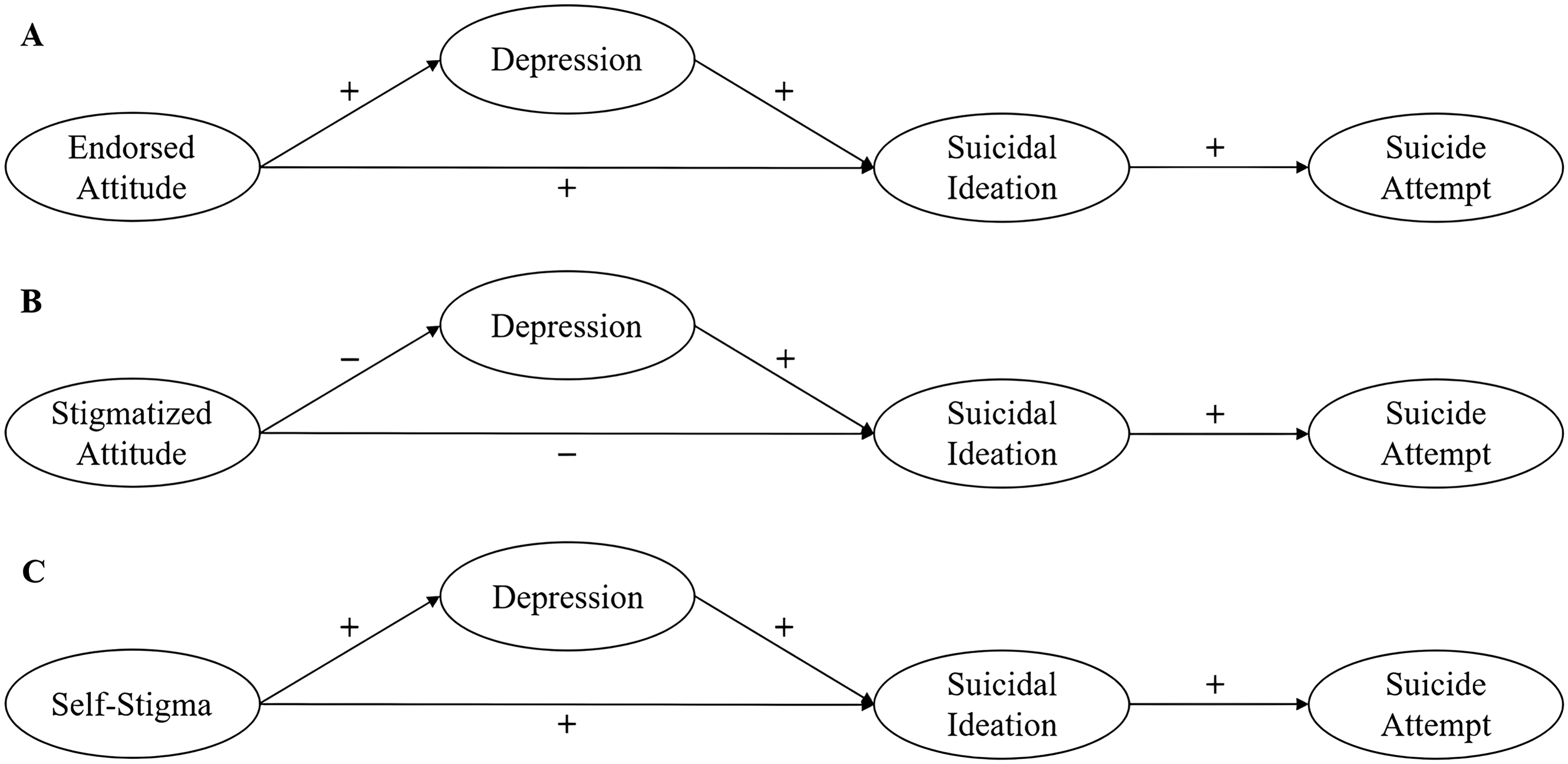
For stigmatized attitude toward suicide, studies on stigma emerged in the late 1890s and suggested that stigma is closely related to stereotyping, prejudice, and discrimination (Corrigan et al., 2005; Link & Phelan, 2001; Major & O'Brien, 2005). As a social phenomenon, stigma exerts significant social influences. From the perspective of people who stigmatize others, Dovidio et al. (2000) proposed that stigmatizing attitude and behaviors can bolster individuals’ self-esteem and social identity, serving as a means of justifying their own status quo (Zhang & Yu, 2007). Besides, in the field of suicidology, stigma is recognized as a major obstacle to suicide prevention (APA, 2022; Hom et al., 2015; Saxena et al., 2014). Suicidal behaviors and individuals who have attempted suicide or have family members who have committed suicide may be confronted with stigmatization from the public (Parker, 2014; Peters et al., 2016; Worden, 2018). Consequently, individuals with stronger stigmatized attitude toward suicide are less likely to engage in suicide attempts, as such attitudes may deter them from becoming part of the group they stigmatize. Our previous research has also demonstrated a negative association between individuals’ stigmatized attitude toward suicide and their suicide behaviors (Lyu & Li, 2023; Lyu et al., 2024, 2025). Therefore, the present study proposed the second hypothesis that stigmatized attitude toward suicide would be negatively associated with suicidal ideation and suicide attempts, both directly and indirectly through depression (Figure 1).
Regarding the term of stigma, it can be broadly categorized into public stigma and self-stigma (Corrigan & Penn, 1999; Corrigan & Watson, 2002; Rüsch et al., 2005). Public stigma denotes the stigma held by others, and self-stigma represents the stigma held by people themselves (Corrigan, 2004; Corrigan et al., 2018; Guarneri et al., 2019; Kowalski & Peipert, 2019). Stigmatized attitude is considered a form of public stigma. Existing research has demonstrated that individuals can internalize public stigma, by leading to a process of agreement, application, and then acceptance of these negative perceptions (Corrigan & Rao, 2012; Livingston & Boyd, 2010; Rimkeviciene et al., 2019). Moreover, in both clinical samples and sexual minority groups, depression has been shown to mediate the association between stigma and suicide (Kaniuka et al., 2019; Zeng et al., 2018). Hence, we proposed the third hypothesis that self-stigma toward suicide would be positively associated with suicidal ideation and suicide attempts, both directly and indirectly through depression (Figure 1).
To test the hypotheses proposed above, we employed structural equation modeling (SEM) in three separate models to investigate whether and how attitudes toward suicide influence the ideation-to-action framework of suicide among college students. For this purpose, we recruited a sample of Chinese college students, both those with and without suicidal ideation, and administered questionnaires to assess their endorsed attitude, stigmatized attitude, self-stigma toward suicide, depression, suicidal ideation, and suicide attempts.
Methods and Materials
Participants
Data from 1427 Chinese undergraduate and graduate students (61.32% females; age range, 18-31 years, M = 22.42, SD = 2.67) were analyzed. Of these students, 9.82% were freshmen, 23.51% sophomores, 37.37% junior students, and 29.30% senior students or postgraduates. The current cross-sectional study was reviewed and approved by the Research Ethics Committee of the authors’ institution. Phone numbers and email addresses of a few local and national crisis intervention agencies in major Chinese cities were provided to all participants.
Measures
Endorsed and stigmatized attitudes were separately measured by the Glorification and Stigma subscales of the Stigma of Suicide Scale – Short Form (SOSS-SF; Batterham et al., 2013a; Batterham et al., 2013). This 5-point Likert scale focuses on endorsement and stigmatized attitudes toward suicide, and each item is responded to by indicating numbers from 1 (strongly disagree) to 5 (strongly agree). The two dimensions were assessed by calculating the total scores of all items within each subscale. The higher scores denote a stronger endorsed or stigmatized attitude toward suicide. The two subscales used in this study were extracted from a revised version of the Chinese SOSS (12 items). The Cronbach’s α of this Chinese version scale in Chinese college students has been previously reported (Glorification, .77; Stigma, .72; Han et al., 2017). In the present study, Cronbach’s α values for the Glorification subscale and Stigma subscale were .72 and .85, respectively, demonstrating good internal consistency.
Depression was measured by the Patient Health Questionnaire-9 (PHQ-9; Spitzer et al., 1999), a widely used tool for measuring depressive symptoms. This 9-item questionnaire focuses on depression symptoms in the past 2 weeks of individuals. Each item is scored on a 4-point Likert scale ranging from 0 (not at all) to 3 (nearly every day; Kroenke et al., 2001; Williams et al., 2009). Adding up all the items yields the total score, and a higher score means a higher level of depression. Acceptable reliability and validity coefficients of this scale among Chinese community samples have been previously reported (Cronbach’s α is above .86; Wang et al., 2014). The Cronbach’s α of the scale was .84 in the current sample, demonstrating good internal consistency.
Suicidal ideation was measured by the Suicidal Ideation Attributes Scale (SIDAS; van Spijker et al., 2014). This 5-item questionnaire assesses suicidal ideation in the past month using an 11-point Likert Scale by measuring the frequency of suicide thoughts [from 0 (never) to 10 (always)], the degree to which the thoughts are uncontrollable [from 0 (no control) to 10 (full control)], the closeness to suicide attempts [from 0 (not close at all) to 10 (made an attempt)], the distress caused by the thoughts [from 0 (not at all) to 10 (extremely)], and the interference with daily activities [from 0 (not at all) to 10 (extremely)]. Adding up all the items yields the total score, and a higher score means a higher level of suicidal ideation. Participants with a total SIDAS score larger than 20 were indicated a high risk of suicidal behavior. Excellent reliability coefficients of this scale among Chinese college students have been previously reported (Cronbach’s α > .91; Han et al., 2017). The Cronbach’s α of the scale was .88 in the current sample, showing excellent internal consistency.
Suicide attempts were measured by the Suicide Behaviors Questionnaire-Revised (SBQ-R; Osman et al., 2001). This 4-item questionnaire assesses suicidal attempts by measuring the lifetime suicide-related thoughts and attempts (from 1 to 4), the frequency of suicidal thoughts in the past year (from 1 to 5), the threats of attempting suicide (from 1 to 3), and the self-reported likelihood of suicide attempts (from 0 to 6). Adding up all the items yields the total SBQ-R score, and a higher score means a higher level of suicide attempts. Participants with a total SBQ-R score larger than 6 were indicated a high suicide risk. Acceptable reliability coefficients of this scale have been reported among Chinese college students (ρ = .79, ω = .075; Huen et al., 2022). In the current study, the Cronbach’s α was .72.
Self-stigma toward suicide in the 570 participants who have suicidal ideation was further measured by the Self-blame subscale of the Personal Suicide Stigma Questionnaire (PSSQ; Rimkeviciene et al., 2019). This 7-item subscale focuses on self-stigma toward suicide, and each item is ranged from 1 (never) to 5 (very often). The subscale was scored by adding up all the items, and a higher score means stronger self-blame toward suicide. Acceptable reliability coefficients of this scale among an Australian community sample have been reported (Rimleviciene et al., 2019). In the current study, the subscale was first translated into Chinese by the first author and then double-checked by the corresponding author (see also, Lyu et al., 2024, 2025). The Cronbach’s α was .90, showing excellent internal consistency.
Data Analysis
All data analyses were conducted using JASP 0.17.1.0 (JASP Team) and Amos 27.0 (IBM Corp). Prior to analysis, data screening involved checking for incomplete responses and rigorous inspection for validity. Specifically, responses were excluded if their completion time fell outside two standard deviations of the mean completion time (DeSimone & Harms, 2018). To detect low effort responding, we inspected item responses for homogeneity (e.g., selected all ‘strongly agree’ or ‘neutral’) across the scales, including the reverse-scored items. Responses exhibiting extremely uniform patterns were removed to ensure data quality and responder validity (Curran, 2016; Meade & Craig, 2012). Furthermore, to diminish the potential for question order bias, the presentation order of items within all scales and questions was randomized during the data collection process (Şahin, 2021).
Pearson correlation analyses were first conducted to examine the correlations among endorsed and stigmatized suicides, depression, suicidal ideation, and suicide attempts. Bootstrapping with 10,000 times replicates was used to determine a 95% confidence interval of correlation coefficients. A multicollinearity test was conducted and assessed with the variables of variance inflation factor (VIF <5.00; Shrestha, 2020). No multicollinearity issue was found in the current sample. According to Efron and Tibshirani (1994), bootstrap procedures offer an empirical means for determining statistical significance that circumvents the need to assume the normality of data. Therefore, we used bootstrapping to deal with the possible non-normal distribution of the data.
To test all hypotheses as well as the hypothesized model, we followed the suggestions by Anderson and Gerbing (1988). First, confirmatory factor analyses (CFAs) were conducted to confirm the measurement models for each scale had acceptable fits. Then the hypothesized relationships were tested with the structural models. Both measurement and structural models were performed with full-information maximum likelihood estimation. The decision to use mediation analysis was driven by the theoretical foundations of the ideation-to-action framework, which posits a sequence of risk factors (Klonsky et al., 2018). Specifically, we hypothesize that attitudes toward suicide (i.e., distal factors) influence the psychological state of depression (i.e., proximal factors), which, in turn, influences suicidal ideation and suicide attempt, which moderation cannot test. Bias-corrected nonparametric percentile bootstrap method was employed to test the mediating effects. Statistical significance was determined with bias-corrected bootstrapping with 10,000 re-samples. For each estimate, 95% bootstrapped confidence intervals (CI) were also calculated, and a 95% CI not including zero was considered statistically significant.
Following Shrout and Bolger (2002), we used a bootstrap procedure to examine the significant levels of indirect effects for the mediation models. First, 10,000 bootstrap samples from the two original data sets were created respectively (N = 1427 and N = 570) by random sampling with replacement. Second, we run the hypothesized structural models 10,000 times separately with these 10,000 bootstrap samples to yield 10,000 estimations of each path coefficient. Third, we save the output of the 10,000 estimations of each path coefficient in the three models designed to calculate an estimate of the mediating or indirect effects.
Four indexes were used to assess the goodness of fit of the models: the comparative fit index (CFI ≥.90; Bentler, 1990); the incremental fit index (IFI ≥.90; Bollen, 1989), the standardized root mean square residual (SRMR ≤.10; Kline, 2005), and the root mean square error of approximation (RMSEA ≤.10; Hair, 2019; Xia & Yang, 2019). As an index which highly sensitive to sample size, Chi-square test results were also reported but not used in assessing model fit because they tend to be statistically significant due to a large sample size (Keith, 2015).
Results
Sample Characteristics
Intercorrelations for all Variables in the Entire Group (N = 1427)
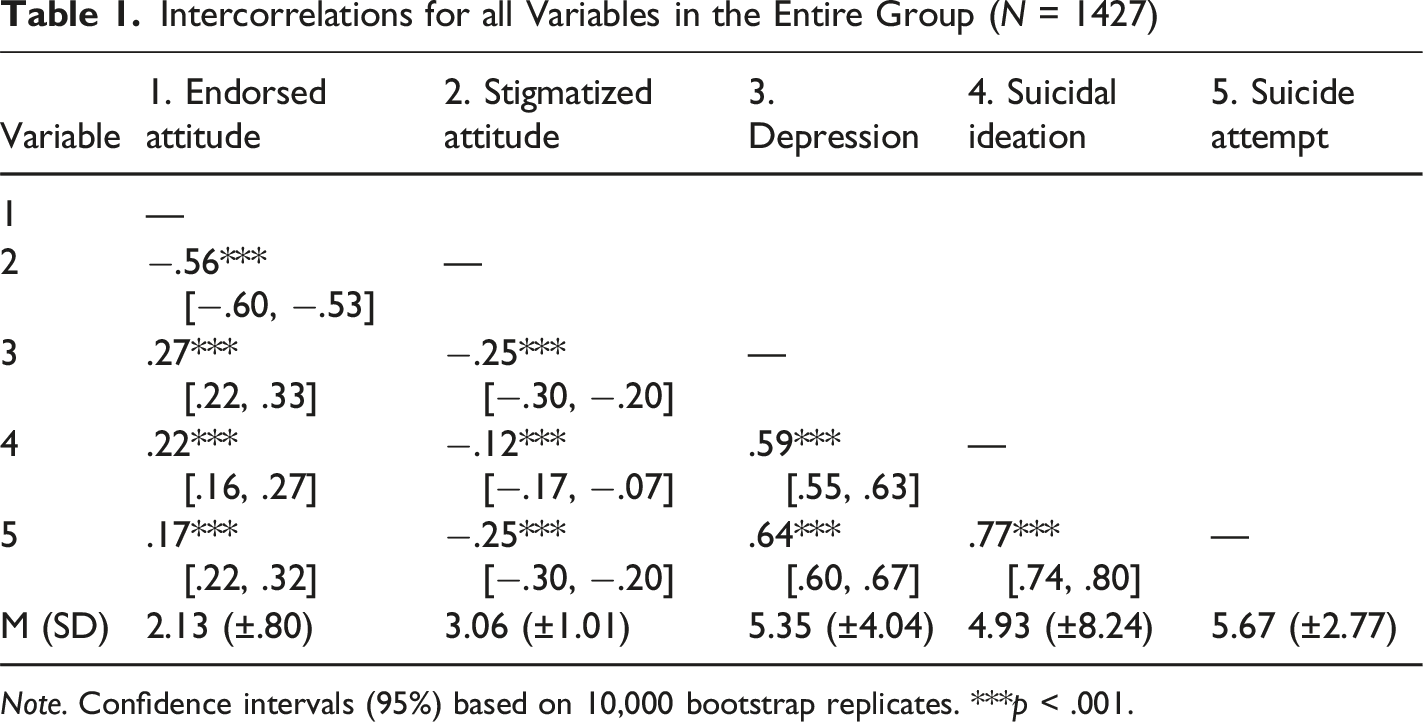
Note. Confidence intervals (95%) based on 10,000 bootstrap replicates. ***p < .001.
Intercorrelations for all Variables in the Students With Suicidal Ideation (N = 570)
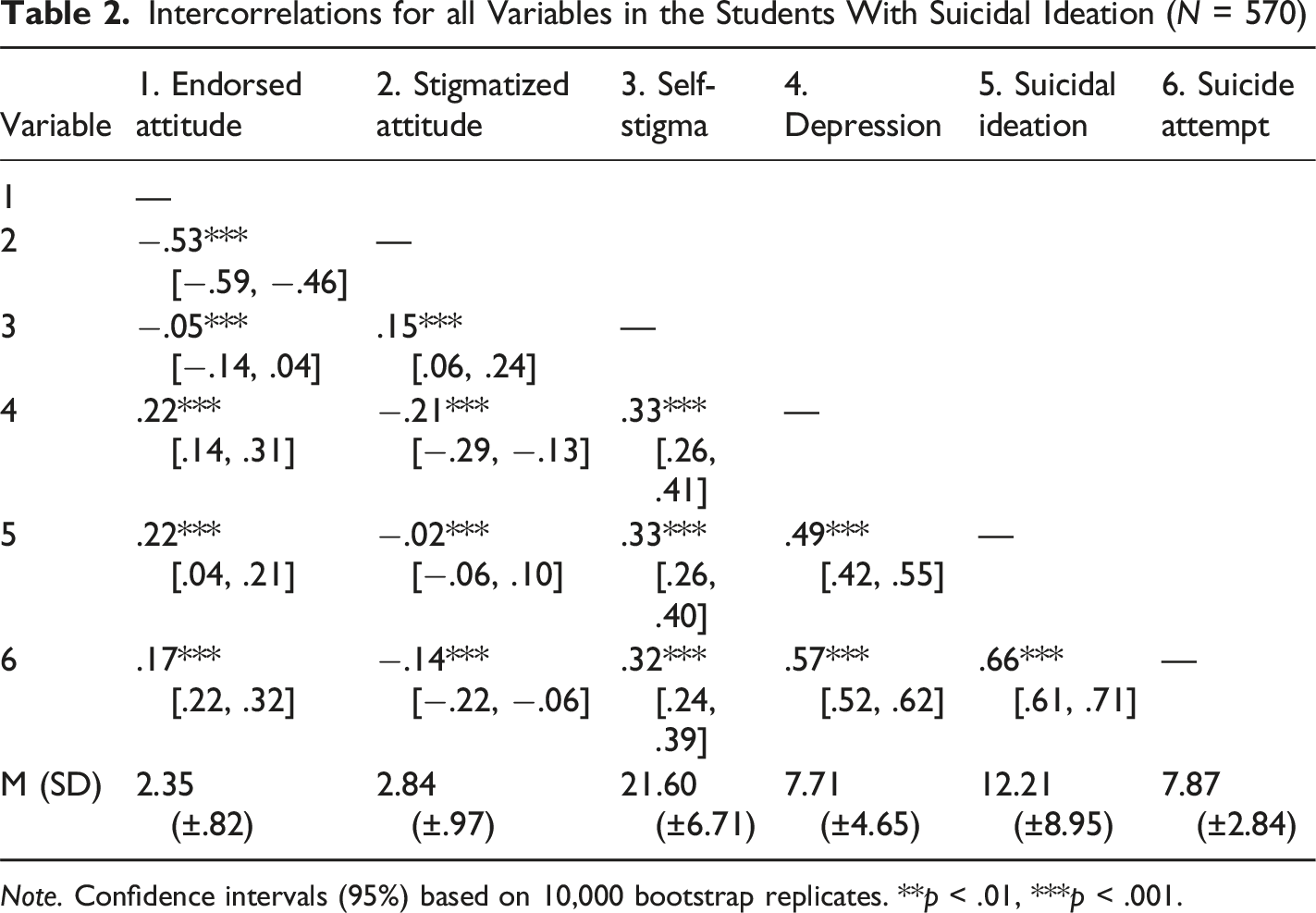
Note. Confidence intervals (95%) based on 10,000 bootstrap replicates. **p < .01, ***p < .001.
Measurement Models
To test the models, observed indicators of the latent constructs were used. For each latent variable, all the items of the corresponding scale were used as observable variables. The measurement model of endorsed attitude showed a good fit with χ2/df = 8.132, CFI = .926, IFI = .926, SRMR = .050, RMSEA = .067, 90%CI = [.063, .070]. The measurement model of stigmatized attitude showed a good fit with χ2/df = 7.374, CFI = .927, IFI = .927, SRMR = .056, RMSEA = .067, 90%CI = [.064, .070]. The measurement model of self-stigma showed a good fit with χ2/df = 3.23, CFI = .915, IFI = .916, SRMR = .060, RMSEA = .063, 90%CI = [.058, .067]. All the observed variables were significantly loaded on their respective latent variables (all ps < .001; see Online Resource 1). The results of confirmatory factor analyses demonstrated that all the scales used formed adequate measurement models, and thus provided evidence for the construct validity of the measures.
Structural Models
No latent variable exhibited multicollinearity issues in all the models, as all VIFs were below 5.00. Therefore, all the latent variables were included in the analysis of structural models. The structural model of endorsed attitude (Figure 2(A)), which is based on all college students, showed a good fit to the data with χ2/df = 8.132, CFI = .916, IFI = .916, SRMR = .058, RMSEA = .071, 90%CI = [.068, .074]. The structural model of stigmatized attitude (Figure 2(B)) also showed a good fit with χ2/df = 8.266, CFI = .916, IFI = .916; SRMR = .067; RMSEA = .071, 95%CI = [.068, .074]. The structural model of self-stigma (Figure 2(C)), which was based on the students with suicidal ideation, showed a good fit with χ2/df = 3.436, CFI = .907, IFI = .907; SRMR = .067; RMSEA = .065, 95%CI = [.061, .070]. Thus, all three models were used in the subsequent bootstrapping and invariance testing analyses. The Results of the Structural Equation Models. The Dashed Line Denotes the Path Coefficient was not Significant. **p < .01, ***p < .001.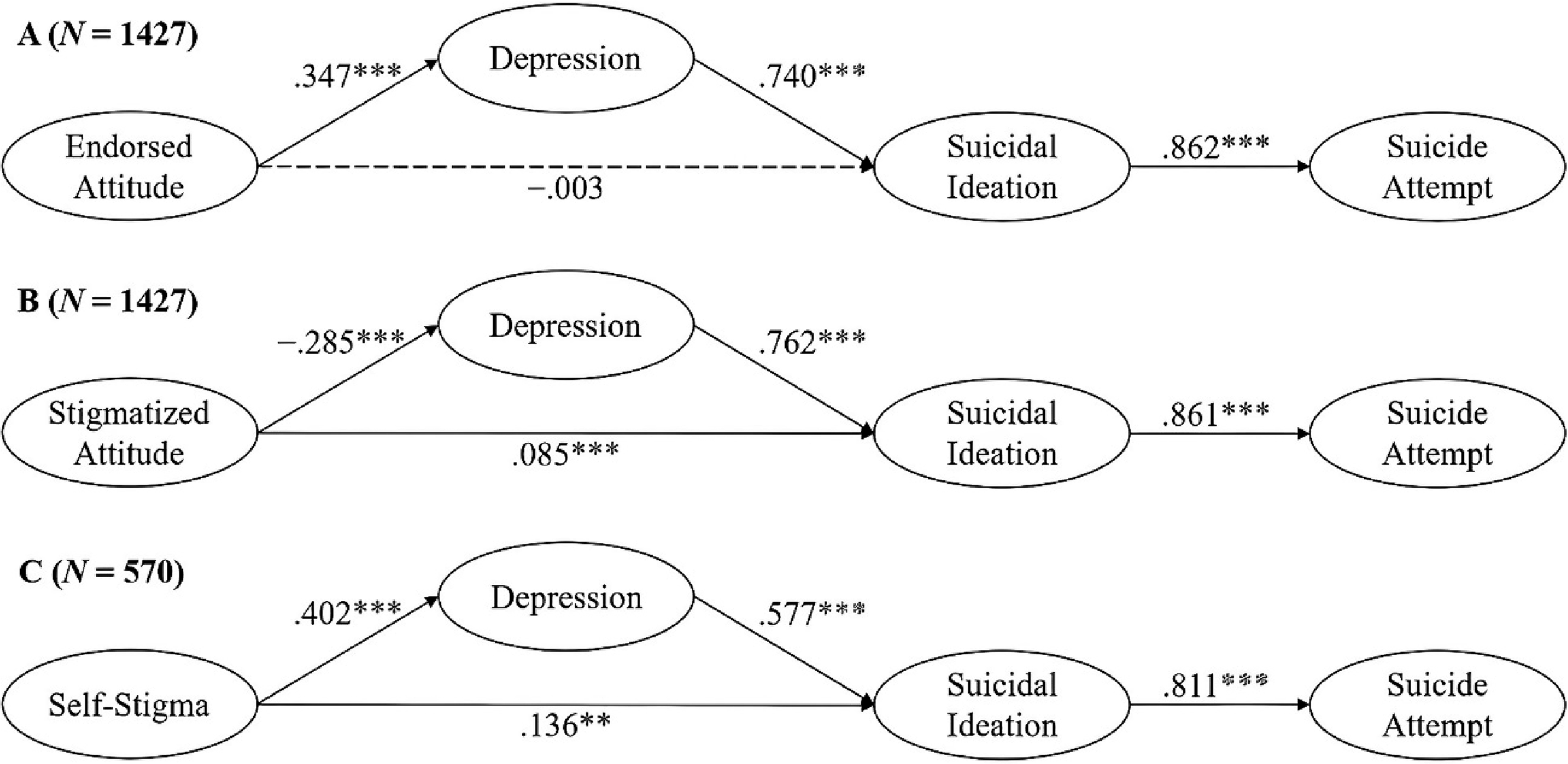
Bootstrap Analyses of the Magnitude and Statistical Significance of the Estimated Mediating Effects
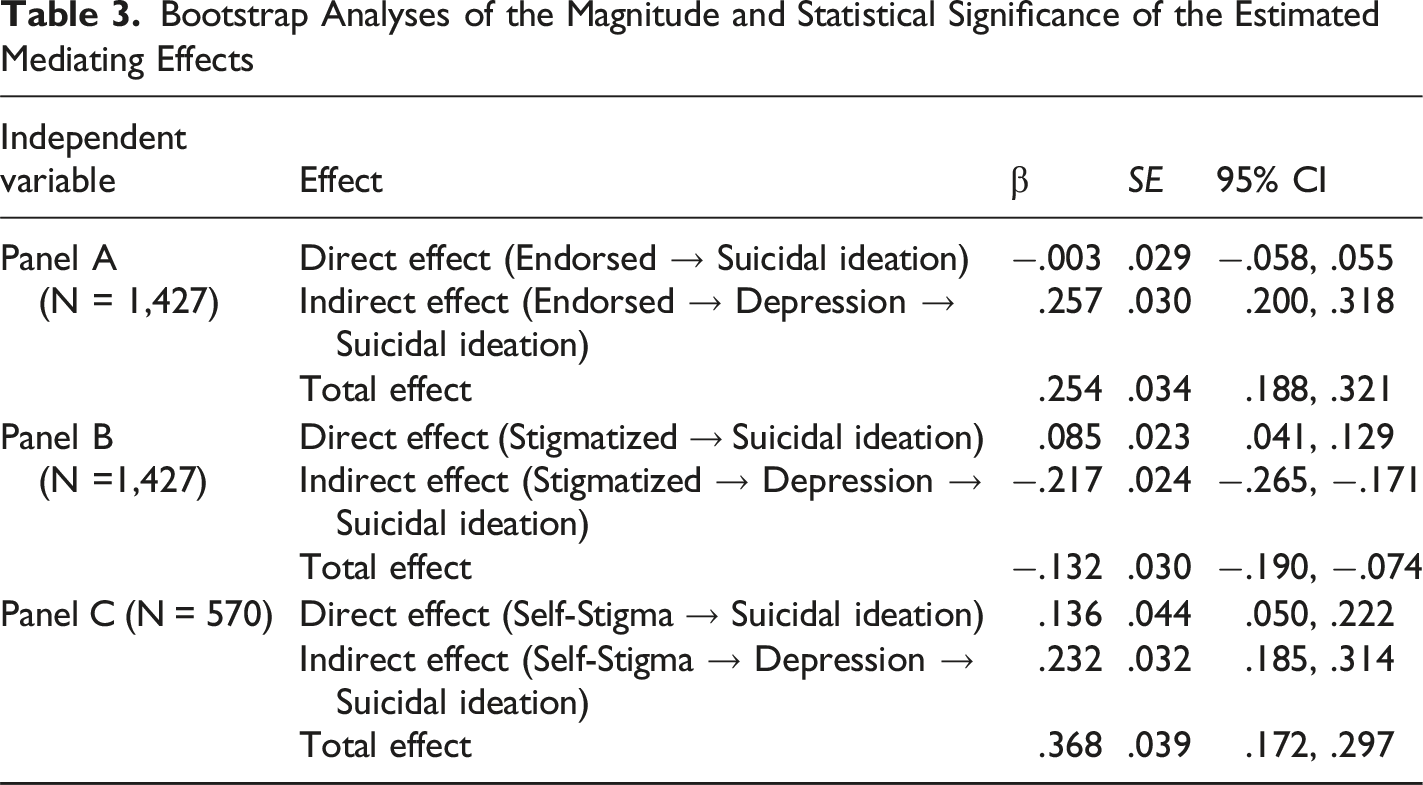
For the model with endorsed attitude in Panel A, there was a complete mediating effect from endorsed attitude to suicidal ideation through depression. For the model with stigmatized attitude in Panel B, there was a suppressing effect from endorsed attitude to suicidal ideation through depression (Cheung & Lau, 2008). Specifically, the influence of the indirect effect was opposite to the direct effect. For the model with self-stigma in Panel C, there is a partial mediation from self-stigma to suicidal ideation through depression, and its mediating effect accounted for 63.04% of the variance in the total effect.
Discussion
Elucidating attitudes toward suicide is paramount to developing effective and efficient suicide prevention strategies (Kim & Park, 2014; Kodaka et al., 2011). Anchored in the ideation-to-action framework (Klonsky et al., 2018), this study delved into the interaction between attitudes toward suicide with suicidal ideation and attempts, mediated by depression. The results across all three models confirmed the widely established positive association between depression and suicidal ideation and attempts in Chinese college students (see also, Wu et al., 2020; Zhou et al., 2021). Furthermore, the results revealed that all three types of attitudes exerted significant influences on suicidal ideation and attempts, with depression serving as the mediating factor. The hypotheses were partially supported the first hypothesis and fully supported the second and third one.
The present study revealed that an indirect-effect-only pathway through depression explained the association between endorsed attitude and suicidal ideation. The direct path between endorsed attitude and suicidal ideation was nonsignificant. Similar relations between endorsement and suicidal ideation have been observed in previous research among college students (Batterham et al., 2013a; Kawashima et al., 2020; Zemaitiene & Zaborskis, 2005). This finding can be interpreted by the notion that such attitude may normalize suicide, rendering it a more acceptable, attainable, and desirable option during a psychological crisis (Gibb et al., 2006; Lee et al., 2007). Individuals with endorsed attitude toward suicide are less likely to perceive suicide as a crisis, thereby diminishing the likelihood of help-seeking behaviors and intentions (McAuliffe et al., 2003). This decreased inclination, in turn, increases their vulnerability to the relatively high risk of suicide and makes them less accessible to professional intervention (Calear et al., 2014). Future studies could delve into the specific role of help-seeking and attitude toward it in suicide and explore how attitude toward help-seeking influences the pathway from endorsed attitude toward suicide to suicidal ideation and suicide attempts.
Simultaneously, stigmatized attitude toward suicide holds considerable significance in the field of suicidology. The present study demonstrated a significant negative association between stigmatized attitude and suicidal ideation, which explained by an indirect-effect-only pathway through depression. Notably, the direct path between stigmatized attitude and suicidal ideation was positive but suppressed by the indirect pathway. The bootstrapping test results further indicated that the indirect path accounted for a larger proportion of variance compared to the direct path. The mediated pathway can be explained by the potential of stigmatized attitude to increase help-seeking intentions, thereby reducing depression and suicide risk (Colucci & Minas, 2013; Dovidio et al., 2000; Downs & Eisenberg, 2012). On the other hand, the direct pathway may be attributable to stigma internalization (Corrigan et al., 2019). Given that internalization processes can be obstructed and only a portion of the participants exhibited self-stigma toward suicide, the association between stigmatized attitude and suicidal ideation was relatively weak in our sample (N = 1427) (Dreier et al., 2023; Jung et al., 2017).
Distinguished from stigmatized attitude as public stigma, self-stigma emerges from the internalization of these negative perceptions, leading to exacerbated depressive symptoms and potentially contributing to suicidal ideation (Aruta et al., 2021; Corrigan et al., 2019; Kaniuka et al., 2019; Zeng et al., 2018). The present study revealed direct and indirect associations between self-stigma and suicidal ideation. Notably, self-stigma toward suicide positively influenced suicide attempts in students with suicidal ideation, with depression and suicidal ideation partially mediating this relationship. Consistent with prior research, self-stigma among students with suicidal ideation was identified as a critical predictor for further suicidal thoughts (Lyu & Li, 2023; Rimkeviciene et al., 2015). A plausible explanation is that individuals with self-stigma may experience guilt and self-blame, increasing their susceptibility to poor mental well-being and suicide, rendering self-stigma a significant barrier to seeking professional intervention (Maclean et al., 2023; Saxena et al., 2014; Williams et al., 2003). Additionally, some studies suggest that negative public attitudes may accelerate suicide attempts in individuals with suicidal ideation (Carpiniello & Pinna, 2017; Worden, 2018). Therefore, self-stigma toward suicide may expedite the process of suicide in individuals with suicidal ideation.
A crucial distinction exists between the self-reported suicide risk measures used in this study (i.e., SIDAS and SBQ-R) and documented medically-verified suicide attempts or deaths by suicide. The current study captured the spectrum of suicide, including ideation frequency and behavioural history, which are often sub-threshold indicators of future, more severe outcomes (Klonsky et al., 2016). While these self-report instruments are highly predictive of subsequent attempts, they rely entirely on participant honesty and memory (see Deming et al., 2021). Thus, the findings should be interpreted as reflecting the relationship between attitudes toward suicide, depression, and suicidal ideation and suicide attempt, rather than confirmed medical events or fatalities.
The current study yields important implications for suicide prevention strategies. Firstly, endorsed and stigmatized attitudes toward suicide are purported to function as accelerators and barriers to suicide among all college students (Downs & Eisenberg, 2012). Therefore, mitigating endorsed attitude toward suicide should be a central focus of overarching suicide prevention efforts. As suggested by Kawashima et al. (2020), the implementation of suicide education programs and the cultivation of public awareness can effectively enhance suicide literacy and advance suicide prevention initiatives (Batterham et al., 2013a; Bunney et al., 2002; Corrigan & Penn, 1999). Several countries have implemented administrative measures to address endorsed attitude toward suicide and alleviate the risk of social media-related copycat suicide (Domaradzki, 2021; Fahey et al., 2018). Additionally, social media platforms can contribute to suicide prevention by providing professional support and fostering the development of interpersonal connections among users (Choi & Noh, 2020; Ha & Yang, 2021; Robinson et al., 2016). Secondly, self-stigma toward suicide is associated with an increased risk of suicide among students with suicidal ideation. Suicide prevention efforts should prioritize reducing self-stigma among these students. Considering that students with self-stigma toward suicide may be less inclined to proactively seek help, one potential approach is to encourage them to engage in regular professional counseling (Drum et al., 2009; Han et al., 2018; Vogel et al., 2007). Providing regular psychological assessments and counseling services can significantly improve personal mental health and reduce suicide risk (Teismann et al., 2018; Teismann et al., 2018).
Inevitably, there are some limitations regarding the current study. Firstly, it did not differentiate between self-stigma subtypes, namely perceived stigma and internalized stigma (Corrigan & Penn, 1999; Livingston & Boyd, 2010). As Corrigan et al. (2011) have asserted, assessing perceived stigma alone is insufficient to elucidate its impact. The detrimental effects of stigma are primarily driven by the internalization of stigma, also known as self-stigma (Corrigan et al., 2011). Future studies should gather data on perceived stigma and integrate it with self-stigma to delve into the internalization process of stigma (Hanschmidt et al., 2016; Nicholas et al., 2022). Secondly, the data collection employed a cross-sectional design with all data gathered at a single time point and limited causal inference. The mediated pathways reflect a best-fit theoretical snapshot anchored in the ideation-to-action framework, but cannot confirm temporal directionality. However, given the reciprocal relationship between stigma and suicide, longitudinal data may be more effective in uncovering causal links (Carpiniello & Pinna, 2017). To enhance the understanding of suicidal ideation and suicide attempts, future studies could consider conducting multi-wave longitudinal research (Franklin et al., 2017; Maclean et al., 2023).
Conclusions
This SEM study demonstrated that depression mediates the relationship between attitudes toward suicide and suicidal ideation and attempts. Specifically, endorsed attitude, stigmatized attitude, and self-stigma toward suicide all exerted indirect positive or negative effects on suicidal ideation and attempts through depression. These findings contribute to a deeper understanding of suicidal ideation and attempts and have implications for suicide prevention efforts. Future studies should further explore both public stigma and self-stigma to gain a better understanding of the internalized process of stigma toward suicide and its influence on suicidal ideation and attempts. Additionally, employing a multi-wave longitudinal design could provide stronger evidence for the relationships between these variables.
Supplemental Material
Supplemental Material - The Relationship Between Attitudes Toward Suicide and Suicidal Ideation and Attempts Among Chinese College Students: The Mediating Role of Depression
Supplemental Material for The Relationship Between Attitudes Toward Suicide and Suicidal Ideation and Attempts Among Chinese College Students: The Mediating Role of Depression by Shunyan Lyu, Zixuan Guo, Sabrina Yanan Jiang, Yu Li in Psychological Reports.
Footnotes
Acknowledgments
The authors gratefully thank Xinyu Tan for providing reference support throughout the study. They also thank Mutian Hou for his guidance on the structural equation modeling analysis.

Ethical Considerations
The current cross-sectional study was reviewed and approved by the Research Ethics Committee of Beijing Normal University – Hong Kong Baptist University United International College.
Consent to Participate
Phone numbers and email addresses of a few local and national crisis intervention agencies in major Chinese cities were provided to all participants.
Authors’ Contributions
S.L. was responsible for conceptualization, data curation, formal analysis, investigation, methodology, software, visualization, writing original draft, review, and editing. Z.G. was responsible for data curation, writing original draft, review, and editing. S.Y.J. was responsible for conceptualization, funding acquisition, resources, visualization, review, and editing. Y.L. was responsible for conceptualization, data curation, funding acquisition, investigation, methodology, resources, supervision, visualization, writing original draft, review, and editing.
Funding
The authors disclosed receipt of the following financial support for the research, authorship, and/or publication of this article: This research was funded by BNU-HKBU United International College Research Grants (R202102, R202011, R72021207) and The Science and Technology Development Fund (FDCT), Macao SAR (no. 0046/2024/RIA1) and (no. 001/2022/NIF).
Declaration of Conflicting Interests
The authors declared no potential conflicts of interest with respect to the research, authorship, and/or publication of this article.
Data Availability Statement
The datasets used and/or analyzed during the current study are available from the corresponding author upon reasonable request.
Supplemental Material
Supplemental material for this article is available online.
Author Biographies
References
Supplementary Material
Please find the following supplemental material available below.
For Open Access articles published under a Creative Commons License, all supplemental material carries the same license as the article it is associated with.
For non-Open Access articles published, all supplemental material carries a non-exclusive license, and permission requests for re-use of supplemental material or any part of supplemental material shall be sent directly to the copyright owner as specified in the copyright notice associated with the article.
