




Abstract
Food healthiness is often an important factor in deciding what to eat and how much. When evaluating healthiness, individuals may have access to only visual information, such as when they see food on display at a store/restaurant or see a food image on a package, menu, or store/restaurant website. However, in other contexts, individuals may have access to multisensory information through product sampling (e.g., grocery stores, food courts). Would sensory mode of evaluation, and specifically eating a food versus only viewing it, differentially influence perceived healthiness? Four preregistered studies address this question. The results show that individuals perceive foods with a combination of flavors/ingredients as healthier when they sample (vs. only view) them. Process evidence suggests the effect may be driven by salience of added flavors/ingredients when evaluating food based only on visual information (vs. sampling). Accordingly, highlighting the added flavor reduces healthiness of sampled foods to attenuate the effect. The effect also attenuates when foods do not have a combination of flavors/ingredients and could therefore be evaluated based on stereotypical healthy/unhealthy categorizations. The findings have implications for consumers, managers, and regulators. They also underscore the need for research investigating how information from different sensory modalities influences product evaluations, and the need for work identifying the mechanisms driving sensory integration.
Healthiness of food is a key factor in food-related decision making (Chandon et al., 2022; Foroni et al., 2022; Perkovic et al., 2022). In many contexts, beliefs about healthiness drive food choices, consumption volume (Biswas, Szocs, et al., 2014), perceived taste (Raghunathan et al., 2006), satiation (Suher et al., 2016), and feelings of guilt (Chandon & Wansink, 2006). Moreover, in the long term, beliefs about food healthiness can have implications for body image (Hayes et al., 2011), obesity (Chan & Zhang, 2022) and a multitude of chronic diseases (Foroni et al., 2022).
Objectively, food healthiness relates to the food’s macronutrient content which is not a pure sensation (Frank & Hettinger, 2005) and can be difficult to determine (Chan & Zhang, 2022). Consequently, consumers rely on judgements of perceived healthiness (i.e., how nutritious or good for you a food is). Judgements of healthiness are subjective, influenced by external factors, and may or may not converge with the food’s macronutrient content (Hagen, 2021).
Sensory properties of food, which are characteristics of food evaluated by the senses (Chambers IV, 2019) impact perceived healthiness. Visual characteristics such as food shape (Wang et al., 2022) and appearance (Hagen, 2021) influence healthiness. Haptic characteristics including food temperature (Yamim et al., 2020), and texture (Biswas, Szocs, et al., 2014) also influence healthiness perceptions. As these studies suggest, most prior research examining how sensory properties of food influence healthiness focus on a single sensory property (e.g., temperature) and compare healthiness evaluations at different levels (e.g., warm vs. cold food). We are not aware of any research examining healthiness perception based on the sensory modalities (e.g., vision, taste) involved in the evaluation.
When evaluating healthiness, people may have access to different types of information and therefore rely on different sensory modalities. In many contexts, such as when viewing food images on social media, packages, store websites, and menus or viewing actual products in a display case or package, people evaluate food visually. However, many grocery stores and restaurants offer product sampling (Biswas, Labrecque, et al., 2014). Eating is a multisensory experience (Elder & Krishna, 2010; Seguias et al., 2025). Thus, while individuals sometimes have access to only visual information, many other times they have access to multisensory information. There might conceivably be situations where individuals evaluate healthiness after smelling food, touching it, or hearing it during preparation (e.g., sizzling). However, vision is rated as the most important modality in product evaluations, and taste is the most important when evaluating foods/beverages (Schifferstein, 2006). As highlighted earlier, evaluations often involve only viewing food or having a multisensory sampling experience. We therefore limit our focus to comparing visual healthiness evaluations to evaluations after sampling.
Would perceived healthiness differ based on whether a person had access to only visual information compared to information from multiple sensory modalities due to sampling? That is, would sensory mode of evaluation (visual vs. taste/sampling) influence perceived healthiness? While prior research has not addressed this question, there is research showing that the sensory modalities involved in evaluations can influence outcomes. For instance, when participants evaluate containers visually, taller containers seem larger than equal volume containers that are shorter and wider; however, the effect reverses when participants evaluate containers only through haptics (Krishna, 2006). Auditory characteristics related to beverage fizzing influence perceived carbonation of beverages held in the hand but have no impact on perceived carbonation of sampled beverages (Zampini & Spence, 2005). These findings suggest there may be differences in healthiness based on the sensory modalities involved in evaluating food.
Next, we discuss prior research on healthiness evaluations to build a framework for our prediction about how perceived healthiness will differ based on whether a food is sampled versus evaluated only visually.
Theoretical Background
Food Healthiness
Healthiness of visually presented food is usually evaluated quickly (e.g., within 166-230 milliseconds) and automatically (Toepel et al., 2009). Evaluations often involve assigning foods to one of two dichotomous categories: good/healthy versus bad/unhealthy (Chernev & Chandon, 2015; Rozin & Holtermann, 2021). Healthy foods are consistent with long-term goals of self-controlled eating and include fruits, vegetables, and foods labeled “light” or “low-fat” (Chernev, 2011; Chernev & Gal, 2010). Unhealthy foods fulfill short-term goals of immediate gratification and include desserts, fried foods, and foods labeled as “decadent” (Chernev, 2011; Chernev & Gal, 2010).
The binary healthy/unhealthy categorization is the default method of thinking about healthiness of foods/beverages (henceforth foods) in the US and abroad (Rozin & Holtermann, 2021). While healthy/unhealthy categorizations are extremely useful for evaluating foods that are stereotypically healthy or unhealthy such as fruits, vegetables, and desserts, binary categorizations may be difficult when a food contains a combination of flavors or ingredients (e.g., chocolate sunflower seeds). The present research uses foods with a combination of flavors as stimuli because healthiness evaluations would have to be constructed rather than recalled from memory. Next, we discuss visual healthiness evaluations.
Visual Healthiness Evaluations
When visually evaluating healthiness of food, consumers often rely on labels. There are more than 900 food labeling schemes in Europe (Kaczorowska et al., 2021) and numerous labels in the US (Latino et al., 2022). Food labels assure consumers of a food’s origin (e.g. Protected Geographical Indication, Protected Designation or Origin; Kaczorowska et al., 2021), production process (e.g., fair trade, organic, kosher), content (e.g., non-GMO, low fat), and overall quality (e.g., USDA; Jahn et al., 2005; Latino et al., 2022).
Consumers use food labels as a heuristic for healthiness (Williams, 2005). Labels often serve as a health halo since consumers generalize one health claim to other positive health characteristics (Chandon & Wansink, 2007b). Health halos lead consumers to believe local food is healthier than conventional food (Demartini et al., 2018). They also lead consumers to believe that food with low sugar (Prada et al., 2021) or containing fruit sugar (Sütterlin & Siegrist, 2015) is healthier than foods with regular sugar or foods without sugar claims. Health halos explain why consumers believe foods with fair trade (Schuldt et al., 2012) or organic labels contain fewer calories (Durand et al., 2025; Schuldt & Schwarz, 2010) than foods without these labels. Even more general labels such as “healthier” can have halo effects leading consumers to infer food contains less salt (Andrews et al., 2000) and fat (Andrews et al., 1998).
Inferences drawn from labels are often inaccurate. Foods with similar health labels may have very different macronutrient content (Heslin et al., 2020) while foods with labels (e.g., organic) may have limited nutritional benefits compared to foods without the labels (Giampieri et al., 2022; Kushi et al., 2012; Smith-Spangler et al., 2012). Finally, foods with some labels (e.g., low-fat, low-calorie) contain more sugar (Nguyen et al., 2016), carbohydrates (Schuchmann, 2023) and sodium than their conventional counterparts (John et al., 2016).
In addition to food labels, consumers also rely on other characteristics to infer healthiness. The name of the food (Irmak et al., 2011), it’s appearance (Hagen, 2021), and most relevant to the current research, the presence of additives (Scott & Rozin, 2017) influence perceived healthiness.
Food additives are chemicals, flavors, or other ingredients that are not naturally part of the product (Rozin et al., 2012). For instance, flavors such as Sugar Cinnamon may be added to products like Special K cereal to extend product lines (e.g., Sugar Cinnamon Special K). Adding ingredients (e.g., chocolate pieces) is another way manufacturers extend product lines (e.g., Special K Chocolatey Delight). The Sugar Cinnamon and Chocolate are additives because they are not always part of the cereal. Additives are salient in food evaluations (Rozin et al., 2009) and highlight that the food is processed (Scott & Rozin, 2017). Food processing negatively impacts perceived healthiness (Szocs & Lefebvre, 2016). The additional processing suggested by additives is one reason they negatively impact perceived healthiness (Bearth et al., 2014; Scott & Rozin, 2017).
When visually evaluating foods like those mentioned in the previous paragraph, the flavors or ingredients, henceforth additives, may be especially salient because consumers form expectations about food based on its appearance and labeling (Shankar, Simons, et al., 2010; Shiv et al., 2005). While taste and mouthfeel are important factors in food evaluations (Szczesniak, 1990), they are difficult to predict (Deblais et al., 2021; Malavolta et al., 2022). Consequently, consumers often rely on easier to evaluate information when assessing healthiness (Chan & Zhang, 2022). We predict that when visually evaluating the healthiness of a food with additives (e.g., Chocolatey Special K), the added flavor or ingredient (i.e., chocolate) will be salient and negatively bias perceived healthiness, even if the additive is stereotypically healthy (e.g., fruit flavor). Next, we discuss the sampling experience and how additives may be less influential in healthiness evaluations of sampled foods.
The Sampling Experience
Encountering a food only visually is fundamentally different than eating it. Both images of food and specific tastes (e.g., sweet, sour) experienced in the mouth activate taste related areas of the brain, however, the activation patterns elicited by viewing food are distinct from those activated by oral experiences (Avery et al., 2021).
In most situations, individuals see a food before it enters their mouth (Hoegg & Alba, 2007). Visual product information would therefore be subsumed in most sampling experiences, including those in this research. Sampling also involves an oral experience that includes gustatory information (e.g., sweetness); haptic information (e.g., food texture, hardness, temperature, weight); olfactory information (e.g., food odor), and often auditory information (e.g., sound of food fracturing). Thus, eating is truly a multisensory experience (Elder & Krishna, 2010; Seguias et al., 2025; Zampini & Spence, 2012).
Despite the multitude of sensory information available during eating, taste perception is holistic, and most people cannot identify the contribution of any individual sensory modality (Stevenson, 2023). While consumers can identify different ingredients/flavors when instructed (Crolic & Janiszewski, 2016), most eating experiences involve multiple sensations fusing together (Auvray & Spence, 2008). Consistent with this, consumers often use the term “taste” to refer to the scent, flavor, and texture of food (Sobal et al., 2006). Next, we discuss how the unique aspects of sampling influence perceived healthiness.
Modality Effects on Healthiness
As mentioned previously, added flavors/ingredients would be salient when visually evaluating healthiness and visual information would be subsumed in most sampling experiences. However, expectations based on visually encoded information would be just one input in the multisensory sampling experience (Shankar, Levitan, & Spence, 2010). When information is available from multiple sensory modalities, the relative influence of any one piece depends on its salience and reliability (Ernst & Banks, 2002; Zampini & Spence, 2012).
This research proposes that when healthiness is evaluated after sampling, oral information should be more salient and reliable than visually formed expectations for several reasons. First, from a functional perspective, it may be advantageous to pay more attention to information within the body than outside of it (Koza et al., 2005; Zampini & Spence, 2005). Consistent with this, Rozin et al. (1995) propose that having a contaminated object in the mouth is more unpleasant and salient than having the object contact parts of the body that are not apertures (e.g., cheek) because the mouth represents the last barrier before the stimulus is incorporated into the body. Moreover, thinking about eating food compared to just thinking about the food leads to stronger sensory associations (Speed et al., 2023). Second, the number of senses involved in an experience is positively correlated with the vividness and memorability of the experience (Dinh et al., 1999). Multisensory memories are more vivid than memories related to a specific sensory property (Andrade et al., 2014). The increased vividness and memorability of information obtained during sampling should make it more salient than visually formed expectations. Oral information should also be more reliable than visual information because marketers have traditionally had discretion over visual characteristics of food like appearance and labeling (Hagen, 2021). In contrast, altering how soft, smooth, or creamy a sampled food seems often requires changing the ingredients in the food, such as by adding fat (Schiffman et al., 1998).
The salience and reliability of oral information when evaluating healthiness after sampling should mute the influence of visually formed expectations. Thus, while additives should render visually evaluated food as unhealthy, information from other modalities involved in sampling should highlight aspects of the food beyond added flavor or ingredients (e.g., texture, smell). Individuals should therefore evaluate food with a combination of flavors as healthier when it is sampled (vs. only visually evaluated).
Overview of Studies
Four preregistered laboratory studies reported in the text (and an additional study in the Appendix) test our predictions. We report how we determined our sample size, all data exclusions (if any), all manipulations, and all study measures. The sample size was determined based on the number of participants who attended the study sessions. We aimed for a minimum of 50 participants per experimental condition to be consistent with recent research (Biswas et al., 2024). For all studies, we excluded participants in the sampling conditions who did not sample the food. All measures and analysis without data exclusions are reported in the Appendices. Data were analyzed using IBM’s 29.0.2.0 version of SPSS Statistics and PROCESS version 4.2 (Hayes, 2018). All the data are available at: https://osf.io/5rnc4/?view_only=db02120e4a86432f996222bf1c979ab2.
Study 1a
Study 1a tests our prediction that individuals will evaluate foods with a combination of flavors as healthier when they sample than when they only view the food. We also explored whether nutritional involvement (e.g., an interest in nutrition) or external eating tendency (e.g., tendency to overeat in response to seeing or smelling food) would moderate the proposed effect. This preregistered study (https://aspredicted.org/5B3_LP2) had two between-subjects conditions (mode of evaluation: visual vs. taste/sample).
Participants entered a lab in groups of about 20 and were seated at individual computer stations. Each station contained a cup of chocolate covered sunflower kernels. One of two randomly distributed sheets of paper covered the kernels. The paper included a number, which unbeknownst to the participant, corresponded to the assigned experimental condition (2 = visual, 3 = sample). A Qualtrics survey instructed participants to enter the number on the sheet. All participants read: “You are shopping online and come across the chocolate covered sunflower kernels below. Take a good look at the product before clicking to the next page.” They saw a photo of the product on a snack company’s webpage (see Appendix A). On the next page, participants saw the same image. Those in the view (sample) condition were instructed to take a good look at the pictured kernels (eat one of the kernels at their station) and respond to the four-item healthiness scale (e.g., This product is healthy. 1 = strongly disagree, 7 = strongly agree;
University students (N = 160) completed the survey. Per the preregistration, we excluded responses from individuals who did not eat the kernel as instructed (N = 39) or failed the attention check (N = 3) leaving a final sample of 119 (56 females, 63 males; Mage = 20.45).
Results
As hypothesized, participants who sampled (vs. only viewed) the chocolate covered sunflower kernel rated the product as healthier (Mvisual = 3.32 (SD = 1.11) vs. Msample = 3.78 (SD = 1.20); F (1, 117) = 4.31, p = .040,
Per a reviewer’s suggestion, we also conducted non-preregistered analysis to examine the effects of mode of evaluation on healthiness perceptions when controlling for nutritional involvement and external eating tendency. ANCOVA revealed a significant effect of mode of evaluation on perceived healthiness (F (1, 115) = 4.18, p = .043,
Discussion
The results of Study 1a provide initial support for our prediction that mode of evaluation influences perceived healthiness. We find that individuals who sample a food rate it as healthier than individuals who evaluate the food only visually. This effect is robust to individuals with varying levels of nutritional involvement and external eating tendencies. Next, we aim to replicate the effect with different food stimuli and address an alternative explanation.
Study 1b
The purpose of Study 1b was twofold. First, we wanted to replicate the effects observed in Study 1a with a different food item. Second, we wanted to address motivated justification as an alternative explanation for the findings of Study 1a. Prior research shows that individuals’ desire to justify behavior influences perceived healthiness (Ilyuk et al., 2019; Jiang & Lei, 2014). Motivated justification should lead sampled (vs. visually evaluated) food to seem healthier irrespective of the presence of a combination of flavors/ingredients. However, if our theorization is correct, we should observe an effect of mode of evaluation on healthiness for foods with added flavors, but no effect for foods without added flavors as the latter would be evaluated based on stereotypical healthy/unhealthy categorizations.
Method
This preregistered study (https://aspredicted.org/w2cm-pm3r.pdf) tests our prediction that the effects of mode of evaluation on perceived healthiness will attenuate when the food can easily be categorized as healthy or unhealthy (i.e., does not contain added flavor). The study had a 2 (mode of evaluation: visual vs. taste/sample) x 2 (added flavor: unhealthy vs. control/none) between-subjects design. To manipulate food flavor, we used Blue Diamond Dark Chocolate Almonds and Blue Diamond Lightly Salted Almonds as stimuli. It should be noted that Chocolate Almonds have fewer calories per one ounce serving (160) than the Lightly Salted Almonds (170; Blue Diamond Growers, 2024).
Similar to Study 1a, participants were first asked to indicate the letter on a printed sheet at their lab station. The letter corresponded to the almond flavor at their station. Next, participants read “you are shopping online and come across the (chocolate flavored) almonds below. Take a good look at the product before clicking to the next page.” All participants were shown a webpage with an image of a bowl containing 43 grams of Blue Diamond Dark Chocolate or Lightly Salted almonds. Upon clicking to the next page, participants saw the same image a second time. Those in the sampling conditions read “There is a sample of the (chocolate) almonds in the cup under the printed sheet. Please eat one of the almonds before answering the questions below.” Participants in the “visual” evaluation condition were not told anything about the cup of almonds but were asked to respond to the same healthiness measure (Hagen, 2021; α = .83). After responding to the healthiness measure, participants advanced to the next page where they completed exploratory measures (i.e., salience and diagnosticity). See Appendix B for measures and analysis. Finally, participants in the sampling conditions were asked if they ate the almonds (yes/no) and all participants were asked to respond to demographics.
Students from a large US university participated for course credit. 245 individuals finished the survey. 32 participants in the “taste” condition did not sample the almonds as instructed. Responses from these individuals were excluded leaving a final sample of 213 (112 females, 101 males; Mage = 20.04).
Results
Perceived healthiness
A (modality) x (added flavor) ANOVA on perceived healthiness revealed a main effect of flavor showing that the salted almonds were perceived as healthier than the chocolate flavored almonds (Mnone = 5.76 (SD = .93) vs. Mchocolate = 3.96 (SD = 1.29); F (1, 209) = 144.10, p < .001,
Discussion
The results of Study 1b provide additional evidence that mode of evaluation influences perceived healthiness. The effects hold for foods with a combination of flavors (i.e., chocolate almonds) but not foods without added flavors (i.e., almonds), which suggests justifying through healthifying (Ilyuk et al., 2019) is not the primary driver of our effects.
In Study 1a and 1b we tried to minimize the influence of information from sensory modalities other than vision (e.g., scent) by having participants view an image of the food. While participants in the visual condition only saw the image, participants in the sample condition viewed the same image and ate the food. This procedure could have resulted in a different visual experience during sampling. Study 2 controls this by having participants in the visual condition view the food at their lab station. Study 2 also provides evidence in support of our proposed process through moderation.
Study 2
We theorize that the salience of food additives negatively biases visual healthiness evaluations but other information available during sampling mutes the influence of additives. If our theorization is correct, making the flavor salient through a product description should reduce the healthiness of the sampled food to attenuate this effect. This preregistered study (https://aspredicted.org/5pkz-wvj3.pdf) tests this prediction with a 2 (mode of evaluation: visual vs. taste/sample) X 2 (food description: present vs. absent) between-subjects experiment. After unlocking the survey with a code supplied by the lab assistant, participants read that we were interested in their evaluation of a new Kit Kat Candy Bar cereal. Those in the “description present” conditions also read: “The cereal has crispy wafer pieces with a light chocolate flavor.” This statement was not included in the “description absent” conditions (See Appendix D for manipulations and measures). On the next page, participants were told that there was a zipper bag of Kit Kat Candy Bar cereal at their lab station. Those in the “visual” conditions were asked to “open the bag and take a look at the cereal” while individuals in the “sample” conditions were asked to “open the bag, pour a piece of cereal on the napkin, and eat it”. After completing the task, all participants clicked to the next page where they completed the healthiness measure (
Students from a university in the US (N = 330) completed the survey. As preregistered, we excluded respondents who indicated they did not sample the cereal as instructed (N = 17) or failed the attention check (N = 4) leaving a final sample of 309 (135 females, 174 males; Mage = 18.93). Appendix D contains analysis without these exclusions.
Results and Discussion
A (mode of evaluation) x (food description) ANOVA on perceived healthiness revealed a marginally significant main effect of mode of evaluation (Mvisual = 2.18 (SD = .96) vs. Msample = 2.45 (SD = 1.13); F (1, 305) = 3.59, p = .059, Effects of Mode of Evaluation and Descriptive Information on Perceived Healthiness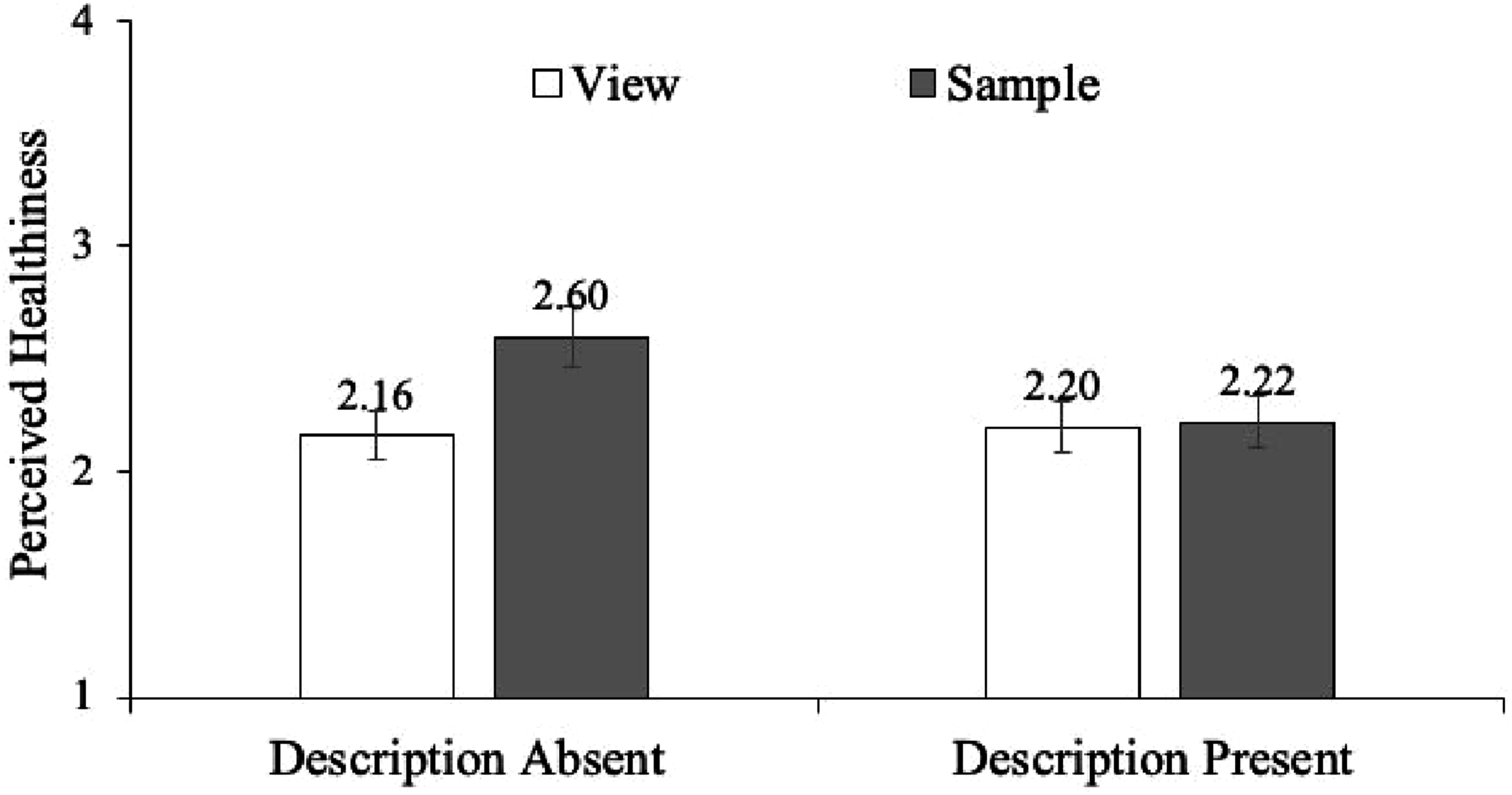
The results of Study 2 lend support to our prediction that the salience of the added flavor negatively biases visual healthiness evaluations. Highlighting the added flavor with a product description attenuates the effect of mode of evaluation on perceived healthiness by reducing healthiness of the sampled food. Next, Study 3 provides additional process evidence.
Study 3
The purpose of Study 3 was to provide additional evidence for our theorization that the salience of additives negatively bias visual healthiness evaluations. If our conceptualization is correct, highlighting additives through prompting individuals to think about food ingredients should reduce healthiness of the sampled food to attenuate the effects. This preregistered study (https://aspredicted.org/gx5j-3yn2.pdf) tests this idea with a 2 (mode of evaluation: visual vs. taste/sample) X 2 (ingredient listing task: present vs. absent) between-subjects design.
University students read that a cereal manufacturer was interested in understanding opinions about a new strawberry milkshake-flavored cereal. Depending on the randomly assigned experimental condition, they were asked to either look at the Ziploc bag of wheat-based cereal with strawberry cream topping at their lab station or eat a piece of the cereal. In the “ingredient listing task present” conditions, participants were asked to list the likely ingredients in the cereal. Upon clicking to the next page, participants responded to the healthiness measure (α = .91) and an attention check. On the last page of the survey, participants indicated age, gender, and whether they sampled the cereal (taste/sample conditions).
We received 344 completed surveys. Per the preregistration, we excluded individuals who failed the attention check (N = 14) or indicated that they did not eat the cereal as instructed (N = 28). The final sample was 303 (127 females, 175 males, 1 other/prefer not to say; Mage = 19.49).
Results and Discussion
A (mode of evaluation) x (ingredient listing task) ANOVA on perceived healthiness revealed a main effect of mode of evaluation (Mvisual = 2.85 (SD = 1.26) vs. Msample = 3.22 (SD = 1.27); F (1, 299) = 6.46, p = .012, Effects of Mode of Evaluation and Highlighting Ingredients on Perceived Healthiness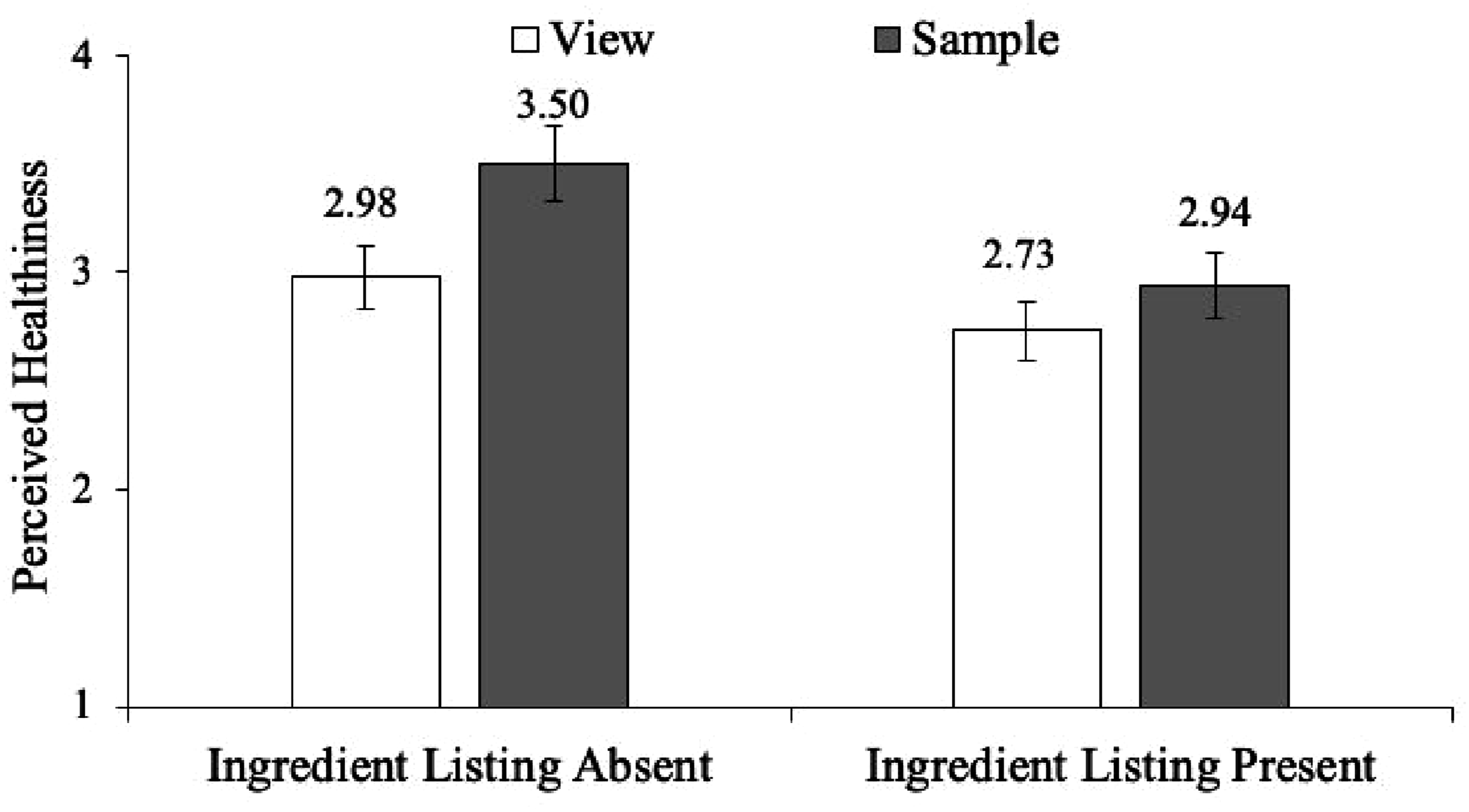
General Discussion
The results of four studies (plus an additional study in the Appendix reveal participants who sample food with added flavors/ingredients rate it as healthier than participants who only look at the food. The effect is robust to foods with stereotypically healthy and unhealthy added flavors (e.g., fruit vs. candy; Appendix C) but attenuates for foods without added flavors (e.g., salted almonds; Study 1b). This is likely because foods without added flavors can be evaluated by relying on stereotypical healthy/unhealthy categorizations in memory (Chernev & Gal, 2010; Rozin & Holtermann, 2021). Preliminary process evidence suggests that the salience of additives negatively biases visual healthiness evaluations. Sampling mutes the salience of additives resulting in greater perceived healthiness relative to visual evaluations. Consistent with our theorization, highlighting added flavor through a product description or prompting participants to think about the ingredients reduces perceived healthiness of the sampled food to attenuate the effect.
Theoretical Contributions
The findings of this research add to the literature on how sensory information is integrated when evaluating products. Prior research in this domain reveals that visual information often dominates information from other senses. For instance, when evaluating the similarity of beverages, individuals rely more on beverage color than taste (Hoegg & Alba, 2007). When identifying the flavor of sampled beverages, individuals often incorrectly identify beverages based on color (DuBose et al., 1980). And, when evaluating container size through a combination of vision and touch, how tall the container looks is more influential than how wide it feels (Krishna, 2006). We contribute by identifying a context (i.e., when sampling foods with added flavors/ingredients) where visually encoded information may be less salient than information from other sensory modalities.
Our findings also contribute to research on perceived healthiness of combinations. Research in this stream reveals that adding a stereotypically healthy side dish (e.g., celery sticks) to a stereotypically unhealthy main dish (e.g., burger) leads the combination to seem healthier than the individual main dish (Chernev, 2011), and that individuals underestimate the number of calories in a healthy/unhealthy combination by averaging calories across items (Chernev & Gal, 2010). There is also work showing that an unhealthy food (e.g., ice cream) seems healthier when topped with a healthy item (e.g., fruit) compared to without a topping (Jiang & Lei, 2014). We extend this stream by identifying sensory mode of evaluation as an additional factor to consider in healthiness evaluations of foods with a combination of flavors.
Applied Implications
The findings of this research have implications for marketing practitioners, consumers, and regulators. From a practitioner perspective, our findings have implications for food presentation. Manufacturers aiming to appeal to health-conscious individuals should provide product samples when foods contain a combination of flavors or ingredients. Sampling can help individuals better evaluate the healthiness of such foods. Manufacturers worried that sampling may lead less health-conscious consumers to mistakenly perceive their products as healthier (and perhaps less tasty; Raghunathan et al., 2006) can increase the salience of added flavors by including product descriptions on packaging or in advertisements. Alternatively, manufacturers can include messages in marketing communications that prompt consumers to think about likely food ingredients. Insurgent Brands (2025) does this with their RXBARs by listing ingredients in large print on the front of packaging. That’s it. Nutrition (2025) highlights ingredients in their fruit bars through their brand name, “That’s it.” and by listing ingredients under the prominent logo on the front of packages.
Retailers also play an important role in shaping consumer perceptions. For items that shoppers may avoid because they are perceived as unhealthy (e.g., children’s breakfast cereals), providing samples can help refine consumer perceptions. It may also be beneficial to offer samples when foods with added flavors are positioned as healthy (e.g., protein bars). Conversely, when there is a risk that consumers may evaluate sampled products as healthier than they are, retailers can use signage or other visual cues to highlight the ingredients or provide product descriptions. Similarly, in-store demonstrations (e.g., leveraging digital platforms) could be utilized to help consumers better understand the flavor aspects of the food, mitigating potential misperceptions.
From a regulatory perspective, it might be valuable to consider limiting product samples in some venues such as school cafeterias and government sponsored pre-schools/day care centers. Beliefs about food healthiness develop early on (Perkovic et al., 2022). Dietary habits formed in childhood often continue in adulthood (Mikkilä et al., 2005). Thus, it is important to ensure children do not form biased perceptions from sampling foods with added ingredients or flavors. Regulators may also consider whether there should be age restrictions on product sampling. Restrictions would prevent retail or brand representatives from offering samples of foods with added ingredients to children under a certain age, much like is done for sampling of alcoholic beverages.
From a consumer well-being perspective, it may be important to educate individuals on the various factors that can impact their healthiness evaluations. People may not be aware of the factors that can influence their perceptions of food healthiness. Given the prevalence of obesity, and the fact that unhealthy diets are a key contributor to the obesity epidemic (Chan & Zhang, 2022) it seems worthwhile to make people aware of the factors, including sensory mode of evaluations that influence healthiness perceptions.
Constraints on Generalization
The focus of this work was limited to examining how mode of evaluation influences healthiness. While prior work reveals that food healthiness influences food choice and consumption (Biswas, Szocs, et al., 2014; Raghunathan et al., 2006), we did not examine these downstream outcomes. It is possible that greater healthiness perception resulting from sampling (vs. visually evaluating) food with added flavors may license indulgence in choice or consumption (Flores et al., 2019). Alternatively, perceiving an item is healthier because of sampling (vs. only viewing) might motivate consumers who really want a treat to choose another even more unhealthy item.
Our studies involved students from US universities. The results could potentially differ with other samples. Also, while nutritional involvement and external eating tendency did not moderate the effects of mode of evaluation on healthiness perceptions in Study 1a, there might be other individual differences that would alter the pattern of results with the same population. First, it is possible that the effects of sampling may vary based on taste sensitivity (Tepper et al., 2009). Supertasters who perceive flavors as more intense may not experience the unhealthy flavor muting that tasters do, while non-tasters may have grown accustomed to relying on factors other than flavor when evaluating food. Hunger might also moderate the effects by biasing visual (Tal, 2021) and oral perceptions (Topolinski & Pereira, 2012). Finally, mode of evaluation might differentially influence healthiness perceptions of individuals with low compared to high body mass index (BMI). While we did not examine the effects of BMI, prior research shows that BMI influences calorie estimates through meal size (Chandon & Wansink, 2007a). Future research should examine the effects of these individual differences.
The effect sizes observed in our studies were small (Cohen, 1988). This could be a function of the subjectivity and often error-proneness of healthiness judgements (Carels et al., 2007; Chandon & Wansink, 2007b) as well as their variability (Provencher et al., 2009). Extant work also shows sensory factors tend to have a subtle nonconscious influence (Krishna, 2012) and small effect sizes (Hagen, 2021; Jung & Dubois, 2023). Nonetheless, at a large scale these effects can still be practically important (Matz et al., 2017).
The effects of mode of evaluation on healthiness perceptions attenuate when a product description makes the added flavor salient, or participants list the likely ingredients in the food. We would not expect to find results among participants who are accustomed to reading ingredient lists before sampling such as those with dietary restrictions or allergies. We would also not expect to find effects when product manufacturers or other individuals made the food ingredients salient.
We propose that the effects are driven by flavor muting during sampling (vs. only viewing). While we provide indirect process evidence through moderation in Study 2 and Study 3, we do not report direct mediation evidence. We acknowledge the lack of direct process evidence as a shortcoming of this research. We also acknowledge that there could be other processes at play. For instance, there might be implicit associations activated by sensory cues during sampling (Lefebvre & Biswas, 2019) which translate into more positive (i.e., healthier) perceptions of the food. Future research should further investigate the process (es) driving the effects observed.
The focus of this work was on how healthiness evaluations vary based on whether a food is evaluated visually compared to sampled. To maintain external validity, we did not compare solely gustatory evaluations to solely visual evaluations. Future research might do so to parse out the role of each modality in healthiness evaluations. There could also be other modality effects on perceived healthiness. For instance, would a food seem healthier if it was smelled (vs. viewed)? What if consumers heard the food being prepared (e.g., popcorn popping) versus smelled it? In addition to these questions, future work might examine modality effects on other outcomes (e.g., price, efficacy, desire). We hope the research stimulates other work on these and related topics.
Supplemental Material
Supplemental material - Looking Versus Tasting: Sensory Mode of Evaluation Influences Food Healthiness Perception
Supplemental material for Looking Versus Tasting: Sensory Mode of Evaluation Influences Food Healthiness Perception by Courtney Szocs, Dipayan Biswas, Mikyoung Lim (Rozin et al., 1995).
Footnotes
Acknowledgements
The Behavioral Group at PSU provided feedback on earlier versions of the project.

Ethical Considerations
This research was approved by the Institutional Review Board at PSU and the first author’s previous university.
Author Contributions
The first and second author developed the idea. The first author oversaw each study and analyzed the data. All authors contributed to writing the manuscript
Funding
The author(s) disclosed receipt of the following financial support for the research, authorship, and/or publication of this article: Food samples used as stimuli were purchased through research funding available to the first author from The Smeal College of Business and her previous institution.
Declaration of Conflicting Interests
The author declared no potential conflicts of interest with respect to the research, authorship, and/or publication of this article.
Data Availability Statement
Availability of supporting data Data are available at the OSF link in the manuscript.
Supplemental Material
Supplemental material is available online.
Author Biographies
References
Supplementary Material
Please find the following supplemental material available below.
For Open Access articles published under a Creative Commons License, all supplemental material carries the same license as the article it is associated with.
For non-Open Access articles published, all supplemental material carries a non-exclusive license, and permission requests for re-use of supplemental material or any part of supplemental material shall be sent directly to the copyright owner as specified in the copyright notice associated with the article.
