




Abstract
Research on personal goals is conducted at various times during the year, and researchers ask participants about their goals in different ways, eliciting both new goals and goals that have been pursued for varying amounts of time. But do these differences affect how people perceive and report on their goals? In line with the fresh start effect, which proposes that people think differently about goals around temporal landmarks, we anticipated that people would perceive goals set and reported on around the New Year differently than goals set or reported on at other times of the year. Participants (N = 362) reported on three goals either in January or in March and rated them on 16 different characteristics. The goals were either young (set since January 1st or in the last month) or older goals that participants were already pursuing. Results showed that participants rated their goals very similarly in January and March. There were, however, many differences in perceptions based on goal age, with greater avoidance, controlled motivation, difficulty, abstractness, and conflict for older goals (compared to newer goals). Other goal characteristics (autonomous motivation, commitment, importance, effort, self-efficacy, approach motivation, and goal facilitation) did not differ by goal age. Participant’s self-reported progress on their goals was also tracked monthly over 6 months. Progress generally followed a quadratic (inverse U) trajectory, initially increasing, then plateauing and slightly decreasing across the 6 months. There were, however, differences between goals set in January and those set in the last month, with January goals more closely following the quadratic pattern. Overall, this research contributes to our understanding of how goal perceptions evolve over time, highlighting the underexplored role of goal age and the seemingly limited role of temporal landmarks.
Pursuing personal goals is central to shaping the life we want. Yet we do not just pursue goals—we reflect on them, reappraise them, and reevaluate them. How we think about our goals (e.g., how difficult they are) shifts across time, and may also differ at different times of the year. A closer look at potential patterns of goal perception (i.e., how one thinks about various characteristics of their goals), such as whether perceptions are more or less favourable at a given time of the year, or whether they change based on how long a goal has been held, may have implications for understanding goal pursuit. From a methodological perspective, the timing of our studies and the type of goals we elicit bias how participants report on goals and their goal progress. From a theoretical perspective, we build on theory that suggests certain times of year (e.g., New Year’s) may shift goal perceptions (Dai & Li, 2019). Other work suggests that motivational characteristics and progress may follow a general pattern over time (Hull, 1932; Touré-Tillery & Fishbach, 2012); we explore whether this holds true for goals set at different times of year or goals of different ages. Specifically, we examine differences in goal perceptions between January and March assessments, compare perceptions across goals of different ages (from a few days to longer than a year), and assess goal progress trajectories across six months.
Personal Goals
A goal is a mental representation of a desired end state that one is committed to attain or maintain (Milyavskaya & Werner, 2018). Personal goals (sometimes referred to as personal projects, Little, 1983, or personal strivings, Emmons, 1986) are “explicitly identified and endorsed by an individual” (Milyavskaya & Werner, 2018)—these are the specific goals that people care about and pursue in their day-to-day lives. Research on personal goals typically consists of a goal elicitation procedure and self-report survey(s) (e.g., Koestner et al., 2015; Little et al., 1992; Salmela-Aro et al., 2007). In this approach, participants write down personal goals they are pursuing or intend to pursue in the near future, then appraise these goals on several researcher-selected characteristics such as importance or difficulty (e.g. Little et al., 1992; Milyavskaya et al., 2022; Sevincer & Oettingen, 2013). Within this approach, however, there is a lot of variability in how the goals are elicited. Some studies ask about certain timeframes (weekend, week, month, academic year, 3-5 years; Koestner et al., 2002; Koestner et al., 2015; Levine et al., 2021; Werner & Milyavskaya, 2018), or don’t specify one at all (e.g., ask for an ongoing goal; Low et al., 2017, or “a wish that is presently most on your mind”, Sevincer & Oettingen, 2013). Studies are conducted across the year, capturing snapshots of goal pursuit at timepoints more or less relevant for certain goals (e.g., January). Results are often synthesized across studies without regard to the type or timeframe of the goal (e.g., Klug & Maier, 2015).
The effect of different definitions/instructions for eliciting personal goals (personal projects, personal goals, open-ended goals) is generally minimal (Milyavskaya et al., 2022). However, other aspects of the goal elicitation procedure remain underexplored and may have methodological and conceptual implications that impact generalizability (Yarkoni, 2022). For example, asking about New Year’s resolutions may elicit very different goals (e.g., self-improvement), perhaps due to perceived cultural pressure to set new year’s resolutions, which might affect motivation quality (Werner & Milyavskaya, 2018). Responses may also be influenced by whether participants report newly set versus ongoing goals. Goals that have been pursued for longer may be more important than goals spontaneously set when the researchers ask (i.e., for the study), and people would presumably report higher commitment for goals held for months or years compared to very new goals. Methodologically, it is important to know whether research conducted in January produces different results than research conducted in March and whether newly reported goals are rated differently than older goals.
Examining Goal Characteristics
Goal characteristics are properties such as difficulty, importance, etc. along which all goals vary (also referred to as goal dimensions, appraisals, or cognitions; see Kiendl & Hennecke, 2022 for a review). In personal goal research, these are often measured quantitatively, using numeric scales (Kiendl & Hennecke, 2022). These ratings reflect self-reported perceptions, so we will refer to them either as goal perceptions or goal characteristics for readability. People’s goal perceptions have implications for goal pursuit, attainment, and well-being (e.g., Koestner et al., 2015; Riediger & Freund, 2004). Developing a deeper understanding of the factors that influence variation in goal perceptions may lead to useful insights for both basic research and applied settings. Previous research (Kiendl et al., 2024) shows that goal characteristics vary a lot between an individual’s goals (e.g., some of your goals feel much more important than others), vary moderately for the same goal over time (e.g., the same goal may feel less important after you have been pursuing it for a while), and vary the least between people (e.g., it is not the case that some people tend to rate their goals as very important while others rate their goals as not being very important). While in that study most of the variation of goal characteristics was between goals, 26%–42% of the variability (depending on the characteristic considered) happened across time, suggesting that temporal influences may be highly relevant for understanding goal perceptions.
List of all Goal Characteristics, Their Assessment, and Hypotheses
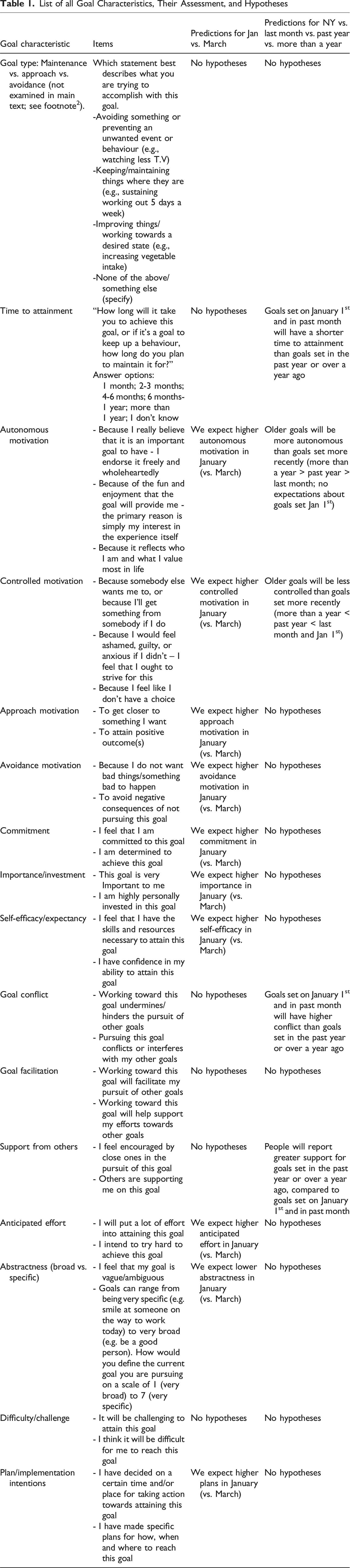
Goal Characteristics and Temporal Landmarks
One type of time-related event that may influence perceptions of goal characteristics are temporal landmarks. Temporal landmarks reflect significant points in our shared time-tables that signal a break or reset in a continuous stream of time (Dai & Li, 2019). Arguably the most salient temporal landmark for goal pursuit is the turn of a new year. In the Western world, the new year is a time to set resolutions, recommit to goals, and make life changes (Ballard, 2024; Lloyd, 2024). New Year’s (and other temporal landmarks) cause a “fresh start” effect that is associated with shifts in goal perceptions such as increases in motivation, planning, and a renewed sense of efficacy (Dai et al., 2014, 2015; Dai & Li, 2019; Peetz & Wilson, 2013). Indeed, one of the reasons goal perceptions/characteristics vary over time may be temporal landmarks. However, the extent to which such landmarks, and New Year’s in particular, affect personal goal perceptions is unknown. Additionally, studies on personal goals collect data at various times of the year, including (frequently) at the start of the year (e.g., Koestner et al., 2002; Powers et al., 2005), or during other fresh starts, such as the beginning of an academic semester (Sheldon & Houser-Marko, 2001; Werner et al., 2016). Could the timing of these studies introduce predictable sources of variance into the results?
How Might Goal Characteristics Shift Around January?
During temporal landmarks such as New Year’s, people are more likely to feel motivated to pursue their goals, create commitment contracts (e.g., committing to exercise regularly), and change their behaviour (e.g., increase gym attendance; Dai et al., 2014; 2015). While people report higher levels of motivation (including more goal-related behaviours such as planning) during fresh starts; Dai et al., 2014; 2015), the exact quality of this motivation has yet to be examined. We could imagine that goals set around fresh starts are characterised by increases in autonomous motivation, where people are reenergized to pursue meaningful life goals. Yet people set a range of New Year’s goals, some known to be high in controlled reasons (e.g., weight loss; LaRose et al., 2013; Poulimeneas et al., 2021; Silva et al., 2018). The general increase in motivation and behaviour may thus translate into higher reported motivation across a variety of motivation types (i.e., based on all possible reasons one has for pursuing their goal), which should taper off by March (the second wave of data collection for this study). And because fresh starts prompt people to change their behaviour and make specific commitment plans (Dai et al., 2014, 2015), we expect that people will anticipate putting greater effort into their goals, make more plans, and perceive their goals as more concrete in January, compared to March.
Also integrated in the fresh start effect is the idea that fresh starts disconnect people from their past and present selves (Dai & Li, 2019; Peetz & Wilson, 2013), which may be tainted with past failures. Indeed, our expectations for successfully initiating a goal increase after fresh starts (Hennecke & Converse, 2017). We thus expect self-efficacy to be higher in January than in March. Furthermore, due to the overlap between perceptions of self-efficacy and difficulty (those with high self-efficacy see their goals as less difficult; (Koestner et al., 2002; Lee & Bobko, 1992; Senko & Harackiewicz, 2005; Yukl & Latham, 1978), we might also expect goal difficulty to be lower in January than in March. However, at New Year’s people may be setting loftier goals than at other times of the year (which may also explain why fail rates are so high; Lloyd, 2024), which may cancel out any effect of self-efficacy. We thus had no expectations about perceptions of difficulty, and for the same reason, no expectations about time to attainment. We similarly did not have any predictions for many other goal characteristics (see Table 1).
Goal Age
In addition to potentially varying across different times of year or different temporal landmarks, people’s perceptions of goal characteristics may vary based on how long they have been pursuing their goals (what we refer to as goal age). Although, to our knowledge, no theories have explicitly addressed whether goal perceptions are directly influenced by a goal’s age, the goal-gradient hypothesis argues for a relevant general principle of goal pursuit: that motivation to attain a goal substantially increases as one gets closer to the goal (Brown, 1948; Hull, 1932). Evidence for this hypothesis is mixed, likely in part due to the range of methods and subjects used (including animal and human studies; Heilizer, 1977; Kivetz et al., 2006; Schmid, 2020). Alternatively, some characteristics of goal pursuit may follow a U-shaped gradient, reflective of participants starting and finishing goal pursuit strong, but slacking in the middle (Kiendl et al., 2024; Touré-Tillery & Fishbach, 2012). For example, people’s motivation for their goals may decrease over time as excitement related to pursuing a new goal diminishes and one is confronted with the day-to-day realities of what it takes to accomplish a long-term goal. As these hypotheses have rarely been applied or tested in the context of goal age—and typically only regarding the extent to which characteristics are stable over time (e.g., Kaiser, 1996; Kiendl et al., 2024)—the present research may provide important additional insights into general patterns of goal pursuit over the lifespan of a goal.
How Might Goal Characteristics Differ Across Goals of Different Ages?
Limited research has considered whether (and how) a goal’s age influences goal perceptions. One study (Houser-Marko & Sheldon, 2006, study 2) asked participants to report how long they had previously been working on their goal but found that this was uncorrelated with self-concordance (computed by subtracting controlled from autonomous motivation) or expectancy (one’s predictions of the likelihood of attaining the goal). Other related research has focused on whether goals are long-term or short-term. For instance, one study found that participants perceived week-long goals to be more conflicting than longer-term goals (Zaleski, 1987). And another study comparing semester-long goals and 3-5-year goals in university students found that the longer-term goals were more autonomous (more intrinsic and more internalized; Koestner et al., 2015). This research, however, asked participants to rate goals that they plan to hold for different durations in the future, rather than to consider how long they have already been pursuing these goals.
Given the scarcity and conflicting evidence of prior research, we did not have any expectations for most goal characteristics and treat those analyses as exploratory. For some characteristics, such as self-efficacy, the evidence was mixed: one study found that people tended to have lower self-efficacy for New Year’s resolutions compared to weekend goals (Koestner et al., 2002), whereas other studies have found no difference in expectancy (a construct similar to self-efficacy) across goals of different durations (Zaleski, 1987), and that goal age was uncorrelated with expectancy (Houser-Marko & Sheldon, 2006). Similarly, although theory might suggest that long-term goals would be more abstract than short-term goals (Trope & Liberman, 2003), it is unclear how often this is true. For example, long-term maintenance goals, which can last a lifetime, likely tend to be concrete and non-abstract (e.g., go to the gym three times a week).
We did expect some differences across goal age, predominantly derived from a broader set of evidence regarding the role of these characteristics in goal pursuit. Specifically, we expected that conflict would be lower, and perceived social support higher, for older (set in the past year or more than a year ago) compared to newer goals (set in the last month or set in January). As conflict is negatively (Gray et al., 2017; Riediger & Freund, 2004) and support positively (Brunstein et al., 1996) related to well-being and progress, we expect that conflicting goals and those with low support to be less sustainable over the long-term, and as such, that older goals would be rated lower on conflict and higher on support. Following the logic that people are more likely to persist in more adaptive goals (those that lead to better well-being), we also expected older goals to be more autonomous and less controlled than younger goals.
Goal Pursuit Over Time
In addition to shifts in characteristics, the trajectory of goal pursuit (i.e., trajectory of goal progress) may also vary across different times of year or across goals of different ages. For instance, New Year’s resolutions appear to drop off rather quickly over time (e.g., Jangra et al., 2024; Lloyd, 2024). Thus after an initial burst of progress, we may see a notable reversal to decreasing progress over time for new goals set in January compared to other goals. For younger goals generally, the trajectory may be more tumultuous than for older, more established goals. Indeed, when people start a goal, they may initially see an upward trajectory until goal completion, or one that flattens out, or people may set untenable goals that quickly plummet in progress. However, once passed this early stage, where viable goals are presumably more likely to be retained and unviable goals discarded, goal pursuit may enter a “steady state” where progress is consistent, and thus change in progress is fairly flat. Understanding the trajectory of progress across goal age and temporal landmarks may help inform what goals we ask about in research or control for in analyses. For instance, if young goals show a burst in progress which tapers, or New Year’s goals show sharp declines, we may want to control for goal age or whether the goal was set on a temporal landmark when predicting progress.
Present Study
Our paper focused on testing four research questions (RQs). Using longitudinal data spanning 6 months that was collected beginning in either January or March, we first examine whether people rate their goals differently on various characteristics depending on the time of year they were first asked about their goals (January vs. March; RQ1). Second, we test whether goal perceptions differ between goals set following a temporal landmark (New Year’s) versus those set recently, or those held for a longer time (set in the past year or more than a year ago; RQ2). We also examine possible differences in trajectories of goal progress over the course of 6 months, focusing on differences between participants who began the survey in January vs. March (RQ3), as well as differences based on when participants first set the goal (New Year’s, past month, past year, longer than a year; RQ4). All hypotheses are outlined in Table 1. These hypotheses and analyses were preregistered on OSF, and deviations from the preregistration are reported in the text. The data, scripts, and results can be found in supplementary online materials (SOM) at https://osf.io/bz8sd.
Method
Participants and Procedure
Participants from western countries (US, UK, Canada, Australia) were recruited on Prolific for a larger study on goal pursuit across time. The survey was launched at two different time points: on January 8th and March 4th. Three hundred and sixty-two participants completed the baseline survey (183 in January, 179 in March). Participants provided online informed consent and were compensated with up to 15GBP for their participation (see baseline survey on OSF for breakdown of compensation). Participants were on average 38.4 years old (SD = 10.8, range 18-73). Most were from the UK (79%), white (78.5%) and working full time (73.2%). A slight majority were male (53.6%). There were no significant differences in age, gender, or work status across the two samples. At baseline, participants set a personal goal in each of three domains (work, leisure, relationships) and responded to items assessing their perceptions of goal characteristics for each goal (along with other measures unrelated to the current study). Then, every month for six months, new studies were opened on Prolific accessible only to those who completed the baseline. Those who did not complete the follow-up after a few days were messaged on Prolific and directly invited to complete the study. Each follow-up survey asked participants where they stood on their goals (whether they were still pursuing the goal or had attained or abandoned it, or changed their goal) and how much progress they had made on them. Those no longer pursuing their goal were asked about a new goal in that domain; only progress data of the original goal (not the new goal) was used. Follow-up completion rate was excellent, ranging between 75 and 85%, with 83.4% of participants completing at least 3 follow-ups (M = 4.78 out of 6, no differences between January and March samples). As the present manuscript uses data from a larger study, only the measures directly relevant to this paper will be discussed; for a full list of measures, see https://osf.io/bz8sd.
Measures
Goal Elicitation
We asked participants to name three goals using the following instructions: Everyone sets and pursues goals in different areas or domains of their lives. Please briefly describe three personal goals that you plan on working towards OVER THE NEXT FEW MONTHS. Please think of
Goal age
Participants also responded to the following question: Have you already been pursuing this goal, or is this a new goal? with the following four response options: This is a new goal (since January 1st); I set this goal sometime in the past month; I set this goal sometime in the past year; I have had this goal for more than a year. In conceptualizing the overall study we had originally intended to examine new goals set in each month, but due to an error the March survey was not changed, so that in both January and March the first choice mentioned was January 1st. This informed our research questions and hypotheses (formulated after the data was already collected, and after the error was noticed).
Goal Characteristics
The specific items used to assess goal characteristics were taken from Leduc-Cummings, 2023 (who adapted them from prior studies and validated the brief measures), and can be found in Table 1. The items assessing autonomous, controlled, approach, and avoidance motivation were preceded with “regarding my goal ___, I am pursuing it…” (Werner et al., 2018). Except where otherwise noted, each goal characteristic was assessed with 2 items, using a Likert scale ranging from 1 = strongly disagree to 7 = strongly agree.
Goal Progress
Goal progress was assessed at each time point using the following three items frequently used in research on personal goals over time (Koestner et al., 2002, 2012): “Over the last month I put energy and effort into achieving this goal.”; “I feel like I am on track with my goal plan.”; “I have made a lot of progress toward this goal.”. All items were rated using a Likert scale ranging from 1 = strongly disagree to 7 = strongly agree. Reliability across the 3 items was excellent at each time point (α = .93 to .95).
Analyses
We preregistered all planned analyses on OSF. To examine RQ1 and RQ2, we used a series of multilevel (3 goals nested within person) models with a categorical predictor variable (January vs. March for RQ1, goal age for RQ2), using lmer in R (Bates et al., 2015). Separate models were conducted for each goal characteristic 1 . Given the rather exploratory nature of this research (we did not have specific hypotheses for many of the characteristics), and the large number of tests performed, we preregistered a-priori that we would interpret differences based on (raw) effect size instead of focusing on p-values. Specifically, we preregistered that “We will treat differences (between January and March) in goal characteristics that are smaller than |.2| (on a 1-7 scale) as very small (and likely meaningless), differences between .2 and .5 as small to moderate, and differences above .5 as large and likely consequential to consider in future research.” We also preregistered that we would apply the same criteria when interpreting differences across goals of different ages. These thresholds were meant to reflect a difference in potentially meaningful versus meaningless effects (Lakens, 2017) that could be uniform across goal characteristics and analyses (between vs. within-person), and were decided in part based on prior descriptive differences in goal pursuit research. For example, a study on personality and goal pursuit over time, which examined 12 goal characteristics (including goal progress) measured on a continuous 7-point scale, found most standard deviations to hover around one (Kiendl & Hennecke, 2022). Milyavskaya and colleagues (2022) found similar results—most characteristics and goal progress measured on a 7-point scale had standard deviations around one. We therefore determined one fifth of the typical standard deviation (0.2) to be the smallest effect size indicative of potentially meaningful differences.
For RQ3 and RQ4, we examined the trajectory of progress using growth curve modeling in a Multilevel Structural Equation Modeling (MSEM) framework. Only data from goals and participants with at least 3 out of 6 follow-up responses were included in analyses. Missing data was, in some cases, a function of prior goal attainment or lack thereof (e.g., if a person reported abandoning a goal, they would not be asked about that goal at the following assessment). To account for this, we created new variables that specified whether the person failed or attained the goal at some point in the study; these were included as auxiliary variables in all analyses. Analyses for RQ3 and 4 were conducted using MPlus (Muthén & Muthén, 2017) with Full Information Maximum Likelihood estimation (FIML). For these research questions we also ran (simplified) models in R to generate predicted values for the figures. As the ICCs for goal progress across the three goals at each time point were very small (.04-.16), the models in R treated timepoints as nested within goal, ignoring that these goals were nested within people. These models also did not take the auxiliary variables into account. Results from the models in R were very similar to those from the more complex MPlus analyses (see OSF for all output), further corroborating our findings.
Results
Descriptive Statistics and ICCs
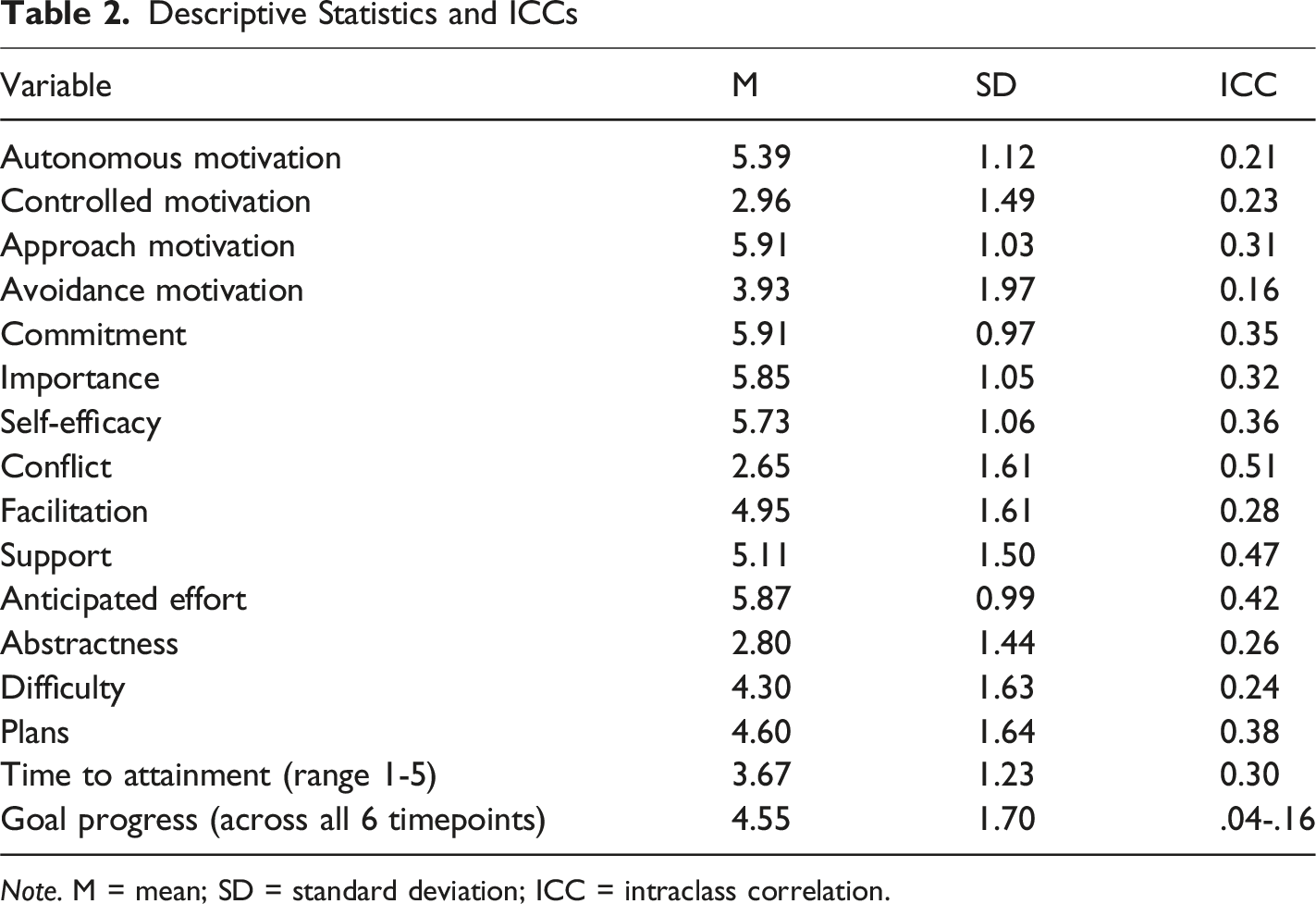
Note. M = mean; SD = standard deviation; ICC = intraclass correlation.
Comparisons of Goal Characteristics Across January and March
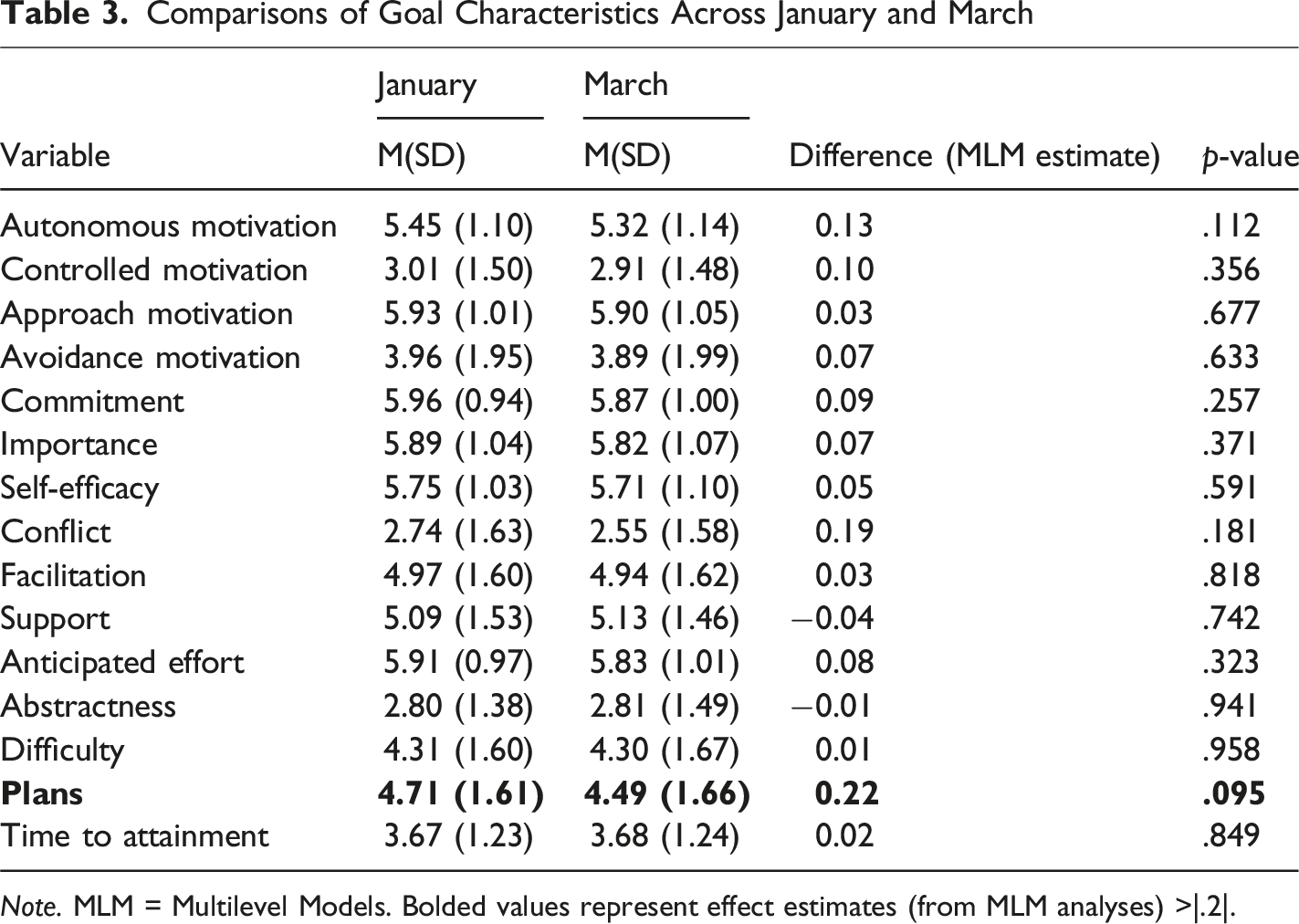
Note. MLM = Multilevel Models. Bolded values represent effect estimates (from MLM analyses) >|.2|.
Means and SDs for by Goal age for all Goal Characteristics
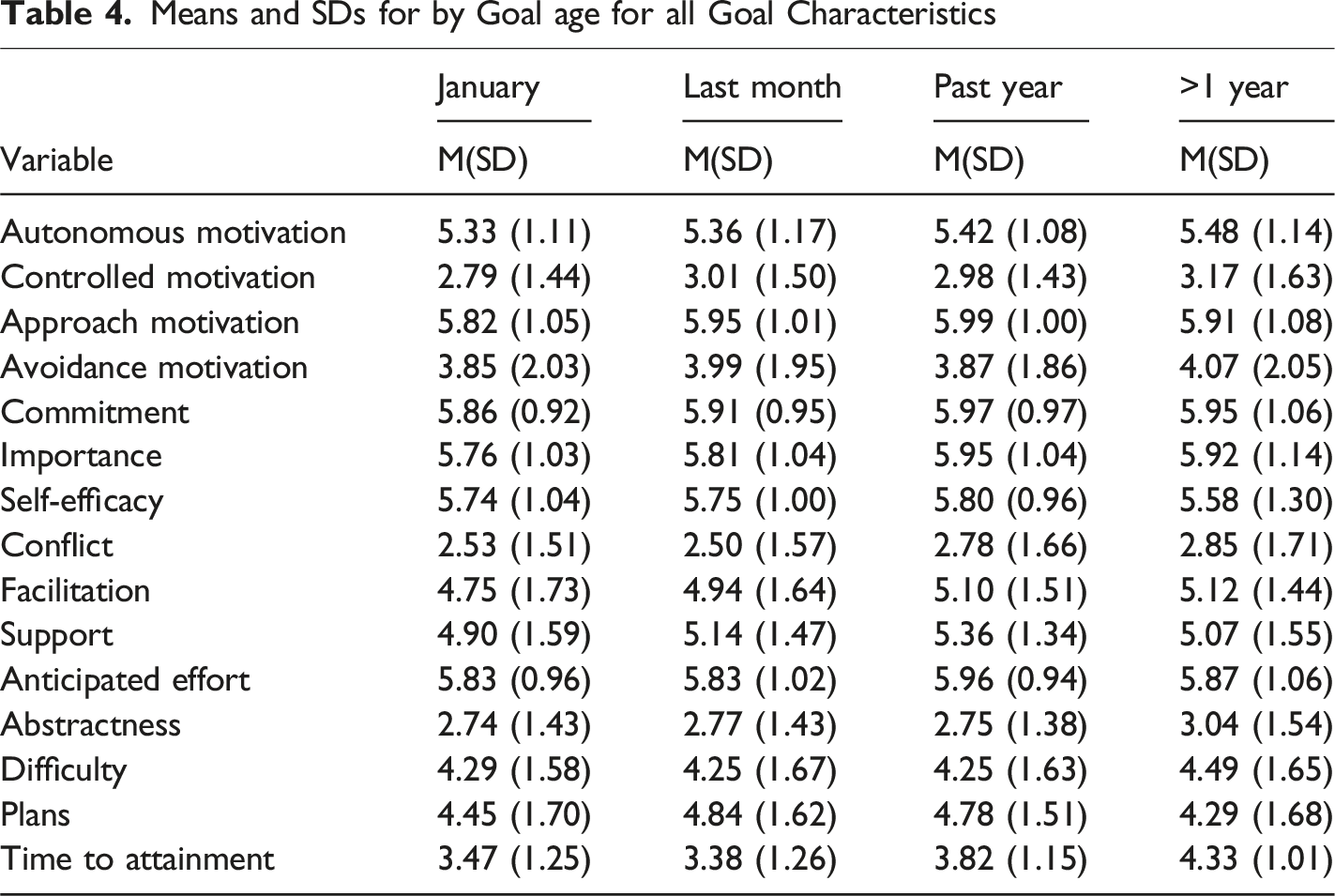
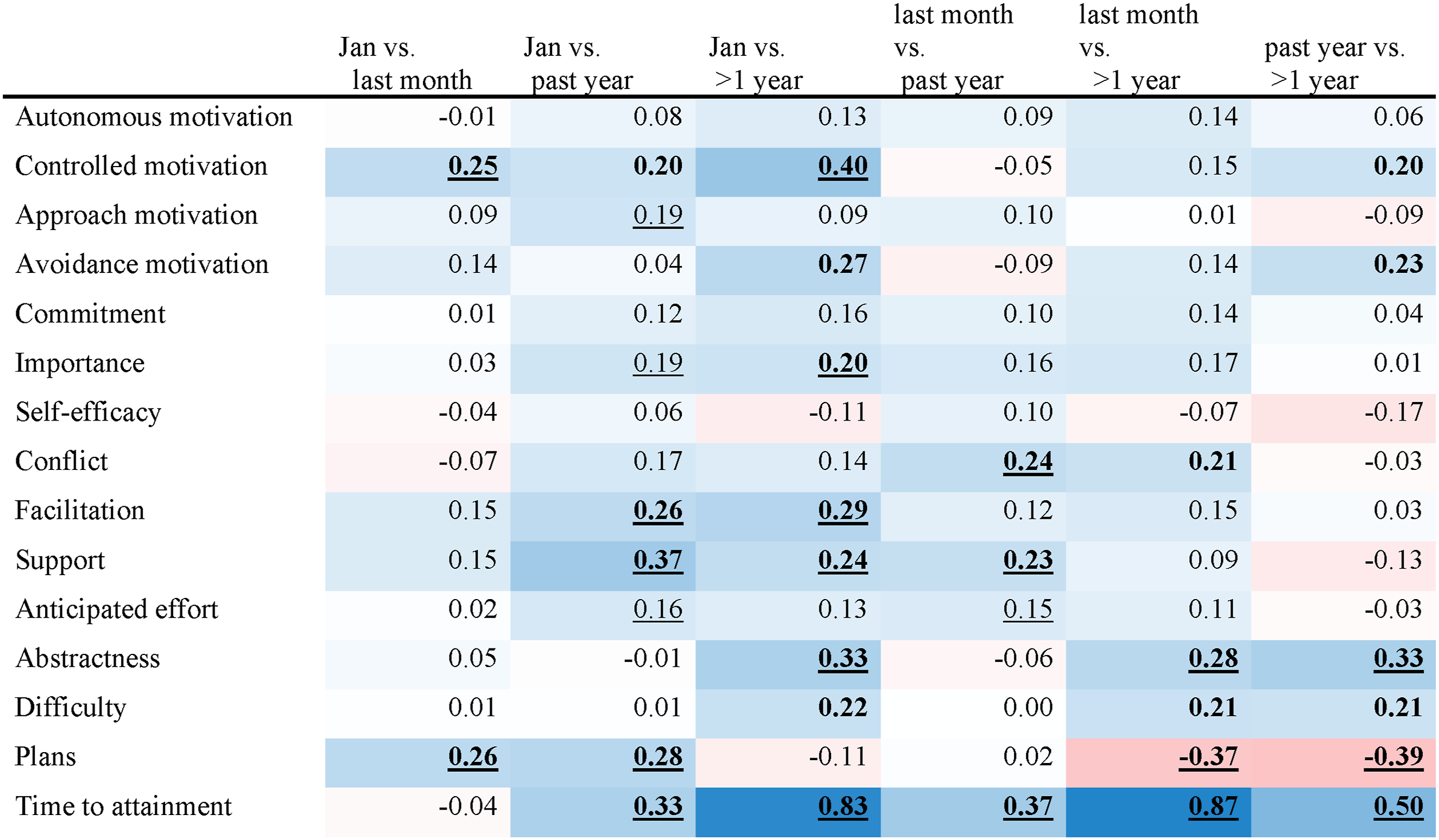
Heat Map of Effect Sizes Across Goal age Comparisons. Note. Bolded Values Represent Effect Estimates (From MLM Analyses) >|.2| and Underlines Denote p < .05. Positive Numbers Represent Higher Values for the Older Goals; Negative Numbers Represent Lower Values for Older Goals
Consistent with our hypotheses, participants expected both goals set in January and newer goals to take less time to attain compared to older goals. In contrast, the hypotheses for autonomous and controlled motivation were not supported: there were no meaningful differences for autonomous motivation, and older goals were not less controlled than goals set in January or in the last month. Instead, January goals were slightly less controlled than other goals. Results for goal conflict were also inverse to our hypotheses, with older goals tending to be more conflicting than goals set in the last month (thought not compared to January goals). Results for the social support hypotheses were similarly mixed. As hypothesized, social support was higher for older goals compared to January goals and higher for goals set in the past year compared to the past month, but the difference between goals set in the past month and goals set more than a year ago was not meaningful. We had no hypotheses for the other goal characteristics. Results showed that goals set more than a year ago were perceived to be more abstract and difficult than all other goals and more important than January goals. Participants also reported fewer plans for January goals and goals set more than a year ago, and avoidance motivation was highest for goals set more than a year ago. There were no meaningful differences for commitment, self-efficacy, approach motivation, effort, or goal facilitation.
Goal Progress
To examine differences in goal progress between January and March samples (RQ3), and between goals of different ages (RQ4), we first fit linear and quadratic models to goal progress (including the auxiliary variables, but no predictors). The model with a quadratic term fit the data better (smaller AIC, BIC, RMSEA; larger CFI), showing an inverse U-shape (all output on OSF). We thus continued our analyses with this model. To test RQ3, we included sample wave (January vs. March) as a between-person predictor of intercept, slope, and the quadratic term. None of these were significant, b = −.11, p = .403, 95% CI [-.37; .16] for intercept, b = .06, p = .474, 95% CI [-.11; .23] for slope, b = −.02, p = .312, 95% CI [-.05; .02] for quadratic term. Figure 2 illustrates the trends for progress for the January and March samples. Predicted Values of Progress for January and March Samples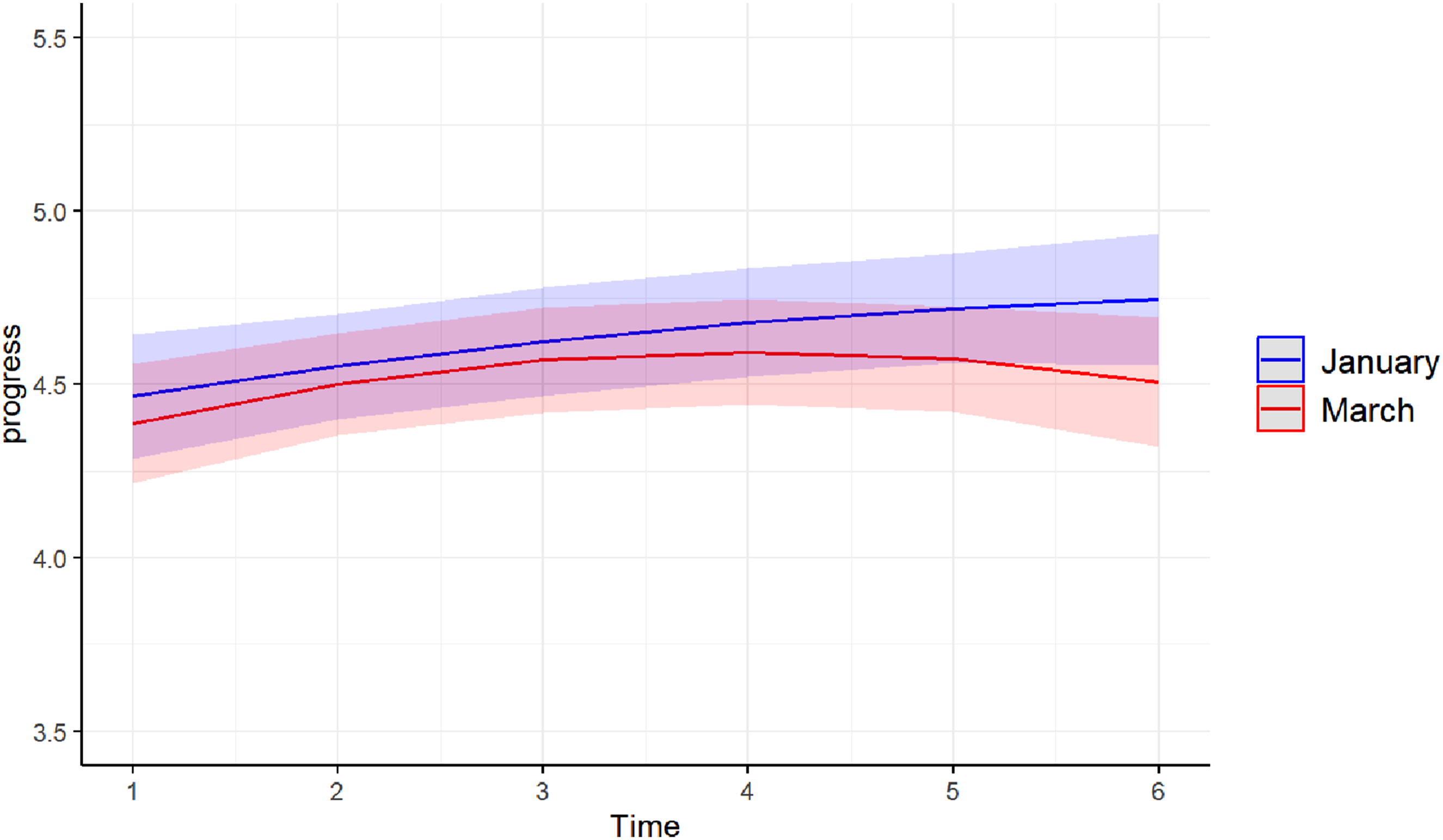
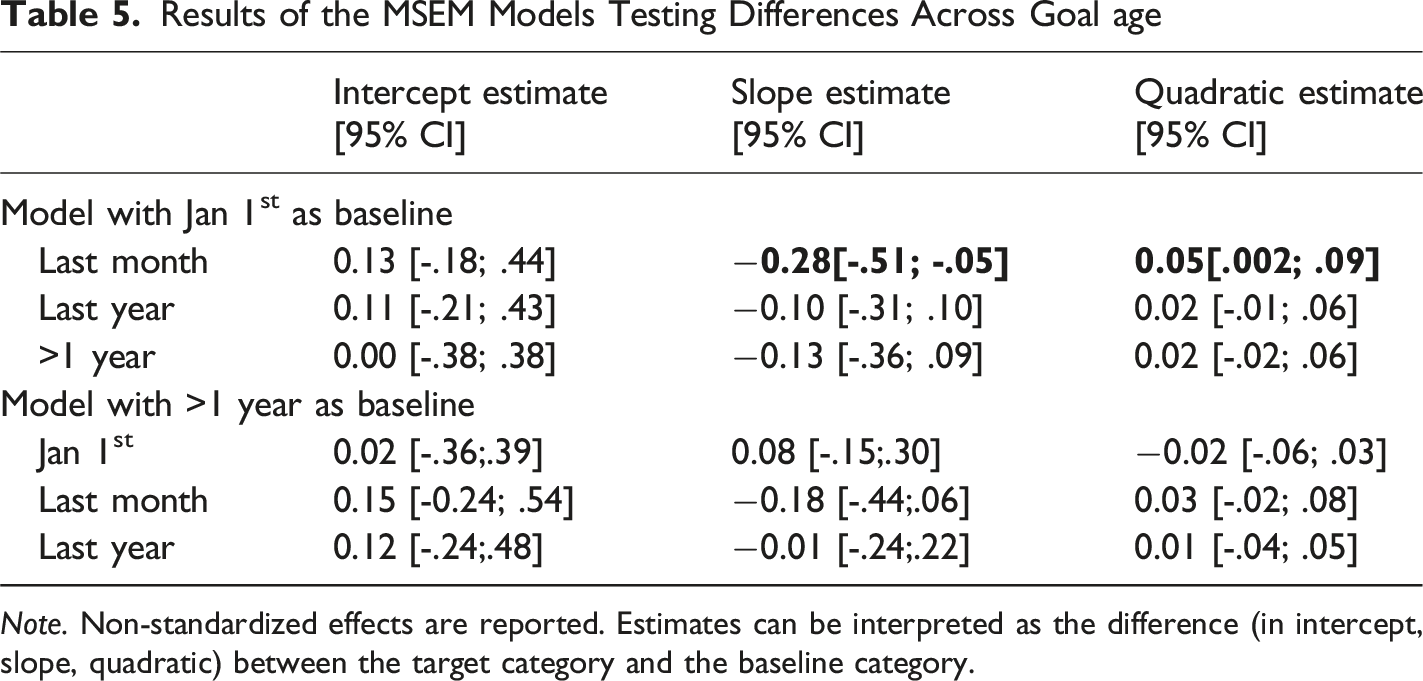
Next, we repeated the analyses using within-person and between-person models of intercept, slope, and quadratic trends, and include dummy-coded variables representing goal age on the within-person (goal) level. Figure 3 illustrates these results. We first used January goals as our comparison condition; results showed that both the slope and quadratic term for goals set in the last month were significantly different from goals set in January. The other contrasts were not significant (see Table 5). Changing the contrast condition showed that none of the other goal ages differed significantly from goals held for more than a year (the oldest age; see also online supplements for results from all possible comparisons). Overall, it appears that the trajectory of progress for goals set in January is characterized by a steeper rise followed by a small plateau and a steeper decline. In contrast, goals set in the past month appear mostly flat, and longer-term goals appear to have a smaller, gradual increase in progress over time (without a sharp later decrease). All these effects, however, were quite small. Predicted Values of Progress for Goals of Different Ages Results of the MSEM Models Testing Differences Across Goal age Note. Non-standardized effects are reported. Estimates can be interpreted as the difference (in intercept, slope, quadratic) between the target category and the baseline category.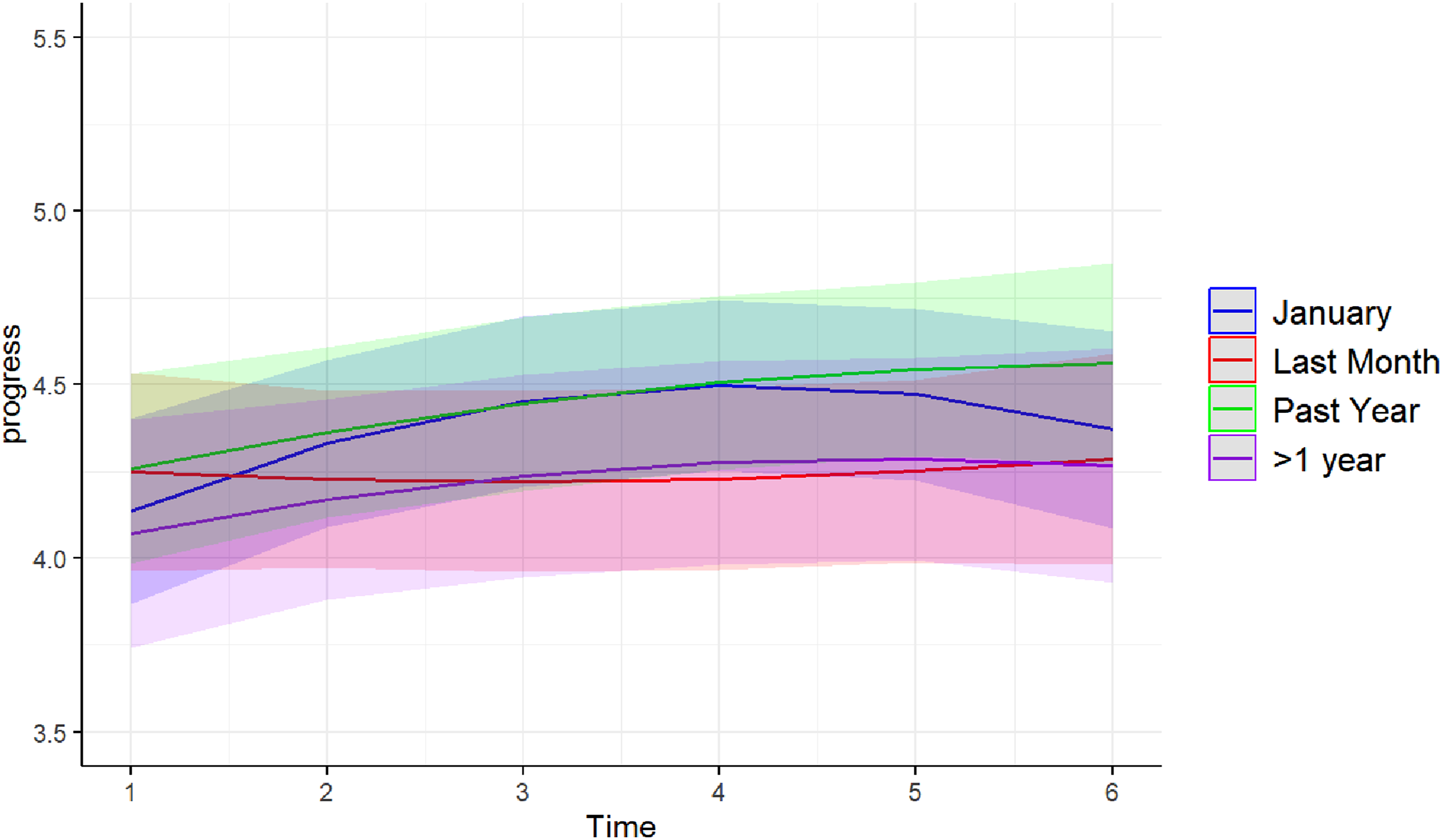
Additional Exploratory Analyses: Goal Domains
Although not preregistered, we additionally examined whether goal domains (leisure, relationship, or work) moderated any of the above results. As this was not the focus of the paper, the full results for these analyses can be found in online Appendix B (https://osf.io/uswbf). Briefly, there were many differences in mean goal characteristics across domains. However, only one interaction term (out of 15 tested) was significant when looking at January vs. March goals (for goal facilitation), and another was significant when examining goal age (for goal difficulty, both at .01 < p < .05). Furthermore, although the trajectory of progress was different across the three types of goals (see Figure B1 in online supplement), there were no interactions with either time of the year or goal age, such that the results presented above do not seem to vary by domain.
Discussion
The present study examined potential differences in how participants rated and pursued their personal goals at different times of the year (January versus March) and for goals of various ages. Although we did have some hypotheses regarding these differences, many were not supported. First, contrary to our expectations that answering questions about one’s goals at different times of the year may yield many differences, only one goal characteristic (planning) was rated differently between January and March. This difference, while exceeding our preregistered effect size threshold, was very small. For goal age the results were more mixed. For example, we found partial support for our hypothesis that social support would be greater for older versus new goals. Social support increased until goals were over a year old, at which point it dropped below the levels observed for goals that were set in the past month or past year. Controlled motivation and goal conflict also varied by goal age, but contrary to our hypotheses, increased as goal age increased. Finally, we found partial support for our hypothesis on goal progress trajectories: goals set in January had a more pronounced increase and then declined more steeply than goals set in the prior month, but did not differ significantly from goals a year old or older. For the most part, the above results did not significantly differ across goal domains. In what follows, we discuss our results wholistically (rather than focusing only on hypotheses) in terms of implications for both theory and methods.
Theoretical Implications
Goals, New Year’s Resolutions, and Fresh Start Effects
In line with the fresh start effect, which should spur planning, motivation, and action (Dai et al., 2014, 2015), we anticipated that goals appraised in January would be perceived differently than goals appraised in March. Specifically, we expected January goals to be rated higher on all types of motivation, commitment, planning, anticipated effort, concreteness, and self-efficacy. We were able to approach this question in two ways. First, we examined whether a temporal landmark boosts any goal, whether new or old (RQ1). Only planning reached our preregistered cut-off of .2, suggesting a small but potentially meaningful effect that aligns with previous research (Dai et al., 2014, 2015). That we see this effect across goals of any age may speak to this effect as more robust. We also examined whether goals set on January 1st differ from other recent goals (set in the last month; RQ2). For half the sample the January 1st goal was newer (when asked in January), and for others it was older (when asked in March); combining these data cancels out the effects of age and allows us to focus on the effects of the temporal landmark (compared to other recent goals). These analyses suggest that the temporal landmark mattered only for controlled motivation and planning, which were both lower for New Year’s goals than goals set in the past month. This latter result (for planning) contradicts our above findings (from RQ1), that planning was higher in January than March. This presents a conundrum, as it suggests that planning is higher in January (across all goals), but is lower when goals are actually set in January. We are not sure why that may be the case, or what it suggests; future research needs to disentangle this.
Despite the predominantly null findings for goal characteristics, we did see a curvilinear (inverse U) goal progress trajectory for goals set on January 1st, which was significantly different from other recent goals (set in the past month, and not tied to the New Year’s). This is in line with other research suggesting that many New Year’s resolutions are abandoned or shelved after an initial push (Jangra et al., 2024; Moshontz de la Rocha, 2020; Norcross et al., 2002). Fresh starts may thus provide an immediate push to action, which can dissipate over time. This calls into question the effectiveness of fresh starts, as it is unclear how long their effects would last. We found no differences, however, between goals set in January and those that participants held for a long time, as both followed similar trajectories. It may be that over the long term, as goal pursuit ebbs and flows, any effects of fresh starts wash out so that these goals become more similar to other long-held goals. The lack of a difference (effects very close to 0) between trajectories of progress of goals reported on in January vs. March further suggests that fresh starts don’t provide a boost to existing goals.
Across all sets of analyses, there was no evidence for fresh start effects, either when appraising all goals, or describing goals set on January 1st, for most goal characteristics. This seems to contradict past research on the fresh start effect, which consistently finds that fresh starts can motivate, increase self-efficacy, and spur planning (Dai et al., 2014, 2015; Dai & Li, 2019; Peetz & Wilson, 2013). That research, however, often looks at goals people are intending to start pursuing at an upcoming temporal landmark or induce experimental goals. In our case, we looked at goals of all ages (not just new goals). Our results suggest that if people have already been pursuing a goal for some time, a temporal landmark may do little to change perceptions of that goal. Future research could corroborate this by examining people’s perceptions of their goal over time before and after a temporal landmark (e.g., ask about a goal in October, November, December, January, and February, to see if perceptions change in January). We also compared goals set on January 1st with other goals, again finding few differences. What we were not able to do, however, is directly examine the effects of fresh starts on brand new goals (i.e., a goal set of January 1st rated in early January vs. a goal set on March 1st rated in early March). It is possible that temporal landmarks are most influential for goal perceptions when new goals are set (e.g., to start an exercise routine). Future research on temporal landmarks could directly test whether fresh starts are more impactful for goal initiation (when setting a brand new goal) over continuation (reappraising an already existing goal).
Newer and Older Goals
Some goal perceptions differed between newer and older goals, with effects ranging from small to moderate, while many others did not. For perceptions that did differ, two primary patterns emerged. First, characteristics often considered to detract from goal pursuit tended to be higher for older goals. Specifically, avoidance motivation (set in past year vs older than a year), controlled motivation (set in past year vs older than a year), difficulty (set in last month and set in past year vs older than a year), abstractness 2 (set in last month and set in past year vs older than year), and goal conflict (set in past month vs set in past year and older than a year) were higher for older compared to newer goals. Second, characteristics often considered to be beneficial for goal pursuit tended not to differ by goal age (autonomous motivation, commitment, importance, effort, self-efficacy, approach motivation, and goal facilitation). However, there were two exceptions. Planning tended to be lower for older goals (set in last month and set in past year vs older than a year), and social support was higher for goals set in the past year compared to the past month.
Characteristics that did not meaningfully differ by goal age were mostly motivation-related (autonomous motivation, commitment, importance, effort, and approach motivation), and controlled and avoidance motivation both barely met our threshold, and only for one comparison each. These results may suggest that motivation-related perceptions are relatively stable across goals of different ages whereas other perceptions may be more likely to change as initial expectations clash with the day-to-day realities of goal pursuit. For instance, people may be overly optimistic in their expectations regarding the difficulty of their goal but remain just as motivated to obtain it even after realizing it will be harder to achieve than initially thought. Some changes may also reflect goals becoming more routine (e.g., planning was lowest for goals over a year old) whereas other results, such as for goal conflict, were very surprising and require future research to both replicate and delve into possible explanations and implications.
Altogether, results for motivational characteristics neither support Hull’s goal-gradient hypothesis (Hull, 1932) or the alternatively proposed U-shaped gradient (Touré-Tillery & Fishbach, 2012). This aligns with previous research findings that, while goal perceptions vary across time, perceptions of motivation do not seem to vary in a systematic or gradient-like fashion (see Figure 1 from Kiendl et al., 2024). Perhaps these perceptions instead fluctuate due to other causes, such as the (parallel) pursuit of other goals (Louro et al., 2007). In comparison, some non-motivational characteristics like planning and difficulty had clearer patterns of change over time and perhaps may be following consistent gradients across the course of goal pursuit. This is a nascent area of research and future work is needed to identify which characteristics (if any) change in predictable ways over time, as well as better understand what it is about the passage of time that could lead to such changes. First steps could include considering other potential gradients of change in light of existing theories with an understanding that many characteristics likely have different trajectories of change—for instance, perhaps perceived social support decrease linearly over time while abstractness might increase exponentially. Future studies should also ensure the full span of goal pursuit is assessed—from inception to completion or abandonment—using intensive longitudinal designs with frequent follow-ups. With feasibility in mind, it may be most practical to first investigate goal-gradients in more tractable, shorter-term goals using experience sampling or daily diary designs, before subsequently investigating whether these patterns extend to longer-term goals.
Examining the trajectory of goal progress over 6 months further allowed us to investigate the aforementioned competing theories of goal pursuit trajectories. Overall, we found evidence for a quadratic effect, such that overall goal progress tends to increase at first, then plateau and later slightly decrease. However, this was not the case for leisure goals, where progress remained stable over time, neither notably increasing nor decreasing. Comparing trajectories for goals of different ages showed no differences between recent (in the past month) and longer-term goals. Looking across goal domains, however, showed that leisure goals tended to differ from relationship goals. Notably, none of the trajectories resembled the exponential-like increase in progress suggested by Hull’s gradient hypothesis (1932). However, our ability to make strong inferences about progress trajectories over the lifespan of a goal is limited, as the present study cannot identify whether changes in progress are more dramatic right after a goal has been set or as it approaches completion. In addition to assessing the full span of goal pursuit, future work may benefit from investigating whether participants perceive progress differently across the life of a goal. For example, participants may consider the same activity to contribute more to goal progress when a goal is near completion than if it had been completed earlier. In the context of a weight loss goal, the last five pounds lost might be perceived to contribute more to progress than the first five, despite their equal contribution.
Methodological Implications
A key issue in personal goal research is whether findings across studies can be generalized. Past research finds that different goal elicitation methods produce similar results (Milyavskaya et al., 2022). Similarly, our results suggest that asking people about their goals in January and in March yields mostly identical results (except for self-reported planning). Given that January is an especially relevant time for new goals, it is likely that if there were any differences, they would be especially salient (such that our choice of January vs. March would be an especially strong test of potential timing differences). We thus expect that these similarities would translate to goals assessed at other times of the year, although this needs to be confirmed by future research.
Our results pertaining to goal age, however, paint a different picture. Indeed, we found differences for many characteristics, although these differences were small to moderate, rather than large. This suggests that researchers should pay closer attention to the kinds of goals that people report when asked about their personal goals. Many studies do not directly compare or consider the age of elicited goals, assuming similar effects across goals of varying ages. That is, even if asked about goals that they are pursuing ‘currently’, or ‘over the next few months’, it is unknown how long participants have already held the goal prior to reporting on it in the study, which could affect results. This may also speak to potential effects of goal duration (how long overall a person pursues their goal), which are frequently overlooked. Although we did not test for these differences directly (since our ‘young’ goals may have ended up being pursued for a long time), our results suggest that goal duration may have implications for a variety of goal characteristics. Research reviews and syntheses summarizing data across studies with goals of different ages and/or durations (e.g., week-long vs. month-long vs. year-long goals) should proceed with caution, as the results are not necessarily comparable. Future research on personal goals should ensure that instructions are explicit about whether participants should report on new goals, or goals that were already in place for months/years/etc. Further research is also needed to directly compare the process of goal pursuit in short-, medium-, and long-term goals.
Supplementary (exploratory) analyses also examined potential differences across domains, finding many differences in both goal characteristics and the trajectories of goal progress across domains. However, there were minimal interactions with our key analyses, suggesting that for the most part, despite meaningful differences across domains, other processes unfold similarly for goals in different domains. Future research, however, needs to consider which specific goals are elicited, and continue to examine for potential differences across domains to ensure that any differences are generalizable across different goals.
Limitations and Future Directions
The most notable limitation of this research is that we were not able to directly compare goals set in January to goals set in March (due to an error in the survey wording in March; see ‘goal age' section of Measures above), which resulted in an inability to compare January and March goals of the same age. Additionally, only goals for three domains (work, leisure, relationships) were solicited and results for some characteristics might differ had goals of other domains been included. This is particularly relevant as prior research findings suggest that a large proportion of new year’s resolutions are health goals (e.g., 48% desired to improve fitness; Lloyd, 2024) which were not (or only incidentally) captured in this study. Moreover, this study only compares one potential fresh start to one non-fresh start time of year and other times of year are likely relevant in a fresh start context, especially for some populations (e.g., beginning of the fall semester for students), while other times of year may also be relevant for reasons unrelated to fresh starts (e.g., people may focus on different kinds of goals at different times of year, like outdoorsy goals during the summer). Lastly, we did not assess whether participants differed in the degree to which they perceived their goals as resolutions. Instead, we considered all goals set in January to be new year’s resolutions, but some participants may not view them this way, which may influence the (potential) degree to which they benefit from the fresh start effect.
Conclusion
Although we had expected differences in how people perceive their goals when asked in January and in March, our results showed that for the most part these goals were viewed similarly. Overall, we may not need to worry too much about whether people are landing on a temporal landmark or not when running multiple waves in a study or deciding if the time of the year will influence goal perceptions. However, how long participants have held their goals may well be worth considering as there were interesting differences between goals that were set recently and those that people have been pursuing for months or even longer than a year. These results can inform future research to help us understand how perceptions of goals unfold over time, as a person continues pursuing a goal over months or years.
Supplemental Material
Supplemental Material - Goals Across Time Frames and Temporal Landmarks: Do Time of Year and Goal Age Influence Goal Perceptions?
Supplemental Material for Goals Across Time Frames and Temporal Landmarks: Do Time of Year and Goal Age Influence Goal Perceptions? by Marina Milyavskaya, Tyler Thorne, Mike Sullivan, Nicolas A. Esselink in Psychological Reports.
Footnotes
Acknowledgements
We would like to thank Brittany Gunpat for her help with the data collection.

Ethical Considerations
REB approval for these studies was obtained (#120539) from Carleton University.
Author Contributions
All authors contributed to the conception and design. MM contributed to the acquisition of data, conducted the analyses, and wrote the results. All authors drafted and revised the manuscript, and approved the submitted version for publication.
Funding
The authors disclosed receipt of the following financial support for the research, authorship, and/or publication of this article: This research was funded by a grant from SSHRC to the first author. The first author also received support from the Canadian Foundation of Innovation and the Ontario Research Fund for infrastructure that was used in this research.
Declaration of Conflicting Interests
The authors declared no potential conflicts of interest with respect to the research, authorship, and/or publication of this article.
Data Availability Statement
Supplemental Material
Supplemental material for this article is available online.
Notes
Author Biographies
References
Supplementary Material
Please find the following supplemental material available below.
For Open Access articles published under a Creative Commons License, all supplemental material carries the same license as the article it is associated with.
For non-Open Access articles published, all supplemental material carries a non-exclusive license, and permission requests for re-use of supplemental material or any part of supplemental material shall be sent directly to the copyright owner as specified in the copyright notice associated with the article.
