




Abstract
Limerence is an overwhelming and debilitating experience involving the intense and often obsessive attachment towards a person who becomes the limerent object, which when left unharnessed, typically results in negative outcomes. At present, there are no published measures to assess the construct of limerence. To address this gap, we developed a short self-report measure to measure limerence (The Limerence Questionnaire-11; LQ-11). This paper reports two studies with data from two different samples (Study 1, n = 269; Study 2, n = 401) of participants that had experienced or were currently experiencing limerence. Results from the exploratory factor analysis revealed a two-factor structure comprising of ‘Intense Need for Attachment’ and ‘Neglect to Self and Others’ (Study 1). Confirmatory Factor Analysis subsequently confirmed a two-factor structure with excellent internal reliability (Study 2). Results demonstrated that the LQ-11 had good concurrent, convergent and discriminant validity. The LQ-11 is an easily administrable questionnaire for potential use in both interpersonal research domains and in clinical and therapeutic settings.
Limerence can be described as an emotional and cognitive dysregulatory state, often an overwhelming and debilitating experience with an acute onset whereby a feeling of profound attachment, akin to ‘being in love’, occurs but in a form that is so obsessive and intense that it can result in negative outcomes for the person who experiences it (Tennov, 1979). For instance, limerence may lead to damaged relationships with significant others as well as engagement in anti-social behaviors such as stalking (Tennov, 2005; see also Bradbury et al., 2024). The term limerence was defined by Tennov (1979), who referred to the obsessive desire to receive some emotional reciprocation from the target (i.e., a person), coined as the limerent object. Limerence appears to be underpinned by an intense fear of rejection from the limerent object. The limerence experiencer often relies heavily on imagined social and emotional interactions with the limerent object (Willmott & Bentley, 2015). The potential importance of limerence as a possibly neglected factor in considerations of psychologically and emotionally complex experiences and behaviors was further expounded by Tennov (2005). Indeed, Tennov (2005) proposed that limerence plays a substantive role in numerous challenging negative situations such as self-harm, relationship breakdown, or antisocial behavior such as stalking.
Tennov (1979) purported that much of the difficulty with limerence stemmed from the fact that the limerent object was typically unavailable or not in a position to requite these feelings of ‘love’ (see also Wyant, 2021). However, it is not simply a case of the limerent object being unavailable, or there being obstacles in the path towards a meaningful reciprocal relationship (e.g., the limerent object being married). Rather, the negative implications for emotional wellbeing of the limerent experiencer seems to depend on the degree of uncertainty about whether the limerent object might possibly feel the same way about them (i.e., uncertainty as to whether the overwhelming desire and intensity of feelings were mutual towards each other). It appears that the greater the level of uncertainty around the limerent object’s feelings or intentions, the higher the degree of desire for and rumination about the limerent object (Wyant, 2021).
Importantly, Wakin and Vo (2008) and Tennov (1979) distinguished limerence as distinct from infatuation that is commonly seen in the early stages of romantic and passionate love. In limerence, the person is so preoccupied by the limerent object that they find it difficult to function in their day-to-day life. This preoccupation can take many forms. For example, the limerent person may experience intense rumination and obsessive replaying of memories of previous interactions with the limerent object over and over in their mind. Furthermore, limerence is often characterized by a deep search for meaning in terms of over-analyzing any potential signs of what the object of their attention might feel about them (Wakin & Vo, 2008; Wyant, 2021). Indeed, as Wyant (2021) put it, each interaction is emotionally charged to the extent that the limerent person’s mood is very much dependent on whether they perceive affection (feel ecstatic) or disapproval (feel utter despair) from the limerent object.
Additionally, whereas limerence appears to overlap with the idea of unrequited love, they are viewed as conceptually distinct (see Willmott & Bentley, 2015). In limerence, love is often (but not always) unrequited and is distinguished by from unrequited love by intensity of feeling and experience (Willmott & Bentley, 2012). Moreover, in cases of unrequited love there may be circumstances of attempting or initiating connection with the object of affection; however, in limerence attempts at initiation of conversation or contact is often avoided due to fear of rejection and damaging the fantasized connection. Similarly, limerence is not regarded as the same construct as lovesickness; the latter being a historic term with roots back to approximately 400BC (Leonti & Casu, 2018) referring to feelings of physiological and psychological distress, but often with a strong sexual component. It should be acknowledged here that while limerence may, in some cases, be sexually motivated, it may also have no conscious sexual component at all (Willmott & Bentley, 2015).
According to Willmott and Bentley (2015), there is a wide range in duration that limerence episodes, typically from one to seven years. Furthermore, there is no consistent manner in which a limerent episode might terminate, but a number of different pathways that limerent episodes end have been proposed (see Tennov, 1979, 2005): (i) complete rejection by the limerent object; (ii) consummation (the limerent person believes their feelings have been reciprocated by the limerent object); and (iii) transformation (they move on suddenly to focus intensely on a new limerent object). Willmott and Bentley (2012) proposed a fourth ‘ending’ pathway whereby the limerent individual accepts a form of friendship with the limerent object while gathering that it will not be the relationship that they desired. However, it is important to note that Tennov (1979; 2005) highlighted that many limerent episodes do not end swiftly or benignly. Indeed, many limerent individuals experience prolonged and emotionally drawn-out periods of time where they perceive consistent rejection or ambivalence from the limerent object, and feel deprived of any source of hope or sign of reciprocated affection (see also Willmott & Bentley, 2015).
Limerence and Associated Psychological Conditions
To date, the numerous psychological conditions and disorders that have been associated with limerence, include anxiety and depression, Post-Traumatic Stress Disorder, Autism Spectrum Disorder, Borderline Personality Disorder, Obsessive Compulsive Disorder (OCD) and Attention Deficit Hyperactivity Disorder (e.g., Bradbury et al., 2024; Sack, 2012; Wakin & Vo, 2008; Willmott & Bentley, 2012). Wakin and Vo (2008) suggested that elements of both OCD and addiction were reflected in their model of limerence which has three functional components: (i) initiating forces (e.g., the longing for reciprocation), (ii) driving forces (e.g., obsessive thinking), and (iii) resultant forces (extreme fluctuations in mood). However, Wakin and Vo noted that it is important to consider that limerence involves interpersonal nuances (i.e., dynamics with another person) that are not typically characteristic of OCD and addiction. For example, the limerent object may try to manage the situation by being polite, they may be flattered, or they may be annoyed. As such, the limerent object may provide mixed messages to the limerent experiencer, unintentionally or not. Moreover, Rehman and Suneel (2025) noted that limerence differed from models of OCD (and addiction more generally), insofar as as those frameworks might not give sufficient attention to potential “deeper, developmental roots of limerence” (p. 12), such as early maladaptive schemas.
Other purported psychological conditions associated with limerence include attachment disorders. For instance, Willmott and Bentley (2015) conceptualized limerence as a form of Adult Separation Anxiety Disorder with a misplaced attachment figure. Adult Separation Anxiety Disorder is now viewed in the Diagnostic and Statistical Manual of Mental Disorders, fifth edition (American Psychiatric Association, 2013) as distinct from Childhood Separation Anxiety Disorder given that the first onset of Adult Separation Anxiety Disorder occurs after the age of 18 years years. Thus, it is feasible that a more nuanced examination of the condition of limerence could potentially contribute to our understanding of this novel area of attachment.
Beyond published scientific literature, limerence has served as a topic of interest in fiction and media (see Moss-Wellington, 2019). Of particular note, there has been an increase in self-help resources for those who experience limerence including on-line communities and blogs related to the condition. According to Bradbury et al. (2024), for intervention or therapeutic work with limerent individuals it seems pertinent to focus on developing psychological traits that could inhibit stalking and promote self-regulation, such as locus of control. Notably, however, there is still limited research in this area which renders providing recommendations for potential therapeutic intervention for limerent experiencers somewhat challenging. Wyant (2021) offered a potentially promising approach in a case study where exposure responsive prevention typically used to treat OCD was employed to treat limerence and found that the number and type of compulsive rituals decreased at 9 months, together with improvements in subjective dysfunctional thought patterns of the limerent client. However, it should be acknowledged here that in the absence of a validated limerence measure, Wyant (2021) employed a novel screening scale based on their own lived experience of limerence but developed with unknown psychometric properties.
Limerence and Associated Psychometric Scales
In terms of validated psychometric scales that are somewhat analogous to limerence, Sperling (1985) developed the Desperate Love Scale that captures components of anxious attachment, diffuse interpersonal boundaries and insatiable desire for love, and includes items related to intensity of feelings and fear of rejection which are relevant to the experience of limerence. Similarly, there are also associated love-based scales, or parts thereof, such as the Passionate Love Scale and the Love Attitude Scale (Acevedo & Aaron, 2009; Graham, 2011; Hatfield & Sprecher, 1986; Hendrick & Hendrick, 1986). However, the main concern with these scales is that they all assess versions of passion and or romantic love whereas limerence need not be either. Indeed, limerence can be conceptualized as a feeling of obsessive and anxious attachment which need not have any regard for love, passion, romance, sexuality or sex, per se (Willmott & Bentley, 2015). It should also be noted that limerence may have other non-sexual facets (e.g., hero worship, misappropriated attachment).
An existing psychometric measure that separates love from attachment and can be used regardless of relationship status, reciprocation, and sex of the beloved target, is the Infatuation and Attachment Scale (Langeslag et al., 2013). This scale views the constructs of attachment and infatuation to be adversely related, with a high level of secure attachment being associated with a low level of infatuation and vice-versa. Over time infatuation decreases and attachment increases, with higher scores on the infatuation scale associated with higher negative affect and un-reciprocation. These findings might relate to limerence since the condition is often un-reciprocated; thus, we can postulate that infatuation remains high and is associated with negative affect. Indeed, Wolf (2017) found that low self-esteem along with attachment anxiety, low self-concept clarity, need to belong, validation-seeking goal orientation, social phobia, social interaction anxiety and mind-wondering were all significantly associated with limerence. Notably, however, Wolf’s scale remains unpublished (Wolf & Lemay, 2015; Wolf, 2017). Thus, there is a danger for replicability and validity of empirical findings in the field of limerence research (e.g., Rehman & Suneel, 2025) relying on an unpublished instrument that has not been subject to the rigors of peer review and has not fully adhered to recognized standards of scale validation. For example, the Wolf measure was not validated using two independent samples from the same population, which limits its psychometric robustness and generalizability. Although principal components analyses (PCA) were conducted, these were based on the same sample used for subsequent analyses. PCA is a data reduction technique and does not serve the same purpose as exploratory factor analysis (EFA) which is designed to uncover latent constructs. Best practice in scale development recommends conducting an EFA to explore the factor structure, followed by a confirmatory factor analysis (CFA) on a separate sample to test its stability (Orçan, 2018). As such, there is now an imperative to develop a conceptually sound contemporary psychometrically validated limerence measure for research, therapeutic, and clinical use.
Present Study
The focus of the present investigation was to develop a Limerence Questionnaire which has excellent psychometric properties, as well as good construct validity. In addition, the aim was to obtain a short scale including only the best markers of each factor that would be appropriate for clinical and research use for those who experience limerence. As such, we present the results of two key research studies in this paper. First, in Study 1 we present the initial development of the Limerence Questionnaire and the examination of the structural validity. Secondly, in Study 2 we present a study designed to confirm the structural validity and reliability of the Limerence Questionnaire as well as test construct validity (e.g., associations with related constructs).
Study 1: Item Generation, Selection, and Exploratory Factor Analysis
Method
Participants
A total of 611 participants initially took part in the study from the general population that reported experiencing an ‘adoration of a person for whom they were not in an intimate relationship with at the time of the study’ (i.e., they were currently or had experienced limerence). Of the 611 participants from the general population who reported experiencing an ‘adoration of a person for whom they were not in an intimate relationship with at the time of the study’ (i.e., they were currently or had experienced limerence) that started the survey, 269 finished it, representing a completion rate of 44.03%. We suspect that the reason for number of non-completions was due to the length of time to complete the survey.
Given that the field of limerence research is still emerging, there is no established benchmark for a representative sample in this context and, as such, our recruitment strategy aimed to cast a wide net. However, the final sample characteristics are typical of much voluntary participation recruitment in online survey research. The proportion of the final sample that identified as female was 67.9% with an average sample age of 31.8 years (SDage = 13.9). The majority of participants identified themselves as white/Caucasian (86.9%). Most participants had obtained a high school degree (40.7%), followed by bachelor’s degree (22.4%), and master’s degree (11.6%). Participants were mostly either employed (44.4%) or in full-time education (48.5%). Ethical clearance was obtained from the University of Chichester Institutional Ethics Committee prior to the collection of data.
Measures
Development of the Limerence Questionnaire
Items included in the draft Limerence Questionnaire were based on previously non-validated Limerence scales (e.g., Tennov, 1979; Wakin & Vo, 2008) and the validated Desperate Love Scale (Sperling, 1985). Items were also developed from qualitative evidence from an interpretative phenomenological analysis study with limerent experiencers that developed the following themes: ruminative thinking; free floating anxiety and depression; disintegration of the self; reintegration of past life experiences; and toward authenticity (Willmott & Bentley, 2015). Following this process, we arrived at 56 items for the initial item pool.
The first draft Limerence Questionnaire was then assessed for face validity, along with checks of clarity, readability and redundancy of the items. In particular, the lead researcher emailed participants with lived experience of limerence from the Willmott and Bentley (2015) study. Two of these participants agreed to review the questionnaire items and agreed that the items were consistent with their experience and understanding of limerence. In addition, David Perl (an expert in limerence and founder of https://www.limerence.net) was emailed, and also confirmed the face validity of the items to assess the construct of limerence. During these face validity checks there were no deviations from the original 56-item pool. This resulted in the 56-item Limerence Questionnaire which used a 5-point Likert scale ranging from “strongly agree (1) to strongly disagree (5)”. Participants were asked to rate the extent to which the thoughts, feelings and behaviors described their experiences in adoration of a person who they were not in an intimate relationship with.
Procedure
Participants were recruited via the Qualtrics online survey platform with links distributed to limerent experiencers online support forums (e.g., https://limerence.net/). Upon logging onto the survey, participants read an information sheet and consented to take part in the study. Participants were reminded of their right to withdraw including to end the survey at any point they may be uncomfortable. Participants were signposted to relevant support services (e.g., https://limerence.net/) in the debrief sheet. Data was collected for both Study 1 and Study 2 from July 2021 to March 2023.
Analysis Plan
To investigate the underlying dimensionality of the 56 items, we conducted an Exploratory Factor Analysis (EFA) with oblique Promax rotation, which accounts for correlations between latent factors. Before proceeding with the factor analysis, we performed a parallel analysis (Horn, 1965) to determine the maximum number of latent dimensions based on 1,000 simulations, retaining only factors whose eigenvalues exceeded the 95th percentile of those generated by the simulations. Finally, given the aim of developing a short scale, we applied very conservative criteria for item selection (Comrey & Lee, 1992; Tabachnick & Fidell, 2007). First, the primary loading should be at least |.60|, reflecting an overlap between item and factor variance of almost 40% or higher. Second, the ratio between the primary and the secondary highest loading should be greater than or equal to |2.0| to avoid selecting cross-loading items that do not adequately distinguish among factors. All the analyses were performed using the software Mplus, version 7 (Muthén & Muthén, 2015). To determine the sample size, we relied on the simulation study by MacCallum et al. (1999), which suggests that a sample of at least 200 cases yields reliable results in an Exploratory Factor Analysis (EFA), even when communalities are low.
Moreover, the accuracy of EFA solutions depends primarily on communalities and factor overdetermination, rather than on simple subject-to-item ratios (MacCallum et al., 1999, 2001). Following this recommendation, we examined our communalities in detail. Monte Carlo studies suggest that, with moderate-to-high communalities (i.e., between 0.20 and 0.80) and more than four items per factor, a sample size of approximately N = 150–300 is sufficient (Mundfrom et al., 2005). In our case, the initial EFA aimed to extract three factors from 56 items, corresponding to an average of 18.7 items per factor. Our communalities ranged between 0.23 and 0.78, with only four items falling below 0.20. Therefore, both criteria outlined above were satisfied. Furthermore, Mundfrom et al. (2005) provide a table that combines different item-to-factor ratios with varying numbers of extracted factors and communalities range, indicating the minimum sample size required to achieve an excellent coefficient of congruence (i.e., excellent power; MacCallum et al., 1999). Among the various combinations, the one most similar to our case was the extraction of three factors from a pool of 12 items per factor, with communalities ranging between 0.20 and 0.80. According to Mundfrom et al. (2005), this scenario would require only 70 participants to achieve excellent power. Therefore, our sample size can be considered more than adequate to conduct the EFA.
Results
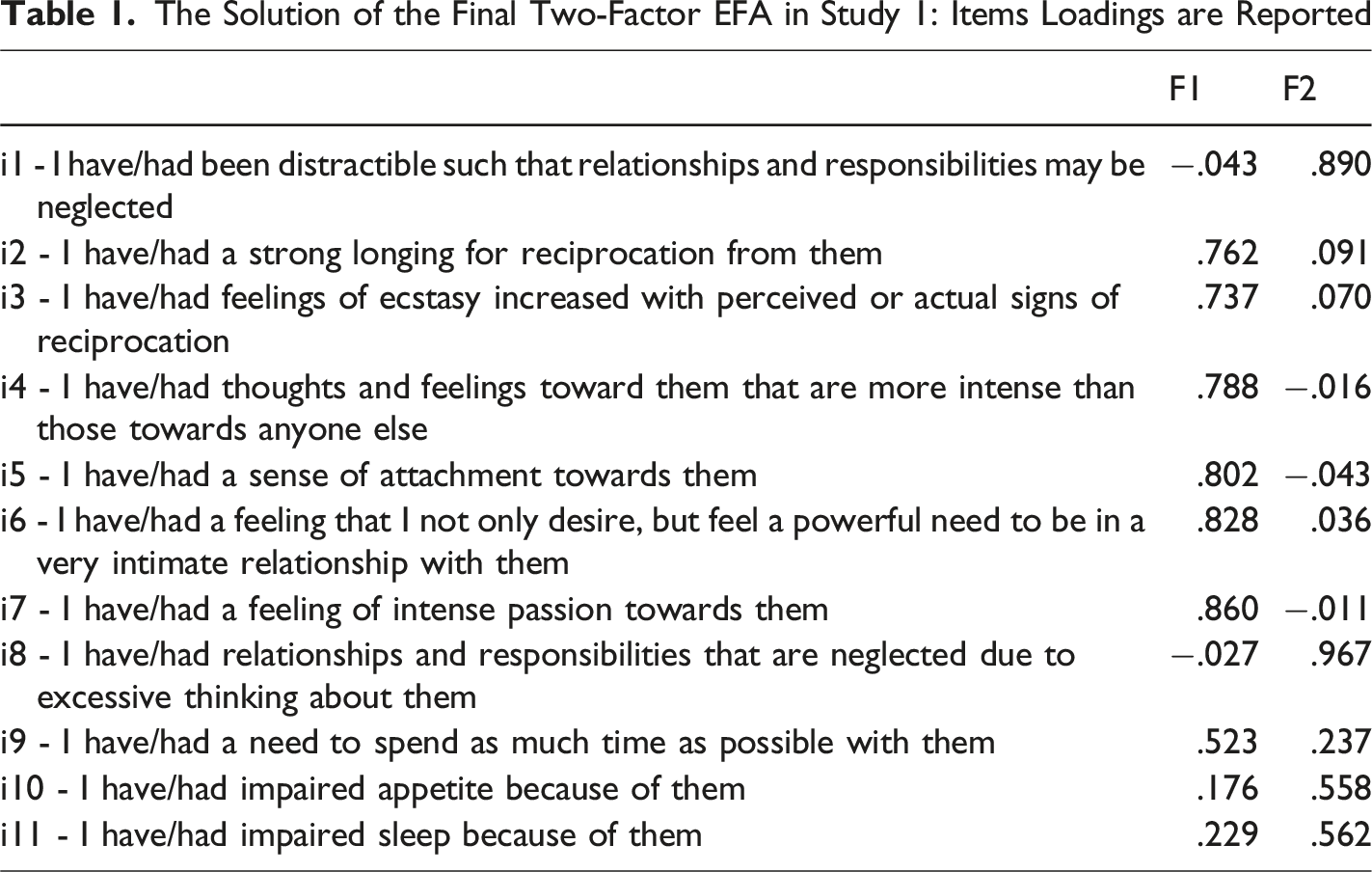
An Exploratory Factor Analysis (EFA) was run on the 56 items to explore the scale dimensionality. Considering the results from the parallel analysis, we estimated three factors. . The oblique Promax rotation was considered appropriate since the factors extracted were highly correlated (F1-F2: r = .63; F1-F3: r = .60; F2-F3: r = .63). Applying the two criteria for item selection reported in the analysìs plan (i.e., primary loading higher than |.60| and ratio between the primary and the secondary highest loading greater than or equal to |2.0|), we retained only 12 items. However, since only one item showed an acceptable primary loading on F3, we reduced the dimensionality to two latent factors.
The two-factor EFA that was conducted on the 12 items confirmed the appropriateness of the oblique rotation due to the high correlation between the two dimensions (r = .67). Concerning loadings, all the items met the second criterion (i.e., ratio between loadings), but four items did not meet the first criterion (i.e., primary loading higher than |.60|). However, dropping four additional items was considered excessive, possibly leading to increased measurement errors and reliability issues for the final measure (DeVellis & Thorpe, 2021). Moreover, three of these four items showed good primary loadings, ranging from .53 to .56, meaning that the items shared 28 to 32% of the variance with their respective factor. Conversely, the remaining item had a primary loading of only .31 (9.3% of the variance shared with the factor) and, thus, was dropped in the following step.
The Solution of the Final Two-Factor EFA in Study 1: Items Loadings are Reported
Discussion
The results and interpretations of the data from both Study 1 and Study 2 will be discussed together in the General Discussion section following the presentation of Study 2.
Study 2: Confirmatory Factor Analysis and Construct Validity Testing
The aim of Study 2 was to further test the factor structure and internal reliability of the LQ-11 with a separate sample of participants from the general population who had experienced/were experiencing limerence. Indeed, confirmatory factor analysis is recommended as it allows for the a priori specification and then testing of different parameters of latent factor measurement models (Kline, 2015). Moreover, we also assessed the construct validity of the LQ-11 to ensure that it correlated with theoretically related constructs. In particular, we focused on concurrent validity (i.e., the LQ-11 being associated with an existing related measure of limerence developed by Wolf (2017) and, as detailed below, convergent validity (i.e., significantly correlated to theoretically related constructs and outcomes).
Attachment
According to Attachment theory (e.g., Bowlby, 1969), early interactions with caregivers in childhood can shape how we interact, react, respond and behave in adult relationships. Hazan and Shafer (1989) suggest there are three key attachment styles. First, attachment anxiety describes those who often fear being abandoned and rejected. Consequently such individuals tend to have a strong need for reassurance and validation as may feel unworthy of love. Attachment avoidance describes those who tend to have difficulty trusting others, avoid intimacy and have discomfort when close with others (Bartholomew & Horowitz, 1991; Bretherton & Munholland, 1999). Finally, securely attached describes those low in attachment anxiety and attachment avoidance. Such individuals usually are comfortable with intimacy and closeness and consider themselves worthy of love (Bowlby, 1969).
As limerence and attachment anxiety both include a focus on fearing interpersonal rejection, we expected there to be a significant positive relationship between these constructs. Indeed, such effects have been noted in previous research (Wolf, 2017). Moreover, there should be less effect for those who are high in avoidant attachment or are securely attached (Wolf, 2017).
Self-Esteem
Self-esteem refers to “an individual’s subjective evaluation of his or her worth as a person” (Orth & Robins, 2014, p. 381). Willmott and Bentley (2015) noted that a consistent experience of many of those who suffer with limerence was that of depression and a tendency to engage in negative self-evaluation. In addition, previous research has demonstrated that limerence is negatively associated with self-esteem (Wolf, 2017), as such we made the same prediction here.
Psychological Inflexibility
Psychological inflexibility refers to the tendency to engage in rigid responding to internal experiences (e.g., thoughts, feelings, sensations) in ways (e.g., suppression, avoidance) that may maintain and perpetuate psychological distress, and the pursuit of valued actions (Hayes et al., 2006; Tyndall et al., 2020). As Willmott and Bentley (2015) discussed, limerent experiencers tend to remain stuck in their thought patterns and behaviors (e.g., excessive rumination of interactions with the limerent object) that are aligned to their fantasy of imagined reciprocation. These behaviors are not consistent with engagement of valued action (e.g., working towards a more authentic relationship with the limerent object or themselves), and as such arguably are representative of inflexible responding. Therefore, we expected a significant positive correlation between limerence and psychological inflexibility.
Need to Belong
Some people (e.g., those high in the need to belong [NTB]) have a strong desire for acceptance and can become distressed when they are disconnected from others (Leary et al., 2013). In contrast, those low in NTB tend to not be concerned with being rejected by others and often prefer to be alone (Baumeister & Leary, 1995). Willmott and Bentley (2015) found that limerence experiencers often described difficulties in feeling accepted across a range of relationships (e.g., childhood, significant others) despite a desire for belonging. Therefore, we expected limerence to be positively associated with the need to belong.
Social Interaction Anxiety
Social interaction anxiety refers to the fear of social interactions in social situations (e.g., meeting people at parties; Carleton et al., 2009). Moreover, limerence experiencers often describe feeling socially awkward in the presence of their limerent object usually due to fearing rejection and the potential disruption of their fantasy (e.g., Willmott & Bentley, 2012). Indeed, Wolf (2017) reported a significant positive relationship between social interaction anxiety and limerence. As such, we expected that social interaction anxiety would be positively related to limerence in our study.
Imaginative Fantasy
Limerence is often experienced with intense preoccupation with the limerent object which can typically involve imagining scenarios of acceptance and reciprocation of their love with the limerent object. Indeed, a similar construct of mind wandering has been shown to be related to limerence in past research (Wolf, 2017). As such, we expected high scores of the LQ-11 to be positively associated with imaginative fantasy.
Method
Participants
A total of 401 participants (70.1% female; Mage = 28.92 years) recruited from a variety of online platforms (e.g., https://www.reddit.com/samplesize;
Measures
Limerence Measure
We used the 31-item limerence measure developed by Wolf (2017) to assess levels of limerence and examine concurrent validity of The Limerence Questionnaire. Participants answered using a 5-point Likert scale from 1 (strongly agree) to 5 (strongly disagree). Sample items include, “Admire everything about the person” and “Obsessed with hopes of reciprocation”. The unpublished limerence measure has demonstrated good reliability and construct validity (Wolf, 2017). Cronbach’s alpha in the present study was .91.
Experiences in Close Relationships-Relationships Structures Questionnaire (ECR-RS)
To measure attachment, participants completed 9 items from the Experiences in Close Relationships- Relationship Structures (ECRS-RS) questionnaire. The ECR-RS was designed to assess individual differences in attachment orientation within four relational domains (mother, father, romantic partner, and [non-romantic] best friend) and as a global domain. For the purposes of the present study, the global domain (i.e., close relationships in general) was used to assess attachment orientation. The items were separated into two domains: attachment-related anxiety (α = .89; e.g., “I’m afraid that other people may abandon me”), and attachment-related avoidance (α = .81; e.g., “I don’t feel comfortable opening up to others”). Responses are scored on a 7-point Likert scale from 1 (strongly disagree) to 7 (strongly agree). Higher scores indicate higher levels of attachment insecurity (Fraley et al., 2011).
Single Item Self-Esteem Measure
Self-esteem was assessed using Robins et al.’s (2001) Single Item Self-Esteem Measure. Participants responded to the following item “I have high self-esteem” using a 5-point Likert scale (1 [not at all true of me] – 5 [very true of me]).
Multidimensional Psychological Flexibility Inventory- Short Form (MPFI Short-form)
Psychological inflexibility (12 items) was assessed using the Multidimensional Psychological Flexibility Inventory (MPFI; Rolffs et al., 2018). Participants responded using a 6-point Likert scale from 1 (never true) to 6 (always true). Sample items include, “I tried to distract myself when I felt unpleasant emotions”. The MPFI has demonstrated good reliability and validity in non-clinical samples (e.g., Seidler et al., 2020; Stabbe et al., 2019). Cronbach’s alpha in the present study was .91 (Rolffs et al., 2018).
Need to Belong Scale (NTB)
Need to belong was tested with Leary et al.’s (2013) Need to Belong scale which is a 10-item measure of the desire to form and maintain enduring interpersonal attachments. Participants responded to items using a 5-point Likert scale from 1 (strongly disagree) to 5 (strongly agree), (α = .80 in the present study). Sample items include: “I want other people to accept me” and “I do not like being alone”.
Social Interaction Anxiety Short Form (SIAS- 6)
We used the Social Interaction Anxiety Short Form (SIAS-6; Peters et al., 2012) to measure perceived anxiety when in social situations. Participants responded to items using a 5-point Likert scale from 0 (not at all characteristic or true of me) to 4 (extremely characteristic or true of me), (α = .86 in the present study). Sample items include: “I have difficulty talking with other people”. The SIAS-6 has demonstrated to have good reliability and validity in past research (Peters et al., 2012).
The Fantasy Questionnaire
We used the imaginative subscale from The Fantasy Questionnaire (Weibel et al., 2018) to assess imaginative fantasy (i.e., participant’s tendency to be immersed in their daydreaming experiences). Participants answered using a 5-point Likert scale from 1 (strongly disagree) to 5 (strongly agree; α = .86 in the present study). Sample items include: “sometimes I become so involved in a daydream that I’m not aware of things happening around me”.
Analysis Plan
Confirmatory Factor Analysis (CFA) was conducted using Mplus, version 7 (Muthén & Muthén, 2015) to check the hypothesized dimensionality, adopting MLR robust estimator to avoid problems related to data non-normality. The evaluation of the goodness of fit was based on recommendations from the literature (Brown, 2015; Kline, 2015), which suggest that a model should have (1) an RMSEA below .08, preferably below .05, (2) CFI and TLI values above .90, ideally above .95, and (3) an SRMR below .08. In the case of suboptimal fit, we relied on the modification indices provided by Mplus and theoretical considerations to respecify the model. Finally, we checked reliability of the resulting dimensions through Cronbach’s Alpha and investigated their validity by assessing their correlation with the other constructs measured in the present study. Given the complexity of conducting power analyses for correlational data using Structural Equation Modeling (SEM) and the lack of consensus in the literature on the best method to determine the sample size a priori for such models, we followed Kline’s (2015) recommendations, which suggest having at least 5 to 10 cases for each estimated parameter.
Results
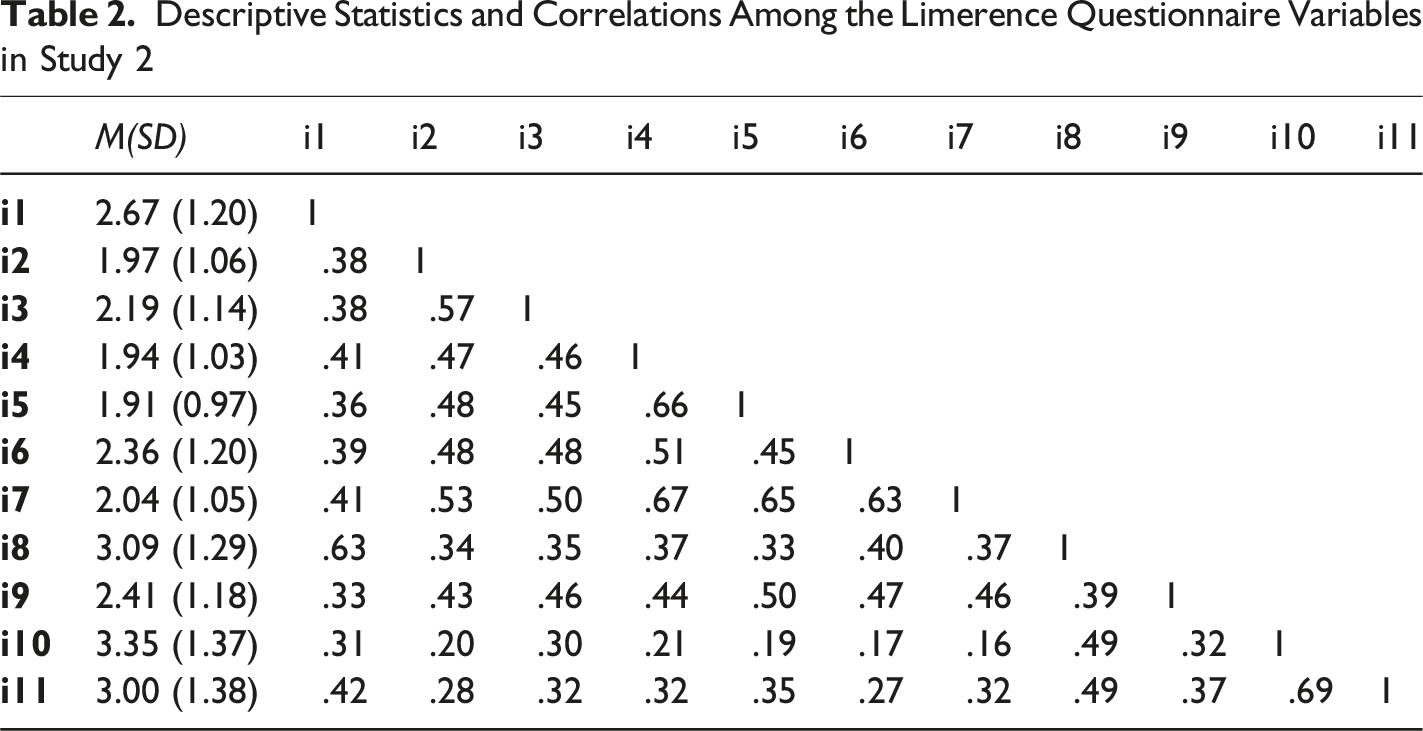
Descriptive Statistics and Correlations Among the Limerence Questionnaire Variables in Study 2
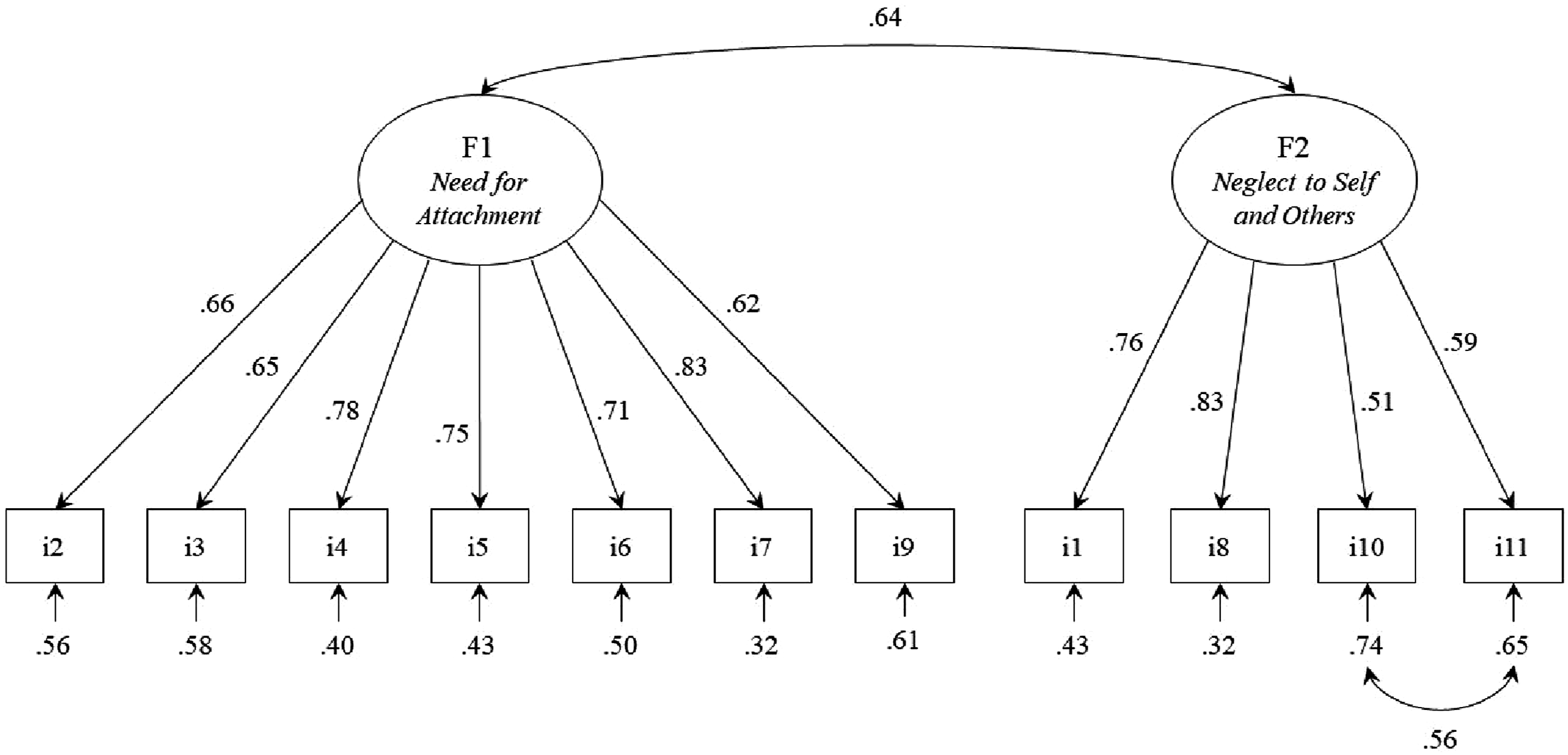
The CFA Model: Standardized Loadings, Measurement Errors, and Correlations are Reported
Correlations of the Two Dimensions of the Limerence Questionnaire (and Its Total Score) With the Constructs Measured in Study 2 for Investigating Scale Validity
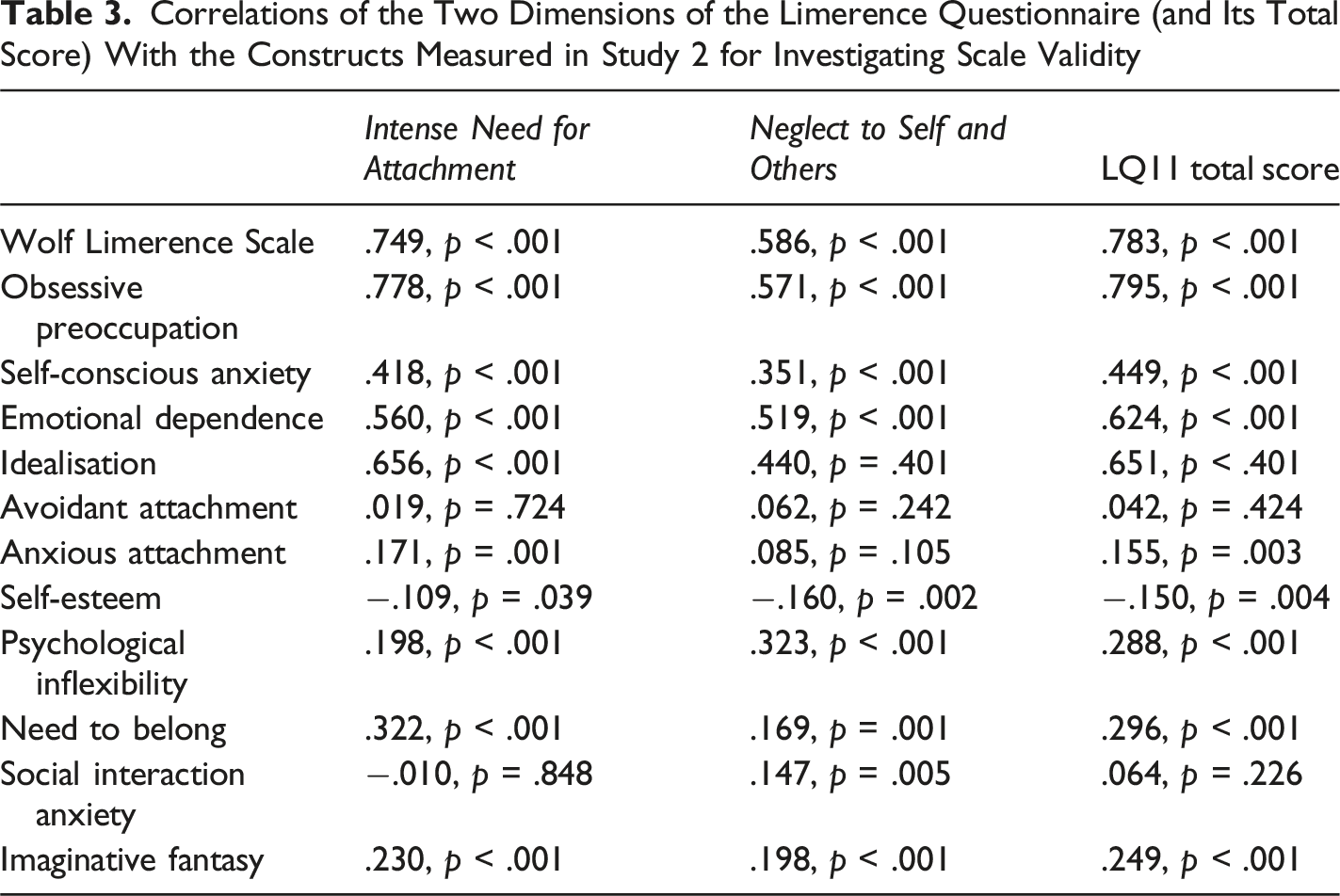
In regard to attachment, avoidant attachment was unrelated to both factors of the LQ-11. However, anxious attachment was significantly positively related to the attachment factor of the LQ-11, but not Neglect. Attachment and Neglect were both significantly negatively related to self-esteem. Both Attachment and Neglect were significantly positively related to psychological inflexibility, the need to belong, and imaginative fantasy. Finally, Neglect was significantly positively related to social interaction anxiety, although there were no significant effects for the attachment factor.
General Discussion
The present set of studies detailed the development and validation of a short measure of limerence, called the Limerence Questionnaire (LQ-11). Across two diverse samples of participants from the general population who had experienced or were experiencing at least one episode of limerence, we observed strong psychometric properties for the LQ-11, including evidence of good construct validity. Firstly, (Study 1), we observed that our LQ-11 measure suggested a two-factor solution with the dimensions labelled as Intense Need for Attachment (Attachment) and Neglect for Self and Others (Neglect). Secondly, this two-factor solution was then subsequently confirmed with a different dataset (Study 2).
Our factor solution contrasts with the Wolf (2017) limerence measure insofar as they identified a four-factor solution (obsessive preoccupation, self-conscious anxiety, emotional dependence, and idealisation). We argue that the concepts included in the Wolf (2017) measure are well represented within our two-factor solution as a form of higher-order themes. Further, there was good concurrent validity between the LQ-11 and the Wolf (2017) measure, although there was no association observed between idealization and neglect. One potential explanation for this lack of association may be that depending on the stage a person is in their particular limerence journey, they may not necessarily be idealizing the limerent object (e.g., “they are not even my type”) and are no longer neglecting themselves but still stuck in an obsessive pattern of thought and behaviour. Second, we noted that the LQ-11 demonstrated good construct validity as it was associated with theoretically-related concepts. Consistent with our predictions and previous research (e.g., Willmott & Bentley, 2015; Wolf, 2017), we observed that both of the LQ-11 dimensions were associated with self-esteem, psychological inflexibility, need to belong, and imaginative fantasy respectively.
Furthermore, we observed that in regards to avoidant attachment, our prediction was partially supported as there were no significant asssociations. However, for anxious attachment this was associated with the attachment dimension which is consistent with theory (Bowlby, 1969) and research (Wolf, 2017), but not for neglect. It could be argued that the lack of association might be when limerence experiencers are high in attachment anxiety, they might not necessarily neglect themselves. Indeed, on the contrary, they might engage in behaviors that they perceive to be self-enhancing (e.g., selectively choosing a diet to help lose weight; spending excessively on new clothes and a haircut) to increase the prospect of future reciprocation from the limerent object. Finally, we noted that social interaction anxiety was associated with neglect but not attachment, which partially supports our hypothesis (Wolf, 2017). One possible reason for this may be that social competence is still possible except in the presence of the limerent object. Further research exploring the nuances of the limerent experience particularly in regard to the role of social interaction anxiety and attachment anxiety would be beneficial.
The correlation between limerence and psychological inflexibility was significant but small. While there are six core processes of psychological inflexibility (Hayes et al., 2006), it seems that three, in particular, could be most relevant in the context of limerence: cognitive fusion, experiential avoidance, and lack of contact with the present moment. More specifically, in cognitive fusion (see Assaz et al., 2023) the limerence experiencer could be characterized by repetitive patterns of rigid, inflexibile thoughts about the limerent object that they literally believe to be true (e.g., that the limerent object must feel the same way about them and it is just a matter of time before they acknowledge and reciprocate). Experiential avoidance is generally considered as avoidance or suppression of unwanted thoughts, emotions, feelings, and sensations (Hayes et al., 1996; Tyndall et al., 2019). The limerent experiencer would likely be aware of the non-reciprocation of their feelings or intentions by the limerent object but they would not engage in any unwanted thoughts or feelings that it might not be reciprocated and such thoughts would be suppressed or avoided. The limerent experiencer often tends to be stuck in a conceptualized past where they ruminate on past interactions with the limerent object or in an imagined future where they visualise positive interactions and recriprocated feelings (e.g., Willmott & Bentley, 2015).
Our research has some limitations that should be noted. First, all data collected was self-report which increases the risk of common method bias and inflating the relationships between variables (Podsakoff et al., 2003). Future researchers may consider collecting outcome data from other collateral sources beyond the participant (e.g., perception of the participant’s levels of current psychological distress, self-esteem, or need to belong to a close other, from a nominated person such as a friend). Second, the sample in this dataset were from mostly from predominantly white, educated, industrialized, rich and democratic (WEIRD) cultures. As such our results may not be generalizable to different cultures. Future researchers may consider testing the structural and construct validity of the LQ-11 in other populations, ideally with non-WEIRD cultures, by striving to recruit samples with greater demographic diversity via more targeted recruitment strategies. Moreover, researchers could also conduct invariance testing to examine if the structural validity of the LQ-11 replicates across several datasets.
Third, for feasibility reasons we were not able to examine some of the likely outcomes of limerence in this study (e.g., psychological distress, stalking behavior, or indeed the potentially positive outcomes such as improved self-concept clarity). As such, future research is needed to further validate the LQ-11. Fourth, we did not check test-retest reliability in our study. Therefore, we cannot confirm, at this juncture, that LQ-11 scores would hold across time. Nevertheless, given that the literature suggests that limerence journey is a trajectory and people may recover over time (Willmott & Bentley, 2015), we argue that test-retest reliability is not as relevant for our measure. Finally, we did not capture in-depth data regarding participants’ attachment history. Willmott and Bentley (2015) noted that those who experience limerence tend to report an insecure attachment history including cases of neglect and unmet psychological needs. Thus, one approach that future researchers could use to further explore the role of attachment in understanding the antecedents of the limerent journey is by using the gold-standard adult attachment interview (George et al., 1996) along with administering the LQ-11.
Conclusion
The present studies provide preliminary evidence that the LQ-11 has excellent psychometric properties, internal reliability, and good construct validity. Further research is needed to establish the antecedents and consequences of limerence. However, the LQ-11 serves as an initial tool to measure the concept of limerence that we believe will be beneficial for researchers in the field of interpersonal relationships and clinicians working with clients that experience limerence.
Supplemental Material
Supplemental Material - Development and Validation of the Limerence Questionnaire (LQ-11)
Supplemental Material for Development and Validation of the Limerence Questionnaire (LQ-11) by L. Marshall, D. Waldeck, L. Pancani, S Churchill, and Ian Tyndall in Psychological Reports.
Footnotes
Ethical Considerations
All procedures were approved by the University of Chichester Research Ethics processes and all participants provided informed consent.
Funding
The authors received no financial support for the research, authorship, and/or publication of this article.
Declaration of Conflicting Interests
The authors declared no potential conflicts of interest with respect to the research, authorship, and/or publication of this article.
Data Availability Statement
Data is available upon reasonable request from the authors.
Supplemental Material
Supplemental material for this article is available online.
Author Biographies
References
Supplementary Material
Please find the following supplemental material available below.
For Open Access articles published under a Creative Commons License, all supplemental material carries the same license as the article it is associated with.
For non-Open Access articles published, all supplemental material carries a non-exclusive license, and permission requests for re-use of supplemental material or any part of supplemental material shall be sent directly to the copyright owner as specified in the copyright notice associated with the article.
