




Abstract
This study explored a longitudinal data-base that assessed a set of psychological and socio-demographic factors associated with parenting styles in a sample of 1,053 parents (55% mothers) with a mean age of 41.2 years (SD = 6.7) who had children aged 10 years. We were interested in the correlates of three distinct parenting styles: Authoritative, Authoritarian, and Permissive Parenting (criterion variables), along with the various predictor variables: gender, age, the Big-Five personality factors, cognitive ability, self-efficacy, mental health problems, educational qualifications and occupational levels. Regression analyses revealed that traits Agreeableness and Openness, self-efficacy, and gender (being mothers) were significant (p < .01 to p < .001) and positive, independent predictors of Authoritative Parenting, accounting for 17% of the variance. Trait Agreeableness, age (negatively), and mental health problems (positively) were significant (p < .05 to p < .001) and independent predictors of Authoritarian Parenting, accounting for 13% of the variance. Trait Conscientiousness, occupational levels, and gender (being mothers) were significant (p < .05) and negative independent predictors of Permissive Parenting, accounting for 10% of the variance. Implications are discussed as well as limitations of the study.
Introduction
In this study we explored an established, British longitudinal data base to examine how parental demographic variables, personality, intelligence as well as mental health related to their parenting styles. Whereas most studies in this area are concerned with the effect of parenting styles on children, this is concerned with the determinants of those styles. It is a large and representative sample which allowed us to examine the incremental validity of trait and ability variables over demographic variables in understanding different parenting styles. Our particular focus was on the relationship between personality, ability and mental health and the adoption of particular parenting styles. Whilst most studies in this area have examined the consequences of parenting style on children’s developmental outcome this study looks at individual difference correlates of parental style.
There is extensive literature on parenting style (Delvecchio et al., 2020; Eden & Tal, 2024), derived primarily from the classification of Baumrind’s (1971) theory (Kuppens & Ceulemans, 2019). As a consequence, there are a number of reviews and meta-analyses surrounding the relationship between parenting style and a range of behaviours like well-being (Huang et al., 2024), aggression (Masud et al., 2019), self-esteem (Pinquart & Gerke, 2019), externalising behaviours (Ruiz-Hernández et al., 2019), behavioural problems (Kinrade et al., 2025; Sun et al., 2024) and general development (Jiang et al., 2024; Zhang et al., 2023). Research has examined the relationship between parenting styles and many child behaviours, including children’s behaviour problems (Alizadeh et al., 2011), healthy lifestyles (Alonso-Stuyck, 2019), materialism (Bi et al., 2024), thinking styles (Fan & Zhang, 2014), creativity (Gralewski & Jankowska, 2020), learning (Kong & Yasmin, 2022), mental health (Peng et al., 2021), career decision making (Tian et al., 2021), and academic performance (Teuber et al., 2022; Yang & Zhao, 2020). This study examines the relationship between parenting style and Big-Five personality factors, cognitive ability, self-efficacy, and mental health problems in a large representative population.
This is a longitudinal study which are often considered crucial to look at causal relationships. There have been a number of longitudinal studies in the area (Aaron & Oliver, 2022; Kaniušonytė & Laursen, 2021; Kassis et al., 2025; Pan et al., 2024) all aimed at exploring the central hypothesis that parenting styles have significant long-term consequences for children. This study is different from these in that parenting style is essentially the dependent variable in that we are interested in understanding what determines adults parenting styles. We were able to examine how various individual differences like personality and intelligence influence preferred parenting style some years later.
According to the Baumrind model, Authoritative Parents are supportive in nature; they have clear guidelines for their behavioural expectations and explain their reasons associated with disciplinary actions. On the other hand, Authoritarian Parents tend to expect their children to obey the instructions of their parents and the rules are not usually explained; mistakes often lead to punishment. Permissive Parents tend to leave their children free to have their own preferences; limited rules can lead to children with unhealthy habits, as the parents do not provide much guidance and rarely use discipline.
Parenting styles result in behavioural and psychological adjustments in children (Chan & Koo, 2011). In a systematic review of parenting styles and aggression among young adolescents, based on 34 studies, Masud et al. (2019) state that Authoritative Parenting plays a positive role in psychological behaviour in children while Authoritarian Parenting and Permissive Parenting result in aggressive and negative behaviours in children. Authoritative Parenting is also associated with academic achievement (Lamborn et al., 1991; Steinberg et al., 1989), self-reliance and social competence (Steinberg et al., 1999), whereas Authoritarian Parenting and Permissive Parenting are associated with substance use (Baumrind, 1991) and adolescent delinquency (Barnes & Farrell, 1992).
In a meta-analysis study on the relationship between parents’ Big Five personality factors and parenting, based on 5,853 parent-child dyads that were included in 30 studies, Prinzie and colleagues report that higher levels of Extraversion, Agreeableness, Conscientiousness, and Openness and lower levels of Neuroticism were related to more warmth and behavioural control. While higher levels of Agreeableness and lower levels of Neuroticism were related to more autonomy (Prinzie et al., 2009). However, this study did not use the three types of parenting styles from Baumrind’s theory (1971). The current study is able to explore the associations between the Big Five personality factors of parents and all three types of parenting styles.
In a recent meta-analysis on perceived parenting styles and the Big Five personality factors, based on 11,061 adolescents in 28 studies, Tehrani and colleagues (2024) report that results provided evidence that Authoritative Parenting style was positively associated with Openness to experience, Conscientiousness, Extraversion, and Agreeableness and negatively related to Neuroticism. A positive association was also found between Authoritarian Parenting style and Neuroticism. Indifferent or neglectful (Permissive) Parenting style was associated negatively with Conscientiousness and Agreeableness and positively with Neuroticism. The study provides evidence that parenting styles are important correlates of personality traits among adolescents (Tehrani et al., 2024). However, studies included in this review involve perceived parenting style rather than the actual parenting style of participants. The present research explores the associations between parents’ actual parenting style and their personality traits.
This Study
What makes this study original is the combination of variables we were able to examine, given the particular data set we were exploring. Whilst studies have looked at trait correlates of parenting style it seems far fewer have examined ability. There are many studies on the consequences of parenting style on childrens’ cognitive and emotional intelligence (Lanjekar et al., 2022) it seems few have looked at parental cognitive ability and the adoption of a particular parenting style. Similarly, studies have looked at the consequences of parenting style on children’s mental health, not the mental health of the parents and the style they adopt. The same is true of parental self-efficacy which we examine (Qazi, 2009). This unique data set allows us to look at the relationship between parental individual differences and the adoption of particular parenting styles.
Further, few studies, if any, have examined the associations between the three types of parenting styles and the Big Five personality factors together with other psychological factors like cognitive ability, self-efficacy, and mental health to ascertain the independent effects of these psychological factors on each of the three types of parenting style. That is, whereas there are various studies examining some of the variables we have one at a time, our data set allowed us to examine them all at the same time, thus being able to determine their relative power. From the available variables assessed in the longitudinal study we choose the Big Five personality factors, cognitive ability, self-efficacy, and mental health problems. We also account for the effects of gender, age, education and occupation on the outcome variables.
Hypotheses
Based on the literature reviewed above, five hypotheses were emulated. (H1) Traits Agreeableness, Conscientiousness, Extraversion, and Openness would be significantly and positively associated with Authoritative Parenting and significantly and negatively associated with Authoritarian Parenting and Permissive Parenting, whereas trait Neuroticism would be significantly and positively associated with Authoritarian Parenting and Permissive Parenting. (H2) Cognitive ability would be significantly and positively associated with Authoritative Parenting and significantly negatively associated with Authoritarian Parenting and Permissive Parenting. (H3) Self-efficacy would be significantly positively associated with Authoritative Parenting and significantly negatively associated with Authoritarian Parenting and Permissive Parenting. (H4) Mental health problems would be significantly negatively associated with Authoritative Parenting and significantly positively associated with Authoritarian Parenting and Permissive Parenting. (H5) Educational qualifications and occupational levels would be significantly positively associated with Authoritative Parenting and negatively associated with Authoritarian Parenting and Permissive Parenting.
Method
The UK Household Longitudinal Study (UKHLS), labelled Understanding Society, is an innovative world-leading study following the lives of 40,000 UK households to provide valuable evidence about 21st-century UK life and how it is changing (Knies, 2014). Since 2009, it annually captures important information about peoples’ social and economic circumstances, attitudes, behaviours and health. The study is longitudinal in its design and of high quality. Data Wave 3 (2011), Wave 5 (2013), and Wave 7 (2015) were used in the study.
Participants
The study was based on a sample of 1,053 parents (55% mothers) with ages ranging from 26 to 70 years old (Mean = 41.17, SD = 6.42) who had 10-years-old children in Wave 7 (in 2015) from the UK Household Longitudinal Study (UKHLS).
Measures
(1) The Big Personality Factors. Personality traits are classified according to the ‘Big Five’ taxonomy: Agreeableness (A), Conscientiousness (C), Extraversion (E), Neuroticism (N), and Openness (O). The Big Five personality traits were assessed in Wave 3 (in 2011) using a 15-item version of the Big Five Inventory (John et al., 2008). Three items were used to assess each of the five dimensions. The Cronbach’s alpha was 0.57 for A, 0.55 for C, 0.60 for E, 0.71 for N, and 0.66 for O. Although reliability coefficients for these five factors may appear modest by traditional standards, past research suggests that these alpha coefficients underestimate the actual reliability of these scales due to their brevity. (2) Cognitive ability tests. A set of four sets of cognitive ability tests were used in Wave 3 (in 2011). They include Immediate Word Recall, Subtraction, Verbal Fluency and Numeric Ability. The standardised cognitive ability test scores were combined. (3) General Health Questionnaire (GHQ). Mental health was measured by GHQ in Wave 5 (in 2013). It is a 12-item instrument measuring depression, anxiety and psychosomatic illness (Goldberg & Williams, 1988), The alpha for the total score was .83. (4) Educational qualifications. Educational qualifications ranged from 0 = no qualification to 5 = university degree in Wave 5 (in 2013). (5) Occupational levels. Current occupation in Wave 5 (in 2013) was measured by the Registrar General’s measure of social class (RGSC). RGSC is defined according to occupational status and lifestyle (Marsh, 1986). It was coded on a six-point scale: I unskilled, II partly skilled, IIIM skilled manual, IIIN skilled non-manual, V managerial/technical, and VI professional (Leete & Fox, 1977). (6) Parenting style. Parenting style was measured in Wave 7 (2015) with 32 items based on Baumrind’s theory (Baumrind, 1971). It includes three distinct types of parenting: Authoritative, consisting of 15 items and an Alpha of .86; Authoritarian Parenting, which consists of 12 items, with an Alpha of .78; Permissive Parenting, which consists of five items, the Alpha was .66 (see Appendix I).
Results
Correlational Analysis
Pearson Correlations Matrix Between Parenting Style, Personality Factors, Cognitive Ability, Self-Efficacy and Mental Health Problems, and Socio-Demographic Indicators
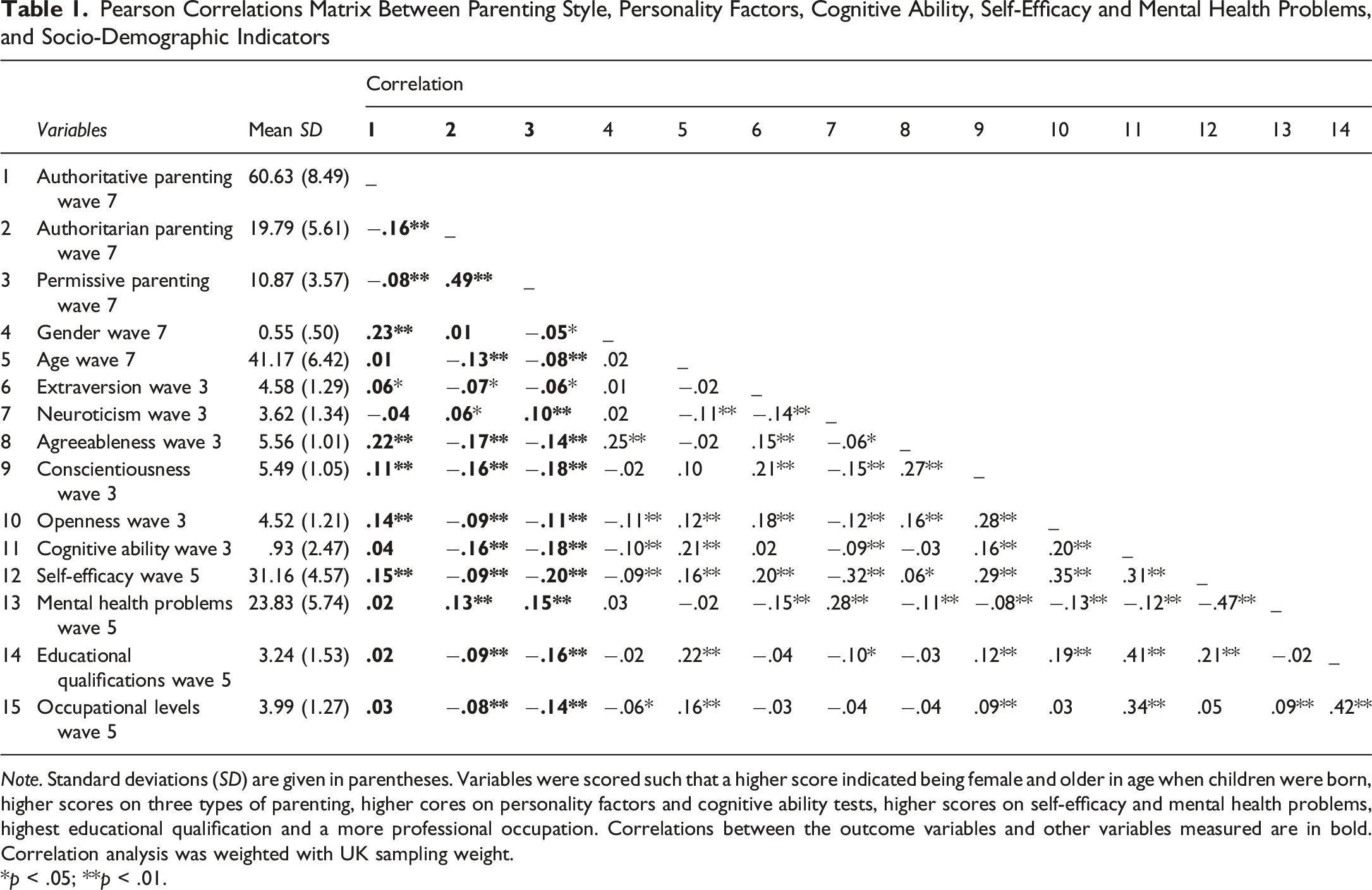
Note. Standard deviations (SD) are given in parentheses. Variables were scored such that a higher score indicated being female and older in age when children were born, higher scores on three types of parenting, higher cores on personality factors and cognitive ability tests, higher scores on self-efficacy and mental health problems, highest educational qualification and a more professional occupation. Correlations between the outcome variables and other variables measured are in bold. Correlation analysis was weighted with UK sampling weight.
*p < .05; **p < .01.
Table 1 indicates that traits Agreeableness, Conscientiousness, Extraversion, Openness, self-efficacy, educational qualifications and occupational levels were all significantly and positively associated with Authoritative Parenting and significantly negatively associated with Authoritarian Parenting and Permissive Parenting. Whereas trait Neuroticism and mental health problems were significantly positively associated with Authoritarian Parenting and Permissive Parenting (p < .05 to p < .001). Thus, (H1), (H3) and (H5) were supported. (H2) and (H4) were partially supported, as cognitive ability and mental health problems were not significantly associated with Authoritative Parenting. Gender (being mothers) was significantly and positively associated with Authoritative Parenting and significantly negatively associated with Permissive Parenting. Age was significantly negatively associated with Authoritarian Parenting and Permissive Parenting.
Regression Analysis
Predicting Authoritative Parenting From Gender and Age, Personality Factors and Cognitive Ability, Self-Efficacy and Mental Health Problems, Educational Qualifications and Occupational Levels
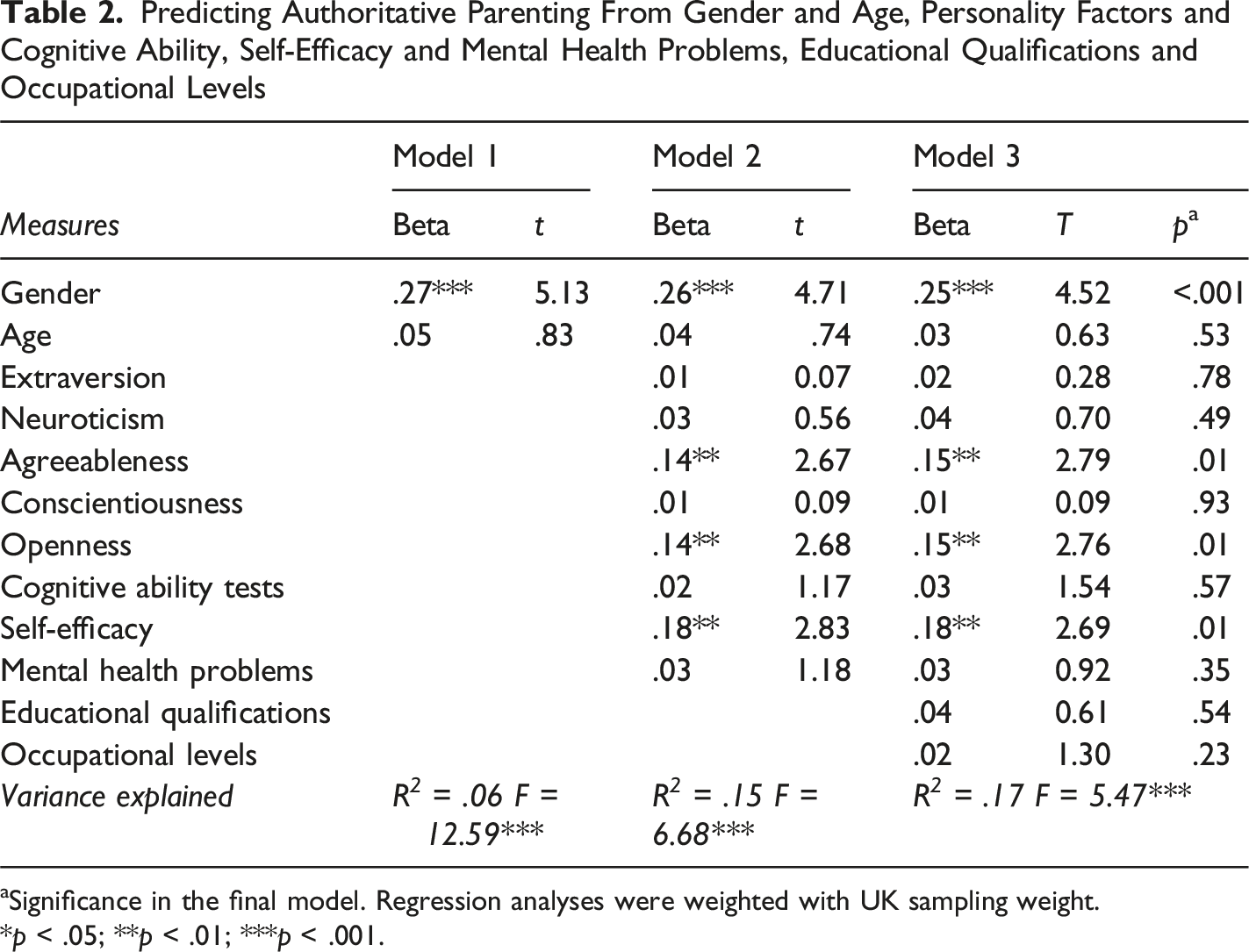
aSignificance in the final model. Regression analyses were weighted with UK sampling weight.
*p < .05; **p < .01; ***p < .001.
Predicting Authoritarian Parenting From Gender and Age, Personality Factors and Cognitive Ability, Self-Efficacy and Mental Health Problems, Educational Qualifications and Occupational Levels
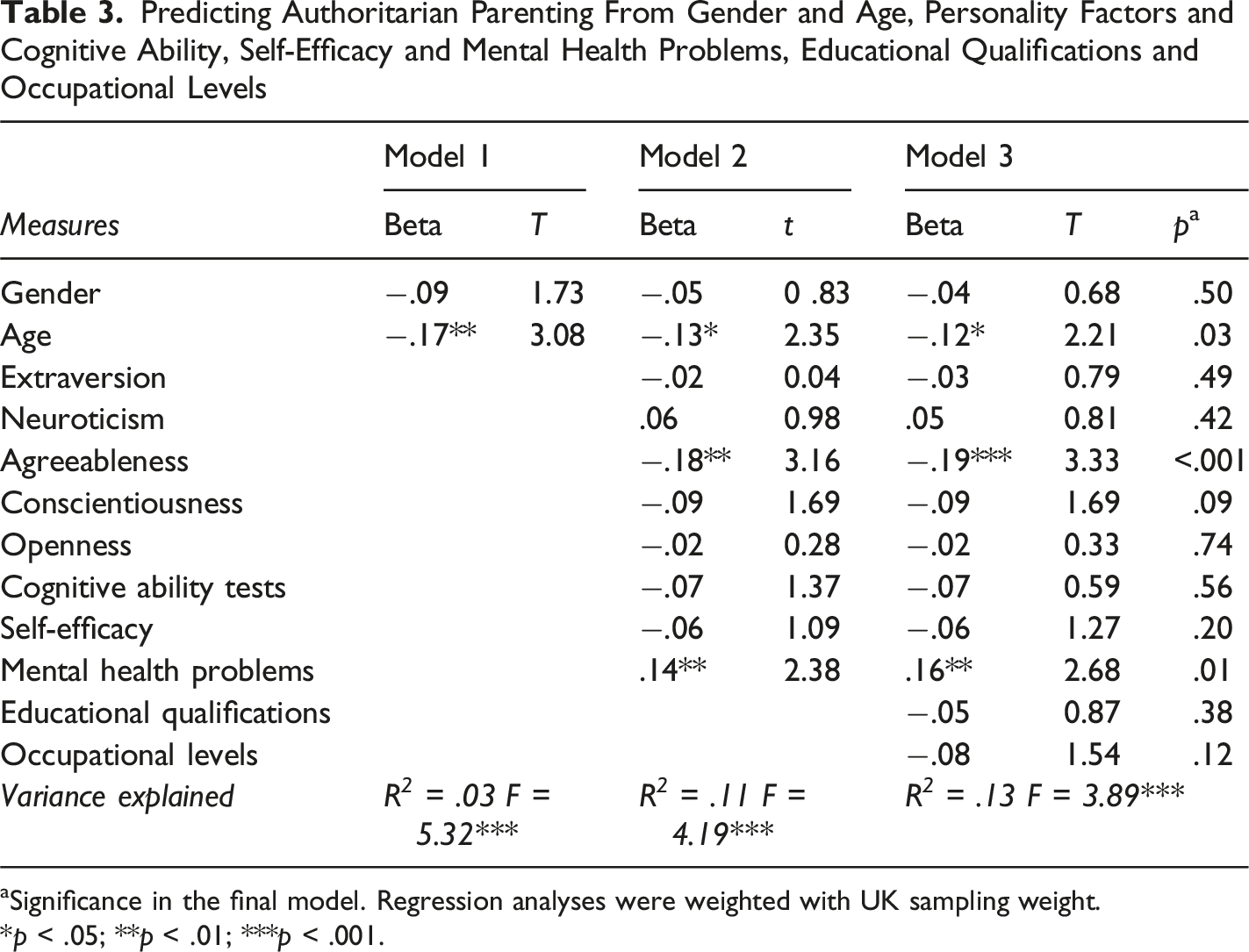
aSignificance in the final model. Regression analyses were weighted with UK sampling weight.
*p < .05; **p < .01; ***p < .001.
Predicting Permissive Parenting From Gender and Age, Personality Factors and Cognitive Ability, Self-Efficacy and Mental Health Problems, Educational Qualifications and Occupational Levels
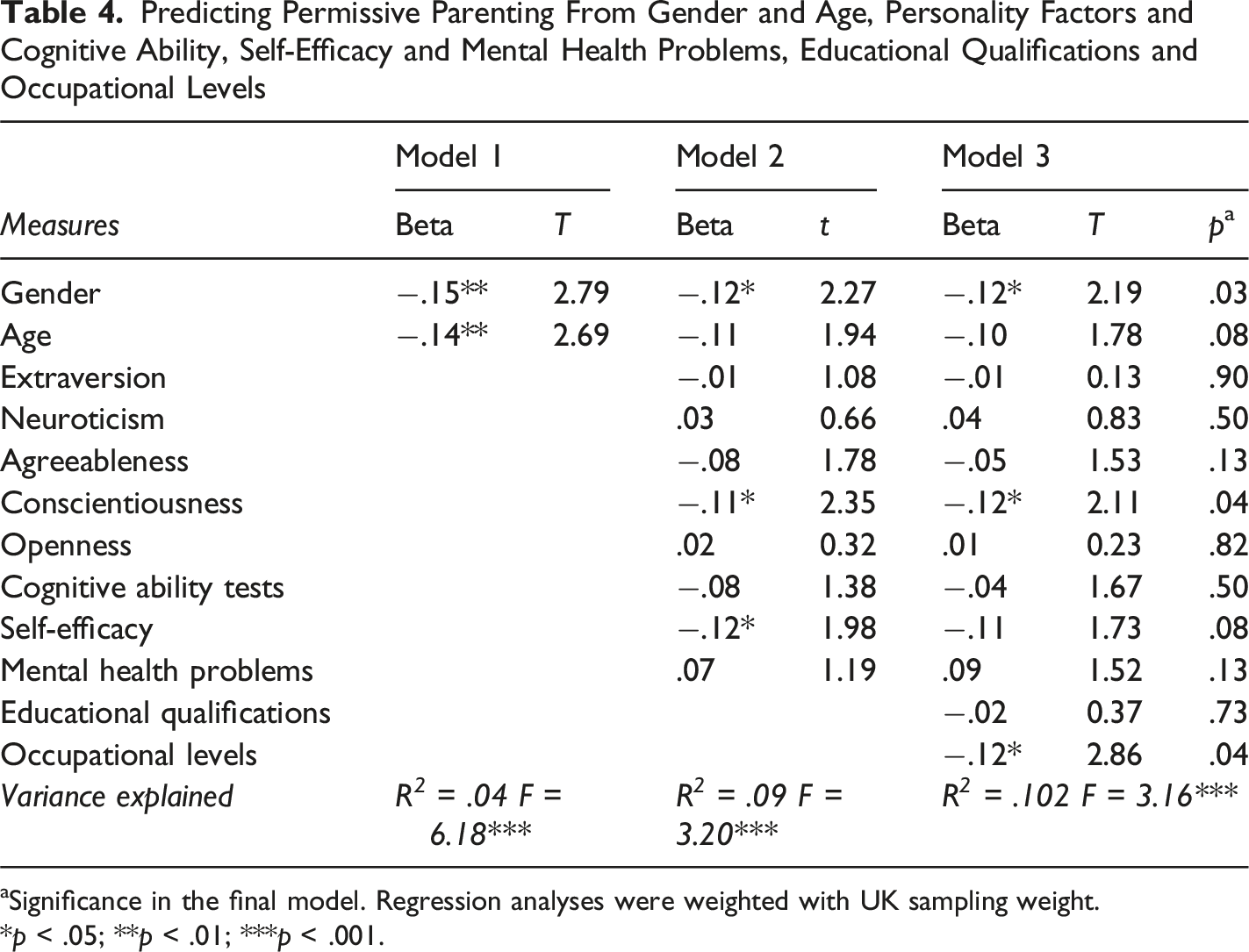
aSignificance in the final model. Regression analyses were weighted with UK sampling weight.
*p < .05; **p < .01; ***p < .001.
Table 2 depicts that in Model 1, gender (being mothers) was a significant and positive predictor of Authoritative Parenting. Model 1 explains 6.3% of the variance. In model 2, after entering a set of psychological variables into the equation, traits Agreeableness and Openness, and self-efficacy became significant and positive predictors of Authoritative Parenting, and gender remained the significant predictor of the outcome variable. Model 2 explains 9.1% of the variance. In Model 3, after entering social variables, education, and occupation into the equation, the model explained an additional 1.4% of the variance. In the final model, traits Agreeableness and Openness, self-efficacy, and gender were significant predictors of Authoritative Parenting, accounting for 16.8% of the total variance.
Table 3 exhibits that in Model 1, age was a significant and negative predictor of Authoritarian Parenting. Model 1 explains 3% of the variance. In Model 2, after entering a set of psychological variables into the equation, trait Agreeableness was a significant and negative predictor of Authoritarian Parenting, mental health problems was a significant positive predictor of Authoritarian Parenting, whilst age remained a significant predictor of the outcome variable. Model 2 additionally explains 8.2% of the variance. Model 3 - after entering social variables, education, and occupation into the equation-explains a further 1.3% of the variance. In the final model, trait Agreeableness, mental health problems, and age were significant predictors of Authoritarian Parenting, accounting for 12.5% of the total variance.
Table 4 shows that in Model 1, gender and age were significant and negative predictors of Permissive Parenting. Model 1 explains 3.5% of the variance. In Model 2, after entering a set of psychological variables into the equation, trait Consciousness and self-efficacy were significant negative predictors of Permissive Parenting, whilst gender remained a significant predictor of the outcome variable. Model 2 further explained 5.2% of the variance. In Model 3, after entering social variables into the equation, occupational levels was a significant and negative predictor of Permissive Parenting, trait Conscientiousness and gender remained significant predictors of the outcome variable; however, self-efficacy ceased to be a significant predictor of the outcome variable. Model 3 explains 1.5% of the variance. In the final model, trait Conscientiousness, occupational levels, and gender were significant predictors of Permissive Parenting, accounting for 10.2% of the total variance.
Discussion
The current study is among the first to examine the association between the three distinct types of parenting styles in relation to parents’ personality traits, cognitive ability, self-efficacy, mental health problems, and socio-demographic factors. Results of the current study portray the critical role of specific Big Five personality factors and self-efficacy in parenting style. It confirms a number of other studies on the relationship between the Big Five and parenting styles (e.g. Hardjanto & Triman, 2024).
The correlational results, shown in Table 1, show the most noticeable result is that nearly all correlations displayed the opposite pattern for Authoritative vs Authoritarian and Permissive Parenting, with more correlations being significant with the latter styles compared to the former style. The four highest sets of correlations suggest that parents higher on Agreeableness, Conscientiousness, Openness, and Self-efficacy tend to be more Authoritative and less Authoritarian/Permissive. Further, whilst factors like cognitive ability and mental health problems were not associated with Authoritative parenting, they were negatively associated with Authoritarian and Permissive parenting. The authoritative parent tends to be a Stable Extravert and particularly high on Agreeableness. On the other hand, both Authoritarian and Permissive parents appear to be younger, less well educated, with more mental health problems and lower self-efficacy, scoring lower on all traits except Neuroticism. These results confirm most previous studies in the area and out hypotheses. That is, happier and psychological healthier people adopt the more adaptive Authoritative parenting style.
The role of self-efficacy is an important in all aspects of life including child-rearing. Indeed a number of studies on parenting efficacy (Hamovitch et al., 2019) and general self-efficacy (Harpaz et al., 2021) have demonstrated both how it relates to parenting style but also the self-efficacy beliefs of their children.
With regard to socio-demographic associations, we confirmed previous findings, noting that mothers tend to engage in more Authoritative Parenting and less Permissive Parenting than fathers; older parents tend to engage in less Authoritarian Parenting and Permissive Parenting; and more professional parents tend to engage in less Permissive Parenting. It would be interesting to trace these associations over time as it seems possible that there are trends in what is thought to be ideal parenting from a time when both aspects of Permissive and Authoritarian parenting were thought of at least partly desirable to the situation today where there seems more agreement on the desirability of Authoritative parenting (Lam et al., 2019).
The regressions are most informative; results reveal that four variables-traits Agreeableness and Openness, self-efficacy, and gender-were significant positive predictors of Authoritative Parenting, accounting for 17% of the variance. Three variables, namely trait Agreeableness (negatively), mental health problems (positively), and age (negatively), were significant predictors of Authoritarian Parenting, accounting for 13% of the variance. Finally, three variables, trait Conscientiousness, occupational levels, and gender, were significant negative predictors of Permissive Parenting, accounting for 10% of the variance. Research in this area tends to examine specific relationships such as that between demography or personality and parenting styles while this examines a dozen variables and there relative contribution to adult parenting styles.
A further three points are noticeable from the regressions. First, many variables were not significant in the third step of all three regressions: Traits Extraversion and Neuroticism, IQ, educational qualifications, and mental health issues. This suggests that parenting style is less affected by classic personality variables (Galen’s humours), intellect and education. Second, despite the comprehensiveness of the variables assessed, all together in each regression, they account for only between 10 and 20% of the variance. It raises the question, what are the variables not measured in this study accounting for much more of the variance in any chosen parenting style? For instance, there was no data on the participants religious and political beliefs, or indeed their perceptions of their own parents’ style. Third, as demonstrated by the correlations, trait Agreeableness seemed most closely linked to 2/3 of the parenting styles. Trait Agreeableness is associated with being selfless, appreciative, compliant, trusting and tender-minded. People high in Agreeableness tend to be generous, kind, sympathetic and warm (Furnham & Cheng, 2015). Similarly disagreeable people are seen as cold, competitive and blunt which are not usually considered ideal characteristics in a parent.
One question not answered by this data is whether we all parent as we were parented. Theorising that we adopt a style that our parents chose for us, and this may account for most of the variance. However it is important to answer the nature-nurture question: that is we in some way inherit a parenting style or that we learn to parent as we were parented. This is an important, but very difficult question to answer.
Limitations
A major limitation of this study is that it was based on self-report, albeit that personality and IQ was assessed four years before Parenting Style. Ideally, we would have had observational data along with some measures of participants children’s actual beliefs and behaviour. Further, some measures, notably the Big Five, were very short, which possibly lead to their relatively low internal reliability. Finally, some of the results could have been exaggerated by social desirability and impression management effects.
Footnotes

Ethical Considerations
The University of Essex Ethics Committee has approved all data collection on Understanding Society main study, the UK Household Longitudinal Study (UKHLS) and innovation panel waves, including asking consent for all data linkages. Approval for the collection of biosocial data by trained nurses in Waves 2 and 3 of the main survey was obtained from the National Research Ethics Service (Understanding Society – UK Household Longitudinal Study: A Biosocial Component, Oxfordshire A REC, Reference: 10/H0604/2).
Consent to Participate
Informed consent was obtained from all subjects involved in the study.
Author Contribution
A.F: Visualisation, Writing - review & editing, HC: Data Curation and Analysis.
Funding
The authors received no financial support for the research, authorship, and/or publication of this article.
Declaration of Conflicting Interests
The authors declared no potential conflicts of interest with respect to the research, authorship, and/or publication of this article.
Data Availability Statement
Data sharing not applicable to this article as no datasets were generated or analyzed during the current study.