




Abstract
Meaning in life is recognised as an important determinant of subjective well-being and is linked to a decreased risk of depression and despair. Additionally, the quality of social interactions significantly influences students’ well-being. This study investigates the relationship between depression and subjective well-being among university students and explores the potential mediating roles of meaning in life and perceived negative interactions. A sample of 198 university students aged 18 to 29 completed an online survey comprising of the Satisfaction with Life Scale, Positive and Negative Affect Schedule, The Centre for Epidemiological Studies Depression Scale, The Meaning in Life Questionnaire, and The Test of Negative Social Exchange. The results indicated a negative relationship between depression and subjective well-being (p < .001), including meaning in life as a mediator (p < .001), whereas perceived negative interactions was not a mediator. These findings offer valuable insights in relation to mental health as they emphasise the importance of understanding correlates of students’ well-being, which are relevant for researchers and educators.
Introduction
According to the World Health Organization (2023), 3.8% of the worldwide population experience depression, and therefore, approximately 280 million people in the world have depression. In the context of Australia, the prevalence of depression has been increasing, with 10.4% of the population reporting symptoms of depression in 2017-18, which increased by 1.5% from 2014-15, particularly among young adults (i.e., 15–24 years; Australian Bureau of Statistics, 2018). University students are particularly vulnerable to depression due to the accumulated stress of adapting to life changes and focusing on their future, with nearly one in three university students struggling with depression (Ibrahim et al., 2013; Mofatteh, 2021). The COVID-19 pandemic has further escalated reports of mental health problems among university students globally, highlighting the need to address this issue due to the negative outcomes, such as impaired academic functioning (Donald & Jackson, 2022; Ibrahim et al., 2013; Mofatteh, 2021). This alarming trend highlights the pressing need to investigate the intricate relationship between depression and subjective well-being within this demographic (Fernandes et al., 2023; Lagnado et al., 2017). Finally, in an increasingly demanding academic environment, recognising the factors that impact this relationship is important for mental health professionals to develop effective support systems to promote student well-being and academic success.
Subjective Well-Being in University Students
Subjective well-being significantly contributes to the success of university students as it has been found to predict improved learning outcomes and academic achievement (Fernandes et al., 2023). Additionally, studies have found that subjective well-being positively correlates with optimism and academic self-efficacy among university students, with academic self-efficacy positively influencing students’ ability to cope with changes they may encounter (Denovan & Macaskill, 2017). Further, promoting subjective well-being among university students can lead to a range of future benefits, including increased relationship satisfaction, improved work performance, more volunteering, better physical health, and longevity (Donald & Jackson, 2022; Fernandes et al., 2023). The overall success of university students is of great societal value, as they are integral to the future of developmental growth in the field of science, technology, engineering, and mathematics (Wu et al., 2021). Given the importance of subjective well-being among university students, it is essential that research is conducted to identify its predictive factors. While existing research has provided valuable insights into promoting subjective well-being, opportunities remain to explore how psychological states such as depression, as well as factors like meaning in life and perceived negative interactions, influence subjective well-being in university students.
The Relationship Between Depression and Subjective Well-Being
Evidence continues to show a negative link between depression and subjective well-being in university students across Western and non-Western societies (De Coninck et al., 2019; Kapur & Khosla, 2013; Kelifa et al., 2021). The Cognitive Theory of Depression suggests that individuals’ thoughts directly influence emotions and behaviour, contributing to depression impacting subjective well-being (Disner et al., 2011; Song et al., 2023). In line with this, Lagnado et al. (2017) found that those with lower levels of subjective well-being were twice as likely to report depression. Further, depression affects subjective well-being through mechanisms like ruminative thinking, hopelessness, diminished positive emotions, and increased negative affect (Kelifa et al., 2021). Fernandes et al. (2023) noted these effects arise from negative cognitions associated with depression.
Recent studies have confirmed the negative relationship between depression and subjective well-being among university students, with one study finding that depression tendency had negative effects on subjective well-being regardless of social media usage patterns (Ye & Ho, 2024). Additionally, research has shown that anxious-depressive symptomatology is closely related to well-being and academic performance in health sciences students (Fernández-Castillo, 2021). It is worth noting that prior studies confirm the negative link between depression and subjective well-being. However, a literature gap exists concerning mediating factors influencing this relationship among university students. Recent research has begun to explore potential mediators, such as resilience, in the relationship between stress and subjective well-being among college students, suggesting a growing interest in understanding the complex interplay of factors affecting students’ mental health and well-being (Shi et al., 2021). Despite the growing interest, there is limited empirical research examining whether meaning in life and perceived negative interactions mediate the relationship between depression and subjective well-being in university students. Identifying these potential pathways is important for guiding targeted interventions that address both cognitive and social factors influencing student mental health, and thus is the focus of this paper.
The Mediating Role of Meaning in Life
The relationship between depression and subjective well-being among university students can be influenced by cognitive factors, such as meaning in life. Specifically, meaning in life is a relevant factor for young adults in tertiary education as they establish their identity and determine their lives’ purpose and significance (Chen et al., 2021; Trevisan et al., 2017). The concept of meaning in life has been divided into three facets: existential significance, purpose, and coherence. Further, this construct has two types: the presence of meaning and the search for meaning (Steger et al., 2006; Wong, 1989). University students are in a unique developmental stage and actively seek purpose and significance in their lives (Chen et al., 2021; Liu et al., 2023). The presence of meaning has been positively correlated with overall well-being among university students (Steger & Dik, 2009; Steger et al., 2006). On the other hand, it is negatively correlated with depression (Buzzetta et al., 2020; Lin, 2021). Additionally, research has shown that meaning in life can act as a protective factor against suicidal behaviour in university students. A study by Lew et al. (2020) found that the presence of meaning in life had a positive effect on preventing suicide and acted as a protective factor against depression, anxiety, and stress. This highlights the critical role that meaning in life plays in promoting mental health and well-being among university students.
The Mediating Role of Perceived Negative Interactions
The Life Circumstance theories propose that both positive and negative events influence subjective well-being. The subjective well-being and life satisfaction are based on individuals’ contentment (or dissatisfaction) across various life domains (e.g., work, family), where positive and negative events occur (Luhmann et al., 2012). Specifically, perceived negative interactions, including capturing experiences of conflict, criticism, or feeling let down, have been associated with heightened stress levels, dissatisfaction, and lack of meaning in life (Zhang et al., 2022).
Constraining the focus on depression, research indicates that individuals experiencing depression encounter a higher frequency of negative social interactions and tend to react more negatively to them (Steger & Kashdan, 2009). This phenomenon may stem from an attentional bias towards negative stimuli and a tendency towards social withdrawal, leading to feelings of alienation and impedes effective communication (Indrani, 2017). Empirical evidence further suggests that the association between depression and subjective well-being is partially explained by the perception of social interactions, which is a central focus of this study. Recent research has provided additional support for this relationship. A study by Zhu et al. (2023) found that sleep quality was associated with subjective well-being among healthcare students, and this relationship was fully mediated by anxiety and depression. This suggests that negative psychological states, such as depression, play an important role in how individuals perceive their well-being and social interactions.
The Current Study: Aims and Hypotheses
While previous studies have explored the individual relationships between depression, subjective well-being, meaning in life, and social interactions, few have examined an integrated model testing the mediating roles of meaning in life and perceived negative interactions specifically among university students. Addressing this gap is important given the high prevalence of depression in this population and the potential for these mediators to inform intervention strategies that target both cognitive and social dimensions of student mental health. The present study aims to investigate the relationship between depression and subjective well-being among university students and to test whether this relationship is mediated by meaning in life and perceived negative interactions. Considering the unique stressors and challenges faced by university students, such as academic pressures and transitions to adulthood, understanding these pathways may provide valuable insights into how depression influences well-being in this demographic. Therefore, it is hypothesised that (i) depression will be negatively correlated with subjective well-being (H1), and (ii) meaning in life and perceived negative interactions will significantly mediate the relationship between depression and subjective well-being (H2 and H3), respectively. By empirically investigating these hypotheses, the study seeks to contribute to the existing literature on mental health and well-being in university populations and to inform the development of targeted interventions that promote resilience and positive functioning.
Method
Participants
This study recruited university students between the ages of 18–29 years, as this population has been found to report high rates of depression (e.g., Ibrahim et al., 2013; Mofatteh, 2021). A power analysis conducted using G*Power indicated that a minimum of 119 participants were needed to achieve a power of .95, with an alpha of .05 and an effect size of .15 in a multiple mediation study. Therefore, the final sample comprised of 198 participants, with a gender distribution of 65.7% female and 34.3% male. Participants’ ages ranged from 18 to 29 (M = 22.79, SD = 3.26) and predominantly included undergraduate students. All participants were either native English speakers or demonstrated sufficient English proficiency to comprehend the survey materials, as evidenced by their enrolment in an English-speaking university in Australia. As such, no translation or adaptation of the scales was required. All measures used in this study demonstrated good psychometric properties in the current sample, as reported in the following sections. The study received ethics approval from Griffith University Human Ethics Committee (GU Ref No: 2022/361).
Measures
First, participants were asked to provide information about their age, gender, education level, and ethnicity. Subsequently, various measures were employed as outlined below:
The Satisfaction With Life Scale (SWLS; Diener et al., 1985)
The SWLS is a 5-item self-report questionnaire for life satisfaction, including a 7-point Likert scale, ranging from 1 (strongly disagree) to 7 (strongly agree). A sample item is “The conditions of my life are excellent”. Total scores range from 5 to 35, with higher scores reflecting greater life satisfaction. In this study, the SWLS had a Cronbach’s alpha of .89 (Diener et al., 1985).
Positive and Negative Affect Schedule (PANAS; Watson et al., 1988)
The PANAS is a 20-item self-report scale consisting of two 10-item subscales, as Positive Affect (PA) assesses trait positive affect, and Negative Affect (NA) assesses trait negative affect. The scale consists of different emotions (e.g., upset, enthusiastic, irritable) rated from 1 (very slightly or not at all) to 5 (extremely). Total scores range from 10 to 50 for each subscale, with higher scores indicating greater levels of positive or negative affect, respectively. In this study, Cronbach’s alpha scores were .91 for PA and .88 for NA, respectively (Watson et al., 1988).
The Centre for Epidemiological Studies Depression Scale (CES-D; Radloff, 1977)
The CES-D was used to measure depression experienced over the past week. It is a 20-item self-report scale rated from 0 (rarely or none of the time) to 3 (Most or all of the time). Sample items include “I felt lonely” and “I was happy”. Total scores range from 0 to 60, with higher scores indicating greater depressive symptoms. In this study, the CES-D had a Cronbach’s alpha of .93 (Radloff, 1977).
The Meaning in Life Questionnaire (MLQ-P; Steger et al., 2006)
The MLQ-P was used to test the presence of meaning and is a 10-item self-report questionnaire using a 7-point Likert scale, ranging from 1 (absolutely untrue) to 7 (absolutely true), with higher scores indicating a greater presence of and search for meaning in life. A sample item includes “My life has a clear sense of purpose”. In this study, the MLQ-P had a Cronbach’s alpha of .94 (Steger et al., 2006).
The Test of Negative Social Exchange (TENSE; Finch et al., 1999)
TENSE is a 24-item self-report scale rated from 0 (Not at all) to 9 (Frequently) and measures the frequency of negative exchanges in ways they considered to be antagonistic and insensitive which are experienced over the last month. A sample item is “Seemed bored with me”. In this study, the TENSE had a Cronbach’s alpha of .97 (Finch et al., 1999).
Procedure
The online survey was hosted on REDCap, with data collected through an online format. Recruitment was conducted via the Subject Participation Pool, which targeted university students, as well as through Facebook to reach a community sample. Before involvement, participants were provided with a participant information sheet and a consent form outlining study details, procedures, confidentiality, and participant rights. Eligibility confirmation and consent were required before proceeding. To thank participants for their time, an optional prize draw was offered through a separate link for a chance to win one of three $50 AUD gift cards. Personal data for the prize draw was securely stored, kept separate from survey responses, and deleted after the draw. Winners were selected randomly.
Statistical Analysis and Results
Before conducting the primary analysis, data underwent extensive screening for outliers (standardised residuals and Mahalanobis distance) and missing values were replaced via mean imputation. Assumption tests showed satisfactory outcomes, confirming the dataset’s reliability. Multicollinearity analysis results indicated no issues among variables of interest (42.5% depression, 65.9% meaning in life, and 57.6% perceived negative interactions), suggesting low correlation and enabling regression analysis without multicollinearity concerns. It is worth noting that two participants did not complete TENSE, so their results were only used for the first mediation model involving meaning in life. The Pearson’s correlational analyses were conducted to test the relationships among variables of interest. The study utilised mediator models to investigate the potential roles of meaning in life and perceived negative interactions in the relationship between depression and subjective well-being. Analyses used PROCESS, a macro for SPSS by Hayes (2017), employing bootstrapping with 10,000 replications to calculate 95% confidence intervals for the indirect effects (ab paths) to determine the significance of the roles of the mediator variables. All tests in this study were conducted using two-tailed criteria (p < .05).
Descriptive Statistics and Correlational Analyses
Descriptive Statistics and Correlations
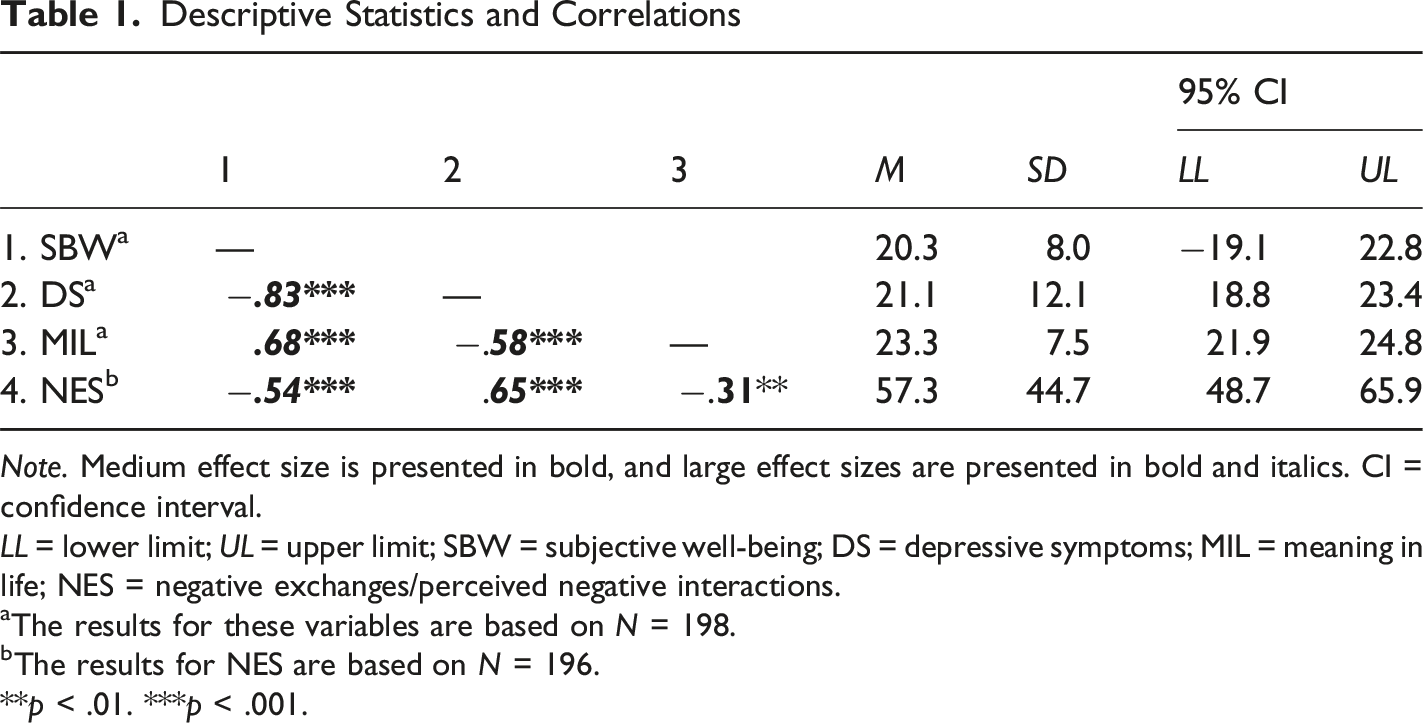
Note. Medium effect size is presented in bold, and large effect sizes are presented in bold and italics. CI = confidence interval.
LL = lower limit; UL = upper limit; SBW = subjective well-being; DS = depressive symptoms; MIL = meaning in life; NES = negative exchanges/perceived negative interactions.
aThe results for these variables are based on N = 198.
bThe results for NES are based on N = 196.
**p < .01. ***p < .001.
Mediation Model 1: Meaning in Life as a Mediator
As presented in Figure 1, the first mediation model revealed that depression was negatively associated with meaning in life. Further, meaning in life was positively correlated with subjective well-being after controlling for depression. As expected, depression was negatively associated with subjective well-being before controlling for meaning in life. Furthermore, the 95% bootstrapped confidence interval for the indirect effect of depression on subjective well-being through meaning in life revealed a statistically significant mediated pathway. The correlation between depression and subjective well-being was reduced after meaning in life was taken into account (β = −.67, p < .001), and thus, supports hypothesis 2. Meaning in Life as Mediator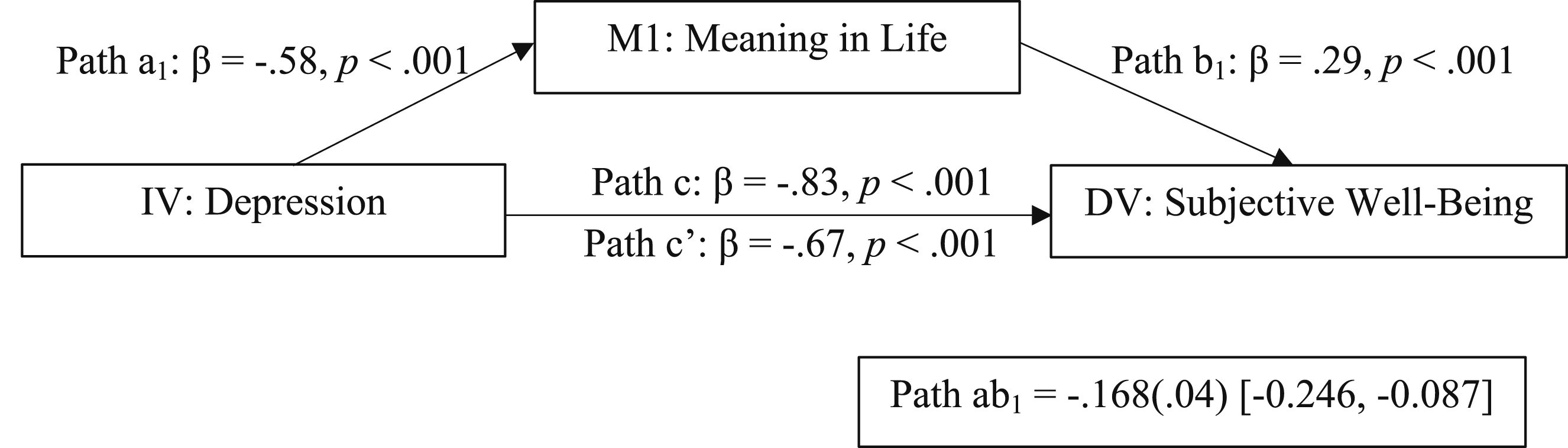
Mediation Model 2: Perceived Negative Interactions as a Mediator
As presented in Figure 2, the second mediation model revealed that depression was positively associated with perceived negative interactions. However, perceived negative interactions were not correlated with subjective well-being after controlling for depression. As a result of the b-pathway was not significant, indicating that the mediated pathway from depression to subjective well-being through perceived negative interactions did not hold. In short, perceived negative interactions did not mediate the relationship between depression and subjective well-being, and thus, does not support hypothesis 3. Perceived Negative Interactions as a Mediator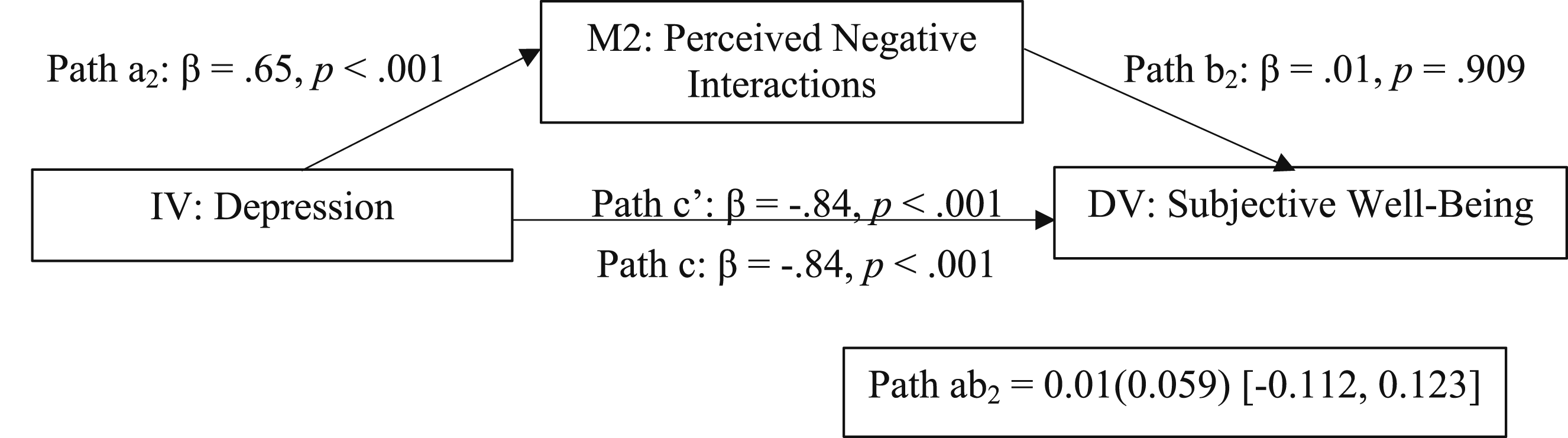
Discussion
In this study, the relationship between depression and subjective well-being among university students was examined, including its mediators, meaning in life and perceived negative interactions. Results revealed a negative correlation between depression and subjective well-being. Additionally, this relationship was found to be weaker when meaning in life was taken into consideration, whereas no mediation effect was found for perceived negative interactions.
Depression and Subjective Well-Being
The strong negative correlation between depression and subjective well-being in this study aligns with previous research, reflecting a global trend among university students (De Coninck et al., 2019; Kapur & Khosla, 2013; Kelifa et al., 2021; Lagnado et al., 2017). This robust association emphasises the widespread impact of depression on students’ overall well-being. From a theoretical perspective, this finding resonates with the Cognitive Theory of Depression, highlighting the intricate interplay between individuals’ thoughts, emotions, and behaviour (Disner et al., 2011; Song et al., 2023). Negative cognitions (e.g., ruminative thinking), feelings of hopelessness, and diminished positive emotions emerged as significant contributors to depression and, subsequently, a decline in subjective well-being (Kelifa et al., 2021). In line with the Cognitive Theory of Depression, these stressors can lead to negative thought patterns, which can perpetuate feelings of depression and lower subjective well-being.
Meaning in Life Mediates the Relationship Between Depression and Subjective Well-Being
In this study, meaning in life mediated the relationship between depression and subjective well-being in university students. This aligns with literature emphasising meaning in life’s importance for young adults at higher risk of depression (Ibrahim et al., 2013; Mofatteh, 2021) in the process of establishing identity and determining life’s purpose (Chen et al., 2021; Liu et al., 2023; Quarta et al., 2022; Trevisan et al., 2017). This finding contributes to existing knowledge by illuminating specific mechanisms through which meaning in life operates as a mediator. In fact, positive psychology’s framework suggests meaning in life buffers against the negative impact of depression, contributing to greater subjective well-being (Datu & Mateo, 2015), and thus, resonates with the findings of the current study.
The negative correlation between depression and meaning in life aligns with previous research (Baquero-Tomás et al., 2023; Buzzetta et al., 2020; Lin, 2021). This suggests depression may play a role in developing a negative outlook on one’s meaning and purpose in life, in line with the Cognitive Theory of Depression. This theory asserts that individuals’ thoughts and perceptions play a direct role in shaping emotions and behaviour; thus, negative thoughts and perceptions contribute to depression and overall subjective well-being (Song et al., 2023).
It would be remiss not to mention that the positive correlation between meaning in life and subjective well-being emphasises that university students, upon realising meaning in their lives, are more likely to experience life satisfaction (Datu & Mateo, 2015). This association is substantiated by the positive impact of meaning on the overall well-being of university students (Steger & Dik, 2009; Steger et al., 2006). The inclination of university students to seek meaning in life (Liu et al., 2023) is further supported by its positive influence on cognitive well-being. One logical explanation for the link between the presence of meaning in life and cognitive well-being in university students is their developmental stage, where forming a healthy identity becomes pivotal (Liu et al., 2023; Quarta et al., 2022). For instance, when students actively engage in activities conducive to realising a sense of purpose, such as making informed choices regarding their vocation or occupational orientation, they are likely to experience higher levels of well-being. This suggests a potential avenue for intervention strategies targeting the promotion of well-being in university students by fostering a meaningful sense of identity during this critical developmental stage.
Perceived Negative Interactions Does Not Mediate the Relationship Between Depression and Subjective Well-Being
Due to perceived negative interactions not being uniquely correlated with subjective well-being, the indirect pathway from depression to subjective well-being through negative interactions was also not significant. This suggests that trying to reduce negative interactions in a depressed person’s life may not impact their overall subjective well-being, at least not under the circumstances tested in the current study. The lack of a significant correlation could suggest that other factors, such as internal cognitive processes or biological factors, might play a more dominant role in influencing the overall well-being of depressed individuals (Kube et al., 2020).
Research has shown that negative social interactions can potentially be more harmful than the benefits of social support (Li et al., 2023). However, the impact of negative social interactions on subjective well-being is not straightforward. Some studies have found that negative social interactions have a stronger effect on psychological well-being than positive interactions (Bai et al., 2021), while others have reported a stronger effect from positive interactions (Li et al., 2023). Moreover, perceived social support has been found to be a significant predictor of life satisfaction and negative affect (Siedlecki et al., 2014). This suggests that the perception of social support, rather than negative social interactions, may directly impact subjective well-being. Furthermore, some research has found that perceived social support is not consistently associated with mental health (Seidman et al., 2006), indicating that the relationship between social interactions and subjective well-being is complex and may be influenced by other factors, such as individual personality traits, life circumstances, and culture. Hence, our finding could be seen as an opportunity to further explore the complex relationship between perceived negative interactions and subjective well-being.
Implications, Limitations, and Future Directions
The finding that meaning in life partially mediates the relationship between depression and subjective well-being holds significant implications. At the university level, there is an opportunity to educate students about the concept of meaning in life and how they can actively enhance it as a preventive measure against depression and other mental health outcomes. Beyond individual interventions, implementing policies at the university level to foster a supportive environment for the development of meaning in students’ lives could contribute to overall well-being. This may involve incorporating meaning in life-related education into existing mental health programs or providing resources for students to explore and strengthen their sense of purpose and meaning during their academic journey.
Although this study provides a clearer understanding of the relationships between the variables, several limitations should be noted. First, the cross-sectional design limit the ability to establish causal relationship among variables, and further longitudinal studies that track the temporal precedence of these variables would be beneficial in understanding the complex relationships. Additionally, re-testing individuals and requesting them to reflect on the causes of their responses could provide valuable insights into these relationships. Second, the sample was predominantly female, which may limit the generalisability of findings to male students or to the broader population. This gender imbalance is consistent with established trends in mental health research participation (Campbell et al., 2021; Seedat et al., 2009), where females are more likely to volunteer for survey-based studies. While the total sample size exceeded the requirement from our a priori power analysis, future research should aim for more balanced gender representation and recruitment strategies that actively target underrepresented groups. Third, as with all self-report data, the results are subject to potential social-desirability and random responding biases, Future studies could include validity checks or multi-method approaches (e.g., interviews, behavioural measures) to address these biases. Additionally, to overcome potential interpretability differences in the meaning in life scale, researchers could explore participants’ personal definitions of meaning and purpose, possibly through additional open-ended questions in the MLQ-P or by using alternative measures such as the Personal Meaning Profile (Wong, 1998).
Conclusion
The results of this study support that depression and subjective well-being are negatively correlated among university students. This relationship is mediated by meaning in life, but not by perceived negative social interactions, which is a significant contribution of this study. These results have important implications for researchers, policymakers, and educators, as they suggest that targeting meaning in life could be a helpful strategy for improving the well-being of university students with depression.
Footnotes

Consent to Participate
Informed consent was obtained from all individual participants included in the study.
Author Contributions
Conceptualisation: Masoumeh Alavi and Wilbert Kilian; Methodology: Masoumeh Alavi, Wilbert Kilian, Anchal Garg and Ching Sin Siau; Formal analysis and investigation: Masoumeh Alavi and Wilbert Kilian; Writing- Original draft preparation: Masoumeh Alavi and Wilbert Kilian; Writing-review and editing: Masoumeh Alavi, Wilbert Kilian, Anchal Garg and Ching Sin Siau; Supervision: Masoumeh Alavi.
Funding
The authors received no financial support for the research, authorship, and/or publication of this article.
Declaration of Conflicting Interests
The authors declared no potential conflicts of interest with respect to the research, authorship, and/or publication of this article.
Data Availability Statement
Data supporting the results are available by contacting the corresponding author.
Research Involving Human Participants and/or Animals
This study involved human participants and was approved by Griffith University Human Ethics Committee (GU Ref No: 2022/361).