




Abstract
The current study examined the experiential components of anxiety-related memories, that is, what is experienced during the event of the memory, and how these experiences can shape subjective emotional responses. A total of 76 participants were asked to recall a personal memory of an event that elicited fear or anxiety. Two key experiential components were evaluated: the level of need satisfaction associated with the memory and the physiological reactivity upon memory recall, as indexed by heart rate. Additionally, networked memories were assessed, referring to other memories associated with the anxiety-related memory, along with the need satisfaction component of each. Results highlighted the role of networked memories and the interaction between need satisfaction and physiological reactivity in predicting self-reported subjective experience. Specifically, participants who exhibited a low increase in heart rate during the recall of their anxiety-related memory found that need satisfaction in networked memories predicted self-reported anxiety and negative emotions. However, this relationship was not observed in participants who experienced a high increase in heart rate. These findings suggest that high physiological arousal linked to a memory may limit access to other memory-related cognitions, thereby influencing the formation of subjective emotional experiences.
Introduction
I was driving my car alone. I had to go see a friend. It was a snowstorm day, roads were slippery and there was wind. [...] I hit a black patch of ice. My car skidded to the right lane to come back to the left lane and then I landed in the ditch. A truck driver stopped to see if I was okay. I was in shock. I was really scared and I was stressed out because I would not be on time [...]. I must have had physiotherapy and occupational therapy sessions for 4 years. I still experience pain to this day.
This is a memory described by one of our participants when asked to report an anxiety-related memory. Memories are known to guide future behaviors and decision-making processes (Biderman et al., 2020; Kuwabara & Pillemer, 2010; Pillemer, 2003; Williams et al., 2022). For instance, this participant’s recollection of the event might have encouraged more careful driving habits and perhaps led them to avoid driving in suboptimal weather conditions. Memories can influence future behavior whenever they are specifically reactivated by external cues. When this occurs, the memory is activated along with its experiential components, that is, how the person has experienced the event of the memory (Conway, 2009; Philippe, 2023; Philippe, Koestner, Beaulieu-Pelletier, & Lecours, 2011). This, in turn, affects the person’s emotional experience and guides their decision-making and behaviors. However, the mechanisms through which the activation of an episodic memory influences individuals’ subjective experiences have largely remained unexplored. Understanding the characteristics of episodic memories that can impact one’s subjective experience during recall could shed light on these mechanisms. The present research examines how the experiential components and the organization of memories within a network can influence subjective experience during the recall of an emotional episodic memory.
Episodic Memories and Their Experiential Components
Each episodic memory comprises unique experiential components. These components can include sensory-based goal-affective representations that correspond to what the individual experienced during the event of the memory (Conway, 2009; Simons et al., 2022). These experiential components can be assessed through the self-perceived valence of the event (Philippe et al., 2009), the emotions the individual recalls having experienced (e.g., Philippe, Koestner, Lecours, et al., 2011), the level of basic need satisfaction experienced (Philippe, 2023; Philippe, Koestner, Beaulieu-Pelletier, & Lecours, 2011), Philippe, Koestner, Lecours, et al., 2011), and the physiological arousal evoked by the event memory. When an episodic memory is recalled, all of its unique experiential components are simultaneously reactivated (Conway & Pleydell-Pearce, 2000; LeDoux, 1992; Philippe, 2022, 2023; Schwartz et al., 1981), which impacts the individual’s subjective emotional experience (Houle & Philippe, 2017; Schwartz et al., 1981).
Research has shown that a key experiential component of memories influencing subjective experience is need satisfaction (Houle & Philippe, 2017; Philippe, 2023; Philippe et al., 2012). According to self-determination theory (Ryan & Deci, 2017), three basic psychological needs support people’s well-being and growth: autonomy, competence, and relatedness. Autonomy refers to the need to feel volitional and authentic in one’s actions. Competence is the need to feel effective and capable. Relatedness encompasses the need to feel connected with others, to care for people, and to be cared about. Satisfaction of these needs signals opportunities to build and expand the self, and situations that should be approached. Conversely, need thwarting signals a potential threat to the self, triggering self-protective strategies and avoidance behaviors (Hodgins & Knee, 2002; Philippe et al., 2015; Philippe, 2023). The level of need satisfaction characterizing a recalled memory can, therefore, critically impact subjective experience upon recall. Past studies have shown that the deliberate recall of a need-satisfying memory is linked to an increase in positive mood, while the recall of a need-thwarting memory correlates with a decrease in positive mood (Houle & Philippe, 2017). Similarly, priming a need-satisfying memory results in an immediate boost in situational well-being (i.e., more positive emotions, increased vitality, and reduced negative emotions), whereas priming a need-thwarting memory leads to an immediate decline in situational well-being (Philippe & Bernard-Desrosiers, 2017; Philippe et al., 2012). Need satisfaction in memories has also been shown to be a better predictor of subjective experience and future outcomes than their valence or recalled emotions (Demblon & D'Argembeau, 2016; Philippe, Koestner, Beaulieu-Pelletier, & Lecours, 2011; Philippe et al., 2015).
Another important experiential component of memory is the physiological arousal associated with the event of the memory. Much research has focused on how arousal during encoding can facilitate consolidation (e.g., Christianson, 1992; McGaugh, 2018) or protect against misinformation (e.g., Hoscheidt et al., 2014). However, the role of physiological responses in predicting subjective experiences during memory recall has received less attention. Studies suggest that the intensity of physiological arousal experienced during the original event is encoded within episodic memories (McCall et al., 2015; Salgado & Kingo, 2019) and that the recall of an episodic memory generates a physiological activation pattern that approximates the one from the original event of the memory (Schwartz et al., 1981). Given the pivotal role physiological arousal plays in shaping subjective emotional experiences (Golland et al., 2014), it is plausible that the physiological arousal characterizing an episodic memory can significantly influence one’s emotional state upon recall (Schwartz et al., 1981). Hence, physiological reactivity during memory recall may constitute an influential experiential aspect of memories, steering subjective emotional experiences.
Memory Networks
Memories tend to associate with other existing memories based on shared characteristics, such as similar surface features (e.g., location), themes, or emotions (Anderson, 1984; Brown & Schopflocher, 1998; Demblon & D'Argembeau, 2016), thus forming memory networks (Philippe et al., 2009). When a memory is activated, all memories in the network to which it belongs will also be activated, as activation spreads through these connections (Anderson, 1984; Philippe, 2023). This means that when a memory is recalled, not only are the experiential components of the main memory reactivated, but also those of each associated memory part of the memory network. A key characteristic of memory networks is that the experiential components of networked memories can influence the affective intensity of the main recalled memory (Philippe et al., 2009; Philippe & Houle, 2020). If a need-thwarting memory, such as the one used to introduce this article, becomes associated with other need-satisfying memories, such as the memory of a party with the mentioned friend or the accomplishment of a significant goal in physiotherapy, these associated memories would likely mitigate the negative effect of the main need-thwarting memory. Conversely, if the main need-thwarting memory is associated with other need-thwarting networked memories, these may amplify the negative effect of the main memory (Tomkins, 1978). Therefore, the level of need satisfaction characterizing networked memories associated with a given memory should significantly influence one’s subjective emotional experience during the recall of that memory. Indeed, research has shown that networked memories contribute to shaping people’s emotional experiences when the main memory is primed (Philippe et al., 2012) or when situations similar to the main memory are encountered (Philippe et al., 2009; 2011b).
The Present Research
The main objective of this study was to investigate the experiential components of episodic memories and the role of memory networks in shaping subjective emotional experiences. We suggest that the level of need satisfaction characterizing a memory and its related networked memories, as well as the physiological arousal triggered by the memory network, are two experiential components that will influence one’s subjective emotional experience during the recall of an episodic memory.
To test this hypothesis, participants were asked to recall a memory of a past event that provoked fear or anxiety. Fear and anxiety typically elicit a sympathetic physiological response (e.g., Kreibig et al., 2007). Heart rate (HR) is a widely employed physiological measure in emotion research, particularly in studies of anxiety (Kreibig, 2010; Mauss & Robinson, 2009), and has been shown to be a reliable indicator of anxiety disorders (Khanade & Sasangohar, 2017). While other physiological measures, such as skin conductance and heart rate variability (HRV), are frequently used in studies on emotional responses, HR provides an immediate and direct measure of emotional arousal through the autonomic nervous system (Iffland et al., 2014; Wascher, 2021), whereas HRV is more closely associated with the regulatory balance of the autonomic nervous system and has been increasingly utilized in studies examining emotion regulation and overall well-being (Acharya et al., 2006; Appelhans & Luecken, 2006; Mather & Thayer, 2018; Sloan et al., 2017; Williams et al., 2015). Moreover, skin conductance can be influenced by confounding factors like levels of engagement and attention (Braithwaite et al., 2013; Frith & Allen, 1983; Iffland et al., 2014). Given these considerations, HR was selected as the most direct and stable physiological indicator of arousal during anxious memory recall.
Therefore, we hypothesized that the subjective emotional experience upon recalling an anxiety-related memory would be independently predicted by 1) the physiological arousal triggered by the recall, as indicated by an increased heart rate, and by 2) the level of need satisfaction associated with the anxiety-related memory and its networked memories. Given that anxiety-related memories typically exhibit low need satisfaction, we hypothesized that need satisfaction in connected memories would serve as a better predictor of subjective emotional experience than the main anxiety-related memory itself. More specifically, we predicted that the frequency of heart rate during the recall of the anxious memory would predict an increase from baseline in self-reported anxiety and other negative emotions, along with a decrease in positive emotions. Conversely, need satisfaction characterizing the networked memories of the anxiety-related memory should predict a decrease in self-reported anxiety and other negative emotions, along with an increase in positive emotions.
Although we predicted that physiological arousal and need satisfaction in networked memories would each independently influence the construction of subjective experience, there is also the possibility of an interaction between these factors. For instance, high physiological arousal could limit access to cognitions and focus participants solely on their physiological reactivity (e.g., Fredrickson & Branigan, 2005; Zillmann, 1988). In such a scenario, need satisfaction in networked memories would predict subjective emotional experience, but only when individuals experience low or moderate physiological arousal. Conversely, related cognitions could orient subjective experience, but only when accompanied by physiological arousal (e.g., Schachter & Singer, 1962). In this case, need satisfaction in networked memories could predict subjective emotional experience, but only when individuals experience high physiological arousal. These two possibilities, although opposite in their predictions, are plausible. Therefore, interactions between physiological arousal and memory networks will be explored in this research to determine which of these two hypotheses, if any, is correct.
Method
Participants
A pilot study (n = 20) found that the smallest effect size for the predictive value of need satisfaction in networked memories and heart rate frequency on self-reported emotional experiences—after controlling for baseline emotion, need satisfaction in the main memory, sex, and age—was f2 = 0.15, indicating a medium effect size. Based on this, a power analysis conducted in G*Power determined that a minimum sample of 68 participants would be required for hierarchical regression analyses to test the significance of two predictors (need satisfaction in networked memories and heart rate change), while accounting for the four control variables (power = .80, α = .05) in assessing a significant R2 increase. To include a third predictor—the interaction between need satisfaction in networked memories and heart rate change— while maintaining the same parameters, the power analysis indicated that a sample of 77 participants would be required.
A total of 78 participants took part in the study. Inclusion criteria included being 18 years or older and being fluent in French. Exclusionary criteria were heart diseases and the use of drugs/medications that might affect cardiovascular function. Two participants were excluded from the analyses for other reasons. One participant’s data was lost due to technical difficulties, and the other had aberrant data on physiological recordings. Thus, the final sample was composed of 76 participants from the general population (54 women, 22 men), with a mean age of 33.97 years (SD = 15.32).
Measures
Phase 1
Anxiety-Related Memory
Participants were asked to recall a personal memory of a specific event that had aroused great fear or anxiety. Instructions were derived from past research on self-defining memories (Philippe, Koestner, Beaulieu-Pelletier, & Lecours, 2011; Singer & Salovey, 1993) and on memory reconsolidation (Engelhard et al., 2010). Instructions were as follows: We would like you to remember a personal memory of a specific negative event or moment that caused you fear or anxiety, such as going to a test unprepared or witnessing an accident. This event must have occurred at least three months ago and be significant (important) to you. Relive your memory as if you were experiencing it again. Put yourself back to the state in which you were when you experienced this event. Describe what happened, where it happened, who was with you (if it applies) and how you or other people reacted. What was your role and what were the consequences of your reaction or your behavior during this event. Provide enough details so that a reader would be able to understand what happened, as if you were sharing it with another person.
Networked Memories
After describing their anxiety-related memory, participants were asked to recall other personal memories that they might find directly or indirectly associated with their anxiety-related memory. Participants were instructed to report any memory that came to mind spontaneously. Three textboxes were provided to describe a maximum of three networked memories. However, participants were free to recall as many memories as they wished, between one and three. This task has been successfully used in previous memory studies to assess memory networks (e.g., Demblon & D'Argembeau, 2016; Lejeune et al., 2021; Philippe et al., 2012).
Illustrative examples of reported anxiety-related memories and their networked memories are available as supplemental material.
Ratings of the Memories
Participants were asked to rate all their memories (fear/anxiety and networked memories) for valence and need satisfaction. The personal valence of the event was rated on a slider scale ranging from 0 (very negative) to 100 (very positive). Participants were also asked to rate the degree of need satisfaction they experienced when the event of their memory occurred. This scale, used in past research (Philippe, Koestner, Beaulieu-Pelletier, & Lecours, 2011, 2012), assesses each basic psychological need (autonomy, competence, relatedness) from self-determination theory (Ryan & Deci, 2017) with two items each on a scale ranging from 0 (Strongly disagree) to 100 (Strongly agree) with the middle of the scale representing “Do not agree nor disagree or not applicable”. Sample items are “I felt free to do things and to think how I wanted” (autonomy), “I felt competent or capable” (competence), and “I felt connected to one or more people” (relatedness). Cronbach’s alpha for this scale was .68 in this study.
Phase 2
Heart Rate
Heart rate was measured using an electrocardiogram with three disposable pre-gelled Ag/AgCl electrodes placed on the chest in a lead II configuration (Blascovich et al., 2011). Signals were recorded using a BIOPAC MP150 system with an RSPEC-R amplifier at a sampling rate of 1000 Hz, while data were simultaneously collected through AcqKnowledge 4.4 software (Biopac Systems, Inc, CA, USA, 2014). Physiological data were continuously transmitted and recorded wirelessly during the experimental session. Psychophysiological data were manually segmented by the experimenter to capture the HR during two specific time intervals: the 2-min neutral task and the 2-min explicit memory recall task.
Subjective Emotional Experience
Participants were asked to describe their current emotional experiences using 17 items derived from the Positive and Negative Affect Schedule (PANAS; Watson et al., 1988) and the Differential Emotion Scale (DES; Izard et al., 1993). Ten items were taken from the PANAS and 7 from the DES. The combined scale was created to provide a more comprehensive assessment of participants’ emotional experiences by integrating the broad affective dimensions of the PANAS with the discrete emotions measured by the DES. This approach allowed us to capture both general emotional states and more specific emotional responses (e.g., sad, shy) within a single measure and allowed for more granular ratings of participants’ emotional experiences. Emotional experience was organized into three subscales: four items were used to measure anxiety (e.g., “nervous”, “fearful”), eight items assessed other negative emotions (e.g., “shameful”, “sad”), and five items measured general positive emotions (e.g., “happy”, “enthusiastic”). Participants rated each item based on how they felt at that moment using a slider scale ranging from 0 (not at all) to 100 (extremely). They completed the same scale both at baseline and after recalling their anxiety-related memory. Items for each subscale were then averaged for both tasks. The baseline scores ranged from 0.25 to 73.50 for anxiety, from 35.40 to 100 for positive emotions, and from 0 to 53.50 for negative emotions. After memory recall, anxiety scores ranged from 0.00 to 89.00, positive emotions from 0.40 to 86.20, and negative emotions from 2.25 to 72.25.
Cronbach’s alpha coefficients for the anxiety, negative emotions, and positive emotions subscales ranged between .80 and .83 for the baseline and between .83 and .87 for the post-memory recall measurements.
Procedure
Participants were contacted by email from a list of volunteers recruited in various public areas of the Greater Montreal area (Quebec, Canada) who showed an interest in participating in psychological studies. They were invited to take part in a study on memories and physiological responses. Participants were informed that taking part in this study involved completing a short online questionnaire (Phase 1) and visiting a university laboratory to complete questionnaires and to recall a personal memory while their physiological activity would be recorded (Phase 2). They were remunerated $15 CAD for their participation in this study. In Phase 1, participants were asked to describe a memory of a past event that caused them to feel fear or anxiety. They were also asked to describe networked memories related to the fear/anxiety memory and to rate the valence and need satisfaction of all described memories.
Once the first phase was completed, the experimenter contacted the participants via email to schedule an appointment for the second phase of the study. Upon their arrival at the laboratory for Phase 2, participants were greeted by the experimenter and asked to sign a consent form. They were then connected to the physiological equipment and seated in front of a computer. Participants rested for 5–10 minutes to acclimate to the laboratory environment and the physiological equipment while reflecting on their morning routine. Afterward, they completed the first measure of subjective emotional experience (emotional baseline). Next, they performed a 2-minute neutral task in which they visualized the route from their home to their university or workplace while their heart rate was monitored (heart rate baseline).
Following these tasks, participants were invited to recall in detail the fear/anxiety memory they had described in Phase 1. Their previously typed memory description was then displayed on the computer screen, and they were instructed to relive the event as if it were happening again, returning to the emotional state they experienced at that time for a 2-minute period. During the task, participants’ heart rate was measured. Once completed, participants completed a second measure of subjective emotional experience (post-memory emotional measure).
Statistical Analyses
Acqknowledge 4.4 software (Biopac Systems, Inc, CA, USA) was used to analyze raw heart rate data. A bandpass filter with cutoffs between 0.5 and 35 Hz was applied to remove unwanted frequencies from the electrocardiogram waveform (Blascovich et al., 2011). Beats per minute were then analyzed with the Acqknowledge software to detect QRS peaks and calculate interbeat intervals. Artifacts were manually corrected based on the previous and following QRS peaks. The mean HR during the 2-minute neutral task (i.e., baseline) and the 2-minute explicit memory recall task were then extracted from the waveform. Items of the subscales relating to emotional experience were also averaged for the ratings at baseline and those following the explicit memory task.
To facilitate the analysis of the data, differential scores were calculated for physiological responses and emotional experience. Specifically, the differential scores for heart rate were determined by subtracting the raw score during the neutral task from the raw score during the recall of the fear/anxiety memory. In addition, for each emotional experience subscale (anxiety, negative emotions, positive emotions), the differential score was calculated by subtracting the baseline score from the score after the recall. These differential scores thus represent the variation, where a positive score indicates an increase and a negative score indicates a decrease, in physiological activity and subjective emotional experiences engendered by the memory recall.
Correlations among the study variables (Table S1) and differences between the baseline and memory recall task on heart rate and emotional experience (Table S2) are available as supplemental material.
A multiple regression analysis was conducted with post-recall anxiety as the dependent variable. The level of need satisfaction in the networked memories and the change in heart rate (recall - baseline) served as the independent variables. Additionally, we included their interaction term, Need Satisfaction in Networked Memories X Heart Rate Change, to examine whether networked memories and heart rate would interact. The level of need satisfaction in the main memory, baseline anxiety 1 , sex, and age were also included in the regression as control variables. A two-tailed significance level of p = .05 was applied for all analyses, which were performed using SPSS version 22. Assumptions for conducting hierarchical regression, including linearity, normality of residuals, and homoscedasticity were examined and met.
Results
Standardized Beta Coefficients of Hierarchical Regression Analyses of Need Satisfaction in the Main Memory and Networked Memories, Heart Rate Change, and Subjective Emotional Experience.
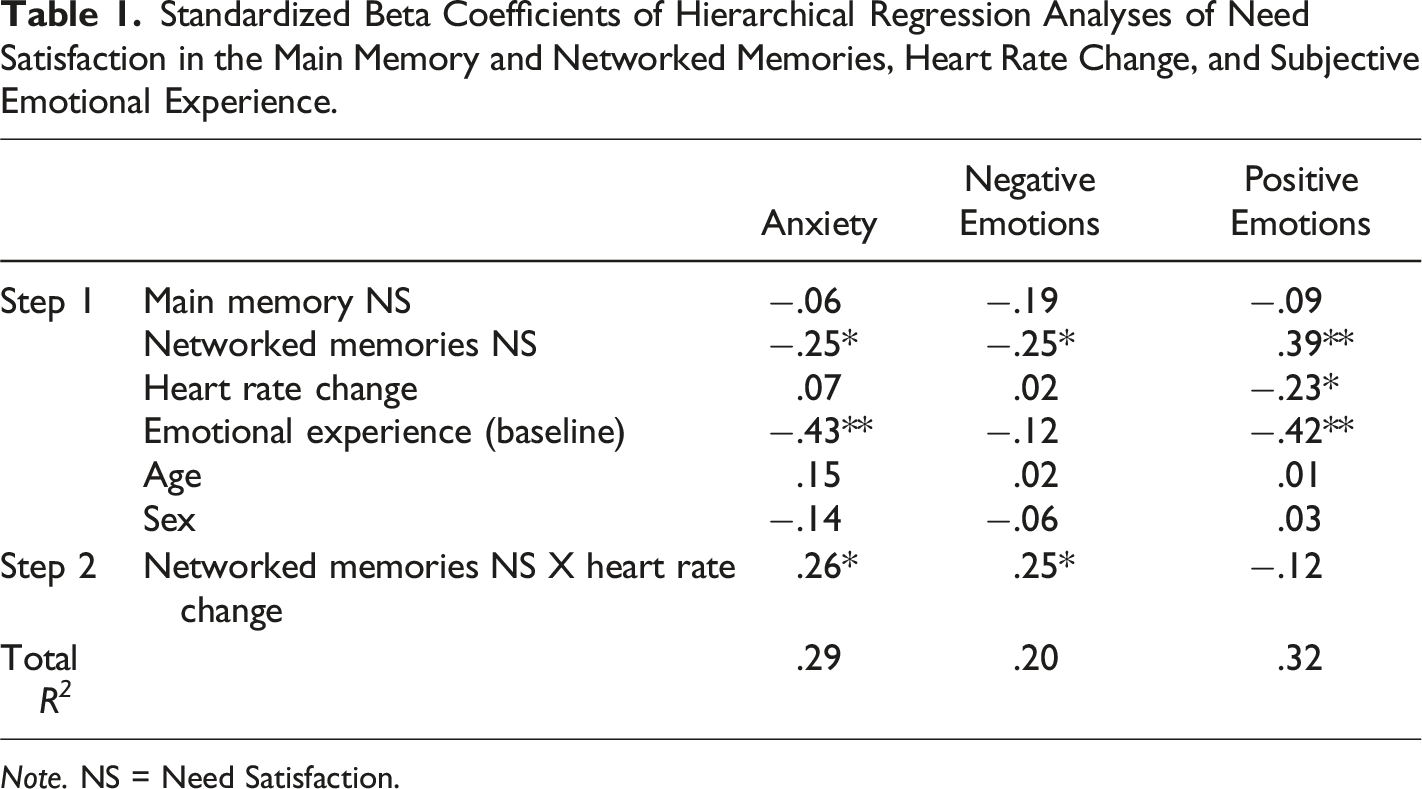
Note. NS = Need Satisfaction.
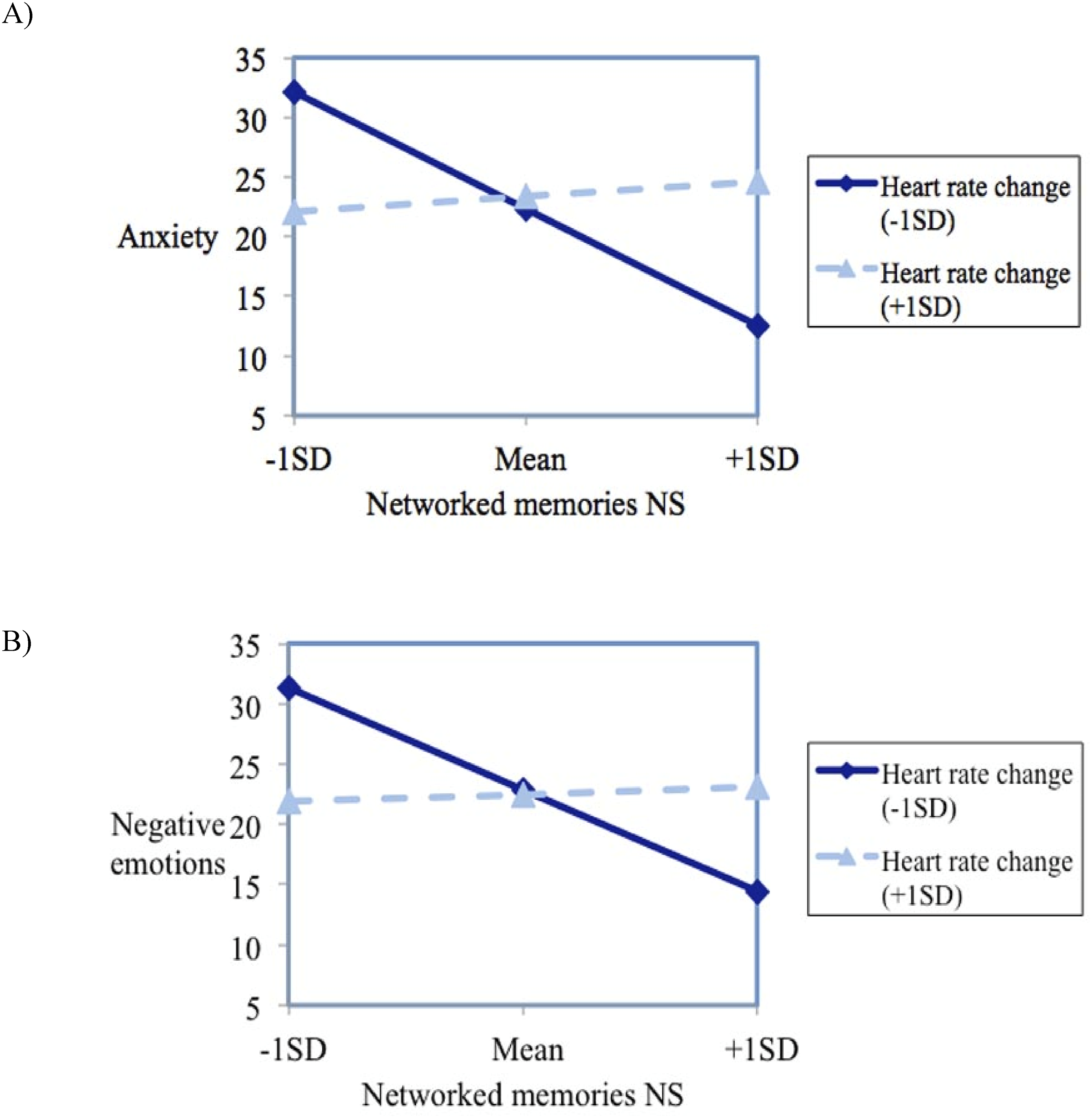
(a) Relationship between need satisfaction in networked memories and anxiety moderated by heart rate change. (b) Relationship between need satisfaction in networked memories and negative emotions moderated by heart rate Change.
The same multiple regression analysis was conducted with post-recall negative emotions as the dependent variable, and the results were virtually identical to those described above (see Table 1). Once again, the simple effects analysis for the significant interaction revealed that the level of need satisfaction in networked memories did not predict negative emotions for participants with a high increase in heart rate (t[68] = 0.20, ns). However, it did predict them significantly for participants with a low increase in heart rate, t(68) = −2.99, p < .01 (see Figure 1(b)).
We conducted the same analysis again, this time with post-recall positive emotions as the dependent variable. Results showed that the level of need satisfaction in the networked memories was positively related to post-recall positive emotions (B = 7.51, β = .39, t = 3.50, p < .01, 95% CI [3.25–11.79) and that change in heart rate was negatively associated with post-recall positive emotions (B = −4.29, β = −.23, t = 1.94, p < .05, 95% CI [-8.17-0.42]). However, the interaction term between these two independent variables was not significant (β = −.12, ns).
General Discussion
The purpose of this study was to investigate the experiential components of episodic memories and their organization within a network that can shape subjective experience upon recall. Results indicated that when recalling an anxious memory, the level of need satisfaction characterizing the networked memories associated with this anxious memory served as a better predictor of subjective experience than the need satisfaction pertaining to the anxiety memory itself. Indeed, the results showed that need-satisfying networked memories predicted a decrease in experienced anxiety and negative emotions, along with an increase in positive emotions following memory recall. This echoes past research (Philippe et al., 2009, 2011b, 2012; Philippe & Houle, 2020), which found that activated networked memories play a significant role in predicting mood and well-being assessed post-activation. The present results further highlight that the organization of memories in specific types of networks is a crucial element in explaining the subjective emotional experience upon memory recall, more so than the components of the actual recalled memory. This finding suggests that when reprocessing negative or traumatic memories, it is essential not to solely focus on the memories themselves, but also to evaluate and reprocess the quality of the memory network in which they are embedded.
The results of the present research also indicated that the physiological experiential component of emotional memories directly influenced the experience of positive emotions, even after accounting for need satisfaction characterizing the main and the networked memories. Increases in heart rate provoked by the recall of an anxious memory were linked to a decline in positive emotions in self-reported subjective experience. This finding emphasizes that physiological arousal associated with a memory functions as an experiential component that operates independently of need satisfaction (and valence) in shaping one’s subjective experience. This is the first study to demonstrate that these components are independent and play a significant role in predicting people’s emotional experience during memory recall, along with their potential influence on behavior and mental health over time. Future research is needed to explore this possibility further. However, heart rate was not directly related to the self-reported experience of anxiety or negative emotions. This finding aligns with results from other studies (e.g., Trotman et al., 2019), which found no significant relationship between actual heart rate changes and reported anxiety, only between perceived heart rate changes and reported anxiety.
Yet, the results of the present research indicate that networked memories and changes in heart rate interact to shape subjective experience. Specifically, the level of need satisfaction characterizing networked memories did not predict self-reported anxiety for participants experiencing a high increase in heart rate during the recall of their anxiety-related memory, although it did predict anxiety for those with a low increase in heart rate. A similar pattern was observed in the prediction of negative emotions, but not in positive emotions. These results align with the hypothesis suggesting that high physiological arousal may limit access to cognition and restrain the role of networked memories in shaping subjective emotional experience (e.g., Fredrickson & Branigan, 2005; Zillmann, 1988). This implies that interventions aimed at facilitating the integration of a distressing negative memory into a more need-satisfying network could be misguided if the physiological component associated with the distressing memory is overwhelming. Thus, it may be beneficial to reduce this physiological component, perhaps through exposure therapy or repeated reliving, before attempting to elaborate or reprocess that memory and facilitate its integration into a need-satisfying memory network.
Lastly, the findings of this study support the theory of constructed emotions (Barrett, 2017a, 2017b; Dreisbach, 2023). Contrary to classical theories, which postulate that emotions have distinct physiological signatures reflecting innate reactions triggered by the world (e.g., Kreibig et al., 2007; Schwartz et al., 1981; Siegel et al., 2018), the theory of constructed emotions posits that emotions are constructed by our brains based on past experiences and interoceptive states. In this framework, variability in physiological arousal (such as heart rate) and the satisfaction of one’s needs in memories triggered by a situation can be viewed as crucial elements in the construction of emotional experiences. Consistent with this theory, the results of the present study demonstrate that the experience of negative emotions (i.e., fear or anxiety) depends on the quality of the memory network and the intensity of the physiological response triggered by memory recall. Indeed, individuals may depend on their past experiences to interpret these physiological responses, specifically the networked memories. Moreover, the level of psychological need satisfaction within memory networks informs the brain about the threat intensity where a network composed of memories in which the needs are satisfied presents situations as less threatening, whereas a network comprising memories that frustrate these needs presents situations as more threatening. Additionally, one can speculate that an initially intense physiological response to a threatening stimulus may impede access to past experiences necessary for constructing the emotional experience. This could explain why the level of satisfaction of needs linked to networked memories does not predict the subjective experience of anxiety or other negative emotions when recalling the anxiety-inducing memory leads to a significant increase in heart rate.
Some limitations of this study need to be highlighted. Firstly, only one marker of physiological reactivity was used (heart rate). It would be interesting to replicate these results in future research with other measures, such as cardiac output or skin conductance, to examine whether other physiological responses also play significant roles as experiential components in determining subjective experience. Secondly, only anxiety-related episodic memories were studied, and it remains unclear whether the present findings apply to other types of memories. Further research could explore the effects of need satisfaction and physiological arousal on different types of memories to gain a more comprehensive understanding.
Thirdly, this study did not account for specific psychopathologies that could influence the experiential components of subjective experience. For instance, post-traumatic stress disorder (PTSD), which develops after one or more traumatic experiences, is characterized by hyperarousal; one of the most persistent symptoms of PTSD (Marshall et al., 2006; Miles et al., 2023). It has been proposed that traumatic memories function as hyperpriors, deeply rooted higher-order beliefs that substantially influence perception and prediction, while constraining the integration or processing of alternative information such as non-threatening experiences (Linson et al., 2020; Linson & Friston, 2019). Consequently, this symptomatology may affect the experiential components of emotion, with the retrieval of traumatic memories potentially dulling the role of memory networks in shaping subjective experiences or leading to distinct psychophysiological arousal patterns during memory recall, which may differentially influence emotional states. More generally, other symptom profiles associated with distressing memories (e.g., anxiety and depression) might also yield varying effects. Although this study focused on the general population and may not have included severe clinical subsamples, future research should investigate the components that shape subjective experience in individuals with specific psychopathologies, such as PTSD and other memory-related disorders.
In addition, we did not consider the influence of past or ongoing therapeutic interventions, which could have impacted the experiential components of memory recall, potentially reducing both subjective experiences of anxiety and physiological arousal associated with the memories. Moreover, future research should examine whether therapeutic interventions can enhance the role of need-satisfying memory networks, which could, in turn, influence subjective experience during memory recall.
Finally, only one memory network was assessed during this study and no control memory network was included for comparison. Therefore, it is uncertain whether the observed effects are specific to the memory network related to the anxiety-related memory or if similar results would be obtained with any other memory network. As such, memory networks could potentially serve as proxies for other trait-level constructs, such as personality traits, for instance. However, past research has shown that distinct memory networks are weakly correlated and relate to outcomes relative to their specific context (see Demblon & D'Argembeau, 2016; Philippe et al., 2012, 2015). Nevertheless, the present study cannot confirm it.
Conclusion
Overall, the present study highlights the significant roles of need satisfaction and physiological arousal as experiential components of anxiety-related episodic memories and their interaction in predicting self-reported anxiety. The component of need satisfaction appears to be particularly important with respect to the memory network in which the anxiety-related memory is embedded.
Supplemental Material
Supplemental Material - Between Body and Soul: The Role of Need Satisfaction and Physiological Reactivity in the Recall of Anxious Memories on Subjective Emotional Experience
Supplemental Material for Between Body and Soul: The Role of Need Satisfaction and Physiological Reactivity in the Recall of Anxious Memories on Subjective Emotional Experience by Christine M. Richard, Valerie A. Lapointe, and Frederick L. Philippe in Psychological Reports
Footnotes
Author Contribution
Conceptualization: [Christine M. Richard, Frederick L. Philippe]; Methodology: [Christine M. Richard, Frederick L. Philippe]; Formal analysis and investigation: [Christine M. Richard, Frederick L. Philippe]; Writing - original draft preparation: [Christine M. Richard, Valerie A. Lapointe]; Writing - review and editing: [Christine M. Richard, Valerie A. Lapointe, Frederick L. Philippe]; Resources: [Frederick L. Philippe]; Supervision: [Frederick L. Philippe].
Declaration of Conflicting Interests
The authors declare no conflict of interest with respect to the research, authorship, and/or publication of this article.
Funding
This research was funded by a grant from the Social Sciences and Humanities Research Council of Canada, Grant/Award Number: 435-2017-1358.
Ethical Statement

Data Availability Statement
The data that support the findings of this study are available upon request.
Supplemental Material
Supplemental material for this article is available online.
Notes
Author Biographies
References
Supplementary Material
Please find the following supplemental material available below.
For Open Access articles published under a Creative Commons License, all supplemental material carries the same license as the article it is associated with.
For non-Open Access articles published, all supplemental material carries a non-exclusive license, and permission requests for re-use of supplemental material or any part of supplemental material shall be sent directly to the copyright owner as specified in the copyright notice associated with the article.
