




Abstract
Almost everyone is affected by loneliness at some stage in their lives, and the long-term effects are dire, leading to depression, addiction, and suicide. To date, interventions have focused on external treatments with limited success. In this study, it is argued that underlying antecedents of social loneliness maintain negative behaviour, whereby it becomes chronic and problematic. Four intrinsic antecedents of social loneliness are examined (Secure and Insecure Attachment, Emotional Regulation Problems – Expressive Suppression, Unclear Self-Concept, and Neuroticism) along with negative (Ignoring and Withdrawing) behavioural coping styles. Ninety-six, mainly female (78%), psychology undergraduates were administered a battery of six questionnaires. In a regression model, Secure Attachment was most strongly (inversely) related to Social Loneliness (SL), explaining 34% of the variance. The remaining four latent variables, in addition to Withdrawal behavioural coping styles, were positively related to SL, and explained 77% of the total variance. Additionally, those higher in SL were more likely to utilise negative (Withdrawal) coping styles but not when controlling for recency effects (i.e., moving house and life changing events). In summary, Attachment type, Neuroticism, and to a lesser extent, Self-Concept Clarity, Expressive Suppression and Withdrawal coping styles may play an important role in averting or predicting SL. Behaviourally, those who are higher in Social Loneliness, particularly young adult females, may adopt less Withdrawal coping styles once a threshold of loneliness has been attained, with cognitive therapies crucial to avert Social Loneliness becoming chronic.
Keywords
Introduction
Loneliness is a growing global public health crisis that affects all aspects of our species (Masi et al., 2011; Preece et al., 2021). The problem of loneliness, however, is cultural as much as it is symptomatic, stemming from the dysphoric aversion and social stigma of the condition, and a theoretical misconception originating from its aversive nature, resulting in sub-optimal interventions (Baumeister & Leary, 1995; Masi et al., 2011). Since the onset of the COVID-19 pandemic, incidences in Australia have been on the rise (Australian Institute of Health and Welfare, 2023, https://www.aihw.gov.au). At any one time, one quarter of adults report feeling lonely, and the proportion is higher among young adults (up to 48% of 18–22-year-olds; Williams & Braun, 2019). Additionally, this cohort are more likely to suffer mental health comorbidity issues in future (Australian Psychological Society, 2023).
Recent research suggests that loneliness is a natural phenomenon like hunger or joy, which ebbs and flows in intensity, and that treatment is more effective when it is perceived as such (Goossens, 2025; Yanguas et al., 2018). Crucially, this change in perception can play a vital role in determining an individual’s level of loneliness. Moreover, the traditional view that fewer interactions and social contacts may contribute to loneliness, social isolation is conceptually distinct to social loneliness (Hawkley & Cacioppo, 2010; Preece et al., 2021). Recently, it has generally been accepted that while social isolation can contribute to loneliness, internal attributions maintain it, leading to a general feeling of hopelessness, whereby it becomes problematic (Cacioppo & Cacioppo, 2012; Masi et al., 2011; Richman et al., 2016; Rubenstein et al., 1979). It is this perception of hopelessness, as compared to the physical separation of being alone, which distinguishes loneliness from social isolation, and the problematic nature of the former.
When meaningful social connections are denied or unavailable, it can produce deleterious effects on cognition and behaviour, increasing the chance of chronic loneliness (Masi et al., 2011). Moreover, loneliness is highly stable (i.e., reoccurring) and affects almost every aspect of human life (Masi et al., 2011). Negative outcomes include depression, suicide, alcoholism, hostility, poor self-concept, depression, and anxiety (Jones et al., 1981; McWhirter, 2011). Medical health determinants of loneliness include metabolic disorders (e.g., obesity), heart disease, high systolic blood pressure (Yanguas et al., 2018), diminished immunity and increased cortisol which is related to inflammation and known to shorten life expectancy (Masi et al., 2011). Despite the prevalence of negative social and health outcomes, our understanding of the origins and treatment of loneliness are not well understood (Masi et al., 2011).
Loneliness Defined
Loneliness is commonly defined as the subjective discrepancy between actual and perceived relationships in terms of companionship, connectedness, or intimacy. In other words, it is the discrepancy between the relationships we have and those we would like to have (Cacioppo & Cacioppo, 2012; Rokash & Brock, 1998; Yanguas et al., 2018). Socially, it is the relative comparison with others in similar situations (e.g., age, education, occupation) and with similar past experiences (e.g., income, material possessions, replication of a successful relationship) that is the reference point which determines the level of suffering, as opposed to an absolute comparison (Richman et al., 2016; Rubenstein et al., 1979). Moreover, it is generally accepted that the quality of relationships is more likely to reduce loneliness whereas an increase in the quantity of contacts is more predictive of a reduction in isolation (Masi et al., 2011). Recently, the concept of loneliness has changed from one of dysphoria to being viewed as naturally occurring, and a core part of our social experience (Yanguas et al., 2018). As the universality of the condition becomes apparent, loneliness is being viewed as an evolutionary necessity like joy, hunger, or sorrow. In turn, if these can be satiated, loneliness too can be controlled. This differs from the traditional view of loneliness as unnatural, and eradicable (Rokach & Brock, 1998).
Social and Emotional Loneliness
A consensus position appears to be that Social Loneliness (SL) and Emotional Loneliness (EL) are different constructs (Masi et al., 2011; McWhirter, 2011; Cacioppo & Cacioppo, 2012). Emotional (or intimate) loneliness is commonly defined as the absence of an attachment figure, together with feelings of isolation. Conversely, SL is associated with a lack of meaningful social relationships, and an absence of community and belonging (Yanguas et al., 2018). While they have different affective reactions, EL and SL have the same core experience, reported as a mismatch between ideal and actual social experiences (Buecker et al., 2020). Moreover, in an illuminating animal study, Hofer (2009) argued that intimate/emotional loneliness may be based on heritable differences in the sensitivity to the pain of separation, finding that some rats cried more than others when separated from their mothers. So, while evolutionary connections do play out in social interactions, EL appears to be less influenced by environmental factors. Like other learned behaviours, this points to SL being more treatable, and therefore a more worthy research focus than EL (Plomin & Daniels, 2011; Study Smarter, 2025).
Etiology of Social Loneliness
The literature elucidating the etiology of loneliness is still limited. According to Boomsa et al. (2005), loneliness is 50% environmental and 50% hereditary, based on two large studies involving children. Genetic variations were estimated to be 48%, in line with previous studies of loneliness in young adults. Etiological attributions, however, usually centre around external reasons (i.e., loss of a spouse, friend, or employment). Known as the ‘individual differences’ model, it has dominated treatments to date, often encouraging social connections, offering support, and correcting social deficits (Masi et al., 2011) rather than treating the underlying dispositions. Further, it is these traits that are known to affect the coping processes following a negative event (Richman et al., 2016). Hence, an examination of the dispositions, coping strategies, and their relationship with SL is needed to better understand the antecedents and effective treatment of the condition.
Latent Antecedents of Loneliness
Four intrinsic antecedents are known precursors of SL.
1. Emotional Regulation Problems
Emotional regulation involves the intrinsic and extrinsic processes responsible for monitoring, evaluating, and responding to emotions (Garnefski & Kraaij, 2007). It is widely held that emotional regulation has two dimensions: Acceptance/Reappraisal and Expressive Suppression. In a sample of 501 Americans, negative emotional regulation strategies such as blaming, rumination and catastrophising explained over half (52%) of the variance in the UCLA Loneliness scale; and the use of cognitive coping among this sample was diminished. Behavioural coping, particularly withdrawing, compliments (suppressive) cognitive coping and both are positively correlated with emotional problems (Preece et al., 2021).
2. Attachment Style
According to Hojat and Crandall (1989) and Bowlby (1960), unsatisfactory attachment in early childhood can affect the attainment of prosocial goals and is associated with later feelings of loneliness (Rokash & Brock, 1998). Bowlby (1969) identified four attachment types: secure, anxious/preoccupied, avoidant/dismissive, and disorganized/fearful. The latter three represent unsatisfactory (insecure) attachment and tend to manifest as heightened emotional responses, avoidance of help or approval, or shifts between secure, avoidant, and anxious attachment, respectively (Rholes & Simpson, 1998).
3. Neuroticism
The Five Factor Model (FFM) of personality, as described by Costa and McCrae (1992), consists of neuroticism, extraversion, openness, agreeableness, and conscientiousness dimensions. A large meta-analysis of 113 studies in 2020 found neuroticism was the only trait positively associated with loneliness (Buecker et al., 2020).
4. Unclear Self-Concept
One’s self-concept provides the paradigm (or boundaries) and circumstances which dictate the view of possibilities of our world view, directing what one can or cannot do. An individual with a poor self-concept will struggle socially and be unable to rationalise social expectations with reality (Brewer & Gardner, 1996). Further, individuals with Unclear Self-Concepts were more likely to suffer depression and negative life outcomes such as relationship break downs, which are strong predictors of loneliness.
Loneliness and Negative Coping
As described by Rubenstein and Shaver (1980), it is widely accepted that coping strategies for loneliness are either active or passive strategies. Passive strategies involve negative coping associated with avoidant social behaviour such as competitiveness, manipulation, selfishness, and lower empathy (Kasser, 2014). In a comprehensive meta-analysis of 146 qualitative and quantitative studies, one internal and three external interventions were examined. The internal intervention which addressed maladaptive cognition using Cognitive Behavioural Therapy (CBT) was found to be the most effective at reducing loneliness (Masi et al., 2011).
Demographics of Social Loneliness
The following demographic variables have been known to moderate the effect of SL: Relational stress (including threats to relationships, i.e., arguments, marginality (Rokach & Brock, 1998)), age (especially younger cohorts (McWhirter, 2011; Rubenstein et al., 1979)), income (higher income is associated with social status (i.e., self-concept; Richman et al., 2016)). Other demographic variables linked to SL include gender (females tend to be lonelier due to relative socioeconomic deficits; Hawkley et al., 2022; McWhirter, 2011; Mushtaq et al., 2014), lower education attainment, remote or rural living, unemployment, having diverse social networks (especially religious networks; Rubenstein et al., 1979), recency of moving to a new town, city, or country, a recent relationship breakdown, and a dependent child (under 18 years of age) moving out of full-time care (Baumeister & Leary, 1995).
The Current Study
This study aims to shed light on the importance of internal interventions to treat the intrinsic precursors of SL which embed a negative cycle of behaviour, and entrench SL, leading to problematic outcomes. To the author’s knowledge, this is the first study to examine the links between the antecedents considered above, SL and negative coping. Much of the extent literature examines predictors and outcomes of emotional (i.e., intimate) loneliness, or a broader combination of emotional and social loneliness. There is a dearth of research therefore, that maps the antecedents and coping strategies of social loneliness.
With this aim, the current study examined potential internal and behavioural determinants of SL, and the associated negative coping strategies. In addition, demographic and recency variables were assessed for moderator effects. It is predicted that individuals with higher ERPs (Expressive Suppression), Neuroticism, Insecure (Anxious) Attachment, Unclear Self-Concept and negative (Withdrawal and Ignoring) coping styles will be higher in SL (Prediction 1). It is further predicted that younger adults, females, those not employed full-time, those not married or in a domestic relationship, who permanently moved to a new location recently (Recently Moved) or experienced significant negative life events in the last six months (i.e., a long-term relationship breakdown, death of a significant other, or a dependent child under 18 years of age moving out of their care) will be higher in SL. Conversely, individuals who self-rate themselves as religious, have higher incomes, attained a higher level of education, or live in metropolitan areas are expected to be lower in SL (Prediction 2). Thirdly, it is predicted that participants who are higher in SL will adopt more passive coping strategies, engaging in more Withdrawal and Ignoring behavioural coping styles (Prediction 3).
Method
Participants and Procedure
Power analysis software G*Power 3.1 was used to determine sample size (Kang, 2021). The results indicated that fifty-three participants would be required for a multiple linear regression with four predictors (r = 0.3, η2 = 0.6–0.7; Gignac & Szodorai, 2016), plus an additional 10–20% allowing for incomplete/incorrect surveys and potential outlier removal. Green (1991), on the other hand, recommends between 15–25 subjects per predictor, equating to 60–100 participants for multiple regression analysis with four predictors. Based on this more conservative approach, a sample size of at least 120 participants was required to enable a 20% allowance for data cleaning.
In this study, first, second- and third-year undergraduate psychology students from Edith Cowan University (ECU), Australia, were given nominal course credit in exchange for their participation in the study equivalent to 1% added to their final grade.
The data collection was undertaken online. A response authentication (Captcha) question preceded a Participant Information Letter (PIL) which detailed the research aims, participant obligations, benefits, risks, identification, privacy policy, and ethical approval of the project. To begin the survey, participants were required to click a button indicating they agreed to the PIL. The survey consisted of 93 questions across seven pages, including a page to gather demographic details and was estimated to take between 15–20 min to complete. Participants were free to exit a partially completed survey and re-commence later at the beginning of their jump-off page. No time restriction was placed on completion, and the survey was live for a total of nine days. Minimum completion times were programmed into each questionnaire to discourage straight lining or other non-attentive responses.
A total of 166 students responded to the survey. Sixty-two participants were removed from the analysis due to incomplete surveys, and eight for failing any of the four attention test questions (e.g., For this statement please choose ‘Sometimes’). Further screening was conducted whereby cases falling outside the interquartile range by a factor of 2.2 would be removed (Hoaglin & Iglewicz, 1987). No cases fell outside of this band, however, for any of the latent or behavioural predictors. The final sample consisted of 96 adults (78% female) with an age range from 18 to 64 years. The cohort was heavily skewed toward a young adult demographic with 81% between 18 and 34 years, and 93% between 18 to 44 years. Thirty-five percent of respondents indicated that their current degree was not their first tertiary education awarded. Eighty percent reported an average household income of $50,000–$75,000 or more, while only 17% reported that they work full time, and sixty-two percent were single person households. Of the two recency controls, 4% of participants had moved in the last six months and 18% reported a Life Changing Event in the past six months.
Measures
To assist participants to overcome the stigma of publicly admitting to loneliness and the other determinants under examination (Fromm-Reichmann, 1959), anonymous online self-reporting measures were used to maintain privacy and encourage honest responses. The UCLA (social) Loneliness scale (Version 3; Russell, 1996) was used to measure loneliness. It is a 20-item self-report measure using 4-point summed Likert scales, where higher scores indicate higher levels of loneliness. It is the most widely used loneliness scale, is highly reliable (α = .92 among students (Nunnally, 1978), and .93 among the current study’s cohort), has good test-retest reliability after 1-year (r = .73), and has good construct and convergent validity.
To examine emotional regulation the 10-item self-reporting Emotional Regulation Questionnaire (ERQ; Gross & John, 2003) was used. Two habitual emotional regulation strategies were assessed; Expressive Suppression (e.g., “I keep my emotions to myself”) and Cognitive Reappraisal (e.g., “I control my emotions by changing the way I think about the situation I’m in”). It uses a 7-point Likert scale where higher scores indicate more use of that strategy and has demonstrated good validity, reliability, and internal consistency (Cronbach’s α = .75–.88; Preece et al., 2021, and .79 among the current study’s cohort).
The 18-item self-report Adult Attachment Scale (AAS; Collins, 1996) – Close Relationships Version was used to measure adult social (non-romantic) attachment (Collins, 1996). Items were evenly dispersed across the three attachment styles (6-items each); Depend, Anxiety and Close. Items are rated using a 5-point Likert scale where higher scores indicate more use of that attachment style. Scale validity and reliability is good and internal consistency acceptable; Cronbach’s α = .75, .72 and .69 for Depend, Anxiety and Close styles respectively (Nunnally, 1978), and .76 among the current study’s cohort, across all three styles.
The Big Five Inventory (BFI; John & Srivastava, 1999) measures the Five Factor Model of personality and was used to measure Neuroticism. It is an abbreviated 44-item Neuroticism Extraversion Openness – Personality Inventory (NEO-PI; Costa & McCrae, 1992) scale. Only the 8-item Neuroticism scale was utilized (items 4, 9R, 14, 19, 24R, 29, 34R, 39), being the only trait expected to be linked to loneliness. Items labelled ‘R’ are reverse scored. Scoring is based on a 5-point Likert scale where higher scores equate to higher agreement. Validity, reliability, and internal consistency are very good (Cronbach’s α = .83 (Nunnally, 1978), and .81 among the current study’s cohort for the Neuroticism sub-scale tested).
The Self-Concept Clarity Scale (SCC; Campbell et al., 1996) is a 12-item unidimensional scale used to measure global self-concept clarity, encompassing knowledge-based (who am I?) and evaluative items (how do I feel about myself?) items. Validity, reliability, and internal consistency were excellent (Cronbach’s α = .86 (Nunnally, 1978)) among psychology undergraduates. Among the current study’s cohort, a Cronbach’s α of .89 was achieved.
The recency effect has been shown to influence behavioural coping mechanisms with significant variance reported. According to Baumeister and Leary (1995) and Rubenstein et al. (1979), individuals who have recently moved to live in a new and permanent location, experience a relationship breakdown, or the removal of a dependent child under 18 years from permanent care, can respond with a short-term loneliness bias. To control for these events, two exploratory items were added to the survey, as follows: “When was the last time you moved to a new town, city, or country?” and “In the last six months, have you experienced the breakdown of a long-term relationship, death of a significant other, or a dependent child (under 18 years) move out of your full-time care?” Categorical response options to the former ranged from “In the last month” to “Over 12 months ago”. Response options to the latter were “Yes”, “No”, or “Prefer not to say”.
The 20-item self-report Behaviour Emotion Regulation Questionnaire (BERQ; Kraaij & Garnefski, 2019) was used to measure behavioural-based emotional regulation strategies, and results compared to the ERQ. The questionnaire includes five sub-scales assessing behavioural techniques: three active or positive and two passive or negative ways of handling stressful events. To assess negative coping, the eight passive/avoidant items of the two negative sub-scales were used. These describe avoidant strategies habitually used in stressful situations and include four Ignoring items (e.g., I repress it and pretend that it never happened), and four Withdrawal items (e.g., I avoid other people). Items are rated using a 5-point Likert scale from Never to Always, where higher scores indicate more use of that strategy. The Withdrawal and Ignoring sub-scales have very good validity, reliability, and internal consistency (Cronbach’s α = .93 and .89 respectively; Kraaij & Garnefski, 2019, and .86 among the current study’s cohort across both sub-scales).
Analysis
Effect Size
Cohen (1992) suggested a high correlation in quantitative psychological studies equates to r = 0.3, and a large effect size of d = 0.8, is to be assumed. In a later assessment, Gignac and Szodorai (2016) found that a high effect is equivalent to d = 0.6 to 0.7 on a quantitative measure, which is still within Cohen’s (1992) large effect size range, and what will be targeted in the present study.
Latent Variable Analysis
To determine if respondents who are higher in Anxious attachment, Neuroticism, Expressive Suppression, Withdrawal and Ignoring behavioural coping are associated with higher SL, and respondents who are higher in Secure attachment and Self-Concept Clarity were lower in SL, hierarchical multiple regression analyses were conducted for each latent variable. Using SPSS version 29, the aggregate mean of the UCLA (social) Loneliness scale (Version 3) was used as the criterion variable for the analysis. In Step 1, the following eight demographic variables were entered to control their potential effect: gender, age, annual household income, education, location (metropolitan/rural/remote), employment status, faith/spirituality, and marital status. In Stage 2, the following recency controls were entered for those who had recently moved to a new town, city, or country; and who experienced a recent life changing event. In Step 3, the aggregate mean scores of each of the following latent variables were entered; the ERQ (Expressive Suppression), AAS (Close/Depend and Anxious), BFI - Neuroticism, SCC, and BERQ (Withdrawal and Ignoring Behavioural Coping) in successive regressions. Follow up regression analyses were then conducted to retest each of the demographic and recency variables. Interaction terms were created between these variables and each of the dependent variables to test for potential moderating effects on SL. Finally, to determine if individuals who are higher in SL were associated with higher levels of passive behavioural coping, additional hierarchical multiple regression analyses were conducted. The aggregated mean of the Withdrawal and Ignoring behavioural coping factors were used as criterion variables, and separate regression analyses were conducted for each. In Steps 1 and 2, the eight sampled demographics and two recency effects respectively, were entered to control for their potential effects. In Step 3, the aggregate mean SL scores were entered. The dataset is available and can be viewed at: TBA.
Results
Data Screening
Predictor Heteroscedasticity, Multicollinearity, Standardised Residuals, and Influential Case Statistics.
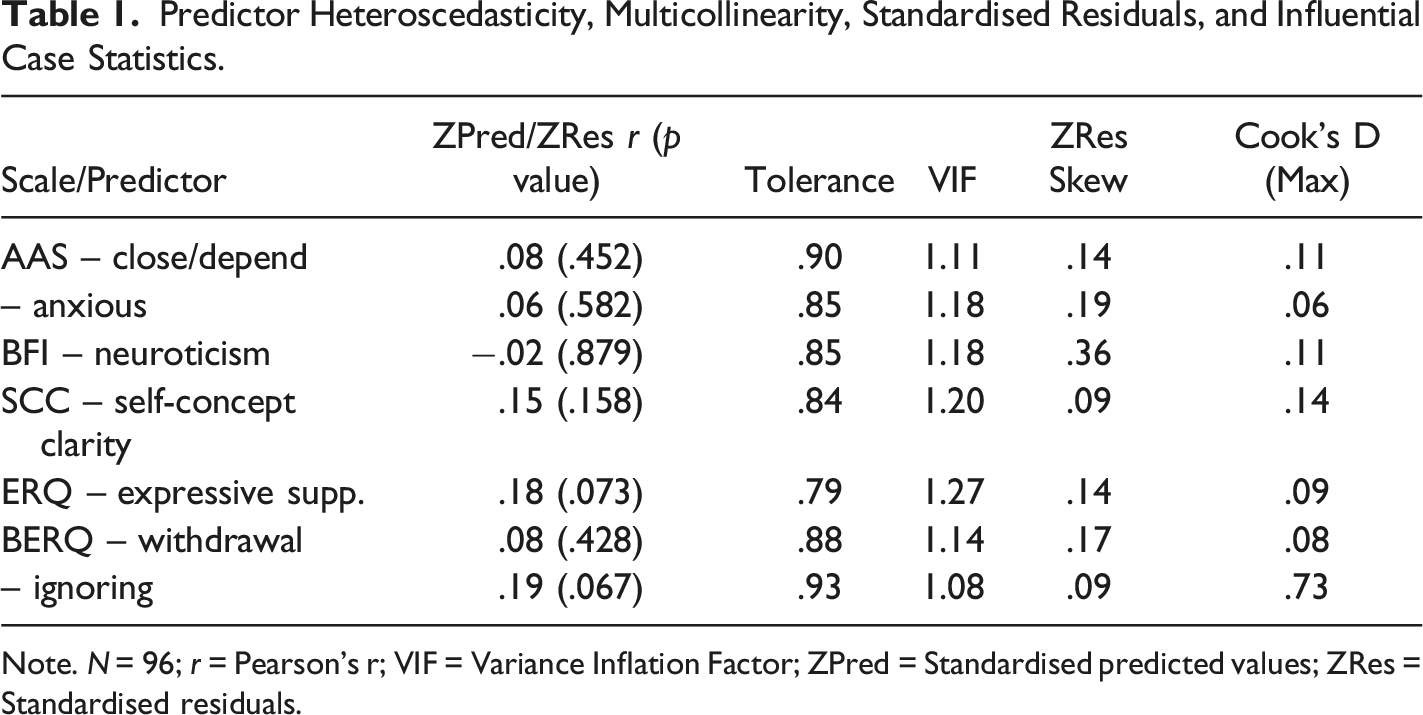
Note. N = 96; r = Pearson’s r; VIF = Variance Inflation Factor; ZPred = Standardised predicted values; ZRes = Standardised residuals.
Latent Variable Analysis
Means, Standard Deviations, Hierarchical Regression Results and Coefficients of the Determinants of Social Loneliness.
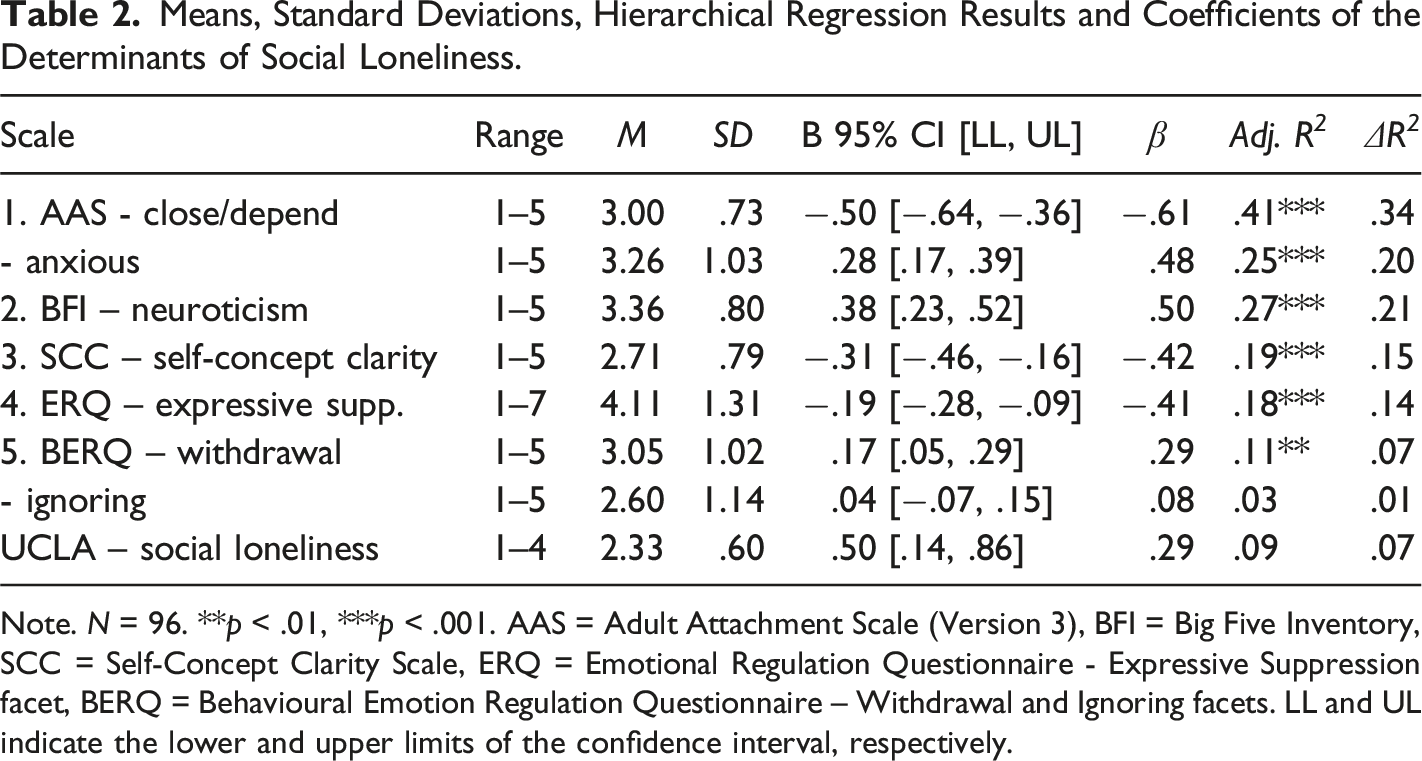
Note. N = 96. **p < .01, ***p < .001. AAS = Adult Attachment Scale (Version 3), BFI = Big Five Inventory, SCC = Self-Concept Clarity Scale, ERQ = Emotional Regulation Questionnaire - Expressive Suppression facet, BERQ = Behavioural Emotion Regulation Questionnaire – Withdrawal and Ignoring facets. LL and UL indicate the lower and upper limits of the confidence interval, respectively.
The semi-partial correlations of the Close/Depend composite dimension and Anxious attachment dimension (r = −.58 and .44 respectively), Neuroticism dimension (r = .46), Self-Concept Clarity (r = −.38), Expressive Suppression dimension (r = −.38), and Withdrawal behaviour coping dimension (r = .27) revealed that they accounted for 33.64%, 19.36%, 21.16%, 14.44%, 14.44% and 7.29% of unique variance of SL, respectively.
Demographic Variables
The following demographic variables and recency effects were assessed using a regression model, for interaction effects between the latent variables and SL; Age, Gender, Household income, Education, Location (Metropolitan/Rural/Remote), Employment status, Faith/spirituality, Marital status, Recent life changing events, and Recently moved to a new and permanent location (Recently Moved). In the analysis, none of the variables, however, were found to be significantly related to SL (R 2 = .06, F(8,87) = .64, p = .740). In terms of correlations, only Household income (r = −.20, p = .028) and both recency effects, Life Changing Experiences (r = .21, p = .021), and Recently Moved (r = −.18, p = .038), were found to be significantly related to SL. Additional regression analysis of the interactions between all eight demographic and latent variables, however, found no statistically significant linear relationship. Prediction 2 was therefore not supported.
Behavioural Coping Style Analysis
A third multiple regression analysis was conducted to assess if participants who were higher in SL engaged in more passive (Withdrawal and Ignoring) behavioural coping styles. When controlling for demographic variables and recency effects, it was found that SL was not significantly related to either Withdrawal or Ignoring coping styles. Further regression analysis, however, found that SL significantly predicted Withdrawal coping styles when controlling for demographic differences, but not recency effects (R 2 = .19, F(1,86) = 2.23, p = .027). In this regression model, the semi-partial correlations revealed that Withdrawal coping styles (.27) accounted for 8.41% of the unique variance in SL. In addition, Withdrawal coping styles were statistically significant when controlling for either recent Life Changing Events or having Recently Moved, independently (R 2 = .19, F(1,85) = 2.04, p = .039 and R 2 = .19, F(1,85) = 2.00, p = .043, respectively). Small (adj. R 2 = .10) positive correlations were observed between SL and Withdrawal coping styles when controlling for either recency effects (Gignac & Szodorai, 2016). The semi-partial correlations for Life Changing Events (.27) and Recently Moved (.30) revealed they accounted for 7.3% and 9% of the unique variance in Withdrawal coping styles in their respective analyses. Thus, Prediction 3 was partially supported for Withdrawal coping styles when demographic variables and the effects of either recent Life Changing Events or Recently Moved were controlled, but not when both were controlled.
Discussion
The aim of this study was to examine the links between potential latent and behavioural antecedents of loneliness and SL and associated behavioural responses. Specifically, the current study examines a more comprehensive list of antecedents than previous studies which also often examine both emotional and social loneliness broadly, or emotional loneliness independently. Moreover, the direction of the relationship differed in this study in that precursors were examined instead of characteristics predicted by SL. The hope was to elucidate the risk factors of SL for preventative mitigation, or to address it before it becomes chronic. A second aim was to examine the universality by assessing a range of demographic variables and recency effects for moderation. Our third aim was to assess any negative coping styles in those who self-rated higher in SL. This was to determine if negative coping could prolong the condition in those who effectively self-sabotage their efforts to alleviate SL. Overall, it was found that all the latent variables and withdrawal coping styles predict SL. Further, the data suggests this was universal across all tested demographic variables including age, gender, income, family, and relationship status. Thirdly, those higher in SL tended to cope by socially withdrawing unless they moved to a new town or city and experienced a recent life changing event in the last six months.
Prediction 1: Links Between the Latent Determinants and SL
Among the determinants, SL was characterised by higher anxious attachment, neuroticism, and an unclear self-concept. Behaviourally, participants who regulate their emotions by suppressing them (Expressive Suppression) and actively reject or withdraw from social interaction tend to be higher in SL. Those higher in Secure Attachment, on the other hand, were less likely to be socially lonely. The results point to emotionally volatile individuals, that is, those Anxiously Attached (overly reactive), Neurotic (emotionally unstable), and Expressively Suppressed, as likely to be higher in SL. This supports the extent literature which argues that a lack of attachment, belongingness and loneliness have a large impact on emotional patterns (Baumeister & Leary, 1995). In other words, in circumstances where satiation cannot be achieved socially, emotional instability and negativity increases when distressed. For young adults, such as those in this study, this may be especially the case as they are still establishing both intimate and social networks and are therefore not as securely attached (McWhirter, 2011).
Links Between Attachment and SL
A second finding of the analysis is the large inverse relationship that secure attachment has with SL, explaining one-third of its variance. In social terms, among the largely female cohort of educated young adults, one-third were less likely to become socially lonely if they have a more secure attachment style. According to Bowlby (1969), attachment is partly developed independently of the primary caregiver and immediate family and is based on social experiences from early childhood (Schaffer & Emerson, 1964). In addition, Franco-O’Byrne et al. (2023) asserts that social influence increases in importance relative to parental influence throughout childhood, taking precedence in early adolescence. Taken together, Bowlby and Franco’s theories, and the finding here that secure attachment tends to be highly preventative of SL, suggests that social interaction may play a greater role in shaping attachment than previously thought. Moreover, attachment styles not only change over the arc of one’s life but also across different relationships, so emotional and social attachment styles are known to diverge, leading to differing, construct-specific levels of attachment. Further, the relative ambiguity inherent in social relationships, compared to the more linear trajectory of “traditional” emotional relationships (from courtship to cohabitation, then marriage), means the associated stress may trigger more insecure working models to play out. If social interactions, particularly early childhood social interactions, are more important than previously thought, it could have significant implications on parenting. Primary caregivers, for instance, could be advised to carefully choose the type of social interactions their child is exposed to, based on their attachment style, to help foster the child’s secure formative attachment.
Links Between Anxious Attachment, Neuroticism, and SL
As expected, Anxious Attachment was also related to SL, in a positive direction. While Secure Attachment was more highly related to SL than Anxious Attachment, collectively, the four positively related latent determinants predicted 70% of the variance. Closer examination revealed that more Anxiously Attached and Neurotic participants were equally predictive, collectively explaining 41% of the variance. Perhaps this is because both are fundamentally similar, characterized by emotional sensitivity and instability, derived from deeply held anxiety, vulnerability, and self-consciousness (Bowlby, 1969; Costa & McCrae, 2008). In social settings, if an individual feels unworthy of others’ support, it is natural they would become more emotionally unstable in response, resulting in a perpetual cycle that repeats due to the relatively stable nature of personality over the lifespan.
Attachment and Behavioural Determinants of SL
In terms of coping styles, Bowlby (1969) argued that those who are more anxious exhibit protesting behaviour, as opposed to more detached behaviours of those higher in avoidant attachment. Protesting behaviours are known to actively reject social engagement and are therefore more aligned with withdrawal behaviour (i.e., removing oneself from social settings). As predicted, overt protestations were linked to SL in this study. In contrast, detachment behaviours that maintain social contact and reciprocation by utilizing ignoring behavioural styles, do not predict SL. To reduce SL, therefore, following stressful situations, it appears to be more effective to continue engaging socially while repressing negative feelings. Notably, Expressive Suppression of all feelings was also linked to SL, explaining 18% of its variance in the analysis. Thus, while suppressing all emotions is positively correlated with SL, expressing positive emotions is negatively correlated, or more socially acceptable.
Unclear Self-Concept and SL
The third affirmed prediction of the analysis was the inverse relationship between Self-Concept Clarity and SL. As social validation and affirmation are derived by the feedback and comparison made with others (Richman et al., 2016), it follows that if social comparison is at odds with social feedback, Self-Concept Clarity could become unclear or ‘fuzzy’. In summary, as shown in the results, individuals who have an Unclear Self-Concept are likely to develop attachment issues due to a lack of consistent self/other feedback and support, becoming emotionally unstable (neurotic), and likely to respond by suppressing their emotions and withdrawing.
Prediction 2: Demographic Interactions Between the Latent Variables and SL
In terms of demographic interactions, no effects were found to exist due to limitations in the cohort which precluded their detection. One limitation was the narrow cohort which was restricted to psychology undergraduates at one university. This resulted in heavily skewed demographics, notably toward females, with concentrated frequencies in one or two categories, across most predictors. Secondly, for a significant interaction to be detected, Baranger (2019) argues that a study requires a sample that is larger than that required to detect a main effect. One reason is that interaction effects have a poor track record of replication across different population subsets, so additional power is warranted to detect potentially smaller effect sizes. In general, an interaction effect is usually half that of a main effect which would require four times the sample size due to the exponential relationship between power and sample size. Within the current study parameters, it was not feasible to gather a sample of 1000 participants (allowing a 40–50% attrition rate) to detect such a small interaction effect.
Prediction 3: Links Between SL and Behavioural Coping Style
As mentioned, the extent literature on coping with SL has been criticised in meta-studies for using small sample sizes and poor study designs (Preece et al., 2021; Yanguas et al., 2018). The findings of the meta-studies, therefore, were unclear and sometimes contradictory. Balzarotti et al. (2010), for instance, noted a paradox in socially lonely people who crave social support while simultaneously reacting to their negative emotions with Expressive Suppression and avoiding social contact. On the other hand, Baeumeister and Leary (1995) argue people become more social the lonelier they get, as their need to connect increases when their sense of belonging falls below a minimum threshold. The results in this study support the latter findings. Socially lonely people tend to respond by engaging in Withdrawal coping styles by removing themselves from contact and social situations. Similarly, more socially lonely people tend to isolate themselves after recently moving to a new town, city, or country. This also tends to happen following recent isolating life changing events (e.g., the death or separation from a significant other or a minor moving out of full-time care). However, the response is different if both effects have occurred. Thus, as proffered by Baeumeister and Leary (1995), we agree that the need for social support becomes overwhelming at a point, and the innate draw toward connection and belonging powerfully acts to motivate prosocial behaviours and assuage the aversion of social loneliness.
Limitations, Future Directions, and Clinical Applications
Within the parameters of the study there were several limitations notable when interpreting the results which have implications for future research. Firstly, given the high number of predictors examined, scale priority was given to short form, self-report surveys to keep the overall questionnaire at a length that would maintain high response and completion rates. In addition, the UCLA Loneliness scale, which although highly valid and reliable, interprets loneliness unidimensionally. Admittedly, it is possible that qualitative methods or multi-facet scales (see Mikulincer & Segal, 1990) may therefore obtain different results. In addition, aside from the demographic limitations of the cohort; namely, the largely female sample of psychology undergraduates, and the insufficient number of participants to detect interaction effects, another limitation is the exclusion of emotional loneliness (EL). In future studies, a comparison of EL and SL could answer some important questions raised here about attachment style by analysing, for example, a more age representative sample which could illustrate these differences across the life span. Based on the strong link between SL and Attachment in the present study, it appears likely that as we age, social attachment may predict overall loneliness more than emotional attachment.
In terms of clinical applications, the results of this study point to the link between observed signs of emotional instability as an indicator of, or precursor to, SL, and withdrawal behavioural styles acting to perpetuate it. Clinically, an observable behavioural outcome appears to be negative social comparison perception. Upward comparison to others within a social set, can lead to a downward emotional spiral and a decrease in self-esteem (APA, 2018). Those seeking treatment could therefore benefit from cognitive therapy to reframe their social comparisons downward (Markus & Wurf, 1987). The type of language a patient uses (i.e., comparing themselves poorly with others, exhibiting signs of worry, rumination and catastrophising) may be symptoms of emotional distress and SL, and thereby treated earlier and more effectively. A further treatment option to aid in reframing social perceptions was revealed in an illuminating study which suggested that loneliness can be induced using hypnosis. Subjects were induced to feel increased anxiety, lower self-esteem, and social skills, giving hope that hypnosis could be used to improve self-and-other perceptions and the prognosis for lonely people (Cacioppo & Hawkley, 2009; Masi et al., 2011).
In conclusion, social loneliness is a complex, naturally occurring, condition which is mainly perception-based and not bound by culture, gender, or age or income. It is more intensely felt in people who are emotionally sensitive and unstable, particularly those higher in Anxious Attachment and Neuroticism and to a lesser degree those with an Unclear Self-Concept, and who engage in Expressive Suppression and social Withdrawal. Conversely, Secure Attachment is highly protective against SL. It is hoped that future research expands the profile of determinants further and examines more representative, cross-sectional cohorts. To improve outcomes, it is further hoped that these and future findings enter the mainstream to aid public awareness of SL, reducing its stigma, and encouraging earlier intervention.
Footnotes
Declaration of Conflicting Interests
The author(s) declared no potential conflicts of interest with respect to the research, authorship, and/or publication of this article.
Funding
The author(s) received no financial support for the research, authorship, and/or publication of this article.
