




Abstract
Previous research has found that colour can affect the interpretation and identification of facial expressions of emotion. Emojis are increasingly being used to communicate similar cues of emotion meaning in online communication. A question that has yet to be addressed is whether colour influences emoji perception in a similar manner to colour in the context of human face processing. This study seeks to empirically investigate whether presenting colours (red, green, blue, and grey) in the background of emojis influences the extent that the emojis are perceived as positive or negative. Forty-three participants from an Australian university completed an emoji categorisation task with positive, negative, and neutral/ambiguous emojis presented on red, green, blue, grey, and blank backgrounds. Negative emojis were found to be categorised significantly faster when presented on a red background compared to green or blue background. In contrast, positive emojis presented on a green or blue background were categorised faster than negative emojis on a blue or green background. Furthermore, in the context of emojis with neutral and ambiguous emotion meaning, a red colour background was found to increase the perception of these neutral or ambiguous emojis as negative. The pattern of responses found for emojis suggests colour influences emoji processing and recognition similar to the previously established colour effects in human face expression processing.
Emotion information processing is a vital skill for social interaction and survival that consistently requires split-second recognition and categorisation of subtle cues present in facial expressions. Humans constantly process facial expressions during personal interactions and recorded interactions such as news, TV shows, movies, etc. However, interpreting and categorising emotion information is made difficult when emotion expressions, such as surprise can be perceived as either negative or positive (Kim et al., 2004). Similarly, expressions such as surprise can be perceived as negative when there is less information to disentangle the ambiguity of the expression and positive when there is more information (Neta & Whalen, 2010). Colour is increasingly being recognised as a salient contextual cue used to influence emotion processing and categorisation (Fetterman et al., 2012; Winskel et al., 2021), particularly in the context of emotion face processing (Sivananthan et al., 2021; Thorstenson et al., 2018). More specifically, colour has been found to be a salient biological cue for perceiving aggression, arousal, and anger through for example red facial flushing (Young et al., 2013; Young et al., 2018). We are increasingly existing in online, device-based environments. In these online environments, we are perceiving screens where emotions are often communicated and processed through a combination of text and emojis (Erle et al., 2022; Phan et al., 2019). In the current study, we aim to investigate whether colour in the context of emoji processing is similar to colour effects on emotion processing of human faces.
There is an increasing body of evidence to suggest that colour also acts as a salient cue for processing emotions when perceived in the background or surrounding environment of emotion content and stimuli. In the context of emotion face processing, the colour red in the background of angry faces has been found to facilitate speed and accuracy when categorising emotions (Sivananthan et al., 2021; Young et al., 2013), whereas green and pink have been found to facilitate recognition of happy emotion faces in an emotion processing task (Gil & Le Bigot, 2014). It is likely that these colour effects on emotion occur due to a combination of innate associations (e.g., facial redness during arousal or anger) and learned experiences (e.g., traffic lights: red-stop and green-go, use of red for danger signs). One theoretical explanation to account for these colour associations is colour-in-context theory, which asserts that colour has affective meaning informed by a combination of innate biological predispositions and socially-learned colour associations that are dependent on the context in which colours are perceived (Elliot, 2015). For example, a study by Meier (2012) shows exposure to the colour red increases approach behaviour when walking to a romantic context such as a date. Culture-specific effects of colour are illustrated by a Lithuanian study, where red has been found to be more strongly associated with love compared to anger, and black is positively associated with compassion compared to the typical black negative association (Jonauskaite, 2024). Colour-in-context as a theoretical framework highlights the role of prior experience with coloured objects informing future associations of positive or negative valence and affect when perceiving colour. Further, the association between colour and emotion, valence, or affect is bidirectional (Elliot, 2015). Consequently, processing and identification of emotion, affect, or valence information is influenced by perception of salient colour stimuli.
It is well established that colour influences the perception and recognition of emotions in the context of face processing. For example, Benitez-Quiroz et al. (2018) suggest that facial colour is used to both transmit and decode relevant emotion information expressed in human faces (such as blushing red faces denoting anger or arousal). Further, it has been found that there is a facilitation of emotion recognition in faces when photographs were presented in colour compared to black and white in young adults, indicating that colour can play a faciliatory role in emotion recognition (Silver & Bilker, 2015). The salience of colour on human face processing extends to specific colour-affective associations, as negative or angry-related emotion expressions are categorised faster and more accurately when the face is coloured red (Young et al., 2018). Similarly, Thorstenson et al. (2018) found that when participants were tasked with altering emotion expressions to make them more angry or disgusted, they made the face redder for anger and greener for disgust. A similar effect was found in a study by Nakajima et al. (2017), who found that increasing the amount of blue in a face increased perception of the emotion expression as sadness. These findings are consistent with previous colour-emotion research suggesting that colour-valence associations can influence the perception of emotions and facilitate responses to congruent colour-affective and colour-valence pairings when consciously attending to colour (Thorstensen et al., 2018) and when colour is not a salient feature of the task (Young et al., 2018). However, findings by Wolf et al. (2021) suggest that red-anger effects in the context of human faces may not occur when controlling for a more natural red face and participant awareness of the study’s purpose. These findings suggest that the effect of red may have limited generalisability and a more nuanced understanding of the contextual factors of potential colour effects in emotion face processing is needed.
While colour has been shown to influence emotion perception and recognition when presented in human face categorisation tasks, a relatively open question is whether this conceptual association between colours and emotions is present in online communication contexts. Emojis are nonverbal visual stimuli that can be used to visually signal different emotional states. They are a common way of communicating emotions and affective preferences with and without written text (Erle et al., 2022), and are used to rapidly communicate emotion and affect in screen-based interactions (Marengo et al., 2019). They provide a nonverbal representation of affective experience, which can be difficult or time-consuming to communicate in words. The emojis frequently used in exchanges are based on facial expressions and are designed to simulate emotional information through markers and symbols to represent affective or emotion information (e.g., tears for sadness, smiles for happiness, hearts for love/affection) (Phan et al., 2019). Thus, emojis can be considered to symbolise or represent facial expressions in screen-based social interactions (Erle et al., 2022). Previous work in the colour-valence literature has explored the influence of colour in the context of facial emotion and emotion word stimuli (Fetterman et al., 2012), but there is a lack of research on colour effects in the context of emojis. As emojis are constructed representations of human emotions, they are a useful tool for further investigating how we conceptualise and communicate emotion and affective experiences, particularly in screen-based contexts (Phan et al., 2019). There is a need to further understand the influence of colours in the context of perceiving emojis, as they are increasingly being used to communicate emotional information in online contexts.
A study by Liao et al. (2022) examined the effect of colours in the context of emoticons. Emoticons are visual proxies of emotion expressions that represent schematic facial expressions to give the impression of basic emotions, for example, these can be expressed as a colon and a curved line to create a “smiling face” or “sad face” e.g., :) or :( or represented as an emoji image typically used in social media, e.g.,  or
or  . In a series of experiments, Liao et al. (2022) asked participants first to categorise emoticons coloured red, orange, yellow, green, cyan, blue, purple, and light grey into five discrete basic emotion categories. Subsequently, participants evaluated the affective meaning of the five basic emotion emoticons by selecting a response on a five-point affective measure scale (e.g., Not Angry-Angry, or Not Sad-Sad). Their findings suggested that the affective meaning of angry and sad emoticons was stronger when presented in congruent colours red (anger) and blue (sad) respectively. The strength of the affective value provided evidence of an affective congruency effect between emoticon expression and colours that was similar to previous studies that have examined the effect of colour in the context of realistic facial expressions (Liao et al., 2022). More recently, emoticons and face emojis are presented through consistent yellow faces to express emotions, valence, and concepts beyond basic emotion expressions (, , or
  ). These more varied type of emojis and emoticons are increasingly used to display emotions in online communication contexts that have yet to be investigated.
In the current study, we investigated whether colour-valence relationships occur in the context of processing emojis. A valence categorisation task was designed to investigate if presenting positive, negative, and neutral or ambiguous valence sets of emojis on coloured backgrounds influences the categorisation of the emojis as positive or negative. Therefore, in line with previous emotion face categorisation tasks, it is predicted that positive emojis will be categorised faster and more accurately when presented on a green background (Gil & Le Bigot, 2014; Sivananthan et al., 2021). Similarly, negative emojis will be categorised faster and more accurately when presented on grey and red coloured backgrounds (Fugate & Franco, 2019; Young et al., 2018). In contrast, blue can have heterogeneous emotional connotations both in the context of the face and when presented as a colour patch. Blue has been found to be associated with positive connotations such as bliss, calming and relaxing, and negative associations of sadness and depression. Based on this, the blue background could facilitate categorisation of both positive and negative emojis (Goodhew & Kidd, 2020; Nakajima et al., 2017). Finally, previous studies (e.g., Silver & Bilker, 2015) have found that processing facial expressions with ambiguous valence can increase the reliance on colour as a cue for emotion recognition. We predict that categorisation of neutral emojis and ambiguous emojis will likely be influenced by the colour of the background. Specifically, the neutral and ambiguous emojis will more likely be categorised as positive when presented on a green background, and negative when presented on a grey or red background (Sivananthan et al., 2021).
Method
Participants
Forty-three participants (12 male and 31 female) with a mean age of 29.1 (SD = 11.4) were recruited for the emotion categorisation experiment. Participants were recruited from Southern Cross University in Australia. Only participants who indicated that they had no known colour vision deficiencies and spoke English as their first language were recruited. The Southern Cross University Ethics committee gave ethical approval for this study (Ethics approval number: 2021/024) and all participants gave written consent to participate after having been provided with an information sheet for the study.
Materials
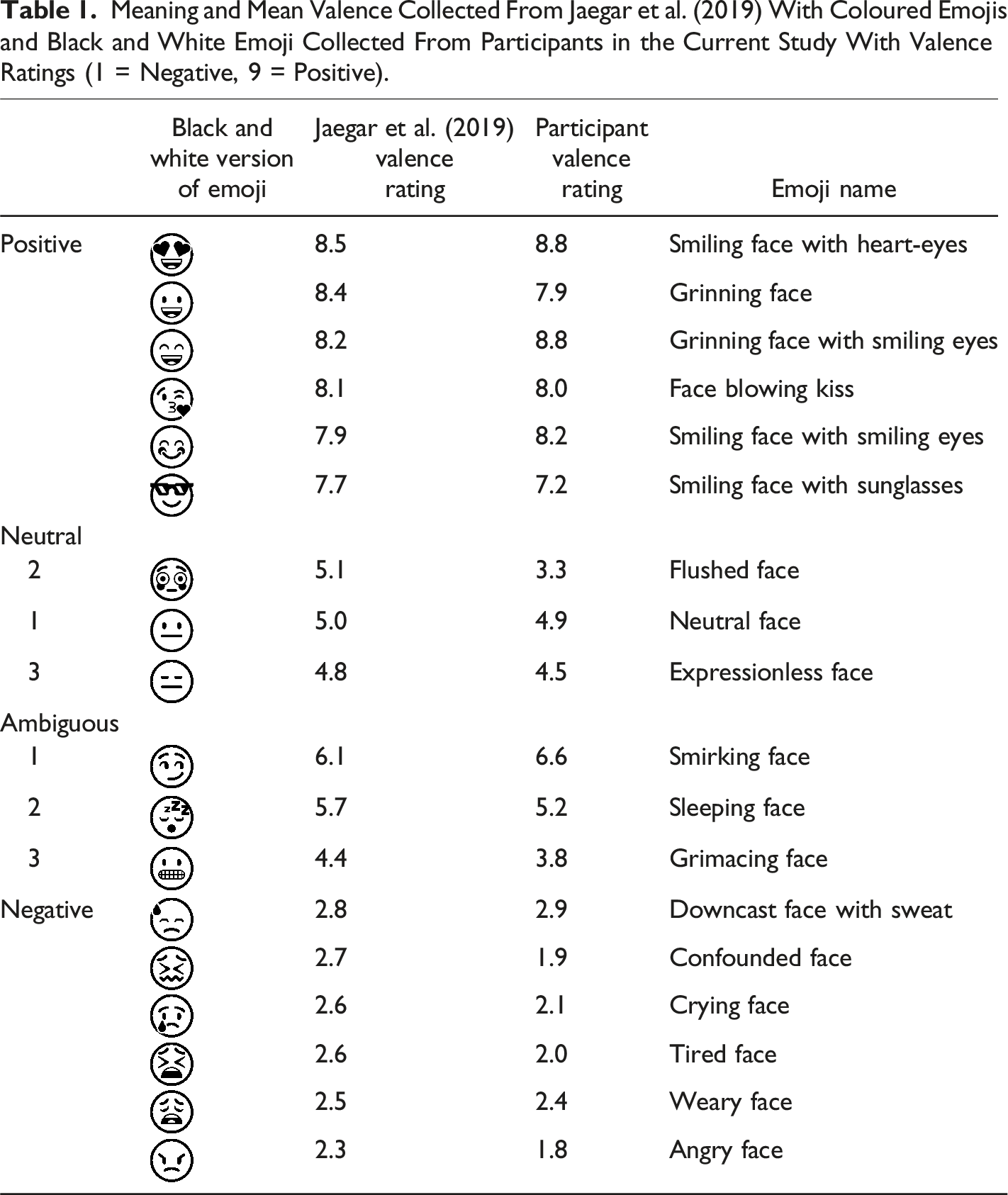
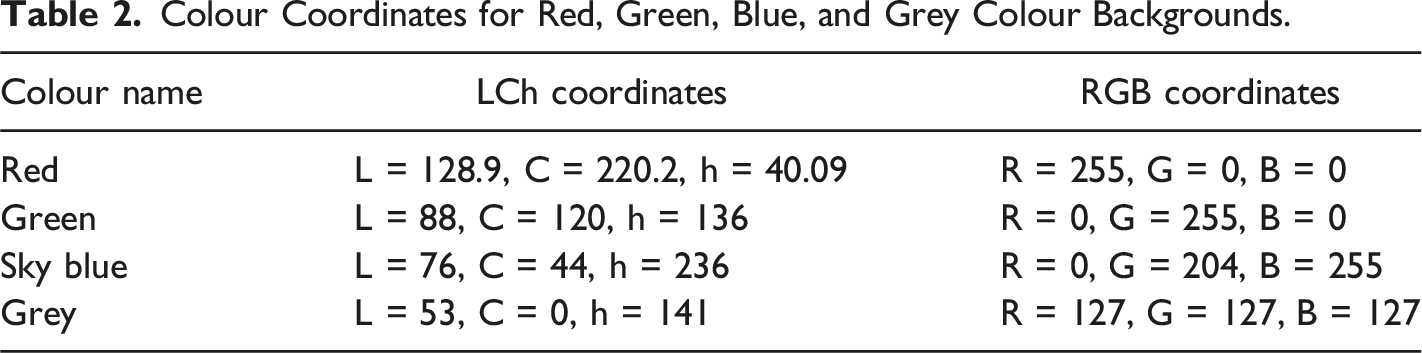
Six positive emojis, six negative emojis, and three neutral emojis were downloaded from emojipedia.org. A further set of three emojis were selected that were considered “ambiguous” when presented without context as they express more complex emotions that are less clearly categorised into a binary positive or negative category. The emojis were selected based on previous normative valence data collected by Jaegar et al. (2019) using a rating scale from 1 to 9. We used a similar design to Jaegar et al. (2019) where emojis and the Self-Assessment Manikin (SAM: Bradley & Lang, 1994) were presented to participants with a 9-point scale (1 being negative and 9 being the most positive; see Figure 1). In our study, emojis were considered negative if they were rated between 1 and 3, neutral if between 4 and 6, and positive if between 7 and 9. The six most positive and six most negative emojis were chosen as positive and negative emotion emojis. The emojis with ambiguous valence were selected based on them bordering either the positive-neutral or negative-neutral categories. All selected emojis and their affective ratings are displayed in Table 1. All emojis selected were Microsoft Windows version 11. The colour was removed from each emoji so that they were presented only as black and white outlines of the main features of each emoji. Each emoji-colour background pairing was presented three times. There was a total of six emojis in each category (positive, neutral/ambiguous, negative). All 18 emojis were placed on a red, blue, grey, green, and white coloured background (see Figure 1.). Colour coordinates for the colours used in this study are presented in Table 2. Emoji stimuli presented with 9-point SAM scale. Meaning and Mean Valence Collected From Jaegar et al. (2019) With Coloured Emojis and Black and White Emoji Collected From Participants in the Current Study With Valence Ratings (1 = Negative, 9 = Positive). Colour Coordinates for Red, Green, Blue, and Grey Colour Backgrounds.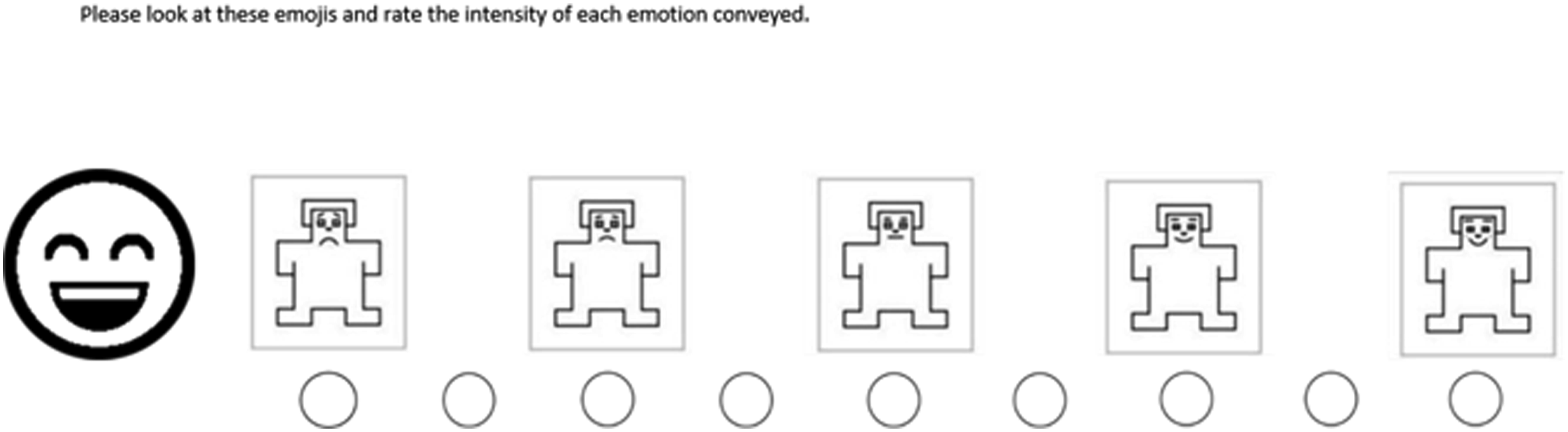
Procedure
An emoji categorisation task was designed using E-Prime 3.0 software (Psychology Software Tools, Pittsburgh, PA). The emoji categorisation task required participants to categorize emojis as either positive or negative. Each trial began with a fixation point in the centre of the screen that appeared for 500 ms prior to presentation of each emoji. A black and white emoji (sized 3.18 cm) placed on a colour patch was then presented. The colour-patch backgrounds were sized at 3.18 cm × 3.18 cm squares to allow a consistent amount of colour to surround the outside of each emoji. The background colours included red, green, blue, and grey colour patches. A control condition was also included where the emoji was presented on a blank white screen with no colour background. The emojis were presented in a randomised order for a period of 5000 ms. Participants were presented each emoji-colour combination three times (270 total trials). If participants did not respond within 5000 ms no response was recorded and the next emoji was presented. Participants were able to categorise emojis as positive (using the X key on the keyboard) or negative (M key on the keyboard) (Figure 2). (a) Example of smiling face with sunglasess emoji on red, green, blank, blue, and grey. (b) Displays the categorisation task schematics. Participants responded by pressing X (positive) or M (negative) to categorise emojis.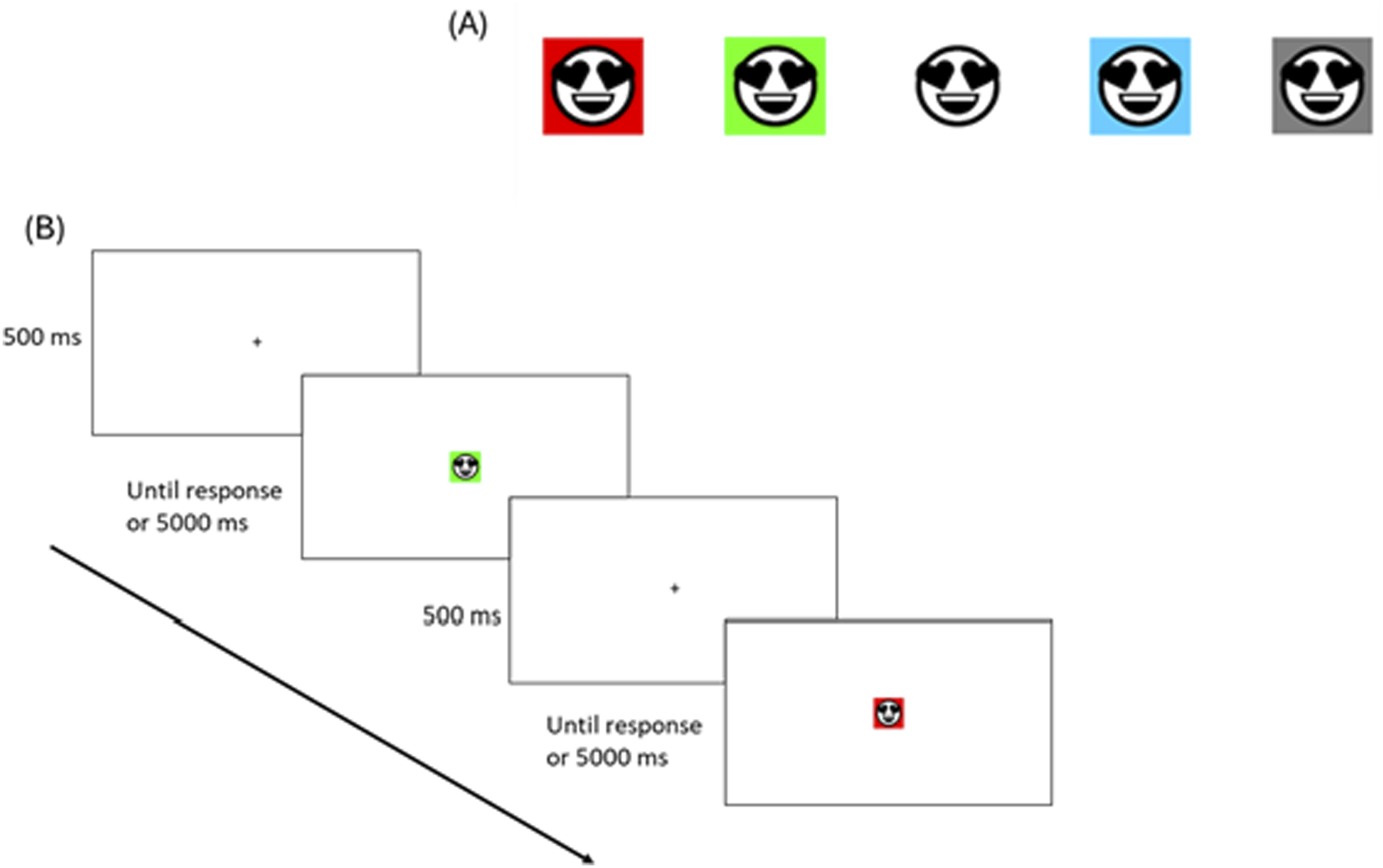
Each participant completed the experiment in a quiet room with the viewing distance set to approximately 60 cm. The room was windowless and had a consistent illumination of one ceiling light with no outside light during the experiment. All participants were given the same set of instructions to categorise the presented emojis as either positive or negative as quickly and accurately as possible. Before beginning the experiment, participants first completed a set of 8 practice trials where they categorised positive and negative emojis that did not appear in the experimental trials. They were able to participate in the practice trials as many times as needed until they felt prepared to complete the experimental trials. The categorisation task had two measures. Firstly, response time speed was measured rounded up to milliseconds using E-Prime 3.0 software (Psychology Software Tools, Pittsburgh, PA) to build the experiment and store the reaction time data. Secondly, mean accuracy of response for positive and negative emotions was used to determine if colour influenced emoji categorisation.
Following the experimental trials, participants were given an emoji rating task to complete. The emoji rating task was adapted from the Jaegar et al. (2019) study which used the SAM scale (Bradley & Lang, 1994), where participants rated the intensity of each emoji from 1 to 9. They were then tasked with stating the emotion or feelings conveyed by each emoji from the study. Finally, participants provided demographic information. This included questions about their age, gender, primary and secondary languages.
Results
To validate the selection of emojis for this study, all participants completed the same emoji valence rating scale and emoji meaning task as Jaegar et al. (2019). Participants were presented with the 18 emojis on a page with the SAM scale presented directly next to each emoji. Participants were then prompted to evaluate how positive or negative the emoji was. Results from this emoji rating task is presented in Table 2 alongside the valence ratings from Jaegar et al. (2019), which were used to inform the selection of emoji stimuli for this study.
Data analysis Plan
The response time and accuracy data for the positive and negative emoji categorisation tasks were analysed using a 2 (emoji: positive, negative) × 5 (background colour: red, green, blue, blank/control, grey) within-participants ANOVAs. Prior to response time analysis, all incorrect responses were removed and response times that were 2.5 SD above participants’ mean or below 100 ms were removed (2.9%).
The neutral and ambiguous emoji stimuli in the categorisation task required participants to categorise emoji stimuli into binary positive or negative categories. To analyse the neutral and ambiguous stimuli, we created a measure of how positive or negative they were perceived by aggregating the categorisations of the emojis as positive or negative. To create the overall measure, we aggregated the responses to each emoji across the three categorisations of the emojis, zero (negative) and 1 (positive), to create an aggregated score between zero and 1, representing how negative or positive the emojis were perceived during the categorisation task. Using this measure we then analysed the data using a 2 (emoji: neutral, ambiguous) × 5 (background colour: red, green, blue, blank/control, grey) within-participants ANOVA. All analyses were conducted using SPSS v 29.
RT Analysis for Positive and Negative Emojis Categorised as Positive or Negative
A 2 (emoji: positive, negative) × 5 (background colour: red, green, blue, blank/control, grey) within-participants ANOVA was conducted using participant response times. A significant main effect was found for emoji, F (1, 42) = 17.26, p < .001, η
p
2
= .291, whereas there was no main effect found for colour (p = .35). Positive emojis (603 ms) were categorized significantly faster than negative emojis (633 ms) (p < .001). A significant interaction was found for colour by emoji, F (4, 168) = 3.15, p = .02, η
p
2
= .070. Post hoc comparisons revealed that negative emojis presented on a red background (622 ms) were categorised faster than negative emojis on a green background (652 ms) (p = .01) (all other ps >.1) (See Figure 3). Mean Response Time (RT) (in milliseconds) of participants in the emoji categorisation task for positive and negative emojis presented with red, green, blue, blank, and grey colour backgrounds.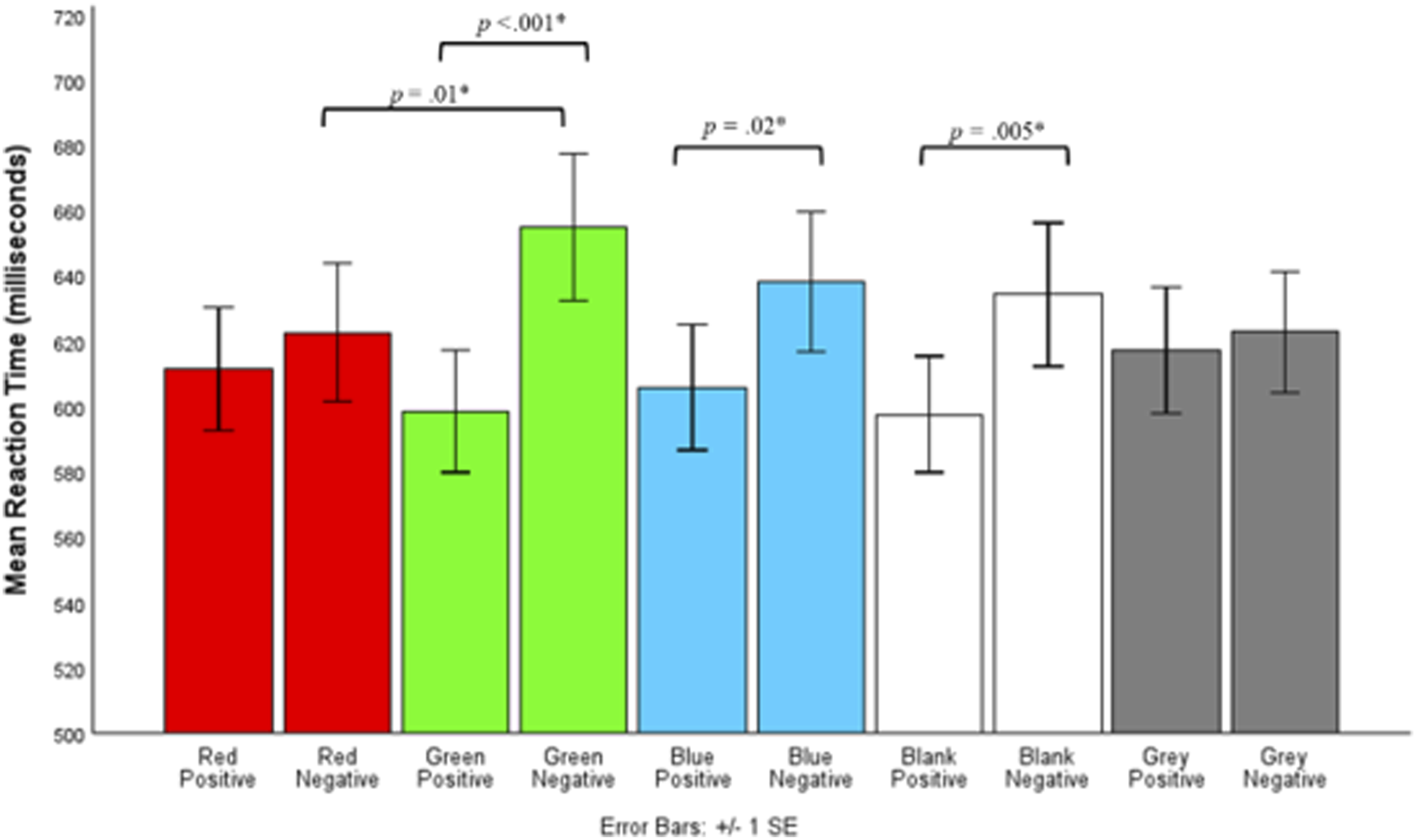
It was also found that positive emojis presented on green (598 ms) were responded to faster than negative emojis presented on green (652 ms) (p < .001). Similarly, positive emojis presented on blue (603 ms) were categorised faster than negative emojis presented on blue (635 ms) (p = .002). Positive emojis (596 ms) were categorised faster than negative emojis (632 ms) and in the blank/control background condition (p = .005).
Analysis of Accuracy of Categorising Positive and Negative Emojis
A 2 (emoji: positive, negative) × 5 (background colour: red, green, blue, blank/control, grey) within-participants ANOVA was conducted on accuracy of emoji categorisation. A significant main effect was found for colour, F (4, 168) = 3.211, p = .014, η p 2 = .071. It was found that categorisation only in the blank/neutral condition (.97) was significantly more accurate than in the green condition (.95) (p = .03). A significant main effect was also found for emoji, F (1, 42) = 4.20, p = .05, η p 2 = .091. Negative emojis (.95) were categorised significantly less accurately than positive emojis (.97) (p = .05).
Further, a significant interaction was found between colour and emoji, F (4, 168) = 5.38, p < .001, η p 2 = .114. Post hoc comparisons revealed that positive emojis presented on grey (.94) were categorised significantly less accurately than positive emojis presented on a blank/control background (.97) (p = .02). Negative emojis presented on green (.94) were significantly less accurately categorised than negative emojis presented on red (.99) (p = .002). No other comparisons across emojis were found to be significant (all ps >.1).
Negative emojis presented on the red background (.99) were categorised significantly more accurately than positive emojis presented on red (.94) p < .001. Similarly, negative emojis presented on grey (.97) were categorised significantly more accurately than positive emojis presented on grey (.94) (p = .01). No other comparisons were found to be significant (all ps >.2).
Categorisation of Neutral and Ambiguous Emoji Analysis
A 2 (emoji: neutral, ambiguous valence) × 5 (background colour: red, green, blue, blank/control, grey) within-participants ANOVA was conducted on categorisation responses. Significant main effects were found for colour, F (4, 168) = 7.54, p < .001, η p 2 = .152 and for emoji, F (1, 42) = 138.37, p < .001, η p 2 = .767.
Emojis presented on the red background (.25) were significantly more likely to be categorised as negative compared to the green background (.31) (p = .04). Furthermore, emojis were more likely to be categorised as negative when presented on the red background (.25) compared to the blue background (.31) (p < .001) and compared to the blank background (.30) (p = .01). Emojis presented on grey (.25) were more likely to be categorised as negative compared to blue (.31) (p = .006) and the blank background (.30) (p = .02). In addition, neutral emojis (.11) were more likely to be categorised as negative compared to the ambiguous emojis (.46) (p < .001). There was no significant interaction between colour and emoji (p = .53). No other effects were found to be significant (all ps > .1).
A further one-way within-participants ANOVA was conducted on categorisation for the valence of emojis. Response time when categorising emojis was significantly different across emoji valence, F (3, 126) = 30.25, p < .001, η
p
2
= .419. Bonferroni post hoc comparisons (see Figure 4) found that categorising neutral emojis (679 ms) was significantly slower compared to positive (603 ms) emojis (p < .001) and negative emojis (632 ms) (p = .002). Similarly, emojis with ambiguous valence (693 ms) were also categorised significantly more slowly compared to positive (603 ms) (p < .001) and negative emojis (632 ms) (p < .001). In other parts of the ms you have rounded off the RTs to no decimal places Mean Response Time (RT) (in milliseconds) of participants in the emoji categorisation task for positive, negative, neutral, and ambiguous valence emojis.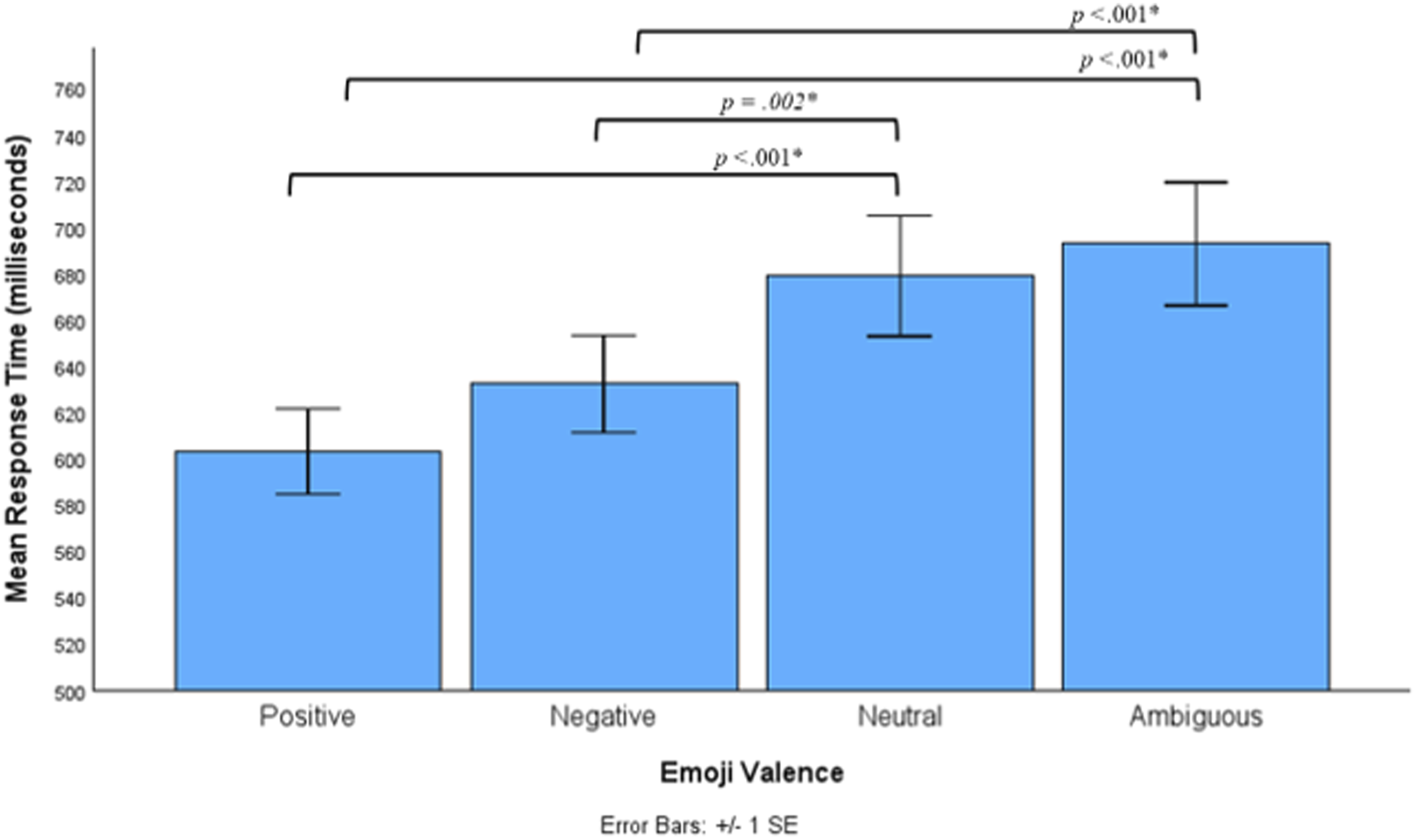
A 6 (neutral face, flushed face, expressionless face, smirking face, sleeping face, grimacing face) x 5 (red, green, blue, grey, blank) within-participants ANOVA was conducted on categorisation responses of the neutral and ambiguous valence emojis. Significant main effects were found for emojis (F (5, 215) = 66.50, p < .001, η p 2 = .607) and colour (F (4, 172) = 5.99, p < .001, ηp 2 = .122). Furthermore, a significant interaction was found for emoji x colour (F (20, 860) = 2.05, p = .004, η p 2 = .045).
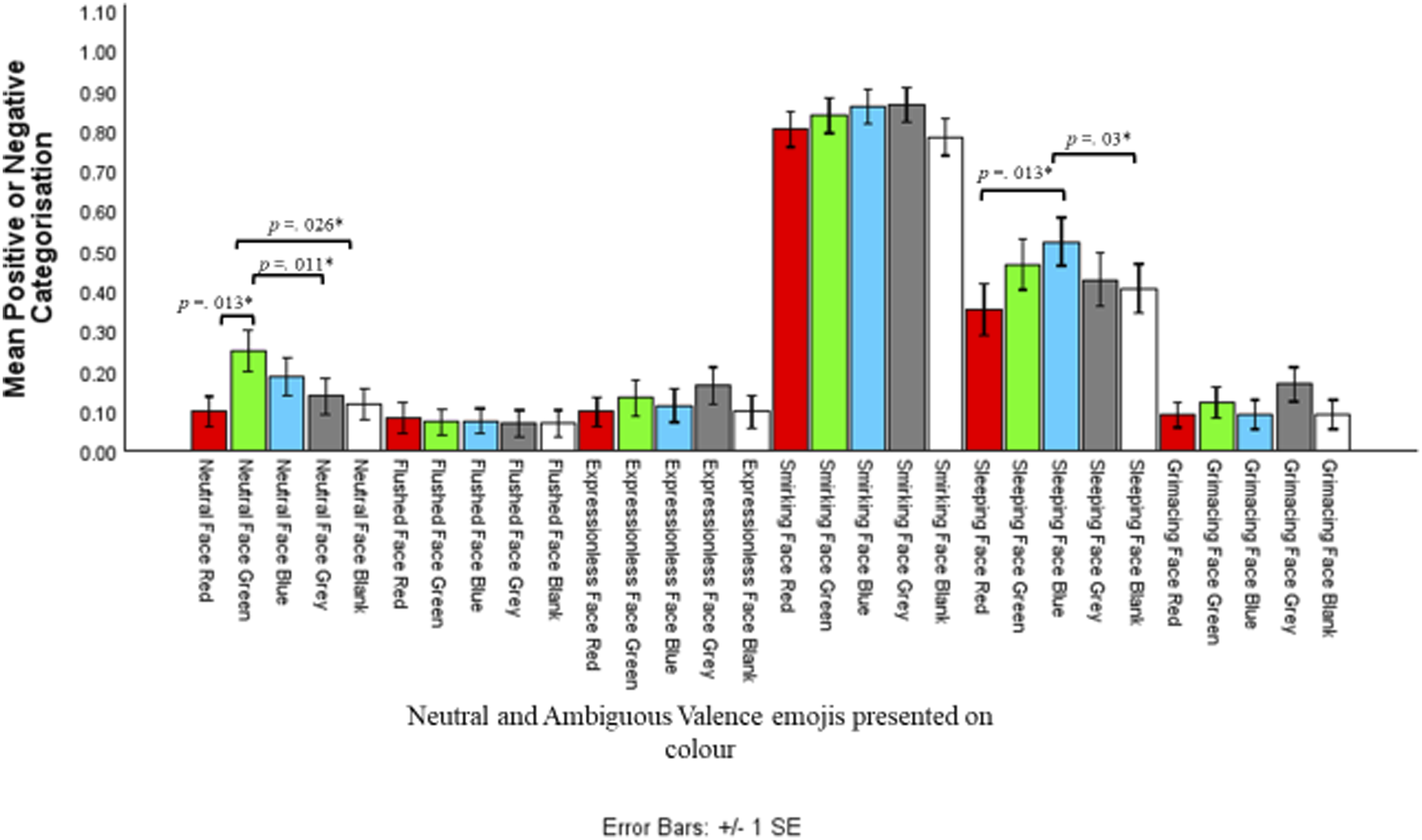
Bonferroni adjusted pairwise comparisons for emojis showed that the smirking face emoji ( Mean categorisation rating in the emoji categorisation task for neutral and ambiguous valence emojis. Mean positive or negative categorisation in the emoji categorisation task for neutral and ambiguous valence emojis presented with red, green, blue, grey, and blank colour backgrounds.) and the sleeping face emoji ( ) were categorised as significantly more positive compared to the other emojis (see Figure 5). In comparison, emojis presented on the blue background (.31 were found to be significantly more positive than emojis on the red background (.25) (p = .024), and blank background (.26) (p = .017). No other significant effects were found for colour. A series of Bonferroni adjusted pairwise comparisons for the emoji × colour interaction showed that the neutral face emoji (
 ) was categorised as positive significantly more when presented on green (.25) compared to red (.098), grey (.14), and blank (.12) (Figure 6). Similarly, the sleeping face emoji () is significantly more positive when presented on blue (.52) compared to red (.35) or blank (.41).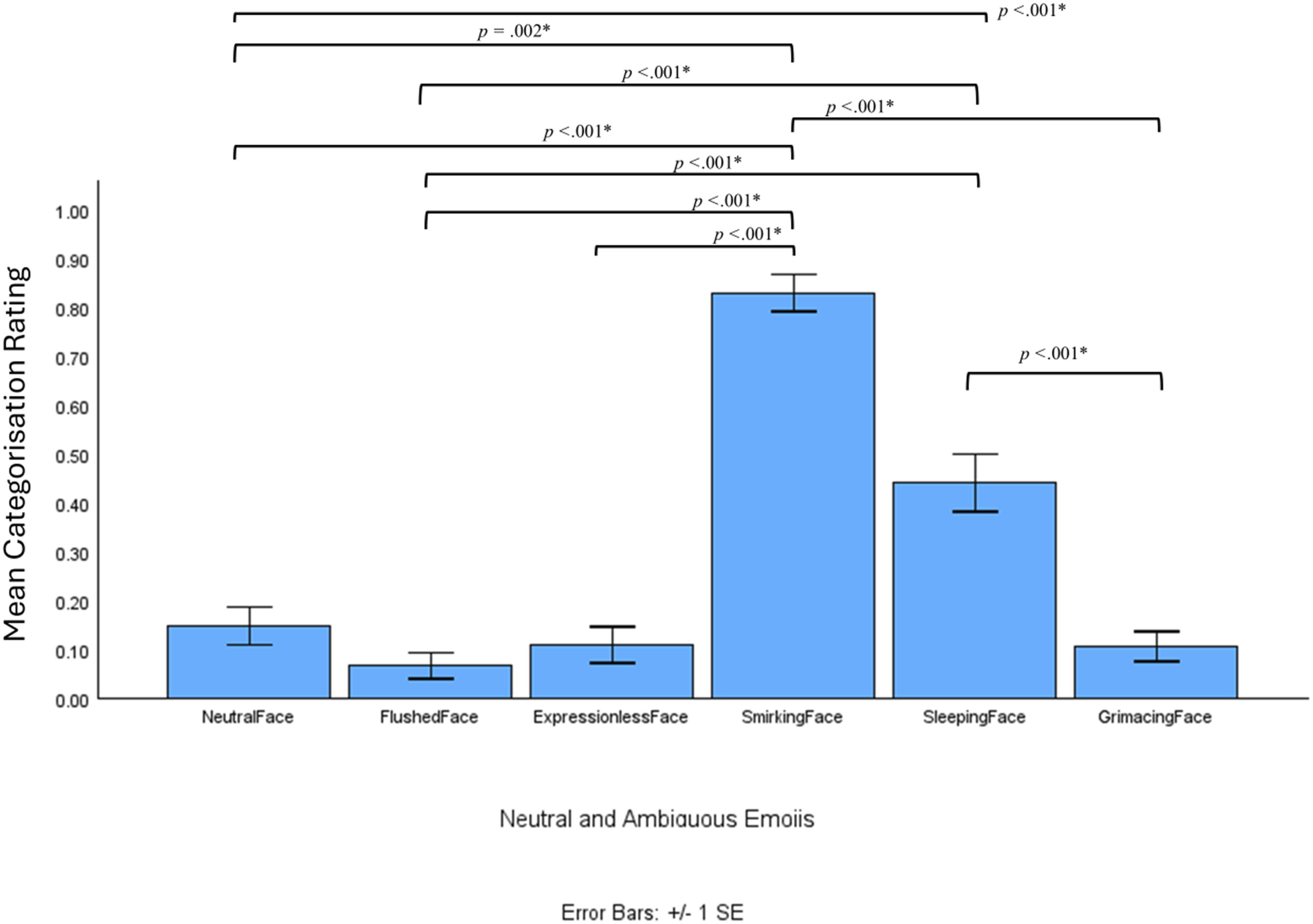
Discussion
The study investigated whether colour-valence associations influence the perception of emojis and have similar effects as colour on face emotion perception. Presenting colours in the background of emotion faces has previously been found to facilitate categorisation and perception of specific emotions in line with colour-emotion associations (e.g., red with anger) (Minami et al., 2018; Sivananthan et al., 2021; Young et al., 2013). We investigated whether presentation of colours in the background of emojis during a valence categorisation task facilitated speed and accuracy of categorisation when displaying a congruent colour for the positive or negative emoji. As predicted, we found that negative emojis were categorised faster and more accurately when presented on a red background compared to a green background. Further, negative emojis were categorised significantly faster and more accurately when presented on a red or grey background compared to positive emojis presented on red or grey backgrounds. These findings are consistent with previous research that has shown a faciliatory effect of the colour red when categorising negative emotion facial expressions (Sivananthan et al., 2021; Thorstenson et al., 2018; Young et al., 2013). The finding that grey background facilitated categorisation of negative emojis aligns with previous findings by Sivananthan et al. (2021) but contrasts with Gil and Le Bigot (2015) who found grey had no emotion or affective meaning. The discrepancy between these findings suggests that grey may have a context-dependent affective meaning as negative or neutral. One possible explanation for this is that in comparison to Sivananthan et al. (2021) and Gil and Le Bigot (2015), the grey used in our study was lower in both lightness and chroma. The lower lightness and chroma has previously been linked with negative emotion associations, such as anger and sadness (Schloss et al., 2020), as well as dark colours being linked with negative affect (Meier et al., 2004). A secondary consideration is the differences in size of colour background presented with stimuli. Previous studies, such as Sivananthan et al. (2021) and Gil and Le Bigot (2015), presented emotion stimuli with coloured backgrounds that covered the full screen. In contrast, our emoji stimuli were presented with a small square of colour surrounding the stimuli on top of a blank white screen. The differences in colour size may result in the smaller surrounding square influencing the emoji stimuli to have negative affective meaning. Future research comparing the effect of colour background size may provide further insight into whether this is a factor in the affective meaning of emoji stimuli. Overall, the response patterns found in this study with emojis was similar to previous colour affective research investigating colour effects in human face processing.
In contrast, the prediction that positive emojis would be categorised faster and more accurately when presented on green and blue compared to red was not supported. However, positive emojis were categorised faster than negative emojis when presented on blue and green backgrounds, which provides support for the predicted green-positive and blue-positive effects. While we found blue to have a positive association effect when categorising emojis, a previous study by Liao et al. (2022) found that blue was associated with sadness in the context of emoticons. Our finding that blue had positive associations may be due to our design tasking participants to categorise emojis as either positive or negative whereas the Liao et al. (2022) design labelled emoticons in line with five basic emotions (e.g., happy, sad, anger). This difference in task instructions may be an important consideration as blue has previously been found to be associated with sadness (Nakajima et al., 2017) and to have positive associations (Goodhew & Kidd, 2020; Kaya & Epps, 2004). One implication of this is that specific conceptual associations with colours might influence perception and processing of emotion faces depending on the context of task instructions or situational demands. A second possible explanation for the blue positive association found in our study is that we positioned blue in the background of the emoji stimuli. In contrast, Liao et al. (2022) and Nakajima et al. (2017) coloured the emoticons and faces blue which may have resulted in the negative affective meaning of blue being more directly projected onto the emotion stimuli. Presenting blue in the background of our emotion stimuli may have resulted in blue taking on positive affective meaning, such as calm or relaxation associated with blue environments that are viewed from a distance (Kaya & Epps, 2004). Future research directly comparing the effects of colour position on human emotions or emoticons with colour positioned in the background could determine whether position in relation to emotion stimuli is a factor in colour- valence associations.
Notably, neutral emojis and emojis with ambiguous valence were more likely to be categorised as negative when presented on a red background compared to a green, blue, or blank/control background. One possible explanation is that ambiguous emotion content increases the reliance on other perceptual cues such as colour. Previous research has found colour to be a salient cue for emotion recognition when processing ambiguous human faces (Benitez-Quiroz et al., 2018; Silver & Bilker, 2015). We found a comparable effect in our study as neutral emojis and emojis with ambiguous valence were more likely to be categorised negatively when presented on a red background, suggesting that a red colour cue is sufficiently salient to act as a cue when tasked with categorising emoji stimuli that do not clearly belong to a positive or negative category. It appears that the specific positive or negative affective connotations of specific colours are activated when perceiving ambiguous or hard to categorise emotion information. For example, neutral facial expressions are not necessarily perceived as neutral and may be dependent on contextual factors influencing their valence, such as the affective context which they are perceived (Lee et al., 2008). Our finding that red influenced categorisation of “neutral” emojis suggests that red as a colour with negative affective and valence connotations may have influenced the perception of these neutral emojis as negative. This has implications for the processing of emojis in online environments due to the complex nature of interpreting affective associations of neutral and hard-to-recognise affective and emotion images. Considering the increasing amount of interaction occurring online, where commonly used nonverbal cues of emotion processing are not present (Erle et al., 2022; Jaeger et al., 2019), colour cues may become more salient to process in more ambiguous online emotion content.
When further analysing the neutral and ambiguous valence emojis, we found that both were categorised significantly more slowly compared to the unambiguous positive and negative emojis. Similarly, when analysing these six emojis individually, it was found that the smirking face emoji () was significantly more positive compared to the other emojis. However, when examining the interaction between colours and emojis, it was found that the neutral face emoji () was more positive when presented on green and the sleeping face emoji () was more positive when presented on blue. The findings that neutral and ambiguous valence emojis were categorised more slowly suggest that more attention or awareness is needed to identify or categorise the emotion, which resulted in longer response times as valence is processed. This finding aligns with previous research on processing facial expressions where identifying emotion expressions requires attention to specific features of facial expressions to identify the emotion or valence, such as attention to the eyes and mouth (Wegrzyn et al., 2017). The smirking face with narrowed eyes and upward curved mouth aligns with features of positive emotions and may have been used to categorise this emoji as having positive valence, similar to findings by Bimler and Paramei (2006), who suggest that narrowed eyes and an upward curved mouth are features of positive facial expressions. However, our finding that the neutral face emoji and sleeping face emoji were categorised more positively when presented on green and blue respectively may indicate that in the absence of facial features to further identify emotion expressions, colour becomes a salient cue to identify valence of the emoji as positive or negative. These findings imply that colour might be a salient cue for processing emotion information but suggests the salience of colour increases when there is fewer or contextually unclear features of the emotion expression to use or process.
Results in the current study indicate that colour influences the categorisation of emojis. Liao et al. (2022) also found that presenting positive or negative emoticon expressions with congruent positive or negative colours facilitated recognition accuracy of the emotion. Liao et al. (2022) measured emoticon affective meaning through unipolar emotions scales, whereas we used a valence categorisation task to measure response time as well as accuracy of categorisation. Together these findings provide evidence that colour-valence associations occur in the context of face expression emojis and emoticons that are frequently used in text and online communication. While both emoticons and emojis are thought to have similar functions, emojis are more widely used for reacting to messages or information presented in text messages, messaging apps, and social media. Our findings suggest that colour is a salient factor in the perception and identification of emojis as positive or negative, similar to previously established effects of colour in the context of processing human facial emotions. Further, we found that the salience of colour appears to increase when categorising neutral or contextually ambiguous valence emojis that provide less emotion information to interpret. These findings indicate the need for future research to determine the extent to which colour is influencing the processing and identification of emotional information in online contexts where commonly used emotion cues, such as facial expressions or tone of voice, are potentially more ambiguous.
One potential limitation of the study is that colour effects were only examined in the background of the emoji stimuli. Previous emotion face research has shown that face colour can influence perception of emotion. It is possible that the effect of colours on the emoji categorisation would be altered or mitigated if presented with their typical colours (e.g., many emojis are primarily yellow). However, we chose to remove colour from the emojis as emotions are found to be more ambiguous when presented with no colour (Silver & Bilker, 2015). Future research could aim to more directly compare effects of colour on emojis to determine whether the configuration of colour location on the emoji itself or in the background influences the extent that these colour-valence associations are activated. A second limitation to consider is that our sample of participants were English speaking Australian participants recruited from a regional university. In line with colour-in-context theory, it is likely that cultural context and background, language, and learned associations resulting from differing experiences in different environments may influence how emojis were perceived. Future research could further explore the effect of language, culture, and environment on the processing and categorisation of emojis.
In conclusion, the current study investigated the extent that colour-valence associations influenced categorisation and perception of emojis. We found that negative emojis (i.e., tired face, weary face, angry face) were categorised faster and more accurately when presented on red and grey backgrounds compared to blue and green backgrounds. A facilitation effect was found for the colour red as it increased the accuracy and speed of categorisation for negatively valenced emojis. A faciliatory effect was also found for positive emojis (i.e., smiling face with heart-eyes, grinning face, smiling face with sunglasses) presented on blue or green backgrounds compared to negative emojis. Neutral and ambiguous valence emojis were more likely to be categorised as negative when presented on a red background. Further, neutral and ambiguous facial expressions with less features of emotion expression (neutral face and sleeping face) were found to be categorised more positively when presented on a green background. Together, these results suggest that similar colour-valence associations occur when perceiving emojis as with faces and that colour is a salient cue for influencing the perceived valence of an emoji when there are less expressive features present. Establishing that colour-valence associations occur in the context of emojis may have implications for identifying and processing emotional information in online contexts, as emojis are increasingly used to communicate emotional information through text, messaging, websites, and applications.
Footnotes
Declaration of Conflicting Interests
The author(s) declared no potential conflicts of interest with respect to the research, authorship, and/or publication of this article.
Funding
The author(s) received no financial support for the research, authorship, and/or publication of this article.
Ethical Statement

Data Availability Statement
Author Biographies