




Abstract
Phubbing, or prioritising smartphone use during face-to-face interactions, is an increasingly common behaviour with detrimental effects on mental well-being. This cross-sectional study aimed to explore the relationships between basic psychological needs, psychological distress, the fear of missing out (FoMO), self-compassion and phubbing. A total of 774 university students (M age = 28.3, 74% women) completed an online questionnaire assessing these variables. After accounting for dysfunctional personality traits, age, gender, and years of smartphone ownership, partial correlations revealed that reduced psychological needs were significantly associated with increased FoMO (r = .27, p < .001), psychological distress (r = .42, p < .001), phubbing severity (r = .17, p = .01), and showed a significant negative relationship with self-compassion (r = - .46, p < .001). FoMO, but not self-compassion, was found to partially mediate the relationship between psychological needs and phubbing. The findings highlight the critical influence of FoMO on phubbing.
Keywords
Introduction
Technological advances have transformed the mobile telephone into a multifunctional smartphone device offering a global audience advanced personal, financial, and social networking functionality (GlobalWebIndex, 2020; Pew Research Centre, 2019). In line with this trend, Deloitte (2021, 2022) reports that 92% of adult Australians use their smartphones for at least three hours daily, and 30% interact with their device at least once every 15 minutes. While smartphones provide an important role in the ability to communicate, there is growing evidence that for some, their use can be problematic and lead to significant psychological distress.
A meta-analysis, including data from 24 countries (Olson et al., 2022), identified that increased screen time was strongly associated with elevated psychological distress (i.e., symptoms of depression, anxiety and stress; Lovibond & Lovibond, 1995). This adverse influence, coupled with an inability to regulate smartphone behaviour, is described as problematic smartphone use (PSU; Billieux, 2012). To date, multiple comprehensive meta-analyses have demonstrated that increased smartphone screen time is associated with greater PSU (Ergün et al., 2020; Nuñez & Radtke, 2023; Olson et al., 2022; Sohn et al., 2019) and that PSU is linked to increased psychological distress (Augner et al., 2022). Further, young adults are more likely to experience PSU (Sohn et al., 2019), with up to 25% experiencing psychological distress associated with PSU.
In recent studies, phubbing has emerged as a specific form of PSU. Phubbing refers to the fusion of phone and snubbing, that is, prioritising smartphone interaction over face-to-face conversation (Butt & Arshad, 2021; Karadag et al., 2015). To date, several studies have explored the prevalence of phubbing. Davey et al. (2018) reported a phubbing prevalence of 49% for up to 1 hour, three to five times a day in young adults (aged 15–29 years). Research conducted by Tekkam et al. (2020) surveyed 430 university students and reported that 52% engaged in phubbing, spending up to an hour on their smartphones three to five times daily. More recently, Barbed-Castrejón et al. (2024) analysed data from 1351 students (aged 12–21 years), observing that 74.5% of the participants almost always had their smartphone within reach and one in six engaged with their smartphone in the company of others. Overall, these findings highlight the enduring nature of phubbing prevalence.
Given the high prevalence of phubbing, especially in young adults, researchers have sought to explore the psychological factors that contribute to phubbing. Key factors include psychological needs (i.e., satisfying the innate desire to achieve well-being; Deci & Ryan, 2000), fear of missing out (FoMO; Przybylski et al., 2013), and psychological distress. A meta-analytical review by Arenz and Schnauber-Stockmann (2023) identified moderate correlations (r = .3 to .49) for psychological distress and FoMO with phubbing, and strong correlations (r = .5 and above) with PSU and social networking addictions, following Cohen’s (1988) guidelines for interpreting effect sizes.
According to the self-determination theory (SDT), psychological needs function as an independent variable linking unmet needs to psychological distress and maladaptive behaviours (Deci & Ryan, 2000). Recent research grounded in SDT has established that unmet psychological needs and psychological distress predict phubbing (Butt & Arshad, 2021; Nuñez & Radtke, 2023; Xiao & Zheng, 2022). For instance, Nuñez and Radtke (2023) conducted a large meta-analysis on young adults (83 studies with a total sample of 53,916, M age = 19.7), finding that reduced perceived psychological needs were associated with increased phubbing. Additionally, reduced psychological needs have been linked to increased psychological distress (Gugliandolo et al., 2021; Liu et al., 2022; Renault et al., 2023; Slemp et al., 2020), FoMO (Butt & Arshad, 2021; Dou et al., 2023; Saeed et al., 2022; Xie et al., 2018), and lower self-compassion (Geng, Bao, Wang, Wang, Gao, & Lei, 2022; Gerber & Anaki, 2021; Gu et al., 2023; Gunnell et al., 2017). Furthermore, psychological distress and FoMO have been associated with phubbing, with greater psychological distress and FoMO correlating with high phubbing behaviour (Psychological distress and phubbing: Blachnio et al., 2021; Gugliandolo et al., 2021; Li, 2023; Li et al., 2023; Zhang et al., 2023) and (FoMO and phubbing: Akat et al., 2023; Balta et al., 2020; Butt & Arshad, 2021; Fang et al., 2020; Tandon et al., 2022).
While it is well-established that psychological needs, FoMO and psychological distress relate to phubbing, potential protective psychosocial factors have received limited attention. One well-established protective factor is self-compassion (i.e., extending kindness to oneself during times of perceived inadequacy while recognising the suffering of others; Neff, 2003; Neff et al., 2021). Self-compassion has demonstrated strong positive correlations with basic psychological needs (Geng, Bao, Wang, Wang, Gao, & Lei, 2022; Gerber & Anaki, 2021; Gu et al., 2023; Gunnell et al., 2017) and reduced psychological distress (Gunnell et al., 2017; Mitropoulou et al., 2022), and FoMO (Geng, Bao, Wang, Wang, Wei, & Lei, 2022). While research has also provided evidence that increased self-compassion is associated with reduced PSU (Geng, Bao, Wang, Wang, Gao, & Lei, 2022; Hodes et al., 2022; Uniyal & Shahnawaz, 2022), no study has, to the authors’ knowledge, explored its potential relationship with phubbing.
It is essential to recognise that repetitive behavioural patterns are central to phubbing (Capilla Garrido et al., 2021; Chatterjee, 2020; Ergün et al., 2023; Schneider & Hitzfeld, 2021). Given this, and in alignment with other psychological conditions associated with addiction and compulsion, it is crucial to explore and account for dysfunctional personality traits (Arenz & Schnauber-Stockmann, 2023; Erzen et al., 2021; Marengo et al., 2020; Parmaksiz, 2021). To date, it has been well established that dysfunctional personality traits (such as neuroticism) significantly impact diminished psychological needs (Vukasović Hlupić et al., 2023), FoMO (Fioravanti et al., 2021), psychological distress (Cena et al., 2021), and phubbing (Akat et al., 2023; Erzen et al., 2021). Despite these established links, phubbing-based research has largely failed to explore or control for dysfunctional personality traits. Reflecting on the recent requests by phubbing experts to account for the role of personality in future phubbing-based research (Akat et al., 2023; Erzen et al., 2021), the current study will incorporate the DSM-5 Personality Inventory (PID-5; Krueger et al., 2013), a well-established dysfunctional personality traits measure, into the mediation model.
Consistent with recent findings, this study emphasises the critical role of FoMO, psychological needs (Butt & Arshad, 2021), and psychological distress (Blachnio et al., 2021; Li, 2023; Li et al., 2023) in phubbing behaviour; however, then integrates these variables into an innovative mediation model. Moreover, no research has incorporated potential attenuating psychosocial processes, such as self-compassion. Lastly, by controlling for dysfunctional personality traits, the research will provide a more nuanced understanding of the psychological mechanisms underlying phubbing by addressing gaps in previous research (Akat et al., 2023; Erzen et al., 2021). The aims of this study are to explore (1) relationships between psychological needs, FoMO, psychological distress, self-compassion, and phubbing after controlling for dysfunctional personality traits, age, gender, and years of smartphone use and (2) the potential mediating role of FoMO, psychological distress and self-compassion on the relationship between psychological needs and phubbing while controlling for dysfunctional personality traits, age, gender, and years of smartphone use. Based on the study aims, it was hypothesised that, after controlling for dysfunctional personality traits, (1) reduced psychological needs will be associated with increased FoMO, psychological distress, phubbing severity, and increased phubbing, and (2) self-compassion, and FoMO, psychological distress and self-compassion will mediate the relationship between basic psychological needs and phubbing.
Method
Participants
Participants were 774 undergraduate students from a metropolitan university recruited using the university research experience program (REP). All participants must be 18 years or older, proficient in English, and own a smartphone. Respondents were aged between 18 and 70 years (M age = 28.84, SD = 10.84), were predominately female (74%), single (43.8%), casually or part-time employed (49.6%), and 43.2% were currently seeking help for a mental health issue.
Materials
Psychological Needs (Basic Psychological Need Satisfaction and Frustration Scale [BPNSFS])
The BPNSFS (Chen et al., 2015) is a 24-item scale measuring psychological needs across autonomy (e.g., “I feel my choices express who I really am”), competence (e.g., “I feel confident I can do things well”) and relatedness (e.g., “I feel connected with people who care for me and who I care for”). Participants rated items on a 5-point scale, from not at all true to completely true, with higher scores (range 24–120) indicating greater needs satisfaction. After reverse scoring the relevant domains, higher scores were indicative of greater psychological needs being met. Internal consistency has been reported as good (α = .89; Chen et al., 2015) and was excellent in the current study (α = .93).
FoMO (The Fear of Missing Out scale [FoMO])
The FoMO (Przybylski et al., 2013) scale is a 10-item anxiety measure of missing out on rewarding experiences, often amplified by social media. Using a 5-point scale, higher scores (range 10–50) indicated greater FoMO. Items were similar to: “I get worried when I find out my friends are having fun without me”. Internal consistency has been reported as good (α = .87; Przybylski et al., 2013) and was good in the current study (α = .89).
Psychological Distress (The Depression and Anxiety Stress Scale [DASS-21])
The DASS-21 (Lovibond & Lovibond, 1995) is comprised of 21 items (range 0–126) measuring depression (i.e., hopelessness, lack of interest), anxiety (i.e., arousal, muscle tension) and stress (i.e., difficulty in relaxing, irritability). The DASS-21 score ranges from 0 to 126, with higher scores indicating greater distress. Internal consistency was reported as good (α = .87; Lovibond & Lovibond, 1995) and was excellent in the current study (α = .95).
Self-Compassion (The State Self-Compassion Scale [SCS])
The SCS (Neff, 2003) contains 26 items across six sub-scales using a Likert scale from 1 (almost never) to 5 (almost always). Higher scores indicated greater self-compassion (range 0–5). Items were exemplified by “I try to be loving toward myself when I’m feeling emotional pain”. The SCS has six sub-scales: self-kindness (5-items), self-judgement (5-items reverse scored), common humanity (4-items), isolation (4-items reverse scored), mindfulness (4-items) and over-identification (4-items reverse scored). Total scores were calculated by reverse scoring the relevant subscales, then adding the mean score for each scale (ranging from 1 to 5). Higher scores indicated greater self-compassion. Internal consistency was reported as excellent (α = .92; Neff, 2003), and was excellent in the current study (α = .94).
Dysfunctional Personality traits (The Personality Inventory for DSM-5 [PID-5])
The PID-5 (Krueger et al., 2013) is a 25-item scale measuring dysfunctional personality traits: Negative affectivity, detachment, antagonism, disinhibition, and psychoticism. Items were scored on a 4-point scale (range 25–100) and exemplified by, “I am tense mixing in a group” by recording 1 (very false or often false) to 4 (very true or often true), with higher scores indicating greater personality trait pathology. Internal consistency was reported as good (α = .86; Krueger et al., 2013) and was good in the current study (α = .89).
Phubbing (The Phubbing Scale [TPS])
The TPS (Karadag et al., 2015) is a 10-item measure of phone snubbing behaviour using a 5-point Likert scale, where higher scores (range 10–50) indicated greater phubbing severity characterised by higher frequency of disturbances and stronger need to use a smartphone during face-to-face communication. Participants respond to items relating to smartphone experiences (e.g., “I am always busy with my mobile phone when I’m with my friends”). In this study, total phubbing scores were used, where higher scores (i.e., above 40) were indicative of addictive phubbing behaviour (Karadağ et al., 2016). Internal consistency was reported as good (α = .86; Karadag et al., 2015) and was acceptable in the current study (α = .79).
Procedure
A convenience sample was recruited using an online Qualtrics questionnaire advertised through a university research program experience. The questionnaire took approximately 60 minutes to complete, and participants received one unit of research credit once the survey was finalised. All questionnaire responses required an entry to minimise missing data. The present study was conducted with the approval of the local university Human Research Ethics Committee.
Statistical Analysis
Statistical analyses were conducted using SPSS (Version 29). Prior to analysis, the data were inspected for missing values, false cases (e.g., incorrect responses to attention item checks), and assumptions underlying parametric analysis (e.g., normality, linearity, outliers). An online Monte Carlo Power Analysis (Schoemann et al., 2017) indicated that the 774 sample was above the minimum required (270) for conducting the regression analysis (i.e., three mediators, β = .4 and r = .4 and a power of .82). To ensure that the study variables were related, yet independent, a Heterotrait-Montrait Ratio (HTMT) analysis was undertaken, as recommended by Hair et al. (2012). Based on the threshold of .85, a derived ratio of .65 supported the independence of the study variables. Exploratory analyses were conducted to examine the impact of demographic variables (e.g., age, gender, education level, employment status, relationship status and years of smartphone ownership).
Pearson’s product-moment correlations indicated that age had a significant positive correlation with psychological needs (r = .16, p < .001), FoMO (r = −.33, p < .001), psychological distress (r = −.24, p < .001), and self-compassion (r = .22, p < .001) and was adopted as a control in the final analysis. A Multivariate Analysis of Variance (MANOVA; IVs: gender, education level, employment status and relationship status; DVs: study variables) indicated significant main effects for gender and relationship status. Dysfunctional personality traits were statistically significant with multiple DVs. Tukey’s HSD (α = .05) post hoc revealed a significant relationship between gender and phubbing, with women scoring lower. Based on the findings, age, gender, and smartphone ownership (years) will be controlled for in the subsequent analyses.
The first hypothesis was evaluated using partial correlations to determine relationships between basic psychological needs, phubbing, FoMO, psychological distress, self-compassion and controlling for dysfunctional personality traits, age and gender. Following the conventions set by Cohen (1988), correlation coefficient effect sizes were interpreted as small (r = .10), medium (r = .30), and large (r = .50). The second hypothesis was analysed using Hayes (2022) PROCESS Macro (Version 4.2) model 4. The mediation analysis assessed the roles of FoMO, psychological distress and self-compassion in their relationship between psychological needs and phubbing with dysfunctional personality traits, age and gender, and years of smartphone ownership as covariates. The mediation model utilised 5000 bootstrap samples to estimate 95% confidence intervals for the indirect effects. An indirect effect was deemed significant if its 95% confidence interval did not include zero (Hayes et al., 2008).
Results
Partial Correlations, Means and Standard Deviations for the Study Variables After Controlling for Dysfunctional Personality Traits, Age, Gender, Smartphone Ownership (years).
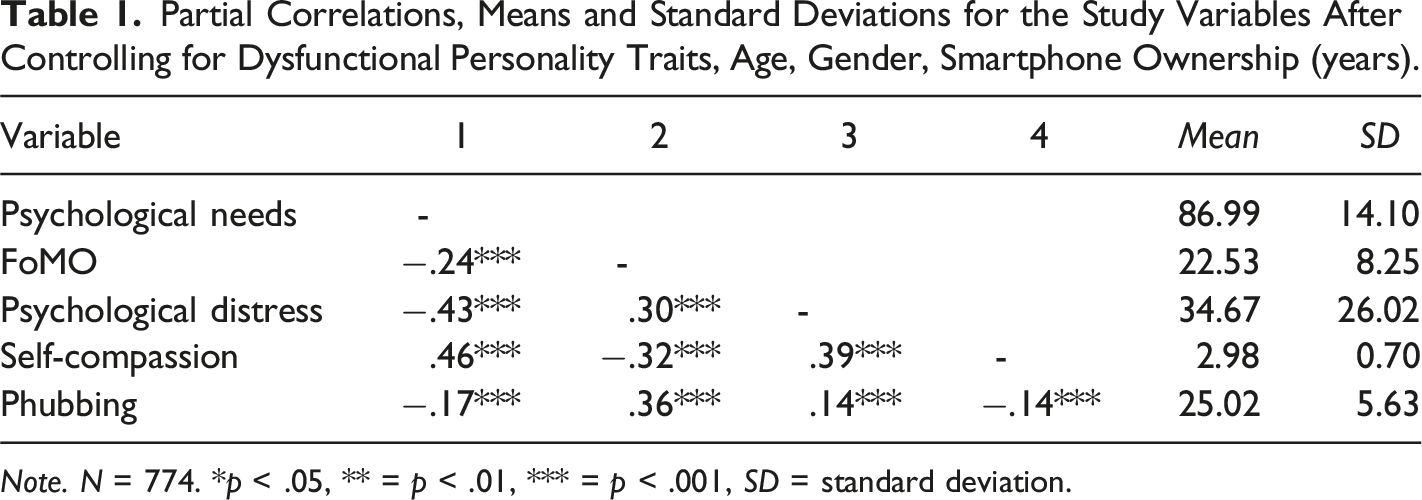
Note. N = 774. *p < .05, ** = p < .01, *** = p < .001, SD = standard deviation.
The mediation analysis revealed that psychological needs (i.e., predictor variable) had a significant negative relationship with FoMO (b = −.15, SE = .02, p < .001), and psychological distress (b = −.74, SE = .06, p < .001) and a significant positive relationship with self-compassion (b = .02, SE = .00, p < .001). Phubbing severity (i.e., criterion variable) significantly predicted FoMO (b = .25, SE = .03, p < .001) and psychological needs (b = −.04, SE = .02, p < .05). However, phubbing’s relationship with psychological distress (b = .00, SE = .01, p > .05) and self-compassion (b = .13, SE = .37, p > .05) were not significant. Regarding the total effect, psychological needs had a small negative significant effect on phubbing (b = −.08, SE = .02, p < .001) and when all mediators were included in the model, the direct effect of psychological needs on phubbing had a small negative significant (b = −.04, SE = .02, p < .05) relationship suggesting partial mediation. For the indirect effects, the FoMO pathway was significant (b = −.04, Boot SE = .01, 95% CI: −.05, −.02). Contrastingly, the paths through psychological distress (b = .00, Boot SE = .01, 95% CI: −.02, .01) and self-compassion (b = .00, Boot SE = .01, 95% CI: −.01, .02) were not significant.
Total, Direct and Indirect Effects in the Phubbing Mediation Model After Controlling for Dysfunctional Personality Traits, Age, Gender, Smartphone Ownership (years).
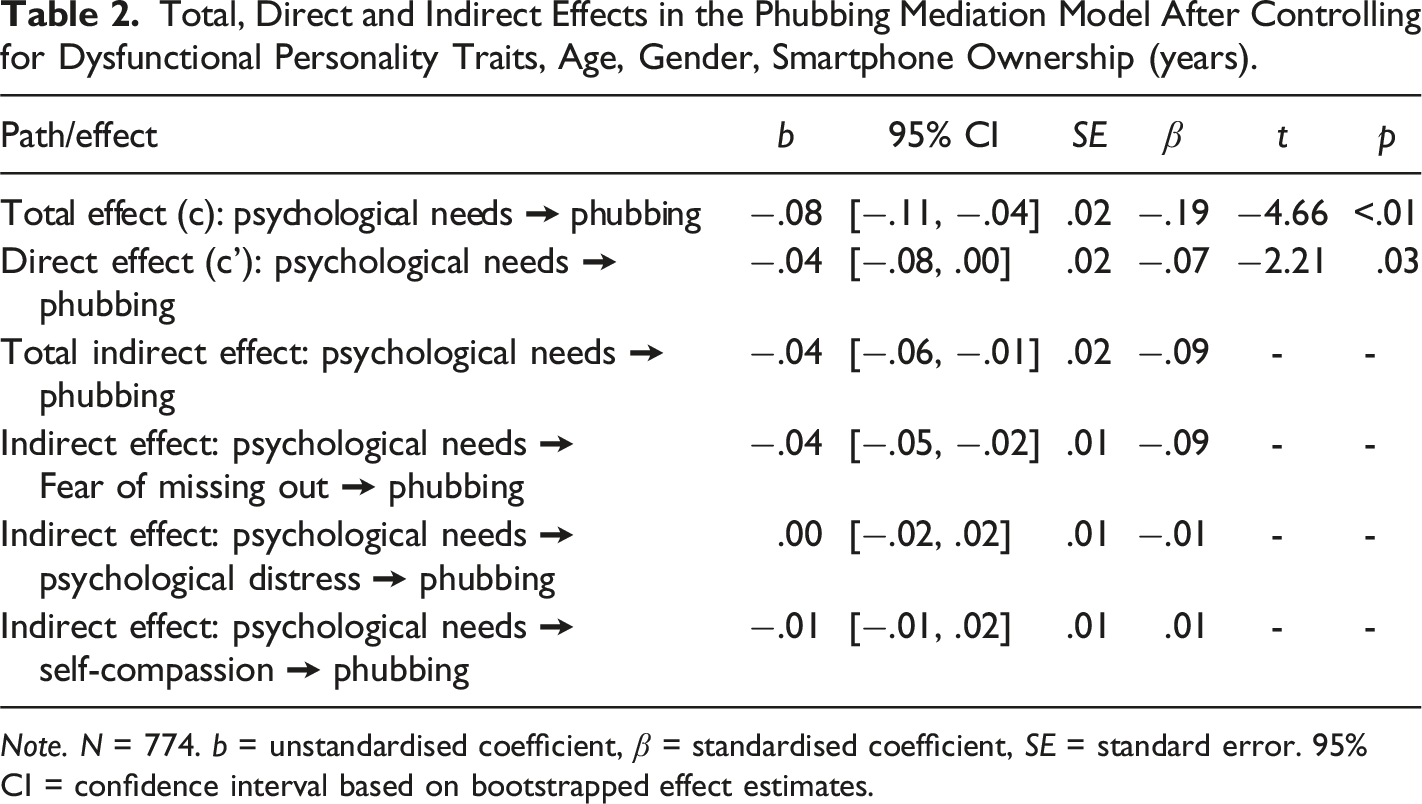
Note. N = 774. b = unstandardised coefficient, β = standardised coefficient, SE = standard error. 95% CI = confidence interval based on bootstrapped effect estimates.
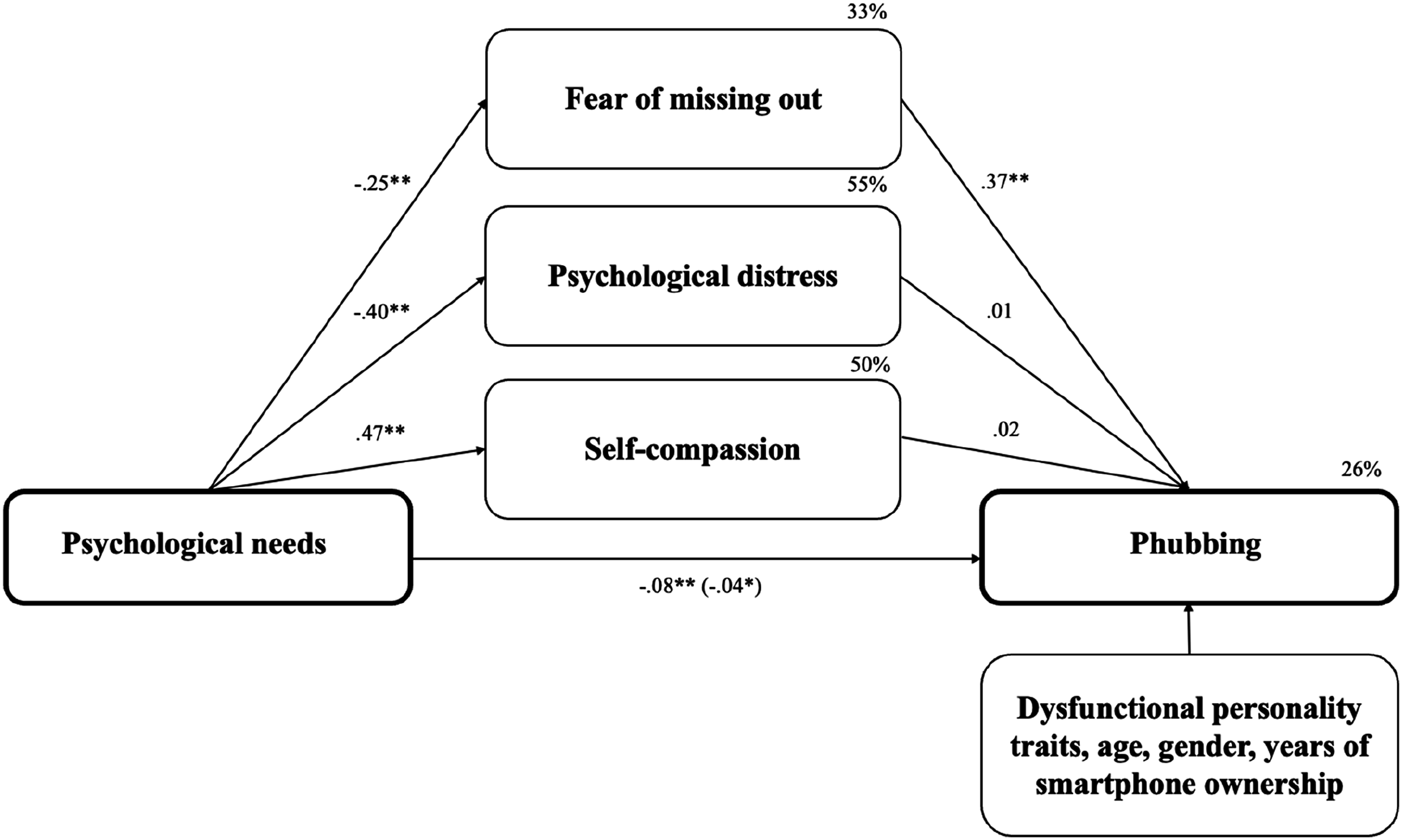
Final Mediation Model Displaying Standardised Regression Co-efficients for FoMO, Psychological Distress and Self-Compassion between Psychological Needs and Phubbing. Note. N = 774. Direct effect of psychological needs on phubbing after controlling for dysfunctional personality traits, age, gender, and years of smartphone ownership (*p < .05, ** = p < .01, *** = p < .001).
Discussion
Recent studies suggest that phubbing has become a prominent concern among young adults, with approximately one in four experiencing significant psychological distress (Sohn et al., 2019; Sudha et al., 2020). This behaviour not only carries profound social implications but is also associated with elevated levels of psychological distress (Bitar et al., 2023; Gao et al., 2023). This study sought to address the limitations of past research by evaluating an integrated mediational model of phubbing while including self-compassion (a known protective factor for PSU) and account for dysfunctional personality traits, age, gender, and years of smartphone ownership.
The hypothesis that reduced psychological needs would be associated with increased FoMO, psychological distress, phubbing severity, and reduced self-compassion after controlling for dysfunctional personality traits, age and gender and smartphone use (years) was supported. These findings are consistent with past research, which found that: psychological needs negatively correlated with FoMO (Butt & Arshad, 2021), psychological distress (Blachnio et al., 2021), and phubbing severity (Nuñez & Radtke, 2023) positively correlated with self-compassion (Geng, Bao, Wang, Wang, Gao, & Lei, 2022). The negative associations between FoMO, psychological distress and phubbing align with SDT and psychological needs theory suggesting that fulfilling autonomy (i.e., reduced smartphone self-control), competence (i.e., inefficient smartphone functionality management), and relatedness (i.e., need for meaningful social connections) satisfies psychological needs and reduces psychological distress, FoMO and phubbing (Butt & Arshad, 2021; Chen et al., 2015, 2022; Deci & Ryan, 2000). The positive correlation between self-compassion and psychological needs outcome aligned with research indicating that self-compassion fosters emotional well-being by addressing unmet psychological needs by promoting self-kindness (Geng, Bao, Wang, Wang, Gao, & Lei, 2022; Neff, 2003).
The second hypothesis that self-compassion, psychological distress, and FoMO would mediate the relationship between basic psychological needs and phubbing severity was partially supported. The significant mediating relationship of FoMO between psychological needs and phubbing was well supported by previous research (Butt & Arshad, 2021; Elhai et al., 2020; Przybylski et al., 2013). Within this framework, FoMO is associated with the adverse effects of unmet psychological needs, propelling individuals toward phubbing as a potential compensatory mechanism for unfulfilled real-world social interactions (Butt & Arshad, 2021; Dou et al., 2023; Elhai et al., 2021).
The non-significant mediating roles of psychological distress and self-compassion suggest a complex, non-linear relationship. It is possible that phubbing behaviour is particularly susceptible to the influence of FoMO when accompanied by psychological distress or low levels of self-compassion. This susceptibility may arise because individuals experiencing psychological distress or lacking self-compassion are more likely to engage in phubbing to mitigate feelings of anxiety or inadequacy. Furthermore, Chotpitayasunondh and Douglas (2018) and Hales et al. (2018) conceptualised phubbing as a form of social exclusion. Their theory extends the work of Williams (2007) on social exclusion by positing that feelings of exclusion contribute to phubbing behaviour. According to this perspective, individuals who feel excluded may turn to their smartphones as a coping mechanism that reinforces phubbing behaviours.
This contention suggests that while self-compassion may help individuals cope with the adverse effects of being phubbed (Geng, Bao, Wang, Wang, Gao, & Lei, 2022), it might not deter them from phubbing others. Phubbing could be more about seeking online validation through digital connectivity rather than smartphone usage (Barrault et al., 2019), and these motivations might overshadow the influence of self-compassion between psychological needs and phubbing.
Social exclusion might also contribute to the non-significant mediation role of psychological distress. Phubbing has been related to social exclusion that can lead to feelings of isolation and, consequently, elevate negative psychological responses, including depression and anxiety (Chotpitayasunondh & Douglas, 2018; Lai et al., 2023; Williams, 2007). However, these emotional responses might better reflect the individual’s reaction to being phubbed rather than their propensity to phub others. While the DASS-21 (Lovibond & Lovibond, 1995) captures the outcome of exclusionary experiences, it might not encapsulate the multifaceted motivations behind the act of phubbing itself. Thus, the intricate dynamics of social exclusion and the diverse manifestations of psychological distress could explain the non-mediation of psychological distress between psychological needs and phubbing behaviour.
Implications
The findings from this study have several clinical implications. Firstly, the results highlight that the emergence of problematic smartphone use (i.e., phubbing) is associated with individuals experiencing greater psychological needs. This finding has significance for the potential development of future interventions targeting the treatment of phubbing behaviours. Secondly, the results of this study demonstrate that there are multiple mediators of the psychological needs-phubbing relationship, which are known psychological processes modifiable through psychological interventions. For example, it is well-established that therapeutical approaches such as cognitive behaviour therapy and transdiagnostic approaches (e.g., self-compassion, dialectical behaviour therapy) can be used to target dysfunctional personality traits (Southward et al., 2023), FoMO (Chang et al., 2023), and psychological distress (Han & Kim, 2022). Clinically, practitioners should look to screen and target modifiable psychosocial processes that may underpin phubbing.
In terms of theoretical implications, the results of the mediation analysis present a challenge for the existing conceptualisation and measurement of phubbing, suggesting characteristics that were previously thought integral to phubbing (i.e., psychological distress and self-compassion) to be non-significant in explaining phubbing severity. Additionally, there is a need to clarify the clinical definition and diagnostic representation of FoMO, given that its operationalisation relies largely on self-report scales due to its absence of standardised diagnostic criteria (Przybylski et al., 2013; Tomczyk & Selmanagic-Lizde, 2018). A review highlighted that FoMO does not have a standardised diagnostic representation in the Diagnostic and Statistical Manual of Mental Disorders, Fifth Edition, Text Revision (DSM-5-TR; American Psychiatric Association, 2022) nor the International Classification of Diseases, 11th Revision (World Health Organisation, 2019). As such, the clinical assessment of FoMO relies on self-report measures (i.e., Przybylski et al., 2013), severely limiting a unified empirical approach to FoMO research. These findings highlight the need to explore the nature of phubbing further and revise the existing conceptualisation.
Limitations
There are several limitations to this study that warrant cautious interpretation of the results. Firstly, the study was administered as an online questionnaire, rendering it impossible to determine whether participants met the study eligibility requirements (i.e., English-speaking, aged 18 and over, or smartphone ownership and usage patterns) or were truthfully completing the questionnaire. In this study, the average age of participants (M age = 28.84 years) is higher than typically reported for global undergraduate populations, which generally fall within the early 20’s (OECD, 2021; Unesco, 2020). This age discrepancy may include non-traditional students, such as those returning to education later or studying part-time. While the findings are valid, caution should be applied when interpreting results involving younger undergraduate populations.
There was also the potential for self-selection and response bias. Given the infancy of the research regarding defining and measuring phubbing, it is difficult to differentiate between phubbing behaviours and other forms of smartphone addiction when measuring the construct (David & Roberts, 2020). It is also essential to recognise the research limitations by employing a cross-sectional design with a self-selected convenience sample that predominantly consisted of young, educated females (74% women). Therefore, wider generalisation based on the current findings should be undertaken with further replication involving samples representing the general population.
Future research should consider utilising contemporaneous data collection using ecological momentary assessments that provide real-time insights into participants’ cognitions and moods (Piot et al., 2022). Exploring other mediators and moderators such as emotional regulation (Fu et al., 2020), digital literacy (Zhang et al., 2023), and social exclusion (Holt-Lunstad, 2021) may also enrich our understanding of psychological needs and phubbing. Additionally, dysfunctional personality traits associated with addiction (Nuñez & Radtke, 2023), ostracism (Knausenberger et al., 2022), compulsive behaviours (Joshi, 2023), neuroticism (Guazzini et al., 2019; Sun & Samp, 2022) and the dark triad traits: Machiavellianism, narcissism, and psychopathy (Akat et al., 2023; Grieve et al., 2021) offer scope for future phubbing investigations. Last, longitudinal experimental designs exploring causal pathways that control for dysfunctional personality traits, age and gender are recommended.
Conclusion
This study provides new insights into the psychological mechanisms driving phubbing behaviour, focusing on the mediating role of FoMO. The findings suggest that unmet psychological needs contribute to phubbing primarily through increased FoMO rather than through psychological distress or self-compassion. The results have important implications for theory and practice, emphasising the need for targeted interventions that address specific social anxieties that drive phubbing. By enhancing our understanding of the factors that contribute to phubbing (i.e., FoMO anxieties induced by unmet needs), this study lays the groundwork for more effective strategies to mitigate the negative impacts of problematic phubbing behaviours.
Footnotes
Acknowledgments
The authors would like to thank all the individuals who participated in this research.
Author Contributions
Both authors confirm that they have made substantial contributions to the research reported in this manuscript, including the study design, data collection, analysis, and interpretation. Both authors have reviewed the manuscript, approved the final version, and agree to be accountable for all aspects of the work, ensuring that any questions regarding the accuracy or integrity of the research are appropriately addressed.
Ethical Statement

Data Availability Statement
The datasets generated during and/or analysed during the current study are available from the corresponding author on reasonable request and after relevant ethical approval.