




Abstract
In contemporary, high-speed work settings, ensuring the well-being of employees is of paramount importance. The current study builds on this concern about employee well-being and aims to explore the complex connection between workload (as a job demand), micro-breaks (as behavioral resources), and psychological capital (PsyCap; as a personal resource) to understand their impact on end-of-day well-being. A daily diary approach was employed, where employees provided data from Monday to Friday throughout a workweek. Micro-breaks exhibit significant negative associations with fatigue and positive associations with vigor, suggesting that employees experience reduced fatigue and heightened vigor when engaging in short respites. However, the type of micro-break activities (work-related or non-work-related) yields distinct effects on well-being. Contrary to our expectations, the data did not support the assumption that PsyCap moderates the relationship between workload and well-being. The findings underscore the importance of recognizing the value of micro-breaks in the contemporary work landscape. Employers and organizations can foster more supportive work environments by encouraging the adoption of micro-breaks as a strategy for improving employee well-being.
Introduction
Organizational stress researchers have focused for decades on how workplace demands affect employee-related outcomes, such as well-being, health, and performance (Bakker et al., 2023; Bliese et al., 2017). However, apart from a few exceptions, the research that raised the question of how employees use their free time to recover from the work demands was rather scarce until fairly recently (Sonnentag et al., 2022). This research area has grown exponentially over the past few years as reflected in several meta-analyses and literature reviews (Albulescu et al., 2022; Bennett et al., 2018; Karabinski et al., 2021; Steed et al., 2019; Wendsche & Lohmann-Haislah, 2017). However, with one exception where data considered is experimental (Albulescu et al., 2022) they are mainly focused on correlational patterns between variables and do not address the dynamic processes operating at the day level. Thus, important questions still linger about the dynamic and real-time process of recovery. One such question is: What underlying processes explain efficient breaks at work? Even more specifically: Are specific combinations of activities and experiences particularly effective in certain contexts and cultures and for certain groups? (Sonnentag et al., 2022). For example, we are yet to find out what makes a break efficient in recovering lost resources while working.
In the current study, we aim to advance knowledge in the field of recovery processes by bringing empirical evidence on the mechanisms that explain the effectiveness of breaks in the recovery process of employees. For this purpose, we rely on the effort-recovery model (ER-M; Meijman & Mulder, 1998) and the conservation of resources framework (COR; Hobfoll, 1989). According to the ER-M approach (Meijman & Mulder, 1998), the effort expenditure at work is associated with acute load reactions, which are experienced by the employee as physiological (e.g., accelerated heart rate) and psychological strain symptoms (e.g., fatigue). In the absence of further demands, load reactions are alleviated and strain symptoms decrease, signs that the recovery process occurs. When demands continue to be present, recovery cannot take place and load reactions accumulate, leaving the employee to resume work in a less-than-optimal state. In this situation, the employee will have to invest compensatory effort to perform adequately. The increased intensity of load reactions will, in turn, initiate an even higher demand on the subsequent recovery process, resulting in an accumulative process developing into chronic load reactions (McEwen, 1998). Thus, under ER-M, the absence of work demands is essential for the recovery process to start.
The COR framework, developed by Hobfoll in 1989, aims to elucidate how people manage stressors. According to COR, when individuals deplete their resources, they tend to reduce their engagement in demanding tasks and instead focus on preserving and acquiring additional resources to mitigate future resource loss (Hobfoll et al., 2018). This implies that when employees experience low energy levels, they are more likely to take more frequent breaks from work. Using cross-sectional data, Fritz et al. (2011) found break activities to be positively related to fatigue but negatively related to vitality, results leading them to speculate that employees engage in helping behaviors only when their energy is already at low levels. Energy (i.e., vigor) is thus seen as a subjective experience individuals strive to retain, protect, and build. In the work context, job demands are seen as depleting one’s resources, such as vigor and increasing fatigue (Bakker et al., 2023). To replenish the resources that become depleted during a challenging workday, employees allocate extra resources to facilitate the recovery necessary for their subsequent return to work. However, our knowledge about what makes a resource particularly effective in the recovery process is still limited. Thus, recovery is not merely the absence of demands or taking some time off from demands, but a dynamic process aimed at restoring the energetic resources expended throughout the workday (Zijlstra et al., 2014).
Building upon this conceptual framework, our first focus is directed towards the recovery process within working hours. More precisely, we are interested in exploring micro-breaks, which are brief, lasting less than 10 minutes, and are voluntary opportunities for recovery (Kim et al., 2017, 2018). Past studies show that taking micro-breaks between work tasks is an efficient way to momentarily recover from work demands, as they are taken at the employee’s discretion, on a need basis (Kim et al., 2017). We chose this specific opportunity to recover from work-related demands and effort, as past studies show that recovery is a dynamic process, with variability even across one workday (Hülsheger, 2016; Hunter & Wu, 2016). Thus, even if their effect is fleeting and short-lived (Dababneh et al., 2001), micro-breaks can be efficient for momentary alleviating the negative effects of work demands, being associated with a decrease in fatigue and negative affect and an increase in positive affect and work engagement (Kim et al., 2022; Zhu et al., 2019). In other words, micro-breaks can be seen as behavioral resources, as they serve as a resource-replenishing activity.
The second focus is on one specific resource-draining work characteristic – workload, and how the variability within a day of this demand shapes the engagement in different strategies (micro-breaks) to help alleviate fatigue and keep high levels of vigor throughout the workday. At the intra-individual level, we examine how day-specific workload level influences the activities employees engage in during the workday, and which of these activities are helpful for employee energy (i.e., fatigue and vigor). We also test the moderating effects of micro-break activities on the link between stressors and strain, thus examining the main assumption of the effort-recovery model (Meijman & Mulder, 1998) stating that recovery refers to recuperation from “negative load reactions” of work demands.
In addition, we take into consideration a cross-level moderator as a boundary condition of taking a micro-break, namely psychological capital (PsyCap). PsyCap, as a “positive psychological state” (Luthans & Youssef, 2007, p. 334) can enable employees to evaluate a certain situation and pursue success in the situation through motivation and perseverance (Luthans et al., 2007). Psychological capital is seen as an internal mechanism of recovery in improving employee well-being (Fang & He, 2023). Thus, we propose that such individual-level positive factors can influence whether and how employees are taking a break during working hours.
The present study aims to examine how the recovery process unfolds within a working day during micro-breaks and how employees manage their well-being throughout recovery activities during micro-breaks at work. In other words, if and how employees are using micro-breaks to manage their well-being levels throughout a working day, mitigating the negative effects of job demands.
Micro-Breaks as Behavioral Resources for Recovery
Micro-breaks are short breaks lasting a few minutes, taken from work tasks in the course of a workday (Bosch & Sonnentag, 2019), unstructured and informal (Sianoja et al., 2015) during which the employee is shifting attention away from work towards something else (Hunter & Wu, 2016). Employees either decide to take a break on their own such as to look out the window (Fritz et al., 2011) or to join in a break initiated by other colleagues, as a strategy to replenish their resources (Zacher et al., 2014) because their resources are low or threatened (Hobfoll, 1989), to regain their energy and to better focus on work (Kim et al., 2022) or because they feel that they need a reward (Bosch & Sonnentag, 2019).
Research identified 42 specific activities that can be used during short breaks between work tasks to restore energy, and which can be related to the work setting (e.g., reflecting on the meaning of work) or be unrelated to it (e.g., taking a walk outside) (Fritz et al., 2011; Zacher et al., 2014). Thus, energy management can create opportunities for respite and recovery (via work breaks), as well as target work itself (via work-related strategies), to make it more motivating or less draining (Trougakos & Hideg, 2009).
Non-work-related breaks seem to be more effective for the momentary recovery of energy (Zacher et al., 2014). However, the energy-related benefits of work-related strategies were evident in between-person comparisons (Fritz et al., 2011; Kinnunen et al., 2015). Work-related strategies might consume resources in the moment and increase stress arousal (Parker et al., 2017) but build benefits over time with repeated use, potentially through mechanisms such as building personal resources or receiving social support (Trougakos & Hideg, 2009; Zacher et al., 2014). Work-related strategies can combine with non-work-related strategies with effects for well-being outcomes. For example, it was found that the frequent use of work-related strategies in combination with physical micro-breaks (i.e., going for a walk, stretching), as compared with less frequent use of these strategies and more use of private micro-breaks (i.e., reading, listening to music, web surfing), was associated with more vitality (Kinnunen et al., 2015). Thus, an important question is which combinations of strategies are most beneficial for the recovery of lost resources and increased well-being (Sonnentag et al., 2022).
Do recovery activities (as behavioral resources) employees engage in during the workday have an influence on end-of-day well-being (i.e., low fatigue and high vigor)?
Job Demands and the Recovery Process
The past several decades have witnessed a dramatic increase in pressure, as well as in mental fatigue (Green, 2004; Perlow, 1999). Specific aspects of work, including high workload, responsibilities, and time pressure considered “challenge stressors” (Lepine et al., 2005; Podsakoff et al., 2007). The trend of increasing challenge stressors is unlikely to reverse itself anytime soon (Kudesia et al., 2022). Unlike other stressors (e.g., job insecurity), challenge stressors are not entirely negative, as they produce ambivalent outcomes, being simultaneously helpful and harmful. Challenge stressors can helpfully prompt people to drive their cognitive resources into tasks, improving engagement, but harmfully could produce feelings of fatigue as a result (Crawford et al., 2010; Widmer et al., 2012). Thus, the question of how to manage the ambivalent outcomes of challenge stressors has become highly relevant from both practical and scholarly perspectives.
Job-related factors play an important role in recovery. Job demands may initiate a health-impairment process if exposure to daily workload transforms into chronic overload. In this case, job demands lead to chronic exhaustion and may eventually result in physical health issues (Bakker & Demerouti, 2018). According to COR perspective (Hobfoll, 1989), people who lack various types of resources are susceptible to losing even more resources and psychological distress (Heath et al., 2012). Moreover, resource loss can also prevent switching of the situation into gain cycles, as there are not enough resources to invest to gain new resources.
Employees do not simply react to their work environments; they also actively influence their job characteristics through adaptive or maladaptive self-regulatory strategies. There are many different activities employees may engage in during micro-breaks to recover, including taking a walk outside, having a social chat, or engaging in a relaxation exercise. Considering this, we look at micro-breaks as behavioral resources one can use to recover promptly from work-related demands to protect individual well-being. When employees are exposed to high job demands and experience increased job strain, they are less likely to engage in recovery activities and less able to recuperate (e.g., Kinnunen & Feldt, 2013; Sonnentag, 2012; Steed et al., 2019).
Nonetheless, taking breaks during the work day is beneficial. Day-level studies showed that engaging in recovery activities is related to overall well-being at bedtime (Sonnentag, 2001) and to low exhaustion and high vigor the next morning (ten Brummelhuis & Bakker, 2012; ten Brummelhuis & Trougakos, 2014). Leisure activities such as physical, social, or creative activities are more helpful for improving well-being than passive leisure activities such as watching TV (Kuykendall et al., 2020). In a recent review of the literature, physical exercise was found to be particularly effective in improving well-being (Calderwood et al., 2021). However, physical activities have complex effects for employees, being related to bedtime procrastination and further to low sleep quality and low vitality (Liu et al., 2021).
Daily-focused research found that both relaxation, and cognitive and social activities moderated the relationship between work demands and end-of-workday negative affect, whereas no moderation effect was found for nutrition intake micro-break activities (Kim et al., 2017). Specifically, engagement in relaxation or social activities during micro-breaks reduced the effects of work demands on the end-of-workday negative affect. In contrast, on days when individuals had high levels of cognitive micro-break activities, work demands, and negative affect had a stronger relationship. It was also found that mindfulness at work moderated the relationship between emotional demands at work and the experiences employees had after the workday was over (Haun et al., 2018). Thus, in the present study, we expect that micro-breaks act as behavioral resources buffering the negative effect of job demands on well-being.
The relationship between workload and well-being (vigor/fatigue) is moderated by micro-breaks as behavioral resources.
Personal Resources
Individuals differ in the way they allocate their time and energy to their work tasks, sometimes even at the expense of having time to recover from work, with negative consequences for their well-being (Bakker et al., 2013; Giunchi et al., 2016; Van Beek et al., 2012; Van Wijhe et al., 2013).
The Big Five personality factors are only weakly related to recovery experiences (Sonnentag & Fritz, 2007), but negative affectivity showed a consistent, albeit small, negative correlation with psychological detachment (Wendsche & Lohmann-Haislah, 2017). Other studies found positive associations between extraversion, agreeableness, and conscientiousness, and psychological detachment from work during the off-job time, and negative ones between openness to experience and neuroticism and detachment (Naseer et al., 2012). These results suggest that individuals who are high in extraversion, agreeableness, and conscientiousness detach mentally from their work when they get home. Personality affects the need for recovery both directly (e.g., high emotional stability contributed to reduced need for recovery after work) and indirectly, through work-related factors (e.g., high openness to experience and extraversion contributed to an increased need for recovery through perceived social support and job pressure) (Fostervold & Watten, 2022). Taken together, these results suggest that personality can shape how people think and act relative to work conditions, the needs they have relative to recovery, and the activities they engage in.
Positive psychological capital is an individual’s positive psychological state of development, comprising four positive psychological resources, namely self-efficacy, optimism, hope, and resilience (Luthans et al., 2005). Importantly, psychological capital (PsyCap) is maleable, each component having the potential to be developed through training and practical interventions (Luthans et al., 2008). A growing body of empirical research suggests that individuals’ PsyCap is positively related to well-being (Avey et al., 2010; Culbertson et al., 2010; Luthans et al., 2008). A meta-analysis of 51 studies indicated significant relationships between employees’ PsyCap, general well-being, and a variety of work-related outcomes (Avey et al., 2011).
PsyCap’s stress-buffering effects have been identified in many studies, most of them indicating a negative relation to stress (Avey et al., 2011), thus it appears to provide individuals with mental hardiness to effectively cope with challenging circumstances. Therefore, both theory and empirical findings suggest that psychological capital can offer a buffer against high experienced strain (Baron et al., 2016). Previous research shows that psychological capital is a protective factor of mental health (low anxiety and depressive symptoms). However, little attention has been paid to the underlying explanatory mechanism and few studies, if any, have attempted to address the role of demands in the relationship between PsyCap and well-being. As this construct builds upon motivation for future tasks and feelings of capability, it can influence how employees interact with the demands and challenges of their professional role. It was suggested that PsyCap can be seen as a personal resource to help employees to perceive their work situation more favourably. Specifically, employees higher on PsyCap can tend to perceive their job demands more positively, as having more resources to get the job done. This way, the demands are approached with more confidence, are perceived as being less overwhelming, which affects employee’s well-being (Grover et al., 2018).
Taken together, knowledge of the role of rather stable individual difference variables for recovery is still limited. Moreover, this would be the first study, as far as we know, testing the effect of PsyCap as a personal resource in the relationship between job demands and recovery at work (Figure 1). A hypothetical multilevel model of behavioral and personal resources buffering the relationship between workload and well-being.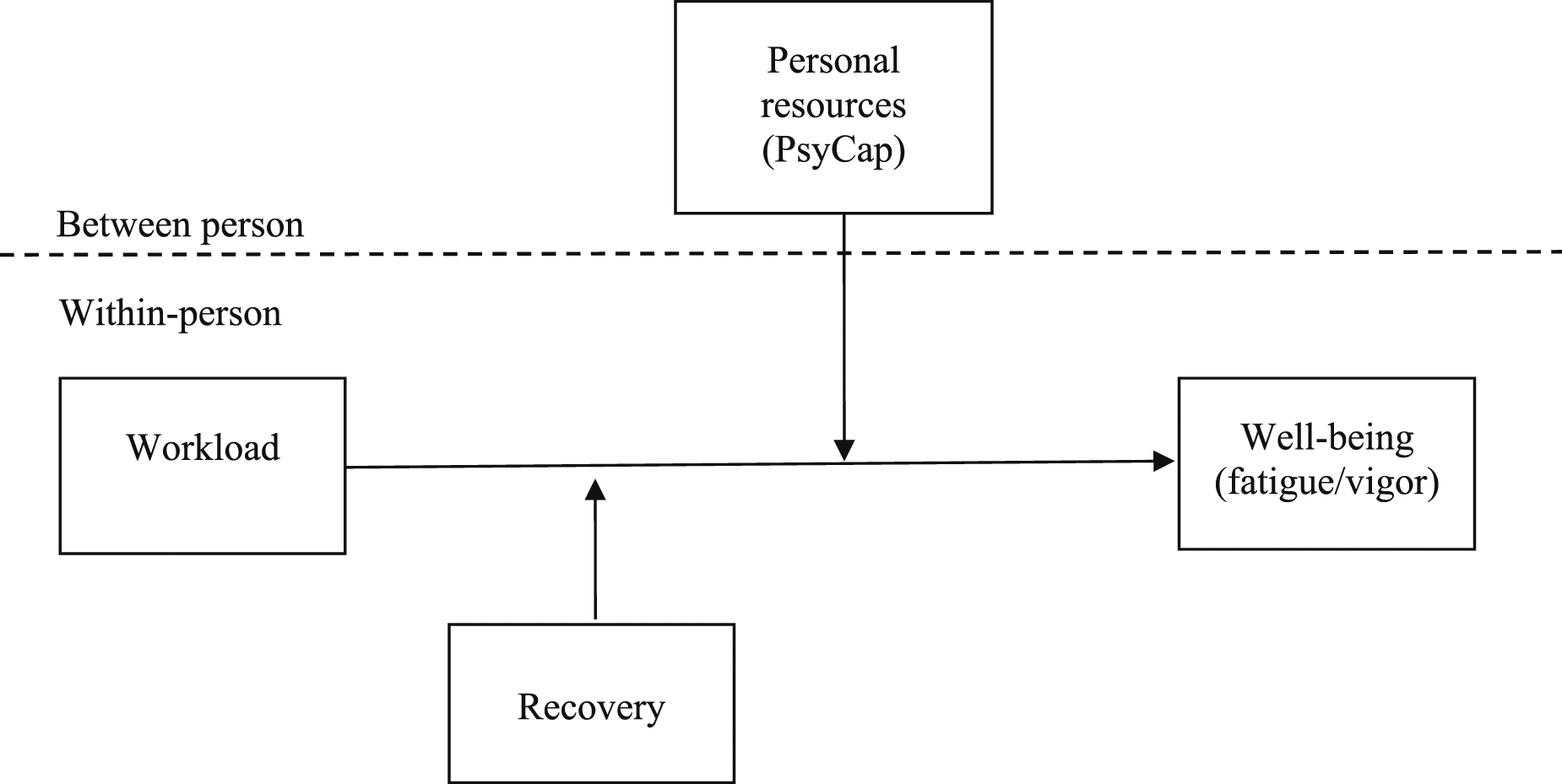
The relationship between workload and well-being (vigor/fatigue) is moderated by personal resources (PsyCap).
Method
Procedure and Participants
Procedure
Interested individuals read and agree with the consent form. Afterwards, they were invited to fill in a baseline assessment that included demographic information (e.g., age, gender, marital status, dependents such as children or persons under care, education level, etc.), basic job information (e.g., weekly/daily work hours, shift work, leadership role, type of activity, etc.), break habits during the work day (frequency of micro-breaks and duration), well-being (i.e., happiness and life satisfaction), health status, and personal resources (i.e., PsyCap). Those who completed the initial assessment were subsequently invited to participate in the daily surveys that was scheduled to start one week after the baseline assessment.
Exclusion criteria for the daily survey responses: (a) we used a time-limited completion window (e.g., between 5 and 6 PM, with delays in responses larger than 1 hour being considered not valid); (b) we removed the observations where more than 10 minutes were spent on one break; (c) we removed observations for careless responding; and (d) we removed duplicate observations for respondents who completed the same survey twice. Moreover, the participants had to have a full-time employment contract, be working 5 days per week, and have fairly regular working hours (i.e., no night-time shift work) to be included in the final sample.
Participants
A convenience sample of participants were invited to take part of in this study. However, in order to be included in the final sample participants had to: (1) be full-time employee, (2) have a five days per week work schedule, and (3) have a fairly regular working hour program (i.e., no night-time shift work). Overall, 202 employees filled in the baseline survey (from 268 invites sent, yielding a 75.37% response rate for this data collection phase). As commonly occurs in daily diary research, participants either skipped some of the daily surveys (n = 63; filling in 1 to 4 days) or did not complete any daily surveys after the baseline (n = 97). Therefore, using a similar strategy with Nezlek (2012), in our final sample we included only those participants with at least two valid daily survey sets (N = 105; 51.89% of 202 employees responding to the baseline survey). Thus, out of possible 525 data points, the number of observation for L1 was 435, with 105 number of clusters at L2, as the sample for this level. The average cluster size was m = 4.143 (average of daily responses).
Multiple independent t-tests showed that the final sample did not significantly differ from those removed in terms of age, t(200) = −.214, p = .831, gender t(200) = −.017, p = .986, social status t(200) = .174, p = .861, education, t(200) = −.208, p = .835, happiness t(200) = −.154, p = .877, life satisfaction, t(200) = .559, p = .577, health t(200) = .061, p = .952, or personal resources available (i.e., PsyCap) t(200) = .693, p = .492, and work characteristics such as occupation, t(200) = −.578, p = .566, job tenure, t(200) = −.996, p = .319, the type of work carried on, t(200) = −.550, p = .585, hours worked, t(200) = .658, p = .505, or days worked within a week, t(200) = −.545, p = .588. Moreover, there was no significant difference between the two groups in terms of the organizational climate they are embedded concerning taking micro-breaks (t(200) = −.840, p = .403; t(200) = −.090, p = .928).
Participants’ age ranged from 21 to 55 years (M = 31.7, SD = 6.7). The majority were female (72%), residing in an urban area (89.4%), married or in a relationship (59.1%), without persons under care such as children or elderly (81.6%), holding a higher education degree (bachelor 37.7%; masters 47.4%), and without a leadership role in the organization (84.6%). Most of the participants worked full-time (part-time 14.9%; full-time 68.9%; 15.8% working more than 8 hours per day). A large part of participants had three or more years of experience in their current job (48.3%) and worked mostly online (43.9%). Slightly more participants were working from the office (49%) than from home (35.4%) or had a mixed schedule of working from home and the office (14.7%). Also, the participants were mostly working in IT (31%) and sales or services (18.4%).
Measures
All instruments’ items were in Romanian. For the instruments not previously available in Romanian, we applied a translation – back translation procedure (Klotz et al., 2023).
Baseline Measurements
Behavioral Resources
Micro-breaks, as behavioural strategies, were assessed both in the baseline and daily survey with a formative measure developed by Kim et al. (2017, 2018) and Parker et al. (2017), adapted originally from Fritz and colleagues’ (2011) scale. The 10 items measuring non-work-related micro-break activities were based on Kim et al.’s (2017, 2018) questions, referring to relaxation activities (2 items; e.g., “Stretching, walking around the office, or relaxing briefly”), nutrition-intake (2 items; e.g., “Drinking caffeinated beverages such as energy drinks, coffee, black or green tea”), social (3 items; e.g., “Chatting with coworkers on non-work related topics”), cognitive (2 items; e.g., “Reading books, newspapers, or magazines for personal learning or entertainment”), to which we added one item measuring nature-related activities in the work setting (1 item; “Taking care of my office plants”). Work-related micro-break activities were also based on Fritz and colleagues’ (2011) items, as well as Parker et al.’s (2017) energy management strategies, which included organizing activities (1 item; “I organize myself to accomplish work-related tasks such as: make a to-do list, check and update schedule, set a new goal), reflection activities (2 items; e.g., “Reflect on how I make a difference at work”), prosocial activities (2 items; e.g., “Talk to a co-worker/supervisor, seek feedback”), and emotion-related activities (2 items; e.g., “Focus on what gives me joy at work”). A six-point Likert scale was used for collecting responses to these 17 questions, ranging from zero (not possible at my current job) to 5 (frequently). All the micro-breaks items used in this study were previously tested by the research team in a small pilot survey during early 2019, making sure that all the possible behavioral strategies were covered in this questionnaire, as well as to gain insights on the relevance of the ones included and the language used. Besides the behavioral strategies collected, we also enquired about their frequency with 1 item (i.e., “How often do you take these short breaks?”, with response options of more than one break per hour, one break per hour, one break at 2 hours, one break at 3 hours, twice a day, once a day and I cannot take micro-breaks at work ) as well as their duration with 1 item (i.e., “Please specify the average duration of such activity carried out.”, with the response options of zero to 2 minutes, 3 to 5 minutes, 6 to 8 minutes, 9 to 10 minutes, and more than 10 minutes).
Personal Resources
For the assessment of the psychological capital construct, The Compound Psychological Capital Scale was used (CPC-12; Lorenz et al., 2016). The scale was successfully used in previous studies on Romanian samples (Turliuc & Candel, 2022). We chose to use the revised version of the CPC-12 as it demonstrated better psychometric characteristics than the original instrument (Dudasova et al., 2021). The scale consisted of 12 items, containing the four components of psychological capital, namely hope (3 items; e.g., “Right now, I see myself as being pretty successful”), resilience (3 items; e.g., “Failure does not discourage me”), optimism (3 items; e.g., “Overall, I expect more good things to happen to me than bad.”) and self-efficacy (3 items; e.g., “I can solve most problems if I invest the necessary effort”). This instrument presents the four PsyCap dimensions (i.e., hope, optimism, resilience, self-efficacy) and also permits the use of a total score, obtained by computing the responses from all the items. For each statement, answers were provided through a 6-point Likert scale ranging from 1 (strongly disagree) to 6 (strongly agree), as higher scores indicating higher levels of PsyCap.
Well-Being and Health
Following the example of de Bloom et al. (2014), we measured general well-being with two items related to happiness and satisfaction with life. One item measured happiness: “How happy do you feel in general?” with a Likert-scale from 1 (very unhappy) to 10 (very happy) and one item measured satisfaction: “How satisfied do you generally feel about your life?” with a scale from 1 (very dissatisfied) to 10 (very satisfied). Health status was also measured with one item (i.e., “How would you rate your general health status?”), based on de Bloom et al. (2014) study. The Likert response scale ranged from 1 (very unhealthy) to 10 (very healthy).
Daily Measurements
Behavioral Resources
Daily micro-breaks were assessed in the end-of-work survey with the same measure used in the baseline, slightly modified to capture the daily dynamic. Ten items measured non-work-related micro-break activities, whereas the other seven items measured work-related micro-break activities, as described above. Participants responded to these items by marking how many breaks they had across the workday, from zero (no such break taken today) to 10 (ten such breaks taken today). After choosing which type of breaks they took during the workday, the respondents also typed the duration for these micro-breaks, expressed in minutes. If an activity was performed for more than 10 minutes, this break was removed from the subsequent analyses, as to reflect the definition of micro-breaks.
Job Demands
We measured day-specific workload at the end of the workday with a short three-item Quantitative Workload Inventory (Spector & Jex, 1998), on a 5-point rating format (1 = strongly disagree to 5 = strongly agree). An example item was “Today, I had a lot of work to do.” We measured day-specific workload because it could influence employees’ engagement in micro-breaks as well as end-of-work fatigue (Kim et al., 2022). This measure was previously successfully used in other daily studies (Kim et al., 2018, 2022) as well as on similar populations (Tecău et al., 2020).
Well-Being
Day-specific fatigue was measured with one item adapted from the work of Van Hooff et al. (2007) and Sianoja et al. (2018). Participants rated their current state of fatigue (“I feel fatigued at this moment”) on a scale from 1 (strongly agree) to 7 (strongly disagree). Similarly, we measured vigor at the end of the workday with one item (“I feel energized at this moment”), adapted from Schaufeli et al.’s (2017) ultra-short measure of work engagement. The item on vigor, namely “At my work, I feel bursting with energy” was slightly modified to capture the vigor levels at the end-of the workday. This item was selected as it refers most unambiguously to the employee’s level of energy, which is considered a hallmark of vigor. Respondents self-assessed their vigor level on a scale form 1 (strongly agree) to 7 (strongly disagree). For the analysis, we recoded the two variables related to fatigue and vigor such as higher values to indicate higher levels of fatigue and vigor, respectively.
Control Variables
We controlled for sleep quantity and quality, as well as day-specific working hours as these variables could affect micro-breaks engagement and end-of-work energy levels (Kim et al., 2022). A single item was used to assess sleep hours (“How many hours did you sleep last night?”), respondents filling in the number of hours slept during the previous night. One item measured sleep quality (“How would you evaluate your previous night’s sleep?”) on a scale from 1 (very bad) to 5 (very good). Higher values indicate better sleep quality and quantity during the previous night. A single item was used to assess work hours (“How many hours did you work today?”), where respondents filled in the number of hours worked during the respective workday.
Statistical Analysis
We analyzed the data by Hierarchical Linear Modeling using Maximum Likelihood Estimation with robust standard errors to test the proposed model in MPlus (Muthén & Muthén, 2012). In the first step, we ran a null-model and assessed the proportion of variability explained by between-person differences using the ICC (Bliese, 2000). In the second step, we added the level 1 predictor (i.e., workload). In step 3, we added the L1 interaction term to assess the moderating effect of micro-breaks. In step 4, we allowed the slopes of the relationship between workload and well-being to vary randomly. In step 5, we used the level-2 variable (PsyCap) to predict the intercept of well-being. In the final step, we tested the cross-level moderating effect of personal resources by regressing the workload-well-being slope on it. We centered the level-2 predictor around the grand mean and the level-1 predictors around the person-mean, to obtain interpretable interaction terms (González-Romá & Hernandez, 2017).
After each step, we tested the improvement in model fit using Bayesian Information Criteria (BIC), and Akaike Information Criteria (AIC) and calculated the Satorra-Bentler scaled chi-square difference based on the log-likelihoods (Satorra & Bentler, 2010).
Results
On average, participants tended to engage more frequently in micro-breaks unrelated to the work environment or tasks (M = 23.11, SD = 27.56) than in breaks related to their work (M = 12.13, SD = 17.58). As specific activities performed during micro-breaks, participant’s preferred activities included snacking or drinking non-caffeinated beverages such as juice, water, or vitamin water (M = 3.24, SD = 3.06), with 45% of them taking up to 3 such breaks during the workday, and 20.7% taking from 7 up to 10 such breaks. Also, participants frequently chat with family members or friends online, on social media, or over the phone (M = 2.99, SD = 3.08) during their short breaks at work, with 43.4% of them taking at least 3 such breaks throughout the work schedule, and 16.2% taking between 7 and 10 such socializing breaks. The least preferred activity was related to nature, such as taking care of plants at work (M = .52, SD = 1.59), with 82.5% of participants taking no such breaks throughout the workday. Regarding job-related activities, our participants most frequently indicated offering help to a colleague or doing something that makes a colleague happy (M = 2.32, SD = 2.69), 35.7% declaring that they take up to 3 such work breaks. Most of the participants declared spending either 3–5 minutes (31.7%), or about 9 to 10 minutes engaging in micro-breaks (30.7%) per day, taking one such break at an interval of 2 hours worked (36.6%). At the extremes, only 5.4% declared that they take more than one micro-break for each hour worked, whereas 4.5% of the participants declared that they take just one micro-break a day. None of the participants declared that they could not take discretionary short breaks during their workday.
Correlations, Reliabilities, and Descriptive Statistics.
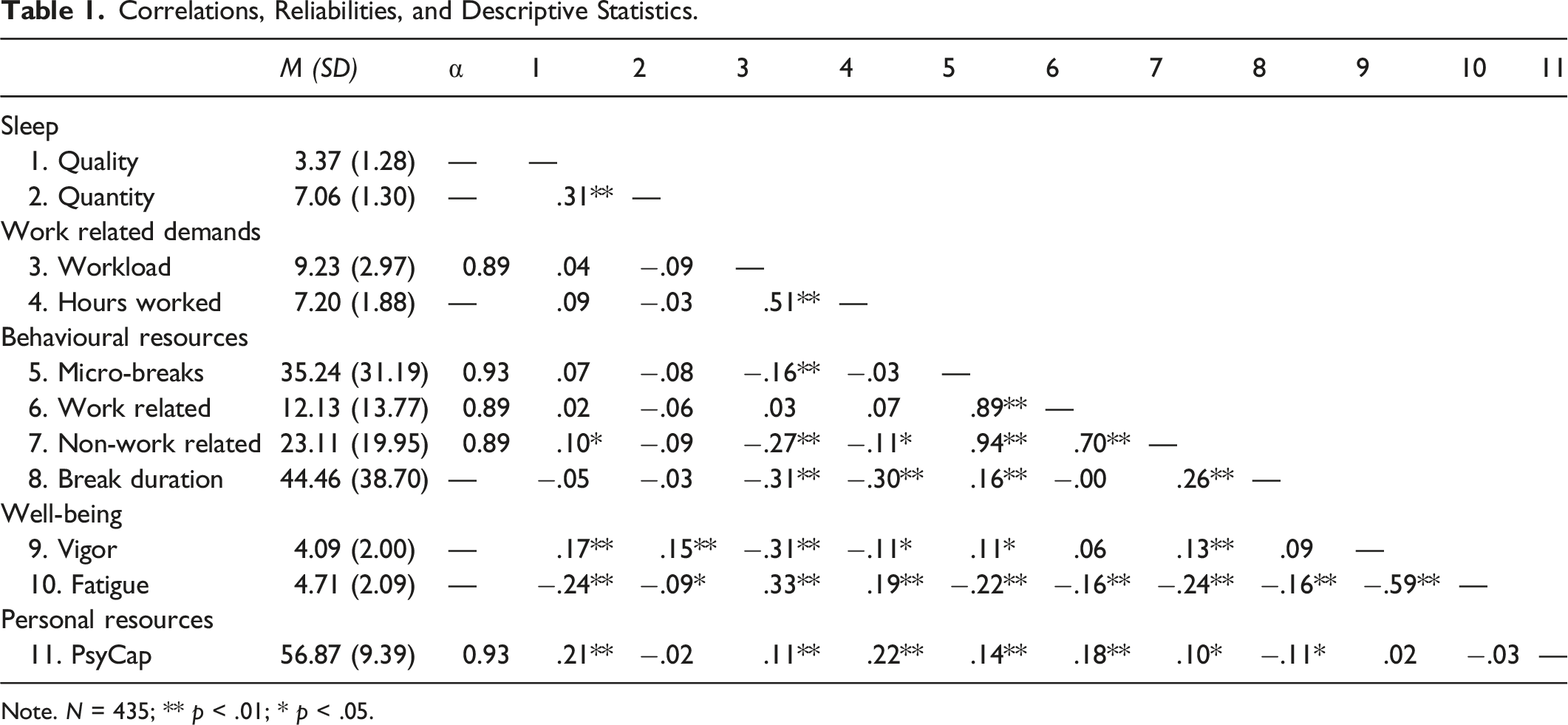
Note. N = 435; ** p < .01; * p < .05.
Results showed good reliabilities for all multi-item scales used in this study, with internal consistencies marginal to or above .90. The associations between variables of interest were in the expected direction. Specifically, last night’s sleep was statistically significantly and positively associated with employee vigor (r(433) = .17, p < .001 for sleep quality, and r(433) = .15, p < .001 for sleep quantity), and positively associated with fatigue (sleep quality r(433) = −.24, p < .001; sleep quantity r(433) = −.09, p < .005), as assessed at the end of the workday. Sleep quality also was significantly and positively associated not only with well-being at the end of the workday but also with engagement in specific behaviors during the day, namely non-work related activities. The perceived workload during the day was statistically significantly and negatively associated with vigor, r(433) = −.31, p < .001, and positively associated with fatigue, r(433) = .33, p < .001, showing that when employees have an increased workload, their well-being decreases. Micro-breaks as behavioral resources were statistically and negatively associated with fatigue, r(433) = −.22, p < .001 and positively associated with vigor r(433) = .11, p < .005, indicating that when employees are engaging in micro-breaks, they tend to feel better at the end of the workday. Looking at the type of the micro-break, results showed that the same holds for non-work related activities, with negative associations with fatigue, r(433) = −.24, p < .001, and positive ones with vigor r(433) = .13, p < .001, whereas work-related activities were significantly associated only with fatigue, r(433) = −.16, p < .001. PsyCap as a personal resource had no significant association with either of the outcomes (r(433) = .02, p = .577 for vigor, and r(433) = −.03, p = .511 for fatigue).
Results of Multilevel Analysis With Vigor as an Outcome.
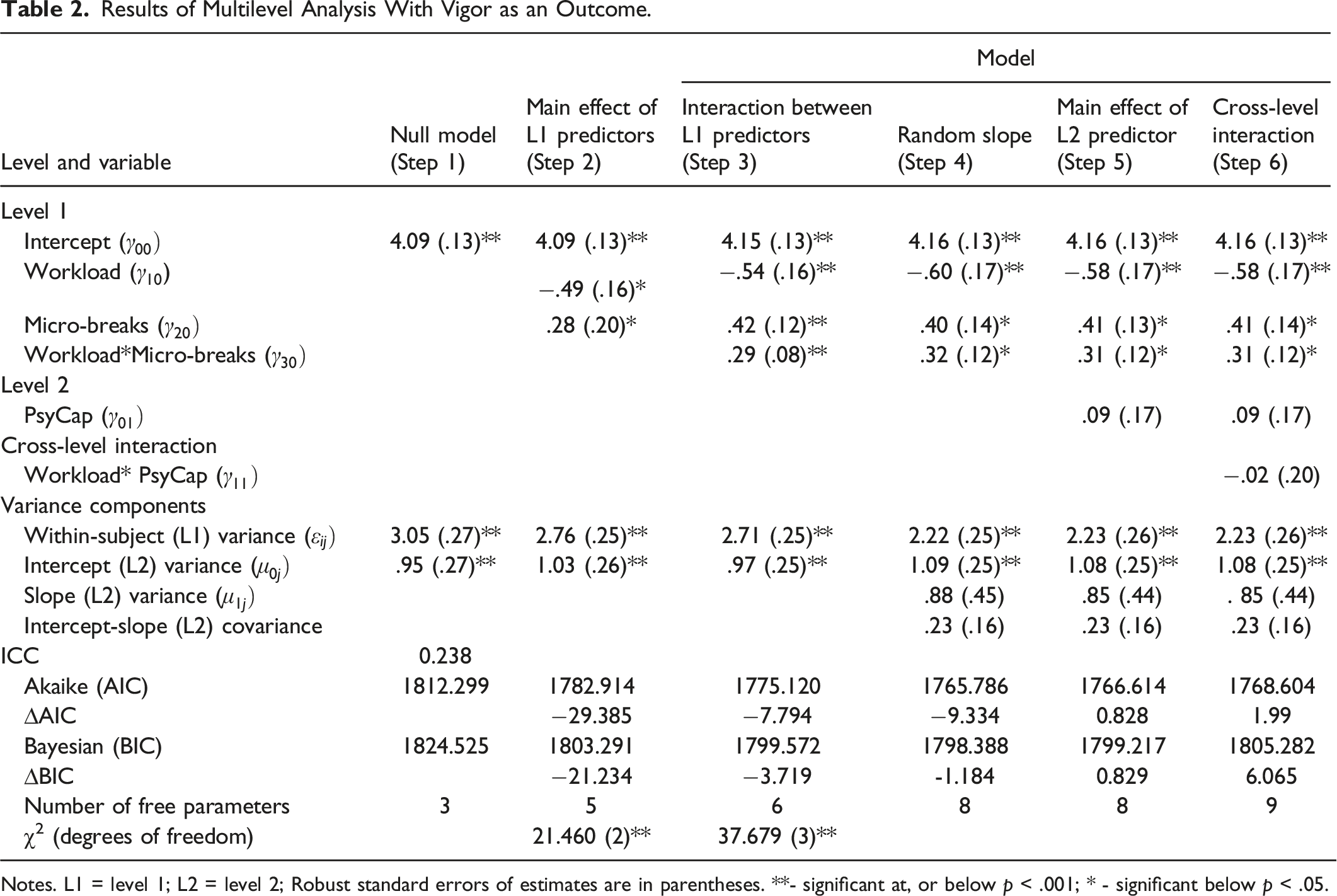
Notes. L1 = level 1; L2 = level 2; Robust standard errors of estimates are in parentheses. **- significant at, or below p < .001; * - significant below p < .05.
Results of Multilevel Analysis With Fatigue as an Outcome.
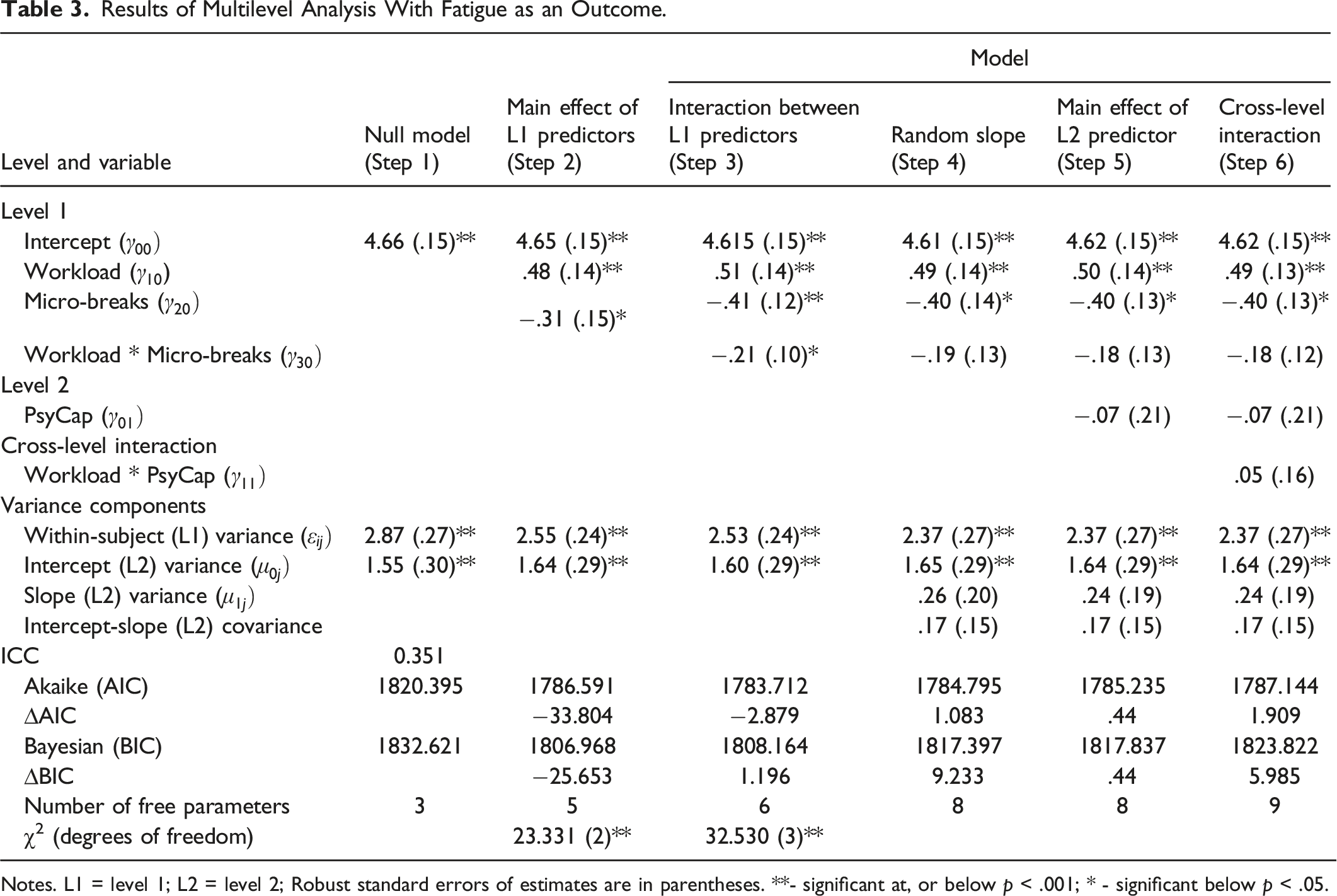
Notes. L1 = level 1; L2 = level 2; Robust standard errors of estimates are in parentheses. **- significant at, or below p < .001; * - significant below p < .05.
The results supported our first research question (RQ1). Specifically, micro-breaks showed a significant and positive association with vigor (γ_20 = .28, p < .05), and a significant and negative association with fatigue (γ_20 = −.31, p < .05). From the direction of associations, we can see that if the use of micro-breaks increases, it has a positive effect on vigor. Conversely, there was a negative association between micro-breaks and fatigue, indicating that when engaging in micro-breaks, less fatigue is felt.
Moving on to the moderation analyses, firstly we looked at the associations between workload and the outcomes of interest. The data showed a significant negative relationship between workload and vigor (γ_10 = −.49, p < .05), and a significant and positive relationship between workload and fatigue (γ_10 = .48, p < .001). Thus, our data indicated that vigor and fatigue at the end of the workday are predicted by the workload employees have thorough the workday. Regarding the buffering effect of micro-breaks (H1), the data showed that the workload–micro-breaks interaction term is a significant predictor for vigor (γ_30 = .29, p < .001), as well as for fatigue (γ_30 = −.21, p < .05). Concerning the buffering effect of personal resources in the relationship between workload and vigor and fatigue respectively (H2), the data showed that higher levels of PsyCap at the individual level do not predict vigor (γ_01 = .09, p = .603) or fatigue (γ_01 = −.07, p = .743). Considering the cross-level moderating effect of PsyCap, the L2 variable did not predict the workload-vigor slope (γ_11 = −.02, p = .920) nor the workload-fatigue slope (γ_11 = .05, p = .757).
Discussion
In the present diary study, our objective was to investigate whether employees utilize use micro-breaks to manage their well-being levels during a working day and if these behavioral resources, as well as personal resources, are mitigating the negative effects of job demands. We focused on one job demand (i.e., workload), and how its variability affects engagement in micro-breaks to alleviate fatigue and enhance vigor throughout the workday. Taking micro-breaks at work is an efficient way to momentarily recover from work demands, as they are taken at the employee’s discretion, on a need basis (Kim et al., 2017). In addition, we took into consideration a cross-level moderator as a boundary condition of taking a micro-break, namely PsyCap, as past studies show that personal factors can influence the recovery process (e.g., Bakker et al., 2013). In short, we aimed at identifying theory-driven and practical resources employees can use during their workday to preserve their energy at work such that they can still enjoy the rest of the day ahead.
We built on widely used and influential theories such as ER-M (Meijman & Mulder, 1998) and COR (Hobfoll, 1989) which explain that human energy is limited resource that needs to be recovered if drained, so that individuals can function in an optimal state (e.g., less fatigued). We used these two approaches to construct a multi-level model in which individual-level resources (micro-breaks), and between-individual resources (PsyCap), moderate the adverse effects of workload on well-being (i.e., vigor and fatigue).
Workload and its Impact
The results support the main assumption that employees go through an energy-depleting process when faced with sustained demands such as having a lot of work to do, which in turn affects well-being. The observed negative impact of workload on employees’ well-being is consistent with the existing literature on occupational stress (Bakker et al., 2023; Lepine et al., 2005). The significant negative relationship between workload and vigor, coupled with the positive relationship between workload and fatigue, underscores the importance of addressing excessive work demands to prevent employee fatigue (Sonnentag & Fritz, 2015). Organizations should recognize the detrimental effects of high workloads and implement strategies that promote workload management and allocation.
Our analysis yielded a noteworthy result revealing a positive and significant correlation between PsyCap and workload in the present study. This finding suggests that individuals with higher levels of PsyCap may tend to experience or engage in higher workload demands. It raises intriguing questions regarding the nature of this association. One possible interpretation is that individuals with elevated PsyCap may be more inclined to take on challenging tasks and responsibilities, as their optimism, self-efficacy, hope, and resilience may equip them to confront and manage high workloads more effectively. Alternatively, it could indicate that individuals with higher PsyCap are more likely to perceive their work demands as manageable and less stressful. This intriguing relationship between PsyCap and workload opens avenues for further investigation. It also implies the potential for PsyCap to influence not only how individuals perceive their workloads but also how they cope with and thrive in high-demand work environments. Future research may explore the mechanisms underlying this association and its implications for employee well-being and organizational outcomes.
Micro-Break and its Impact
Micro-breaks emerged as vital recovery strategies in this study. The negative association between micro-breaks and fatigue, as well as the positive association with vigor, highlights the potential of these short interludes to mitigate the adverse effects of sustained work activity. These findings resonate with the idea that brief moments of disengagement can serve as opportunities for psychological detachment, leading to improved well-being (Sonnentag & Niessen, 2020). Organizations can foster a culture that values and encourages micro-breaks as a means to enhance employee recovery.
The results shed light on the nuanced interplay between micro-breaks and workload, as well as personal resources. The interaction effect between workload and micro-breaks supports the first hypothesis, indicating that the benefits of micro-breaks are particularly pronounced when employees face higher workloads. This suggests that micro-breaks serve as effective coping mechanisms to counteract the negative impact of heavy work demands, enabling employees to maintain higher vigor and lower fatigue levels.
However, the second hypothesis, which predicted a moderation effect of PsyCap on the relationship between workload and well-being outcomes, was not supported by the data. Contrary to expectations, higher levels of PsyCap did not show a significant buffering effect on the associations between workload, vigor, and fatigue. This suggests that while PsyCap might contribute to other aspects of well-being, its impact might not be as pronounced in the context of end-of-day recovery.
Our initial analysis revealed a significant and positive association between PsyCap and the frequency of both work-related and non-work-related micro-breaks, underscoring the role of personal resources in influencing individuals’ micro-break behaviors. The positive relationship between PsyCap and micro-breaks suggests that individuals with higher PsyCap tend to engage more frequently in brief respites during their workday, irrespective of whether these breaks are related to their tasks or personal needs. This result not only highlights the importance of individual differences in the use of micro-breaks but also provides valuable insights into the potential role of PsyCap as a facilitator in taking these short interludes. These findings imply that employees with higher PsyCap may be better equipped to manage their workload by utilizing micro-breaks as a behavioral resource, which, in turn, may influence their overall well-being by mitigating the adverse effects of high workload demands. However, this result was not replicated in the multilevel analysis.
Theoretical and Practical Implications
From a theoretical standpoint, this study contributes to the literature by uncovering the interplay between workload, micro-breaks, personal resources, and well-being within a daily context. This enriched understanding can inform the development of comprehensive theoretical models that account for both individual and organizational contextual factors in predicting employee well-being (Bakker & Demerouti, 2018).
Practically, organizations can leverage the findings of this study to create impactful interventions aimed at enhancing employee well-being. Recognizing the role workload management and micro-breaks can have in shaping employees’ end-of-day states, organizations can tailor their strategies to foster a healthier and more supportive work environment.
Firstly, advocating for and accommodating regular micro-breaks can play a pivotal role in employees’ well-being. Organizations can create a culture that encourages brief moments of disengagement throughout the workday, recognizing the benefits of such breaks for enhancing cognitive functioning, reducing fatigue, and fostering a sense of rejuvenation.
By integrating these practical implications into their organizational strategies, companies can create a virtuous cycle where improved well-being leads to enhanced engagement, productivity, and overall job satisfaction (Sonnentag et al., 2023). Ultimately, aligning workplace practices with the findings of this study can contribute to the creation of work environments that prioritize employee health, leading to increased long-term performance and sustainable organizational performance.
Secondly, training on effective workload management can empower employees and supervisors alike to prioritize tasks, allocate resources efficiently, and prevent burnout. Importantly, PsyCap can be trained and cultivated within the work environment (Lupsa et al., 2020). Workplace initiatives, such as training programs, coaching, and mentoring, can be instrumental in fostering personal resources. By equipping employees with the skills and mindset to approach challenges with confidence, positive expectations, and a solution-oriented outlook, organizations may witness a boost in both individual and collective PsyCap.
Limitations and Future Research
While this study provides valuable insights, it is not without limitations. One notable limitation stems from the cross-sectional design adopted for this study. While this design enables us to explore the associations among variables, it inherently restricts our possibility to establish causal relationships or capture the intricate temporal dynamics between workload, micro-breaks, and well-being. The observed associations might be susceptible to unobserved confounding variables, which could impact the validity of our findings. For example, individual differences in personality traits or external life events could influence both work-related experiences and well-being outcomes. A longitudinal research approach in which data is collected in multiple data points throughout the workday, with antecedents (e.g., job demands) and outcomes (well-being) having separate time points would be invaluable in unraveling the directionality of relationships and identifying potential causal pathways. By tracking changes in workload, micro-break engagement, and well-being over time, researchers could disentangle the complex interplay between these factors and gain a more accurate understanding of how they evolve and influence each other.
Furthermore, the presence of reverse causation is another plausible concern in cross-sectional designs. For instance, employees who experience higher levels of fatigue or lower well-being may be more inclined to report engaging in micro-breaks as a coping mechanism. Longitudinal further research would allow us to discern whether changes in workload or well-being predict subsequent changes in micro-break behavior. This would offer a more robust basis for determining causality and help disentangle the relationships among these variables.
Additionally, our study relies on self-reported data, which introduces the potential for common method bias and response biases. Participants’ perceptions and subjective interpretations may not always align with objective reality. Future research could benefit from incorporating a multi-method approach that combines self-report measures with objective data, such as physiological markers of well-being or observational assessments of micro-break activities (Podsakoff et al., 2003). For example, wearable devices could provide more accurate and unbiased data in the future (Clark & Watson, 2019). This would enhance the accuracy and reliability of our findings and provide a more comprehensive understanding of the phenomena under investigation. Moreover, a notable limitation of this study is the use of a relatively small number of items to measure key constructs. While we strived to ensure the validity and reliability of our measurements, as to limit issues with participant attrition and non-compliance, we applied very short questionnaires with a low number of items. The limited item pool may have constrained the depth and comprehensiveness of our assessments, especially for the well-being measure used in the daily surveys, with only one item assessing fatigue and one item measuring vigor.
Moving forward, the absence of significant moderation effects involving personal resources (PsyCap) in this study opens the door to further investigation into its intricate role in the context of end-of-day recovery. Personality and other variables related to individual differences that could potentially influence recovery at work have not been extensively studied to date. Several studies have explored the function of personality and other relatively enduring individual differences in recovery after work, obtaining mixed results. For example, the Big Five personality factors were only weakly related to after-work recovery (Sonnentag & Fritz, 2007), whereas high learning-goal orientation was associated negatively with recovery (Mehmood & Hamstra, 2021). However, individual inclinations like job engagement and the inclination to separate work from personal life appear to hold significance (Park et al., 2011). A couple of studies examined the associations between recovery and individual differences, but the focus was rather on traits that impede recovery, such as employee workaholism (Bakker et al., 2013; Van Wijhe et al., 2013). While the current research did not uncover immediate associations between PsyCap and well-being outcomes, this does not preclude its potential significance in other scenarios — individual differences variables may unfold their impact only under specific circumstances (e.g., low-stress situations), or with different outcomes. This warrants a more nuanced exploration of PsyCap’s effects on various dimensions of employee well-being, on the one hand, and, a call for the inclusion of other personal factors, on the other hand.
One such variable which was not yet been tested in the context of at-work recovery is grit, trait-level perseverance, and passion, with a significant impact on work goal pursuit (Khan et al., 2021). Grit was also studied in effort regulation, showing that gritty individuals are likely to engage in more deliberate practice (Duckworth et al., 2011), persist in the face of adversity (Hochanadel & Finamore, 2015), and develop proactive learning strategies (Wolters & Hussain, 2015). Moreover, individuals with higher levels of grit can be less vulnerable to the effects of stressful events (Ceschi et al., 2016). Thus, grit could represent a fruitful future research avenue in the context of job demands and recovery.
Future research could delve into the mechanisms underlying the interaction between PsyCap and recovery processes. Although not evident in the current study, PsyCap might influence other aspects of employees’ experiences, such as their ability to cope with stressors, adapt to changing work demands, or maintain a positive outlook despite challenges. Researchers could investigate whether PsyCap plays a role in shaping an individual’s propensity to engage in effective recovery behaviors, even if it does not directly moderate the relationships examined here. Understanding the specific ways in which PsyCap interplays with recovery processes could provide a more comprehensive view of its implications for employee well-being.
The exploration of PsyCap’s impact on various other outcomes beyond well-being is a promising avenue for future research. Luthans et al. (2007) suggest that PsyCap can influence employee performance, job satisfaction, and even long-term health outcomes. Investigating how PsyCap relates to these domains in the context of end-of-day recovery could unveil previously unexplored connections. For instance, does a higher level of PsyCap enable employees to better navigate work-related challenges, resulting in increased job satisfaction and performance? Can PsyCap serve as a buffer against long-term health issues associated with chronic work-related stressors? Addressing these questions could yield valuable insights into PsyCap’s multifaceted role in shaping employees’ overall well-being beyond the immediate recovery context.
Additionally, as PsyCap encompasses positive psychological resources such as self-efficacy, optimism, hope, and resilience, researchers could examine how these individual components independently interact with recovery factors. Our relatively small sample size raised concerns about statistical power and the ability to detect smaller, yet potentially meaningful, effects, limiting us in testing important questions. Are certain components of PsyCap more influential in specific recovery situations? Do these components vary in their impact depending on an individual’s role, task demands, or work environment? By disentangling the specific contributions of each element within the broader construct of PsyCap, researchers could uncover differential effects that provide a deeper understanding of the underlying processes. To sum up, the absence of significant moderation effects involving PsyCap in the current study should be seen as an opportunity for further exploration rather than a conclusion of its insignificance. Future research has the potential to unveil the nuances of PsyCap’s role in shaping end-of-day recovery, shedding light on its broader implications for employee well-being, performance, and long-term health outcomes.
In addition to investigating the current set of variables, considering alternative moderators can enhance our comprehension of the intricate dynamics that shape employees’ daily well-being. By examining how other factors intersect with the workload, micro-breaks, and personal resources, we can refine our interventions to better meet individual needs.
Furthermore, considering the interplay between these alternative moderators and the existing variables—workload, micro-breaks, and personal resources—can provide a more holistic view of employee well-being. Researchers could explore how employees with varying job characteristics or chronotypes experience recovery differently based on sleep quality and personal resources. Such investigations could uncover complex interaction effects, guiding the development of targeted interventions that cater to diverse employee needs. In conclusion, broadening our scope to include alternative moderators beyond the current variables can enrich our understanding of the complexities influencing employees’ daily well-being. By examining the roles of job characteristics and individual differences, we can unveil novel layers of complexity and tailor interventions to address specific contexts and individual profiles, ultimately contributing to more effective well-being initiatives in the workplace.
In sum, while this study contributes valuable insights into the relationships between workload, micro-breaks, personal resources, and employee well-being, further research is needed to overcome the limitations and expand the scope of our understanding. Employing longitudinal designs, integrating objective measures, and exploring alternative moderators will enhance the robustness and applicability of our findings.
Conclusions
Overall, the present study results show that micro-breaks represent behavioral resources employees can potentially use throughout the workday to preserve high levels of well-being, such as to be able and willing to invest further resources in their work or their private life after they finish working. In short, this study advances our understanding of the complex relationships between workload, micro-breaks, personal resources, and employee well-being. The findings underscore the importance of micro-breaks as key determinants of recovery, while also highlighting the detrimental effects of high workloads. By addressing these factors, organizations can contribute to healthier and more productive work environments, ultimately benefiting both employees and the organizations they work for. Through a combination of theoretical insights and practical implications, this study provides a foundation for fostering employee well-being in modern workplaces.
Footnotes
Author Contributions
All authors contributed to the study conception and design. Material preparation, data collection and analysis were performed by Patricia Albulescu, Coralia Sulea, Zselyke Pap and Andrei Rusu. The first draft of the manuscript was written by Patricia Albulescu and all authors commented on previous versions of the manuscript. All authors read and approved the final manuscript.
Declaration of Conflicting Interests
The author(s) declared no potential conflicts of interest with respect to the research, authorship, and/or publication of this article.
Funding
The author(s) received no financial support for the research, authorship, and/or publication of this article.
Ethical Statement

Author Biographies