




Abstract
The present study was designed to investigate the impact of advertising on adolescents’ mental health. To achieve this, we sought to test the mediating effect of commercial fear of missing out (FOMO) related to gadgets and clothing items on the relationship between the need to belong and psychological distress. The research was conducted on a sample of 335 Romanian adolescents (54.9% female, 45.1% male), aged between 14 and 19 years old (M = 17.76; SD = 1.57). They filled out questionnaires that measured FOMO related to gadgets and clothing items, psychological distress, need to belong, and some socio-demographic data. The findings underscored the direct association between the need to belong and psychological distress, as well as the mediating effect of FOMO related to gadgets and clothing on this relationship. This study contributes to advancing understanding of the connections between commercial FOMO associated with gadgets and clothing, psychological distress, and the need to belong, while highlighting the negative impacts of advertising on adolescent mental health. Theoretical and practical implications of the current study are discussed.
Introduction
Nowadays, children and adolescents are more exposed to digital media and this became an integral part of their lives (Bloemen & De Coninck, 2020; O’Reilly, 2020). A study from 2018 shows that more than 90% of adolescents possess or have access at home to a smartphone or desktop or laptop computer (Anderson & Jiang, 2018). More recently, in 2022, 96% of young people in Europe reported using the internet daily (Eurostat, 2024). In this context, researchers have started to ask themselves if this phenomenon could affect teen’s mental health (Best et al., 2014; Marciano et al., 2022; Odgers & Jensen, 2020; Orben, 2020; O’Reilly, 2020; Santos et al., 2023). Thus, even if technology’s advancement can bring multiple benefits to adolescents, such as the possibility to connect with their friends (Chassiakos & Stager, 2020), there are still many concerns regarding psychological and emotional negative consequences of digital media usage on youth. In this regard, the literature links digital tools, gadgets, and media usage among adolescents with negative outcomes of mental health, such as depression (Keles et al., 2020; Odgers & Jensen, 2020; Santos et al., 2023; Thorisdottir et al., 2020), anxiety (Keles et al., 2020; Odgers & Jensen, 2020; Thorisdottir et al., 2020), lower self-esteem (Chassiakos & Stager, 2020; Woods & Scott, 2016), lower life satisfaction (Keresteš & Štulhofer, 2020), or internet addiction (Tomczyk & Selmanagic-Lizde, 2018). Besides these, a newer mental health concern that has started to receive more attention is fear of missing out (FOMO; Chassiakos & Stager, 2020).
In psychology, FOMO is defined as the “pervasive apprehension that others might be having rewarding experiences from which one is absent” (Przybylski et al., 2013). This phenomenon is very common in the digital era, because on social media and other digital platforms, people can easily get information about what others do and what they might miss out (Alabri, 2022; Gupta & Sharma, 2021; Hayran et al., 2020; Przybylski et al., 2013) and thus, feel that other persons are having better lives or experiences than them (Chassiakos & Stager, 2020; Hayran & Anik, 2021). The period of adolescence is characterized by significant changes in various aspects of life, such as intellectual, emotional, and physical (World Health Organization, 2024). Also, during adolescence, individuals are more predisposed to experience negative outcomes related to mental health (Karner-Huțuleac & Huțul, 2023; Marcelli & Braconnier, 2006; Munno et al., 2016). Taking these into consideration, as well as the fact that adolescents are known to spend a lot of time online (Bloemen & De Coninck, 2020; Chassiakos & Stager, 2020; Coskun & Karayagız Muslu, 2019; Statista, 2023), it is not surprising that they are also more prone to experiencing FOMO (Bloemen & De Coninck, 2020).
Therefore, the literature about FOMO amongst adolescents is abundant (Akbari et al., 2021; Alt & Boniel-Nissim, 2018a, 2018b; Anjani & Widyatama, 2023; Beyens et al., 2016; Bloemen & De Coninck, 2020; Brunborg et al., 2022; Coskun & Karayagız Muslu, 2019; Fabris et al., 2020; Franchina et al., 2018; Gul et al., 2022; Rinaldi, 2024; Song & Kim, 2022; Tomczyk & Szotkowski, 2023; J. Wang et al., 2019). Many of these papers have signaled negative implications of experiencing FOMO as a teenager, such as phubbing behavior (Franchina et al., 2018), stress (Beyens et al., 2016), decreased emotional well-being (Fabris et al., 2020), internet addiction (Rinaldi, 2024), and even risk of binge-drinking (Brunborg et al., 2022). However, there are some gaps in the literature, because FOMO is most of the time treated as induced by (intense/problematic) social media use (Anjani & Widyatama, 2023; Bloemen & De Coninck, 2020; Mohanan & Kushe Shekhar, 2021), (problematic) smartphone use (Coskun & Karayagız Muslu, 2019; Gul et al., 2022), or (problematic) internet use (Alt & Boniel-Nissim, 2018b).
Nevertheless, a topic that received relatively less consideration is FOMO induced to adolescents by marketing practices. Nowadays, FOMO appeals are very common in marketing strategies (Hodkinson, 2019; Weideinger et al., 2021). Marketers try to trigger FOMO (i.e., to transmit the idea that by not buying their product/service, consumers might miss something out) so they can decrease consumers’ hesitancy to buy (Hodkinson, 2019). Many of the so-called commercial FOMO appeals target the youth (Hodkinson, 2019), not least due to the fact that adolescents are known to be more persuadable by advertising influence (Livingstone & Helsper, 2006). Yet, the topic of commercial FOMO aimed at adolescents seems neglected in scientific literature. Indeed, a few papers approached it, at least partially (Borshalina et al., 2022; Deliana et al., 2024; Saavedra & Bautista, 2020), but only from a micromarketing perspective (i.e., with a focus on aspects of interest for companies and for their own business). These papers talk about FOMO effects on Generation Z’s consumers behavior (Saavedra & Bautista, 2020), online impulse buying (Deliana et al., 2024), or consumers’ purchase decision (Borshalina et al., 2022). In other words, the extant literature rather provides valuable information for firms, which could use the findings to better rely on FOMO characteristics within marketing strategies targeting youth. However, given the potential negative implications of FOMO on adolescents mentioned above, the “dark side” of the phenomenon should not be neglected.
Therefore, this study aims to fill this gap by exploring mental health concerns of commercial FOMO targeting adolescents. The variables we will explore are detailed below.
FOMO, Commercial FOMO, and Their Negative Impact on Adolescents
By now, FOMO was more frequently explored as a trait variable – referring to the individual, internal tendency to experience FOMO (Hayran et al., 2020). However, companies often try to externally trigger FOMO. This is called commercial FOMO, defined as “any initiating appeal, whether in person or impersonal [...] in which FOMO or ‘missing out’ is mentioned or specifically implied and the context of which is the stimulation of demand, usage or purchase of a product” (Hodkinson, 2019). In simpler terms, commercial FOMO appears when marketers try to stimulate the purchase intention (in-person through salesperson or impersonally through advertising) by highlighting the fact that the potential customer would miss out an important opportunity if they did not buy a certain product/service (Good & Hyman, 2020). When talking about these opportunities, the literature distinguish between scarcity appeals and FOMO appeals (Good & Hyman, 2020; Hodkinson, 2019). The former rather regard the product itself and try to create the perception of limited time offers, supply etc., while the latter imply a more subtle idea and address the individual, stressing the possibility of missing out an opportunity that would please the inner self , such as the joy of sharing the same experience with others (Hodkinson, 2019). Even if they are thought to be conceptually different (Good & Hyman, 2020), both scarcity appeals and FOMO appeals can trigger FOMO at an individual level (Hodkinson, 2019).
When targeting adolescents, using FOMO appeals seems an efficient practice for marketers, because this cohort could easily respond to such stimuli. Adolescence is a crucial period in one’s development (World Health Organization, 2024). At this point in their lives, people have a strong need to be socially connected with their peers (Beyens et al., 2016) and to feel included in their friends’ groups (Marengo et al., 2021). Relying on these, marketing communications targeting adolescents often try to increase adolescents’ sensitivity to fear missing out things (Beyens et al., 2016) (e.g., a travel agency might advertise its offer by stressing the message that if not going on a certain excursion, individuals might miss out some memorable experiences – Hodkinson, 2019). However, by triggering FOMO, advertisers can directly trigger or indirectly contribute to many other negative mental health outcomes (Fabris et al., 2020; Tomczyk & Selmanagic-Lizde, 2018). Among the most common negative consequences are the principal components of psychological distress: anxiety, depression, and stress (Elhai et al., 2020; Lin et al., 2021; Marsh et al., 2018; Miller-Roenigk et al., 2023). Thus, we consider that addressing the psychological distress related to commercial FOMO is imperative, especially concerning adolescents.
Psychological Distress
Psychological distress is most often described as a state of emotional suffering, characterized by symptoms resembling those of depression and anxiety (Belay et al., 2021). The fifth edition of the Diagnostic and Statistical Manual of Mental Disorders (DSM) describes psychological distress as “an undifferentiated group of symptoms ranging from anxiety and depression symptoms to functional impairment, personality traits (confusing, troubling), and behavioral problems” (APA, 2013). Although psychological distress can be experienced in multiple periods of someone’s life, adolescence is a common one (Arbour-Nicitopoulos et al., 2012; Cénat et al., 2014; Keles et al., 2020; Malik et al., 2023; Marsh et al., 2018; Zhang & Li, 2023). There are various reasons for experiencing psychological distress as a teenager, but many of them are related to digital tools, gadgets and media usage (Arbour-Nicitopoulos et al., 2012; Cénat et al., 2014; Deng et al., 2024; Keles et al., 2020; Malik et al., 2023; Thorisdottir et al., 2020), especially since these environments can facilitate addictions’ development, such as internet addiction or social media addiction (Karner-Huțuleac & Huțul, 2023; Liang et al., 2022; Malik et al., 2023), exposure to cyberbullying (Cénat et al., 2014), sexual cyberbullying (Huțul & Karner-Huțuleac, 2022), or FOMO (Liang et al., 2022). In previous studies psychological distress was linked with FOMO (Liang et al., 2022; Malik et al., 2023; Miller-Roenigk et al., 2023). Since FOMO is often caused by unmet social needs, it can produce a negative emotional state (Liang et al., 2022). Therefore, when stressing over the fact that others are having fun without them or might have better experiences than them in general, adolescents can respond with emotions such as anxiety and depression (Miller-Roenigk et al., 2023).
Need to Belong
Need to belong represents a framework of human motivation explaining the fundamental motivation of individuals to form and maintain a number of significant relationships with others (Baumeister & Leary, 1995). Through this, individuals can connect with other groups, propelling cognitive, physical, social, and economic actions (Allen et al., 2021). These significant relationships are marked by interactions with a certain frequency that are non-negative, stable, and provide mutual affective concern (Perna, 2020). Although the establishment of social relationships can be positive, it must be acknowledged that the need to belong can lead individuals to engage in maladaptive actions, such as relinquishing their own principles and values in order to feel more accepted within a certain group (Maftei et al., 2024). Moreover, it can lead to negative experiences when individuals do not feel they belong to a group, do not feel accepted, or fear they may be socially excluded for various reasons (MacDonald & Leary, 2005). The fear of exclusion can manifest in various forms, such as rejection or social isolation (Riva & Eck, 2016; Smart Richman & Leary, 2009). Social exclusion is associated with negative outcomes of mental health, such as impulsivity (Duclos et al., 2013) or loneliness (Cacioppo & Patrick, 2008), as well as a range of negative emotions experienced when individuals feel like they lose their social ties, such as shame, anger, or sadness (Baumeister & Tice, 1990; Leary, 1990; Marcus & Askari, 1999; Williams et al., 2000). All these experiences of psychological distress can even lead individuals to behave maladaptively towards other people (Leary et al., 2006). The concept of need to belong has been extensively researched in the context of adolescents and their digital activities (Maftei et al., 2024). Social networks (such as Facebook or Instagram) are often used to satisfy people’s social needs and, therefore, need to belong is a key motivator for adolescents’ social media use, especially since they need to seek and maintain many social connections in this period of their live (Beyens et al., 2016). However, need to belong was linked with adolescents’ problematic smartphone use (Panek et al., 2018) and a higher usage of Facebook (Beyens et al., 2016) or Instagram (Sarita & Suleeman, 2017). This is concerning since various scholars associated higher time spent on digital devices or networks with psychological distress (Marino et al., 2018; Squires et al., 2021). Hence, it can be said that instead of achieving their need to belong through social networks, adolescents might encounter negative mental health issues since these networks can facilitate the development of psychological distress. Here, an important thing to mention is the fact that FOMO also plays a role in the relationship between adolescents’ need to belong, psychological distress and social networks/internet/smartphone use. This is not surprising, since in the social media context, FOMO was often linked with the need to belong, because social networks satisfy the social connection need (Alabri, 2022; Roberts & David, 2020). For example, FOMO was found to mediate the relationship between adolescents’ need to belong and Facebook use, but also the relationship between adolescents’ need to belong and perceived stress due to not belonging on Facebook (Beyens et al., 2016).
Putting the Pieces Together: The Mediating Role of FOMO
While in previous sections we showed that adolescents are susceptible to experiencing all FOMO (whether it is internally or externally, marketing triggered), psychological distress, and need to belong, by now, no study has explored commercial FOMO targeting adolescents, psychological distress and need to belong within the same framework. However, the literature points out a potential relationship between all these three constructs. Furthermore, we emphasize that FOMO has often been used in the literature as a mediator variable. Firstly, it was found to mediate the relationship between psychological distress and internet addiction (Liang et al., 2022) or social media addiction (Malik et al., 2023). Secondly, FOMO was also a mediator variable in the relationship between need to belong and adolescent authentic self-presentation on social networking sites (Wang et al., 2018) or problematic smartphone use (Ng & Fam, 2024). Therefore, it should not surprise if FOMO mediated the relationship between psychological distress and need to belong, as suggested in a study (Beyens et al., 2016).
The Present Study
Based on the previous findings, the present study aims to address two gaps identified in the literature. Firstly, we aim to fill the gap regarding the relationships between FOMO, need to belong, and psychological distress within the same context. Secondly, we aim to approach commercial FOMO from the perspective of its negative impact on adolescents’ mental health, because to the best of our knowledge, the literature to date has rather focused on commercial FOMO marketing-related outcomes such as adolescents’ buying intention or adolescents’ mental health within FOMO induced by social media, internet, or smartphone use (but not by marketing practices). To fill this gap, this research addresses commercial FOMO in terms of the outcomes that advertisements for gadgets and clothing items can bring. We choose to focus our research on these two items because they represent important possessions to youth. They help adolescents express themselves and their identity (Badaoui et al., 2018; Piacentini & Mailer, 2004) or align with or differentiate from others (Badaoui et al., 2018). They also facilitate adolescents’ social inclusion (Isaksen & Roper, 2012) and even contribute to their self-esteem (Isaksen & Roper, 2012; Sutanto & Aubelia, 2022).
Hypotheses
Need to belong predicts psychological distress.
The relationship between need to belong and psychological distress is mediated by FOMO gadgets and FOMO clothing.
Method
Participants and Procedure
In this research, 335 Romanian adolescents participated. They were aged between 14 and 19 years old (M = 17.76; SD = 1.57) and out of the total participants, 184 were female (54.9%) and 151 were male (45.1%). Regarding their background, 206 individuals came from urban areas (61.5%) and 129 individuals came from rural areas (38.5%). Their average time spent online per day was between 3 minutes and 720 minutes (M = 276.35 minutes; SD = 140.03 minutes).
The data was collected between February 26, 2024, and March 18, 2024. All participants in our study are high school students from multiple schools in Iași, Romania. Responses were collected through two procedures – online (via a Google Forms questionnaire) or in paper-pencil format. Students who had their phones with them and internet access could complete the questionnaire online, while those who did not have a phone or internet access could complete it in paper-pencil format.
This research, which adhered to the ethical principles outlined in the 2013 Helsinki Declaration, received approval from the ethics committee of the authors’ affiliated institution (approval no. 316/21.02.2024). Additionally, all participating adolescents were required to read the informed consent regarding data protection, anonymity, and confidentiality before starting to respond to our questionnaire. They were also informed that they could withdraw from the study at any time and that their participation was voluntary, not obligatory. If they chose not to participate in the study, while their peers were completing the questionnaire battery, they were free to engage in any other unrelated activity (e.g., reading). Furthermore, their parents were informed about the research and were required to sign an agreement for their children’s participation. In turn, the directors and teachers of the schools collaborating with us were briefed on the entire research protocol and provided official permission for the study to be conducted in the schools where they are employed.
Measures
The process of translation entailed converting the instruments from English to Romanian using the backward method, following the prescribed guidelines for translation and adaptation (Hambleton & Zenisky, 2010; Maneesriwongul & Dixon, 2004; Sousa & Rojjanasrirat, 2011). In this regard, two different teams were formed for translating the instruments into Romanian. These teams comprised psychologists and marketing professionals specialized in studying the variables of this research. Their efforts led to the creation of two versions. After careful comparison and discussion of the two versions, a single final version was selected for each instrument. Subsequently, these versions were translated back into English by a qualified individual for comparison with the original English versions. Any discrepancies observed between our version and the English version were resolved through discussion, resulting in the final versions of each instrument in Romanian. This back-translation approach helped maintain the conceptual integrity of the original measures to a high degree.
Fear of Missing Out
To assess individuals’ FOMO, we employed “Fear of Missing Out scale” (FoMOs; Przybylski et al., 2013). This scale comprises 10 items referring to everyday experiences on a Likert-type scale, ranging from 1 = “not at all true for me” to 5 = “extremely true for me”. We adapted this scale and asked respondents to recall and indicate the degree to which they felt FOMO after viewing advertisements for the following categories of products/services: (1) gadgets or other electronics and (2) clothing items. For example, the original item “I fear others have more rewarding experiences than me” was adapted to “When I see advertisements for the following products, I feel fear that if I don’t purchase that thing, others would have more rewarding experiences than me”. The participants were instructed to recall advertisements they had seen related to the two categories proposed by us (gadgets and clothing items). The instrument has demonstrated its psychometric properties in other studies involving the population of Romania (Ceobanu et al., 2023; Stanciu & Calugar, 2022). The Alpha Cronbach coefficients are.90 for “gadgets or other electronics” and .89 for “clothing items”. Higher scores indicated a higher level of FOMO experienced after viewing advertisements for the aforementioned categories..
Psychological Distress
To assess participants’ psychological distress, we utilized “The Kessler Psychological Distress Scale” (K-6; Kessler et al., 2003). The original scale comprises six items pertaining to an individual’s emotional condition – e.g., “How often did you feel so depressed that nothing could cheer you up?”. The items are rated on a 5-point Likert scale, ranging from 0 = “none of the time” to 4 = “all of the time”. The instrument has demonstrated its psychometric properties in other studies involving the population of Romania (Huțul & Karner-Huțuleac, 2024). An Alpha Cronbach of α = 0.88. Higher scores indicated a higher level of psychological distress.
Need to Belong
To assess participants’ need to belong, we utilized “Need to Belong Scale” (NTBS; Leary et al., 2013). This instrument comprises 10 items (e.g., “I want other people to accept me”). The items are rated on a 5-point Likert scale, ranging from 0 = “strongly disagree” to 5 = “strongly agree”. This scale has previously demonstrated its psychometric properties in the Romanian population, including in samples of adolescents and young students (Maftei et al., 2024; Stănculescu & Griffiths, 2023). An Alpha Cronbach of α = 0.76 was obtained. Higher scores indicated a higher level of need to belong.
Socio-Demographic Variables
The participants reported their age, gender, place of origin (rural or urban), and the average time spent online expressed in minutes, regardless of the activity being carried out.
Results
Overview of the Statistical Analysis
Firstly, we conducted preliminary analysis, and then we tested the associations between the main variables of the study – need to belong, FOMO gadgets and FOMO clothing articles, and psychological distress. We conducted regression analysis to examine the relationship between need to belong and psychological distress. Finally, we tested the mediating role of FOMO gadgets and FOMO clothing articles on the relationship between need to belong and psychological distress, using the SPSS macro PROCESS – Model 4, with a 95% confidence interval (CI) and 5000 bootstrapped samples. Moreover, Structural Equation Modeling (SEM) was employed using IBM AMOS Graphics 20 to verify the stability and reliability of the mediation effects. Following the standards adopted in the literature (Hu & Bentler, 1999; Kline & Little, 2023), goodness of fit was assessed using the following criteria: CFI value greater than .90, GFI value greater than .95, and SMRM value lower than .08.
Preliminary Data Analyses
Descriptive statistics and associations among the main variables.
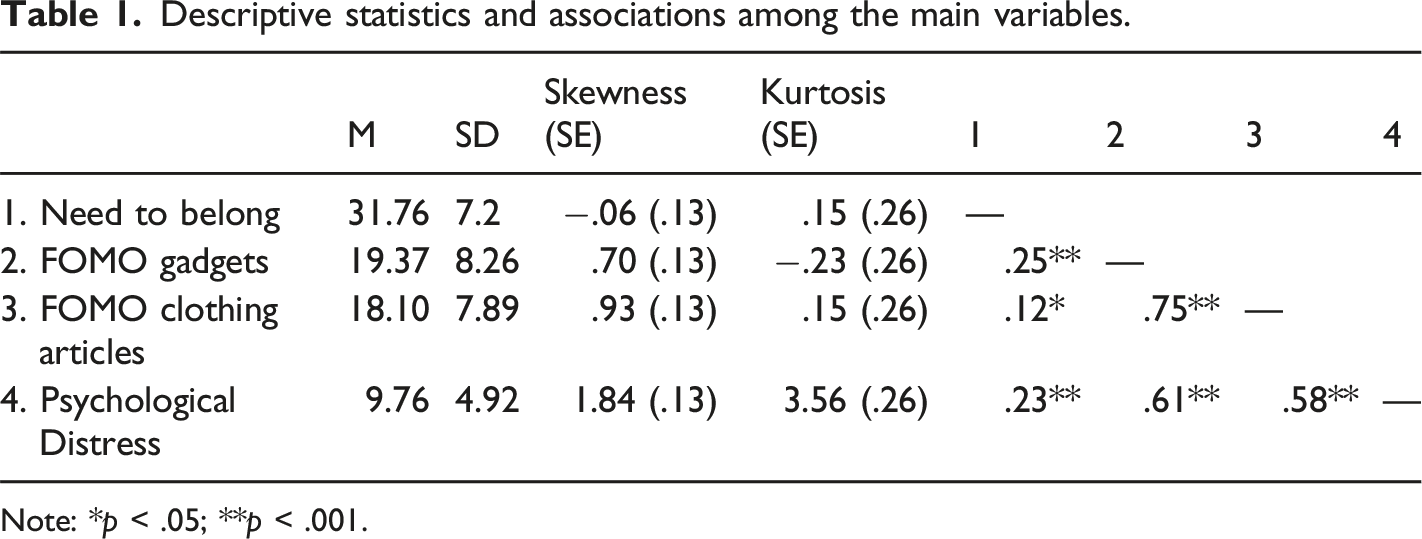
Note: *p < .05; **p < .001.
Associations Among the Main Variables
The results of the correlational analysis (see Table 1) suggest that there are significant positive associations between need to belong, FOMO gadgets, FOMO clothing articles, and psychological distress.
Testing the Regression
The results of the linear regression analysis indicate that need to belong significantly predicts psychological distress (R = .23; R 2 = .05; R 2 adj = .053; p < .001; F (1; 333) = 19.86). Need to belong is a significant and positive predictor of psychological distress (B = .16; SE = .03; β = .23; p < .001).
Testing the mediating role of FOMO gadgets and FOMO clothing articles on the relationship between need to belong and psychological distress
We explore the potential mediating roles of FOMO gadgets and FOMO clothing articles on the link between need to belong and psychological distress, controlling for online time spent. The results suggested (see Figure 1) that the total effect of need to belong and psychological distress was significant, b = .16; SE = .03; p < .001; 95% CI [.09; .23]. The direct effect was significant, b = .07; SE = .02; p = .01; 95% CI [.01; .13]. Both FOMO gadgets, b = .02; SE = .01; 95% CI [.003; .05], and FOMO clothing articles, b = .06; SE = .01; 95% CI [.03; .10], had a significant indirect effect on the relationship between need to belong and psychological distress. The mediating role of FOMO gadgets and FOMO clothing articles on the relationship between need to belong and psychological distress. Note: *p < .05; **p < .001; the coefficients presented are standardized coefficients.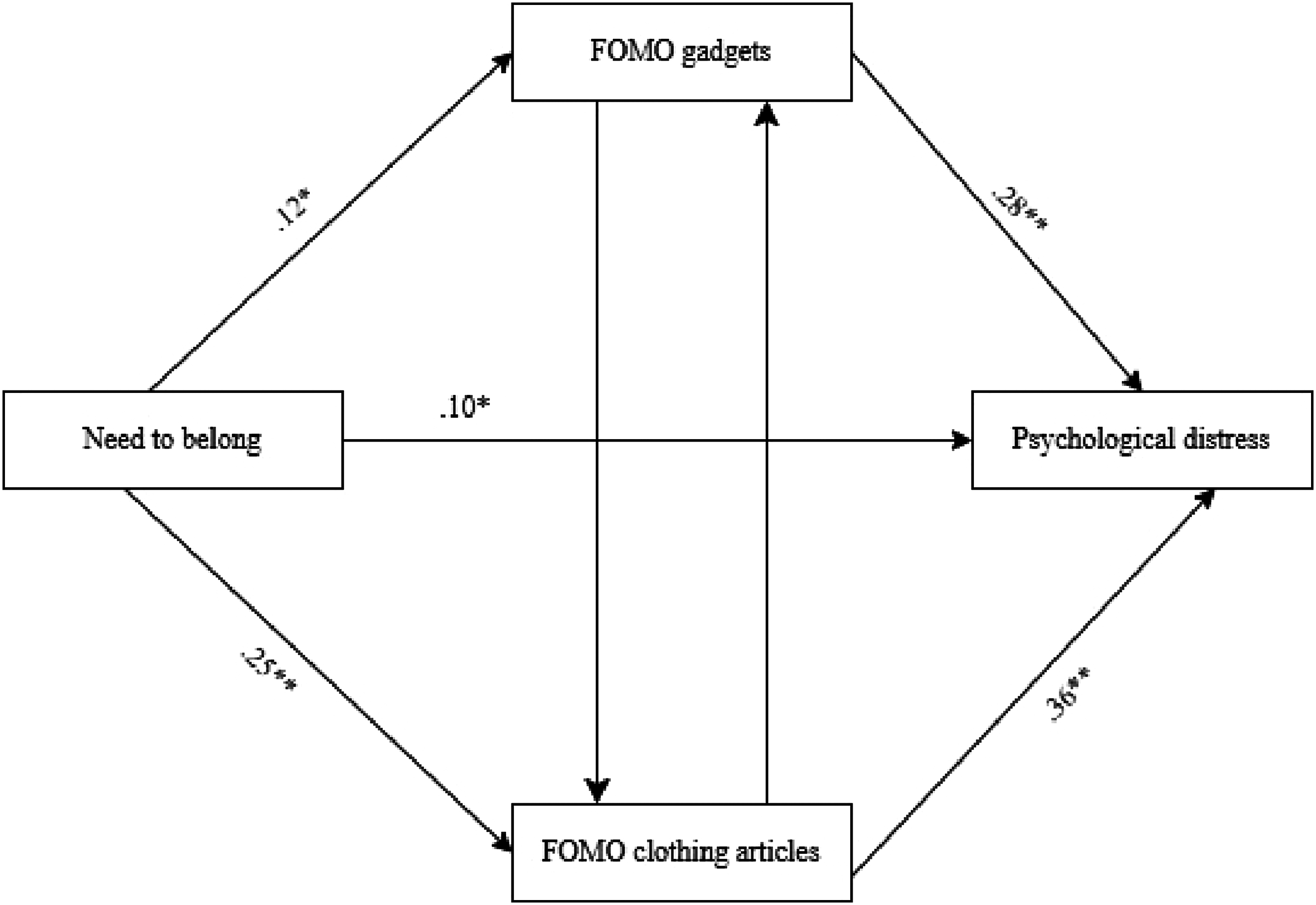
For a better model fit, Amos Graphics suggested the existence of a relationship between FOMO gadgets and FOMO clothing articles. Results of the SEM indicated good fit values: CFI = 1; GFI = 1; SMRM < .001.
Discussion
Our study has revealed a series of important aspects regarding mental health concerns for adolescents experiencing FOMO induced by ads. Firstly, our findings have shown that the main variables of our study, namely need to belong, FOMO gadgets, FOMO clothing articles, and psychological distress, are associated. Furthermore, our study has indicated that need to belong predicts psychological distress. This result is consistent with the existing literature, which has demonstrated the association of the need to belong or fear of exclusion with various negative mental health outcomes (Cacioppo & Patrick, 2008; Duclos et al., 2013; Riva & Eck, 2016; Smart Richman & Leary, 2009). A potential explanation for this outcome could be the fact that the need to belong may lead to negative physical experiences, arising when individuals do not feel accepted and perceive social exclusion (MacDonald & Leary, 2005). Thus, the higher the need to belong, the greater the suffering caused by the feelings of rejection or exclusion, resulting in a high level of psychological distress. Social exclusion resulting from a strong desire to belong can lead to negative outcomes of mental health, such as impulsivity (Duclos et al., 2013) or loneliness (Cacioppo & Patrick, 2008), as well as negative emotions experienced by individuals when they feel a loss of social ties, such as shame, anger, or sadness (Baumeister & Tice, 1990; Leary, 1990; Marcus & Askari, 1999; Williams et al., 2000). All these negative outcomes experienced by adolescents can be crucial for long-term mental health, as this period of life is when individuals are forming emotionally (World Health Organization, 2024). Therefore, negative outcomes on mental health developed during adolescence can predispose individuals to other psychiatric disorders in adulthood.
Moreover, our results have shown that FOMO gadgets mediate the relationship between the need to belong and psychological distress. Additionally, FOMO clothing articles mediate the relationship between the need to belong and psychological distress. Our result can be explained by the fact that FOMO gadgets and FOMO clothing articles may act on the association between need to belong and psychological distress by activating mechanisms of social comparison, through which adolescents may feel less socially connected or included if they do not meet the standards presented in advertisements or if they do not possess these objects they peers might have. At the same time, another potential explanation could be that the absence of gadgets and clothing articles may activate a sense of insecurity regarding belonging to a group, thus fueling the psychological distress experienced when individuals have a strong need for belonging. Through the acquisition of gadgets and clothing items, adolescents may perceive that they can connect with other groups (Allen et al., 2021), activating their need for group belonging in this regard. Moreover, the need for group belonging can also be activated through the purchase of gadgets and clothing items, serving as a framework for human motivation to form and maintain close relationships with others (Baumeister & Leary, 1995). Hence, another explanation may lie in the fact that if adolescents showcase their new gadget or clothing acquisitions on social networks, the resulting FOMO can be linked to the need to belong, as social networks and online posting of new acquisitions can fulfill adolescents’ need for social connection (Alabri, 2022; Roberts & David, 2020).
In conclusion, regarding advertisements for gadgets and clothing items, our results reveal that these can impact the psychological distress experienced by adolescents. Seeking acceptance from peers and desiring inclusion in specific social groups, adolescents aspire to possess such items. However, if they are unable to access these items due to social, financial, or other related considerations, they may develop distress that affects their functioning, both within their family and school settings, as well as in their relationships with others.
Limitations and Future Directions
Despite the numerous positive aspects, we must also address a series of aspects that we could not take into consideration; however, future studies may take them into account. One of the limitations of our study is that the participants’ online time was measured in total minutes, without distinguishing between the specific activities being performed. We acknowledge that different online activities, such as social media usage, online shopping, or video content consumption, may have varying impacts on FOMO and psychological distress. Therefore, future research could address this limitation by categorizing online time into distinct segments (e.g., time spent on social media, time spent on online shopping, time spent on gaming, etc.), and controlling for these activities as potential confounding variables. This would allow for a more nuanced understanding of how specific online behaviors influence the relationships between the need to belong, FOMO, and psychological distress. Additionally, in the case of social media, the time spent on these platforms can be further divided according to the most popular social networks (e.g., Facebook, Instagram, TikTok, etc.). Such information could be valuable for identifying some patterns regarding the FOMO phenomenon amongst adolescents (e.g., for determining if adolescents spending more time doing online shopping are more likely to experience FOMO when seeing ads for certain articles). Another important limitation is represented by the way FOMO was measured. By adapting the respective scale, the study measured how adolescents recalled the feelings they experienced when viewing advertisements, rather than measuring the feelings induced immediately after exposure to the advertisements. This method does not allow for a direct examination of causal relationships. Filling out the questionnaire immediately after watching the advertisements could provide a better framework for illustrating causality. Thus, a potential future direction could involve conducting an experimental study where the mediating variables are induced through experimental manipulation, allowing researchers to measure the FOMO experienced in real time and how viewing advertisements can affect individuals in that specific moment.
In another vein, we believe that future studies on this topic could incorporate even more constructs that may affect FOMO experienced regarding gadgets and clothing articles. For instance, a potential direction could involve inquiries regarding the social group to which participants belong or aspire to belong. More specifically, participants could be asked whether there are individuals in their social group who possess the latest generation gadgets that they also desire, or if individuals in that social circle own designer clothes while the participants do not. Additionally, future research should include a variable related to participants’ income or purchasing power. We expect that a higher family income could influence participants’ FOMO, especially if they have easy access to gadgets or clothing items they desire.
Another limitation related to our model involves the high correlation between the two mediating variables: FOMO gadgets and FOMO clothing articles. Given their high correlation, it may be possible to combine these two variables into a common factor, such as a general FOMO construct, which could simplify the model while still explaining the effects of FOMO on psychological distress. Future studies may consider this approach to explore whether a unified FOMO construct would provide a sufficient framework for understanding the relationship between need to belong and psychological distress. However, it is important to note that we deliberately chose to treat these two forms of FOMO as separate mediators, as they may represent distinct mechanisms through which advertisements impact adolescents’ psychological distress. By doing so, we aim to capture the unique influences of gadgets and clothing articles, as they are likely to trigger different social comparisons and emotional responses. Nevertheless, further research could explore the benefits and drawbacks of combining these two forms of FOMO into a single factor.
In conclusion, researchers can certainly consider other categories of FOMO, in addition to gadgets and clothing articles. Such categories that adolescents may experience could include advertisements for music festivals or various experiences such as beach or mountain vacations, which others in their close circles can afford, while they cannot.
Theoretical and Practical Implications
From a theoretical perspective, our research contributes to filling two gaps in specialized literature. Firstly, to the best of our knowledge, it is the first study addressing negative mental health outcomes of commercial FOMO for adolescents. By now, the only studies approaching the topic of negative outcomes of FOMO on adolescents’ mental health treated FOMO as induced by internet and/or social media (but not by marketing practices). In turn, papers treating the topic of FOMO induced to adolescents by marketing practices rather ignored its negative side of the phenomenon and talked about outcomes of interest for marketers (such as buying intention or consumer behavior). Secondly, by exploring for the first time all commercial FOMO, need to belong and psychological distress within the same context, our paper shows that there is a relationship between need to belong and psychological distress, with commercial FOMO as a mediator.
From a practical perspective, our findings should concern multiple actors on the society. before elaborating on this aspect, it must be mentioned that given the potential negative implications of commercial FOMO on teen’s mental health, we believe that this issue would be better tackled from a preventive perspective. To do so, actions should be taken in three main directions. The first one concerns education. Here, we consider that adolescents nowadays need to be better educated in terms of both mental health and digital media. On one hand, in schools, adolescents should be more frequently educated on aspects related to mental health. By doing so, they could better cope with negative outcomes such as psychological distress or FOMO. This can be achieved through psycoeducation concerning the psychological aspects involved in internet and media consumption in general. On the other hand, it is important for adolescents these days to understand digital media and what is behind it. Therefore, new disciplines focusing on these aspects could be introduced in educational programs. Considering the increasing presence of digital media on youth’ live, adolescents should better understand what social media is, how it works for them, how it works for brands that try to catch their attention and how it could affect them in terms of both their buying interests and mental health. The second path that could be followed to prevent the negative impact of commercial FOMO on teenagers’ mental health regards the legislative framework. Here, authorities and institutions taking care of marketing and advertising regulations should be aware of the commercial FOMO’s negative impact. Lastly, to prevent this negative impact, marketers should approach a more responsible attitude when thinking about introducing FOMO appeals in their ads or other marketing communications. Such a responsible attitude could involve using marketing messages that stress the characteristics and/or the benefits of the products instead of the fear of losing a certain opportunity if not buying the respective products.
At the same time, being given that it is difficult to completely prevent this issue, our findings need to be taken into consideration by mental health workers such as clinical psychologists or psychotherapists when working with adolescents. Additionally, non-governmental organizations (NGOs) involved in the education and well-being of adolescents should consider the aspects discussed in this research.
Conclusions
In summary, our results indicate that the need to belong can lead to psychological distress among adolescents. Additionally, our findings have shown that advertisements related to gadgets and clothing items can negatively impact the mental health of adolescents. In this regard, preventive and protective measures should be discussed and implemented by NGOs and relevant authorities to mitigate the negative effects experienced by adolescents.
Footnotes
Author Contributions
Tudor-Daniel Huțul, Mara Mațcu-Zaharia, Andreea Huțul, and Adina Karner-Huțuleac contributed equally to conceptualization, methodology, formal analysis, supervision, writing-original draft, writing-review, editing, and data curation.
Declaration of Conflicting Interests
The author(s) declared no potential conflicts of interest with respect to the research, authorship, and/or publication of this article.
Funding
The author(s) received no financial support for the research, authorship, and/or publication of this article.
Ethics Statement
This study’s protocol was designed in concordance with ethical requirements specific to the Faculty of Psychology and Educational Sciences, Alexandru Ioan Cuza University of Iași, Romania, before beginning the study and supervised by Tudor-Daniel Huțul.

Data Availability Statement
The data supporting the findings of this research are available from the corresponding author upon request.