




Abstract
Across two studies, we investigated when, how, and how often people share traumatic events (N = 1008). In Study 1, most participants (78.5%) perceived their most stressful/traumatic event as shared primarily due to knowing others were present during the event (physical sharing), knowing/believing others had experienced or could experience a similar event (relational sharing), discussing the event with others (verbal sharing), or having the same emotions about the event as others (emotional sharing). In Study 2, we assessed the frequency and characteristics of these forms of sharing along with attitudinal sharing (same attitudes/beliefs/opinions about the event) and perpetrator sharing (perpetrator involved in the event). Nearly all participants (98.6%–99.4%) shared their most stressful/traumatic event with others in some way. Our findings demonstrate that people commonly share a range of traumatic events in various unique ways. This framework can inform and guide research addressing the impacts of these diverging forms of sharing.
Introduction
Most people (∼70%) will experience at least one traumatic event within their lifetime (Bromet et al., 2018); many of these events are likely to be shared. In fact, “sharing” in the most general sense can be experienced in numerous ways and across multiple stages of traumatic events. People can experience traumatic events in the presence of others (e.g., natural disasters; Armenian et al., 2002), be exposed to similar traumatic experiences as others (e.g., sexual assault; Konya et al., 2020), discuss traumatic events with people (e.g., the sudden death of a loved one; Rimé et al., 1998), and experience similar emotions about traumatic events to others (e.g., terrorist attacks; Garcia & Rimé, 2019). Although these experiences are all manifestations of “sharing,” they represent distinct forms of sharing. Decades of research across social (e.g., Rimé, 2009), cognitive (e.g., Nahleen et al., 2019), and forensic psychology (e.g., Paterson & Kemp, 2006) has investigated the frequency, characteristics, and effects of different forms of sharing in trauma contexts. However, this research lacks clear and consistent terminology and operationalizations of sharing. Thus, it is difficult to determine how, when, with whom, how often, and why people share traumatic events in different ways. Without an integrated understanding of the nature of these issues, we cannot address major questions about how sharing traumatic events shape psychological functioning.
Here, we aimed to advance conceptual understanding of “shared” traumatic experiences within WEIRD populations (Western, Educated, Industrialised, Rich and Democratic; Henrich et al., 2010). To identify different forms of sharing, we first reviewed existing terminology, operationalizations, and investigations of sharing in the context of traumatic and negative experiences. We then assessed whether people view traumatic and negative events as shared in these ways and explored novel concepts of sharing by thematically analyzing why participants perceived their most stressful/traumatic event as shared or not. This process allowed us to identify and categorize several unique ways in which traumatic events can be shared (Study 1) and assess the frequency and characteristics of these forms of sharing (Study 2). Figure 1 provides an overview of the various types of sharing, discussed in detail below. Terminology and definitions of the unique sharing concepts developed in the present research based on existing research and Study 1 Data. Note. We developed the concept of subjective sharing as a foundation for identifying how people share traumatic events in other, more concrete ways. Attitudinal sharing was a concept that emerged following Study 1 data analysis to distinguish between shared emotions and shared attitudes. All concepts were tested in Study 2.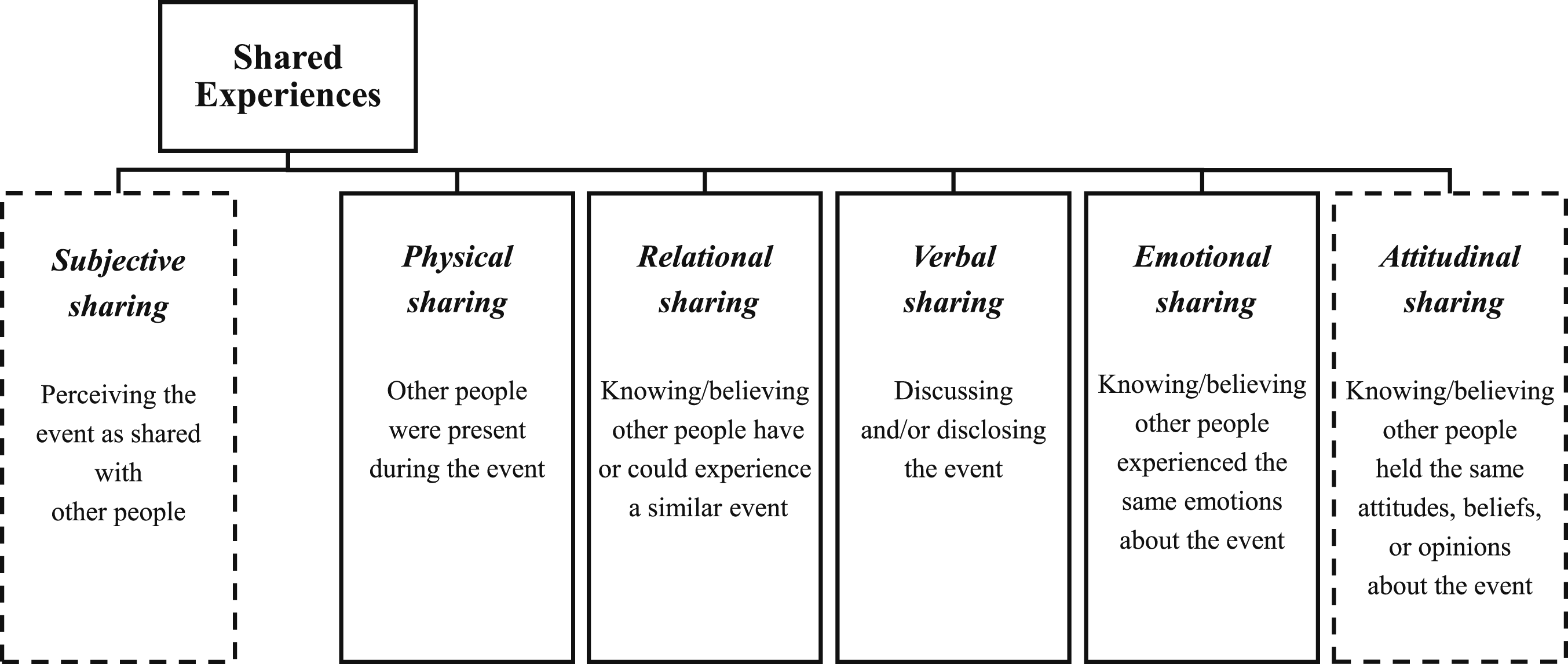
Current Research on Shared Traumatic Experiences
Broadly speaking, research suggests sharing traumatic events with others may be common, experienced across different stages of these events and in various ways. First, people share traumatic events as they occur through the presence of other people (physical sharing in Figure 1). In research examining real-world traumatic events, events shared via the presence of many people—such as terrorist attacks (e.g., McConnell et al., 2010) and natural disasters (e.g., Armenian et al., 2002)—are often termed “mass traumatic events” (e.g., Shalev et al., 2004). This research also uses the term “interpersonal trauma” to describe events that involve and occur between people, often with one or more people perpetrating harm to another or others (e.g., Mauritz et al., 2013). Interpersonal traumas include events like childhood abuse (e.g., Balch & Golub, 2020) and sexual assault (e.g., Steenkamp et al., 2012). Such interactions may be considered a subform of sharing via the presence of others, whereby people share a traumatic event specifically with a perpetrator (or perpetrators) of the event. Alternatively, in experimental settings, negative experiences (e.g., the Cold Pressor Task) shared via the presence of others have been termed “co-experienced negative events” (i.e., negative events others participate in; e.g., Miao et al., 2021), “shared attention experiences” (i.e., attending to a negative object simultaneously with others; Shteynberg, 2015) or, more generally, “shared negative experiences” (i.e., experiencing negative events simultaneously with others; Nahleen et al., 2019). Although unique, these concepts are clearly linked. Thus, to synthesize current conceptualizations of sharing within the literature, we use the term physical sharing hereon to represent instances where multiple people are physically present during an event, simultaneously (Figure 1). This term represents similarities in people’s exposure to a traumatic event (e.g., people being in the epicentre of the same earthquake) rather than people’s physical proximity with others during the same event (e.g., being in the same room as others during an earthquake). Of course, people can be physically close to others when physically sharing a traumatic event, but this is not essential for such sharing to occur.
Therefore, physical sharing can also encompass situations where multiple people are simultaneously present during the same event, but in a different location. Considerable research has investigated this notion in clinical settings by assessing mental health workers’ psychological and behavioral responses to a traumatic event (e.g., 9/11 attacks) which both they and their client have been exposed to (“shared traumatic reality”; Goelitz, 2022; Tosone et al., 2012). However, this form of sharing is not confined to mental health workers. Many people may discover or believe others are experiencing the same event as them while it is occurring (e.g., via virtual live-streamed content) or afterwards (e.g., via discussion), like the COVID-19 pandemic (Muldoon, 2020). These experiences are evidently distinct from occasions where people are consciously aware that others are present during the same event. Nevertheless, we consider these experiences to fit within our conceptualization of physical sharing given they involve multiple people being physically present during the same event, simultaneously or synchronously.
Second, people share traumatic events asynchronously through similar experiences. That is, people can know others who have experienced an event similar to their own experience, that took place at a different time and/or location. This form of sharing is generally referred to as “common”, “similar”, or “shared” experiences (Bartone et al., 2019; Konya et al., 2020). Research exploring the characteristics and effects of peer support suggests people commonly discuss personal trauma—such as suicide survival and sexual assault—with others who have had similar experiences (van de Ven et al., 2021). Moreover, we are often exposed to accounts of traumatic events through social and news media platforms; some of these accounts may be relevant to our own experiences. Thus, people may share traumatic events by simply believing other people have experienced a similar event to them. Because this form of sharing is distinct from physical sharing (which refers to the same event), we refer to it as relational sharing, which we define as knowing or believing others have experienced or could experience a similar event (see Figure 1).
Third, people share traumatic events by talking about these events. For instance, during a hurricane, people may discuss what they have witnessed with people who are physically present or connected virtually. Further, we know many people discuss traumatic events—including car accidents, terrorist attacks, and crimes—days, weeks, months, and even years after exposure (e.g., Paterson & Kemp, 2006; Rimé, 2009). In fact, this form of sharing has been extensively researched, particularly regarding what (content), when (time/duration), how (modes/methods), how often (frequency), and why people talk about traumatic events with others (e.g., Davidson & Moss, 2008; Duprez et al., 2015; Garcia & Rimé, 2019; Gorissen et al., 2023; Paterson & Kemp, 2006; Rimé et al., 2010; Seery et al., 2008; Skagerberg & Wright, 2008; for a review, see Rimé, 2009). Across this research, operationalizations of sharing have remained relatively consistent, however, terminology varies, with researchers using terms such as “discussions” (e.g., Skagerberg & Wright, 2008), “disclosures” (e.g., Alea & Bluck, 2003), “social sharing” (e.g., Rimé et al., 1998), and “expressions” (e.g., Seery et al., 2008) in their work. Thus, for clarity, hereon we refer to this form of sharing as verbal sharing, which we define as discussing an event with, or disclosing an event to, others (see Figure 1). We use the term verbal sharing because it encompasses various modes of verbal communication, including oral and written modes (Oxford Reference, n.d.). We included the terms discuss and disclose because discussing an event involves generally talking about something whereas disclosing an event refers to specifically revealing something to others, usually for the first time (Oxford University Press, n.d.).
Last, people can share the same or similar emotions about a traumatic event. For instance, mass traumatic events, like disasters and terrorist attacks, can elicit a “collective emotion” or “group affect” in which people within the same group (e.g., survivors) simultaneously experience similar emotional or affective states (e.g., sadness; Barsade & Gibson, 2012; Garcia & Rimé, 2019; Von Scheve & Salmella, 2014). Likewise, people can mirror each other’s emotional expressions, causing their emotional states to align (i.e., “emotional synchronisation/convergence”; Durkheim, 1912; Rimé, 2020) or simply believe they are experiencing the same emotional states as others (i.e., “perceived emotional synchronisation”; Páez et al., 2015) during such events. To consolidate these different terms and concepts, we refer to this form of sharing as emotional sharing, to describe either knowing or believing others are or were emotionally affected in the same or a similar way about an event (see Figure 1).
To summarize, existing research indicates that people likely share traumatic events in several ways, including via the physical presence of others, experiencing a similar event to others, talking about events with others, and experiencing the same/similar emotions about an event as others—or, as we term these forms, by physically, relationally, verbally, and emotionally sharing events (see Figure 1). In fact, there are likely other ways that people share traumatic events, for instance by holding the same attitudes as others about a traumatic event. Unfortunately, other shared traumatic experiences (e.g., shared attitudes) aside from the four discussed here (i.e., physical, relational, verbal and emotional sharing) are less established in scientific literature and require further investigation.
Notably, the various forms of shared traumatic experience anticipated in Figure 1 may be interrelated, meaning different forms of sharing may arise from the same traumatic event. For instance, people commonly discuss traumatic events with people who were physically present during the same event (e.g., Paterson & Kemp, 2006; Rimé, 2009; Skagerberg & Wright, 2008). Moreover, discussing and being present during the same traumatic event can elicit similar emotional responses in people (e.g., Bartholomew & Victor, 2004; Garcia & Rimé, 2019; Hatfield et al., 1993; León et al., 2019; Páez et al., 2015; Rimé, 2020; Schachter, 1959). Further, people often learn about others’ similar experiences of trauma from others’ verbal disclosures of the event (e.g., MacNeil & Mead, 2005; Regev & Slonim-Nevo, 2019; Solomon, 2004). However, much of the research examining the link between different shared experiences is theoretical (i.e., has not been empirically tested), does not clearly distinguish and measure different sharing concepts, or only generalizes to certain contexts (e.g., criminal events, mass traumatic).
Defining sharing in the context of traumatic events and identifying how often people share trauma with others in different ways is an important first step to understanding whether, and if so, how, sharing traumatic events impacts people’s experiences and memories of the event. Currently, there is evidence that sharing traumatic events with others leads to positive and negative outcomes for people. For instance, sharing negative events (e.g., terrorist attacks) can lead to posttraumatic growth (i.e., positive psychological change from challenging life events; Tedeschi & Calhoun, 2004), positive affect, social support, cooperation, and social integration (Miao et al., 2021; Rimé et al., 2010), improved social and collective resilience (Drury et al., 2009; Rimé et al., 2010), and a decreased risk of depression (Armenian et al., 2002). Yet, sharing negative events can also lead to increased rumination (Rimé et al., 2010), negative affect (Rimé et al., 2010), posttraumatic stress symptoms (Seery et al., 2008), memory distortion (Gabbert et al., 2004; Paterson & Kemp, 2006) and memory amplification (i.e., remembering the event as more negative overtime; Nahleen et al., 2019; Southwick et al., 1997).
Unfortunately, there are several barriers to consolidating findings concerning how, when, with whom, how often, and why people share traumatic events and the psychological implications of such sharing. Evidently, researchers investigating shared experiences have conceptualized and defined sharing based on different theoretical frameworks and traumatic contexts. For instance, although mass traumatic events (Shalev et al., 2004), interpersonal trauma (Mauritz et al., 2013), and co-experienced events (Miao et al., 2021) all describe events where numerous people are physically present, they differ conceptually regarding how and how many people are involved in these events. Moreover, researchers have explored the nature and effects of sharing trauma within studies that aimed to address other research questions (e.g., what are the risk factors for depression for 1988 Armenian earthquake survivors?; Armenian et al., 2002), meaning often the operationalization of sharing is unclear, the methodology used to investigate sharing is unclear, and findings are incidental. This lack of clarity makes it difficult to determine whether findings reflect the unique qualities and effects of a singular form of sharing (e.g., verbal sharing) or an accumulation of the qualities and effects of multiple forms of sharing (e.g., verbal and physical sharing). Consequently, we likely cannot generalize existing data on the forms, frequency, characteristics, and effects of sharing traumatic events beyond the specific contexts in which they were examined. Even if these data are generalizable, no research appears to have synthesized work on the varying conceptualizations of sharing all together, or examined the different ways people share traumatic events using inductive methods. As such, here, we used a theoretically agnostic approach to identify and map the unique ways people share trauma without being guided by one theoretical tradition more than another. To truly understand the implications of sharing traumatic events, we need to have a clear grasp on when, how, how often, and with whom traumatic events are shared in unique ways as well as how and when different forms of sharing are linked. Our study design aimed to overcome these limitations by (1) investigating all the unique ways people share traumatic events with others, (2) exploring how people share traumatic events using deductive (i.e., considering current conceptualizations of sharing) and inductive (i.e., examining participants’ perceptions and experiences of sharing) approaches, and (3) assessing the frequency and characteristics of different forms of sharing individually and together.
Research Overview
In Study 1, we defined a “shared” traumatic event by identifying common reasons why people consider a traumatic event to be shared or not. Participants described the most stressful/traumatic event they had been exposed to, selected the trauma category the event aligned with best (e.g., vehicle accident), and provided details about the event (Carlson et al., 2011). We then asked participants to rate the extent to which they believed the event was shared and to explain their rating. We used thematic analysis to evaluate and code participants’ sharing explanations into themes representing different forms of sharing (e.g., physical sharing, verbal sharing). Independent of these data, we identified two additional sharing forms (i.e., perpetrator and attitudinal sharing), which we were interested in exploring further. In Study 2, we aimed to determine how often and how, when, and with whom people share traumatic events in the different ways we identified in Study 1. Participants completed the same measures as in Study 1 plus a measure we developed to assess whether and how participants shared their most stressful/traumatic event with other people. We analyzed the frequency of each form of sharing overall and for different kinds of events, and examined the characteristics of each form of sharing individually.
Transparency and Openness
Data Availability
We preregistered Study 1 (https://osf.io/we2pn) and Study 2 (https://osf.io/4d8hv). All de-identified data, materials, and supplementary material can be found at https://osf.io/fn24q.
Reporting
We report how we determined our sample size, all data exclusions, all manipulations, and all measures in the studies.
Ethical Approval
Both studies were approved by the Flinders University Social and Behavioural Research Ethics Committee and conducted in accordance with the provisions of the World Medical Association Declaration of Helsinki and APA ethical standards.
Participant Consent
All participants were required to read an information sheet and provide their written consent prior to participation. Participants were informed of the research aims, nature of the survey tasks, expected duration of their participation, potential risks of participating in this research, and their right to withdraw from the study without penalty. Participation was voluntary and confidential.
Summary of Sharing Concepts
Terminology, Definitions and Examples of Sharing Concepts in Study 1 and Study 2.
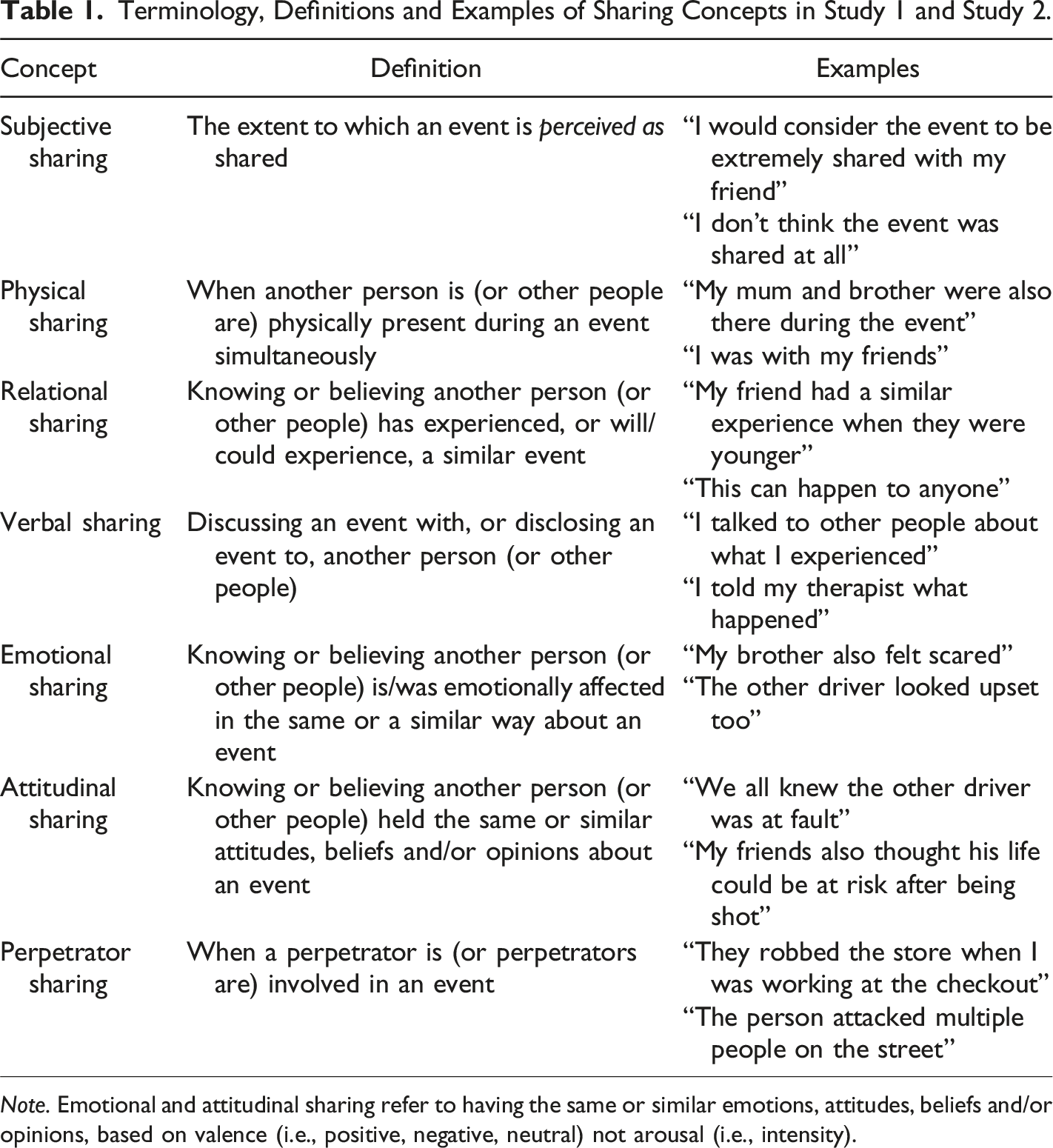
Note. Emotional and attitudinal sharing refer to having the same or similar emotions, attitudes, beliefs and/or opinions, based on valence (i.e., positive, negative, neutral) not arousal (i.e., intensity).
We measured “subjective sharing” by asking participants’ about their perceptions of how shared they considered their worst event to be (Studies 1 & 2). We then asked participants’ to report specific, often observable, details (i.e., frequency, characteristics) concerning how they shared their worst event in various specific ways (i.e., physical, relational, verbal, emotional, attitudinal, and perpetrator; Study 2). Notably, two sharing forms (i.e., attitudinal sharing and perpetrator sharing) were not identified from Study 1 data. Nevertheless, we assessed these forms in Study 2 to explore the nature of other possible shared experiences. We also removed unspecified sharing in Study 2 and Table 1 because this form was only included to represent codes that did not specify how participants shared their worst event in Study 1.
Study 1
Method
Participants
For the magnitude of a correlation to be deemed stable, the typical sample size should approach 260 (Schönbrodt & Perugini, 2013); even larger numbers narrow the corridor of stability and increase confidence in results. We increased our sample size beyond the recommended 260 participants to what was feasible within our resource limitations (∼500 participants). We wanted to capture a broad range of interpretations of what it means for a stressful/traumatic event to be “shared.” We also aimed to collect a sample size that would allow us to obtain sharing data about a range of event types, given some event types have relatively low base rates (e.g., military experiences; Bromet et al., 2018).
Thus, we recruited 514 participants from five English-speaking western counties (i.e., Canada, the United States of America [USA], Australia, New Zealand, and the United Kingdom [UK]) with similar socio-economic make-up (Henrich et al., 2010) using two online platforms: Amazon’s Mechanical Turk (MTurk; via CloudResearch.com; Litman et al., 2017; compensated USD$1.27) and Prolific (compensated GBP£1.73-£2.13). We excluded seven responses: five completed the study twice, one failed both attention checks (Berinsky et al., 2014), and one failed to select and describe an event and provide a subjective sharing explanation. Our final sample comprised of 507 participants (n = 126 for Canada, USA, and Australia/New Zealand; n = 129 for UK) from MTurk (n = 258) and Prolific (n = 249). Participants were predominately male (58%, female = 40.8%, non-binary = 1.2%) with a mean age of 34.37 (range: 18–74, SD = 11.42). Most participants were Caucasian (including “White”; 58.8%) and others were of Asian (13.2%); African (including “Black”, 6.3%); European (4.7%); Middle Eastern (1.4%); and Hispanic (1.0%) descent, or Indigenous (0.2%); Pacific Islander (0.2%) and Mixed (3.9%) ethnicity. The remaining participants provided nationality (e.g., “Australian”, 10.1%) or no answer (0.2%). Most participants’ highest level of education was a college/university undergraduate degree (53.8%; Supplementary Table S1).
Trauma History Screen (THS)
Participants saw a list of events from 14 trauma categories (e.g., Attacked with a gun, knife, or weapon; Sudden death of close family or friend) and were asked to “select the events that had happened to you [them]” and “indicate the number of times” these events had happened to them (Carlson et al., 2011). Participants then described the event they were most bothered by (i.e., their worst/most stressful or traumatic event), selected the trauma category that best described their worst event (same list as above), and reported several characteristics of their worst event (e.g., age at event). We followed the format of trauma exposure measures that typically ask participants to identify, describe, and report details about the event they have experienced that was the most emotionally bothersome to them—often referred to as their “worst” event (e.g., Carlson et al., 2011; Weathers, Blake, et al., 2013). We assessed participants’ worst event because asking participants to report sharing-related details about all traumatic events they had experienced would have been demanding for participants and may have led to inaccurate or less considered responses. The THS has excellent convergent validity (rs = .73–.77) and temporal stability for high magnitude stressor events (i.e., sudden events that cause extreme distress in most people exposed; r = .93), and persisting posttraumatic distress events (i.e., events associated with significant distress lasting longer than a month; r = .73; Carlson et al., 2011).
Subjective Sharing
We asked participants “to what extent do you [they] feel like this [their worst] stressful or traumatic event was a ‘shared’ event?” (1 = Not at all, 5 = Extremely), and to explain their answer in an open text box. 1 To avoid influencing their responses, we did not provide participants with definitions or examples of a “shared” event.
Procedure
To prevent bots/non-residents from completing the study, participants had to pass a captcha and score at least 8/10 on an English proficiency test to enter the study (Moeck et al., 2022). After providing consent, participants saw each questionnaire in the order presented above. Considering participants may have experienced discomfort, a link to contact details for support services appeared at the bottom of each survey page. Participants were compensated and debriefed after completing the study.
Results and Discussion
Analysis Strategy
We used a combination of quantitative and qualitative data analysis to explore the nature of shared traumatic experiences in Study 1. First, we present descriptive information about the characteristics of participants’ worst events (i.e., sample characteristics). We then report the extent to which participants perceived their worst event as shared both overall and for different types of traumatic events (i.e., subjective sharing). To determine how people share traumatic experiences with others, we next present the thematic analysis procedure and results (i.e., thematic analysis). This analysis not only allowed us to verify and consolidate existing sharing concepts from the scientific literature but also to identify novel sharing concepts. Last, we report the frequency of different sharing forms (i.e., forms of sharing) so that the relative prevalence of these can be assessed overall and for different types of traumatic events.
Data Cleaning
Our data cleaning process is summarized in Supplementary Material: https://osf.io/fn24q. Consistent with PTSD Criterion A.1 (DSM-IV), we operationalized traumatic events as “events participants experienced, witnessed, or were confronted with, involving actual or threatened death or serious injury, or a threat to the physical integrity of themselves or others” (American Psychiatric Association [APA], 2000). 2 This operationalization encompasses all THS trauma categories aside from “Some other sudden event that made you feel scared, helpless or horrified” and “Other” (Carlson et al., 2011). Rather than losing data from the 19.3% of our sample who reported events from these two categories, we assessed whether responses differed between these miscellaneous negative events—which we termed stressful events—and traumatic events (i.e., THS trauma categories). We found a similar pattern of results for stressful and traumatic events (Supplementary Table S16). To provide greater context to these stressful events, we inductively created five additional categories that captured most responses (i.e., Non-sudden death of close family or friend, Stress in everyday activities, Health-related problems for the participant/a close other, Human rights violation, and Relationship issues; Supplementary Table S2).
Sample Characteristics
We first examined our sample for prevalence of exposure to traumatic event(s). In most cases, participants’ worst event was considered a high magnitude stressor event (80.7%), a persisting posttraumatic distress event (54.8%), and a Criterion A.1 event (90.1%; APA, 2000; Carlson et al., 2011). The most common worst event was the sudden death of a close other (25.6%), followed by vehicle accidents (10.7%), health-related problems (7.1%), and sudden abandonment (5.5%; see Supplementary Material for all characteristics data).
Subjective Sharing
We were interested in determining the extent to which participants rated their worst event as shared. Overall, 78.5% of participants rated their worst event as shared to some extent (21.5% = not at all, 12.6% = slightly, 17.8% = moderately, 24.7% = considerably, 23.5% = extremely; total sample: M = 3.16, SD = 1.47). We ran a one-way between subjects ANOVA for mean subjective sharing ratings by event type to determine which events were most subjectively shared. Participants perceived the non-sudden (M = 4.25, SD = 1.22) and sudden (M = 4.06, SD = 1.06) death of a close other, and natural disasters (M = 3.88, SD = 1.12) as the most shared (Welch’s F[18, 78.58] = 9.17, p < .001, ηp2 = .261, 95% CI [0.17, 0.30]; Supplementary Tables S9–10). These types of events appear related because they would almost always affect a significant number of people participants know (e.g., family, community members).
Thematic Analysis
Before conducting our thematic analysis, we analyzed participants’ subjective sharing explanations using two computer-based qualitative analysis programs: the Linguistic Inquiry and Word Count program (LIWC2015; Pennebaker et al., 2015) and NVivo 12 (QSR International Pty Ltd, 2018). We used these analyses to explore general categories within participants’ subjective sharing explanations, which informed our thematic analyses (i.e., highlighted themes we may have otherwise overlooked). Consistent with current conceptualizations of sharing, we found that participants frequently used words associated with other people—particularly close others (e.g., family), their mood and emotions, the presence of others, and discussions with others in their subjective sharing explanations (see Supplementary Material).
Next, we conducted a more precise qualitative analysis by developing a thematic codebook to identify patterns in our data concerning why participants perceived their most stressful/traumatic event as shared or not shared (Braun & Clarke, 2006; Fereday & Muir-Cochrane, 2006; see Supplementary Table S14 for final codebook). We included both deductive and inductive components to identify patterns in the data based on pre-existing concepts within the psychological literature and new concepts generated from participants’ perceptions and experiences (Figure 2; Roberts et al., 2019). Process of theme and code development and application for thematic analysis.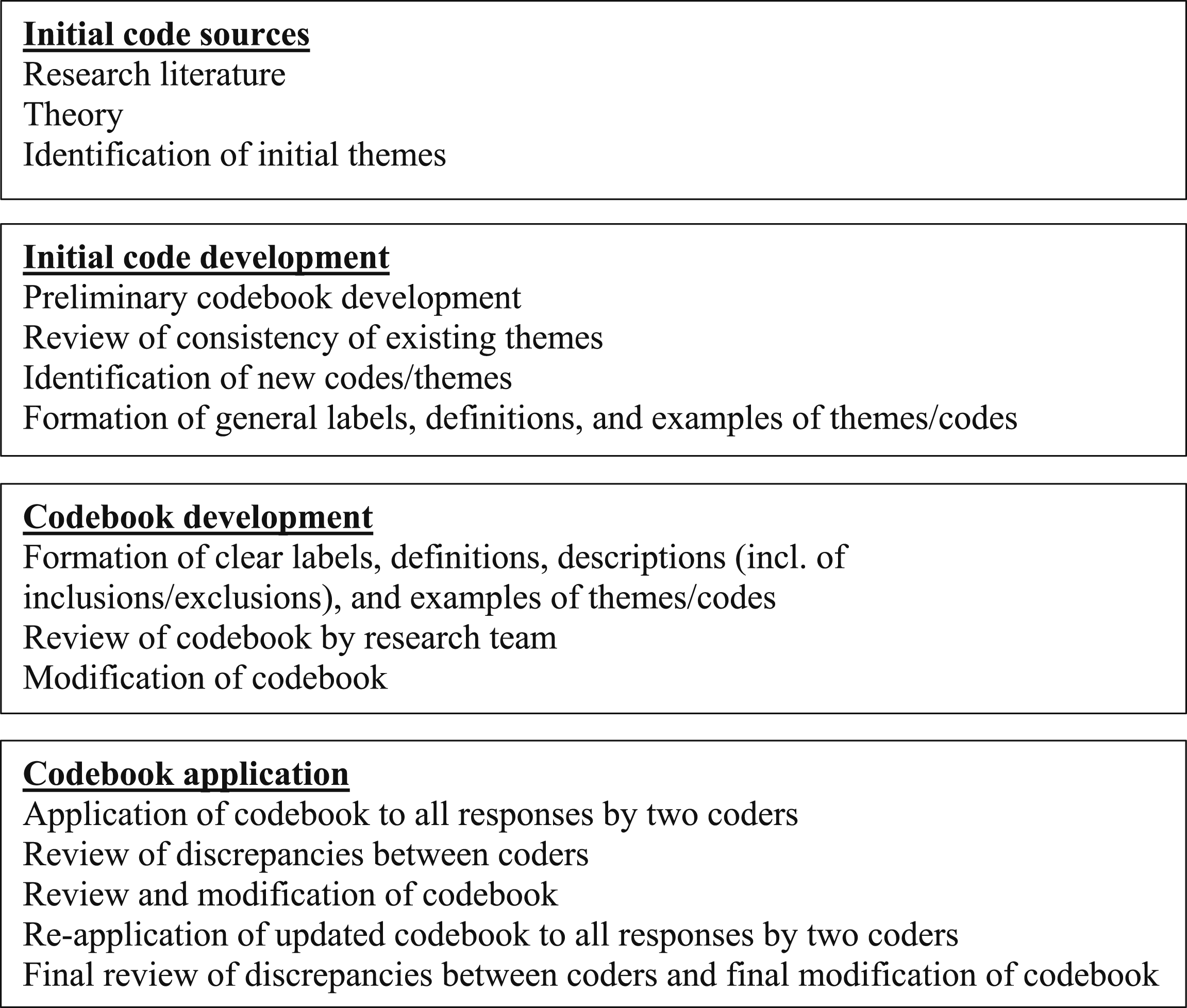
First, we developed a preliminary codebook of sharing-related themes based on our literature review (i.e., deductive work). Themes included physical sharing (i.e., presence/absence of others during the event), relational sharing (i.e., knowing/believing others have/haven’t or will/won’t experience a similar event), and verbal sharing (i.e., discussing/not discussing the event with others). At the time, we were unaware of specific research on emotional sharing and therefore did not include this form in the preliminary codebook. One coder (first author) then repeatedly read all subjective sharing explanations to familiarize themselves with the data and note consistencies with themes from the preliminary codebook. Here, the coder also began the inductive work by identifying new themes or codes that emerged. General labels, definitions, and examples of the themes and codes were reviewed after reading the data each time until the coder reached saturation (i.e., no new codes/themes emerged and no changes to codes/themes were needed). All codes and themes were then given clear labels, definitions, descriptions, and examples.
The coder developed new codes for physical sharing concerning the participants’ and other people’s level of involvement in the event, including “same/similar involvement” (including involvement unclear), “others less involved”, and “others more involved”. The coder also detected new themes of unspecified sharing (i.e., vague responses suggesting the event was/wasn’t experienced with others), emotional sharing (i.e., experiencing the same/different emotions about the event as others), and kinds of others (i.e., mentioning certain kinds of other people). Unspecified sharing was included as a broad category of sharing reflecting responses where participants did not provide enough information to categorize into existing sharing categories. That is, responses coded under this sharing category mentioned sharing (or not sharing) an experience associated with the traumatic event, but did not specify the nature of what experience was shared (e.g., the same event, emotional experience, the type of event) or how the experience was shared (e.g., discussion/disclosure, physical presence). Emotional sharing was derived from codes concerning participants’ and other people’s degree of emotional bother from the event, including “same/similarly affected” (including extent of bother unclear), “others more affected”, “others less affected”, and “others not affected or affected differently”. Kinds of others was derived from codes of “close others” (e.g., close friends, family) and “community members” (e.g., people in the same area/country as participants). Themes of emotional sharing and kinds of others were consistent with findings from our LIWC and NVivo text analyses, and with research suggesting people often share trauma with socially and spatially close others (e.g., Paterson & Kemp, 2006; Rimé, 2009) and experience similar emotions to others about traumatic events (e.g., Durkheim, 1912; Rimé, 2020). A final theme of Unclear was included to code unclear and absent responses.
The updated codebook was reviewed by the wider research team and modified where needed (e.g., relational sharing originally termed similar event sharing, unspecified sharing discussed as a broad theme of sharing). Following modifications, two coders (author/code developer and independent coder) used the updated codebook to systematically code each subjective sharing explanation into the codes and themes (i.e., responses assessed against each theme/code; 0 = did not include reason consistent with code, 1 = included reason consistent with code). Each sharing explanation could receive numerous codes, based on the reasons participants provided (e.g., “There were more friends involved and we talked it through multiple times.” was coded as kinds of others – close, physical sharing – same/similar involvement, and verbal sharing – discussed/disclosed). Agreement between coders was initially poor (43.79%; based on exact matches of codes selected for each response) so the coders met with one another to identify patterns in coding discrepancies and related overarching issues about the coding (e.g., issues with assumptions made about sharing experience). The coders then reviewed the issues with the research team and refined the codebook without reviewing or coding individual responses. The coders then independently re-coded all responses based on these refinements. Subsequent agreement between coders was good (82.84%) and all discrepancies were resolved between the coders in a single meeting. Following our thematic analysis, we re-coded some themes to further clarify subcategories of sharing within our data. 3 Specifically, we separated the physical sharing code of “same/similar involvement” (including involvement unclear) into “same/similar involvement” and “others’ involvement unclear”. Similarly, we recoded the emotional sharing code of “same/similarly affected” (including extent of bother unclear) into “same/similarly affected” and “others’ affect unclear”. Agreement between coders for this recoding process was high (94.7%) and the coders met to resolve any discrepancies.
Forms of Sharing
We addressed our next research aim by assessing the frequency of the different forms of sharing derived from our thematic analysis codebook (i.e., physical, relational, verbal, emotional, and unspecified sharing, and sharing with certain kinds of people).
What Forms of Sharing do People Most Often Consider When Deciding Whether a Stressful/Traumatic Event was Shared or Not?
Description, Sample Percentage and Count for Each Form and Level of Sharing.
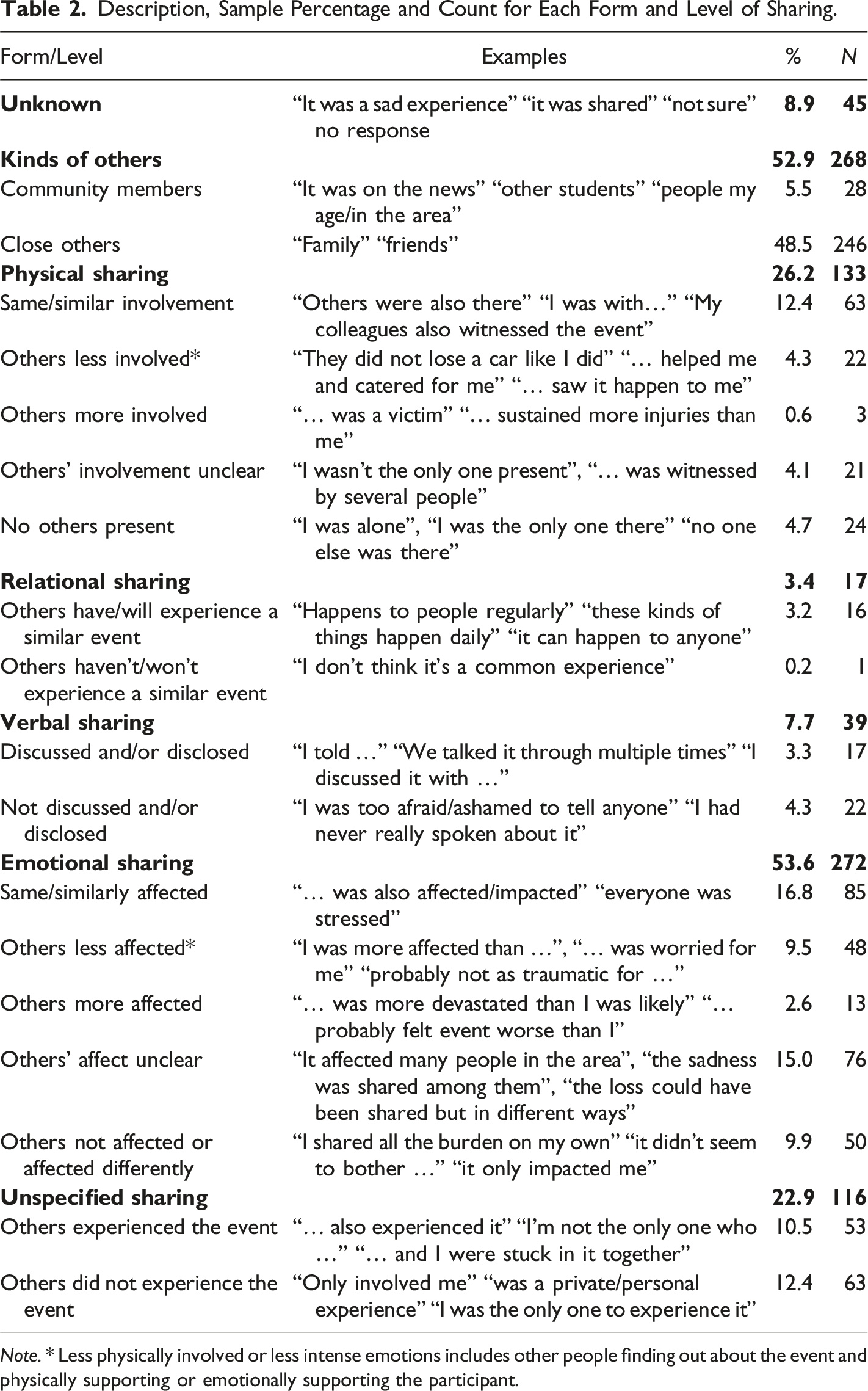
Note. * Less physically involved or less intense emotions includes other people finding out about the event and physically supporting or emotionally supporting the participant.
Does Event Type Influence Which Forms of Sharing People Most Often Consider When Deciding Whether a Stressful/Traumatic Event was Shared or Not?
Sample Percentage (and Count) for Forms and Levels of Sharing Within Each THS Event Category.
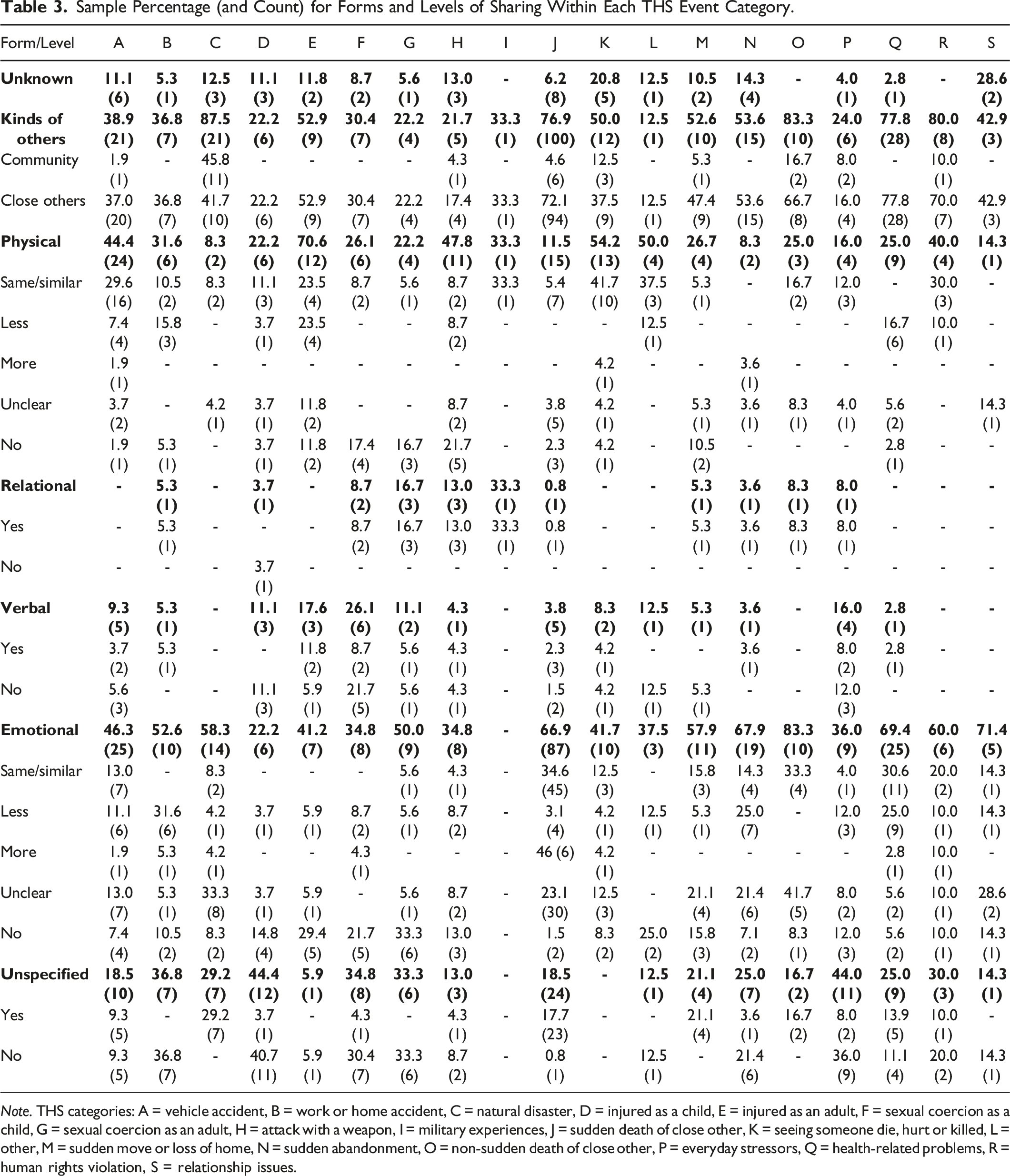
Note. THS categories: A = vehicle accident, B = work or home accident, C = natural disaster, D = injured as a child, E = injured as an adult, F = sexual coercion as a child, G = sexual coercion as an adult, H = attack with a weapon, I = military experiences, J = sudden death of close other, K = seeing someone die, hurt or killed, L = other, M = sudden move or loss of home, N = sudden abandonment, O = non-sudden death of close other, P = everyday stressors, Q = health-related problems, R = human rights violation, S = relationship issues.
Further, physical sharing was the most common form for the remaining event types, possibly because these events tend to occur in public (e.g., vehicle accidents) and around others (e.g., perpetrators/witnesses of physical assault). Indeed, many eyewitnesses to stressful/traumatic criminal events report physically sharing these events (Paterson & Kemp, 2006; Skagerberg & Wright, 2008). Finally, although not a specific form of sharing, the most common theme that emerged from participants’ subjective sharing explanations was sharing with kinds of others, particularly close others. This finding seems logical considering people usually discuss emotional events with close others (Rimé, 2009), people often spend time with friends and family (Ortiz-Ospina et al., 2020), and many of the THS events likely affect or involve close others (e.g., sudden death of close other).
How Often Do People Share Stressful/Traumatic Events in Multiple Ways?
In addition to our planned analyses, we were also interested in determining whether different shared experiences may be related. Thus, we ran exploratory descriptive analyses to determine how often participants mentioned numerous forms of sharing in their subjective sharing explanations. Many participants’ responses (62.5%) were coded into more than one sharing category. However, after removing the community members, close others, and unspecified sharing categories—because these categories were not linked to specific shared experiences—few responses (22.3%) were coded into numerous categories. Amongst these responses, the greatest overlap between different sharing forms was physical and emotional sharing (12.0%), followed by verbal and emotional sharing (4.1%), and verbal and unspecified sharing (3.9%; see Supplementary Table S17 for overlap data across all sharing categories). Thus, whilst we know different shared experiences can emerge from the same stressful or traumatic event (e.g., Bartholomew & Victor, 2004; MacNeil & Mead, 2005; Paterson & Kemp, 2006; Rimé, 2009; Solomon, 2004), most participants seemed to consider one key shared experience they did or did not have when determining the extent to which their worst event was shared.
Summary
Most participants (78.5%) perceived their most stressful/traumatic event as shared to some extent for reasons including, sharing the overall experience with others (unspecified sharing), knowing others were physically present during the event (physical sharing), experiencing the same emotions as others about the event (emotional sharing), discussing and/or disclosing the event with/to others (verbal sharing), knowing others who had experienced a similar event (relational sharing), and sharing the event with close others or their community. The most common reasons for perceiving an event as shared—for all event types—were emotional sharing, physical sharing and sharing the event with close others. Importantly however, these results reflect the forms of sharing that were most influential or noticeable for participants when considering whether their worst event was shared or not, meaning the data do not necessarily capture how often participants actually shared their worst event with other people in these ways. We aimed to address this gap in Study 2 by examining how often people share traumatic events with others, using a more structured questionnaire.
Study 2
To test our aims, we asked participants about the specific sharing categories we identified in Study 1 (physical, relational, verbal, and emotional sharing), and two additional categories we developed (perpetrator and attitudinal sharing). Conceptually, the presence of a perpetrator during an event could be considered a subform of physical sharing (i.e., physically sharing an event specifically with a perpetrator). However, perpetrators are likely to subjectively experience stressful/traumatic events differently to eyewitnesses and victims of such events, meaning participants may have emotionally and attitudinally shared their worst event with non-perpetrators (e.g., feeling scared, blaming the same person), but not with perpetrators (e.g., feeling scared vs. angry, blaming the perpetrator vs. the victim). Thus, we included perpetrator sharing as a separate form of sharing to isolate findings relating to participants’ experiences of sharing their most stressful/traumatic event with the perpetrator(s) and non-perpetrators of the event. We asked participants to not consider the perpetrator(s) for the other sharing measures.
Recall we considered that there may be other ways that people share trauma that have not been established in previous research, and may not have been identified from our Study 1 data. Thus, we examined attitudinal sharing in Study 2 to determine whether participants shared the same attitudes, beliefs, and/or opinions as other people regarding their worst event. As with emotions, people are often driven to establish common beliefs, judgments, and evaluations about their experiences (i.e., shared reality) to improve their understanding of the world, and foster connections with others (see Echterhoff et al., 2009). Some research has even indicated that experiencing a collective trauma can elicit shared values and goals amongst affected groups (e.g., Drury, 2018; Reicher, 2011). Further, other work suggests that people tend to believe that victims of sexual assault were assaulted and were not responsible for the event occurring, meaning people’s attitudes about sexual assault experiences can align (e.g., Acquaviva et al., 2021; Li et al., 2017). Yet, whilst this work suggests that people’s attitudes and beliefs about traumatic events may align, it does not explore the nature of these shared experiences in depth, making it difficult to discern whether such experiences truly occur. Despite not considering this sharing form prior to Study 1, we found some evidence for attitudinal sharing when reanalyzing our Study 1 data: 15 participants reported experiencing the same or different attitudes to others as a reason for their sharing perception rating (e.g., “none of them believed me”). However, attitudinal sharing was often implied rather than explicitly referenced in these explanations (e.g., “other people cared [about the event]”), which may explain why this theme did not emerge in our thematic analysis. Thus, we assessed attitudinal sharing in Study 2 to explore this potential form of sharing further. We differentiated between emotional sharing—representing people’s feelings and emotional reactions to an event—and attitudinal sharing—representing people’s views and evaluations of an event—because these forms may not always overlap (e.g., experiencing similar emotions of fear, but different attitudes about government restrictions, during the COVID-19 pandemic).
Method
Participants
We recruited 514 participants from the same countries as in Study 1; they were compensated USD$1.20–USD$1.40 (MTurk) or GBP£1.50 (Prolific). We excluded thirteen responses: three completed the study twice and ten failed both attention checks (Berinsky et al., 2014). Our final sample was 501 participants (n = 125 for Canada, USA, and Australia/NZ each; n = 126 for UK) from MTurk (n = 239) and Prolific (n = 262). Participants were mostly female (51.7%, male = 46.3%, non-binary = 1.6%, preferred not to say = 0.4%) and with a mean age of 36.09 (range: 18–75, SD = 13.15). Most participants were Caucasian (including “White”, 56.7%) and other participants were of Asian (15.6%); European (4.2%); African (including “Black”, 3.8%); Hispanic (1.0%) and Middle Eastern (0.6%) descent, or Pacific Islander (0.2%) and Mixed (3.2%) ethnicity. All other participants either provided nationality (e.g., “Australian”, 13.4%) or no answer (1.4%). Roughly half of the sample had a college/university undergraduate degree (53.3%; Supplementary Table S18).
Materials and Procedure
We used the same materials and procedure as in Study 1 but did not ask participants to provide an explanation for their subjective sharing ratings, and included a forms of sharing measure.
Forms of Sharing
We asked participants questions about sharing-related details of their worst event. We assessed perpetrator sharing first to ensure participants only included a perpetrator in their responses for this measure. All other forms of sharing measures appeared in a randomized order. For each measure—other than perpetrator and relational sharing—we asked participants whether they shared their worst event in this way and provided them with options: “Yes”, “No”, and “Unsure” (i.e., initial responses). Participants who selected “Unsure” then saw a follow-up question asking them to predict whether they shared the event in this way (“Yes”, “No”; i.e., predicted responses). For instance, participants were initially asked if they emotionally shared their worst event with other people (i.e., same/similarly emotionally affected) and participants who selected “Unsure” were then asked whether they believed they emotionally shared the event with others. We used this procedure to capture shared experiences as inclusively as possible, given reports of these experiences can be subjective and rely on memory accuracy.
Perpetrator Sharing
We provided participants with a definition and an example of a perpetrator and then asked whether a perpetrator was involved in their worst event (Yes/No). Participants who selected “Yes” identified how many perpetrators were involved in the event (1 = 1 perpetrator, 10 = 10+ perpetrators), identified who the perpetrator(s) were (Close others, Distant others, Strangers), and briefly described what the perpetrator(s) did.
Physical Sharing
Participants identified whether other people were present during their worst event (Yes/No). Participants who selected “Yes” indicated how many people were present (1 = 1 person, 8 = 100+ people), who these people were (Close others, Distant others, Vocationally-exposed people, Strangers), and how involved these people were in the event compared to them (More involved, Same/similarly involved, Less involved, Unsure).
Relational Sharing
Participants identified whether they knew anyone else who had experienced, or believed someone would experience, a similar (but not the same) event to them (Yes/No). Participants who answered “Yes” then selected who these people were or could be (see physical sharing).
Verbal Sharing
Participants identified whether they had discussed their worst event with and/or disclosed their worst event to anyone (Yes/No). Participants who selected “Yes” indicated how many people and who they verbally shared the event with (see physical sharing), and whether any of these people were present during the event (Yes/No). These participants also reported when they first and last discussed/disclosed the event (1 = During the event, 7 = Longer than 6 months after the event), how often they discussed/disclosed the event within 24 hours, 1 week, and 6 months of the event occurring (1 = Never, 6 = Almost continuously), and what they discussed/disclosed (Event details, Emotions, Attitudes, beliefs or opinions, Similar events, Other). 4 Participants identified how they discussed/disclosed the event (Orally/in-person, Orally/virtually, Written/in-person, Written/virtually) and whether their discussions/disclosures were public and/or private.
Emotional Sharing
We provided participants with examples (e.g., “did other people seem to have negative feelings and emotions [e.g., sadness] about the event too?”) and nonexamples (i.e., an explanation of what we were not asking about, e.g., “were other people emotionally affected about the event but in a different way”) of emotional sharing. We asked participants to identify whether other people were emotionally affected in the same or a similar way to them about their worst event (Yes/No; see Supplementary Material for a detailed description of the measure). Participants who selected “Yes” identified how many people and who they emotionally shared the event with (see physical sharing), how emotionally affected others were about the event compared to them (More affected, Same/similarly affected, Less affected, Unsure) and, if others were physically present, whether they believed any of these people were emotionally affected in the same or a similar way to them (Yes/No).
Attitudinal Sharing
We provided participants with examples (e.g., “did other people also believe the other driver was at fault”) and nonexamples (i.e., an explanation of what we were not asking about, e.g., “did other people feel the same or similar to you about the event”) of attitudinal sharing. We asked participants to identify whether other people had the same or similar attitudes, beliefs and/or opinions as them about their worst event (Yes/No; see Supplementary Material for a detailed description of the measure). Participants who answered “Yes” identified how many people and who they attitudinally shared the event with (see physical sharing), how strong other people’s attitudes, beliefs and/or opinions were compared to them (Stronger, Same/similar strength, Weaker, Unsure) and, if others were present, whether they believed these people had the same or similar attitudes, beliefs and/or opinions as them (Yes/No).
Results and Discussion
Analysis Strategy
We used a range of quantitative methods to further examine the nature of shared traumatic experiences in Study 2. As with Study 1, we first report descriptive information about the characteristics of participants’ worst events (i.e., sample characteristics) and then report the extent to which participants perceived their worst event as shared both overall and by event type (i.e., subjective sharing). Next, we present data on several unique forms of sharing, including perpetrator, physical, relational, verbal, emotional, and attitudinal sharing (i.e., forms of sharing). Here, we report how often participants shared their worst events in these ways overall and for different types of stressful/traumatic events. We then provide descriptive information about the characteristics of each sharing form including how, how often, with whom, and when participants shared their most stressful/traumatic event. We next report how often stressful/traumatic events are shared in multiple ways. Finally, we report correlational data on the relationships between subjective sharing and other sharing forms (i.e., associations between subjective sharing and forms of sharing).
Data Cleaning
We followed the same data cleaning process as in Study 1. Further information about the data cleaning process can be found in Supplementary Martial. We present results from initial responses and note where differences emerged between initial and initial/predicted responses (see Supplementary Material for data on initial/predicted responses and stressful vs. traumatic events).
Sample Characteristics
We analyzed our sample for prevalence of exposure to traumatic event(s). Most participants’ worst events were considered a high magnitude stressor event (75.5%), a persisting posttraumatic distress event (61.1%), and a Criterion A.1 event (88.6%; APA, 2000; Carlson et al., 2011). The most common worst events were the sudden death of a close other (22.8%), sudden abandonment (8.8%), and seeing someone die, hurt, or killed (8.6%; see Supplementary Material for all characteristics data).
Subjective Sharing
Similar to Study 1, 72.1% of participants rated their worst event as shared to some extent (27.9% = not at all, 14.8% = slightly, 16.2% = moderately, 23.6% = considerably, 17.6% = extremely; total sample: M = 2.88, SD = 1.48). As with Study 1, we identified the most subjectively shared traumatic events in our sample by conducting a one-way between subjects ANOVA for mean subjective sharing ratings by event type. The event types participants perceived as shared to the greatest extent were natural disasters (M = 4.45, SD = 0.82), the sudden death of a close other (M = 3.75, SD = 1.10), and seeing someone die, hurt, or killed (M = 3.47, SD = 1.30; Welch’s F [18, 69.58] = 12.47, p < .001, ηp2 = .263, 95% CI [0.17, 0.30]; Supplementary Table S25–26).
Forms of Sharing
How Often Do People Share Stressful/Traumatic Events in Different Ways?
We assessed the frequency of each form of sharing to answer this question. Almost all participants (initial: 98.6%, initial/predicted: 99.4%) shared their most stressful/traumatic event with others in some way. Based on initial responses, participants most commonly shared their worst event verbally (81.0%), followed by relationally (64.7%), emotionally (57.5%), physically (54.4%), attitudinally (52.7%), and with a perpetrator (36.9%). However, when including predicted responses (i.e., predictions [Y/N] about whether a shared experience occurred for participants who initially reported being “unsure”) in analyses, participants most often shared their worst event verbally (82.8%), followed by attitudinally (74.5%), emotionally (69.7%), relationally (64.7%), physically (57.6%), and with a perpetrator (36.9%). Therefore, verbal sharing was the most common form of sharing and perpetrator sharing was the least common but the frequency of attitudinal and emotional sharing increased considerably when including predicted responses in analyses. Perhaps these forms of sharing were less familiar to participants or more difficult for participants to identify or recall, particularly if they had not discussed or observed other people’s emotions or attitudes, beliefs and/or opinions about the event.
Does Event Type Influence the Frequency of Sharing Stressful/Traumatic Events?
Participants across many event types most often shared their worst event verbally and/or with a perpetrator (Supplementary Tables S29–30). The event types with the highest percentage of perpetrator sharing were all interpersonal traumas (e.g., sexual coercion as a child, attacked with a weapon), meaning, by definition, they all would have involved a perpetrator. Thus, we removed perpetrator sharing from these analyses to ascertain other common ways participants who experienced such events shared the event. After removing perpetrator sharing, verbal and physical sharing were the most common ways that these events were shared. We found a similar pattern of results when analyzing sharing frequencies using initial/predicted responses, but attitudinal and emotional sharing became more common than other forms of sharing for some event types (Supplementary Tables S31–32). Although these patterns differ from the overall frequency of each form of sharing, they illustrate that verbal sharing may be the most common form irrespective of the type of event experienced and attitudinal and emotional sharing are more difficult for participants to recognize when first asked. These findings are inconsistent with our Study 1 results, where participants most often mentioned emotional and physical sharing in their subjective sharing explanations. Thus, perhaps discussing and/or disclosing a stressful/traumatic event is the most common way people actually share such events with others, but knowing others are present and having the same or similar emotions as others about an event influences whether such events feel shared.
What are the Common Characteristics of Each Form of Sharing in the Context of Stressful/Traumatic Events?
We analyzed each form of sharing individually to examine how, how often, with whom, and when participants shared their most stressful/traumatic event. Additional characteristics data appears in Supplementary Material.
Perpetrator Sharing
At least one perpetrator was involved in 36.9% of participants’ worst events. Consistent with homicide research (Roscoe et al., 2012), most often (73.5%) only one perpetrator was involved in the event (2–6 perpetrators: 24.8%; 10+ perpetrators: 1.6%) and perpetrators were typically identified as close others for single-perpetrator events (59.7%; stranger: 25.4%; distant other: 14.9%) and strangers for multiple-perpetrator events (53.1%; close others: 38.8%; distant others: 26.5%). Events that most often involved a perpetrator included human rights violations (100%), sexual coercion as a child (100%) or adult (95.0%), being attacked with a weapon (94.4%), and being injured as an adult (91.7%) or child (88.5%). Despite our expectations that all these events would have involved a perpetrator, 5.3% (n = 6) of participants who experienced one of these events did not report perpetrator involvement. Although these responses could be inaccurate due to participant inattention or erroneous responding, participants may have felt reluctant to label these people as perpetrators, particularly if they knew them well (see Gagnon et al., 2017), or were a perpetrator themselves (e.g., reciprocal violence).
Physical Sharing
Between 54.4% (initial responses) and 57.6% (initial/predicted responses) of participants physically shared their worst event. Physical sharing was less frequent in our sample than existing eyewitness samples (86–88%; Paterson & Kemp, 2006; Skagerberg & Wright, 2008), however this difference could have emerged because only a subsection of events we assessed would have been experienced by eyewitnesses (i.e., events involving crime). Approximately half these participants (52.4%) physically shared their worst event with two to five people. Participants most often physically shared their worst event with close others (75.7%; vocationally-exposed people: 29.2%; strangers: 23.3%; distant others: 21.2%), which may reflect the substantial time people spend with close others (Ortiz-Ospina et al., 2020) and thus the increased likelihood of being exposed to stressful/traumatic events with close others around (e.g., vehicle accident). Participants often reported being involved to the same or a similar extent to others during the event (45.8%; others less involved: 33.0%; others more involved: 26.4%; unsure: 10.8%). Military experiences (100%), the non-sudden death of a close other (100%), and natural disasters (81.8%) were most often physically shared. Interestingly, these events were within the four most subjectively shared events in Study 1. Thus, as suggested in Study 1, events involving or affecting many people seem to be perceived as highly shared.
Relational Sharing
Over half (64.7%) of participants relationally shared their worst event. Participants most often relationally shared their worst event with close others (69.4%; strangers: 60.5%; distant others: 59.1%; vocationally-exposed people: 28.1%; unsure: 15.3%). Natural disasters (81.8%), the non-sudden death of a close other (80.0%), and sexual coercion as a child (76.7%) were most commonly relationally shared, perhaps because these events tend to be verbally shared (e.g., personal discussions or public announcements), enabling people to identify others with similar experiences.
Verbal Sharing
Between 81.0% (initial responses) and 82.8% (initial/predicted responses) of participants verbally shared their worst event. Most participants verbally shared their worst event with two to five people (55.2%) and nearly all reported verbally sharing their worst event with close others (95.9%; distant others: 28.7%; vocationally-exposed people: 21.5%; strangers: 5.5%). These findings support research indicating that discussing negative emotional events is very common (Rimé et al., 1998, 2010) and often occurs with close others (Rimé, 2009).
For verbal sharing, we assessed the timing, frequency, content, and modes of participants’ discussions/disclosures about their worst event. Initial discussions/disclosures often occurred shortly after the event (e.g., immediately after: 34.0%; same day: 16.4%; 6 months after: 3.6%) and final discussions/disclosures often occurred long after the event (e.g., >6 months: 73.5%; 1 month: 5.3%; same day: 2.7%). The overall frequency of verbal sharing declined from 24 hours (M = 3.24, SD = 1.86) to 1 week (M = 3.18, SD = 1.59), and from 1 week to 6 months (M = 2.75, SD = 1.28) after participants’ worst event. Thus, consistent with existing research (e.g., Paterson & Kemp, 2006; Rimé et al., 2010), participants discussed their worst events shortly after they occurred but these discussions declined over time.
Participants most often verbally shared their worst event orally/in-person (i.e., talking to others; 95.2%), followed by orally/virtually (e.g., video/phone call; 29.9%), written/virtually (e.g., text messages, social media posts; 25.8%), and written/in-person (e.g., letters/cards; 4.3%). Most participants discussed/disclosed the event with others privately (i.e., others couldn’t hear or see discussion/disclosure; 69.5%) but some discussed/disclosed the event publicly (i.e., others could hear or see discussion/disclosure; 4.0%) or both privately and publicly (9.2%). Consistent with previous research on co-witness discussions (Paterson & Kemp, 2006; Skagerberg & Wright, 2008), participants most often reported verbally sharing event details with others (e.g., what happened; 89.6%), followed by emotions about the event (e.g., fear; 82.4%), attitudes, beliefs and/or opinions about the event (e.g., aftermath of event; 49.6%), and similar events (e.g., a previous car accident; 16.6%).
Work or home accidents, vehicle accidents, and human rights violations (all 100%) were most commonly verbally shared and even the least commonly verbally shared events were shared often (≥65%). Thus, as Rimé (2020) suggests, people frequently talk with others following negative emotional events.
Emotional Sharing
Between 57.5% (initial responses) and 69.7% (initial/predicted responses) of participants emotionally shared their worst event with other people, with most of these participants sharing the event with two to five people (54.7%). Most participants emotionally shared the event with close others (89.1%; distant others: 22.1%; strangers: 15.2%; vocationally-exposed people: 13.8%) and many believed they were emotionally affected by their worst event to the same or a similar extent as other people (61.6%; others less affected: 28.4%; others more affected: 25.5%; unsure: 7.7%). These findings align with research demonstrating that stressful experiences can elicit synchronization of negative affect between partners (Levenson & Gottman, 1983) and friends (Cook, 2020). Natural disasters (90.9%) and the sudden (80.7%) and non-sudden (80%) death of a close other were most frequently emotionally shared. As with physical sharing, these events were perceived as shared to the greatest extent in Study 1, suggesting events eliciting similar emotional reactions amongst people are highly subjectively shared.
Attitudinal Sharing
Between 52.7% (initial responses) and 74.5% (initial/predicted responses) of participants attitudinally shared their worst event. Nearly half of these participants attitudinally shared their worst event with two to five people (49.3%) and most shared the event with close others (75.4%; vocationally-exposed people: 29.1%; strangers: 23.5%; distant others: 21.1%). Indeed, people often consider the views and beliefs of close others to form a more valid and reliable understanding of their experiences (Andersen & Przybylinski, 2018; Hardin & Higgins, 1996). Participants most often reported that others had the same or similar attitudes, beliefs and/or opinions about the event as them (65.9%; others weaker attitudes: 20.4%; others stronger attitudes: 14.5%; unsure: 12.4%). Seeing someone die, hurt or killed (72.1%), military experiences (66.7%), and a sudden move or loss of home (64.7%) were most often attitudinally shared, possibly reflecting a moral element of such events whereby commonly held standards were violated in some way (e.g., harming others, damaging property).
How Often Do People Share Stressful/Traumatic Events in Multiple Ways?
We examined this question by (1) calculating the percentage of participants who reported sharing their worst event in two different ways, and (2) analyzing questions within the forms of sharing measure explicitly designed to assess the overlap of multiple sharing forms.
Our first analyses revealed that verbal sharing had the highest overlap with other forms of sharing (77.3%–88.3%), meaning many participants who shared their worst event physically, relationally, emotionally, attitudinally, and/or with a perpetrator also verbally shared the event at some point (Supplementary Table S45). Relational and emotional sharing also frequently overlapped with other forms of sharing (51.4%–75.4%), whereas perpetrator sharing had the lowest overlap with other forms (39.1%–77.3%). Emotional and attitudinal sharing overlapped with other forms of sharing more often when predicted responses were included in analyses (Supplementary Table S46).
Our second analyses demonstrated that many participants emotionally (75.4%) and attitudinally (72.1%) shared, but fewer verbally shared (40.5%), their worst event with people they physically shared the event with. Emotional and attitudinal sharing can be inferred by making assumptions about others’ feelings and attitudes at any time. Alternatively, verbal sharing is a concrete behavior and often occurs during or shortly after certain traumatic events, such as mass traumatic events (e.g., terrorist attacks), criminal events (e.g., physical assault), and the death of a loved one (e.g., Pelletier & Drozda-Senkowska, 2016; Pennebaker & Harber, 1993; Rimé et al., 1998, 2010). Thus, there may have been greater opportunity for participants to emotionally and attitudinally (vs. verbally) share the event with people who were present during the event. Yet, verbal sharing can be delayed for some traumatic events (e.g., events eliciting shame or guilt such as sexual assault; Rimé, 2009; Rimé et al., 1991), meaning this pattern could have emerged for other reasons. For instance, participants may not have felt the need to verbally share events with people they physically shared the event with because they assumed their knowledge of the event would be similar. Meanwhile, emotional and attitudinal sharing could have arisen naturally, without requiring action from participants towards others who were present during the event. Moreover, many participants reported discussing and/or disclosing their emotions (82.4%) and attitudes, beliefs, and/or opinions (49.6%) regarding the event whereas fewer reported discussing and/or disclosing similar events with others (i.e., relational sharing; 16.6%). This finding could indicate that these forms overlapped especially considering discussing the event may have encouraged participants to have, or realize they had, similar or the same emotions, attitudes, and experiences as others.
Our overlap analyses suggest many participants shared their worst event with others in multiple ways. Verbal sharing most often overlapped with the other sharing forms, particularly emotional and attitudinal sharing, which is consistent with research demonstrating that people frequently verbally share their emotions, thoughts, and experiences regarding a stressful/traumatic event with others (e.g., Rimé et al., 2010; Skagerberg & Wright, 2008). Further, perpetrator sharing overlapped with the other sharing factors the least, possibly because events involving a perpetrator are unlikely to occur with others around (e.g., victims or eyewitnesses) and may not be discussed and/or disclosed to others (e.g., due to shame; Rimé, 2009). Consequently, not verbally or physically sharing events involving a perpetrator may reduce the opportunity, and thus the likelihood, of relationally, emotionally, and attitudinally sharing the event with other people too.
Associations Between Subjective Sharing and Forms of Sharing
Finally, we assessed whether perceiving stressful/traumatic events as shared was related to sharing such events in the different ways we examined here. Subjective sharing was positively correlated with physical (r = .37, p < .001), verbal (r = .13, p = .004), emotional (r = .51, p < .001), and attitudinal sharing (r = .28, p < .001), negatively correlated with perpetrator sharing (r = −.29, p < .001), and not significantly correlated with relational sharing (r = .08, p = .060; Supplementary Table S50). We also found significant positive correlations between subjective sharing and the number of people events who physically (r = .14, p = .019), verbally (r = .22, p < .001), emotionally (r = .27, p < .001), and attitudinally (r = .17, p < .001) shared the event. There was no significant difference for perpetrator sharing (r = .07; p = .316). Therefore, sharing an event physically, verbally, emotionally, and/or attitudinally with others and sharing with more people in these ways was related to perceiving the event as more shared, yet sharing an event with a perpetrator was related to perceiving the event as less shared.
Summary
Our findings demonstrate that the majority participants (98.6%–99.4%) shared their most stressful/traumatic event with other people in some way, and many shared the event in numerous ways. The most common form of sharing was verbal sharing followed by relational, emotional, physical, attitudinal, and perpetrator sharing, however attitudinal and emotional sharing were more common when participants predicted whether they shared their worst event in these ways. Although participants most often shared their worst event with close others for all forms of sharing, the number of people participants shared their worst event with varied based on how the event was shared. Furthermore, sharing stressful/traumatic events physically, verbally, emotionally, and attitudinally was related to perceiving these events as more shared, whereas sharing such events with a perpetrator was related to perceiving the events as less shared.
General Discussion
Across two studies, we examined (a) the unique ways people share traumatic events with others, and (b) the frequency and characteristics of these diverging forms of sharing from WEIRD populations (Henrich et al., 2010). Based on participants’ explanations of their subjective sharing ratings (Study 1), we identified four common forms of sharing: physical sharing (i.e., others present during the event), relational sharing (i.e., knowing/believing others who have/could experience a similar event), verbal sharing (i.e., discussed and/or disclosed the event with/to others), and emotional sharing (i.e., having the same/similar emotions about the event as others). Independent of these data, we identified two additional forms: perpetrator sharing (i.e., perpetrator/s involved in the event) and attitudinal sharing (i.e., having the same/similar attitudes, beliefs, and/or opinions about the event as others) prior to conducting Study 2. Most participants (72.1%–78.5%) perceived their most stressful/traumatic event as shared with other people to some extent (Studies 1 & 2) and, indeed, nearly all participants (98.6%–99.4%) reported having shared the event in some way (Study 2). Together, these data provide evidence for the idea that people share traumatic events often, and in various ways.
Our findings fit with previous research conducted with similar samples (e.g., Bartone et al., 2019; Garcia & Rimé, 2019; Paterson & Kemp, 2006; Rimé et al., 1998, 2010; Tosone et al., 2012) suggesting that traumatic events can be, and usually are, shared between people physically, relationally, verbally, and emotionally. In our research, the most common form of sharing was verbal sharing, reflecting the high frequency with which people discuss autobiographical (including traumatic) memories with others (e.g., Beike et al., 2016). In addition, verbally sharing autobiographical memories can help form and strengthen social closeness between people by facilitating empathy, social support, and shared knowledge (Alea & Bluck, 2003; Rimé, 2009), and can reinforce a sense of identity (self-continuity) and memory retention (via rehearsal and meaning making; Bluck & Alea, 2008; Wang et al., 2017). Thus, sharing stressful/traumatic events with others may have myriad functional outcomes. Moreover, our findings expand upon existing literature by showing that people share traumatic events attitudinally (i.e., by holding attitudes, beliefs and/or opinions about an event as others) and that people share a range of traumatic events in many unique ways.
Our research has implications for current conceptual understandings of shared experiences. Here, we provide several broad, umbrella-like definitions of sharing that may encompass various, more specific forms of sharing—associated with time, place, type of event/people etc.—that are novel in the literature (see Table 1). For instance, our conceptualization of physical sharing corresponds with definitions of mass traumatic events, interpersonal traumas, co-experienced traumatic events, traumatic events involving joint or shared attention, and shared traumatic realities (regarding mental health workers and their clients) by representing sharing via the physical presence of multiple people during an event. However, these pre-existing concepts may reflect subforms of physical sharing, given they all differ based on how, where, and how many people are involved in a traumatic event (Mauritz et al., 2013; Miao et al., 2021; Shalev et al., 2004; Shteynberg, 2015; Tosone et al., 2012). Similarly, the social sharing of emotions may represent a subform of verbal sharing specifically concerning the discussion of emotional events (Rimé, 2009) while collective emotions/group affect, emotional synchronisation/convergence, and perceived emotional synchronisation may represent subforms of emotional sharing that specify with whom (e.g., groups) and how (e.g., perceived or actual, emotional states or behaviour) emotions are shared. We also distinguished between emotional and attitudinal sharing here to evaluate how these inner states of a shared reality (i.e., common experiences; Echterhoff et al., 2009) vary for traumatic events and to separate from the term shared traumatic reality used within clinical contexts (Tosone et al., 2012).
By categorizing sharing into these broad constructs, we provide a middle ground between sharing and the specific subforms of sharing previous research has examined. Our findings may assist future research on shared traumatic events by highlighting possible areas of interest or importance that are yet to be explored (e.g., how/when people verbally and physically share individual stressful/traumatic events). In addition, our research provides insight into the different contexts in which it may be useful to assess the characteristics and effects (e.g., psychopathology) of sharing (e.g., military experiences for physical sharing), and forms of sharing that may be relevant when investigating certain traumatic contexts or populations (e.g., relational sharing for events involving sexual coercion). Further, our frequency data may allow researchers investigating shared traumatic events to better understand the scope, relevance, and impact of their findings for WEIRD populations (e.g., effects of emotional sharing within western societies may be most relevant to close others). Future research should consider these definitions when identifying and conceptualizing target variables of sharing and when examining the nature and effects of shared traumatic events. Whilst we provide new insights into how people share traumatic events, future research could consider how different perspectives of sharing could be united to form an overarching theoretical framework of shared traumatic experiences.
Our research has limitations. First, due to unequal samples sizes within event types, commonly reported events (e.g., sudden death of loved one: 22.8%–25.6%) may have been overrepresented in, and thus inflated or reduced, the overall sample frequency of different forms of sharing and their characteristics; further, results for uncommon events (e.g., military experiences: 0.6%) may be less accurate because the data were based on few responses. Second, we used self-report measures to assess sharing and thus may not have identified all possible forms of sharing because our participants did not report experiences other samples may have, or only reported the salient ways, rather than all the ways, they shared the event. Nevertheless, our large sample sizes may mitigate this issue. Third, it is possible that participants under- or over-reported sharing-related details of their worst event given autobiographical memories are susceptible to change over time (Loftus, 2005), sharing traumatic events with others can distort or amplify people’s memories of the event (e.g., Nahleen et al., 2019; Paterson & Kemp, 2006), and processes and strategies used to retrospectively report past behavior and experiences can lead to biased and inaccurate reporting (Schwarz, 2007). Without directly observing traumatic events as they occur and interviewing everyone involved in, affected by, and who discussed, such events we cannot obtain truly objective data regarding how people share traumatic events. Although beyond the scope of the current study, future research could assess unique forms of sharing individually through observations and interviews to obtain more objective data. Additionally, future research could randomly assign participants to certain event types or assess participants’ most recent traumatic event to triangulate data on shared traumatic events. Fourth, we did not assess how often people share traumatic events with others virtually, other than briefly for verbal sharing (i.e., we asked participants whether they verbally shared their worst event with others virtually). Considering this behavior appears to be common—for instance people often express condolences of a loved one’s death online, discuss similar experiences of trauma within online support groups, and view live footage of traumatic events (e.g., Christchurch terrorist attack; Crothers & O’Brien, 2020)—future research should examine the frequency and impact of sharing trauma virtually.
Of final note, we collected a modest sample of participants from WEIRD populations (Western, Educated, Industrialised, Rich and Democratic; Henrich et al., 2010). We chose this sample because considerable work on the conceptualizations, nature, and effects of sharing are based on experiences from WEIRD populations (e.g., Baum, 2010, 2014; Drury, 2018; Drury et al., 2015; Garcia & Rimé, 2019; Paterson & Kemp, 2006; Rimé et al., 1991, 1998; Shetynberg & Wright, 2018). Notably, social experiences of trauma have also been explored within other contexts, such as within collectivist societies (Erikson, 1976, 1979; Nils & Rimé, 2012; Rimé et al., 2010). We recognize the importance of investigating shared trauma in such populations, but we did not have the resources to recruit the large and diverse sample that would accurately represent variations in people’s shared experiences within and across difference societal structures, or for the processes required to do so (e.g., survey translations). Future research could investigate the nature of shared traumatic experiences using similar a methodology within different populations (e.g., collectivist cultures) to develop a more comprehensive understanding of the nature of shared traumatic experiences globally, and to compare such experiences across populations. We expect our findings regarding the nature of shared traumatic experiences to generalize to subjective perceptions and accounts about sharing highly stressful and traumatic events experienced by adults from western societies, specifically the US, UK, Canada, Australia, and New Zealand (Simons et al., 2017). We acknowledge that our frequency data may vary in replications of our research given our sample size. Nevertheless, we believe our findings suggesting that people share traumatic experiences with others often and most commonly with close others, is generalisable to these populations. Further, we used online crowdsourcing platforms to collect our data because these platforms provide reliable data when appropriate measures are used (e.g., pre-screening; Casler et al., 2013; Moeck et al., 2022; Peer et al., 2017) and more diverse samples than university sourced populations (Casler et al., 2013; Hauser & Schwarz, 2016). Therefore, we believe we captured a wide range of perceptions and experiences of sharing from our sample.
Overall, our research makes a novel contribution to the literature by developing an integrated understanding of “shared” traumatic experiences within WEIRD populations. Our findings demonstrate that people share traumatic events often, and in many ways, including physically, relationally, verbally, emotionally, attitudinally, and with perpetrators. Further, our data suggests that people most often share traumatic events in these ways with close others, however the frequency of sharing and number of people participants shared traumatic events with varied based on the form of sharing and the type of traumatic event experienced. These results have both conceptual and practical implications for research on shared traumatic experiences. We provide clear terminology, definitions, and evidence for the unique ways in which people share traumatic experiences to support and guide research investigating the psychological consequences of sharing traumatic events. We recommend future research considers these forms of sharing when investigating the characteristics and effects of shared traumatic events to help consolidate our knowledge in this field of research.
Supplemental Material
Supplemental Material - The Nature of Shared Traumatic Experiences: When, How, and How Often Do We Share Trauma With Others?
Supplemental Material for The Nature of Shared Traumatic Experiences: When, How, and How Often Do We Share Trauma With Others? by Nadine P. Hutchison, Emma F. Thomas, and Melanie K. T. Takarangi in Psychological Reports
Footnotes
Acknowledgements
Thank you to Isabelle Slattery for assisting with data collection and Sarah Lewitzka for coding subjective sharing explanations.
Author Contributions
Conceptualization: NPH, EFT, & MKTT, Methodology: NPH & MKTT, Investigation & Formal Analysis: NPH, Supervision: MKTT, Writing – Original Draft Preparation: NPH, Writing – Review & Editing: NPH, EFT, & MKTT.
Declaration of Conflicting Interests
The author(s) declared no potential conflicts of interest with respect to the research, authorship, and/or publication of this article.
Funding
The author(s) declared the following potential conflicts of interest with respect to the research, authorship, and/or publication of this article: This work was supported by a Flinders University College of Education, Psychology, and Social Work HDR Research Award.

Data Availability Statement
Supplemental Material
Supplemental material for this article is available online.
Notes
Author Biographies
References
Supplementary Material
Please find the following supplemental material available below.
For Open Access articles published under a Creative Commons License, all supplemental material carries the same license as the article it is associated with.
For non-Open Access articles published, all supplemental material carries a non-exclusive license, and permission requests for re-use of supplemental material or any part of supplemental material shall be sent directly to the copyright owner as specified in the copyright notice associated with the article.
