




Abstract
The purpose of this study was to compare the psychometric properties of two measures of alexithymia – the Toronto Alexithymia Scale (TAS-20) and the Perth Alexithymia Questionnaire (PAQ) – as well as the Barratt Impulsiveness Scale 11 measure of behavioural impulsivity because the psychometric properties of these scales have not been established in athletes. As part of a larger study, 298 participants completed an online survey that included the TAS-20, PAQ, and BIS 11, as well personal- (age and gender) and sport-specific (primary combat sport and level of competition) demographic measures. A unidimensional model was retained for the TAS-20. A unidimensional model with the possibility of multidimensional measure was retained for the PAQ, with the viability of a subscale for Generalised Externally Orientated Thinking supported. The only versions of the BIS that were retainable were unidimensional models for the BIS-15 (a 15-item version of the BIS 11) and the BIS-Brief (an 8-item version of the BIS 11). As expected, the measures of alexithymia were highly correlated. The associations between impulsivity and alexithymia as well as age and alexithymia were small in nature, with none these associations moderated by level of gender, level of competition, or primary sport for the participants. No differences in alexithymia or impulsivity according to gender, level of competition, or primary sport were noted for the participants. Implications of these findings for the measures of alexithymia – the TAS-20 and PAQ – and impulsivity – the BIS-15 and BIS-Brief – examined in the present study with athletes (as well as with other populations) are discussed.
Combat sports are a set of contact sports where competitors typically engage in one-on-one combat under a specific ruleset which varies between sports. Athletes compete at a wide range of competitive levels ranging from amateur to professional (Barley et al., 2019; James et al., 2017). Combat sports can be classified as a higher risk type of sport because it is common for athletes to acquire injuries both during competition and training. In mixed martial arts (MMA) for example, the injury rate has been reported as ∼23 per 100 fight participations. There is also a high incidence of concussion (∼3% chance per match) across combat sports, which has a risk of long-term brain injury (Graham et al., 2011; Ngai et al., 2008). The risks of injury have been found across a range of combat sports including boxing (Zazryn et al., 2006), kickboxing (Romaine, 2003), Muay Thai (Gartland et al., 2005), taekwondo (Feehan & Waller, 1995), Brazilian Jiu Jitsu (BJJ: Scoggin et al., 2014) and wrestling (Agel et al., 2007).
Despite an increasing interest in examining the impact of alexithymia in the context of participation (Roberts & Woodman et al., 2015) as well as performance in sport (Proença Lopes et al., 2022; Roberts & Woodman et al., 2015), limited research has been conducted on the possible role of alexithymia in combat sports. In combat sports, greater alexithymia maybe needed to take the risks necessary to succeed despite the potential of harm noted above. Consistent with the suggested application of the work of Fenichel (1939) noted by Woodman et al. (2008) in the context of attraction to high-risk sports, perhaps combat sport athletes with higher levels of alexithymia may be attracted to training and competition to feel some release from felt anxiety but without the examination of the cause of the anxiety. Given the highly prevalent practice of ‘weight cutting’ (i.e., rapid weight loss before a competitions) in combat sports (Barley et al., 2018, 2019) in combat sports, and that alexithymia has been implicated in problematic patterns of food consumption in the general population (Gramaglia et al., 2020; Westwood et al., 2017), it is possible that combat sport athletes with higher levels of alexithymia might also be more prone to extremes of ‘weight cutting’ behaviour.
Alexithymia has been examined from different theoretical frameworks including self-determination (Barberis et al., 2022) as well as attachment (Barberis et al., 2023) theories. From a broadly psychoanalytic perspective, Taylor et al. (1991) defined alexithymia as difficulties with identifying and describing feelings as well as having an external orientation (rather than an awareness of internal emotional states). This definition of alexithymia stimulated the development of the 20-item Toronto Alexithymia Scale (TAS-20: Bagby et al., 1994)
There has been an on-going discussion of the psychometric properties of the TAS-20. The main models for the TAS-20 are unidimensional (e.g., one-factor or single second-order factor models), where multidimensional models – such as a three- correlated-factors (difficulty identifying feelings [DIF], difficulty describing feelings [DDF], and externally oriented thinking [EOT]) model – are essentially ‘straw man models’ (Brown, 2015) specified to determine if these unidimensional models are a better fit of the data than the multidimensional models. A method-factor is sometimes specified to account for variance attributed to items that are reverse-scored.
Recently, researchers have also tested the efficacy of a model that postulates a view of the TAS-20 as being unidimensional in nature with the possibility of multidimensionality. Such a view of the TAS-20 can be examined by a bifactor model, where the degree of association between the items of the TAS-20 can be explained by an overall alexithymia factor and three orthogonal specific factors (DIF, DDF, and EOT). These researchers (Carnovale et al., 2021; Tuliao et al., 2020) have found that despite concerns about some redundant items, such a bifactor model is a better fit of the data compared to the other multidimensional or unidimensional models for the TAS-20.
Despite its popularity as a measure of alexithymia, the TAS-20 has been criticised by Preece et al. (2018a, 2018b) on the following grounds: conceptual, for not clearly articulating attention appraisal aspects of alexithymia as well as a lack of reference in the items of the TAS-20 to emotional valence (i.e., to negative or positive emotions); and psychometric, such as problems with the EOT component of the TAS-20, where low Cronbach’s alpha values and non-salient factor loading have been noted, and the conceptual ambiguity of reverse-scored items.
To improve on these concerns about the TAS-20, Preece et al. (2018b) developed and psychometrically appraised a new measure of alexithymia – the Perth Alexithymia Questionnaire (PAQ). In this measure, four items are intended to measure difficulty with identifying and describing negative and positive emotions respectively (making a total of 16 items); and eight items are intended to measure generalised externally oriented thinking. Of the five models – multidimensional (correlated-factor), unidimensional (one or second-order), and unidimensional with the possibility of multidimensionality (bifactor) models – to explain the association between the 24 items of the PAQ examined across two different samples of mixed community and university students, a bifactor model was the best fit of the data, and all FLs were statistically significant and salient.
The TAS-20 has been used in research examining the role of alexithymia in the sporting experience of athletes. For example, in a recent systematic review of 23 papers by Proença Lopes et al. (2022), the TAS-20 as one of four measures of alexithymia noted, and the TAS-20 was used in 74% (17 of 23) of the papers reviewed. Despite the use of the TAS-20 in examining the link between alexithymia and preparation for and performance in competition as well as well-being in the context of sport, no study has examined the psychometric properties of the TAS-20 with a sample of athletes. Further, the psychometric properties of both the TAS-20 and PAQ have been examined with the same group of participants twice previously– with a US population (Preece et al., 2020a) and a Singaporean as well as an Australian population (Chan et al., 2023) – with both studies finding that the most parsimonious models were the three correlated-factors with method effect model for the TAS-20 and the five correlated-factor model for the PAQ.
Another construct of interest in understanding behaviour in combat sports is impulsivity. In the domain of sport, impulsivity has been found to be linked with participation in high-risk sports (see McEwan et al., 2019) and as a common symptom associated with sport-related concussion (Beidler et al., 2021; Byrd et al., 2022; Eagle et al., 2022; Liebet al., 2021; Tingaz et al., 2022). A number of studies have also examined differences in impulsivity between various levels of athletes (Sánchez-Sánchez et al., 2023; Siekanska & Wojtowicz, 2020; Vaughan et al., 2021) or between sports (Jack & Ronan, 1998; Svebak & Kerr, 1989), with findings being inconclusive. Some research has implicated impulsivity with some dysfunctional aspects of sporting performance such as higher error rates in team sport (Lage et al., 2011), greater competitive anxiety (Terres-Barcala et al., 2022) as well as perfectionism (González-Hernández et al., 2019), and higher rates of personal injury (Madžar et al., 2017). Research has begun to find links between greater impulsivity with problematic behaviours by athletes in sport such as gambling (Grall-Bronnec et al., 2016), sport-related cheating (Kang et al., 2021), and substance use (McNamara et al., 2022). In combat sports specifically, impulsivity as a symptom of sport-related concussion has been reported on (Bryant et al., 2020). Only one study (Litwiniuk et al., 2012) has conducted reported on differences in impulsivity between athletes. However, greater impulsivity in combat sport athletes may impact of performance as they need to combine patience with aggression to win bouts. A combat sport athlete with higher levels of impulsivity may lack the patience to be effective in bouts, particularly at higher levels of competition where combatants’ defensive skills are generally of a higher standard. Further, and as noted earlier, given the elevated presence of unhealthy weight loss practices prior to bouts by combat sport athletes and the interest in examining the link between impulsivity and problematic aspects of disordered eating and related phenomena (Carr et al., 2021; Howard et al., 2020), it is possible that greater impulsivity may be associated with greater engagement with weight cutting by combat sport athletes before bouts.
In the field of psychology, impulsivity has been measured in a variety of ways, depending on the conceptualisation of impulsivity, the response format for the items, and the identification of facets. In the Impulsiveness and Venturesome Questionnaire (Eysenck, 1985), impulsivity is conceptualised as a personality construct, the response format is dichotomous (yes/no), and contains 19 items general (that is, not allocated to facets or aspects of impulsivity). While the five-factor version of the UPPS-P (Cyders et al., 2007) also conceptualises impulsivity as a personality construct, a Likert-like scale is the response format, and five facets are articulated: urgency, premeditation (lack of), perseverance (lack of), sensation seeking, positive urgency, and impulsive behaviour. Conceptualised in behavioural terms, that also uses a Likert-scale response format, and also proposes facets of impulsivity – lack of attention, deliberation, and planning (Barratt, 1965) – is the Barratt Impulsiveness Scale 11 (BIS 11: Patton et al., 1995) is one of the most widely used measures of impulsivity in the field of psychology.
With a long history of use (see Stanford et al., 2009) as well as being translated into many languages (see Juneja et al., 2019 for a summary), the BIS 11 is a widely used measure of behavioural impulsivity. Originally, the 30 items of the BIS 11 were modelled (Patton et al., 1995) as being explained by 3 correlated-second-order-factors – attentional, motor, and non-planning impulsivity – and that these correlated second-order factors explain the association between six first-order factors – attention and cognitive instability (as indictors of attentional impulsivity); motor and perseverance (as indicators of motor impulsivity); and self-control as well as cognitive complexity (as indicators of non-planning impulsiveness). Several studies have found no support for this model for the BIS 11 (e.g., Coutlee et al., 2014; Steinberg et al., 2013). One-factor (e.g., Coutlee et al., 2014; Reise et al., 2013) and simple bifactor (Reise et al., 2013; Stenberg et al., 2013) models have also been rejected.
Several shorter versions of the BIS 11 have been developed including: the BIS-24 (Haden & Shiva, 2009), where two correlated but distinct factors – motor and non-planning impulsivity are proposed; and the BIS-21 (Kapitány-Fövény et al., 2020), where three correlated but distinct factors – cognitive impulsivity, behavioural impulsivity, and impatience/restlessness – are proposed). In the BIS-15 (Spinella, 2007), 15 of the 30 original BIS 11 items are conceptualised such that a single second-order impulsivity factor explains the association between the three lower-order (attentional, motor, and non-planning) factors. Additional support for this factor structure for the BIS-15 has been found with a sample of German adults (Meule et al., 2020). The BIS-Brief is an eight-item scale that includes seven items included in the BIS-15; and support has been found for a single unidimensional factor model (Steinberg et al., 2013).
The BIS 11 as well as previous versions (e.g., the BIS 10) has been used to study impulsivity in the sporting domain. For example, the BIS was one of four measures of impulsivity noted in a meta-analysis by McEwen et al. (2019) which, in part, reported on the association between impulsivity and participation in high-risk sports; and the BIS was use in approximately 29% (2 of 7) studies reviewed. However, the psychometric properties of the BIS 11 has not been examined with a sample athletes.
In summary, despite the interest in the role that alexithymia and impulsivity might play in the domain of sport, and particularly in combat sports, little is known about the psychometric properties of two measures of alexithymia – the TAS-20 (Bagby et al., 1994) and the PAQ (Preece et al., 2018b) – as well as BIS 11 (Patton et al., 1995), as a measure of behavioural impulsivity. Saw et al. (2017) point to the importance of establishing the psychometric properties of questionnaires to be used with athletes based on the responses of athletes. More generally, examining the psychometric properties of the TAS-20, PAQ, and the BIS 11 will help to clarify how best to model and therefore conceptualise both alexithymia and impulsivity. A further examining the psychometric properties of the TAS-20 and the PAQ will also contribute to a more general debate about how to best measure the alexithymia construct using a self-report scale.
Therefore, the focus of the present study was to investigate the psychometric properties of the TAS-20, PAQ, and the BIS 11 as well as its other incarnations in athletes in a sample of combat sport athletes. The first phase of the study focused on establishing the factorial validity of the three measures; and the results of this analysis would be used to inform how the measures should be simply scored. Based on previous research, it was expected that some form of unidimensional model would be found to be plausible for the TAS-20 and PAQ using all the existing items for these scales. For the BIS 11, it was expected, based on findings of Juneja et al. (2019) who examined several variations of the BIS 11 with a Thai population, that unidimensional models for the BIS-15 and BIS-Brief were the only versions of the BIS 11 likely to be found to be plausible.
In the second phase of the study, and using simply summing for scale scores based on the findings from the first phase of the study, the links between alexithymia as well as impulsivity age, and according to main combat sport as well as level of competition (i.e., amateur, regional/state, or elite) were examined because such an examination helps to describe the full fabric of combat sports and the findings will provide further information about the potential of these constructs as covariates or moderators in statistical analyses. Other than the expected negative relationship between age and alexithymia (González-Hernández et al., 2019), no other hypotheses were offered as these analyses were exploratory in nature.
Methods
All experimental procedures are subject to approval by ECU University Human Research Ethics Committee. The participants completed a questionnaire in Qualtrics (Qualtrics August to December 2019, Qualtrics, Provo, Utah, USA), with the link to the survey being e-mailed to the participants by combat sports gyms/organisations/message boards around the world who agreed to send out the link to the survey. Participants were informed of the study procedures and indicated their consent by accepting the terms and conditions before data collection.
Participants
The participants in the present study were combat sport athletes who participated in a larger study that aimed to develop a global psychological, performance and weight-loss behaviour profile of combat sport athletes.
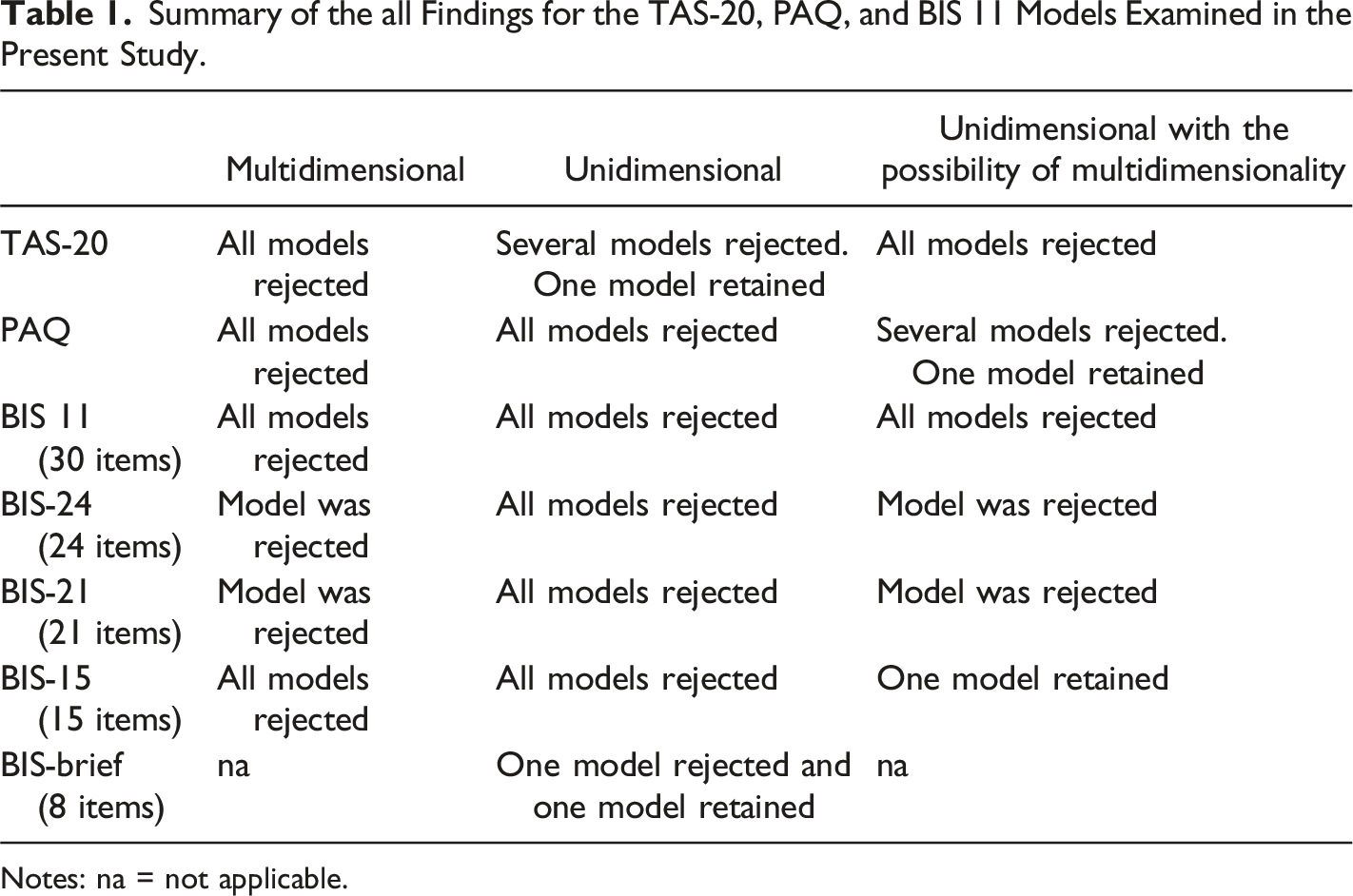
Summary of the all Findings for the TAS-20, PAQ, and BIS 11 Models Examined in the Present Study.
Notes: na = not applicable.
Measures
Toronto Alexithymia Scale-20 (TAS-20: Bagby et al., 1994)
The TAS-20 is a 20-item self-report questionnaire where participants respond to the items on a 5-point Likert scale (1 = strongly disagree to 5 = strongly agree). The items of the TAS-20 are commonly broken down into three components – difficulty identifying feelings (DIF: 7 items), difficulty describing feelings (DDF: 5 items), and externally oriented thinking (EOT: 8 items, where a person prefers to focus on external stimuli rather than internal experiences). The TAS-20 includes five reverse-scored items, four of which are associated with the EOT component. Higher scores on this scale indicates greater alexithymia.
Perth Alexithymia Questionnaire (PAQ: Preece et al., 2018b)
For the PAQ, participants respond to 24 items on a 7-point Likert scale (1 = strongly agree to 7 = strongly disagree). The authors preferred conceptualisation of the PAQ is that it is made up of 5 components: difficulty identifying feelings, positive (4 items) and negative (4 items) valence; difficulty describing feelings, positive (4 items) and negative (4 items) valence; and generalised externally oriented thinking (8 items). The PAQ contains no reverse-scored items. Higher scores on this scale indicates greater alexithymia.
Barratt Impulsiveness Scale 11 (BIS 11: Patton et al., 1995)
The BIS 11 is a 30-item scale where participants respond to items on a 4-point Likert scale (1 = rarely/never to 4 = almost always). The BIS 11 contains 11 reverse-scored items. The BIS-24, -21, −15, and -Brief contain items that are a subset (24, 21, 15, and 8 respectively) of the items from the BIS 11, including several reverse-scored items. One aspect of the BIS-15 that separates it from other versions of the BIS 11 is that the BIS-15 contains two items (about future orientation and places where the participant experiences restlessness) that are slightly re-worded versions of BIS 11 that have been taken from the BIS-11a (Lijffijt, 2011). Higher scores on all variations of the BIS 11 indicates greater behavioural impulsivity.
Personal and Combat-Sport Related Demographic Variables
As part of the larger study referred to earlier, participants completed a questionnaire adapted from previous combat sports research (Barley et al., 2018) that contained questions on personal demographic variables such their age such as their sex (male or female). Participants also completed questions about combat-sport related demographic variables, such as which combat sport was their primary combat sport as well as their current level of competition (amateur; regional or state; or elite, where elite was defined as competing at national, international, semi-professional, and professional levels).
Statistical Analysis
The initial step of the analysis involved using Confirmatory Factor Analysis (CFA) to establish the factor validity of the BIS 11, TAS-20, and PAQ. Several models were examined for the BIS 11, BIS-24, BIS-21, BIS-15, and BIS-Brief as well as the two measures of alexithymia – the TAS-20 and the PAQ. Models aimed at testing underlying multidimensionality (i.e., correlated-factors), unidimensionality (i.e., 1-factor and 2nd-order-factor), and unidimensionality with the possibility of multidimensionality (bifactor). Where negatively framed items were included in the scales (e.g., version of the BIS), common-method (CM) factor models were also examined. It should be noted that several possible 2nd-order factor models that were indicated by three or fewer first-order factors (e.g., for the PAQ) were not examined in the present study because the upper portion of this model is just identified. To over-identify the upper portion of this type of model, it would be necessary to constrain the 2nd order FLs to equality, and there are no clear guidelines as to which 2nd-order FLs should be constrained as such.
All analyses were conducted using Mplus Version 8.3 (Muthén & Muthén, 2017). Weight-least squares (WLSMV) method of estimation for ordered categorical data was used. The following fit indices were reported: χ2, Root Mean Square Error of Approximation (RMSEA), Comparative Fit Index (CFI), and Tucker-Lewis Index (TLI). Models were retained if model fit if RMSEA was ≤.08 (Browne & Cudeck, 1993; Kline, 2015) and as well as CFI or TLI values were < .90 (Bentler & Bonett, 1980). The decision-making regarding CFA model retention appears in Appendix A. Guidelines for FL size (Marsh & Hau, 1999), the assessment of bifactor models (Stucky et al., 2014, 2015), the viability of subscales (Hammer & Toland, 2016) as well as non-salient items (Heinrich et al., 2020) in the context of bifactor models, and the assessment of discriminant validity of factors in the context of multidimensional models (Farrell, 2010; Fornell & Larcker, 1981) were noted. Based on the findings for the retained scales, decisions were made as to the summing of the items for the scale for the next step in the analyses. Using the TAS-20 as an example, where a multidimensional model was retained as plausible, the scale was summed as separate and distinct measures (e.g., DIF, DDF, and EOT). Where a unidimensional model was retained as plausible, the scale was summed as single measure (e.g., of alexithymia). Where a model that supported the plausibility of a unidimensionality with the possibility of multidimensionality conceptualisation for the scale, then the scale single measure (e.g., of alexithymia) and the items for any viable subscales (e.g., for DIF, DDF, and EOT) were also summed.
The second step in the analysis focused on correlations between measures as well as any differences in the measures according to groups. Pearson r correlation was used to examine the association between measures of alexithymia, impulsivity, and age. Analysis of variance was used to examine differences in alexithymia and impulsivity according to primary combat sport, level of competition, and gender. These analyses were conducted in SPSS (version 28). A p value of .05 was used for these analyses. Cohen’s criteria (Cohen, 1988) were used to establish effect sizes for all parametric tests. Whether the associations between alexithymia, impulsivity, and age were moderated by primary combat sport, level of competition, and gender was examined using multigroup analysis conducted using Mplus Version 8.3 (Muthén & Muthén, 2017).
Results
CFAs for the Toronto Alexithymia Scale (TAS-20), Perth Alexithymia Questionnaire (PAQ), and different versions of the BIS 11
TAS-20
A summary of the findings of the models examined in the present study for the TAS-20 appears in Table 1. All models that postulated a multidimensional conceptualisation for the TAS-20 were rejected because: a lack of factor discriminant validity; and some models did not converge. The detail for these findings appears in Appendix B. These findings do not support the scoring of difficulty identifying feelings (DIF, difficulty describing feelings (DDF), or externally orientated thinking (EOT) as separate scales.
Models that postulated ‘unidimensionality with the possibility of multidimensionality’ conceptualisation for the TAS-20 were also rejected due to lack of model fit. The detail for these findings appears in Appendix B. It is worth noting that latent-variable correlation between the DDF and DIF factors in these multidimensional models was very high (∼.90). These findings do not support the scoring of difficulty identifying feelings (DIF, difficulty describing feelings (DDF), or externally orientated thinking (EOT) as separate subscales.
Of the unidimensional models, the second-order factor models were rejected to lack of the model fit. See Appendix B for details. The only model that was retained as plausible for the TAS-20 was the one-factor model and an orthogonal common-methods factor (which proved to be a better fit of the data than a simple one-factor model – see Appendix B for details). Such a model supports the simple summing of items (after reverse-scoring of five negatively framed items) for the TAS-20 as a single score for alexithymia.
PAQ
A summary of the findings of the models examined in the present study for the PAQ appears in Table 1. All models postulating a multidimensional conceptualisation for the PAQ were rejected due to poor model fit. The detail for these findings appears in Appendix E. These findings do not support the scoring for the following as separate scales: generalised difficulty appraising feelings, generalised externally orientated thinking, generalised difficulty identifying feelings, generalised difficulty describing feelings, positive difficulty appraising feelings, or negative difficulty appraising feelings, negative difficulty identifying feelings, positive difficulty identifying feelings, negative difficulty describing feelings, and negative difficulty identifying feelings.
Findings for Retained Models for the TAS-20, PAQ, BIS-15, and BIS-Brief.
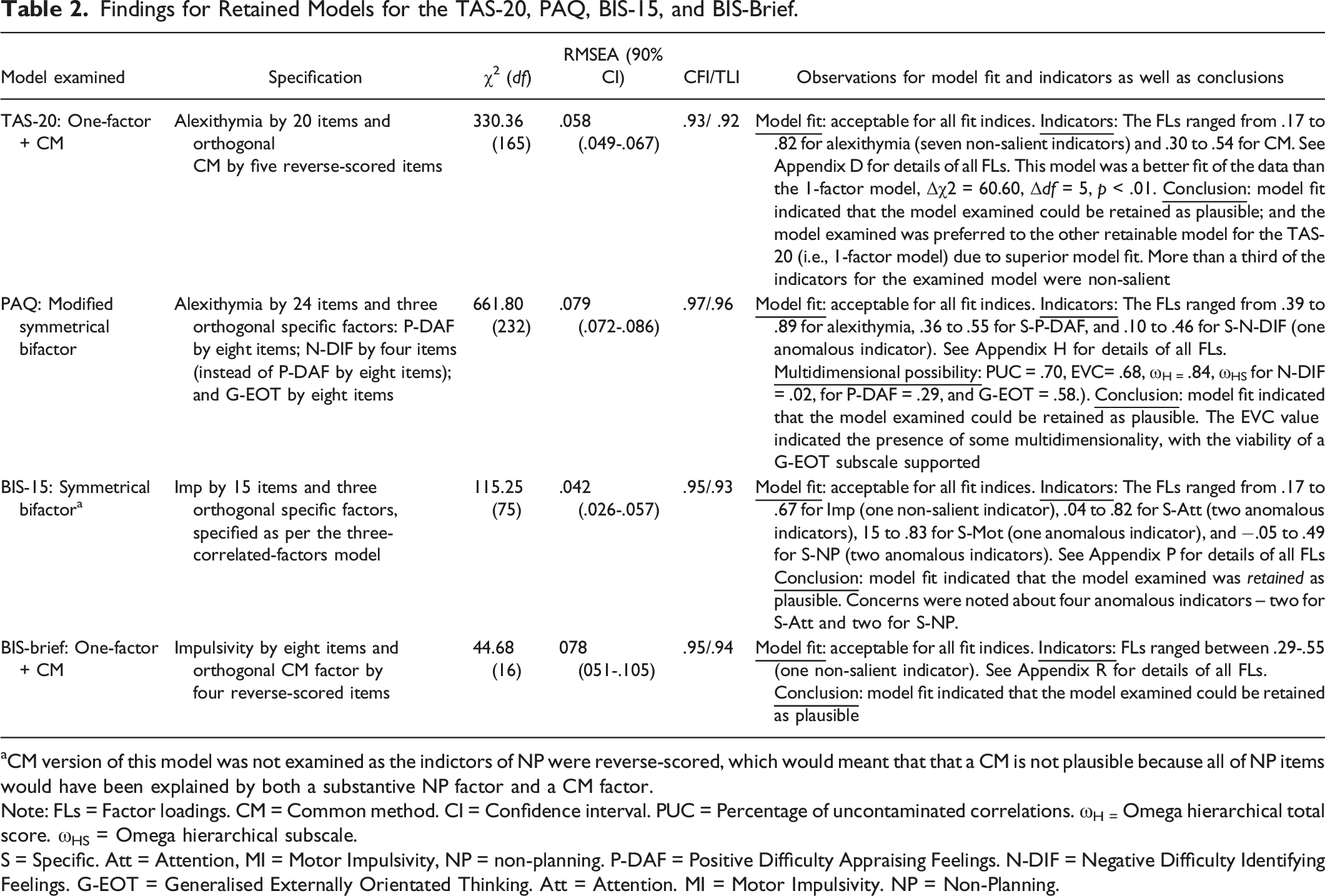
aCM version of this model was not examined as the indictors of NP were reverse-scored, which would meant that that a CM is not plausible because all of NP items would have been explained by both a substantive NP factor and a CM factor.
Note: FLs = Factor loadings. CM = Common method. CI = Confidence interval. PUC = Percentage of uncontaminated correlations. ωH = Omega hierarchical total score. ωHS = Omega hierarchical subscale.
S = Specific. Att = Attention, MI = Motor Impulsivity, NP = non-planning. P-DAF = Positive Difficulty Appraising Feelings. N-DIF = Negative Difficulty Identifying Feelings. G-EOT = Generalised Externally Orientated Thinking. Att = Attention. MI = Motor Impulsivity. NP = Non-Planning.
BIS 11, BIS-24, BIS-21, BIS-15, and BIS-Brief
A summary of the findings of the models examined in the present study for the BIS 11, BIS-24, BIS-21, BIS-15, and BIS-Brief appears in Table 1. All models postulating either a multidimensional or unidimensional (with or without the possibility of multidimensionality) for the BIS 11, BIS-24, or BIS-21 were rejected due to lack of model fit and/or problematic items. See Appendices I, K, M, O, and Q for details.
For the BIS-15, all models postulating a multidimensional conceptualisation, or a unidimensional conceptualisation were rejected. The only model that retainable for the BIS-15 – with the details of model fit and findings in Table 2 was a modified symmetrical 3- (attention [Att], motor impulsivity [MI], and non-planning [NP]) bifactors model. These findings support the summing of the items of the BIS-15 as single score, with higher scores indicating greater impulsivity. As PUC, EVC, ωHS values for Att, MI, and NP specific factors were not indicative of a viability, sub-scale scales for Att, MI and NP (by simple summing) were not calculated because they were not justified.
For the BIS Brief, a unidimensional model which also accounted for reverse-scored nature of the items was also retained and a simple 1 factor model was rejected (see Appendix Q for details). As such, the eight items of the BIS-Brief were summed (after reverse-scoring four items) as a second score for impulsivity.
Parametric Analyses
Associations Between Retained Measures of Alexithymia, Impulsivity, and Age
Correlations Between Measures of Alexithymia and Impulsivity Retained After the CFA Analyses as Well as Age.
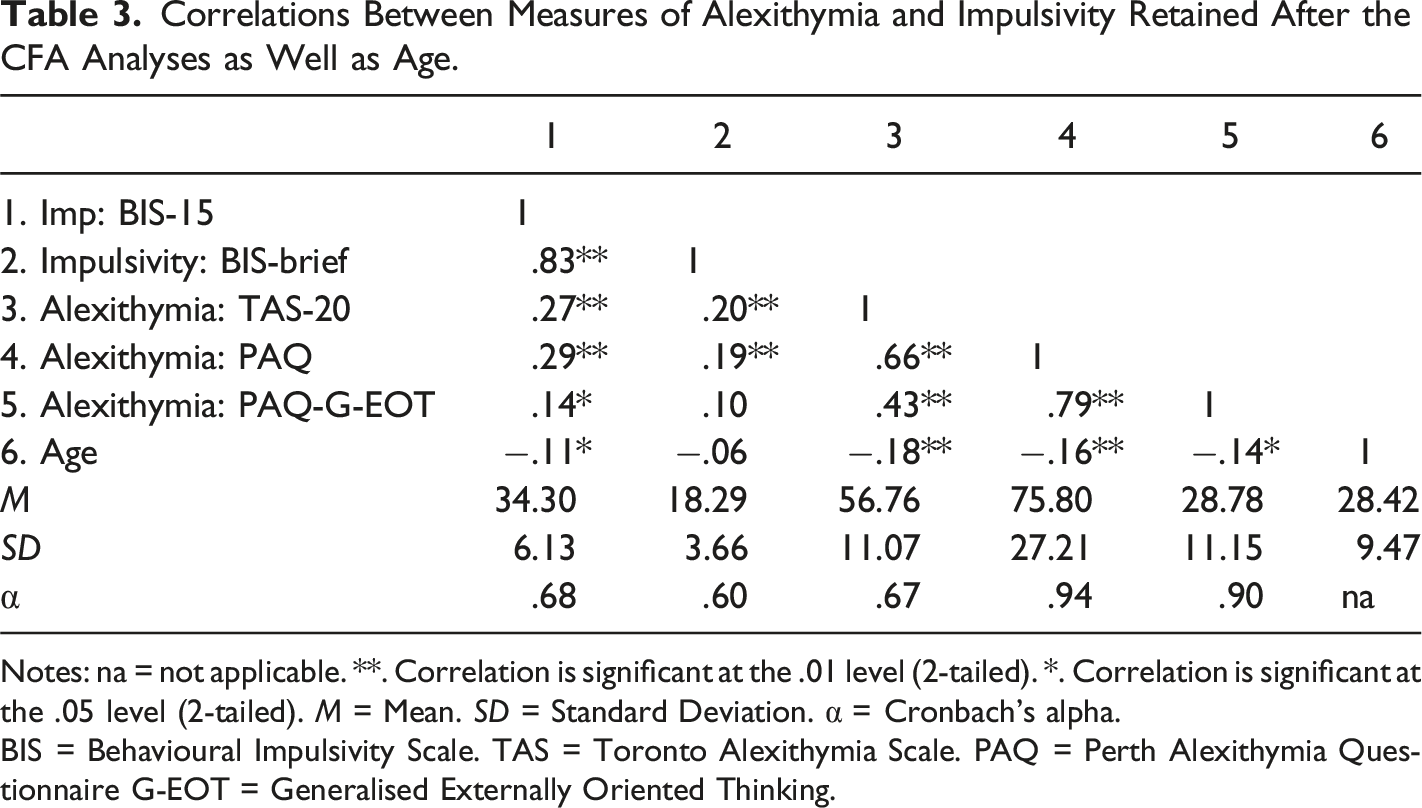
Notes: na = not applicable. **. Correlation is significant at the .01 level (2-tailed). *. Correlation is significant at the .05 level (2-tailed). M = Mean. SD = Standard Deviation. α = Cronbach’s alpha.
BIS = Behavioural Impulsivity Scale. TAS = Toronto Alexithymia Scale. PAQ = Perth Alexithymia Questionnaire G-EOT = Generalised Externally Oriented Thinking.
Measures of Impulsivity and Alexithymia and Sex: Differences According to Sex and Level of Competition as well as Sport Type (see Table 4)
No statistically differences were noted the measures of impulsivity, alexithymia, and age according to sex (see Appendix S for details) or level of competition as well as sport type (see Appendix T for details).
Discussion
Of interest in the present study was establishing the psychometric properties with a sample of combat sport athletes of two measures of alexithymia – the Toronto Alexithymia Scale-20 (TAS-20 Bagby et al., 1994) and the Perth Alexithymia Questionnaire (PAQ: Preece et al., 2018b) – as well as a commonly used measure of impulsivity – the Barratt Impulsiveness Scale 11 (BIS 11: Patton et al., 1995). The study proceeded in two phases. In first phase, the factorial validity of the three measures was examined to inform how the measures should be simply scored.
For the TAS-20, the only model that was retained, despite reservations about several indicators, was a unidimensional model where, while accounting for the method of measure (i.e., the reverse-scored nature of five items), a single alexithymia factor explained the association between the 20 items of the TAS-20. The findings of the present study support, after reverse-scoring the five negatively framed items, the summing of the items for the TAS-20 as a single score for alexithymia for combat sport athletes.
However, three points are worth noting. First, unlike the findings by Tuliao et al. (2020) and Carnovale et al. (2021), the findings from the present study did not support the specification of some type of bifactor model as being plausible. It is possible that the bifactor models did not converge in the present study because the correlation between the DDF and DIF aspects of the TAS-20 in three-factor models was large. As such, it is possible that the experience of difficulty describing and identifying feelings may be less pertinent to the emotional experience of combat sports athletes. Second, seven non-salient items were noted in the retained model for the TAS-20. Thirdly, and in support of what has been previously noted by Preece et al. (2018b), Cronbach’s α for the TAS-20 in the present study was much lower than preferred.
The only model that was found to be plausible for the PAQ was a unidimensional model with the possibility of multidimensionality. However, this finding was only achieved after a modification where the negative describing feelings (N-DDF) were not specified as indicators of a difficulty with appraising specific negative feelings (N-DAF) factor, perhaps meaning that, for combat sport athletes, the notion of describing negative feelings was not as prominent as identifying negative feelings. In general, the findings of the present study for the PAQ are broadly consistent with those reported by Preece et al. (2018b) that the 24 items of the PAQ can be explained by a single alexithymia factor; and that the items for PAQ can be simply summed as a measure of alexithymia for combat sport athletes. The findings of the present study provide support for some multidimensionality for general externally orientated thinking (EOT) as a viable sub-scale of the PAQ.
As has been noted previously (Chan et al., 2023; Preece et al., 2020bPreece, Parry, et al., 2020), the findings of the present study indicated that the general psychometric properties of the TAS-20 and PAQ were of a similar standard. However, some comparisons between the TAS-20 and the PAQ as measures of alexithymia are worth noting. The model fit for the PAQ was on the outer limits of plausibility whereas the overall model fit for the TAS-20 was found in the present study to be of a higher standard, However, and unlike for the TAS-20, no non-salient indicators were noted for the PAQ. Also, Cronbach’s alpha for the PAQ was much higher than that observed for the TAS-20.
Several findings of note were observed for the BIS 11 (30 items) and the variants of this measure. Only two – the BIS-15 (Spinella, 2007: 15 items) and the BIS-Brief (eight items) – were retained as plausible. However, it should be noted that even though a bifactor model was retained as plausible for the BIS-15, this model was retained after four items were no longer specified as indicators of the relevant specific factors; and none of the potential subscales were found to be viable. However, these findings are novel in that this is the first study to demonstrate the plausibility of the BIS-15 with all items based on the original BIS 11. Thus, the findings of the present study support, after reverse-scoring of negatively framed items, the summing of the items for the BIS-15 and the BIS Brief as single scores for impulsivity for combat sport athletes.
More generally, the findings of the present study continue the trend of rejecting all simple ways of uni or multidimensionally modelling the items of the BIS 11 (see Coutlee et al., 2014; Reise et al., 2013; Sternberg et al., 2013). The findings of the present study also rejected other ways of modelling subsets of items from the BIS 11 proposed by Haden and Shiva (2009: BIS-24), and Kapitány-Fövény et al. (2020: BIS-21). A notable finding for all the versions of the BIS 11, including the BIS-15, was the number of non-salient findings. It is worth noting the relatively low Cronbach’s α for BIS-15 and BIS-Brief. While researchers will continue to use BIS 11 and other variants because of its long history, the findings of the present study continue to add to the body of research indicating that there is little psychometric evidence to summing the items of BIS 11 scale scores for impulsivity to be used in subsequent parametric analyses.
The second phase of the study focused on examining the summed scores for BIS-15, BIS-Brief, TAS-20, and PAQ together and in the context of general demographic (e.g., age and gender) and combat sport-specific demographic variables (e.g., current level of competition and current main combat sport). That the associations between the retained measures of impulsivity and the two measures of alexithymia were small in nature indicates the substantial degree of distinctiveness between these constructs. Given that the association between the measures alexithymia and impulsivity were small, it is reasonable to conclude that alexithymia and impulsivity represent meaningfully and statistically separate constructs in the context of explaining aspects of, participation, performance, and well-being in combat sports.
Regarding the effect of age in the present study, and consistent with the findings of González-Hernández et al. (2019), a small negative association was found between both measures of alexithymia and age. In a similar finding, the association between age and both measures of impulsivity were negative and small (as well as being not-statistically significant for the BIS-Brief).
None of the associations between alexithymia, impulsivity, or age were moderated by gender, various levels of competition, and types of combat sports. Also, no differences in impulsivity and alexithymia were observed between males and females as well as across various levels of competition or types of combat sports. Based on these findings, it can be concluded that the effects of alexithymia, impulsivity, and age previously noted were homogenous across the combat sport athletes who participated in the present study. Further, participant age is likely to be of limited utility as a covariate in parametric analysis involving impulsivity and alexithymia with athletes.
There are several caveats to the above findings. The measures of competition level and combat sport type were self-reported and were not independently verified. The data that was collected was cross sectional in nature, and so any notions of causation could not be examined; and relied on self-report measures, such that the findings by impacted by social desirability. Larger samples will be needed to further examine differences in findings according to the sex of the participants, level of competition, and the type of combat sport. Further research will need to be conducted to determine if the findings of the present study generalise to other athlete types.
The findings of the present study have a number of implications for researchers. That the overall model fit for the PAQ only met the model fit criteria for acceptability suggests that future development of the PAQ may be needed, perhaps with fewer items, to improve overall model fit. Such a development has taken place with the development of a six-item version of the PAQ (Preece et al., 2023). At its current stage of development, it is suggested that researchers across all domains of psychological research test the factor structure of the long and short form of the PAQ before simple summing is conducted.
Despite both measures of alexithymia having psychometric strengths and weaknesses, the simple summing of the TAS-20 and PAQ can be equally recommended to researchers interested in the role of alexithymia in aspects of preparation for and performance in competition as well as well-being in athletes as the measures of alexithymia used in the present study were highly correlated and the association between these measures and age were in the same direction as well as being similar in magnitude. Despite its uniqueness, the utility of the EOT subscale for the PAQ remains to be demonstrated. However, the use of other subscales for the PAQ as well as any subscales for the TAS-20 in parametric analyses in general and for combat sport athletes is not recommended due to lack of viability of these proposed subscales. The simple summing of both the BIS-15 and the BIS-Brief can be recommended to researchers interested in the role of impulsivity in aspects of preparation for and performance in competition as well-being in athletes.
One issue worthy of note was the number of non-salient indicators for the TAS-20 and the various incarnations of the BIS. The importance of non-salient models in model development in the field of psychology has been previously noted by Brown (2015). Without any justified guidelines for the potential rejection of models on the basis of presence of non-salient items, no models were rejected due to a certain number of non-salient items. However, if a guideline such as 25% or 33% of total indicators was applied, then some retained models for the TAS-20 and BIS-15 would have been rejected. The development of such guidelines would be beneficial. Another feature of the present study was the utility of a bifactor modelling to demonstrate the plausibility of subscales. It is recommended that researchers interested in scale development and the refinement of previously developed scales continue to pay attention to the implications of such items for models that researchers retain and use a bifactor modelling approach to demonstrate the plausibility of proposed subscales for a measure.
In conclusion, the findings from the present study indicated, for combat sport athletes at least, that: the TAS-20 and PAQ were found to be unidimensional in nature – justifying the summing of the items of each scale as measures of alexithymia, with evidence for some multidimensionality (in the form of a generalised externally-orientated thinking subscale) for the PAQ; the BIS-15 and BIS-Brief (as item subsets of the BIS 11) were also found to be unidimensional in nature, justifying the summing of the relevant item subsets as measures of impulsivity; alexithymia and impulsivity can be viewed as relatively distinct constructs due to the small association between these constructs; and the association between alexithymia and impulsivity as well as age were small in nature, indicating that participant age was of limited utility as a covariate in any parametric analysis that involved alexithymia and impulsivity. That these findings were consistent across the sex, type of combat sport, and level of competition indicates the essential homogeneity of these findings. Whether these findings generalise to other sports awaits further research.
Supplemental Material
Supplemental Material - Alexithymia and Impulsivity in Combat Sports – A Tale of Three Measures
Supplemental Material for Alexithymia and Impulsivity in Combat Sports – A Tale of Three Measures by Craig A. Harms and Oliver R. Barley in Psychological Reports
Footnotes
Declaration of Conflicting Interests
The author(s) declared no potential conflicts of interest with respect to the research, authorship, and/or publication of this article.
Funding
The author(s) received no financial support for the research, authorship, and/or publication of this article.

Supplemental Material
Supplemental material for this article is available online.
Author Biographies
References
Supplementary Material
Please find the following supplemental material available below.
For Open Access articles published under a Creative Commons License, all supplemental material carries the same license as the article it is associated with.
For non-Open Access articles published, all supplemental material carries a non-exclusive license, and permission requests for re-use of supplemental material or any part of supplemental material shall be sent directly to the copyright owner as specified in the copyright notice associated with the article.
