




Abstract
Educational assessments can affect students’ mental health, particularly during a pandemic. Acceptance and Commitment Therapy (ACT) and Cognitive Behavioral Therapy (CBT) are widely efficacious for reducing test anxiety, as well as general anxiety and rumination. However, the effectiveness of these two therapies for students during COVID-19 is unclear. We measured the effectiveness of ACT and CBT for managing test anxiety, general anxiety, and rumination during COVID-19 for 77 students taking Türkiye’s national university entrance exam, assigned to either the ACT or CBT psychoeducation programs. Both programs reduced test anxiety, general anxiety, and rumination, and showed similar levels of effectiveness. This suggests that ACT and CBT are both important for improving students’ mental health during COVID-19 and either may be beneficial.
Introduction
Formal testing of student ability is a tool for educational measurement and evaluation that is used widely in most educational systems across the world. In Türkiye, such tests are used at many stages in the educational system and especially for high school and university entrance examinations which play a decisive role in the educational life of students. In particular, performance in the nationwide high school entrance examination lasting approximately 3 hours determines whether students will study in a good high school. Similarly, a further 3 hours’ performance in a nationwide university entrance examination determines if students can go to university, and in which university and department they will study. The number of candidates applying for the university entrance examination in Türkiye in 2020 was 2,424,718; however, the number of people who were placed in all undergraduate and associated degree units was only 781,165 (ÖSYM, 2020a; ÖSYM, 2020b). In other words, nearly 70% of all applicants were not placed within the university quota. So, the emergence of anxiety and related problems seems very likely in this age group, and an increase in the use of interventions for test anxiety may be particularly beneficial (Softa et al., 2016; Şahin et al., 2006).
According to DSM-5, test anxiety is classified as a social anxiety disorder (Kavakcı et al., 2011) which, in turn, is expressed as an intense fear of evaluation by others in social situations, engaging in behaviors that can be evaluated negatively, and showing symptoms related to anxiety (American Psychiatric Association, 2013). But test anxiety is not limited to social anxiety, and also manifests itself in academic settings and expresses the intense fear and anxiety experienced in this setting (Brown et al., 2011; de Hullu et al., 2017; Sarason & Sarason, 1990). It is also known that test anxiety that emerges in evaluation environments has a negative effect on one’s personal development, academic performance, and consequently career and business life (Hembree, 1988; McDonald, 2001; Putwain & Best, 2011; Sarason & Sarason, 1990; Topp, 1989; Yıldırım & Ergene, 2003). Many studies also indicate that the maintenance of social anxiety disorder, specifically in performance settings, may be related to cognitive processes such as rumination, which is defined by repetitive cognitive processes including self-focus for events (Clark & Wells, 1995; Hofmann, 2007; Penney & Abbott, 2015). According to Martin and Tesser’s (1989) theory, certain cognitive and behavioral strategies, like rumination, are engaged during stressful situations and are an emotion-focused strategy causing negative affect. In parallel to this theory, rumination mediates the relationship between emotional attention and test anxiety (Pena & Losada, 2017). But although recent findings have shown that test anxiety and rumination are positively related (Aydın & Yerin Güneri, 2020; Yu et al., 2015), the evidence concerning rumination among anxious people is limited (Grant & Beck, 2010).
Test anxiety is common not only in Türkiye but also in many other countries (see Soares & Woods, 2020), but the use of intervention programs and studies of their effectiveness are limited (Ergene, 2003). According to the meta-analysis conducted by Ergene (2003), the most effective intervention methods for reducing test anxiety are approaches in which behavioral and cognitive interventions are used together. For example, several studies point out that Cognitive and Behavioral Therapy (CBT) interventions reduce social and test anxiety (de Hullu et al., 2017; Fayand et al., 2013; Gregor, 2005; Tunç & Karaburç, 2017), while also noting that cognitive techniques reduce test anxiety without behavioral techniques. However, this effectiveness may also be increased by the combination with behavioral interventions (Ulusoy et al., 2016). In addition, according to randomized controlled studies (Smith et al., 2015; Topper et al., 2017; Watkins et al., 2011), CBT-based interventions showed a significant reduction in rumination.
In addition, according to the findings reported in the studies using Acceptance and Commitment Therapy (ACT), one of the third wave of cognitive behavioral psychotherapies, reduction in social anxiety symptoms and rumination (Kocovski et al., 2009; Norton et al., 2015; Swain et al., 2013), was associated with improvement in psychological flexibility (Grégoire et al., 2018; Khoramnia et al., 2020), self-compassion (Khoramnia et al., 2020), mindfulness and acceptance increased (Kocovski et al., 2009, 2013). Although there are not many studies on test anxiety, a study using acceptance-oriented behavioral interventions showed that acceptance-oriented behavioral interventions were more effective than cognitive interventions for reducing test anxiety (Brown et al., 2011). In a new ACT intervention study conducted on test anxiety, it was noted that when students increased their use of language, including psychological flexibility in their verbal expressions, their perceptions about test anxiety also changed (Aydın & Aydın, 2020). In addition, in an ACT intervention study on math anxiety, participant’s anxiety about math lesson significantly decreased (Zettle, 2003). In addition, a mindfulness-based intervention program, which is one of the ACT techniques, was reported to have reduced test anxiety (İkiz & Uygur, 2019). Moreover, in a recent study (using 11 students in each condition) carried out before the pandemic (Yapan et al., 2021), both CBT and ACT interventions were effective at reducing test anxiety in 12th grade Turkish students compared to a control group, and the therapeutic effects of these interventions were also maintained one and 3 months’ post-intervention.
At the beginning of March 2020, education in Türkiye started to be transferred to online platforms, and examination and evaluation processes started to be rearranged. As a result, the date for the nationwide university entrance exam was changed twice (Republic of Türkiye Ministry of National Education, 2020). Since then, the pandemic has put pressure on many aspects of society, even for people who are not directly affected by COVID-19, because of social distancing, uncertainty, and fear of contracting the virus or infecting family and friends (Brooks et al., 2020; Carvalho Aguiar Melo & de Sousa Soares, 2020). Indeed, this pressure is apparent in a number of studies which have shown increases in anxiety symptoms of young people. In one study conducted in Türkiye with young people aged 12–18 years, symptoms of anxiety and loneliness were increased compared to pre-COVID levels (Kılınçel et al., 2020). In another study carried out during COVID-19 in six countries outside Türkiye (Oman, Saudi Arabia, Iraq, Jordan, United Arab Emirates, and Egypt) with young people aged 15–24 years, the prevalence of symptoms of depression, anxiety, and stress were all unusually high (57%, 40.5%, and 38.1%, respectively; Al Omari et al., 2020). Another study, this time in Germany, with children and adolescents aged 7–17 reported anxiety symptoms were higher (24.1% vs. 14.9%) compared to a study conducted before COVID-19 (Ravens-Sieberer et al., 2022). Similar findings were found for 1028 children and adolescents between the ages of 6–18 in Spain, where 67.9% demonstrated anxiety symptoms (Lavigne-Cerván et al., 2021). This pressure on children and young people can be particularly distressing in ways related to both physical health and mental health (e.g., sleep hygiene, healthy nutrition, relaxation exercises, etc.,) and further research is required, especially to determine the appropriate psychosocial support programs (Jiao et al., 2020; Wang et al., 2020).
The primary purpose of the current study was to compare the effectiveness of two of the most commonly used therapeutic interventions-namely ACT and CBT—at reducing the test anxiety of 12th grade students in Türkiye during the psychological climate of the COVID-19 pandemic and online education. The secondary purpose was to assess the impact of a test-anxiety specific intervention on non-specific anxiety levels in general and rumination levels. In this study, it was hypothesized that the two psychoeducation programs would each be effective on test anxiety, rumination, and total anxiety in 12th grade students, and no difference was expected between the ACT and CBT psychoeducation groups.
Methods
Participants
Between May and December 2020, a total of 150 participants were recruited through an online survey in Türkiye. All participants were 12th grade students or those who had graduated from high school and had been preparing for the once-a-year nationwide university entrance exam. Participants were invited to attend the psychoeducation programs on test anxiety, which were developed and conducted by the co-authors, via videoconference. All interactions and assessments were conducted in Turkish. Initially, all 150 participants were assigned equally to either the ACT or CBT psychoeducation groups and were required to take part in all four sessions. For each group, drop-out occurred leaving 30 participants in the ACT group and 47 in the CBT group (these rates are consistent with previous research, e.g., Melville et al., 2010). Of the 77 participants who completed the programs, 82% (n = 63) were female and ages ranged between 17 and 20 years (M = 18.8, SD = .72).
Measures
Sociodemographic Information Form
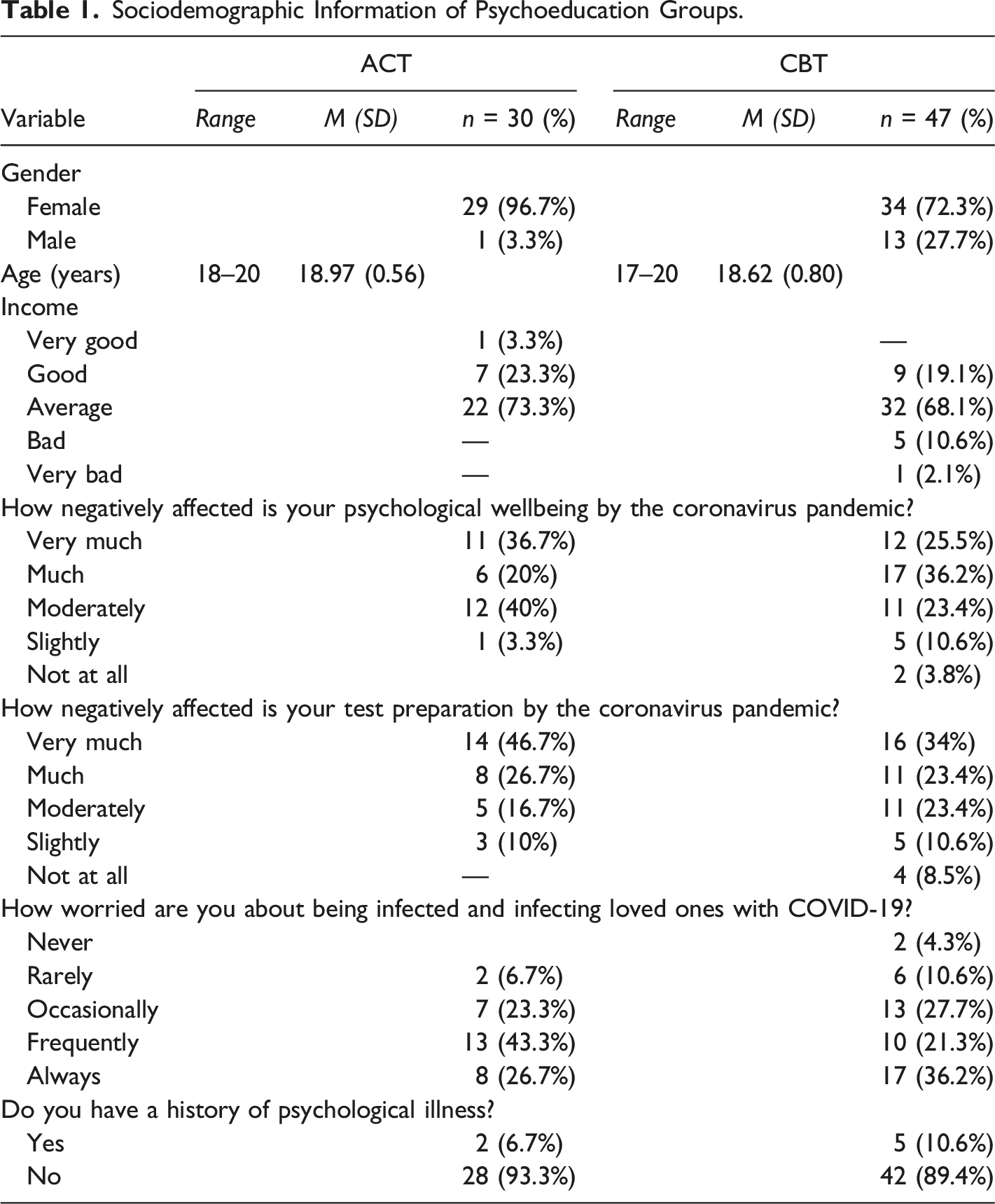
Sociodemographic Information of Psychoeducation Groups.
Test Anxiety Scale
The Test Anxiety Scale, consisting of 34 items, was developed by Bahçeci (2006) based on the item pool of Baltaş (1999). It is a 5-point Likert scale, with options range between (1) never and (5) always. Reliability of the scale was calculated as .87 (Cronbach’s alpha). The highest score possible is 170, the lowest score is 34, and (following Bahçeci, 2006), scores of 34–78 indicated low level anxiety, 79–125 moderate anxiety, and 126–170 high level anxiety.
Revised Child Anxiety Depression Scale—Anxiety Subscale (RCADS)
The child anxiety and depression scale developed by Chorpita et al. (2005) was translated into Turkish by Gormez et al. (2017) who also determined its validity and reliability. The scale is a child-based self-assessment scale that is used to screen DSM-based depression, anxiety related disorders and obsessive-compulsive disorder in children and adolescents (primary, middle, and high school students). It also provides total anxiety and total psychopathology scores. The current research used the five anxiety subscales of the scale, and these consist of a total of 37 items. For each anxiety subscale, a 4-point Likert scale (0 = never, 1 = sometimes, 2 = often, and 3 = always), was used and scores ranged between 0—141. Cronbach’s alpha for these subscales is reported as .95 and coefficients for these subscales range from .75 to .86 (Gormez et al., 2017). The lowest score possible is 0, the highest score is 111, with higher scores indicating higher anxiety levels. The cut-off score indicating anxiety are accepted as 33 and over (Brown et al., 2019).
Ruminative Thinking Style Questionnaire
The Ruminative Thinking Style Questionnaire developed by Brinker and Dozois (2009) was translated into Turkish by Karatepe et al. (2013) who also determined its validity and reliability. The questionnaire is a 7-point Likert self-assessment consisting of 20 items (1: it does not describe me at all, 7: it defines me very well). The lowest score possible is 20, the highest score is 140, with higher scores indicating higher levels of ruminative thinking. According to Karatepe et al. (2013), the Cronbach alpha level is .93.
Procedure
The data of this study stems from two different projects. Both studies were approved by the Ethics Committee. Participants took part in one of two psychoeducation programs (ACT or CBT), each of which comprised four sessions taken over 4 weeks, with one session per week. Each program was conducted online via videoconferencing and the duration of each session lasted for 60–90 minutes. All participants were informed with a consent form and voluntarily agreed to participate. Parents’ permission was obtained for participants under the age of 18. The group leaders were accredited, experienced therapists and trainers and the coauthors of this manuscript (HTK for ACT and VG for CBT).
Acceptance and Commitment Therapy (ACT) Sessions
The following components of ACT were addressed in the four sessions: 1. Session 1. Introduction to the basic ACT principles, followed by warm-up exercises and behavior analysis of ACT. 2. Session 2. Discussion of personal values. 3. Session 3. Value-oriented actions, mindfulness-based techniques, and acceptance were discussed using the matrix technique which assesses psychological flexibility. 4. Session 4. Acceptance and self-compassion techniques were discussed.
Cognitive Behavioral Therapy (CBT) Sessions
The following components of CBT were addressed in the four sessions: 1. Session 1. Familiarization with the basic CBT principles, followed by psychoeducation about the cognitive model of anxiety in general and test anxiety, with emphasis on the bidirectional interaction between dysfunctional thoughts and self-defeating behaviors. 2. Session 2. Expansion on the vicious cycle of dysfunctional thinking habits, cognitive distortions, and accompanying unhelpful behavioral responses related to anxiety and depression. 3. Session 3. Functional analysis of test anxiety through the Antecedent-Behavior-Consequence (ABC) model. Skill-building session in order to cope with acute anxiety (deep breathing technique and attention-redirection exercises). 4. Session 4. Further training on test-anxiety specific cognitive reframing. Skill-building in order to cope with chronic stress (including deep muscle relaxation exercises and basic mindfulness-based techniques) and inactivity cycles of depression.
Preliminary Statistical Analyses
The data were analyzed using SPSS 25.0 (IBM Corp., 2017). Preliminary analyses were conducted to determine normality and showed that the assumptions of normality were met. Accordingly, parametric tests were then carried out to investigate between-subjects (the differences between the two psychoeducation groups) and within-subjects (within each psychoeducation groups) effects. First, independent t-tests showed no significant differences between the two psychoeducation groups in anxiety pretest scores (t (75) = −1.62, p > .05), total anxiety pretest score (t (75) = −.52, p > .05) and rumination pretest scores (t (75) = −.47, p > .05). Thus, the two groups were accepted as comparable. A two-way mixed repeated measures ANOVA was conducted to examine the differences between pretest and posttest scores in both ACT and CBT groups on test anxiety and to examine the differences between the two groups.
Results
Descriptive Statistics
Of the 77 adolescents who completed participation in the psychoeducation groups, 30 completed the ACT group, and 47 completed the CBT group. Demographic information about these 77 participants is shown in Table 1. According to baseline scores, most of the participants showed moderate levels of test anxiety in the ACT (M = 122.67, SD = 21.46) and CBT (M = 114.55, SD = 21.46) groups. In the ACT group, while 66.7% (n = 20) of participants showed an average level of test anxiety, 26.7% (n = 8) showed a high level of test anxiety. In the CBT group, 57.4% (n = 27) of participants showed an average level of test anxiety, and 40.4% (n = 19) showed a high level of test anxiety. 33.3% (n = 10) of participants in the ACT group and 34.0% (n = 16) in the CBT group were above the cut-off point for total anxiety according to RCADS. The average level of total anxiety was 55.80 (SD = 19.71) in the ACT and 53.45 (SD = 19.29) in CBT group.
Primary Outcomes of Psychoeducation Programs
Test Anxiety
The results demonstrated that the main effect of time on test anxiety level was significant, F (1, 75) = 10.45, p = .002, η p 2 = .122. The test anxiety scores observed in the ACT and CBT groups were both higher in the pretest (ACT: M = 122.67, SD = 21.46; CBT: M = 114.55, SD = 21.46) than in the posttest (ACT: M = 113.77, SD = 21.86; CBT: M = 107.62, SD = 25.39). In line with our hypothesis, there was no significant difference between the posttest scores for ACT and CBT groups, F (1, 75) = .14, p > .05, η p 2 = .029. In addition, the Group x Test (pre, post) interaction was not significant, F (1, 75) = .16, p > .05, η p 2 = .002.
Total Anxiety
There was a main effect of time on total anxiety level, F (1, 75) = 9.14, p = .003, η p 2 = .109. The total anxiety scores observed in the ACT and CBT groups were both higher in the pretest (ACT: M = 55.80, SD = 19.71; CBT: M = 53.45, SD = 19.29) to the posttest (ACT: M = 51.60, SD = 20.55; CBT: M = 46.36, SD = 20.00). As expected, there was no significant difference between the posttest scores ACT and CBT groups, F (1, 75) = .800, p > .05, η p 2 = .011. Besides, there was no significant Group x Test (pre, post) interaction, F (1, 75) = .59, p > .05, η p 2 = .008.
Ruminative Thinking Style
The results illustrated that the main effect of test (pre, post) on ruminative thinking style was significant, F (1, 75) = 4.34, p < .05, η p 2 = .055. The ruminative thinking style scores observed in both the ACT and CBT groups were higher in the pretest (ACT: M = 109.20, SD = 15.44; CBT: M = 107.36, SD = 17.68) to the posttest (ACT: M = 105.93, SD = 18.25; CBT: M = 100.45, SD = 23.07). In accordance with our hypothesis, there was no significant difference between the posttest scores for ACT and CBT groups (F (1, 75) = .94, p > .05, η p 2 = .012). In addition, the Group x Test (pre, post) interaction for ruminative thinking styles was not significant, F (1, 75) = .56, p > .05, η p 2 = .007. These findings indicated that both ACT and CBT psychoeducation were associated with a significant reduction in test anxiety, total anxiety and rumination.
Discussion
The current study aimed to comparatively examine the effectiveness of two of the most commonly used psychotherapy approaches (ACT and CBT) in relation to test specific anxiety, anxiety in general and ruminative thinking styles among a group of students preparing for the highly competitive, nationwide university entrance exam in Türkiye. The aim, therefore, was to develop a short psychotherapy intervention program for the target population to enable them to cope better with the anxiety in general, test anxiety and rumination. The findings of the present study showed that test anxiety, general anxiety, and rumination levels reduced after both ACT and CBT psychoeducation-based intervention programs compared to pretest conditions, and there were no significant differences between these two psychoeducation groups.
The current results demonstrate that both ACT and CBT psychoeducation programs were effective for test anxiety in adolescents which is in line with the literature (de Hullu et al., 2017; Ulusoy et al., 2016; Yapan et al., 2021). A meta-analysis by Ergene (2003) indicates that a combination of cognitive and behavioral techniques would be the most effective way to reduce test anxiety; therefore, it was expected that both psychoeducational approaches in ACT and CBT would alleviate test anxiety, general anxiety, and rumination levels. In addition, although Brown et al. (2011) stated that acceptance-based intervention programs were more effective than CBT, a recent study in Türkiye by Yapan et al. (2021) found that ACT and CBT psychoeducation were both effective and no differences were found between the groups. The present study supports this view that there is no significant difference between ACT and CBT psychoeducation programs and both are effective for reducing test anxiety as well as general anxiety and rumination.
The negative effects of the COVID-19 pandemic on adolescents and the need for psychosocial support were well-documented in previous studies (Gabor et al., 2020; Jiao et al., 2020; Munasinghe et al., 2020; Wang et al., 2020). The results of the present study indicate that even though the content of the psychoeducation programs primarily targets test anxiety, a decrease in general anxiety during the COVID-19 pandemic was also observed. These findings demonstrate that psychosocial support programs work for adolescents during the COVID-19 pandemic and the psychoeducation programs are important to support the mental health and wellbeing of adolescents (Jiao et al., 2020; Wang et al., 2020).
Previous studies revealed that rumination was a significant predictor of maintenance of social anxiety disorder in performance settings (Brozovich et al., 2015; Modini et al., 2018). Hence, focusing on rumination could also be important in test anxiety interventions. Consistent with the literature, a reduction in the scores measuring ruminative thinking style from pretest to posttest for those who participated in the ACT (Kocovski et al., 2009; Norton et al., 2015; Swain et al., 2013) and CBT (Smith et al., 2015; Topper et al., 2017; Watkins et al., 2011) groups was shown in the present study.
Studies explaining the mechanism by which ACT creates an effect for change have brought the concept of psychological flexibility to the fore. The concept of psychological flexibility refers to the ability to connect with the present moment with conscious awareness, to stay in touch, to change one’s behavior in line with needs and values, and to persevere in this behavior (Hayes et al., 1999). In a recent systematic evaluation and meta-analysis study, it was reported that patients diagnosed with OCD, in particular, learned to change their rapport with these symptoms instead of wrestling with intrusive obsessions and compulsions after ACT intervention, and thus recovery was associated with this mediator (Soondrum et al., 2022).
Increasing psychological flexibility does not involve questioning or changing thoughts and feelings, but rather by reacting more mindfully to such experiences, not seeing them as obstacles and helping them to free themselves from this vicious circle of avoidance and cognitive fusion (Blackledge et al., 2009). In a recent survey study involving a sample of 705 people, it was reported that psychological rigidity and rumination were associated with the severity of test anxiety (Doğan, 2023). Based on these data, we can suggest that therapy studies specific to test anxiety should include interventions to reduce rumination and increase cognitive flexibility. We can emphasize the psychological flexibility focused intervention as one of the possible mechanisms of the positive effect in the ACT group in the current study.
Limitation and Future Direction
The current study has some limitations. For example, the sample sizes of both groups were substantial but lower than in some other studies, and the number of students who completed the two programs could not be equated. In addition, the majority of the current sample for both groups were females. This is consistent with the findings of Kessler et al. (1994) which indicated that anxiety and depression are more common in females than males, but a more balanced gender distribution could be a focus for future research. The absence of an additional group in which no interventions occurred would also have been useful, but the focus of the current research was to contrast the relative effectiveness of ACT and CBT. Moreover, high drop-out rates were observed in the present study, and this reduced the sample sizes in both groups. In previous studies that were carried out with adolescents, drop-out rates in CBT-based research varied from 17% to 31% (May et al., 2007), which resembles the drop-out rates in the CBT psychoeducation program in the current study (30%). However, the drop-out rate for the ACT psychoeducation group was 53%, which is noticeably higher than reported for other ACT studies (18%, Karekla et al., 2019; 16%, Ong et al., 2018). This may show that there was a greater need for test anxiety psychoeducation in the CBT group, and accordingly, lower drop-out rates developed. Another possible explanation may be that ACT or CBT approaches can better suit some individuals more than others. For example, from the study by Ong et al. (2018), people who have a high level of control of their anxiety, are more religious, and are more avoidant of physiological arousal symptoms, are more likely to drop out in the ACT group compared to the CBT group. This suggests that before assigning participants to ACT or CBT groups, some other factors should also be controlled. Nevertheless, the drop-out rates we observed are in line with those reported previously for online studies. Melville et al. (2010), for example, reported that drop-out rates in an assesment of 56 online intervention studies were as much as 83% but had an average of 35%. In addition, the drop-out rates we observed may also have been influenced by the COVID-19 pandemic itself, where fatigue may have exerted a substantial effect (e.g., Morgul et al., 2021). This effect itself may be the focus for future research. Finally, neurocognitive aspects such as intelligence tests or attention span can also be explored among students to observe the neurocognitive effects of psychoeducational programs and this could be taken into account in future research.
Conclusion
In conclusion, test anxiety is a general problem for all students all over the world and changes in the education system can affect students’ mental health, particularly during the COVID-19 pandemic. University placements in Türkiye are based on a 3-hour exam, and so make this problem to be experienced more intensely for those who take the university exam. The current study was planned to support students in this group during the pandemic, when social limitations and uncertainties were particularly disruptive. Although the study involved a relatively short program of four sessions, both ACT and CBT were effective. The findings showed that both programs decreased test anxiety, general anxiety, and rumination levels, and the effectiveness of these two programs did not differ from each other. These effects suggest that psychosocial support programs are important for improving students’ mental health and wellbeing, especially during crises.
Footnotes
Declaration of Conflicting Interests
The author(s) declared no potential conflicts of interest with respect to the research, authorship, and/or publication of this article.
Funding
The author(s) disclosed receipt of the following financial support for the research, authorship, and/or publication of this article: The present study was implemented as part of a larger project titled ‘Improving the psychological well-being of young people with rising anxiety for the future during COVID-19’ and was funded by the Istanbul Development Agency (ISTKA, grant number TR10/20/COVID/0633).
Ethical Approval
The data of this study stems from two different projects. Both studies were approved by the Ibn Haldun University Ethics Committee (NO. 14/09/2020-689 and NO. 13/05/2020-283).
Informed Consent
Informed consent was obtained from participants and all participants confirmed they were participating voluntarily.
Data Availability
The data are not publicly available due to privacy/ethical restrictions.
