



Abstract
Existing research has shown that daily hassles are associated with increases in between-meal snacking, often resulting in the increased consumption of high sweet and high fat foods. However, it is currently unclear whether the presence of daily uplifts may buffer the negative effects of daily hassles on unhealthy eating behaviour. Therefore, the current study explored the main and interactive effects of daily hassles and daily uplifts on snacking behaviours in adults. One hundred and sixty participants (M age: 23.69 years) reported their daily hassles, daily uplifts and snacking behaviours over the preceding 24 hour period. Participants’ emotional eating style was also measured. Using moderated regression analysis, the daily hassles x daily uplifts interaction was found to be statistically significant for both total snack and unhealthy snack consumption. Simple slopes analyses showed that the relationship between daily hassles and snacking was weaker and non-significant at higher levels of daily uplifts compared to moderate and lower levels. The current study provides novel evidence that daily uplifts may act as a buffer against the negative impact of daily hassles on food consumption.
Introduction
It is well established that stress is associated with changes in eating behaviour (Araiza & Lobel, 2018; Hill et al., 2018, 2021) and that the stress-eating relationship represents an important pathway through which stress negatively influences health outcomes (O’Connor, Thayer & Vedhara, 2021). Previous research has shown that stress is related to both increases and decreases in food consumption (Araiza & Lobel, 2018). It has been estimated that 35–40% of people increase their food intake when experiencing stress, whilst others either decrease or do not change their food intake in response to stress (Oliver & Wardle, 1999). Moreover, it has also been demonstrated that stress can influence particular types of food consumption. For example, stress has been shown to be associated with increased intake of high fat and high sugar snacks, lower intake of fruit and vegetables and has been found to disrupt main meal consumption (Hill et al., 2018; 2021). A notable study found sweets, chocolate, cakes and biscuits were 60–70% more likely to be consumed when experiencing stress (Oliver & Wardle, 1999). Taken together, existing evidence demonstrates that stress is associated with increased consumption of high energy, low nutrient and highly palatable foods. Maintenance of such consumption is likely to be damaging for health.
There are also a growing number of studies that have begun to identify the important role played by positive daily events (also known as daily uplifts) and positive emotions for understanding eating behaviour. For example, positive emotion has been shown to initiate the consumption of healthier food (e.g., Macht, 2008) and unhealthy foods (e.g., Evers et al., 2013). Richenberger et al. (2018) found the presence of daily positive emotion was related to increased food consumption. Evers et al. (2013) have suggested that positive emotions are a neglected trigger for food intake. Moss et al. (2021a, 2021b) have shown that daily hassles and daily uplifts were both significantly associated with greater unhealthy snacking and daily uplifts were associated with lower healthy snack intake. Therefore evidence is beginning to suggest positive, as well as negative events are associated with healthy and unhealthy food consumption. No study to our knowledge has explored the way that daily hassles and daily uplifts interact to influence subsequent snacking behaviour, however, research has identified that daily uplifts have been found to buffer the impact of stress during pregnancy and daily emotional exhaustion, respectively (Klusmann et al., 2021; Nierop et al., 2008). Therefore, an important next step, and the primary aim of the current study, was to explore the extent to which daily hassles and uplifts interact with each other. In particular, to investigate whether daily uplifts (positive experiences) may buffer the negative effects of daily hassles (negative experiences) on daily eating behaviour.
Understanding the impact of moderators within the stress-eating relationship has received a great deal of research attention. Previous studies have identified numerous key moderating variables including gender, body mass index, cortisol reactivity to stress, dietary restraint, emotional and external eating behaviours (e.g., Araiza & Lobel, 2018; Moss et al., 2020, 2021a). Emotional eating style, the tendency to eat more when anxious or emotionally aroused has been found to be important in understanding the stress-eating relationship, such that individuals high in emotional eating tend to respond to stress by eating more unhealthy foods. Amongst numerous other variables, O’Connor et al. (2008) identified emotional eating as being a pre-eminent moderating variable of the stress-eating relationship. Therefore, we were interested in exploring the influences of daily hassles and uplifts on eating outcomes, while accounting for the effects of this important eating style variable.
The main aims of this study were to investigate the effects of daily hassles and uplifts on between-meal snacking behaviour and to explore whether daily uplifts buffered the effects of daily hassles on eating behaviour outcomes.
Method
Design and Participants
This study used a 24 hour retrospective questionnaire design to investigate whether participants’ daily hassles and uplifts experienced during the previous day were associated with between-meal snacks that were consumed over the same period. Adults and children aged 8–11 years old were recruited. However, due to difficulties in the recruitment of children, only data from adults is presented. Adults were recruited by targeting undergraduate students in the School of Psychology at the University of Leeds. Participants were recruited using several different methods: using the Call for Participants and Survey Circle websites and the primary researcher invited potential participants to take part across a range of study locations around the School of Psychology. One hundred and sixty undergraduate students were recruited and completed all variables reported, 112 were female and 48 were male. Within the 160 individuals that took part, 109 took part online and 51 took part in person. Participants’ mean age was 23.69 years (SD: 4.99, range: 18–49 years). The study received ethical approval from the School of Psychology’s Research Ethics Committee (reference number: PSY-273).
Questionnaire Measures
The study used a questionnaire consisting of two parts: the first consisted of demographic questions and the emotional eating scale from the Dutch Eating Behavior Questionnaire (DEBQ, van Strien et al., 1986), and the second consisted of a retrospective diary questionnaire. Participants were able to complete the questionnaire using either a paper or an online version.
Emotional eating was measured using 11 of the 13 emotional eating items from the DEBQ (van Strien et al., 1986). Two of the original emotional eating questions were omitted for all participants because they were deemed to be unsuitable (one because it was similar to another item, and another because children had difficulties understanding a key word (“irritated”) within the question). Participants answered each question by choosing one of the 5-point Likert scale options, ranging from never (i.e., a score of 1), seldom (e.g., 2/‘rarely’), sometimes (3), often (4) and very often (5). A Cronbach’s alpha value measuring the reliability amongst the items illustrated that there was a good level of internal consistency present (α = 0.72). In addition, in a pilot dataset (N = 156), the correlation between the 11 item and 13 item emotional eating scales was .994.
24 hour Retrospective Questionnaire
This measure was created specifically for this study. The first section asked participants to think about the previous 24 hours and report any positive or negative experiences that had occurred. Participants were asked to report up to 3 positive and 3 negative experiences from each of the previous morning, afternoon and evening. Negative experiences (or daily hassles) were defined as “Events, thoughts or situations which can make you feel down, annoyed or worried”. Positive experiences (or daily uplifts) were defined as “Events, thoughts or situations which can make you feel good, happy or excited”. Participants had the space to report up to 9 positive and 9 negative experiences for the previous 24 hour period (i.e., up to 3 at each time point (morning, afternoon and evening)). A total number of hassles (negative experiences) and uplifts (positive experiences) was computed as a sum of experiences (scored 0–9 experiences).
The second section of the 24 hour retrospective questionnaire asked participants to report any between-meal snack or drink that they had consumed during the previous day, and at what time of day (morning, afternoon or evening) they had consumed these snacks/drinks. Each snack was coded independently by two individuals as being high in fat and/or sugar (see below). The inter-rater reliability values were found to be good (α = 0.73 for snacks high in fat, and α = 0.89 for snacks high in sugar; McHugh, 2012). A total number of unhealthy (i.e., high in fat and/or sugar; range 0–6) and healthy (i.e., neither high in fat nor sugar; range 0–4) snacks was computed. A total number of snacks consumed was computed as the sum of healthy and unhealthy snacks (range 0–9).
Coding Reported Snack Items
The snack items were initially coded in terms of whether or not they contained high levels of sugar and/or fat. These categorisations were made using food composition tables (McCance & Widdowson, 2014). Therefore, if a food or drink snack item was deemed high using these categorisations, it was deemed as being either high in fat and/or sugar. Snacks were subsequently categorised as being either healthy or unhealthy. Snack items were deemed unhealthy if they consisted of high levels of fat and/or sugar, and if the item was highly processed (e.g., a cheese-string).
Data Analysis
There was no missing data on the measures reported here. The means and standard deviations of the measures and their intercorrelations were examined first. Moderated multiple regression analysis was used to test our main hypothesis about the moderating effect of uplifts on the hassles-snacking relationship. Variables were entered as predictors in a series of steps based on our hypotheses. At step 1, snacks were regressed onto daily hassles and daily uplifts. Step 2 added emotional eating behaviour. Step 3 added the interaction between hassles and uplifts. Mean-centered scores were used in the regression to minimize problems of multicollinearity (Aiken & West, 1991). Simple slopes analyses (Aiken & West, 1991) were used to explore any significant interaction terms by examining the unstandardized regression slope for hassles at low (mean–1 SD), mean, and high (mean + 1 SD) levels of the moderator (uplifts). These regression analyses were repeated for total snacks, healthy snacks and unhealthy snacks.
Results
Descriptive Data and Intercorrelation of Measures (N = 160).
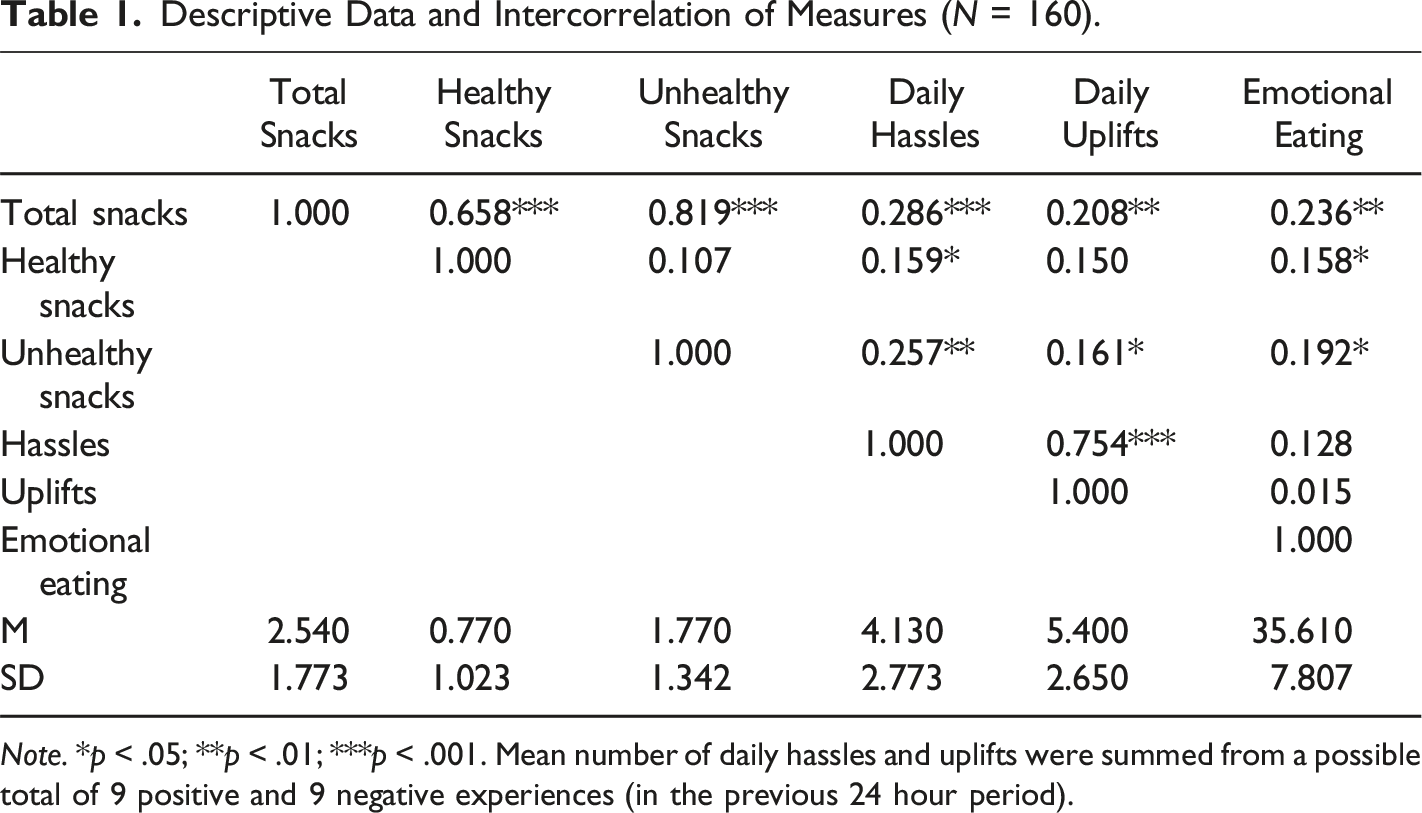
Note. *p < .05; **p < .01; ***p < .001. Mean number of daily hassles and uplifts were summed from a possible total of 9 positive and 9 negative experiences (in the previous 24 hour period).
Moderated Linear Regression of Three Snacking Measures onto Hassles, Uplifts, Emotional Eating and Hassles x Uplifts (N = 160).
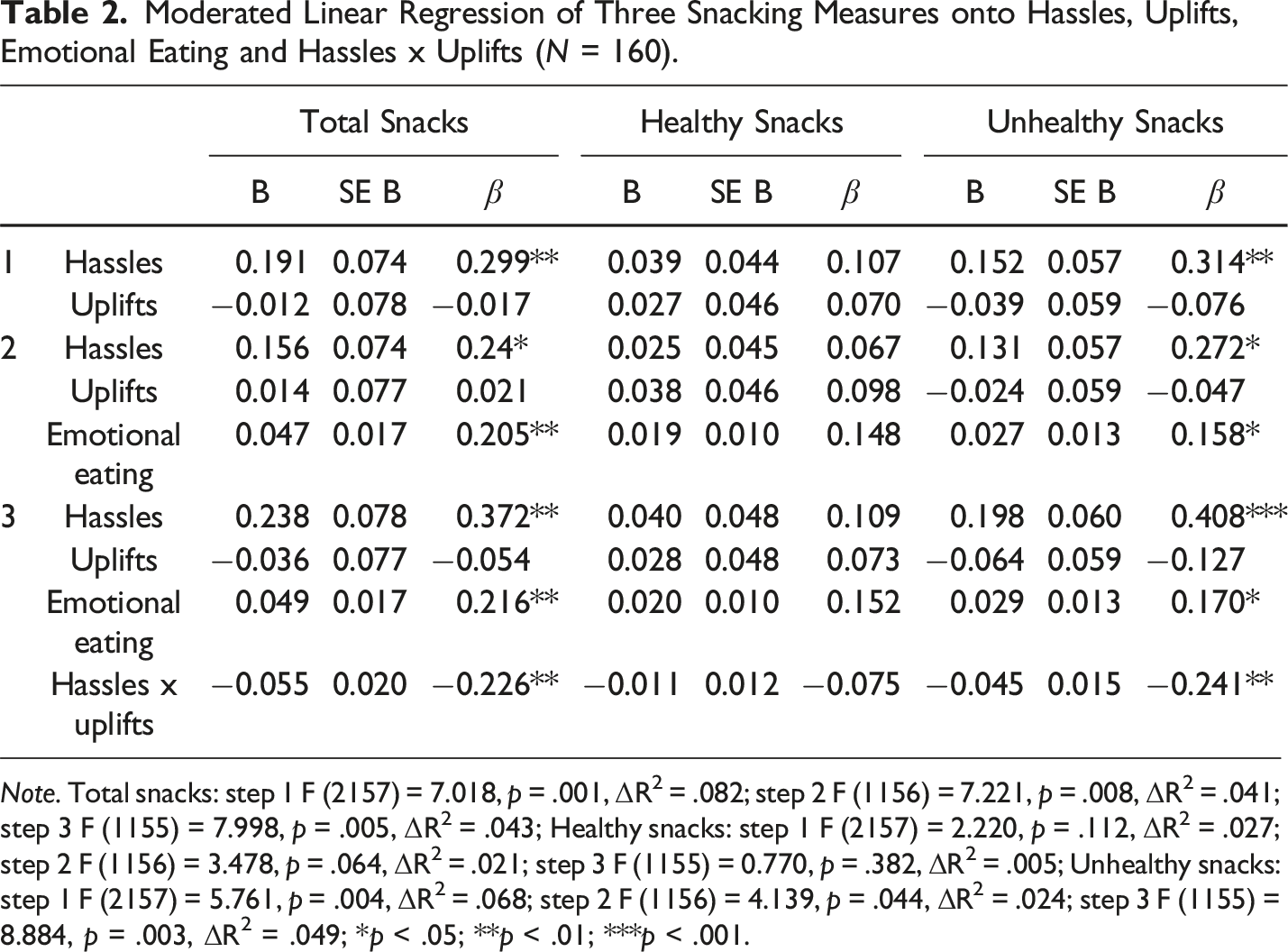
Note. Total snacks: step 1 F (2157) = 7.018, p = .001, ΔR2 = .082; step 2 F (1156) = 7.221, p = .008, ΔR2 = .041; step 3 F (1155) = 7.998, p = .005, ΔR2 = .043; Healthy snacks: step 1 F (2157) = 2.220, p = .112, ΔR2 = .027; step 2 F (1156) = 3.478, p = .064, ΔR2 = .021; step 3 F (1155) = 0.770, p = .382, ΔR2 = .005; Unhealthy snacks: step 1 F (2157) = 5.761, p = .004, ΔR2 = .068; step 2 F (1156) = 4.139, p = .044, ΔR2 = .024; step 3 F (1155) = 8.884, p = .003, ΔR2 = .049; *p < .05; **p < .01; ***p < .001.
In relation to healthy snacks, Table 2 shows that entering hassles and uplifts at step 1 did not explain a significant proportion of the variance and neither hassles nor uplifts were significant predictors. Entering emotional eating at step 2 failed to explain a significant increment in variance in healthy snacks and none of the three predictors were significant. Entering the interaction between hassles and uplifts at step 3 also failed to explain a significant increment in variance in healthy snacks and none of the beta weights were significant. Overall, when exploring healthy snacking behaviour, there were no main or interactive effects of daily hassles or uplifts.
In relation to unhealthy snacks, Table 2 shows that entering hassles and uplifts at step 1 explained a significant proportion of the variance. The beta weights indicated that hassles was a significant positive predictor. Entering emotional eating at step 2 also explained a significant increment in variance in unhealthy snacks. The beta weights indicated that hassles and emotional eating were significant positive predictors. Entering the interaction between hassles and uplifts at step 3 also explained a significant increment in variance in unhealthy snacks. The beta weights indicated that hassles and emotional eating remained as significant positive predictors and the interaction between hassles and uplifts was a significant negative predictor. Simple slopes analyses of the hassles × uplifts interaction, indicated that at low levels of uplifts, hassles was strongly related to unhealthy snacks (B = 0.331, SE = 0.084, p < .001), while at moderate levels of uplifts, hassles was then less strongly related to unhealthy snacks (B = 0.217, SE = 0.060, p < .001), and at high levels of uplifts, hassles was unrelated to unhealthy snacks (B = 0.103, SE = 0.058, p = .078). In sum, when individuals had low daily uplifts, the amount of daily hassles they had was found to be strongly related with the amount of unhealthy snacks consumed (see Figure 1). However, when looking at moderate levels of uplifts, individuals’ daily hassles were less related to unhealthy snacking behaviour and when individuals had high levels of daily uplifts, daily hassles was found to be unrelated to unhealthy snacking behaviour.
Discussion
The main aim was to explore whether daily uplifts buffered the effects of daily hassles on eating behaviour outcomes while accounting for the effects of emotional eating style. Our analyses showed that the interaction between daily hassles and daily uplifts was statistically significant for total snack and unhealthy snack consumption, such that the relationship between daily hassles and snacking was weaker and non-significant at higher levels of daily uplifts compared to moderate and lower levels. To the best of our knowledge, this is the first study to demonstrate the buffering influence of daily uplifts (or daily positive experiences) on the same day effects of daily hassles (or daily negative experiences) on between-meal snacking.
The current findings showing associations between daily hassles and total snack and unhealthy snack consumption are consistent with a growing number of studies (e.g., Hill et al., 2021; O’Connor et al., 2008). In a large daily diary investigation, O’Connor et al. (2008) showed that daily hassles were associated with increased consumption of high fat, energy dense snacks together with a reduction in vegetable intake and main meals. In another daily diary investigation, Hsu & Raposa (2020) showed that on days with high perceived stress and more daily negative life events, adolescents reported elevated rates of craving tasty foods and trouble stopping the consumption of tasty foods. Therefore, this study adds to existing evidence that has shown that stress, in the form of daily hassles or negative daily experiences, is associated with increased consumption of high energy, low nutrient and highly palatable foods.
The main findings are important because they suggest that the negative effects of daily hassles on between-meal snacking behaviour can possibly be mitigated by the experience of daily uplifts. The results may have implications for the development of future interventions aimed at reducing stress-induced eating. There are currently a relatively small number of studies that have explored the effectiveness of psychological interventions in the stress-eating context. For example, Adriaanse et al. (2009) have used implementation intentions to promote healthy eating and to reduce unhealthy food intake. These authors tested whether implementation intentions can be used to replace unhealthy snacks with healthy snack alternatives by linking critical cues for unhealthy snacking (if) to healthy snacks (then). They also investigated the influence of different types of critical cues on the undesirable behaviour and differentiated between situational (where/when) and motivational (why) cues. Across a series of experiments, they found only implementation intentions that specified a motivational cue and not a situational cue were effective in decreasing unhealthy snacking behaviour. Using an implementation intentions-based tool, O’Connor et al. (2015) found that the effects of daily stressors on unhealthy snack consumption were reduced in participants who were randomized to complete a stress management support tool with an instruction to link stressful situations with healthy snack alternatives and not for those who did not receive the linking instruction. Therefore, a possible avenue for future research might be to test the effectiveness of an implementation intentions approach that links the experience of daily hassles (if) with the seeking out of daily uplifts (then) and to explore whether this helps to protect against stress-induced, high-calorie snack consumption.
The current study also found emotional eating style was a unique predictor of total snacks and unhealthy snack intake. This is not surprising given that this eating style has been found to be important in understanding the stress-eating relationship. As outlined earlier, O’Connor et al. (2008) identified emotional eating as being a pre-eminent moderating variable of the stress-eating relationship. Oliver et al. (2000) found that emotional eaters consumed significantly more sweet high-fat foods and more energy dense foods in response to stress. In a laboratory-based study, Klatzkin et al. (2022) found stress facilitates food consumption for individuals high on emotional eating under conditions of rest, as well as stress. These authors have suggested that there may be a subgroup of emotional eaters who gain greater emotional relief from stress by eating and as such are more vulnerable to the stress-induced eating. Nevertheless, the current findings highlight the importance of future research to explore further the role of daily uplifts in the context of unhealthy snacking behaviour (Figure 1). Effects of daily hassles on total snacks (upper panel) and unhealthy snacks consumed (lower panel) at low, moderate and high levels of daily uplifts.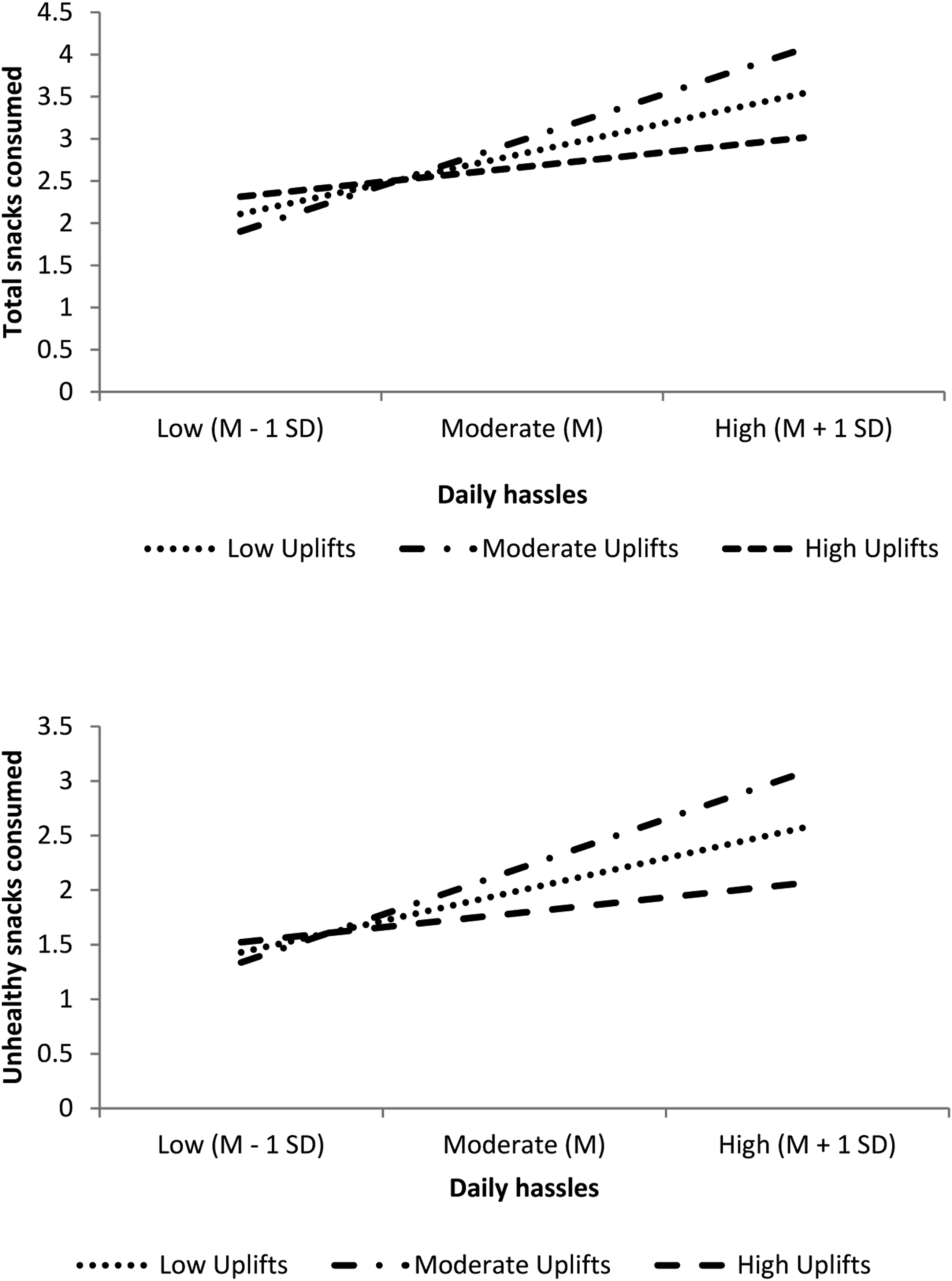
There are a number of shortcomings of the current study that require comment. First, we are aware that the sample size included might be considered small in relation to other large scale investigations. Therefore, it is important that future studies attempt to replicate the effects observed here before firm conclusions can be drawn. We are also aware that the current study had narrow inclusion criteria and that we did not measure SES or ethnicity. As result, it would be useful to measure these variables in future research while also encouraging recruitment of participants from more diverse backgrounds. We are also cognizant that our measure of eating behaviour, the 24 hour retrospective questionnaire measure of between-meal snacking is a self-reported measure and that we did not utilize a more objective measure. This type of retrospective methodology could also be less accurate than other methods because it relies upon recollection/recall of information. As such, measures that capture behaviour soon after the action has taken place may be preferable. The main reason we utilised this retrospective approach however was because we were concerned that using more detailed methods might have an adverse effect on recruitment and also that in depth daily assessment can be considered burdensome and may influence participants’ normal eating. Nevertheless, we would suggest that future research attempts to replicate the current findings using a range of different approaches.
To conclude, the current study provides novel evidence that daily uplifts may buffer the negative effects of daily hassles on between-meal snack consumption. Future research should attempt to replicate these findings in larger samples over a more sustained period of time and to explore how the results can be integrated into interventions to help reduce stress-induced eating.
Footnotes
Declaration of conflicting interests
The author(s) declared no potential conflicts of interest with respect to the research, authorship, and/or publication of this article.
Funding
The author(s) received no financial support for the research, authorship, and/or publication of this article.
