



Abstract
Abdication—the act of giving up a choice to another person—has been shown to prompt reciprocal generosity (Kardas et al., 2018), but it is not clear whether men or women are more likely to engage in abdication. The present research utilized a gift card scenario adapted from Kardas et al. (2018) in two Amazon Mechanical Turk samples to explore whether women abdicated more frequently than men, whether men abdicated to women less frequently than to other men, and whether employment status predicts abdication. In experiment one, participants (N = 520) were assigned to one of three conditions in which they had to either choose who received a hypothetical gift card themselves or abdicate the decision to a friend (sex not specified, male friend, or female friend). Chi-square analyses revealed no significant differences between participants who abdicated and those who allocated; men and women had similar abdication patterns; there was no significant difference in abdication as a function of friend gender for male or female participants. In experiment two, participants (N = 707) were again assigned to one of the three conditions but were also asked their employment status. Chi-square analyses indicated that participants generally preferred to be allocators rather than abdicators; women showed a similar abdication pattern to men; there was no significant difference in abdication as a function of friend gender for male or female participants. Lastly, unemployed participants abdicated more frequently (70%) than their employed counterparts (42%), and this was especially likely for women. These results have implications for potential factors that influence abdication decisions.
Introduction
In making allocation decisions—that is, determining how to distribute resources to various recipients—individuals often weigh the pros and cons of giving the other party the better versus worse resource. As described by Kardas et al. (2018), an allocator is in charge of making the decision on how to distribute resources, while an abdicator relinquishes their rights to make the decision on distributing resources to someone else. One thing that makes an allocator’s decision particularly challenging is the instance in which another person has abdicated or left the decision up to the allocator. On the one hand, those with the power to allocate may interpret another person giving up decision-making as generous because he/she did not behave as selfishly as allocators expected (Kardas et al., 2018). The allocator then gives the abdicator the better resource to reciprocate the perceived generosity. On the other hand, the allocator can keep the better resource, which can be beneficial but comes with the expense of seeming selfish (Kardas et al., 2018; Simpson & Willer, 2008).
Generous resource allocation has the potential for reputational benefit for the allocator, especially following an abdication decision from another party. The generosity that the allocatee, (the person who receives the resources) perceives may lead to increased liking toward the allocator, thus increasing motivation to build a relationship with him/her (Baumeister, 1982). For example, Kardas et al. (2018) found that abdicators not only appeared generous for ceding control, but they also reaped the material benefits of reciprocity. Their research presented participants with a variety of resources (granola bars, gift cards) and tested whether people were more generous with the better resource (higher value gift card, for example) after the other party allowed them to make the allocation decision. They found that people abdicated frequently, both in scenarios and live interactions, and abdicating prompted allocators to reciprocate by giving the better resource to the abdicator.
In sum, once a person abdicates a decision about resources, the behavior of the allocator tends to be generous via reciprocity (Kardas et al., 2018). Abdication is perceived as generous; thus, allocators reward the abdicator with a generous distribution of resources. What remains unanswered is whether these patterns hold true in the context of gender. Specifically, women (compared to men) may be more likely to abdicate allocation decisions to fulfill social roles.
Gender & Decision-Making
The manner in which people present themselves to others is partially driven by motivation to show their best qualities, or the parts that are most socially acceptable (Baumeister, 1982). The perception of socially desirable qualities varies across gender, indicating that men and women may utilize different self-presentation strategies (Lee et al., 1999; Sczesny & Kaufmann, 2018). Research suggests that when women violate traditional gender norms, they are subjected to social “backlash” and are evaluated more negatively by others (Heilman et al., 2004; Rudman & Glick, 2001). For example, Gleason et al. (2019) investigated this in a courtroom setting. They found that when arguments by female counsel were consistent with gender norms (e.g., high affective content), women were judged more favorably by male justices. Conversely, male attorneys fared best before a male justice when they argued in a manner with low affective content, which is consistent with gender norms for men.
Women often abdicate sexual decision-making to their male partner (e.g., giving him the power to decide whether and under what conditions they have sex), which is consistent with traditional gender role prescriptions that women be passive and men be active in sexual situations (Sanchez et al., 2012). Research by Danube et al. (2016) demonstrated that women are more likely to abdicate sexual decisions to a familiar partner, relative to a new partner, indicating that women may feel pressure to conform to gender role expectations in certain relational contexts.
People spontaneously infer individuals’ social roles from their behaviors and ascribe role-consistent traits to them (Chen et al., 2014). In other words, behaviors exhibited across different roles (including gender roles) influence the traits people believe to be true of that group. One way to describe attributed traits to gender is through communion and agency (Abele & Wojciszke, 2007). According to Wiggins (1991), communion orients people toward others and their well-being (compassion, warmth, expressivity), while agency orients people to the self and one’s own goal attainment (assertiveness, competitiveness). Communion is thought to be prominent in the female stereotype and agency in the male stereotype (Eagly et al., 2020). Using public opinion polls, Eagly et al. (2020) found that consensual beliefs about gender attributes have changed since the mid-20th century, specifically regarding an increase in perceived communion of women, relative to men, but a lack of perceived change in agency. Furthermore, women who display masculine, agentic traits are viewed as violating prescriptions of feminine niceness (Rudman, 1998). Because women are held to a higher standard of niceness than men, they may be more likely to be punished for perceived violation of these standards (Rudman & Glick, 1999). In their study, participants evaluated videotaped agentic or communal male or female applicants for a computer lab manager position. The computer lab manager position was described as being masculine (emphasizing the need for agentic personality traits) or feminine (emphasizing the need for communal as well as agentic traits). Participants rated the applicants on competence, social skills, and hire-ability. They found that female applicants who displayed strong agentic traits (competence, competitiveness) were consistently rated as less socially skilled than an identically presented male applicant. Interestingly, these perceptions only translated into discrimination when the job was feminized—the agentic female applicant was discriminated against when she was viewed as not nice.
Additionally, gender may affect the way in which chosen incentives are perceived in the context of the workplace. Shurchkov and van Geen (2019) divided participants into groups in which the gender of the worker was either revealed or not revealed. Subjects were randomly assigned to groups of three, in which one person was assigned to be the decision-maker, while the other two were assigned to be workers. The randomly selected decision-maker made a decision based on resume information from both workers—which did not include gender of the worker. The decision-maker then chose how many points to give to each worker in an incentive task. Workers also rated the competence of the decision-maker by looking at the decision-maker’s resume. On average, men and women did not differ in their willingness to incentivize workers in general, but female decision-makers were significantly less likely than men to select competitive incentives. Across all conditions, women were rated as less competent than men in the decision-maker role. These findings indicated that women are viewed as incompetent to be positions of decision-making in workplace contexts. This perception may lead women to abdicate decision-making responsibilities to their male counterparts in other contexts. The present study seeks to examine this possibility by investigating whether gender plays a role in abdication decisions in resource allocation scenarios.
Current Research
The present line of research aims to replicate and extend previous research by Kardas et al. (2018). Their studies revealed that people tend to abdicate decision-making responsibilities frequently, and that abdication prompts reciprocal generosity. More specifically, when given the opportunity to allocate resources (between oneself and a friend) or abdicate the decision to allocate resources to a friend, people had a general tendency to abdicate. We expect to find the same pattern of results here. However, Kardas et al. (2018) did not investigate whether this pattern of results was consistent across gender. Due to previous research outlining the negative effects of women breaking stereotypical gender norms (Gleason et al., 2019), along with women’s perceived incompetence in decision-making contexts (Shurchkov & van Geen, 2019), we sought to examine whether women would be more likely to abdicate decision-making duties when the second party is a man, relative to a woman.
Experiment 1
We utilized the abdication gift card scenario used by Kardas et al. (2018) but additionally explored the role of gender in abdication decisions. We did this by manipulating the gift card scenario to communicate to participants that the person to which they could abdicate was either a “friend,” “male friend,” or “female friend.” We made the following hypotheses: 1. People will abdicate a decision more often than not. 2. Women will abdicate more frequently than men. 3. Men will abdicate to women less frequently than they will abdicate to another man, and women will abdicate more frequently to a man than they will to another woman.
Method
Participants
Participants (N =520) were recruited from Amazon Mechanical Turk (MTurk) and paid $.50 cents for participating in a brief online survey. The mean age of participants was 40.57 years (SD = 13.12), and all were residents of the United States. The ethnic distribution was mostly White (70%), followed by Black (14%), Asian (10%), and Hispanic/Latino (3%). The gender distribution of the sample was relatively equal (49% male and 50% female).
Procedure
Participants were directed to a welcome screen that informed them they would read a hypothetical scenario and answer some questions related to decision-making. Participants were randomly assigned to one of three conditions (baseline, male friend, or female friend). In the baseline condition, participants were not told whether their friend in the scenario was male or female. Friend gender was manipulated in the other two conditions. Then, participants read the corresponding version of the scenario based on their assigned condition. One item followed the scenarios in which participants selected one of two options: choose who gets which gift card themselves or ask their (friend, male friend, or female friend) to choose who gets which gift card. Lastly, participants responded to demographic items.
Measures
Gift card scenario. Participants were randomly assigned to one of three conditions (friend, male friend, female friend), and they read the following scenario (adapted from Kardas et al., 2018):
“Imagine that you and your friend (male friend; female friend) book plane tickets to fly across the country. The flight is delayed overnight, and as an apology the airline promises to give gift cards to all passengers. You and your friend approach the flight attendant to claim your gift cards. The flight attendant only has two gift cards left on hand, and they are each slightly different: one has high value whereas the other has medium value, although both can be used at the same stores. Both you and your friend see both gift cards as well as their value. Because you happen to be standing closer, the flight attendant hands both of the gift cards to you, so now you need to decide what to do next.”
You Could Make One of Two Decisions
1. Choose who gets which gift card yourself. 2. Ask your friend (male friend; female friend) to choose who gets which gift card.
Results and Discussion
Random assignment provided similar sample sizes across conditions: baseline (29.2%), male friend (35.4%), female friend (35.4%). Across all participants, 50.8% chose not to abdicate (i.e., selected “choose who gets which gift card yourself”) and 49.2% chose to abdicate (i.e., selected “ask your friend/male friend/female friend) the decision of who gets which gift card. A chi-square test of independence examining whether these frequencies differed was not significant, χ 2 (1, N = 520) = .123, p = .73, failing to provide support for hypothesis 1.
Next, we conducted a chi-square test comparing the frequencies of abdicating or allocating the gift card decision as a function of participant gender. This analysis was not statistically significant, χ 2 (1, N = 512) = .287, p = .59, indicating that women showed a similar abdication pattern to men. Thus, hypothesis 2 was not supported by the data.
Abdication decisions for male participants and female participants across experimental conditions in Experiment 1 (N = 512).
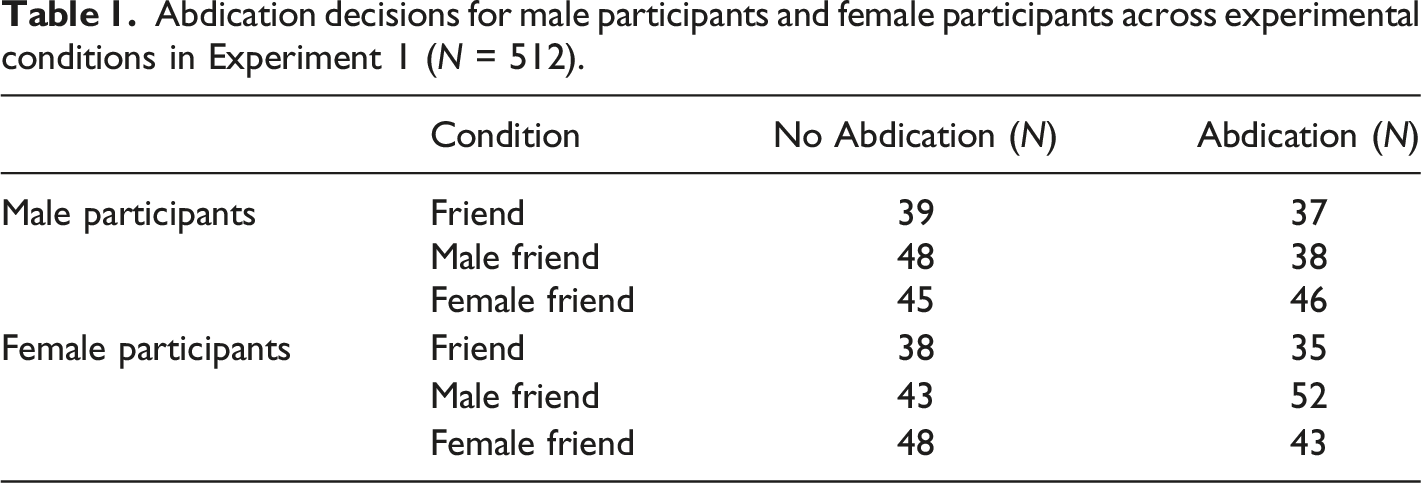
In sum, our hypotheses were not supported by the data. Contrary to the results observed by Kardas et al. (2018), we found that people were just as likely to abdicate a decision about resource allocation as they were to allocate the resources themselves. Furthermore, neither the gender of the participant nor the gender of the friend sharing the resources had any effect on abdication decisions. We speculate that other between-person variables might alter the likelihood of abdicating a decision about resources. One such variable might be employment status. Unemployed individuals may have a greater tendency to abdicate a decision based on resource allocation for a number of reasons. First, unemployed individuals may have less experience allocating resources among adults, as earners tend to have more control about how resources are distributed within households (Commuri & Gentry, 2005). Second, unemployed people are stigmatized as having inferior leadership and decision-making skills, and this stigmatization may be consciously reflected upon by unemployed individuals (Krug et al., 2019). This might motivate people who are unemployed to abdicate decisions about resource allocation to avoid appearing incompetent or confirming a negative stereotype.
Experiment 2
We aimed to replicate and extend the previous experiment by examining whether abdication behavior would vary as a function of employment status. We predicted that unemployed individuals would abdicate a decision about resource allocation more often than employed individuals. We did not make any predictions about how this pattern might differ across gender.
Participants
Participants (N = 707) were recruited from Amazon Mechanical Turk (MTurk). The mean age of participants was 37.80 years (SD = 12.18), and all were residents of the United States. The ethnic distribution was mostly White (79%), followed by Black (6%), Asian (6%), and Hispanic/Latino (4%). A small percentage indicated they were multiracial or preferred not to answer (5%). The gender distribution of the sample was relatively equal (53% male and 47% female).
Procedure
We utilized the same procedure from the previous experiment with the addition of a demographic question asking “What is your employment status?” with the following response options: I have a full-time job; I have a part-time job; I do not currently have a job, but I am seeking employment; I do not currently have a job, and I am not seeking employment. We then created a dichotomous variable representing whether participants were employed (i.e., selected one of the first two items) or unemployed (i.e., selected one of the last two items).
Results and Discussion
Random assignment provided similar sample sizes across conditions: baseline (33%), male friend (32%), female friend (33%). Across all participants, 55% chose to allocate (i.e., selected “choose who gets which gift card yourself”) and 45% chose to abdicate (i.e., selected “ask your friend/male friend/female friend) the decision of who gets which gift card. A chi-square test of independence examining whether these frequencies differed was significant, χ 2 (1, N = 707) = 7.54, p = .006, indicating that participants generally preferred to be allocators rather than abdicators. This result is inconsistent with that from the previous experiment and is the opposite pattern observed by Kardas et al. (2018).
Next, we conducted a chi-square test comparing the frequencies of abdicating or allocating the gift card decision as a function of participant gender. This analysis was not statistically significant, χ 2 (1, N = 707) = 1.38, p = .24, indicating that women showed a similar abdication pattern to men. This pattern of results is comparable to that of the previous experiment.
Further, we conducted chi-square analyses, separately for male and female participants, that included abdication decisions and experimental condition (friend; male friend; female friend). For male participants, there was no significant difference in abdication as a function of friend gender, χ 2 (2, N = 334) = 1.37, p = .51. Similarly, there was no difference in abdication decisions as a function of friend gender for female participants, χ 2 (1, N = 373) = 4.94, p = .084. This pattern of results is analogous to that observed in the previous experiment.
Abdication decisions for male participants and female participants by experimental condition and employment status in Experiment 2 (N = 707).
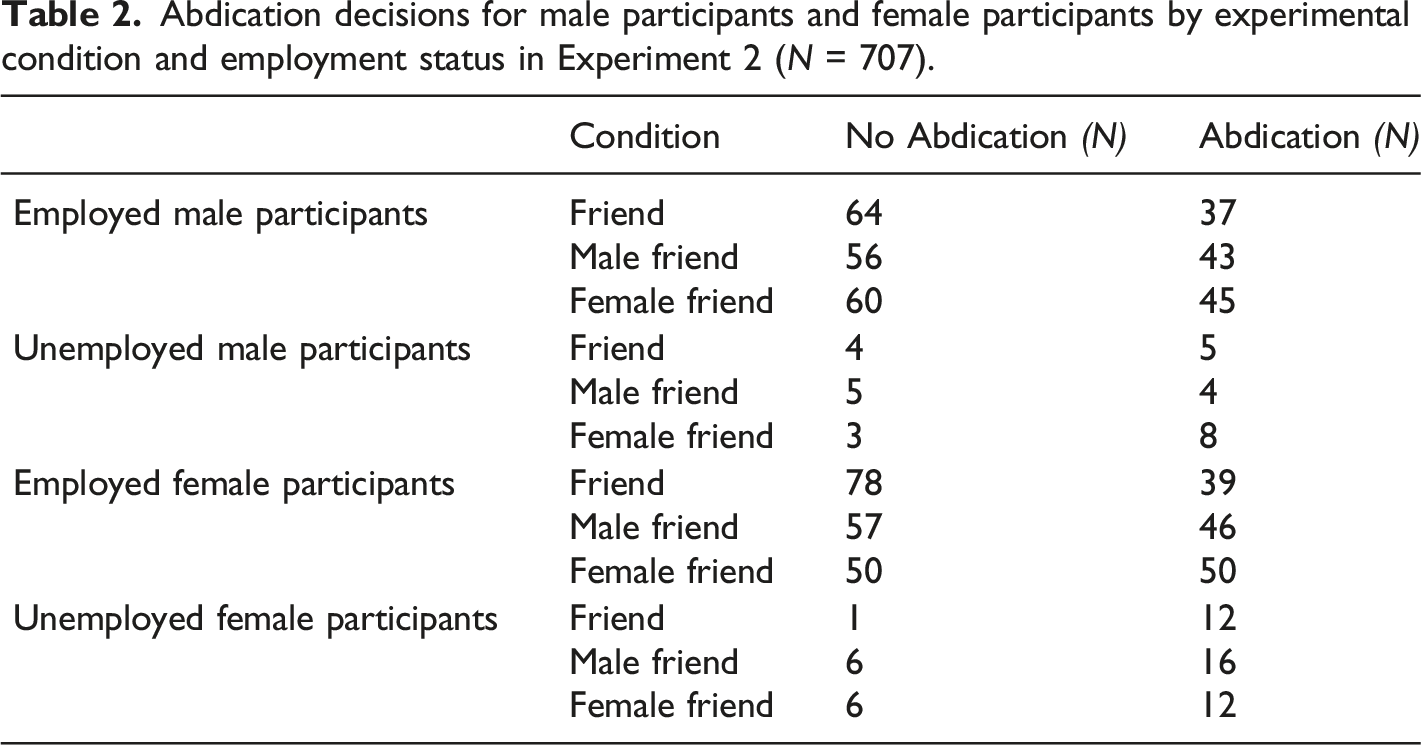
In sum, employment status was a relevant variable when predicting abdication behavior, but only for female participants (who were more likely to abdicate if unemployed, relative to employed). Furthermore, this tendency was especially strong if the partner sharing the resource was male (or undisclosed), relative to female.
General Discussion
Although previous research has established that giving up decision-making control prompts reciprocal generosity (Kardas et al., 2018), few studies have explored who is more likely to engage in abdication and under what circumstances people are more likely to abdicate. In the current study we hypothesized that, in line with Kardas et al. (2018), people would abdicate more frequently than not. Our pattern of results in both experiments was inconsistent with this prediction (and the results found in previous research). Participants tended to abdicate just as frequently as they allocated in Experiment 1, and they were generally more likely to allocate in Experiment 2. Furthermore, we hypothesized that women would abdicate more frequently than men. We did not find any evidence to support this prediction across both experiments. We also hypothesized that men would abdicate less to women than they would to other men, and that women would abdicate more to men than to other women. These hypotheses were based on the idea that gender norms may dictate the role that both women and men are expected to play in abdication decisions, such that women who break the norms are perceived more negatively than men for the same behavior. However, our data did not show any evidence of this predicted pattern of results. Men and women abdicated equally, regardless of the gender of their friend. However, an important caveat to this pattern of results is that women’s abdication behavior varied as a function of employment status. Unemployed women were especially likely to abdicate a decision to a male friend, but not a female friend. When the friend’s gender is not specified, women were still more likely to abdicate if they were unemployed.
It is unclear why the results of the present study did not reflect similar patterns to those obtained by Kardas et al. (2018) or the additional hypothesized gender differences. Our sample sizes were relatively large (N = 520, 707), which provided a high degree of power to detect the hypothesized effects. One possible explanation is that MTurk workers may characteristically deviate from the general U.S. population. Some research has found that MTurk workers tend to be younger, more educated, and more liberal than the U.S. population (Huff & Tingley, 2015; Paolacci & Chandler, 2014). Even though our sample was relatively older than typical college student samples, it is possible that we oversampled people with liberal ideology, who may be more likely to defy traditional gender roles. We did not assess political orientation, but future research may benefit from considering how the political views of participants may influence adherence to traditional gender roles. If MTurk workers are more liberal, and being liberal correlates to less adherence to gender roles, these relationships could reveal an interesting potential moderator in decision-making patterns. Moreover, our research was conducted several years after Kardas et al.’s (2018) initial investigation, and global events may have shifted people’s general orientation toward allocation, rather than abdication. For example, the COVID-19 pandemic, supply chain shortages, and rising inflation may lead people to focus on scarcity, thereby increasing their desire to allocate resources instead of rely on others’ decision-making.
A notable limitation of this study is that the scenarios asked participants to imagine their friend. Although Kardas et al. (2018) found that abdication was likely among both friends and strangers, our research did not include strangers in the scenarios. Outcomes may be different with strangers versus friends in these studies if gender roles warrant different acceptable social behavior across different relational contexts (e.g., Danube et al., 2016).
These experiments make a novel contribution to understanding allocation versus abdication behaviors. Specifically, they highlight that individual circumstances (i.e., employment status) have predictive power for determining whether someone is likely to abdicate a decision, especially for female decision-makers. This may have important real-world consequences in numerous domains. For example, stereotypes about women and men in the workforce (e.g., men should be the “bread winner”) may discourage women from pursuing careers (Commuri & Gentry, 2005). This may lead unemployed women to abdicate decisions more frequently, which subsequently feeds into the stigma about women being inferior leaders, thus creating a vicious cycle (Krug et al., 2019). Of course, this is admittedly speculative, and our data only indicate an association between unemployment and abdication (not a causal relationship). Nevertheless, subsequent research examining this possibility, along with the mechanism by which unemployment relates to abdication, would be enlightening.
Our results provide additional opportunities for future empirical investigations. For instance, future research could benefit from exploring variables that affect perceptions of gender in decision-making. For example, in southern culture, it may be more acceptable for a man to abdicate a decision to a woman to uphold values related to “southern hospitality.” Values based on geographic location could potentially moderate the relationship between abdication decisions and perceptions of abdicators. Further, some personality traits could also influence the role of gender in abdication decisions. For example, people who adhere more to benevolent or hostile sexist beliefs/actions may respond differently in abdication scenarios. It could also be explored whether personality traits (e.g., agreeableness, openness) interact with gender in abdication decisions.
Footnotes
Declaration of Conflicting Interests
The author(s) declared no potential conflicts of interest with respect to the research, authorship, and/or publication of this article.
Funding
The author(s) received no financial support for the research, authorship, and/or publication of this article.
