



Abstract
Child sex abuse (CSA) is a specific category of crime for which the presumption of guilt may be particularly high, especially for defendant categories stereotypically associated with the crime. The current study utilized survey methodology to examine the magnitude of the presumption of guilt for CSA, as well as stereotypes associating perpetrator race and relationship to the victim with likelihood of CSA. Participants (N = 220) indicated the percentage of CSA allegations they believed to be true, and rank-ordered racial and relationship categories they believed most likely to commit CSA. Female (77%) and male (71%) participants believed most CSA allegations were true. White men and stepfathers were ranked as the most likely perpetrators compared to Hispanic men, Black men, other male relatives, neighbors, and others. These data suggest that alleged perpetrators of CSA are particularly likely to be perceived negatively, especially if they possess stereotypical racial and relational characteristics.
Among the most well-established findings in psychology are the myriad effects of social stereotypes on social judgments (Stangor, 2016 for review), including judgments of criminal defendants (Osborne et al., 2017 for review). A criminal defendant’s social category membership tends to be selectively associated with specific crimes or crime types (Chiricos et al., 2020). Such crime-specific stereotypes associating specific social characteristics with propensity to commit specific crimes are arguably those most likely to affect judgments of a particular criminal case or case type.
Past research has examined effects of victim or defendant race (Devine & Caughlin, 2014), gender (McCoy & Gray, 2007), physical attractiveness (Mackelprang & Becker, 2017), and socioeconomic status (Mazzella & Feingold, 1994) on lay peoples’ judgments of crime. A valuable contribution to this body of research should theoretically or empirically address the range of demographic characteristics stereotypically associated with specific crime types (i.e., crime-specific stereotypes). The current study examined lay people’s racial and relationship stereotypes about the perpetrators of child sex abuse (CSA).
Crime-Specific Stereotypes
Crime-specific stereotypes refer to social judgments about which social characteristics (e.g., sex, race, age) are most associated with a given crime. Past findings have empirically examined crime-specific stereotypes linking victim or perpetrator characteristics to specific categories of crime (e.g., Jones & Kaplan, 2003). For example, lay people often link Black suspects to violent crime such as assault (Welch, 2007) and White suspects to financial crimes such as embezzlement (Gordon et al., 1996).
Such crime-specific stereotypes can be relevant during the process of a criminal investigation. Suspects with stereotypical characteristics are targeted for questioning at a higher rate than are non-stereotypical suspects and enter the process with a higher presumption of guilt (Davis & Leo, 2016). Stereotypical characteristics can also bias interpretations of forensic evidence (Smalarz et al., 2016) and influence juror decisions (Livingston et al., 2019). To date, few studies have aimed to identify social categories stereotypically linked to the crime of CSA. Given the large number of such cases tried annually—that is, approximately 57,000 in the U.S. in 2016 (RAINN, 2018)—it is of current interest to determine what types of persons are viewed as most likely to commit CSA.
Who are the Expected Perpetrators of CSA?
Some studies suggest that perpetrators are assumed to be older men who find it easier to sexually abuse children than to obtain consensual sex with adults (Bolen, 2001). Researchers in one study presented participants with 20 crimes and a list of suspect characteristics (Smalarz et al., 2016). Participants circled each characteristic they believed best described the suspect for each crime. For the crime of CSA, 97% of participants endorsed stereotypes about perpetrators being male and 75% of participants endorsed stereotypes about perpetrators being White. The same study suggested that these stereotypes influenced participants’ evaluations of forensic evidence: Participants were nearly twice as likely to perceive identical forensic evidence as incriminating a White man versus an Asian woman. Moreover, participants were explicitly unaware of the effect these evaluations had on their judgments (Smalarz et al., 2016). The current research used a ranked-choice methodology to directly compare the most prevalent racial and ethnic group memberships in the U.S. (i.e., Black, Hispanic, and White) to assess the nature and prevalence of race and ethnicity-bases stereotypes associated with perpetrators of CSA.
Similar stereotypes also exist for relationships between the perpetrator and the victim. Male mock jurors in one study (McCoy & Gray, 2007) judged a defendant as more likely to be guilty of CSA when he was a stepfather compared to a neighbor. Together, these findings suggest that racial- and relationship stereotypes exist in CSA cases and that they might influence social perceptions and legal decisions. In the current research, mock jurors received a more extensive list of possible relationships between perpetrators and victims to elucidate differences between family members of various types (e.g., stepfathers, uncles), authority figures (e.g., teachers), and acquaintances (e.g., neighbors).
Sex Abuse Defendants and the Presumption of Guilt
Although laypeople might associate certain social categories of defendants with the crime of sex abuse, prior research suggests that defendants accused of sexual assault receive relatively high presumptions of guilt (e.g., Vidmar, 1997; see also Davis & Leo, 2016, for review). One examination revealed that 36.2% of prospective jurors indicated under oath that they could not remain impartial in a case of sexual assault (Vidmar, 1997). Acknowledgements of bias against defendants accused of sexual assault might result from especially negative community sentiment toward sexual assault (Reed & Bornstein, 2014), beliefs that people accused of heinous crimes are “guilty until proven innocent” (Vidmar, 1997, p. 18), or explicit stereotypes regarding who is likely to commit sexual assault (e.g., stepfathers; Davis & Leo, 2016). These particularly negative attitudes toward sexual assault might contribute to the 68% conviction rate for defendants tried for rape in 2009 relative to the 61% conviction rate for violent offences in general that same year (i.e., murder, rape, robbery, assault, and unspecified violent offenses; Reaves, 2013). Given this apparent bias against sex abuse defendants, we included a question assessing the percent of accusations of sexual abuse participants presumed to be true.
Overview of the Current Study
Given the importance of understanding stereotypes about individual crimes and the scarcity of empirical work on stereotypes of CSA perpetrators, the current research aimed to replicate and extend past findings about stereotypes regarding perpetrators of CSA by examining mock jurors’ preexisting beliefs about the demographic characteristics of perpetrators.
Our investigation focused on two variables: the race of the perpetrator, and the relationship between the perpetrator and the victim. Given that perhaps most criminal stereotypes associate minority racial and ethnic groups with crime (e.g., Quillian & Pager, 2001), we examined the extent to which the previous finding associating White persons with CSA (Smalarz et al., 2016) would replicate. Additionally, because perpetrators of CSA are often related to or acquainted with the victim (Russell, 1983), we examined which specific persons among family and acquaintances would be perceived as the most likely perpetrators. In this regard, we sought to (1) examine whether the previous finding that stepfathers were particularly associated with CSA (McCoy & Gray, 2007) would replicate and (2) extend the range of family and acquaintances considered.
Method
As part of a larger mock juror decision-making study, participants first indicated the percentage of all CSA accusations they believed to be true. Next, participants rank-ordered various racial groups and perpetrator-victim relationship types according to who they believed most likely to sexually abuse a female child. Participants rank-ordered racial groups and relationship types on separate lists. Participants responded to the current materials before reviewing any case materials provided within the larger study. Thus, participants’ responses reported here were not influenced by the specific case that was the subject of the larger mock juror study. The present data represent participants’ generalized rankings separate from the facts of any particular legal case. The study received research ethics approval from a university in the Western U.S.
Participants
University student mock jurors (N = 220) responded to the survey titled “Criminal Investigations.” The mean age of the sample was 19 years (SD = 5.1 years). Female participants comprised the majority of the sample (60.6%). Participants could select multiple categories to describe their race/ethnicity. Most participants identified as White (54.1%) followed by Latinx (18.6%), mixed race/other race (16.8%), Asian (7.3%), and Black (3.2%).
Materials and Procedure
Before reviewing evidence associated with the larger mock juror study, participants indicated what percentage of CSA accusations they believed to be true, rank-ordered three racial groups (i.e., Black, Hispanic, and White) and seven relationship types (i.e., brother, cousin, father, neighbor, stepfather, teacher, and uncle), and responded to a demographic questionnaire. Participants also indicated whether they had endured sexual abuse, as we believed such experiences could affect their perceptions. All participants ranked racial groups before relationship types.
Results
Participants believed that most CSA accusations are true (M = 74.66%, median = 80%), suggesting a predisposition among participants toward a guilty verdict. Female participants (M = 77.1%, SD = 16.0) also reported believing a significantly higher percentage of CSA accusations were true than did male participants (M = 70.9%, SD = 17.9%; t(219) = 2.57, p = .01; see Figure 1 for distributions of responses by participant sex). Seventeen percent of participants indicated that they had experienced sexual abuse. We ran each analysis reported below including and excluding these participants to test for group differences. Results did not differ between groups for any analysis; thus, all results report on the full sample. Distributions of percentages of CSA accusations believed to be true by male and female participants.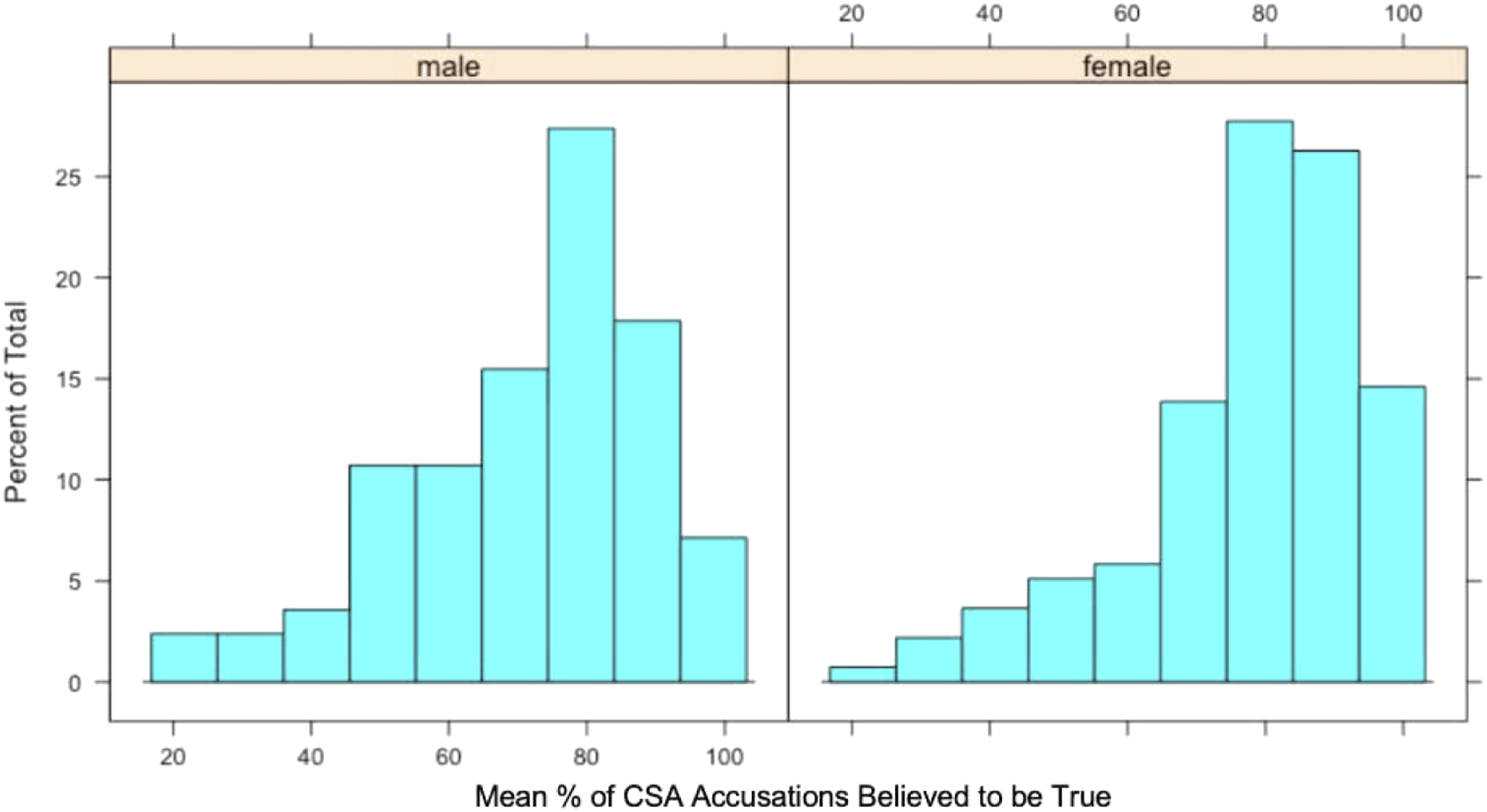
For each racial and relationship category, we calculated the mean ranking and compared means using two-sample t-tests with Bonferroni alpha adjustments of p = .017 for racial groups and p = .0025 for relationship types.
Perpetrator Race
Mean Rank-Order of Perpetrator Racial Stereotypes by Male and Female Participants.
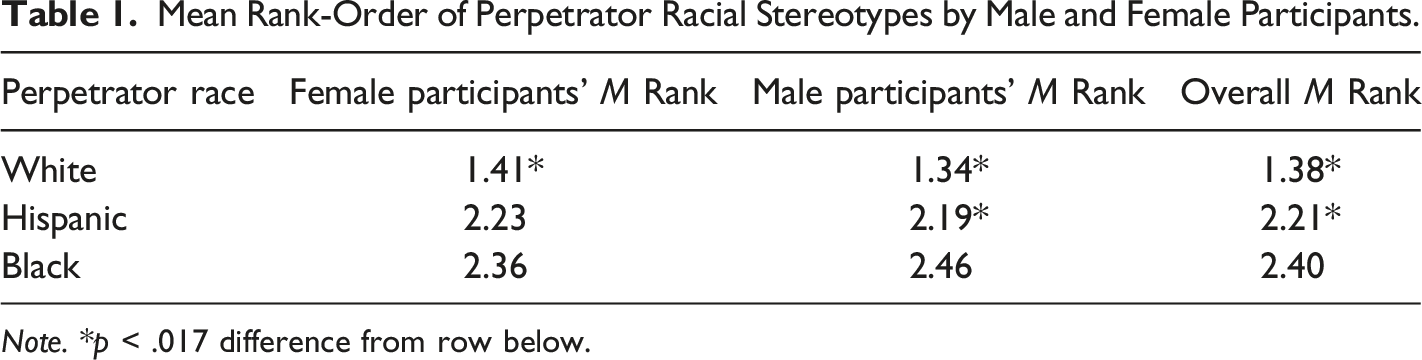
Note. *p < .017 difference from row below.
Perpetrator-Victim Relationship
Mean Rank-Order of Perpetrator-Victim Relationship Stereotypes by Male and Female Participants.
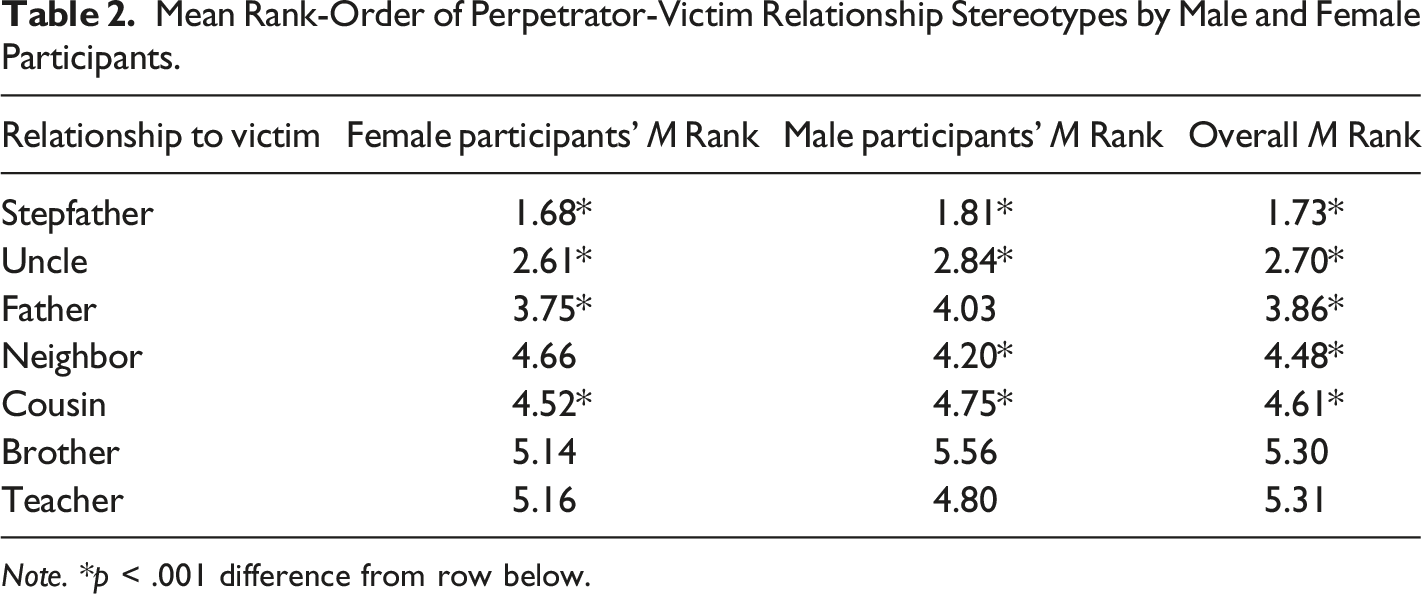
Note. *p < .001 difference from row below.
Discussion
Results reinforced the common finding that CSA defendants are likely to be presumed guilty based on an accusation alone and convicted at high rates (e.g., Reed & Bornstein, 2014; Vidmar, 1997). Findings converged with reviews of mock jury research finding that although gender does not exert fully consistent effects on verdicts in CSA cases, women, compared to men, generally possess more prosecution friendly attitudes in CSA cases and are more likely to find CSA defendants guilty (Livingston et al., 2019 for review). The current study revealed that mock jurors associated White persons and stepfathers most strongly with perpetration of CSA. These defendants might experience crime-specific stereotypes that lead to a higher rate of questioning or interrogation (Davis & Leo, 2016), biased interpretations of forensic evidence when evaluators are aware of the suspect’s stereotypic characteristics (Smalarz et al., 2016), and more punitive legal decisions (Livingston et al., 2019).
Findings regarding stereotypes of CSA perpetrators also converged with those of previous research, while also offering additional distinctions. Our results suggested that mock jurors hold stereotypes that White persons and stepfathers are most likely to commit CSA, and that adult men with familial relations to the victim are the most likely perpetrators more generally. The stepfather as child sexual abuser stereotype also supports prior findings that participants deemed sexual abuse more likely when a defendant was a stepfather compared to a neighbor (McCoy & Gray, 2007). Male and female participants largely shared these stereotypes in the present study.
Mock jurors’ stereotypes of the types of crime likely to be committed by suspects of various racial and relationship categories might explain equivocal findings regarding the effects of defendant race on juror decisions (for meta-analyses, see Devine & Caughlin, 2014; Mazzella & Feingold, 1994; Mitchell, 2005). Stereotypes associating White persons with specific crimes (e.g., CSA) reveal exceptions to the general trend of bias against members of minority racial and ethnic groups. When included in meta-analyses, studies examining crimes such as CSA might reduce the size of the observed effect of minority racial or ethnic membership on legal bias and lead readers to perceive racial bias as exerting a small effect on legal decisions. Although main effects of race on sentencing might be “substantively small and highly variable” (Mitchell, 2005, p. 456), effects of race and ethnicity are likely larger in the context of stereotype-consistent crimes (e.g., violent crime or auto theft for Black suspects; embezzlement or CSA for White suspects; Gordon et al., 1996; Sunnafrank & Fontes, 1983; Welch, 2007). Current findings underscore the importance of examining race and ethnicity-based stereotypes in combination with crime type to capture more accurate assessments of mock jurors’ biases. Identifying these distinctions represents a step toward greater nuance in future empirical investigations and provides legal counsel with a starting point for overcoming jurors’ biases.
It is possible the perception of White men as more likely to perpetrate CSA comes from the public’s understanding that most sex crimes against children are committed by individuals with mental illnesses (e.g., Haywood et al., 1996; Langevin et al., 2000), which are frequently some form of sexual dysfunction. Laypeople more commonly attribute general criminal violence to mental illness for White perpetrators compared to perpetrators of other races/ethnicities, especially Black perpetrators (Lundequam, 2022; Thomas et al., 1998; Thompson, 2010). When laypeople conjure a stereotype of a CSA perpetrator, they might consider the characteristics of a mentally ill criminal, and White man is the most readily available prototype. The current investigation represents a step toward elucidating the content of stereotypes of CSA perpetrators.
Findings were generally consistent with the overwhelming placement of stepfather, uncle, and father at the top of the rankings by both men and women. However, the rankings could also indicate that participants believed older relatives are more likely to commit CSA (i.e., brother and cousin were rank-ordered lower than were older-aged roles such as stepfather).
Although the current research did not establish how these stereotypes might affect trial decisions in an experimental context, alleged perpetrators accused of stereotype-consistent crimes tend to be perceived more negatively (i.e., Jones & Kaplan, 2003; Livingston et al., 2019). Perpetrators of stereotypically inconsistent crimes often receive more lenient judgments in part because mock jurors tend to attribute stereotype-inconsistent behavior to situational versus dispositional factors.
Lastly, Smalarz and colleagues’ (2016) findings—specifically, that stereotypes about people who commit CSA can bias evaluation of forensic evidence—might become increasingly relevant as the defendant matches more stereotypical categories (e.g., White, stepfather, older). Regardless of the demographic characteristics of the accused, our findings suggested that jurors might often enter CSA trials with a seemingly overwhelming belief that the accused is guilty. Several participants in the current investigation reported believing 100% of all cases. Researchers and practitioners should use sensitive measures when evaluating perceptions of CSA cases, as laypeople’s predispositions toward guilt might contribute to ceiling effects on guilt judgments.
Limitations and Future Directions
The present findings are limited by the demographic categories offered to participants as well as the study’s mock juror methodology. Regarding demographic categories, the current study provided participants with the opportunity to rank Black, Hispanic, and White persons according to their assumed propensity to commit CSA. The finding that participants ranked White persons highest is consistent with prior research (Smalarz et al., 2016) and indicative of a higher presumption of guilt toward suspects of this racial group. These results are limited in that racial and ethnic categories ranked by participants were non-exhaustive. Future research should replicate and extend these findings by investigating participants’ associations between CSA and other racial or ethnic groups including Asian persons, Indigenous persons, and persons with mixed racial identities. The inclusion of additional racial and ethnic categories in future studies can contribute to a growing body of research at the intersection of psychology and law addressing diverse populations beyond the Black-White racial binary (Miller et al., 2020; West et al., 2021; Willis-Esqueda, 2020). Future research should provide participants with a more exhaustive list of racial categories or solicit participants’ rankings in an open-ended format as not to constrain their responses. In a similar vein, future investigations should examine additional demographic categories including suspect age, socioeconomic status, gender, and sexual orientation.
Mock juror methodologies introduce limitations to the generalizability of research findings. Mock juror studies such as the present investigation collect data from individual participants who do not engage in group deliberation as would a real jury. The process of thorough jury deliberation can reduce the influence of any one juror’s stereotypes on the final verdict outcome (Sommers, 2006, 2007); thus, a lack of deliberation can limit the external validity of the present findings. Despite this limitation, it is pertinent to examine social judgments at the individual level to predict jurors’ pre-deliberation attitudes. Researchers can minimize threats to external validity by developing research materials and procedures that mimic the tasks of real jurors (e.g., by developing realistic and immersive trial summaries, images, videos, or audio recordings; Bornstein, 1999).
Sample characteristics can also reduce the generalizability of the present findings to real jury outcomes. Indeed, university students are sometimes less punitive compared to members of the community who comprise the average jury (Keller & Wiener, 2011; McCabe et al., 2010). In cases of CSA, enhanced punitiveness among community samples might result in part from exacerbated stereotypes associating specific racial and relationship categories with perpetration of CSA. Additionally, community samples are older, on average, than university students and thus more likely to have children or grandchildren of their own. These differences might contribute to greater stereotyping of, and more negative attutudes toward, CSA suspects among community samples. Future research should compare the prevalence of observed stereotypes between university and community samples and test whether differences in stereotypic associations explain greater punitiveness among community samples.
Footnotes
Declaration of Conflicting Interests
The author(s) declared no potential conflicts of interest with respect to the research, authorship, and/or publication of this article.
Funding
The author(s) received no financial support for the research, authorship, and/or publication of this article.
